 plumi
Supply-side policies: Edexcel A‑Level Economics A questions
Every Edexcel A-Level Economics A exam question on 2.6.3 Supply-side policies, 2016–2025, with its mark scheme and examiner’s report.
Find questions784
Calculations
Q6(e)
The whole paper ↗
Q6(g)
The whole paper ↗
Q6(e)
The whole paper ↗
Q1(a)
The whole paper ↗
Q1(b)
The whole paper ↗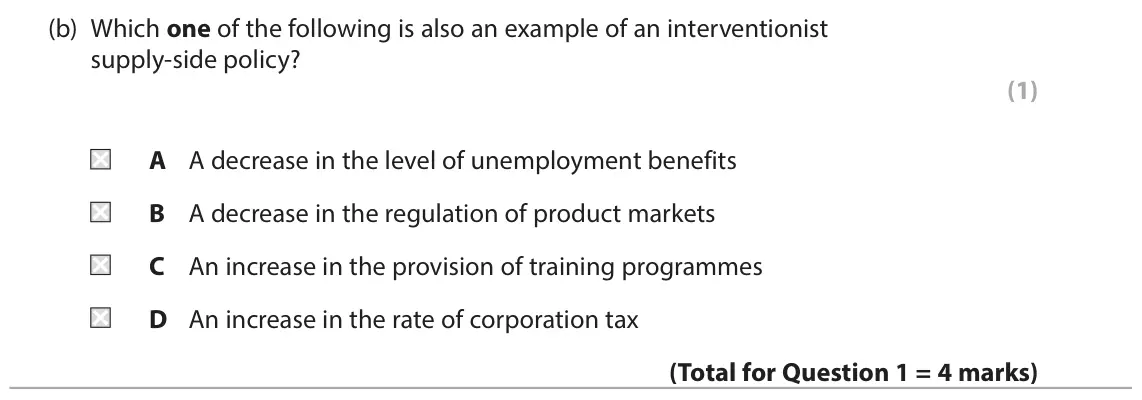
Q6(e)
The whole paper ↗
Q6(g)
The whole paper ↗
Q2(c)
The whole paper ↗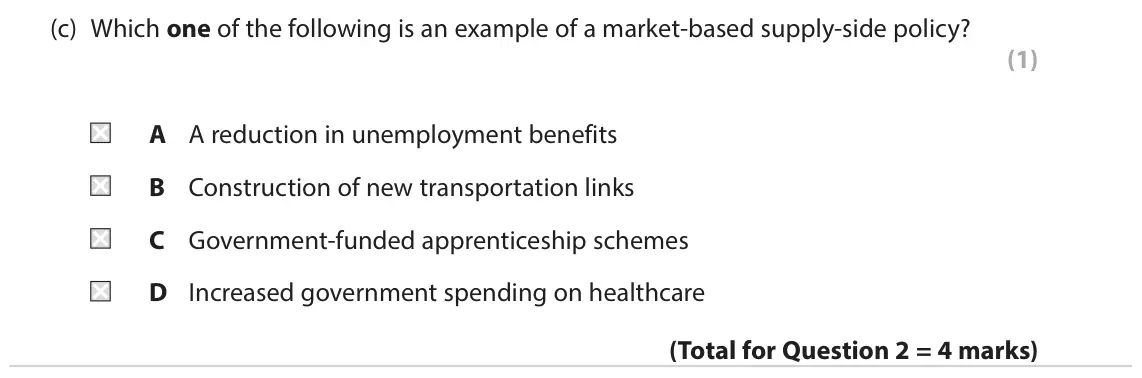
Q6(f)
The whole paper ↗
Q4(a)
The whole paper ↗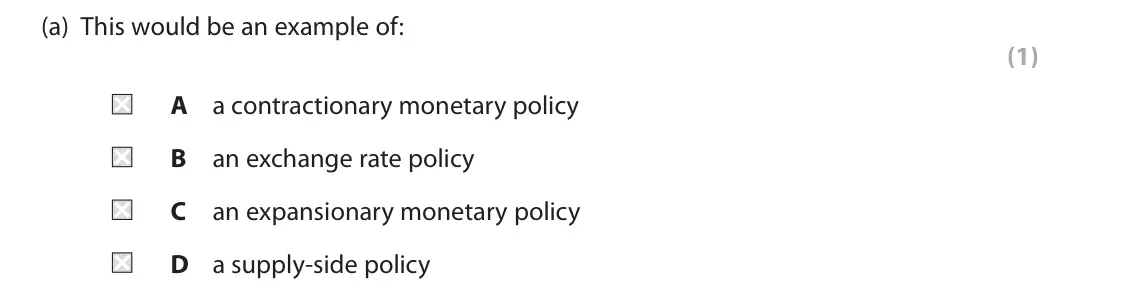
Q4(b)
The whole paper ↗
Q4(c)
The whole paper ↗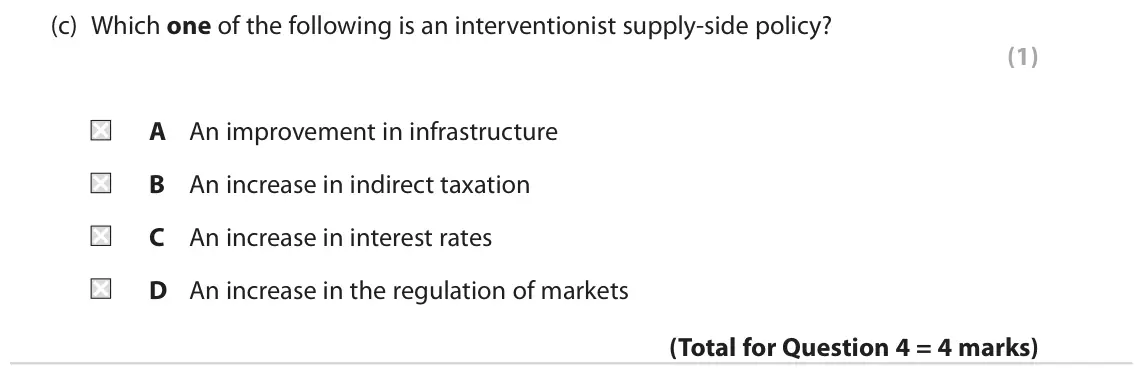
Q2(e)
The whole paper ↗
Q6(f)
The whole paper ↗
Q6(e)
The whole paper ↗
Q6(e)
The whole paper ↗
All 18 questions on Supply-side policies, as a list
- June 2025, Paper 2, Q6(e) (15 marks): Discuss supply‑side policies the German government could use ‘to improve its economic performance’ (Extract A, line 6). (15) Read Figures 1 and 2 and the follow
- June 2025, AS Paper 2, Q6(g) (20 marks): Evaluate the use of market-based supply-side policies to increase UK employment. (20) Read Figures 1 and 2 and Extract A in the Source Booklet before answering
- June 2024, Paper 2, Q6(e) (15 marks): Discuss supply-side policies the UK government could introduce to stimulate economic growth. (15) Read Figures 1, 2, 3 and 4 and the following extracts (A and B
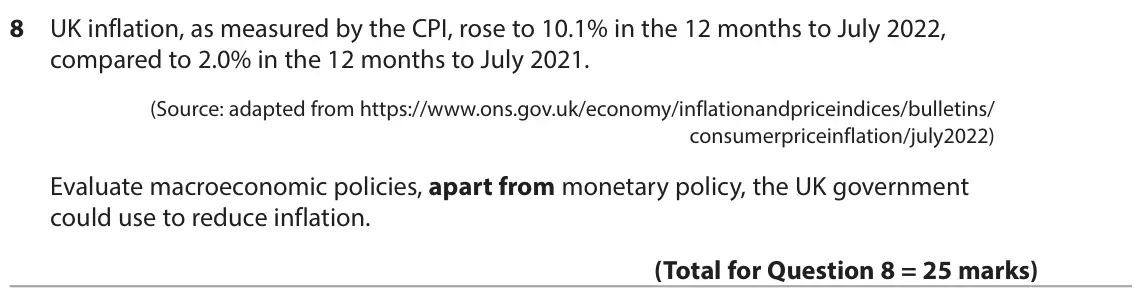
- June 2023, Paper 2, Q8 (25 marks): UK inflation, as measured by the CPI, rose to 10.1% in the 12 months to July 2022, compared to 2.0% in the 12 months to July 2021. (Source: adapted from https:/
- June 2023, AS Paper 2, Q1(a) (3 marks): Explain one likely impact of this interventionist supply-side policy on aggregate supply in the UK. (3) 1 Between 2019 and 2020 the UK Government increased its
- June 2023, AS Paper 2, Q1(b) (1 mark): Which one of the following is also an example of an interventionist supply-side policy? (1) A A decrease in the level of unemployment benefits B A decrease in t
- June 2022, Paper 2, Q6(e) (15 marks): With reference to Extract B, discuss the benefits of an increase in infrastructure spending on the UK economy. Use an aggregate demand and aggregate supply diag
- June 2022, AS Paper 2, Q6(g) (20 marks): Evaluate the supply-side policies the UK Government could use to increase the UK’s productivity. (20) Read Figures 1 and 2 below and Extract A before answering
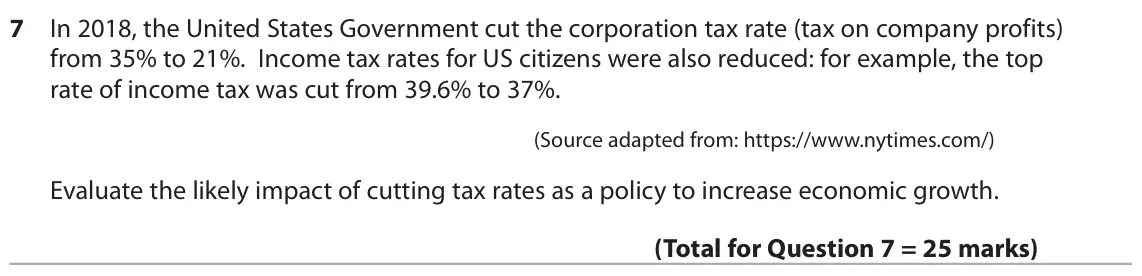
- October 2020, Paper 2, Q7 (25 marks): In 2018, the United States Government cut the corporation tax rate (tax on company profits) from 35% to 21%. Income tax rates for US citizens were also reduced:
- October 2020, AS Paper 2, Q2(c) (1 mark): Which one of the following is an example of a market-based supply-side policy? (1) A A reduction in unemployment benefits B Construction of new transportation l
- October 2020, AS Paper 2, Q6(f) (20 marks): Evaluate supply-side policies that could be used to increase the UK’s rate of economic growth. (20) Read Figures 1 and 2 and extracts (A and B) before answering
- June 2019, Paper 2, Q4(a) (1 mark): This would be an example of: (1) A a contractionary monetary policy B an exchange rate policy C an expansionary monetary policy D a supply-side policy 4 The UK
- June 2019, AS Paper 2, Q4(b) (2 marks): Annotate the diagram above to show the likely impact of government policy to promote business competition on the equilibrium level of real output and price leve
- June 2019, AS Paper 2, Q4(c) (1 mark): Which one of the following is an interventionist supply-side policy? (1) A An improvement in infrastructure B An increase in indirect taxation C An increase in
- June 2018, Paper 3, Q2(e) (25 marks): Evaluate the likely microeconomic and macroeconomic effects of the supply-side policies recently introduced in Indonesia. (25) Read Figures 4 and 5 and the foll
- June 2018, AS Paper 2, Q6(f) (20 marks): Evaluate government policies, apart from migration policies, that could be used to increase the employment rate in the UK. (20) Read Figures 1 to 3 and the foll
- June 2017, Paper 2, Q6(e) (15 marks): Discuss ‘looser fiscal policy’ and ‘supply-side reforms’ (Extract A, lines 20 and 21) that may be used by governments of Eurozone countries to increase economic
- June 2017, AS Paper 2, Q6(e) (15 marks): Evaluate policies the government could use to increase the UK’s productivity. (15) Read Figures 1 and 2 and extract A before answering Question 6. Answer ALL Qu
Questions, mark schemes and examiner’s reports are © Pearson Edexcel, from their published past papers. Plumi isn’t affiliated with any exam board. Want whole papers? Full past papers.
Rather write your answers by hand on iPad? Plumi marks them against the same mark schemes.