 plumi
Demand-side policies: Edexcel A‑Level Economics A questions
Every Edexcel A-Level Economics A exam question on 2.6.2 Demand-side policies, 2016–2025, with its mark scheme and examiner’s report.
Find questions784
Calculations
Q6(a)
The whole paper ↗
Q4(a)
The whole paper ↗
Q4(c)
The whole paper ↗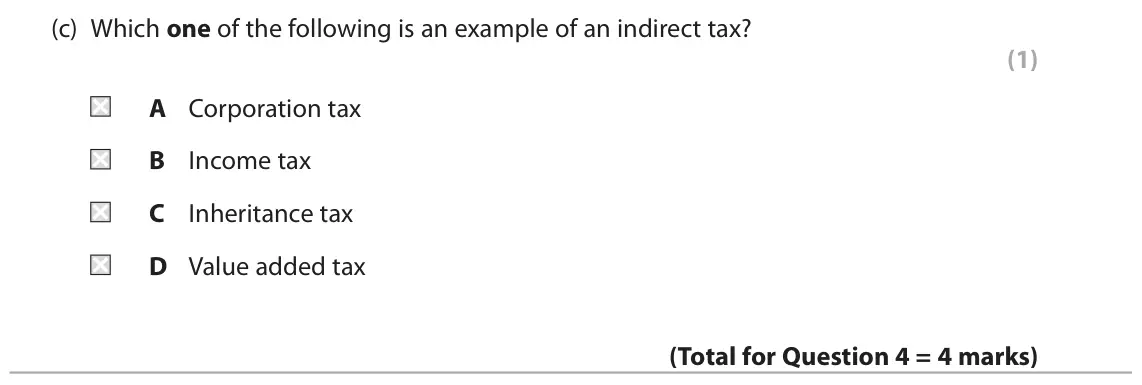
Q6(d)
The whole paper ↗
Q6(e)
The whole paper ↗
Q6(d)
The whole paper ↗
Q2(d)
The whole paper ↗
Q5(a)
The whole paper ↗
Q5(b)
The whole paper ↗
Q5(c)
The whole paper ↗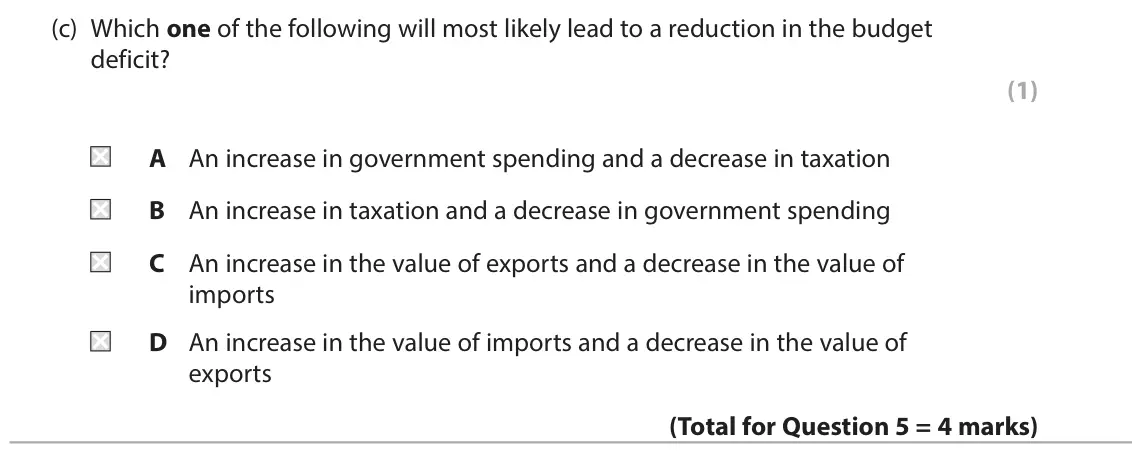
Q6(e)
The whole paper ↗
Q6(f)
The whole paper ↗
Q6(g)
The whole paper ↗
Q1(a)
The whole paper ↗
Q1(b)
The whole paper ↗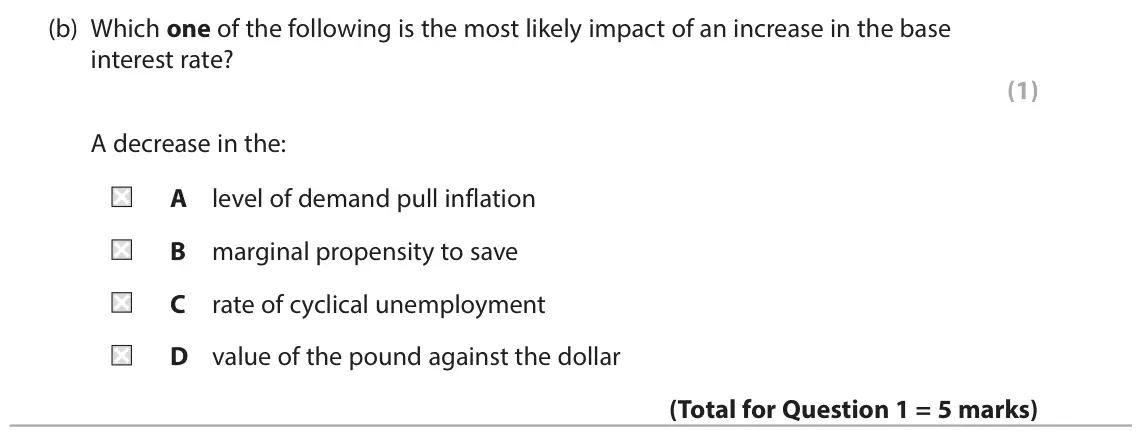
Q3(a)
The whole paper ↗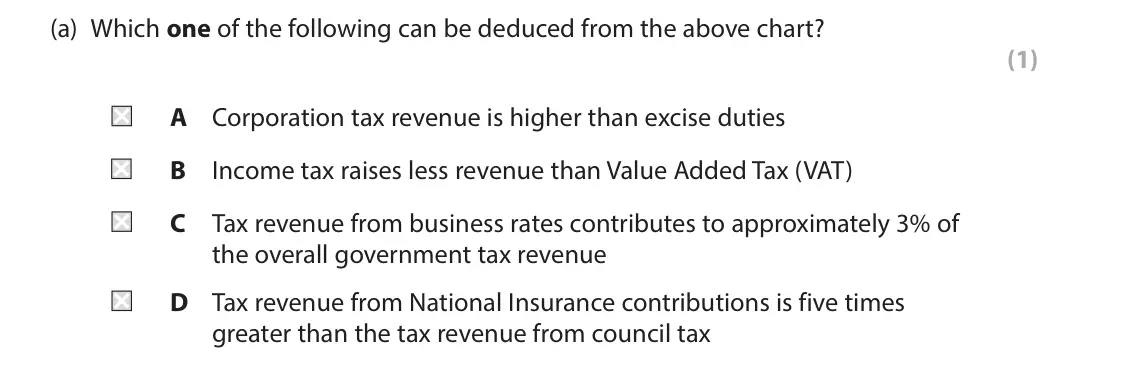
Q3(b)
The whole paper ↗
Q6(g)
The whole paper ↗
Q3(b)
The whole paper ↗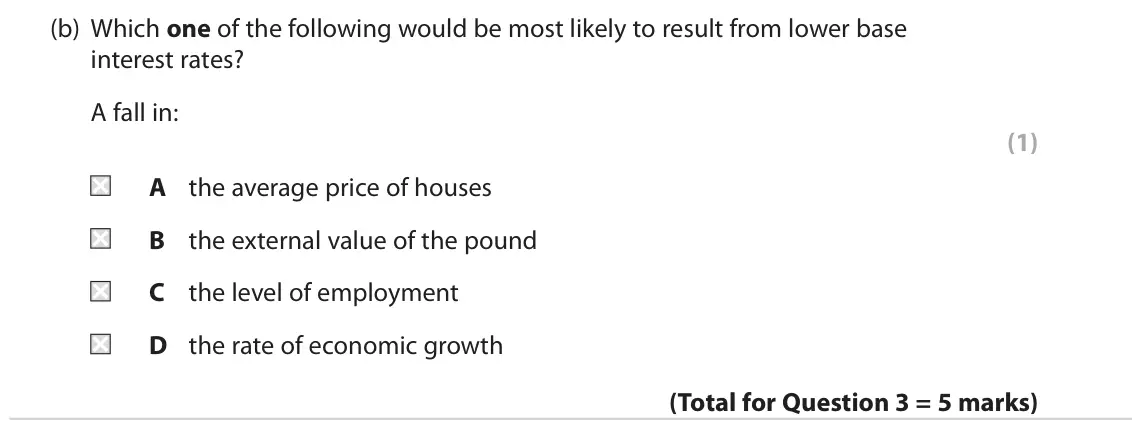
All 46 questions on Demand-side policies, as a list
- June 2025, Paper 2, Q6(a) (5 marks): With reference to Figure 1, explain the distinction between direct and indirect taxation. (5) Read Figures 1 and 2 and the following extracts (A and B) in the S
- June 2025, AS Paper 2, Q4(a) (1 mark): Define the term ‘indirect tax’. (1) 4 In 2023 the UK government reduced indirect tax on certain goods and services.
- June 2025, AS Paper 2, Q4(c) (1 mark): Which one of the following is an example of an indirect tax? (1) A Corporation tax B Income tax C Inheritance tax D Value added tax 4 In 2023 the UK government
- June 2025, AS Paper 2, Q6(d) (6 marks): With reference to the information provided, explain two factors that the Bank of England’s Monetary Policy Committee may have considered when changing the base
- June 2025, AS Paper 2, Q6(e) (15 marks): Discuss the likely macroeconomic effects of a decrease in government expenditure on the UK economy. Use an aggregate demand and aggregate supply diagram to supp
- June 2024, Paper 2, Q6(d) (12 marks): With reference to Extract B, discuss the use of quantitative easing in preventing deflation. (12) Read Figures 1, 2, 3 and 4 and the following extracts (A and B
- June 2024, Paper 3, Q2(d) (25 marks): Evaluate the microeconomic and macroeconomic effects of high interest rates in Ghana, or another developing country of your choice. (25) Read Figure 3 and the e
- June 2024, AS Paper 2, Q5(a) (1 mark): Define the term ‘budget deficit’. (1) 5 The table below shows the UK’s budget deficit between March 2016 and March 2019. Year Budget deficit (£ billion) 2016 83
- June 2024, AS Paper 2, Q5(b) (2 marks): Using the above table, calculate the percentage decrease in budget deficit between March 2016 and March 2019. You are advised to show your working. (2) 5 The ta
- June 2024, AS Paper 2, Q5(c) (1 mark): Which one of the following will most likely lead to a reduction in the budget deficit? (1) A An increase in government spending and a decrease in taxation B An
- June 2024, AS Paper 2, Q6(e) (15 marks): Discuss factors, apart from changes in real wages, which the MPC may have considered when changing the base interest rate. (15) Read Figures 1 and 2 and Extract
- June 2024, AS Paper 2, Q6(f) (20 marks): Evaluate whether expansionary demand-side policies lead to conflicts between macroeconomic objectives. (20) Read Figures 1 and 2 and Extract A before answering
- June 2024, AS Paper 2, Q6(g) (20 marks): Evaluate whether the MPC has been successful in meeting the UK’s macroeconomic objectives between 2008 and 2019. (20) Read Figures 1 and 2 and Extract A before
- June 2023, Paper 2, Q1(a) (4 marks): Draw an aggregate demand and aggregate supply diagram to illustrate the likely impact of an increase in the UK base interest rate on the average price level and
- June 2023, Paper 2, Q1(b) (1 mark): Which one of the following is the most likely impact of an increase in the base interest rate? (1) A decrease in the: A level of demand pull inflation B margina
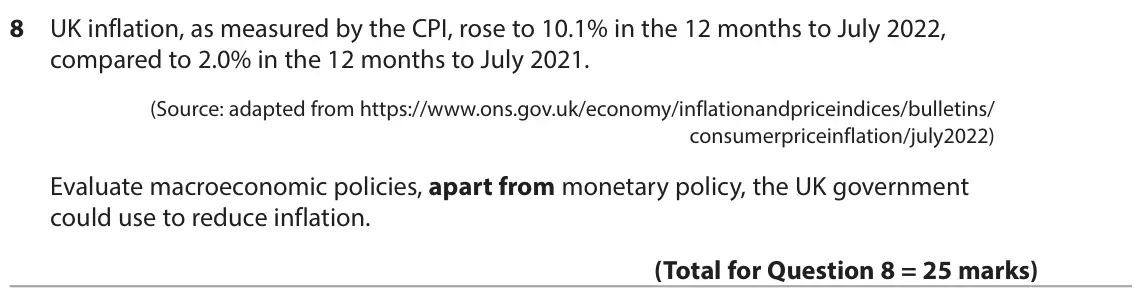
- June 2023, Paper 2, Q8 (25 marks): UK inflation, as measured by the CPI, rose to 10.1% in the 12 months to July 2022, compared to 2.0% in the 12 months to July 2021. (Source: adapted from https:/
- June 2023, AS Paper 2, Q3(a) (1 mark): Which one of the following can be deduced from the above chart? (1) A Corporation tax revenue is higher than excise duties B Income tax raises less revenue than
- June 2023, AS Paper 2, Q3(b) (3 marks): Total UK Government tax revenue for 2021–22: £820 billion. Total UK Government expenditure for 2021–22: £1 053 billion. Using these figures, explain the likely
- June 2023, AS Paper 2, Q6(g) (20 marks): Evaluate how interest rates are used to control UK inflation. (20) Read Figures 1 and 2 below and Extracts A and B before answering Question 6. Answer ALL Quest
- June 2022, Paper 2, Q3(b) (1 mark): Which one of the following would be most likely to result from lower base interest rates? A fall in: (1) A the average price of houses B the external value of t
- June 2022, Paper 3, Q2(d) (25 marks): Evaluate the microeconomic and macroeconomic effects of decreasing interest rates in Kenya, or another developing country of your choice. (25) Read Figure 2 and
- June 2022, AS Paper 2, Q1(a) (1 mark): Which one of the following is the most likely effect of this quantitative easing? (1) A A fall in economic growth B A fall in the rate of inflation C An increas
- June 2022, AS Paper 2, Q1(b) (3 marks): Explain one likely impact of a decrease in the base interest rate on inflation. (3) 1 In March 2020 the Monetary Policy Committee (MPC) of the Bank of England r
- June 2022, AS Paper 2, Q6(f) (20 marks): Evaluate the fiscal policies the UK Government could use if it believes that ‘the UK economy is likely to experience another recession’ (Extract A, lines 27–28)
- November 2021, Paper 2, Q7 (25 marks): The European Central Bank introduced a new round of quantitative easing (QE) in March 2020, purchasing up to €750 billion of assets. The objective of this QE wa
- November 2021, Paper 3, Q2(e) (25 marks): Evaluate the microeconomic and macroeconomic impacts of ‘a much more expansionary fiscal policy’ (Extract C line 23) on the German economy. (25) Read Figures 1
- October 2020, Paper 2, Q5(b) (1 mark): Which one of the following would be most likely to solve a negative output gap problem in a domestic economy? An increase in (1) A government funding to the Wor
- October 2020, Paper 3, Q1(d) (25 marks): Evaluate the likely microeconomic and macroeconomic effects of a rise in interest rates in Turkey. (25) Read Figures 1 and 2 and the following extracts (A, B an
- October 2020, AS Paper 2, Q4(a) (1 mark): Define the term ‘interest rate’. (1) 4 In August 2018 the Monetary Policy Committee of the Bank of England raised the UK’s base interest rate from 0.5% to 0.75%
- October 2020, AS Paper 2, Q4(b) (2 marks): Annotate the aggregate demand (AD) and short-run aggregate supply (SRAS) diagram below to show the possible impact of a rise in the base interest rate on the eq
- October 2020, AS Paper 2, Q4(c) (1 mark): Which one of the following demand-side policies best explains a rise in the base interest rate? (1) A Contractionary fiscal policy B Contractionary monetary pol
- October 2020, AS Paper 2, Q6(g) (20 marks): Evaluate the likely macroeconomic effects of the UK government pursuing a policy of reducing its budget deficit. (20) Read Figures 1 and 2 and extracts (A and B
- June 2019, AS Paper 2, Q3(b) (1 mark): Which one of the following policies is most likely to reduce the unemployment rate in the UK? (1) A A decrease in direct taxes on company profits B A decrease i
- June 2019, AS Paper 2, Q6(f) (20 marks): Evaluate the use of interest rate changes as a means of controlling UK inflation. (20) Read Figures 1 to 4 and extracts (A and B) before answering Question 6. A
- June 2018, Paper 2, Q2(b) (4 marks): Draw an aggregate demand and aggregate supply diagram illustrating the likely impact of a rise in interest rates on the price level and real output. (4)
- June 2018, AS Paper 2, Q3(a) (3 marks): With reference to the chart above, explain one factor that the Monetary Policy Committee (MPC) of the Bank of England may have considered when reducing the base
- June 2018, AS Paper 2, Q3(b) (1 mark): Which one of the following is the most likely effect of the Bank of England’s quantitative easing? (1) A A fall in economic growth B A fall in the money supply
- June 2018, AS Paper 2, Q5(c) (1 mark): Define the term ‘budget deficit’. (1) 5 The chart below shows selected areas of forecast UK government spending for 2015/16 and 2016/17. 232 Social protection 2
- June 2018, AS Paper 2, Q6(f) (20 marks): Evaluate government policies, apart from migration policies, that could be used to increase the employment rate in the UK. (20) Read Figures 1 to 3 and the foll
- June 2017, Paper 2, Q6(d) (12 marks): Discuss the likely success of the ECB’s quantitative easing programme in moving Eurozone inflation closer to ‘the central bank’s ceiling of 2%’ (Extract A, line
- June 2017, Paper 2, Q6(e) (15 marks): Discuss ‘looser fiscal policy’ and ‘supply-side reforms’ (Extract A, lines 20 and 21) that may be used by governments of Eurozone countries to increase economic
- June 2017, AS Paper 2, Q4(a) (2 marks): Annotate the aggregate demand and aggregate supply diagram below to show the likely impact of the increase in the personal allowance on the UK’s price level and
- June 2017, AS Paper 2, Q4(b) (1 mark): Define the term ‘direct tax’. (1) 4 The Chancellor announced in the 2015 Budget that the personal allowance (the annual income that can be earned before startin
- June 2017, AS Paper 2, Q4(c) (1 mark): Which one of the following is an example of a direct tax? (1) A Value Added Tax B Vehicle Excise Duty C Corporation tax D Alcohol duty 4 The Chancellor announce
- June 2016, AS Paper 2, Q6(f) (20 marks): Evaluate whether the MPC has been successful in controlling the UK’s inflation rate since 2011. (20) Read Figures 1 and 2 below and read extracts A and B before
- June 2016, AS Paper 2, Q6(g) (20 marks): Evaluate demand-side policy responses to the Global Financial Crisis of 2008. (20) Read Figures 1 and 2 below and read extracts A and B before answering Questio
Questions, mark schemes and examiner’s reports are © Pearson Edexcel, from their published past papers. Plumi isn’t affiliated with any exam board. Want whole papers? Full past papers.
Rather write your answers by hand on iPad? Plumi marks them against the same mark schemes.