Skip to content

General properties of waves: CAIE IGCSE Physics questions

Every CAIE IGCSE Physics exam question on 3.1 General properties of waves, June 2024 and the specimen papers, with its mark scheme and examiner’s report.

Find questions355
Calculations
355 questions

  1. Q16

    June 2024 · Paper 1

    The whole paper ↗
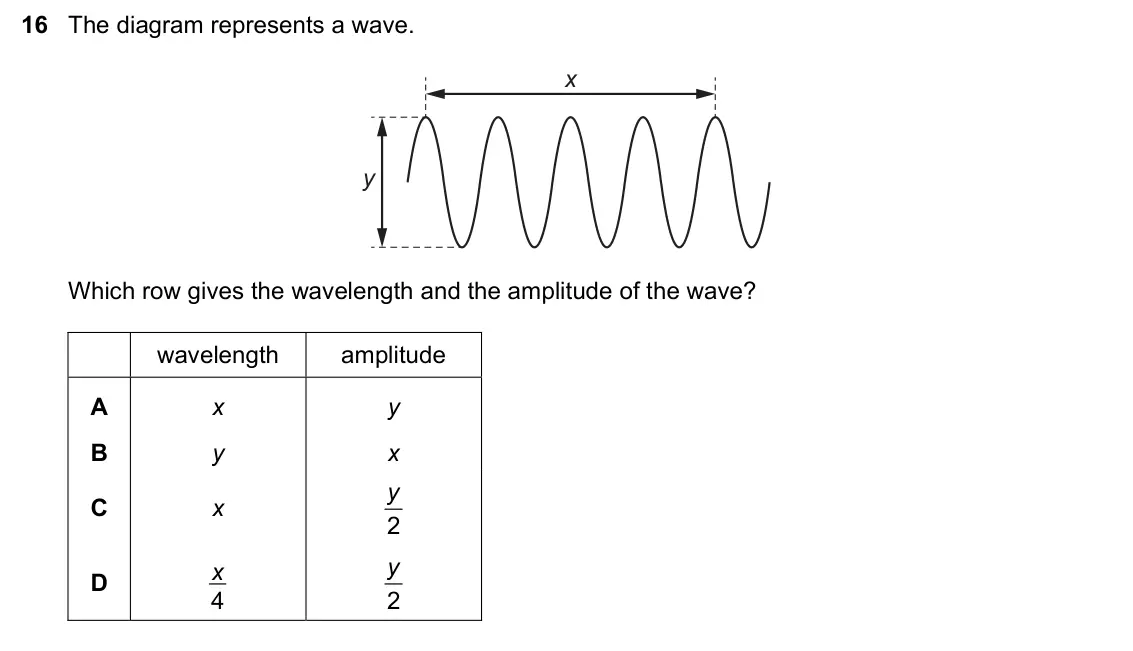
    June 2024 Paper 1, question 16: The diagram represents a wave. x y Which row gives the wavelength and the amplitude of the wave? wavelength amplitude A x y B y x y C x 2 y x D 4 2
  2. Q17

    June 2024 · Paper 1

    The whole paper ↗
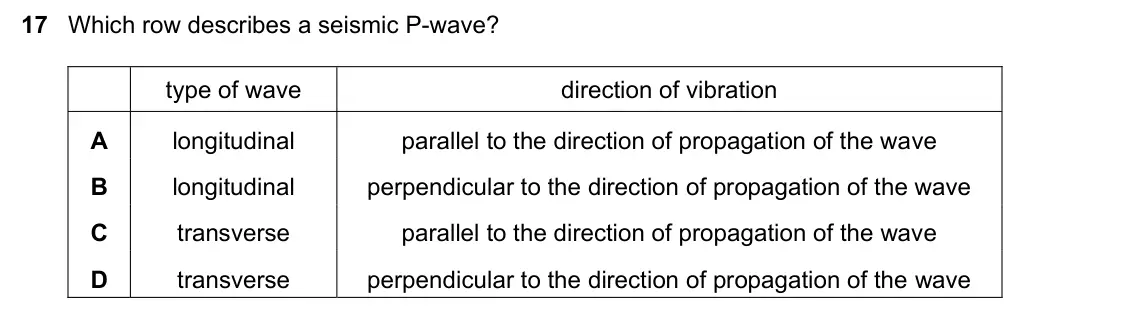
    June 2024 Paper 1, question 17: Which row describes a seismic P-wave? type of wave direction of vibration A longitudinal parallel to the direction of propagation of the wave B longitudinal per
  3. Q18

    June 2024 · Paper 1

    The whole paper ↗
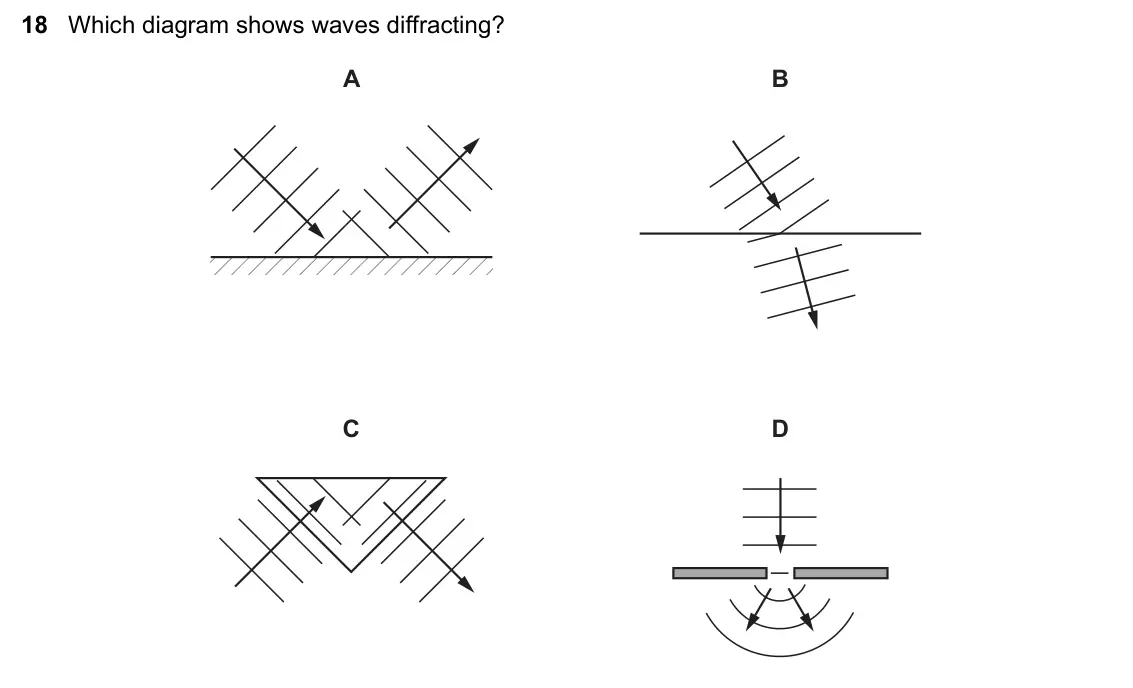
    June 2024 Paper 1, question 18: Which diagram shows waves diffracting? A B C D
  4. Q20

    June 2024 · Paper 1

    The whole paper ↗
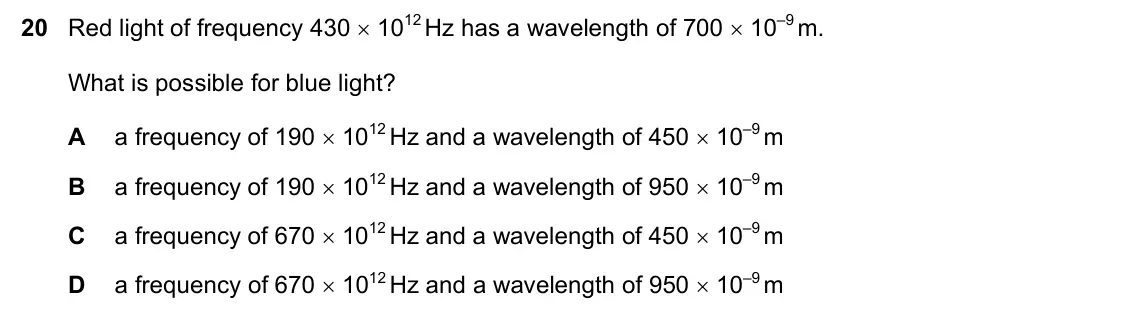
    June 2024 Paper 1, question 20: Red light of frequency 430  1012 Hz has a wavelength of 700  10–9 m. What is possible for blue light? A a frequency of 190  1012 Hz and a wavelength of 450 
  5. Q16

    June 2024 · Paper 2

    The whole paper ↗
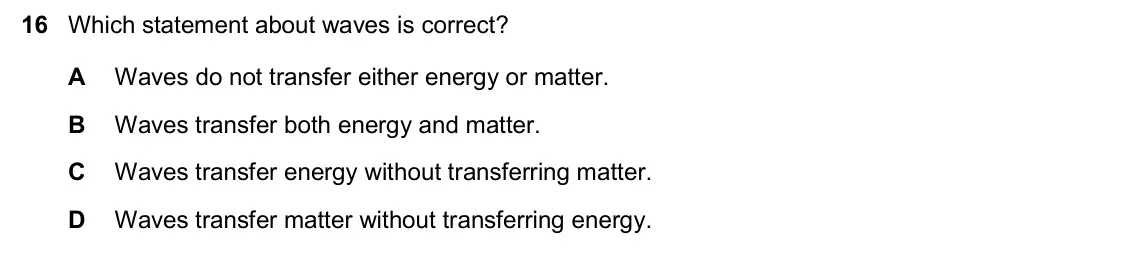
    June 2024 Paper 2, question 16: Which statement about waves is correct? A Waves do not transfer either energy or matter. B Waves transfer both energy and matter. C Waves transfer energy withou
  6. Q6(b)(i)

    June 2024 · Paper 3

    The whole paper ↗
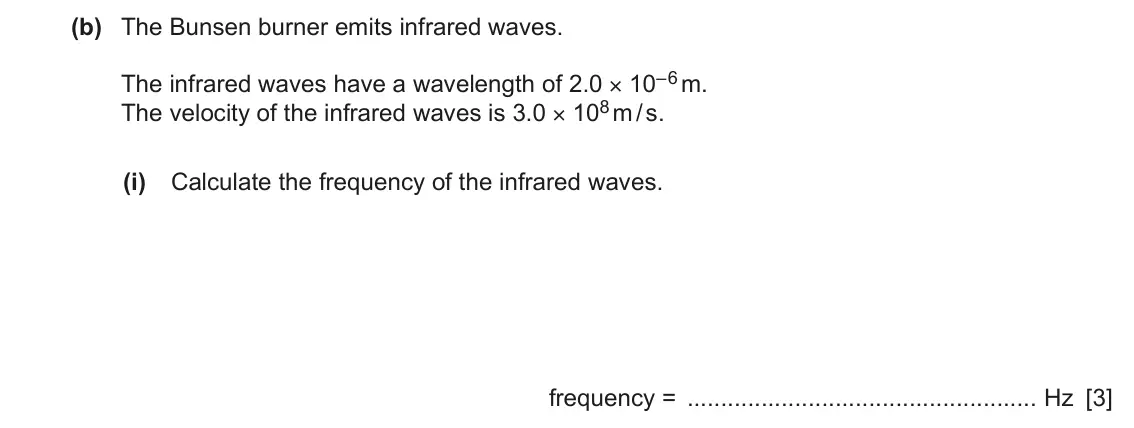
    June 2024 Paper 3, question 6(b)(i): Calculate the frequency of the infrared waves. frequency = Hz [3]
  7. Q5(a)

    June 2024 · Paper 4

    The whole paper ↗
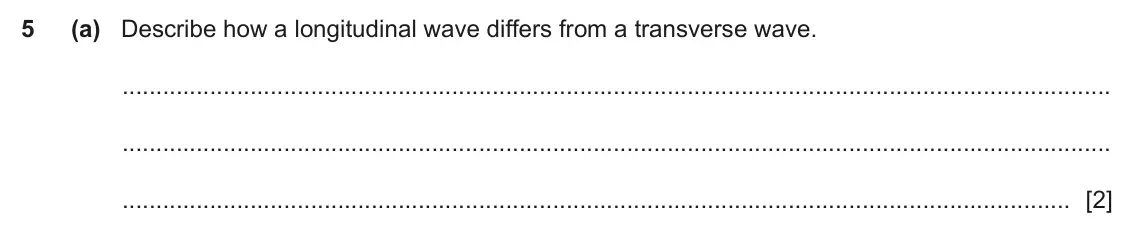
    June 2024 Paper 4, question 5(a): Describe how a longitudinal wave differs from a transverse wave. [2]
  8. Q5(b)(i)

    June 2024 · Paper 4

    The whole paper ↗
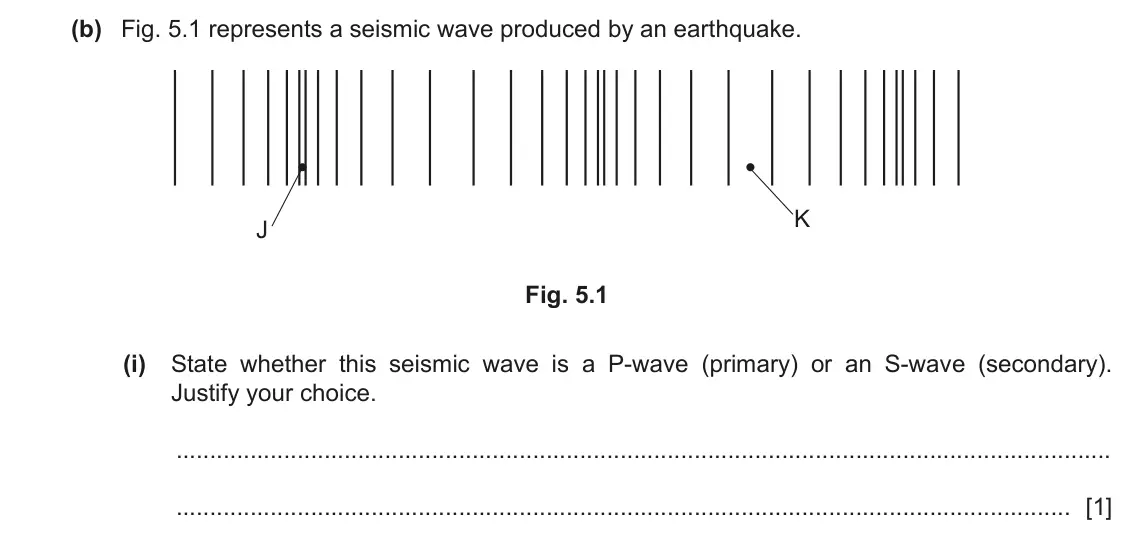
    June 2024 Paper 4, question 5(b)(i): State whether this seismic wave is a P-wave (primary) or an S-wave (secondary). Justify your choice. [1]
  9. Q5(b)(ii)

    June 2024 · Paper 4

    The whole paper ↗
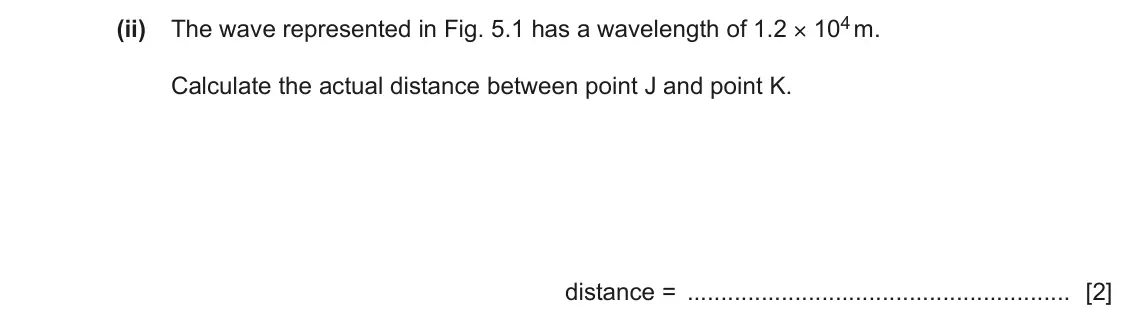
    June 2024 Paper 4, question 5(b)(ii): The wave represented in Fig. 5.1 has a wavelength of 1.2 × 10⁴ m. Calculate the actual distance between point J and point K. distance = [2]
  10. Q5(b)(iii)

    June 2024 · Paper 4

    The whole paper ↗
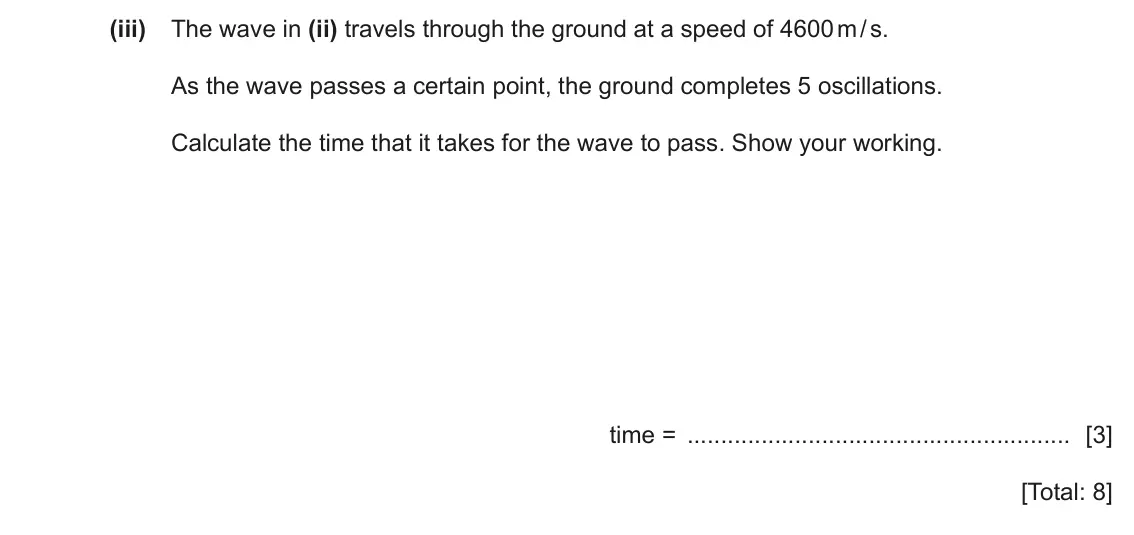
    June 2024 Paper 4, question 5(b)(iii): The wave in (ii) travels through the ground at a speed of 4600 m / s. As the wave passes a certain point, the ground completes 5 oscillations. Calculate the tim
  11. Q19

    Specimen · Paper 1

    The whole paper ↗
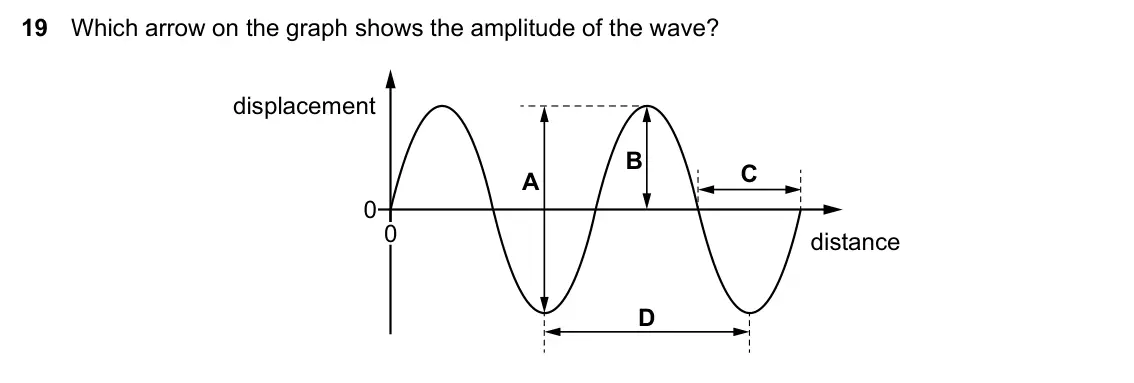
    Specimen Paper 1, question 19: Which arrow on the graph shows the amplitude of the wave? displacement B C A 0 0 distance D
  12. Q20

    Specimen · Paper 1

    The whole paper ↗
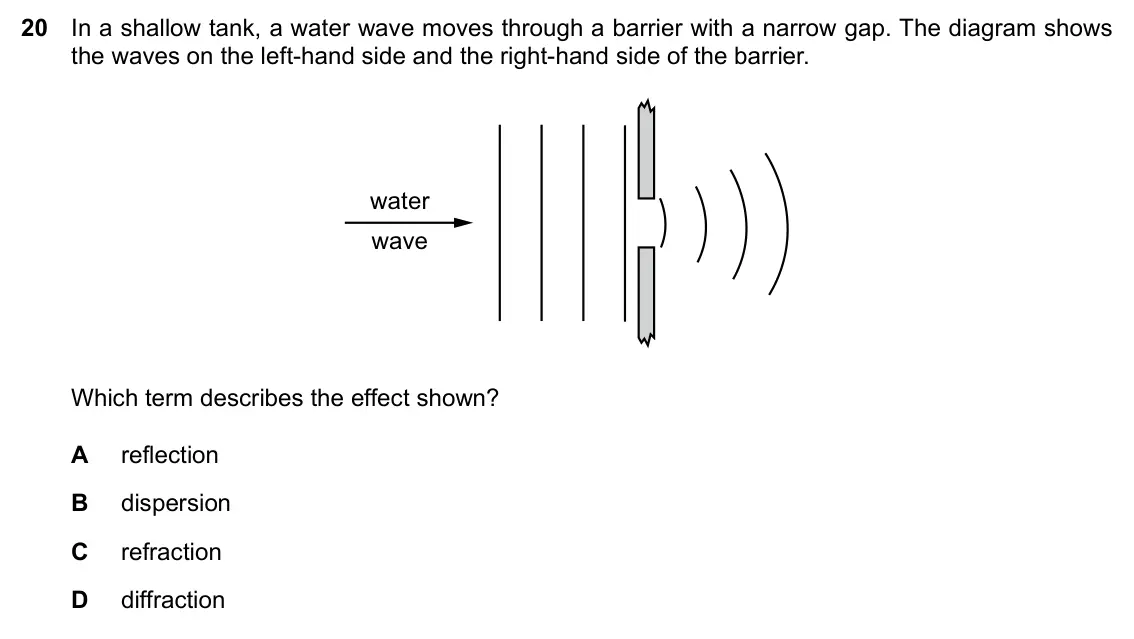
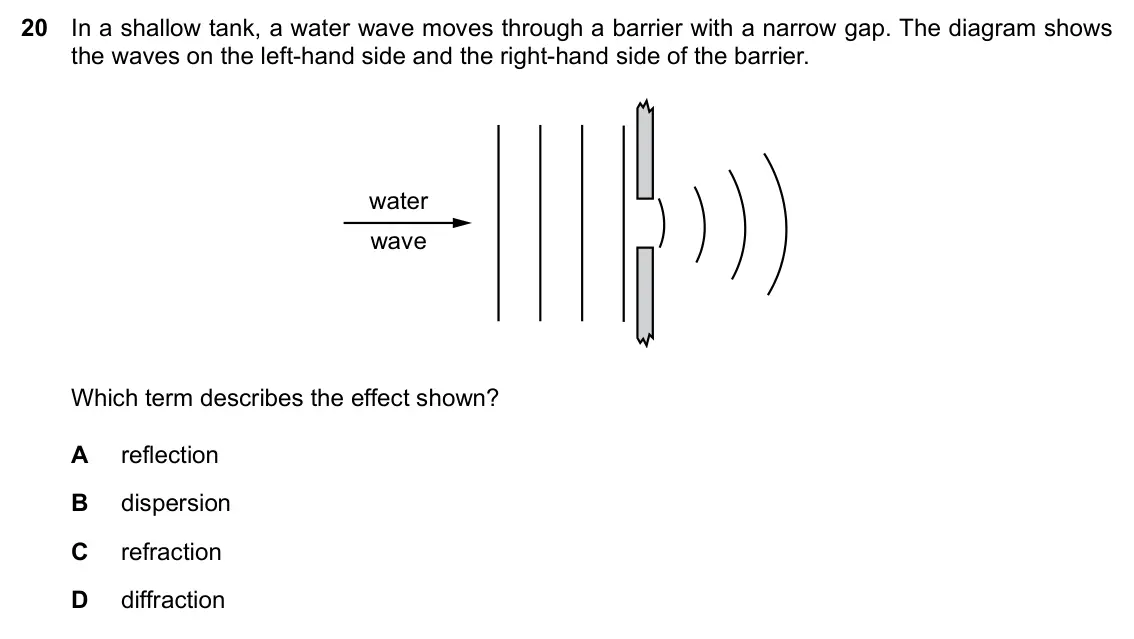
    Specimen Paper 1, question 20: In a shallow tank, a water wave moves through a barrier with a narrow gap. The diagram shows the waves on the left-hand side and the right-hand side of the barr
  13. Q19

    Specimen · Paper 2

    The whole paper ↗
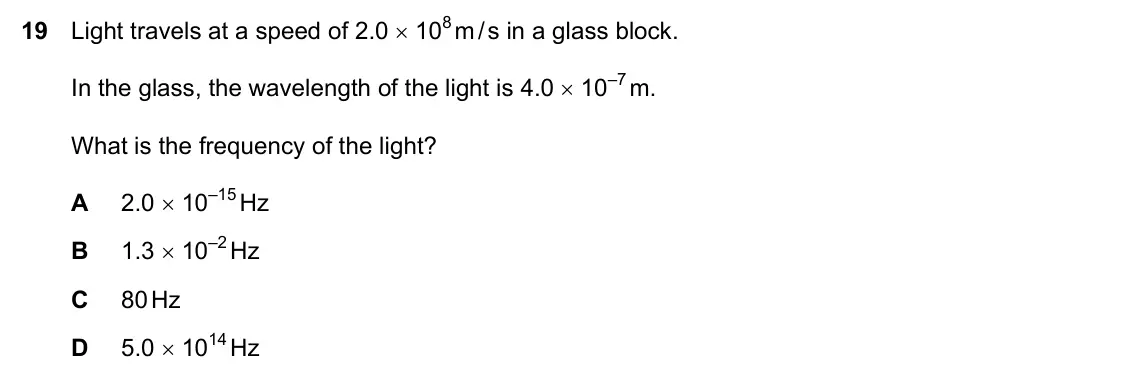
    Specimen Paper 2, question 19: Light travels at a speed of 2.0 × 10⁸ m / s in a glass block. In the glass, the wavelength of the light is 4.0 × 10⁻⁷ m. What is the frequency of the light? A 2
  14. Q20

    Specimen · Paper 2

    The whole paper ↗
    Specimen Paper 2, question 20: In a shallow tank, a water wave moves through a barrier with a narrow gap. The diagram shows the waves on the left-hand side and the right-hand side of the barr
  15. Q7(a)

    Specimen · Paper 3

    The whole paper ↗
    Specimen Paper 3, question 7(a): On Fig. 7.1, show the wavelength of the wave. Label the distance W. [1]
  16. Q7(b)

    Specimen · Paper 3

    The whole paper ↗
    Specimen Paper 3, question 7(b): Determine the amplitude of the wave. amplitude = cm [1]
  17. Q7(c)

    Specimen · Paper 3

    The whole paper ↗
    Specimen Paper 3, question 7(c): The ball reaches its maximum height 40 times in 60 seconds. Calculate the frequency of the wave. frequency = Hz [2]
  18. Q7(d)

    Specimen · Paper 3

    The whole paper ↗
    Specimen Paper 3, question 7(d): Explain how the motion of the ball shows that the water wave is transverse. [1]
  19. Q7(e)

    Specimen · Paper 3

    The whole paper ↗
    Specimen Paper 3, question 7(e): State another example of a transverse wave. [1] [Total: 6]
  20. Q8(b)

    Specimen · Paper 3

    The whole paper ↗
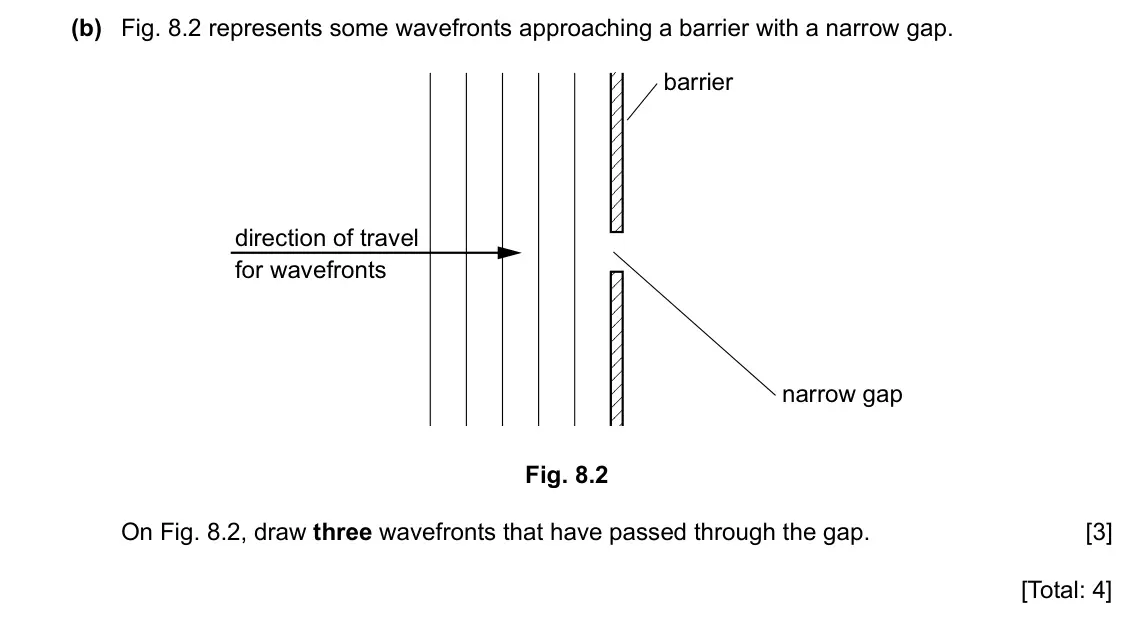
    Specimen Paper 3, question 8(b): Fig. 8.2 represents some wavefronts approaching a barrier with a narrow gap. barrier direction of travel for wavefronts narrow gap Fig. 8.2 On Fig. 8.2, draw th
All 20 questions on General properties of waves, as a list
  1. June 2024, Paper 1, Q16 (1 mark): The diagram represents a wave. x y Which row gives the wavelength and the amplitude of the wave? wavelength amplitude A x y B y x y C x 2 y x D 4 2
  2. June 2024, Paper 1, Q17 (1 mark): Which row describes a seismic P-wave? type of wave direction of vibration A longitudinal parallel to the direction of propagation of the wave B longitudinal per
  3. June 2024, Paper 1, Q18 (1 mark): Which diagram shows waves diffracting? A B C D
  4. June 2024, Paper 1, Q20 (1 mark): Red light of frequency 430  1012 Hz has a wavelength of 700  10–9 m. What is possible for blue light? A a frequency of 190  1012 Hz and a wavelength of 450 
  5. June 2024, Paper 2, Q16 (1 mark): Which statement about waves is correct? A Waves do not transfer either energy or matter. B Waves transfer both energy and matter. C Waves transfer energy withou
  6. June 2024, Paper 3, Q6(b)(i) (3 marks): Calculate the frequency of the infrared waves. frequency = Hz [3]
  7. June 2024, Paper 4, Q5(a) (2 marks): Describe how a longitudinal wave differs from a transverse wave. [2]
  8. June 2024, Paper 4, Q5(b)(i) (1 mark): State whether this seismic wave is a P-wave (primary) or an S-wave (secondary). Justify your choice. [1]
  9. June 2024, Paper 4, Q5(b)(ii) (2 marks): The wave represented in Fig. 5.1 has a wavelength of 1.2 × 10⁴ m. Calculate the actual distance between point J and point K. distance = [2]
  10. June 2024, Paper 4, Q5(b)(iii) (3 marks): The wave in (ii) travels through the ground at a speed of 4600 m / s. As the wave passes a certain point, the ground completes 5 oscillations. Calculate the tim
  11. Specimen, Paper 1, Q19 (1 mark): Which arrow on the graph shows the amplitude of the wave? displacement B C A 0 0 distance D
  12. Specimen, Paper 1, Q20 (1 mark): In a shallow tank, a water wave moves through a barrier with a narrow gap. The diagram shows the waves on the left-hand side and the right-hand side of the barr
  13. Specimen, Paper 2, Q19 (1 mark): Light travels at a speed of 2.0 × 10⁸ m / s in a glass block. In the glass, the wavelength of the light is 4.0 × 10⁻⁷ m. What is the frequency of the light? A 2
  14. Specimen, Paper 2, Q20 (1 mark): In a shallow tank, a water wave moves through a barrier with a narrow gap. The diagram shows the waves on the left-hand side and the right-hand side of the barr
  15. Specimen, Paper 3, Q7(a) (1 mark): On Fig. 7.1, show the wavelength of the wave. Label the distance W. [1]
  16. Specimen, Paper 3, Q7(b) (1 mark): Determine the amplitude of the wave. amplitude = cm [1]
  17. Specimen, Paper 3, Q7(c) (2 marks): The ball reaches its maximum height 40 times in 60 seconds. Calculate the frequency of the wave. frequency = Hz [2]
  18. Specimen, Paper 3, Q7(d) (1 mark): Explain how the motion of the ball shows that the water wave is transverse. [1]
  19. Specimen, Paper 3, Q7(e) (1 mark): State another example of a transverse wave. [1] [Total: 6]
  20. Specimen, Paper 3, Q8(b) (3 marks): Fig. 8.2 represents some wavefronts approaching a barrier with a narrow gap. barrier direction of travel for wavefronts narrow gap Fig. 8.2 On Fig. 8.2, draw th

Questions, mark schemes and examiner’s reports are © Cambridge University Press & Assessment, from their published past papers. Plumi isn’t affiliated with any exam board. Want whole papers? Every CAIE IGCSE Physics paper.

Rather write your answers by hand on iPad? Plumi marks them against the same mark schemes.