 plumi
Hubble’s law and the Big Bang theory: CAIE A‑Level Physics questions
CAIE A-Level Physics past-paper questions on 25.3 Hubble’s law and the Big Bang theory, 2017 to 2025 and the specimen papers, with mark schemes and examiner’s reports where available.
Past paper difficulty
Paper
All papers
Exam
All years
Calculations
Loading the full question list…
Q9(c)
The whole paper ↗1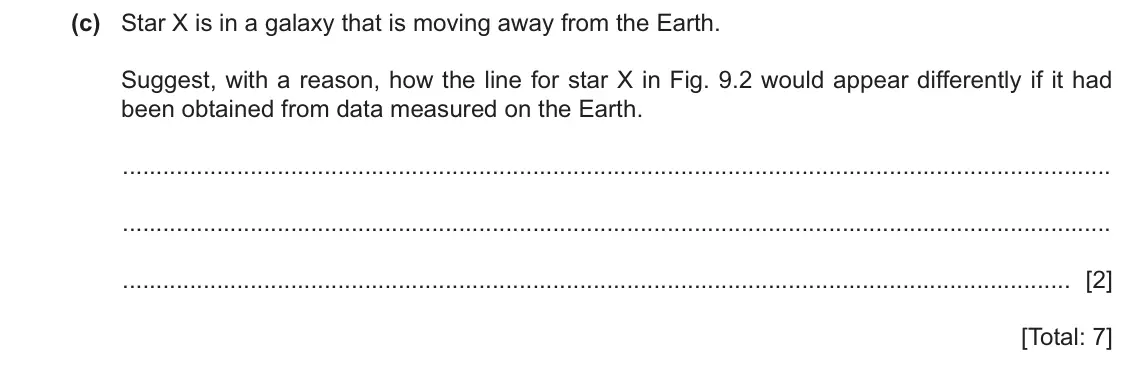
Q2(a)
The whole paper ↗2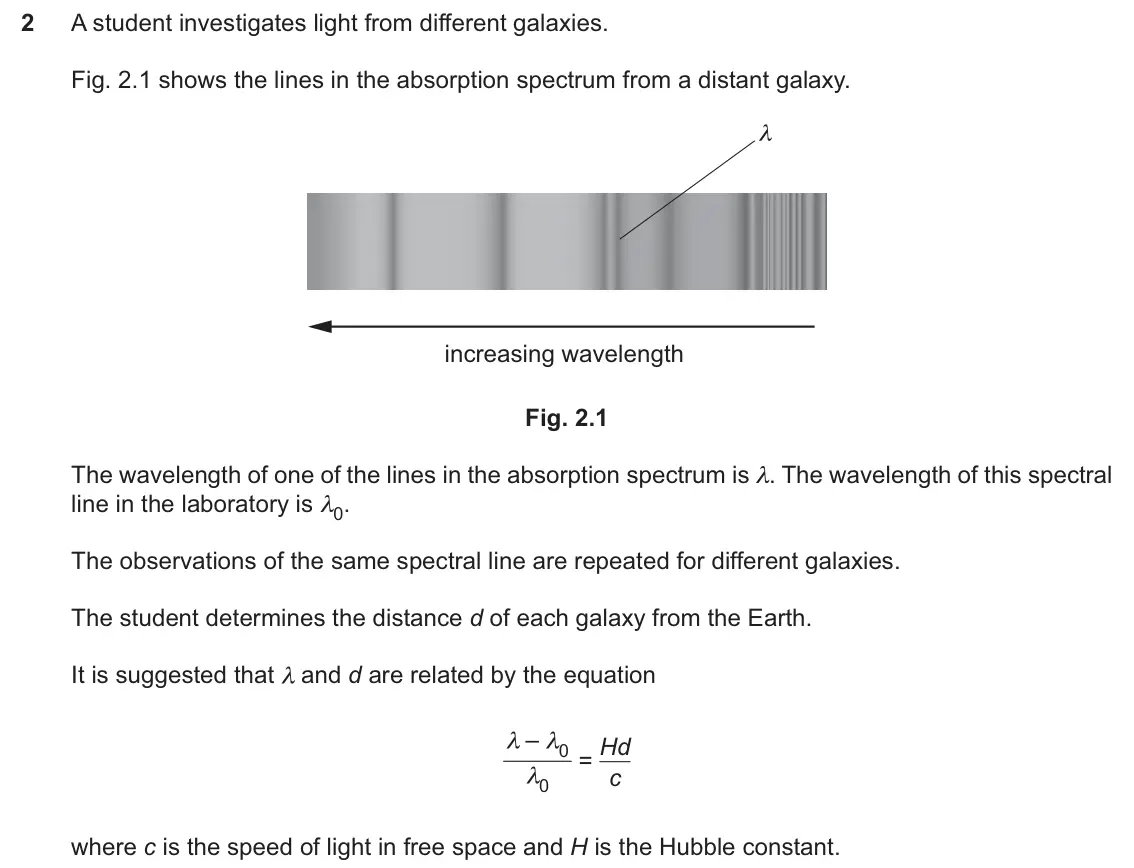

Q2(b)
The whole paper ↗3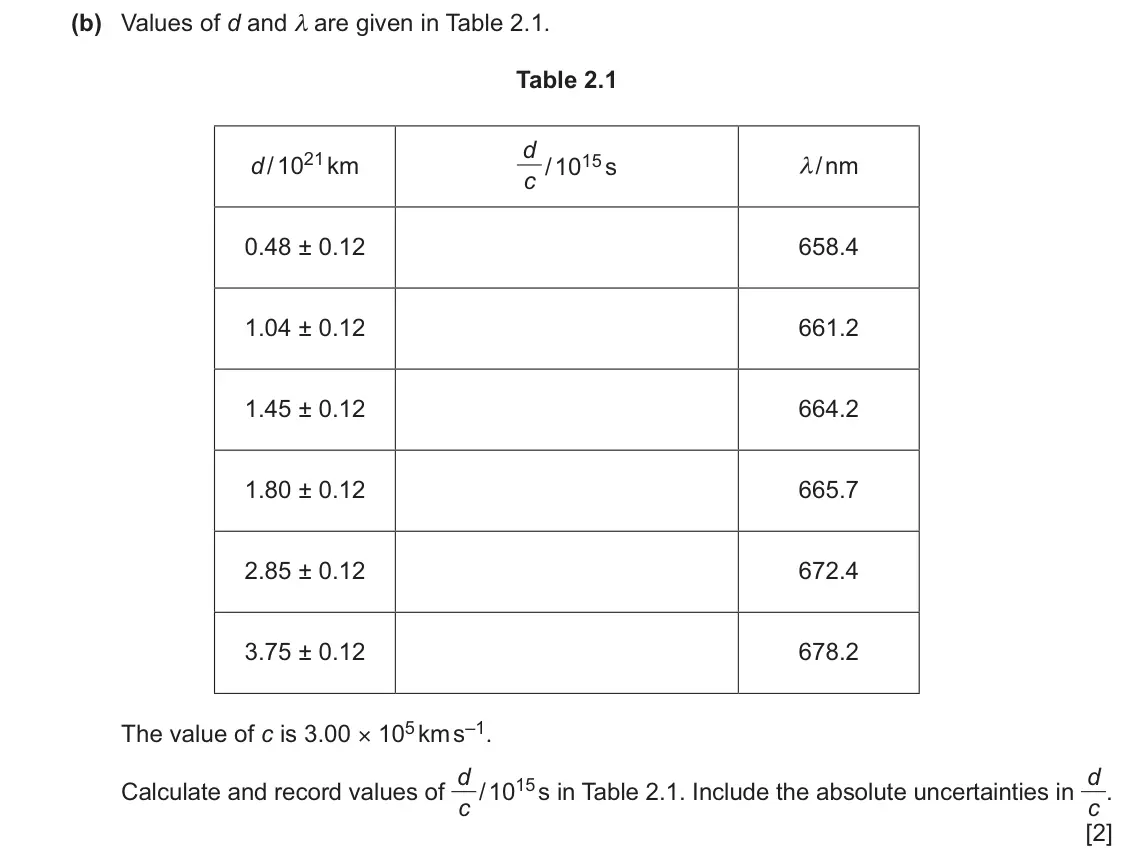
Q2(c)(i)
The whole paper ↗4
Q2(c)(ii)
The whole paper ↗5
Q2(c)(iii)
The whole paper ↗6
Q2(c)(iv)
The whole paper ↗7
Q2(d)
The whole paper ↗8
Q2(e)
The whole paper ↗9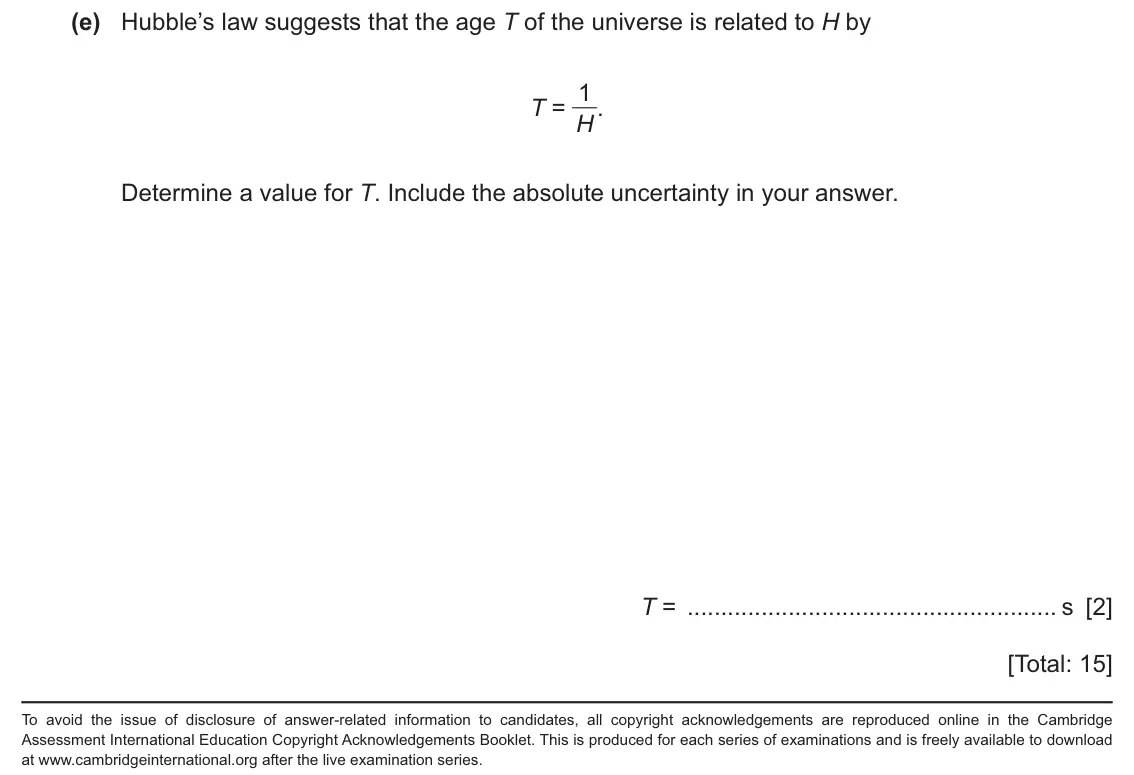
Q9(c)
The whole paper ↗10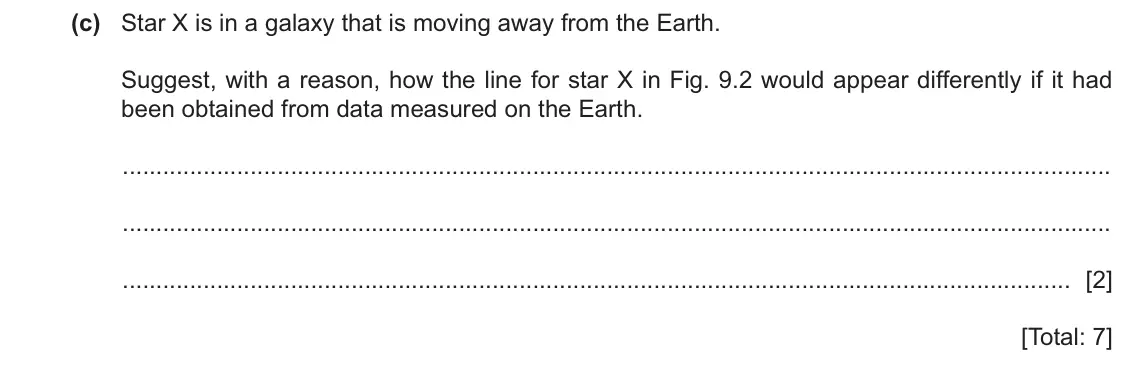
Q2(a)
The whole paper ↗11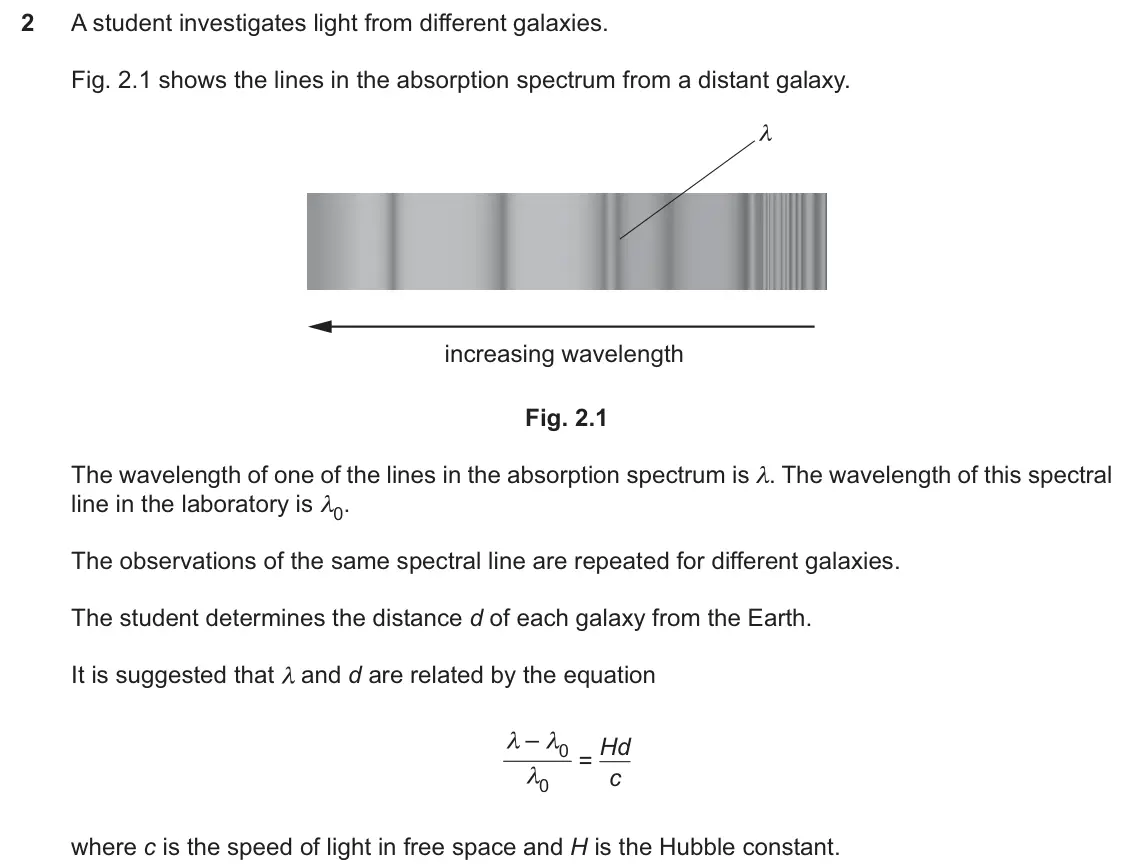

Q2(b)
The whole paper ↗12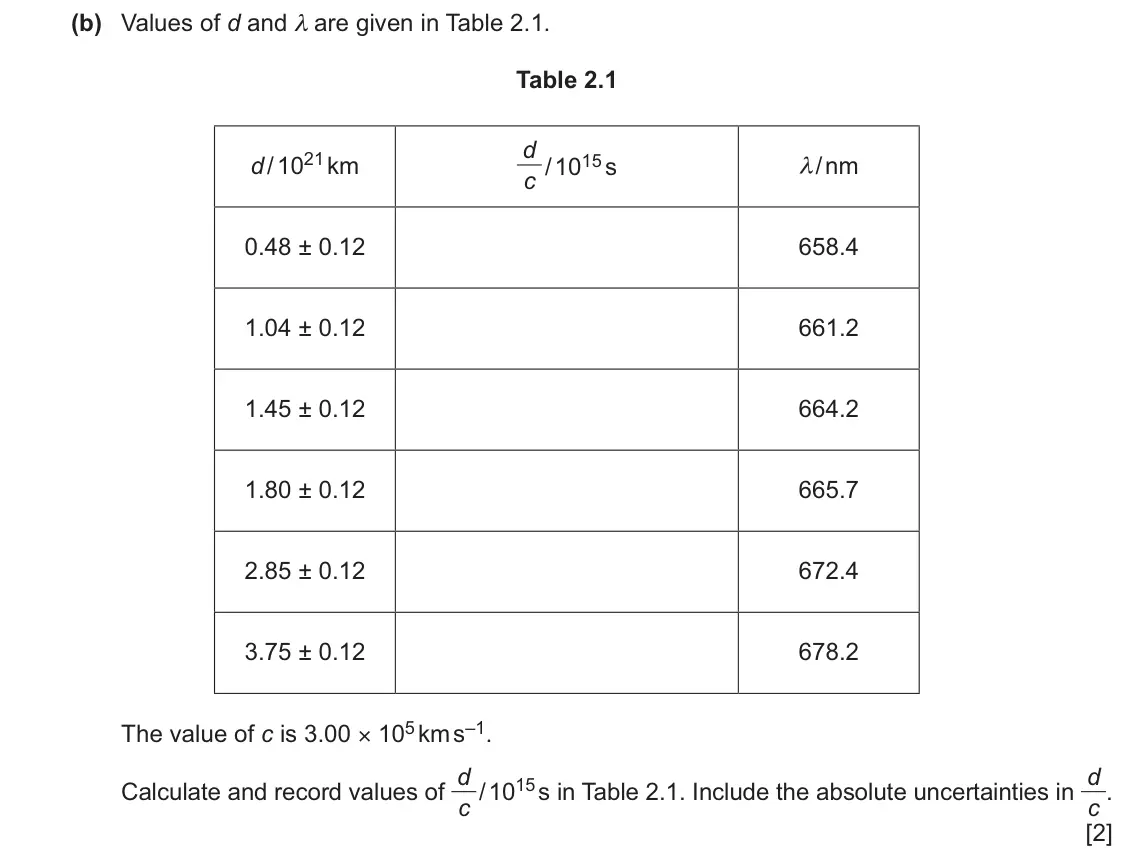
Q2(c)(i)
The whole paper ↗13
Q2(c)(ii)
The whole paper ↗14
Q2(c)(iii)
The whole paper ↗15
Q2(c)(iv)
The whole paper ↗16
Q2(d)
The whole paper ↗17
Q2(e)
The whole paper ↗18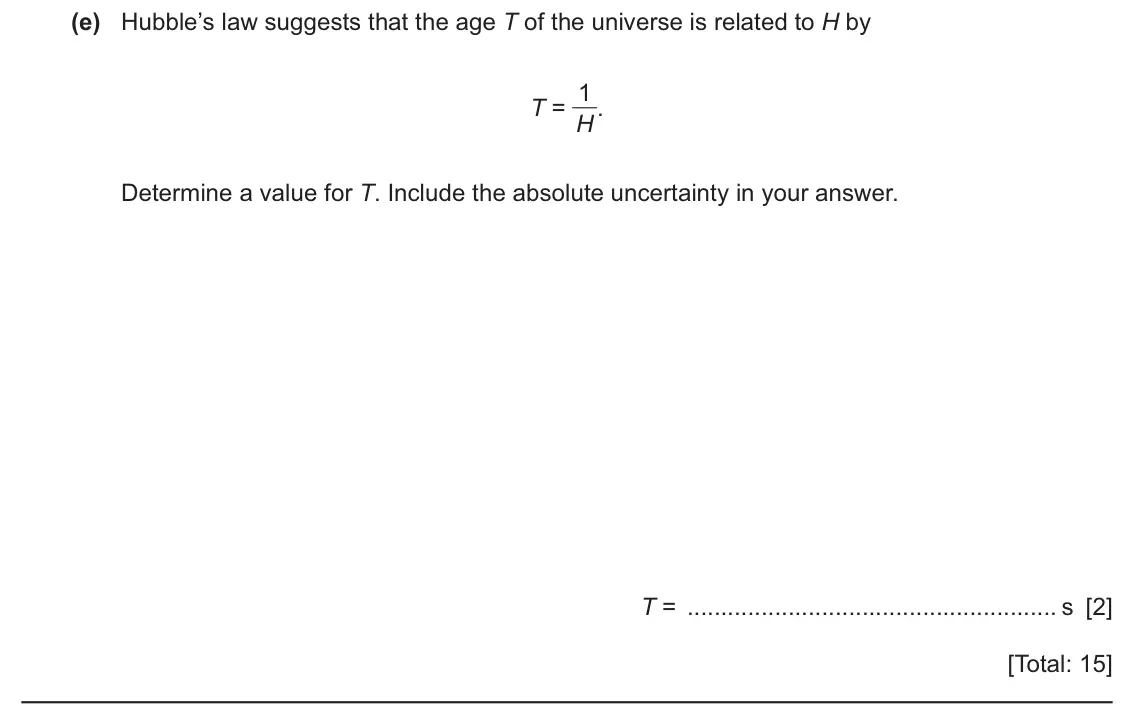
Q10(a)
The whole paper ↗19
Q10(b)(i)
The whole paper ↗20
All 61 questions on Hubble’s law and the Big Bang theory, as a list
- November 2025, Paper 4, Q9(c) (2 marks): Star X is in a galaxy that is moving away from the Earth. Suggest, with a reason, how the line for star X in Fig. 9.2 would appear differently if it had been ob
- November 2025, Paper 5, Q2(a) (1 mark): A graph is plotted of λ on the y-axis against d c on the x-axis. Determine expressions for the gradient and y-intercept. gradient = y-intercept = [1]
- November 2025, Paper 5, Q2(b) (2 marks): Values of d and λ are given in Table 2.1. Table 2.1 d d / 1021 km c / 1015 s λ / nm 0.48 ± 0.12 658.4 1.04 ± 0.12 661.2 1.45 ± 0.12 664.2 1.80 ± 0.12 665.7 2.85
- November 2025, Paper 5, Q2(c)(i) (2 marks): Plot a graph of λ / nm against d c / 1015 s. Include error bars for d c . [2]
- November 2025, Paper 5, Q2(c)(ii) (2 marks): Draw the straight line of best fit and a worst acceptable straight line on your graph. Label both lines. [2]
- November 2025, Paper 5, Q2(c)(iii) (2 marks): Determine the gradient of the line of best fit. Include the absolute uncertainty in your answer. gradient = [2]
- November 2025, Paper 5, Q2(c)(iv) (2 marks): Determine the y-intercept of the line of best fit. Include the absolute uncertainty in your answer. y-intercept = [2]
- November 2025, Paper 5, Q2(d) (2 marks): Using your answers to (a), (c)(iii) and (c)(iv), determine the values of λ0 and H. Include appropriate units. λ0 = H = [2]
- November 2025, Paper 5, Q2(e) (2 marks): Hubble’s law suggests that the age T of the universe is related to H by T = 1 H . Determine a value for T. Include the absolute uncertainty in your answer. T =
- November 2025 (variant 3), Paper 4, Q9(c) (2 marks): Star X is in a galaxy that is moving away from the Earth. Suggest, with a reason, how the line for star X in Fig. 9.2 would appear differently if it had been ob
- November 2025 (variant 3), Paper 5, Q2(a) (1 mark): A graph is plotted of λ on the y-axis against d c on the x-axis. Determine expressions for the gradient and y-intercept. gradient = y-intercept = [1]
- November 2025 (variant 3), Paper 5, Q2(b) (2 marks): Values of d and λ are given in Table 2.1. Table 2.1 d d / 1021 km c / 1015 s λ / nm 0.48 ± 0.12 658.4 1.04 ± 0.12 661.2 1.45 ± 0.12 664.2 1.80 ± 0.12 665.7 2.85
- November 2025 (variant 3), Paper 5, Q2(c)(i) (2 marks): Plot a graph of λ / nm against d c / 1015 s. Include error bars for d c . [2]
- November 2025 (variant 3), Paper 5, Q2(c)(ii) (2 marks): Draw the straight line of best fit and a worst acceptable straight line on your graph. Label both lines. [2]
- November 2025 (variant 3), Paper 5, Q2(c)(iii) (2 marks): Determine the gradient of the line of best fit. Include the absolute uncertainty in your answer. gradient = [2]
- November 2025 (variant 3), Paper 5, Q2(c)(iv) (2 marks): Determine the y-intercept of the line of best fit. Include the absolute uncertainty in your answer. y-intercept = [2]
- November 2025 (variant 3), Paper 5, Q2(d) (2 marks): Using your answers to (a), (c)(iii) and (c)(iv), determine the values of λ0 and H. Include appropriate units. λ0 = H = [2]
- November 2025 (variant 3), Paper 5, Q2(e) (2 marks): Hubble’s law suggests that the age T of the universe is related to H by T = 1 H . Determine a value for T. Include the absolute uncertainty in your answer. T =
- June 2025, Paper 4, Q10(a) (2 marks): State Hubble’s law. [2]
- June 2025, Paper 4, Q10(b)(i) (2 marks): Explain why the observed wavelength and the emitted wavelength have different values. [2]
- June 2025, Paper 4, Q10(b)(ii) (2 marks): Calculate the speed of the star relative to the Earth. speed = m s–1 [2]
- June 2025, Paper 4, Q10(c) (2 marks): A value for the Hubble constant is 2.3 × 10⁻¹⁸ s–1. Use your answer in (b)(ii) to determine the distance of the star in (b) from the Earth. distance = m [2] [To
- June 2025 (variant 3), Paper 4, Q10(a) (2 marks): State Hubble’s law. [2]
- June 2025 (variant 3), Paper 4, Q10(b)(i) (2 marks): Explain why the observed wavelength and the emitted wavelength have different values. [2]
- June 2025 (variant 3), Paper 4, Q10(b)(ii) (2 marks): Calculate the speed of the star relative to the Earth. speed = m s–1 [2]
- June 2025 (variant 3), Paper 4, Q10(c) (2 marks): A value for the Hubble constant is 2.3 × 10⁻¹⁸ s–1. Use your answer in (b)(ii) to determine the distance of the star in (b) from the Earth. distance = m [2] [To
- November 2024, Paper 4, Q10(a) (3 marks): Explain how redshift leads to the idea that the Universe is expanding. [3]
- November 2024, Paper 4, Q10(b)(ii) (2 marks): the speed v of the galaxy relative to the Earth. v = m s–1 [2]
- November 2024, Paper 4, Q10(c)(i) (2 marks): On Fig. 10.1, sketch the variation of v with d. v 0 0 d Fig. 10.1 [2]
- November 2024, Paper 4, Q10(c)(ii) (1 mark): State the name of the quantity represented by the gradient of the line in Fig. 10.1. [1] [Total: 10]
- November 2024 (variant 3), Paper 4, Q10(a) (3 marks): Explain how redshift leads to the idea that the Universe is expanding. [3]
- November 2024 (variant 3), Paper 4, Q10(b)(ii) (2 marks): the speed v of the galaxy relative to the Earth. v = m s–1 [2]
- November 2024 (variant 3), Paper 4, Q10(c)(i) (2 marks): On Fig. 10.1, sketch the variation of v with d. v 0 0 d Fig. 10.1 [2]
- November 2024 (variant 3), Paper 4, Q10(c)(ii) (1 mark): State the name of the quantity represented by the gradient of the line in Fig. 10.1. [1] [Total: 10]
- June 2024 (variant 2), Paper 4, Q8(a)(i) (2 marks): Explain how the positions of the lines in the emission spectrum seen by an observer on the Earth differ from the positions shown in Fig. 8.1. [2]
- June 2024 (variant 2), Paper 4, Q8(a)(ii) (2 marks): On Fig. 8.1, draw the three lines in possible positions in the spectrum seen by the observer. [2]
- June 2024 (variant 2), Paper 4, Q8(b)(iii) (2 marks): Determine the wavelength, in nm, of this radiation as detected by the observer on the Earth. wavelength = nm [2]
- June 2024 (variant 2), Paper 4, Q8(c) (2 marks): A value for the Hubble constant is 2.3 × 10⁻¹⁸ s–1. Determine the distance of the galaxy from the Earth. distance = m [2] [Total: 12]
- March 2024, Paper 4, Q10(b)(i) (1 mark): The visible emission spectrum for the Sun is shown in Fig. 10.2. 350 400 450 500 550 600 650 700 wavelength / nm Fig. 10.2 The lines are at wavelengths of 397 n
- March 2024, Paper 4, Q10(b)(ii) (2 marks): The galaxy in Corona Borealis is moving away from the Earth at a speed of 21 400 km s–1. Use information from (b)(i) to calculate, in nm, the observed wavelengt
- November 2023 (variant 2), Paper 4, Q10(b)(ii) (1 mark): State the reason why the radiation from the star is redshifted. [1]
- November 2023 (variant 2), Paper 4, Q10(b)(iii) (4 marks): The true values of the quantities observed or estimated are those that are corrected to allow for redshift. However, the student does not correct for redshift.
- June 2023, Paper 4, Q10(a) (2 marks): State Hubble’s law. Identify any symbols that you use. [2]
- June 2023, Paper 4, Q10(c)(i) (2 marks): Explain why the wavelength observed on the Earth is different from the wavelength that the galaxy is known to have emitted. [2]
- June 2023, Paper 4, Q10(c)(ii) (3 marks): Determine a value for the Hubble constant H0. H0 = s–1 [3] [Total: 9]
- June 2023 (variant 3), Paper 4, Q10(a) (2 marks): State Hubble’s law. Identify any symbols that you use. [2]
- June 2023 (variant 3), Paper 4, Q10(c)(i) (2 marks): Explain why the wavelength observed on the Earth is different from the wavelength that the galaxy is known to have emitted. [2]
- June 2023 (variant 3), Paper 4, Q10(c)(ii) (3 marks): Determine a value for the Hubble constant H0. H0 = s–1 [3] [Total: 9]
- March 2023, Paper 4, Q10(c)(ii) (3 marks): Calculate the distance to the star. The Hubble constant is 2.3 × 10⁻¹⁸ s–1. distance = m [2]
- March 2023, Paper 4, Q10(c)(iii) (3 marks): State and explain what can be concluded about the Universe based on this change in observed wavelength. [3] [Total: 9]
- November 2022 (variant 2), Paper 4, Q9(b)(i) (1 mark): State the name of the phenomenon that gives rise to the change in the wavelengths. [1]
- November 2022 (variant 2), Paper 4, Q9(b)(ii) (1 mark): State what this phenomenon shows about the motion of the galaxy. [1]
- November 2022 (variant 2), Paper 4, Q9(b)(iii) (3 marks): Use one of the lines in Fig. 9.1, and the corresponding line in Fig. 9.3, to determine the speed of the distant galaxy relative to the observer. speed = m s–1 [
- November 2022 (variant 2), Paper 4, Q9(c) (2 marks): The galaxy in (b) is known to be a distance of 5.7 × 1024 m from the Earth. Use your answer in (b)(iii) to determine a value for the Hubble constant H0. H0 = s–
- June 2022, Paper 4, Q10(c)(i) (2 marks): State what is meant by redshift. [2]
- June 2022, Paper 4, Q10(c)(ii) (2 marks): Explain how cosmologists are able to determine that light from a distant star has undergone redshift. [2] [Total: 9]
- June 2022 (variant 2), Paper 4, Q9(a)(i) (2 marks): State Hubble’s law. [2]
- June 2022 (variant 2), Paper 4, Q9(a)(ii) (2 marks): Explain how cosmologists use observations of emission spectra from stars in distant galaxies to determine that the Universe is expanding. [2]
- June 2022 (variant 2), Paper 4, Q9(b) (3 marks): Explain how Hubble’s law and the idea of the expanding Universe lead to the Big Bang theory of the origin of the Universe. [3] [Total: 7]
- June 2022 (variant 3), Paper 4, Q10(c)(i) (2 marks): State what is meant by redshift. [2]
- June 2022 (variant 3), Paper 4, Q10(c)(ii) (2 marks): Explain how cosmologists are able to determine that light from a distant star has undergone redshift. [2] [Total: 9]
Questions, mark schemes and examiner’s reports are © Cambridge University Press & Assessment, from their published past papers. Plumi isn’t affiliated with any exam board. Want whole papers? CAIE A-Level Physics past papers.
The Plumi iPad app also offers exam-style questions with AI feedback on your handwritten working.