 plumi
Capacitors and capacitance: CAIE A‑Level Physics questions
CAIE A-Level Physics past-paper questions on 19.1 Capacitors and capacitance, 2017 to 2025 and the specimen papers, with mark schemes and examiner’s reports where available.
Past paper difficulty
Paper
All papers
Exam
All years
Calculations
Loading the full question list…
Q6(a)
The whole paper ↗1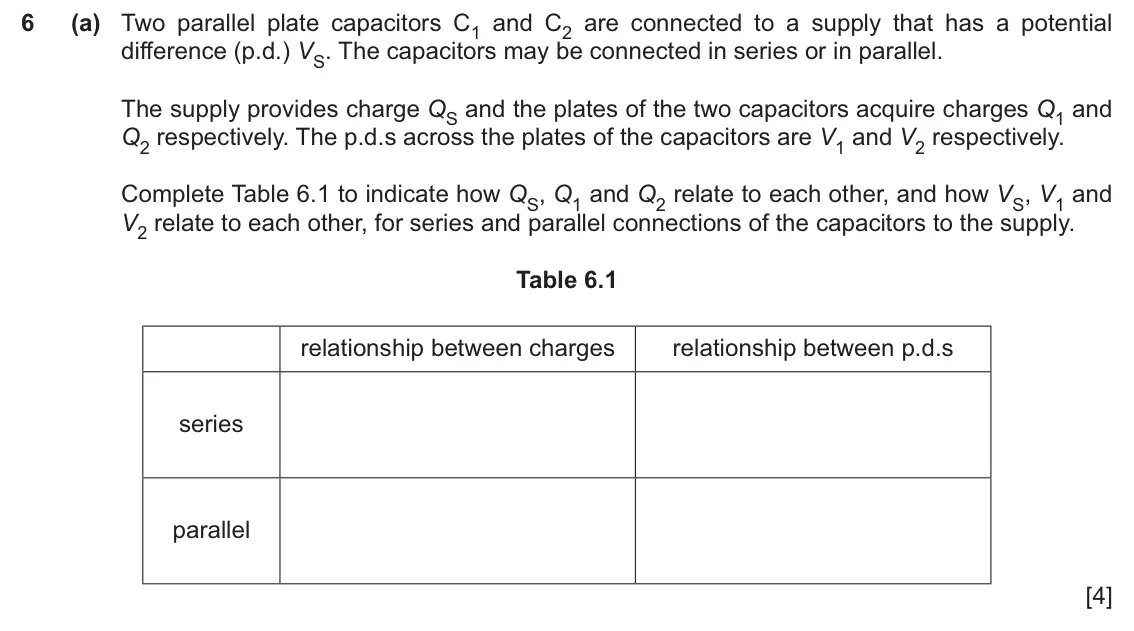
Q6(b)(ii)
The whole paper ↗2
Q6(a)
The whole paper ↗3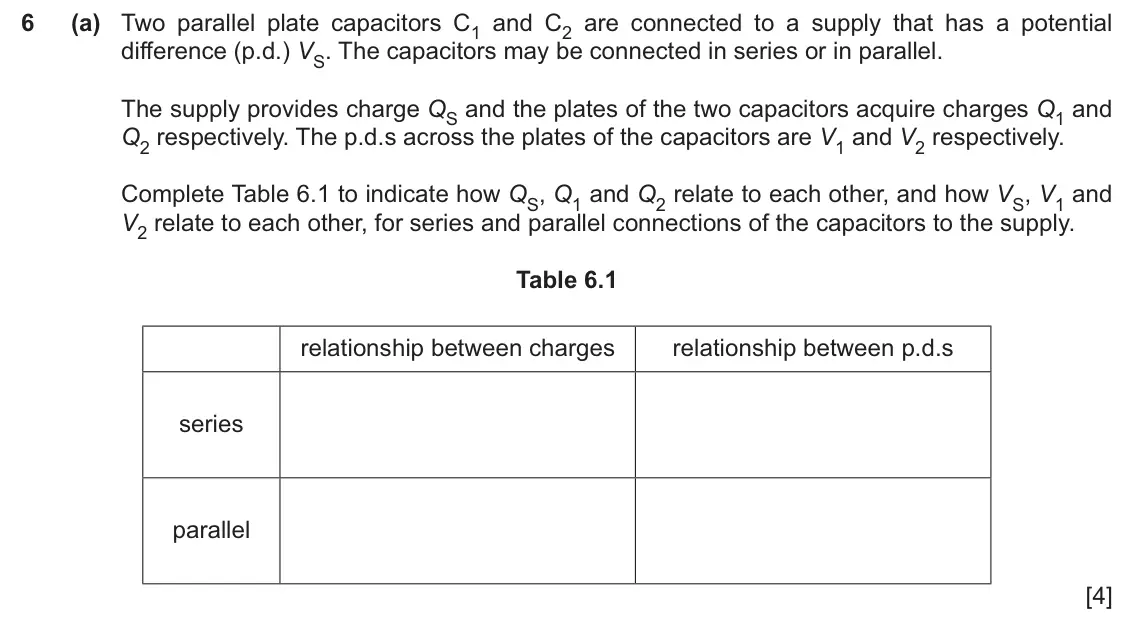
Q6(b)(ii)
The whole paper ↗4
Q2(a)
The whole paper ↗5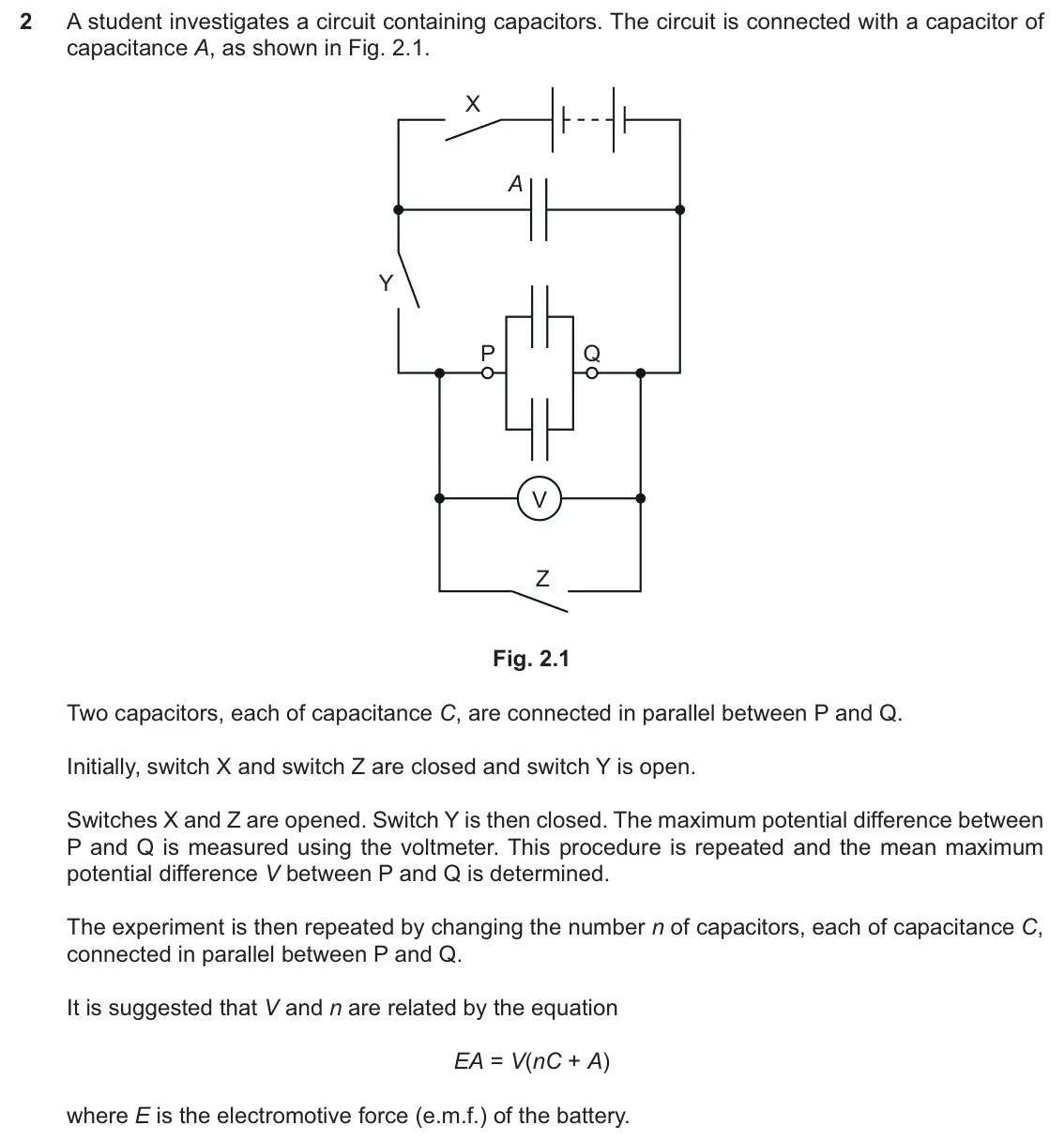

Q2(b)
The whole paper ↗6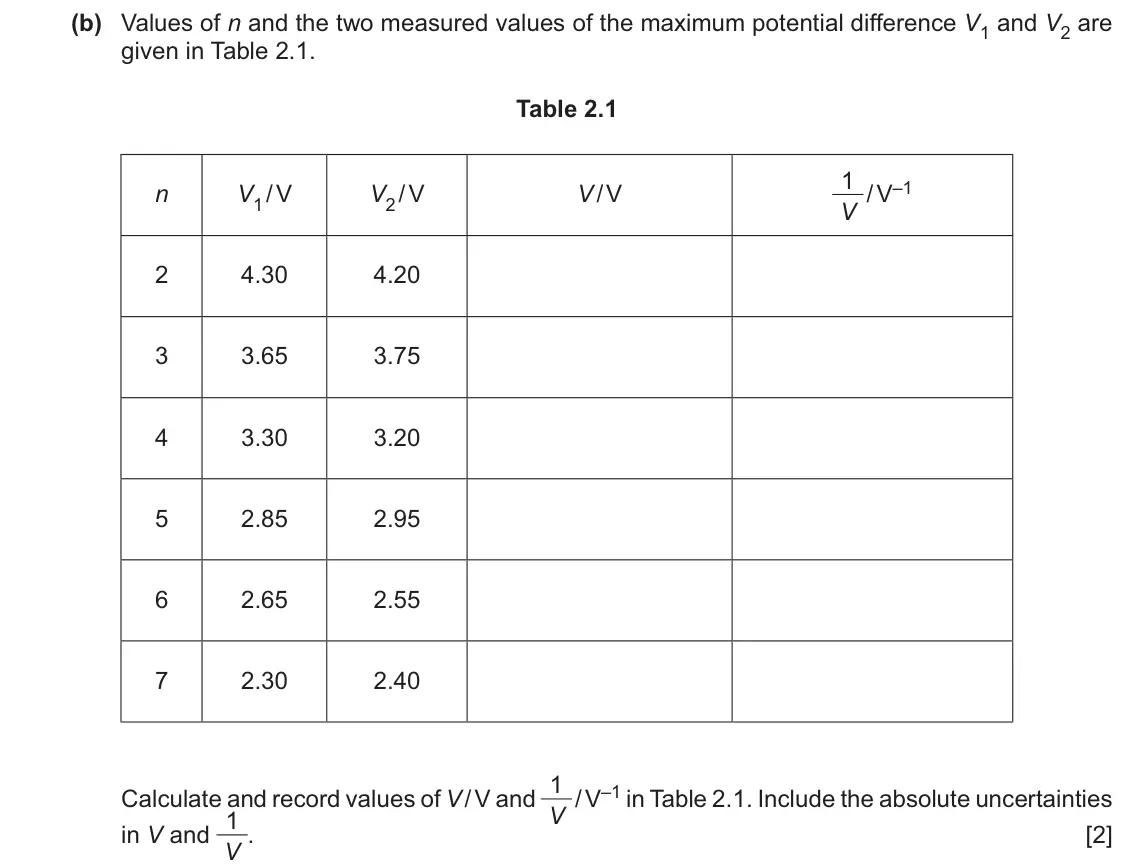
Q2(c)(i)
The whole paper ↗7
Q2(c)(ii)
The whole paper ↗8
Q2(c)(iii)
The whole paper ↗9
Q2(c)(iv)
The whole paper ↗10
Q2(d)(i)
The whole paper ↗11
Q2(d)(ii)
The whole paper ↗12
Q2(e)
The whole paper ↗13
Q5(a)
The whole paper ↗14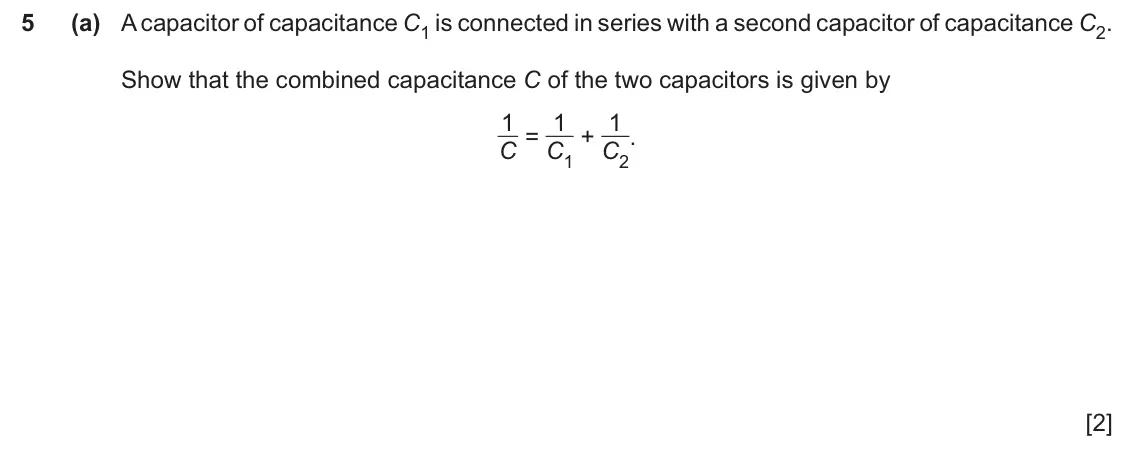
Q5(b)
The whole paper ↗15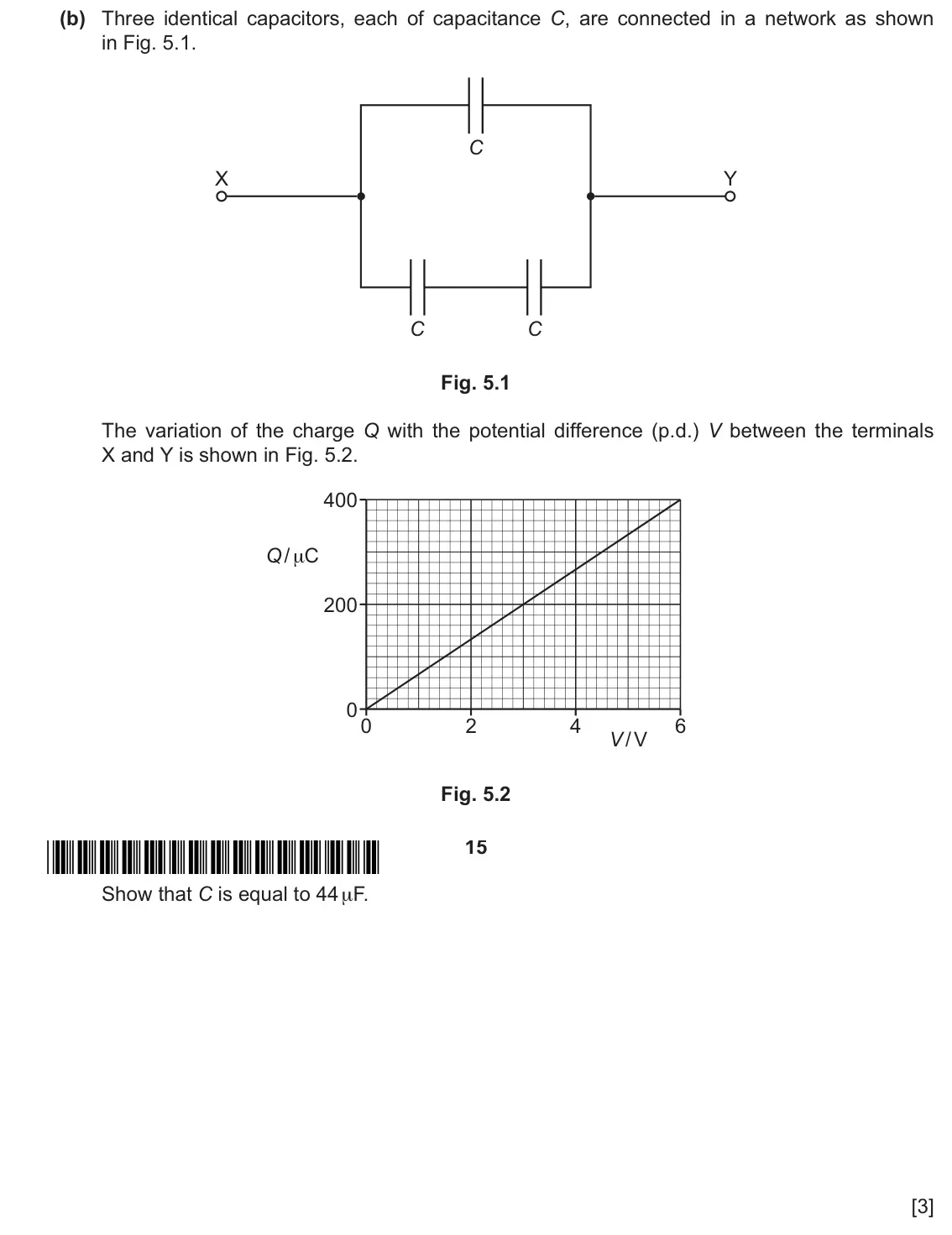
Q7(a)
The whole paper ↗16
Q7(c)(i)
The whole paper ↗17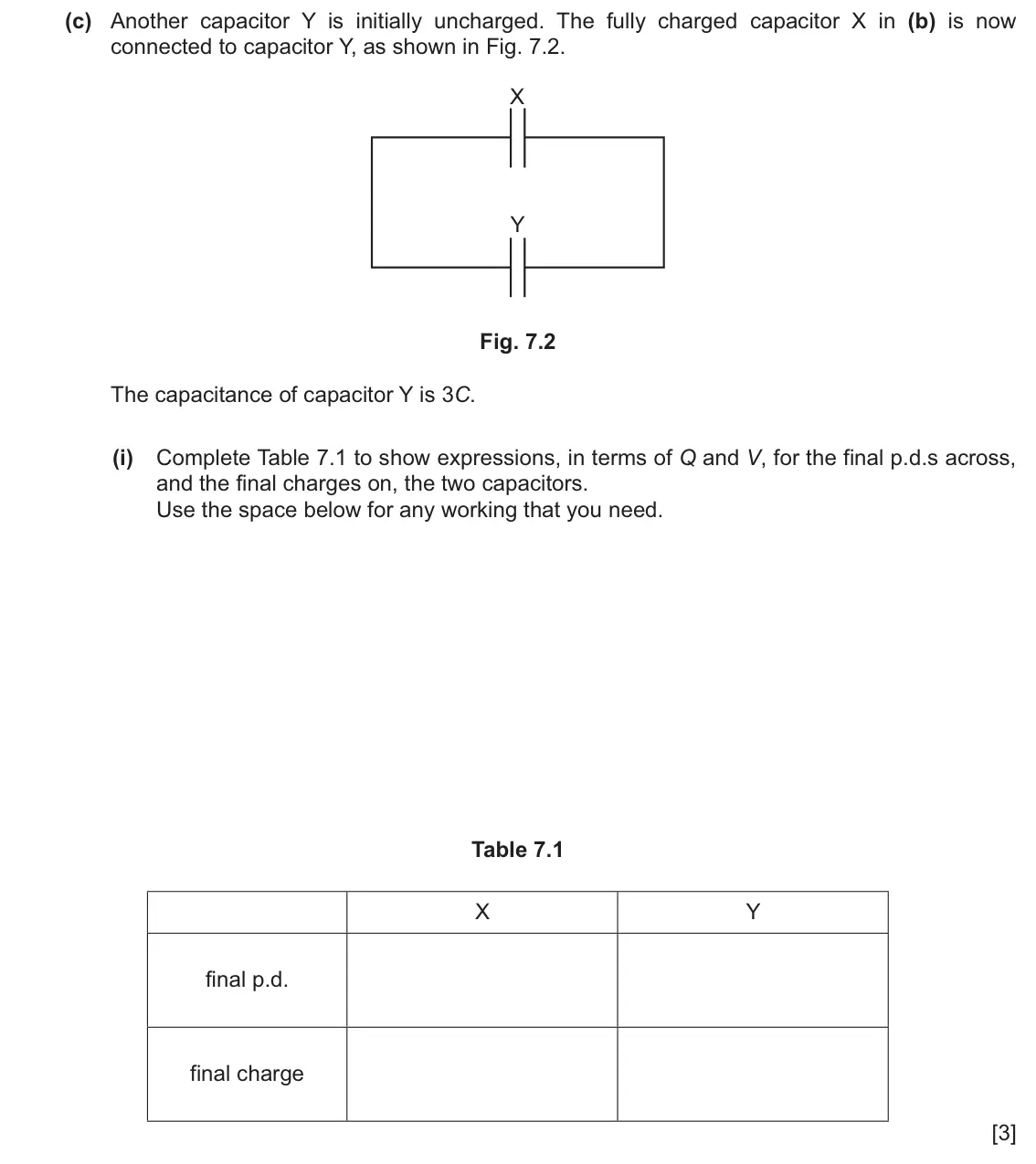
Q6(a)
The whole paper ↗18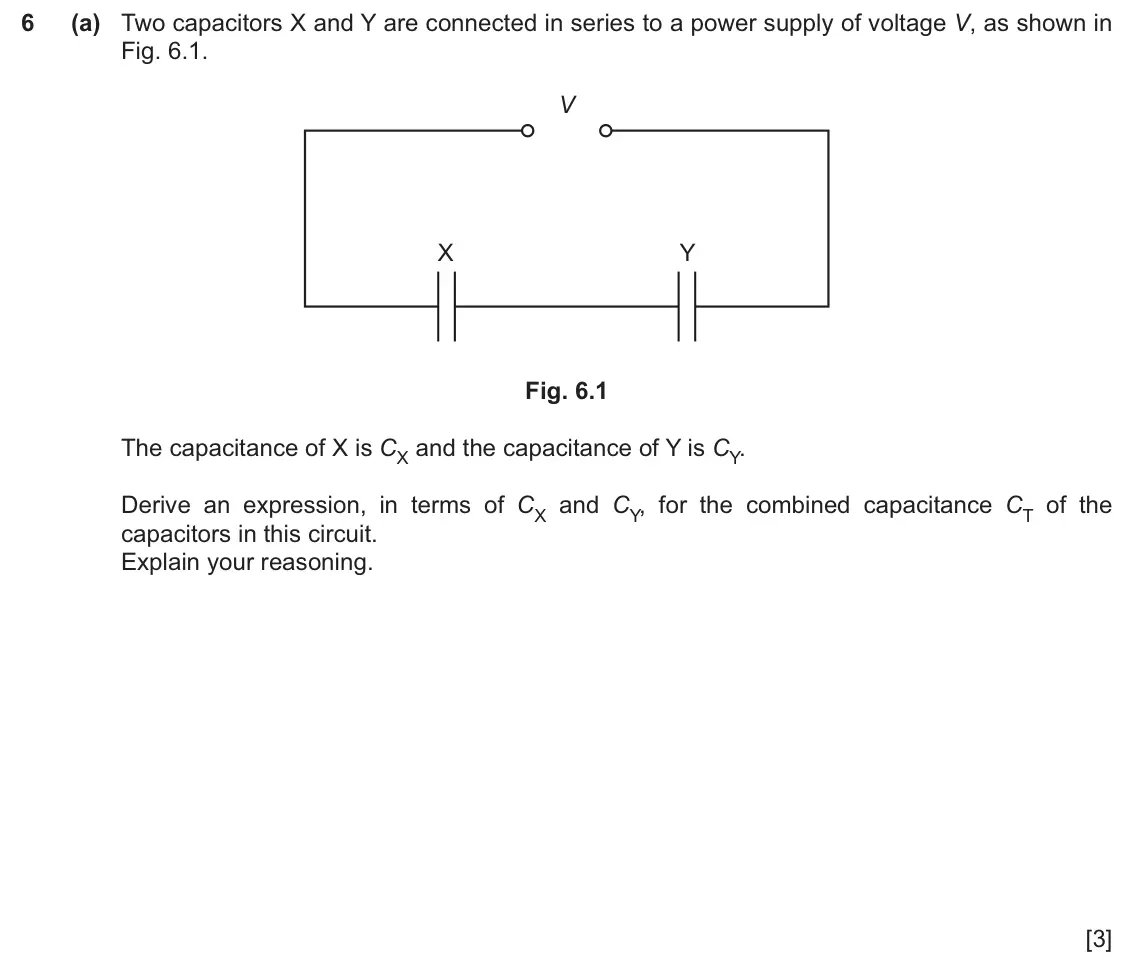
Q4(a)
The whole paper ↗19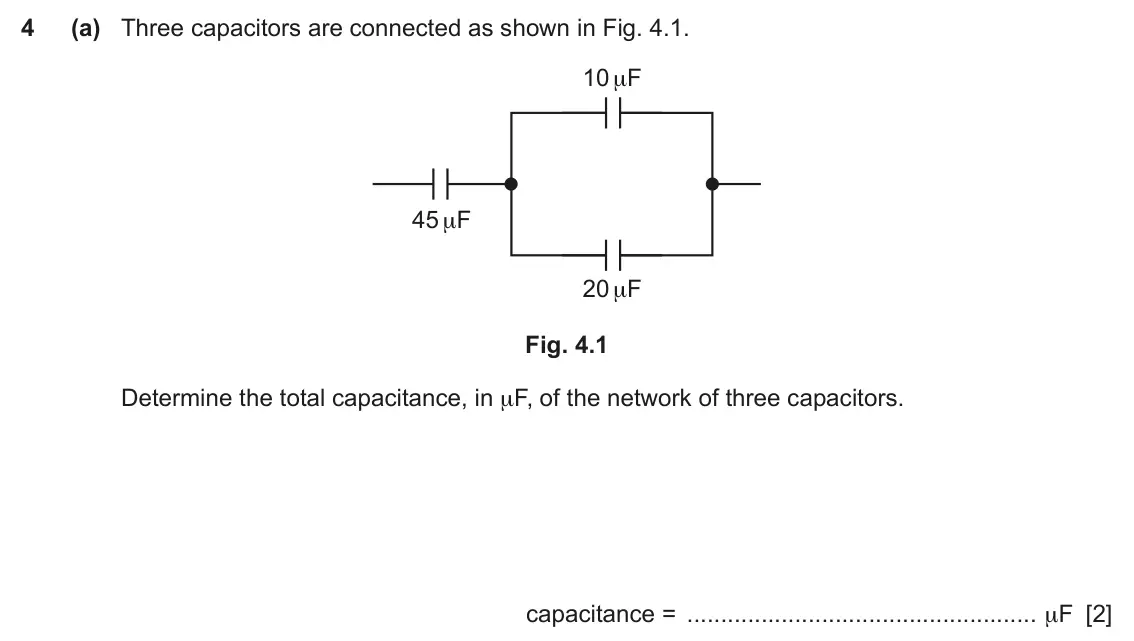
Q6(a)(ii)
The whole paper ↗20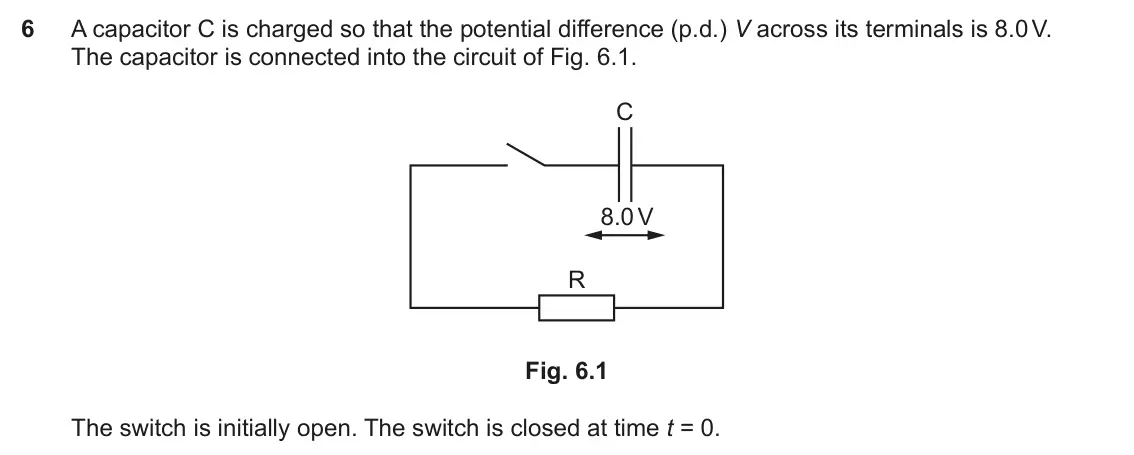

All 91 questions on Capacitors and capacitance, as a list
- November 2025, Paper 4, Q6(a) (4 marks): Two parallel plate capacitors C1 and C2 are connected to a supply that has a potential difference (p.d.) VS. The capacitors may be connected in series or in par
- November 2025 (variant 2), Paper 4, Q6(b)(ii) (2 marks): Calculate the electric potential at the surface of the sphere. electric potential = V [2]
- November 2025 (variant 3), Paper 4, Q6(a) (4 marks): Two parallel plate capacitors C1 and C2 are connected to a supply that has a potential difference (p.d.) VS. The capacitors may be connected in series or in par
- November 2025 (variant 3), Paper 4, Q6(b)(ii) (2 marks): Calculate the charge on the capacitor. charge = C [2]
- June 2025 (variant 2), Paper 5, Q2(a) (1 mark): A graph is plotted of 1 V on the y-axis against n on the x-axis. Determine expressions for the gradient and y-intercept. gradient = y-intercept = [1]
- June 2025 (variant 2), Paper 5, Q2(b) (2 marks): Values of n and the two measured values of the maximum potential difference V1 and V2 are given in Table 2.1. Table 2.1 1 n V1 / V V2 / V V / V V / V–1 2 4.30 4
- June 2025 (variant 2), Paper 5, Q2(c)(i) (2 marks): Plot a graph of 1 V / V–1 against n. Include error bars for 1 V . [2]
- June 2025 (variant 2), Paper 5, Q2(c)(ii) (2 marks): Draw the straight line of best fit and a worst acceptable straight line on your graph. Label both lines. [2]
- June 2025 (variant 2), Paper 5, Q2(c)(iii) (2 marks): Determine the gradient of the line of best fit. Include the absolute uncertainty in your answer. gradient = [2]
- June 2025 (variant 2), Paper 5, Q2(c)(iv) (2 marks): Determine the y-intercept of the line of best fit. Include the absolute uncertainty in your answer. y-intercept = [2]
- June 2025 (variant 2), Paper 5, Q2(d)(i) (2 marks): Using your answers to (a), (c)(iii) and (c)(iv), determine the values of E and C. Include appropriate units. Data: A = (2.2 ± 0.2) mF E = C = [2]
- June 2025 (variant 2), Paper 5, Q2(d)(ii) (1 mark): Determine the percentage uncertainty in your value of C. percentage uncertainty = % [1]
- June 2025 (variant 2), Paper 5, Q2(e) (1 mark): The experiment is repeated with 10 capacitors, each of capacitance C, connected in parallel between P and Q. Determine the maximum potential difference V betwee
- March 2025, Paper 4, Q5(a) (2 marks): A capacitor of capacitance C1 is connected in series with a second capacitor of capacitance C2. Show that the combined capacitance C of the two capacitors is gi
- March 2025, Paper 4, Q5(b) (3 marks): Three identical capacitors, each of capacitance C, are connected in a network as shown in Fig. 5.1. C X Y C C Fig. 5.1 The variation of the charge Q with the po
- November 2024 (variant 2), Paper 4, Q7(a) (2 marks): Define the capacitance of a parallel‑plate capacitor. [2]
- November 2024 (variant 2), Paper 4, Q7(c)(i) (3 marks): Complete Table 7.1 to show expressions, in terms of Q and V, for the final p.d.s across, and the final charges on, the two capacitors. Use the space below for a
- June 2024 (variant 2), Paper 4, Q6(a) (3 marks): Two capacitors X and Y are connected in series to a power supply of voltage V, as shown in Fig. 6.1. V X Y Fig. 6.1 The capacitance of X is CX and the capacitan
- March 2024, Paper 4, Q4(a) (2 marks): Three capacitors are connected as shown in Fig. 4.1. 10 μF 45 μF 20 μF Fig. 4.1 Determine the total capacitance, in μF, of the network of three capacitors. capa
- November 2023 (variant 2), Paper 4, Q6(a)(ii) (2 marks): Determine the capacitance of capacitor C. Give a unit with your answer. capacitance = unit [2]
- June 2023 (variant 2), Paper 4, Q5(a)(i) (1 mark): the initial charge QA on the plates of capacitor A QA = [1]
- June 2023 (variant 2), Paper 4, Q5(b)(i) (2 marks): State and explain what happens to the charge that was initially on the plates of capacitor A. [2]
- November 2022, Paper 4, Q5(a)(i) (2 marks): Calculate the charge Q0 on the capacitor at time t = 0. Q0 = C [2]
- November 2022 (variant 2), Paper 4, Q6(c)(i) (2 marks): capacitance C, in μF C = μF [2]
- June 2022, Paper 5, Q1 (15 marks): Two parallel metal plates, each of area A, are separated by a small distance d, as shown in Fig. 1.1. area A metal plates d Fig. 1.1 (not to scale) The plates a
- June 2022 (variant 2), Paper 4, Q5(a) (2 marks): Define the capacitance of a parallel plate capacitor. [2]
- June 2022 (variant 2), Paper 4, Q5(b) (3 marks): Two capacitors, of capacitances C1 and C2, are connected in parallel to a power supply of electromotive force (e.m.f.) E, as shown in Fig. 5.1. E C1 C2 Fig. 5.1
- June 2022 (variant 2), Paper 4, Q5(c)(i) (1 mark): Show that the combined capacitance of the two capacitors is 15 μF. [1]
- June 2022 (variant 3), Paper 5, Q1 (15 marks): Two parallel metal plates, each of area A, are separated by a small distance d, as shown in Fig. 1.1. area A metal plates d Fig. 1.1 (not to scale) The plates a
- November 2021, Paper 4, Q6(b)(i) (1 mark): the new capacitance CN CN = [1]
- November 2021, Paper 4, Q6(b)(ii) (1 mark): the new charge QN on one of the plates QN = [1]
- November 2021, Paper 4, Q6(b)(iii) (1 mark): the new p.d. VN between the plates. VN = [1]
- November 2021 (variant 2), Paper 4, Q6(b) (2 marks): An isolated conducting sphere in a vacuum has radius r and is initially uncharged. It is then charged by friction so that it carries a final charge Q. This char
- November 2021 (variant 2), Paper 4, Q6(c) (3 marks): The dome of an electrostatic generator is a spherical conductor of radius 13 cm. It is initially charged so that the electric potential at the surface is 4.5 kV
- November 2021 (variant 3), Paper 4, Q6(b)(i) (1 mark): the new capacitance CN CN = [1]
- November 2021 (variant 3), Paper 4, Q6(b)(ii) (1 mark): the new charge QN on one of the plates QN = [1]
- November 2021 (variant 3), Paper 4, Q6(b)(iii) (1 mark): the new p.d. VN between the plates. VN = [1]
- June 2021, Paper 4, Q7(a) (2 marks): State what is meant by the capacitance of a parallel plate capacitor. [2]
- June 2021, Paper 4, Q7(b)(i) (2 marks): Show that the average current I in the ammeter is given by the expression I = fCV. [2]
- June 2021, Paper 4, Q7(b)(ii) (2 marks): For a potential difference V of 150 V and a frequency f of 60 Hz, the average current in the ammeter is 4.8 μA. Calculate the capacitance, in pF, of the capacit
- June 2021, Paper 4, Q7(c) (3 marks): A second capacitor, having the same capacitance as the capacitor in (b), is connected into the circuit of Fig. 7.1. The two capacitors are connected in series.
- June 2021 (variant 3), Paper 4, Q7(a) (2 marks): State what is meant by the capacitance of a parallel plate capacitor. [2]
- June 2021 (variant 3), Paper 4, Q7(b)(i) (2 marks): Show that the average current I in the ammeter is given by the expression I = fCV. [2]
- June 2021 (variant 3), Paper 4, Q7(b)(ii) (2 marks): For a potential difference V of 150 V and a frequency f of 60 Hz, the average current in the ammeter is 4.8 μA. Calculate the capacitance, in pF, of the capacit
- June 2021 (variant 3), Paper 4, Q7(c) (3 marks): A second capacitor, having the same capacitance as the capacitor in (b), is connected into the circuit of Fig. 7.1. The two capacitors are connected in series.
- March 2021, Paper 4, Q6(c) (3 marks): Using the formula for the electric potential due to an isolated point charge, determine the capacitance of the sphere in (b). capacitance = F [3] [Total: 7]
- November 2020, Paper 4, Q6(a)(i) (2 marks): Define the capacitance of a parallel plate capacitor. [2]
- November 2020, Paper 4, Q6(a)(ii) (3 marks): State three functions of capacitors in electrical circuits. 1. 2. 3. [3]
- November 2020, Paper 4, Q6(b) (2 marks): A student has available four capacitors, each of capacitance 24 μF. The capacitors are connected as shown in Fig. 6.1. 24 μF X 24 μF 24 μF 24 μF Y Fig. 6.1 Calc
- November 2020 (variant 2), Paper 4, Q6(a)(i) (2 marks): Define the capacitance of a parallel plate capacitor. [2]
- November 2020 (variant 2), Paper 4, Q6(a)(ii) (3 marks): State three functions of capacitors in electrical circuits. 1. 2. 3. [3]
- November 2020 (variant 2), Paper 4, Q6(b)(i) (1 mark): A student has available three capacitors, each of capacitance 12 μF. Draw diagrams, one in each case, to show how the student connects the capacitors to give a
- November 2020 (variant 2), Paper 4, Q6(b)(ii) (1 mark): 8 μF. [1] [Total: 7]
- November 2020 (variant 3), Paper 4, Q6(a)(i) (2 marks): Define the capacitance of a parallel plate capacitor. [2]
- November 2020 (variant 3), Paper 4, Q6(a)(ii) (3 marks): State three functions of capacitors in electrical circuits. 1. 2. 3. [3]
- November 2020 (variant 3), Paper 4, Q6(b) (2 marks): A student has available four capacitors, each of capacitance 24 μF. The capacitors are connected as shown in Fig. 6.1. 24 μF X 24 μF 24 μF 24 μF Y Fig. 6.1 Calc
- March 2020, Paper 4, Q6(c)(ii) (2 marks): Calculate the capacitance of sphere A. capacitance = F [2] [Total: 8]
- June 2019, Paper 4, Q6(a) (2 marks): State two different functions of capacitors in electrical circuits. 1. 2. [2]
- June 2019, Paper 4, Q6(b) (3 marks): Three uncharged capacitors of capacitances C1, C2 and C3 are connected in series with a battery of electromotive force (e.m.f.) E and a switch, as shown in Fig.
- June 2019, Paper 4, Q6(c)(i) (1 mark): A student has available four capacitors, each of capacitance 20 μF. Draw circuit diagrams, one in each case, to show how the student may connect some or all of
- June 2019, Paper 4, Q6(c)(ii) (1 mark): 15 μF. [1] [Total: 7]
- June 2019 (variant 3), Paper 4, Q6(a) (2 marks): State two different functions of capacitors in electrical circuits. 1. 2. [2]
- June 2019 (variant 3), Paper 4, Q6(b) (3 marks): Three uncharged capacitors of capacitances C1, C2 and C3 are connected in series with a battery of electromotive force (e.m.f.) E and a switch, as shown in Fig.
- June 2019 (variant 3), Paper 4, Q6(c)(i) (1 mark): A student has available four capacitors, each of capacitance 20 μF. Draw circuit diagrams, one in each case, to show how the student may connect some or all of
- June 2019 (variant 3), Paper 4, Q6(c)(ii) (1 mark): 15 μF. [1] [Total: 7]
- March 2019, Paper 4, Q6(a) (2 marks): Define the capacitance of a parallel-plate capacitor. [2]
- March 2019, Paper 4, Q6(b)(i) (1 mark): A student has three capacitors. Two of the capacitors have a capacitance of 4.0 μF and one has a capacitance of 8.0 μF. Draw labelled circuit diagrams, one in e
- March 2019, Paper 4, Q6(b)(ii) (1 mark): 10 μF. [1]
- June 2018, Paper 4, Q7(a) (3 marks): Explain what is meant by the capacitance of a parallel plate capacitor. [3]
- June 2018, Paper 4, Q7(b)(i) (1 mark): the charge, in coulomb, passing through the ammeter in 1.0 s, charge = C [1]
- June 2018, Paper 4, Q7(b)(ii) (1 mark): the charge on one plate of the capacitor, each time that it is charged, charge = C [1]
- June 2018, Paper 4, Q7(b)(iii) (2 marks): the capacitance of capacitor C. capacitance = F [2]
- June 2018, Paper 4, Q7(c) (2 marks): A second capacitor, having a capacitance equal to that of capacitor C, is now placed in series with C. Suggest and explain the effect on the current recorded on
- June 2018 (variant 2), Paper 4, Q6(a) (3 marks): Explain what is meant by the capacitance of a parallel plate capacitor. [3]
- June 2018 (variant 2), Paper 4, Q6(b)(i) (1 mark): Three parallel plate capacitors each have a capacitance of 6.0 μF. Draw circuit diagrams, one in each case, to show how the capacitors may be connected together
- June 2018 (variant 2), Paper 4, Q6(b)(ii) (1 mark): 4.0 μF. [1]
- June 2018 (variant 2), Paper 4, Q6(c)(i) (1 mark): Calculate the combined capacitance of the capacitors. capacitance = μF [1]
- June 2018 (variant 2), Paper 4, Q6(c)(ii) (4 marks): Use your answer in (i) to determine, for the capacitor of capacitance 3.0 μF, 1. the charge on one plate of the capacitor, charge = μC 2. the energy stored in t
- June 2018 (variant 3), Paper 4, Q7(a) (3 marks): Explain what is meant by the capacitance of a parallel plate capacitor. [3]
- June 2018 (variant 3), Paper 4, Q7(b)(i) (1 mark): the charge, in coulomb, passing through the ammeter in 1.0 s, charge = C [1]
- June 2018 (variant 3), Paper 4, Q7(b)(ii) (1 mark): the charge on one plate of the capacitor, each time that it is charged, charge = C [1]
- June 2018 (variant 3), Paper 4, Q7(b)(iii) (2 marks): the capacitance of capacitor C. capacitance = F [2]
- June 2018 (variant 3), Paper 4, Q7(c) (2 marks): A second capacitor, having a capacitance equal to that of capacitor C, is now placed in series with C. Suggest and explain the effect on the current recorded on
- November 2017, Paper 4, Q6(a)(i) (2 marks): the combined capacitance, in terms of C, of the three capacitors, capacitance = [2]
- November 2017, Paper 4, Q6(a)(ii) (2 marks): the potential difference across capacitor Q. Explain your working. potential difference = V [2]
- November 2017, Paper 4, Q6(b) (4 marks): Switch S is now moved to position Y. State what happens to the potential difference across capacitor P and across capacitor Q. capacitor P: capacitor Q: [4] [To
- November 2017 (variant 3), Paper 4, Q6(a)(i) (2 marks): the combined capacitance, in terms of C, of the three capacitors, capacitance = [2]
- November 2017 (variant 3), Paper 4, Q6(a)(ii) (2 marks): the potential difference across capacitor Q. Explain your working. potential difference = V [2]
- November 2017 (variant 3), Paper 4, Q6(b) (4 marks): Switch S is now moved to position Y. State what happens to the potential difference across capacitor P and across capacitor Q. capacitor P: capacitor Q: [4] [To
- June 2017 (variant 2), Paper 4, Q7(a) (2 marks): Suggest why, when the capacitor is connected across the terminals of a battery, the capacitor stores energy, not charge. [2]
- June 2017 (variant 2), Paper 4, Q7(b) (2 marks): Define the capacitance of the capacitor. [2]
Questions, mark schemes and examiner’s reports are © Cambridge University Press & Assessment, from their published past papers. Plumi isn’t affiliated with any exam board. Want whole papers? CAIE A-Level Physics past papers.
The Plumi iPad app also offers exam-style questions with AI feedback on your handwritten working.