 plumi
The gaseous state: ideal and real gases and pV = nRT: CAIE A‑Level Chemistry questions
Every CAIE A-Level Chemistry exam question on 4.1 The gaseous state: ideal and real gases and pV = nRT, June 2024 and the specimen papers, with its mark scheme and examiner’s report.
Find questions312
Calculations

Q2(c)(iii)
The whole paper ↗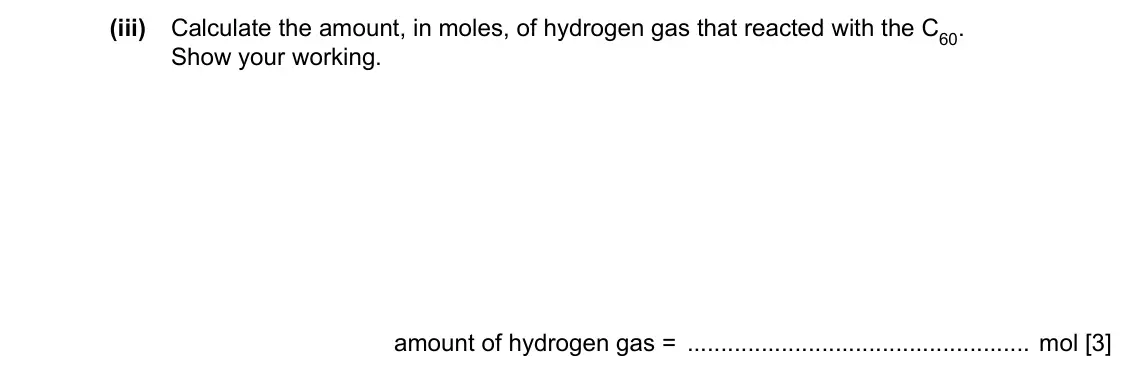
All 4 questions on The gaseous state: ideal and real gases and pV = nRT, as a list
- June 2024, Paper 1, Q7 (1 mark): What is the density of a sample of fluorine gas at 32 C and 100 000 Pa? Assume fluorine behaves as an ideal gas under these conditions. A 1.4 g dm–3 B 1.5 g dm
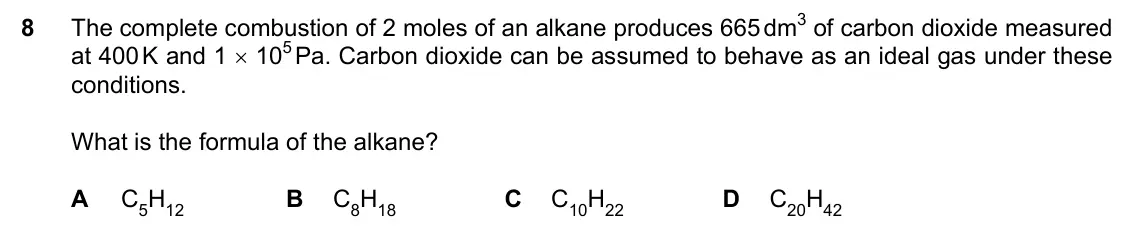
- Specimen, Paper 1, Q8 (1 mark): The complete combustion of 2 moles of an alkane produces 665 dm3 of carbon dioxide measured at 400 K and 1 × 10⁵ Pa. Carbon dioxide can be assumed to behave as
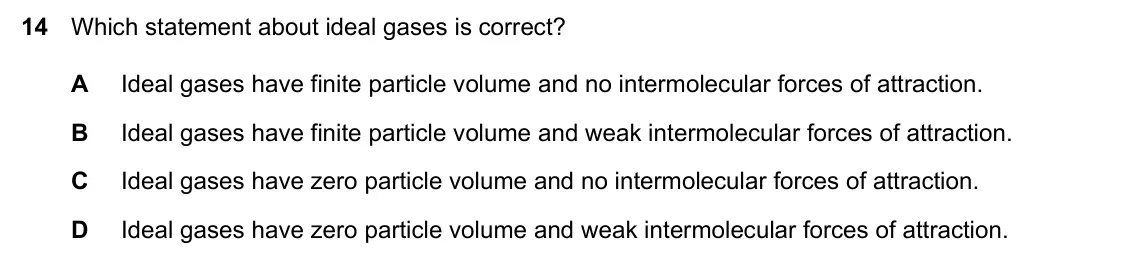
- Specimen, Paper 1, Q14 (1 mark): Which statement about ideal gases is correct? A Ideal gases have finite particle volume and no intermolecular forces of attraction. B Ideal gases have finite pa
- Specimen, Paper 2, Q2(c)(iii) (3 marks): Calculate the amount, in moles, of hydrogen gas that reacted with the C60. Show your working. amount of hydrogen gas = mol [3]
Questions, mark schemes and examiner’s reports are © Cambridge University Press & Assessment, from their published past papers. Plumi isn’t affiliated with any exam board. Want whole papers? Every CAIE A-Level Chemistry paper.
Rather write your answers by hand on iPad? Plumi marks them against the same mark schemes.