 plumi
Simple rate equations, orders of reaction and rate constants: CAIE A‑Level Chemistry questions
Every CAIE A-Level Chemistry exam question on 26.1 Simple rate equations, orders of reaction and rate constants, June 2024 and the specimen papers, with its mark scheme and examiner’s report.
Find questions312
Calculations
Q5(a)(i)
The whole paper ↗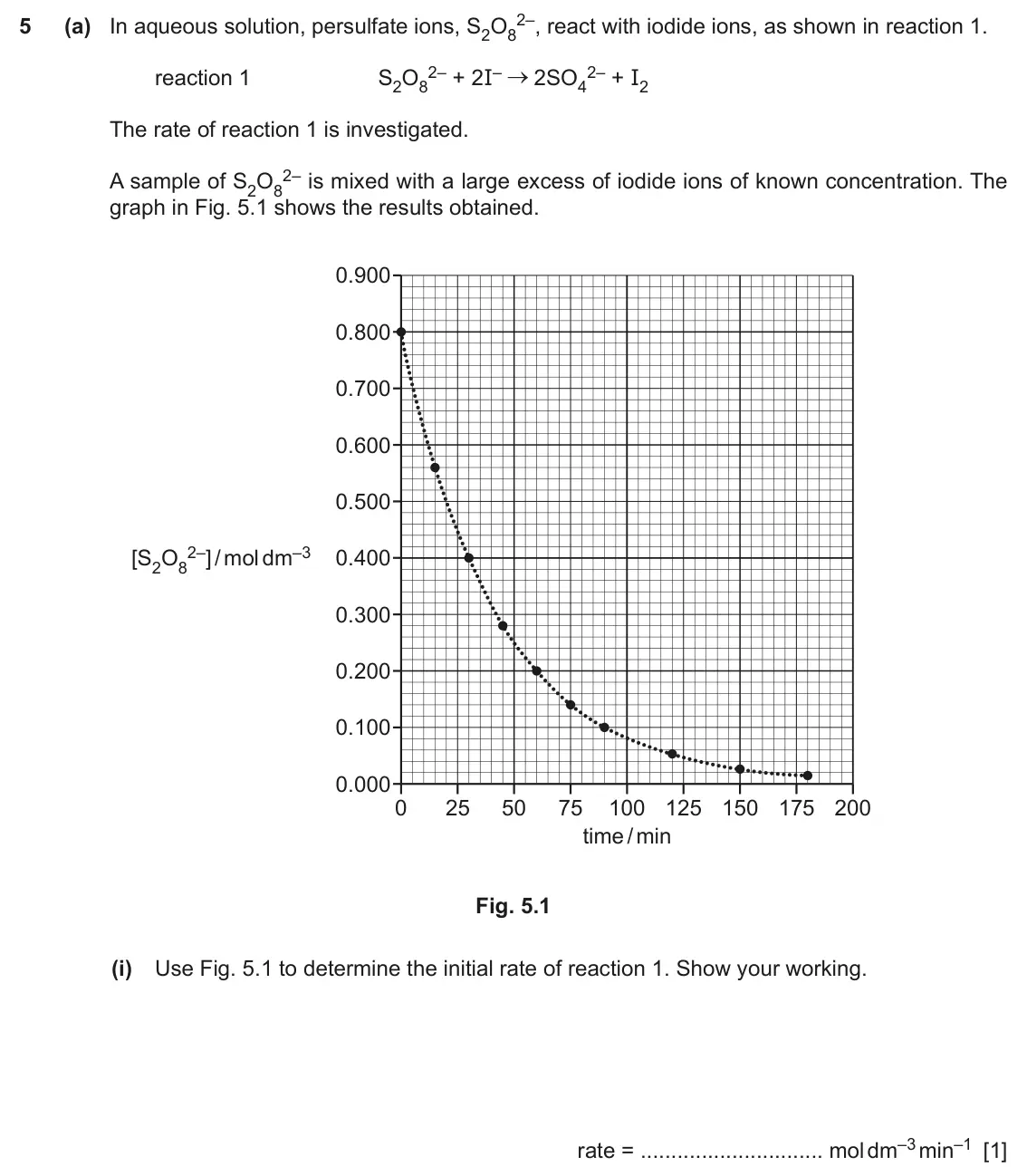
Q5(a)(ii)
The whole paper ↗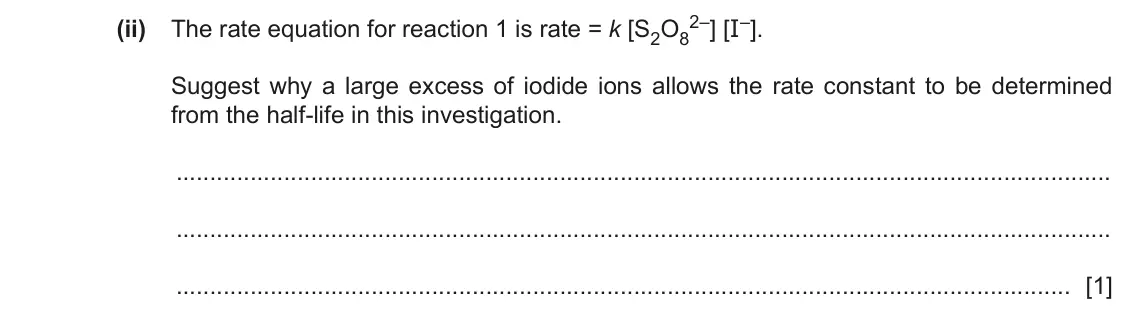
Q5(c)
The whole paper ↗
Q5(d)
The whole paper ↗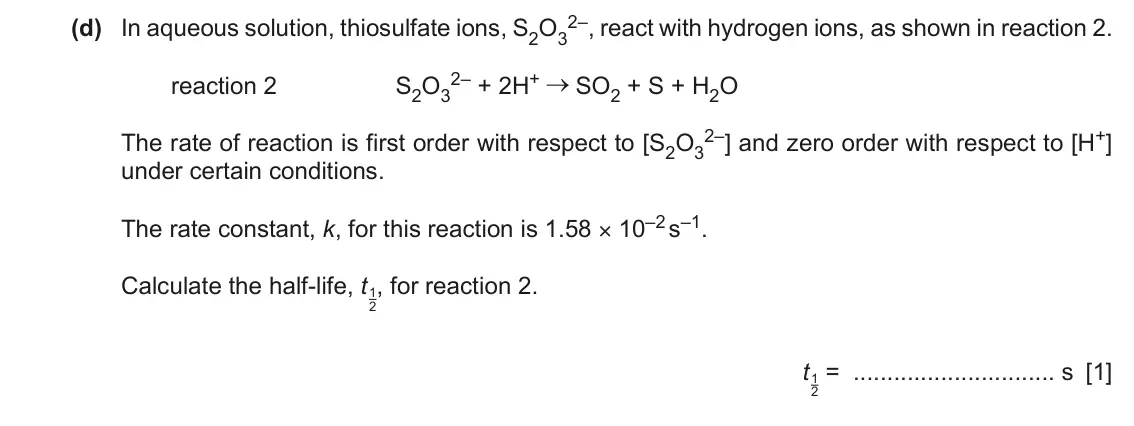
Q5(e)
The whole paper ↗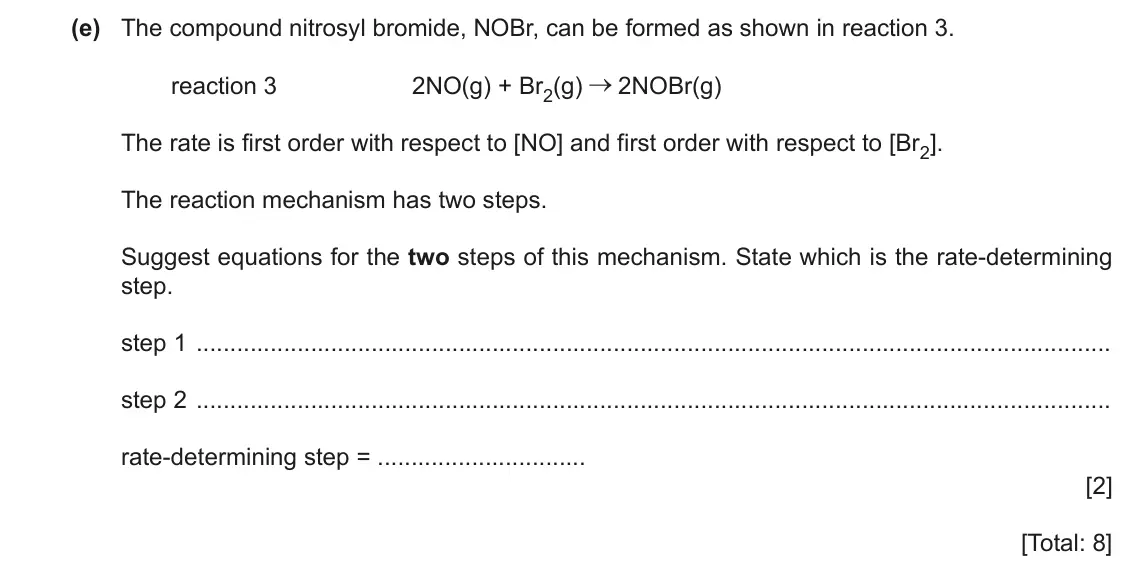
Q3(a)(i)
The whole paper ↗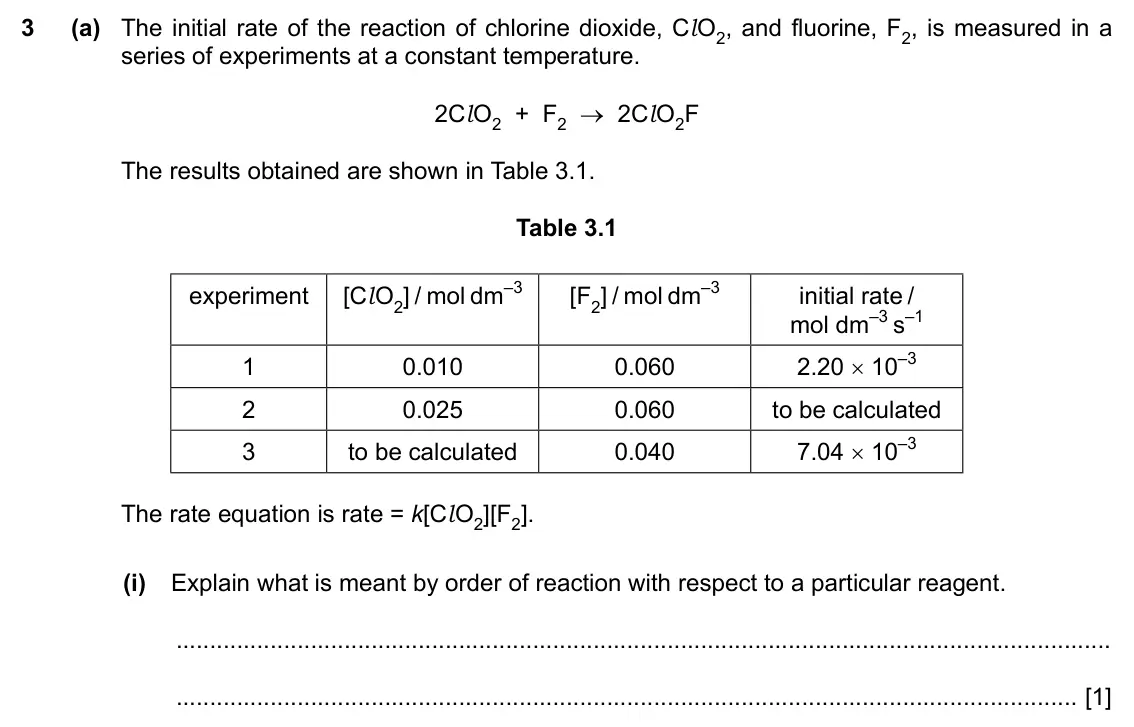
Q3(a)(ii)
The whole paper ↗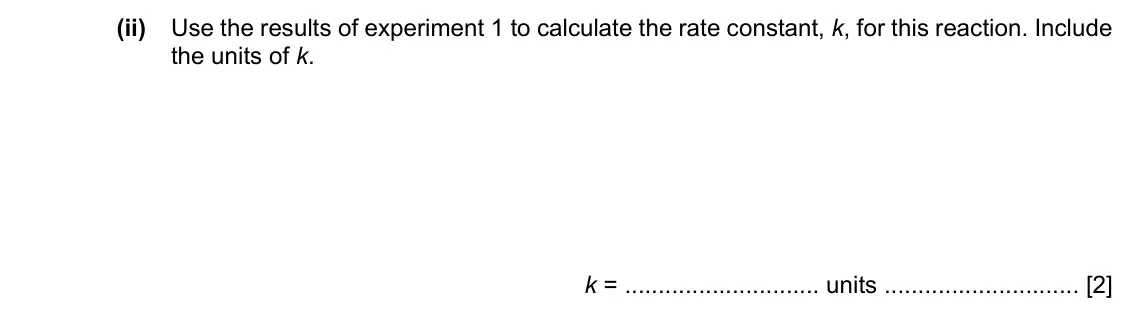
Q3(a)(iii)
The whole paper ↗
Q3(a)(iv)
The whole paper ↗
Q3(b)(i)
The whole paper ↗
Q3(b)(ii)
The whole paper ↗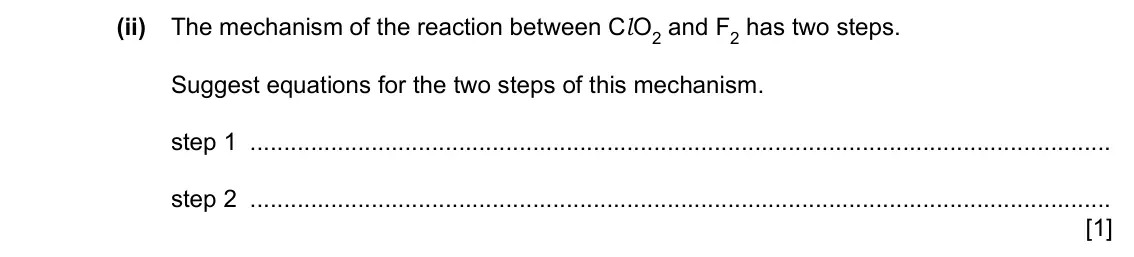
Q3(b)(iii)
The whole paper ↗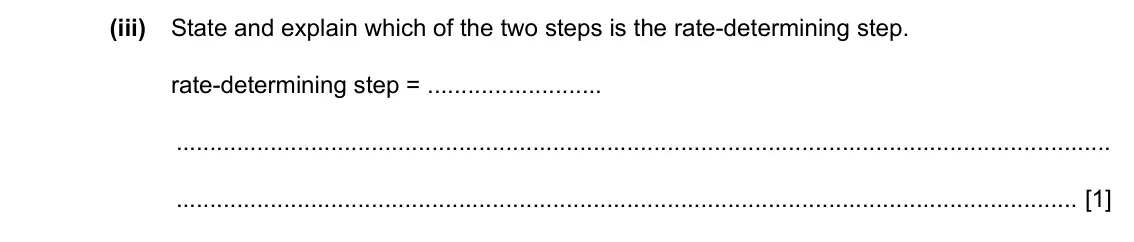
Q3(c)
The whole paper ↗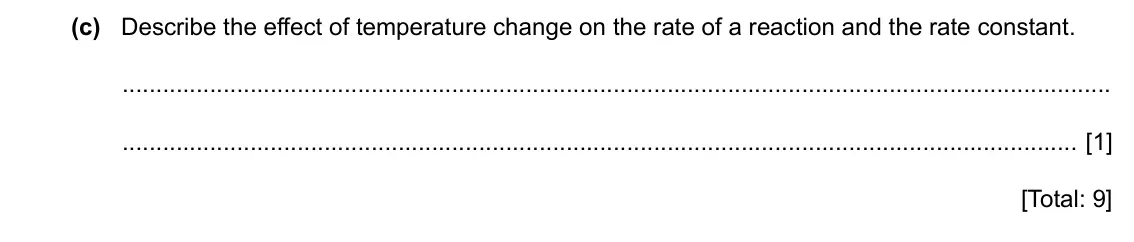
All 13 questions on Simple rate equations, orders of reaction and rate constants, as a list
- June 2024, Paper 4, Q5(a)(i) (1 mark): Use Fig. 5.1 to determine the initial rate of reaction 1. Show your working. rate = mol dm–3 min–1 [1]
- June 2024, Paper 4, Q5(a)(ii) (1 mark): The rate equation for reaction 1 is rate = k [S2O8 2–] [I–]. Suggest why a large excess of iodide ions allows the rate constant to be determined from the half-l
- June 2024, Paper 4, Q5(c) (1 mark): Describe the effect of an increase in temperature on the rate constant and the rate of reaction 1. [1]
- June 2024, Paper 4, Q5(d) (1 mark): In aqueous solution, thiosulfate ions, S2O3 2–, react with hydrogen ions, as shown in reaction 2. reaction 2 S2O3 2– + 2H+ SO2 + S + H2O The rate of reaction is
- June 2024, Paper 4, Q5(e) (2 marks): The compound nitrosyl bromide, NOBr, can be formed as shown in reaction 3. reaction 3 2NO(g) + Br2(g) 2NOBr(g) The rate is first order with respect to [NO] and
- Specimen, Paper 4, Q3(a)(i) (1 mark): Explain what is meant by order of reaction with respect to a particular reagent. [1]
- Specimen, Paper 4, Q3(a)(ii) (2 marks): Use the results of experiment 1 to calculate the rate constant, k, for this reaction. Include the units of k. k = units [2]
- Specimen, Paper 4, Q3(a)(iii) (1 mark): Use the data in Table 3.1 to calculate the initial rate in experiment 2. initial rate = mol dm–3 s–1 [1]
- Specimen, Paper 4, Q3(a)(iv) (1 mark): Use the data in Table 3.1 to calculate [Cl O2] in experiment 3. [Cl O2] = mol dm–3 [1]
- Specimen, Paper 4, Q3(b)(i) (1 mark): Explain what is meant by rate-determining step. [1]
- Specimen, Paper 4, Q3(b)(ii) (1 mark): The mechanism of the reaction between Cl O2 and F2 has two steps. Suggest equations for the two steps of this mechanism. step 1 step 2 [1]
- Specimen, Paper 4, Q3(b)(iii) (1 mark): State and explain which of the two steps is the rate-determining step. rate-determining step = [1]
- Specimen, Paper 4, Q3(c) (1 mark): Describe the effect of temperature change on the rate of a reaction and the rate constant. [1] [Total: 9]
Questions, mark schemes and examiner’s reports are © Cambridge University Press & Assessment, from their published past papers. Plumi isn’t affiliated with any exam board. Want whole papers? Every CAIE A-Level Chemistry paper.
Rather write your answers by hand on iPad? Plumi marks them against the same mark schemes.