 plumi
Redox processes: electron transfer and changes in oxidation number (oxidation state): CAIE A‑Level Chemistry questions
Every CAIE A-Level Chemistry exam question on 6.1 Redox processes: electron transfer and changes in oxidation number (oxidation state), June 2024 and the specimen papers, with its mark scheme and examiner’s report.
Find questions312
Calculations
Q1(h)
The whole paper ↗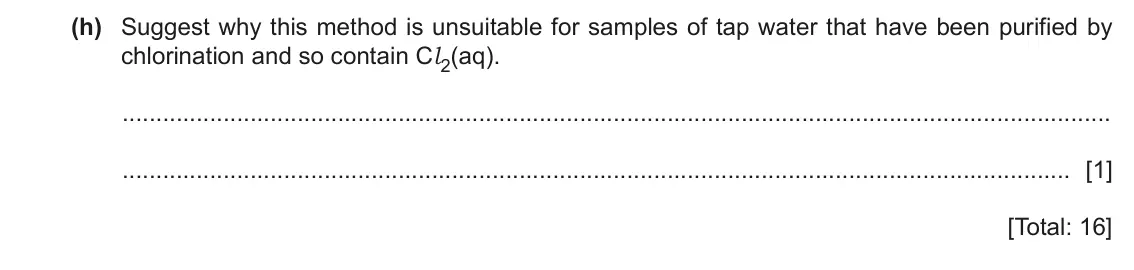
Q2(c)(i)
The whole paper ↗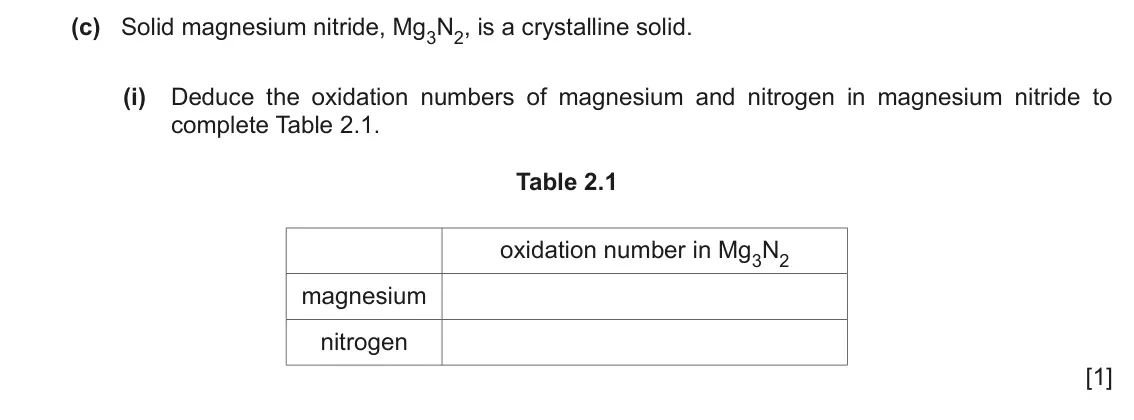
Q3(c)(ii)
The whole paper ↗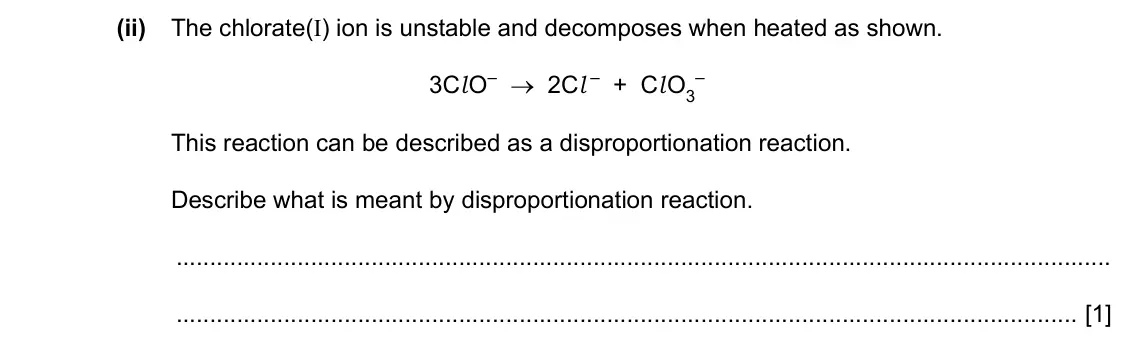
Q3(c)(iii)
The whole paper ↗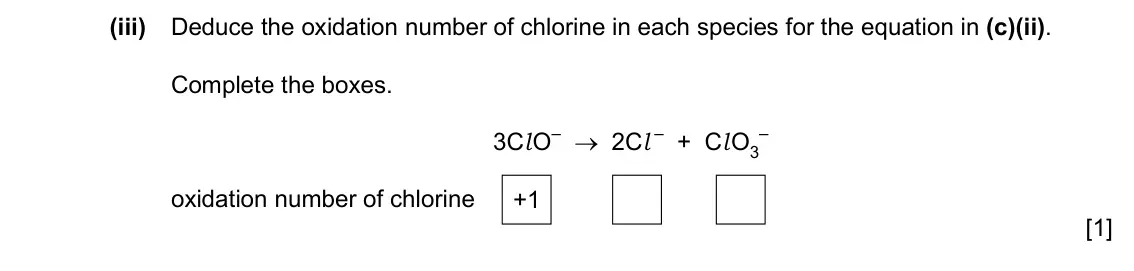
All 8 questions on Redox processes: electron transfer and changes in oxidation number (oxidation state), as a list
- June 2024, Paper 5, Q1(h) (1 mark): Suggest why this method is unsuitable for samples of tap water that have been purified by chlorination and so contain Cl2(aq). [1] [Total: 16]
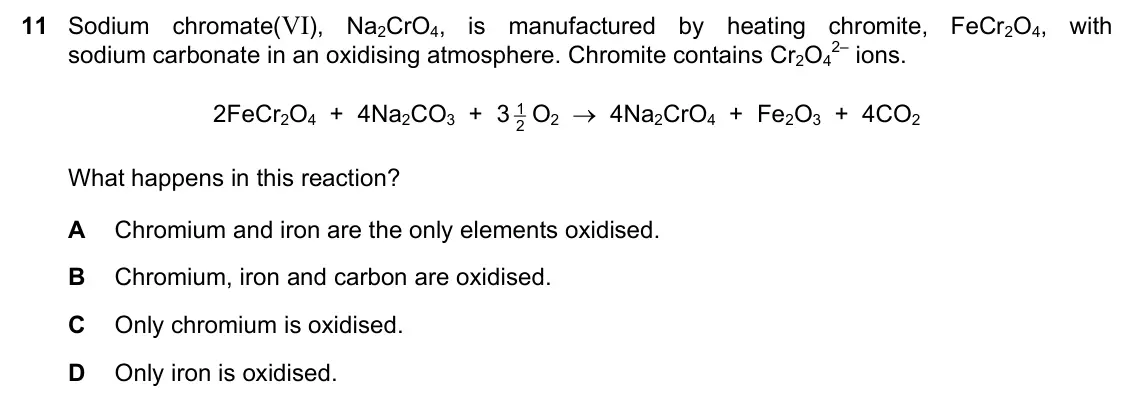
- June 2024, Paper 1, Q11 (1 mark): Sodium chromate(VI), Na2CrO4, is manufactured by heating chromite, FeCr2O4, with sodium carbonate in an oxidising atmosphere. Chromite contains Cr2O4 2– ions. 1
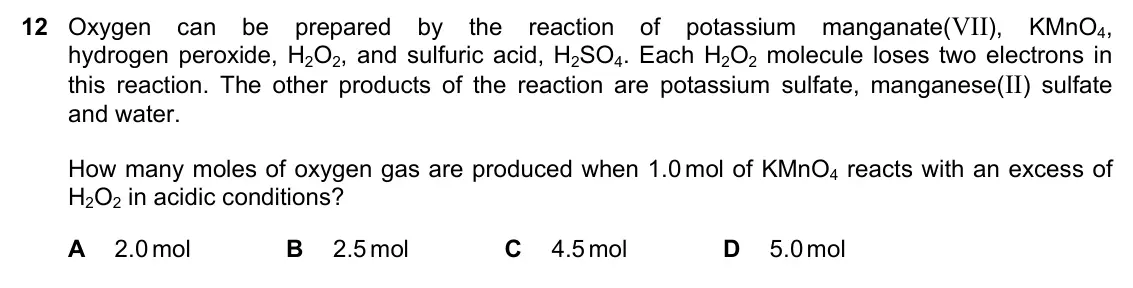
- June 2024, Paper 1, Q12 (1 mark): Oxygen can be prepared by the reaction of potassium manganate(VII), KMnO4, hydrogen peroxide, H2O2, and sulfuric acid, H2SO4. Each H2O2 molecule loses two elect
- June 2024, Paper 2, Q2(c)(i) (1 mark): Deduce the oxidation numbers of magnesium and nitrogen in magnesium nitride to complete Table 2.1. Table 2.1 oxidation number in Mg3N2 magnesium nitrogen [1]
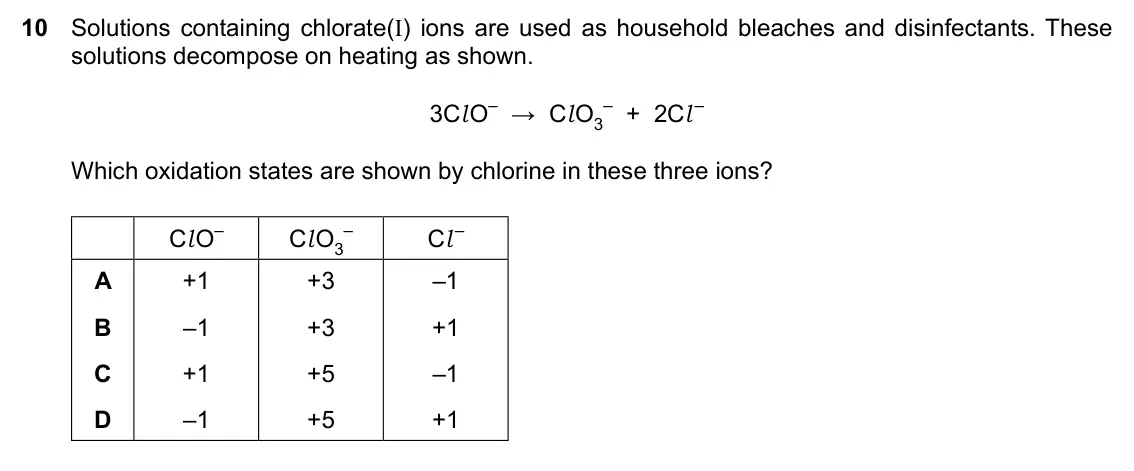
- Specimen, Paper 1, Q10 (1 mark): Solutions containing chlorate(I) ions are used as household bleaches and disinfectants. These solutions decompose on heating as shown. 3Cl O– → Cl O3 – + 2Cl –
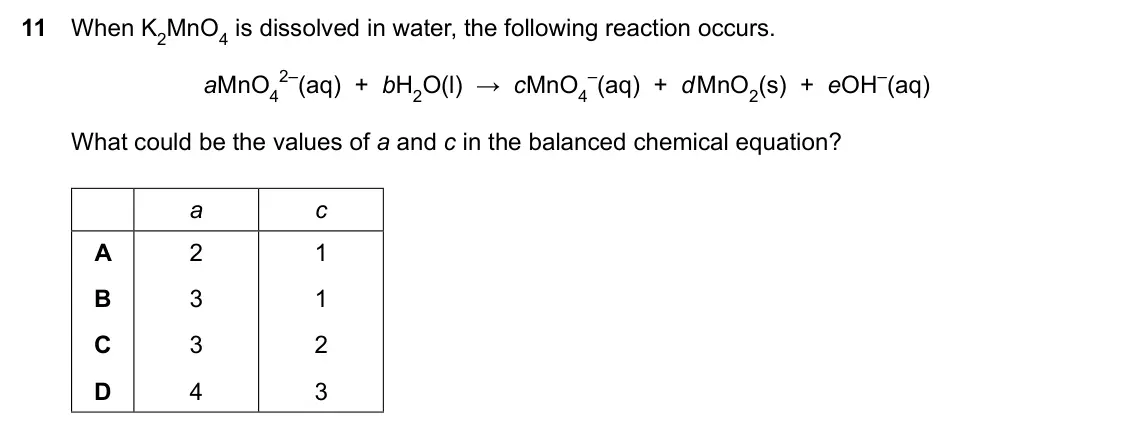
- Specimen, Paper 1, Q11 (1 mark): When K2MnO4 is dissolved in water, the following reaction occurs. aMnO4 2–(aq) + bH2O(l) → cMnO4 –(aq) + d MnO2(s) + eOH–(aq) What could be the values of a and
- Specimen, Paper 2, Q3(c)(ii) (1 mark): The chlorate(I) ion is unstable and decomposes when heated as shown. 3Cl O– → 2Cl – + Cl O3 – This reaction can be described as a disproportionation reaction. D
- Specimen, Paper 2, Q3(c)(iii) (1 mark): Deduce the oxidation number of chlorine in each species for the equation in (c)(ii). Complete the boxes. 3Cl O– → 2Cl – + Cl O3 – oxidation number of chlorine +
Questions, mark schemes and examiner’s reports are © Cambridge University Press & Assessment, from their published past papers. Plumi isn’t affiliated with any exam board. Want whole papers? Every CAIE A-Level Chemistry paper.
Rather write your answers by hand on iPad? Plumi marks them against the same mark schemes.