 plumi
Reacting masses and volumes (of solutions and gases): CAIE A‑Level Chemistry questions
Every CAIE A-Level Chemistry exam question on 2.4 Reacting masses and volumes (of solutions and gases), June 2024 and the specimen papers, with its mark scheme and examiner’s report.
Find questions312
Calculations
Q1(a)(i)
The whole paper ↗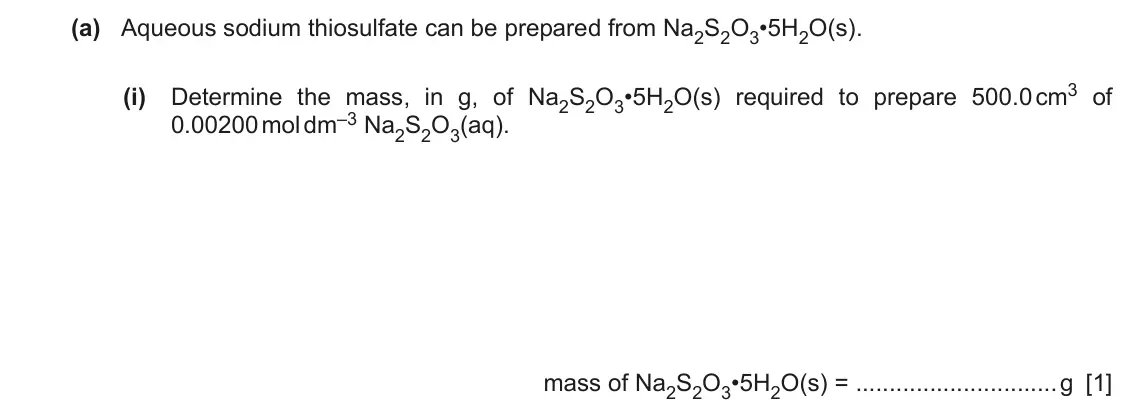
Q1(a)(ii)
The whole paper ↗
Q1(b)(i)
The whole paper ↗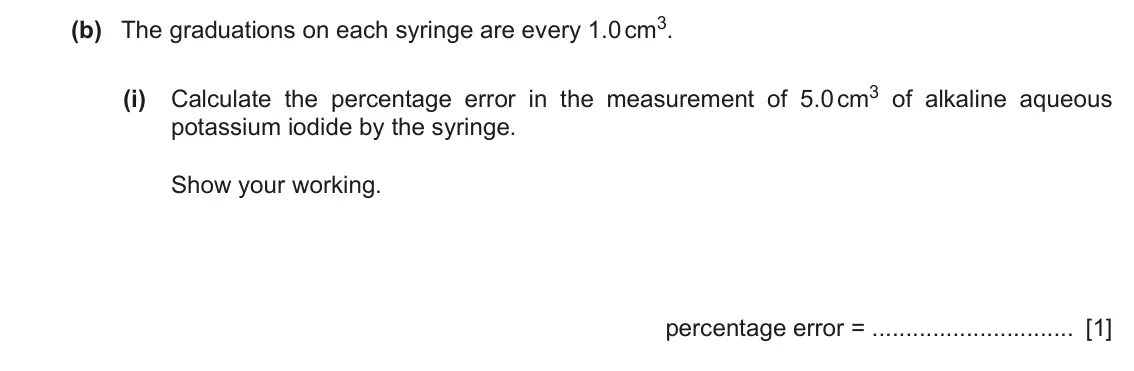
Q1(b)(ii)
The whole paper ↗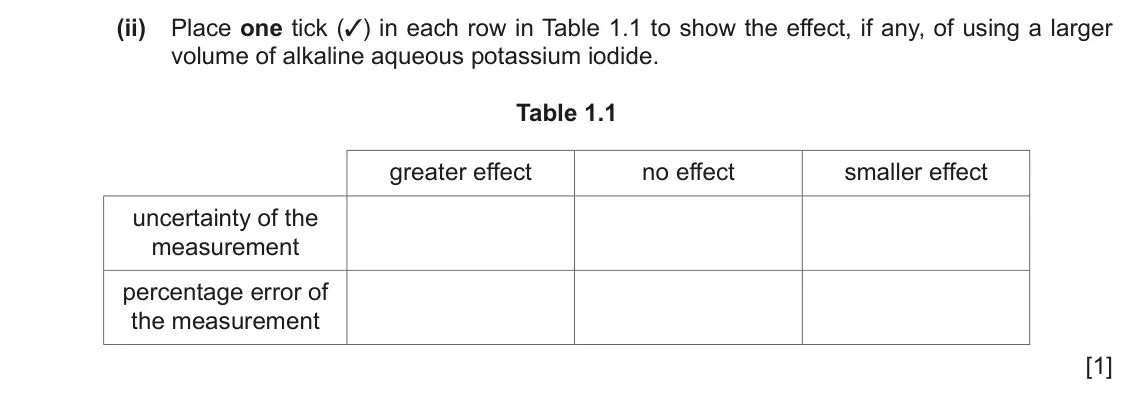
Q1(c)(i)
The whole paper ↗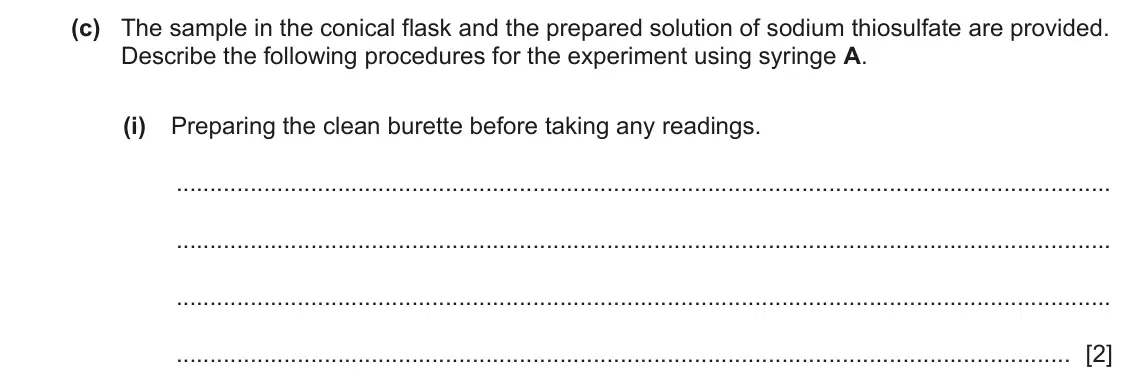
Q1(c)(ii)
The whole paper ↗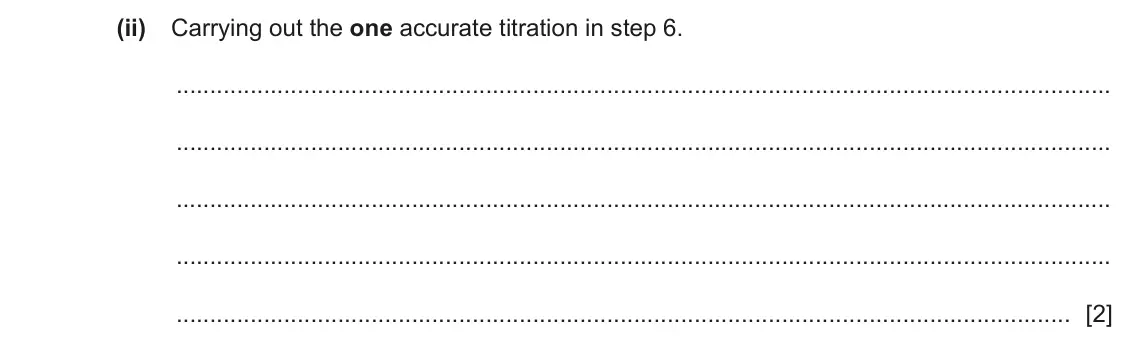
Q1(d)
The whole paper ↗
Q1(e)
The whole paper ↗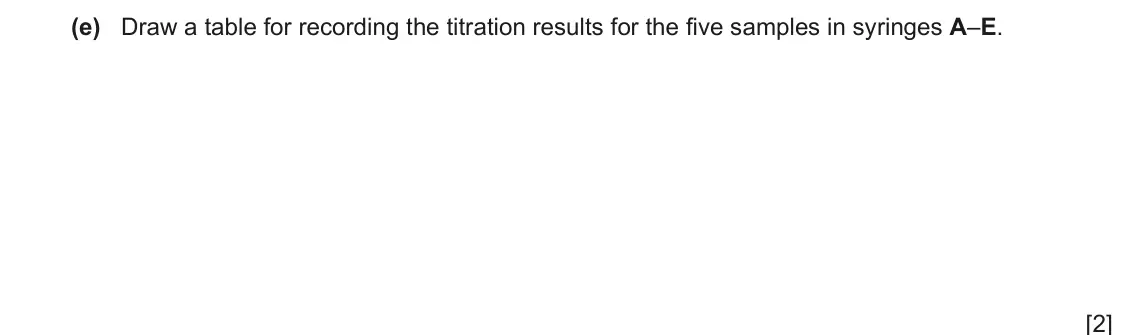
Q1(f)
The whole paper ↗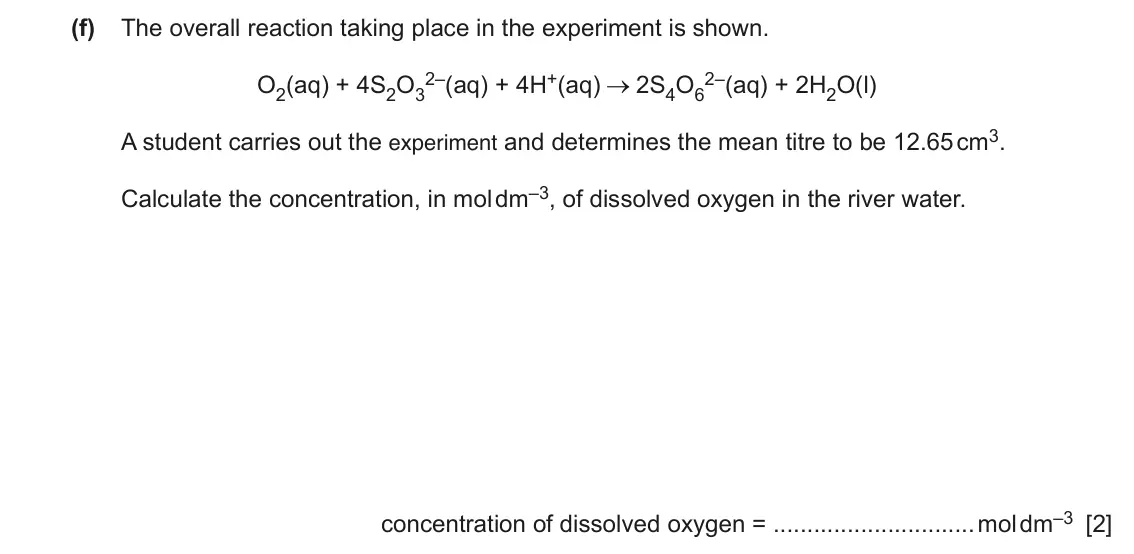
Q1(g)(i)
The whole paper ↗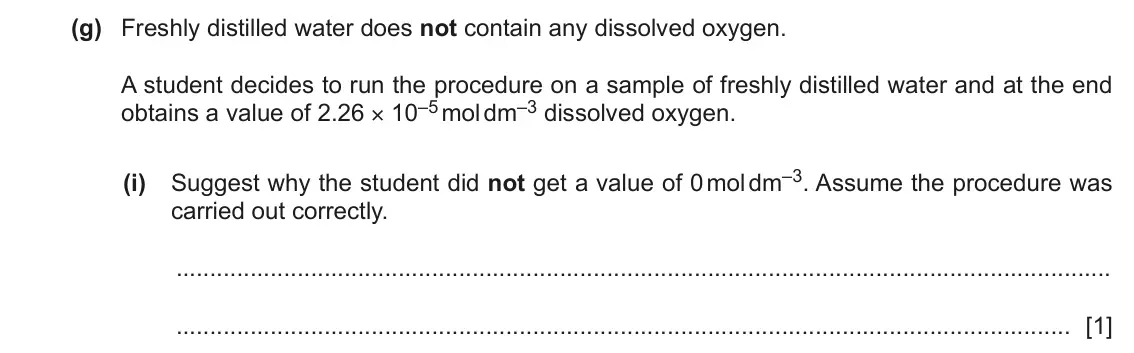
Q1(g)(ii)
The whole paper ↗

Q6(c)(iii)
The whole paper ↗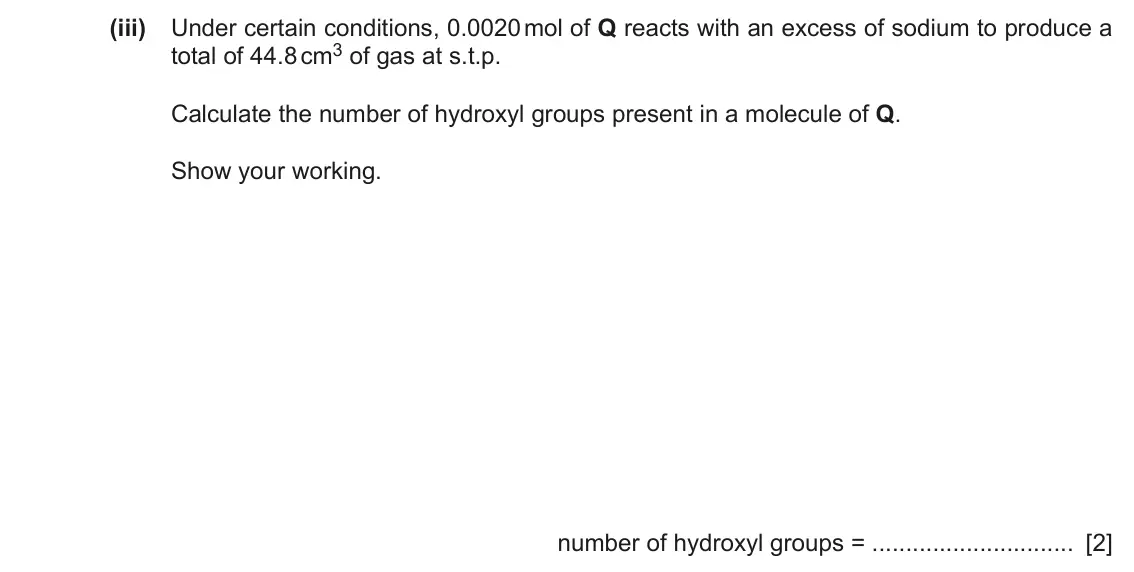
Q1(a)(i)
The whole paper ↗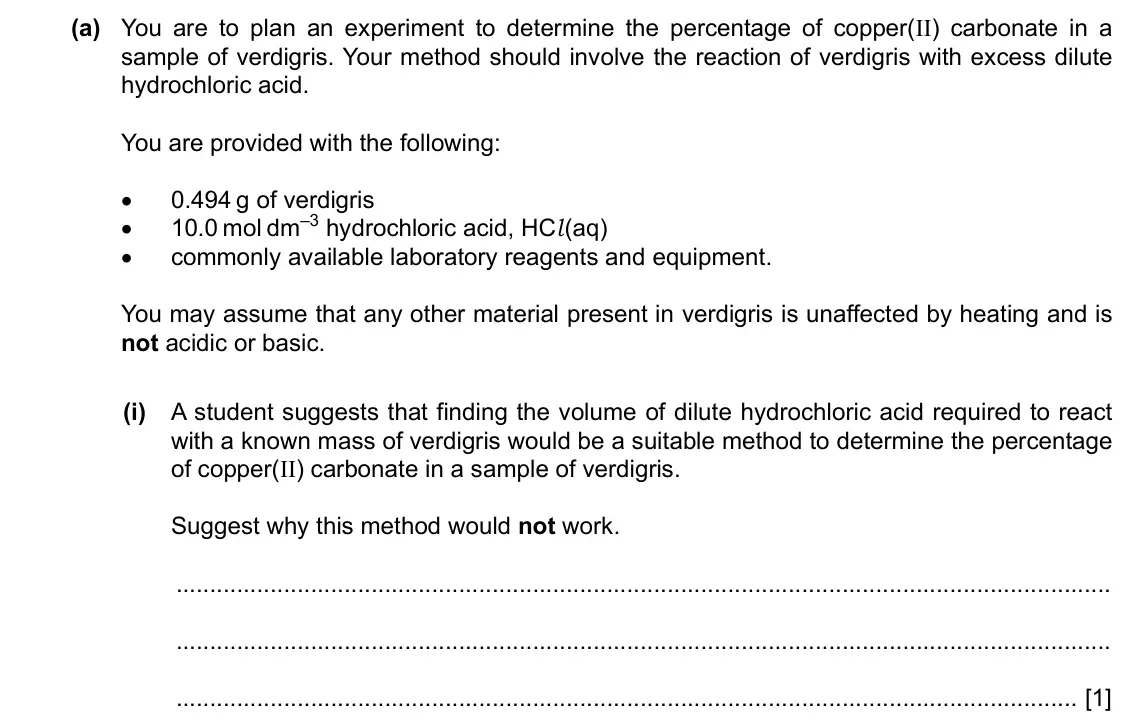
Q1(a)(ii)
The whole paper ↗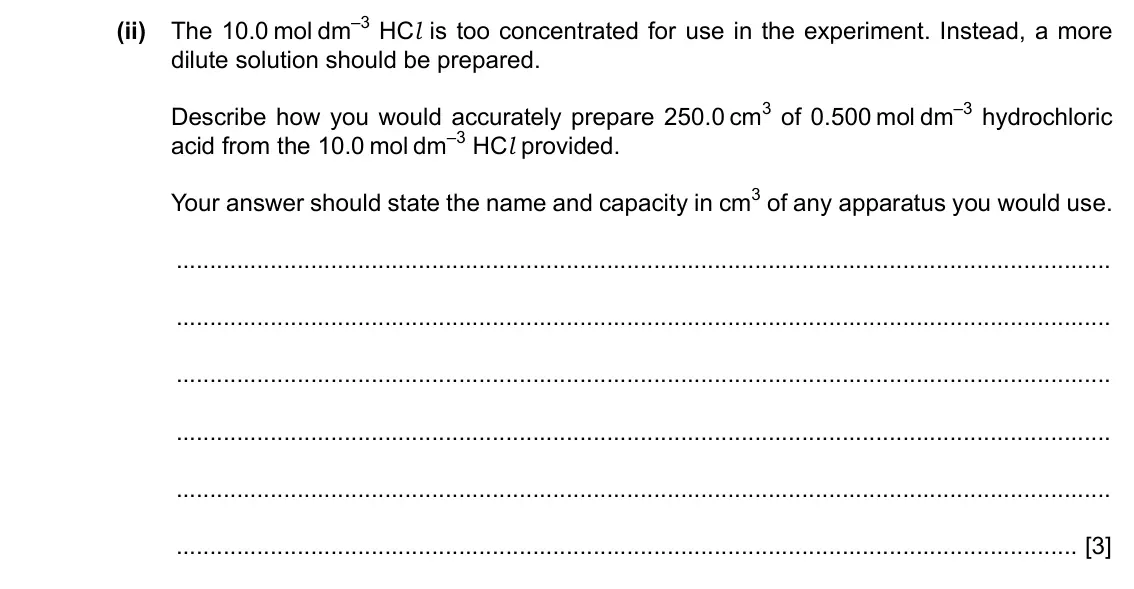
Q1(a)(iii)
The whole paper ↗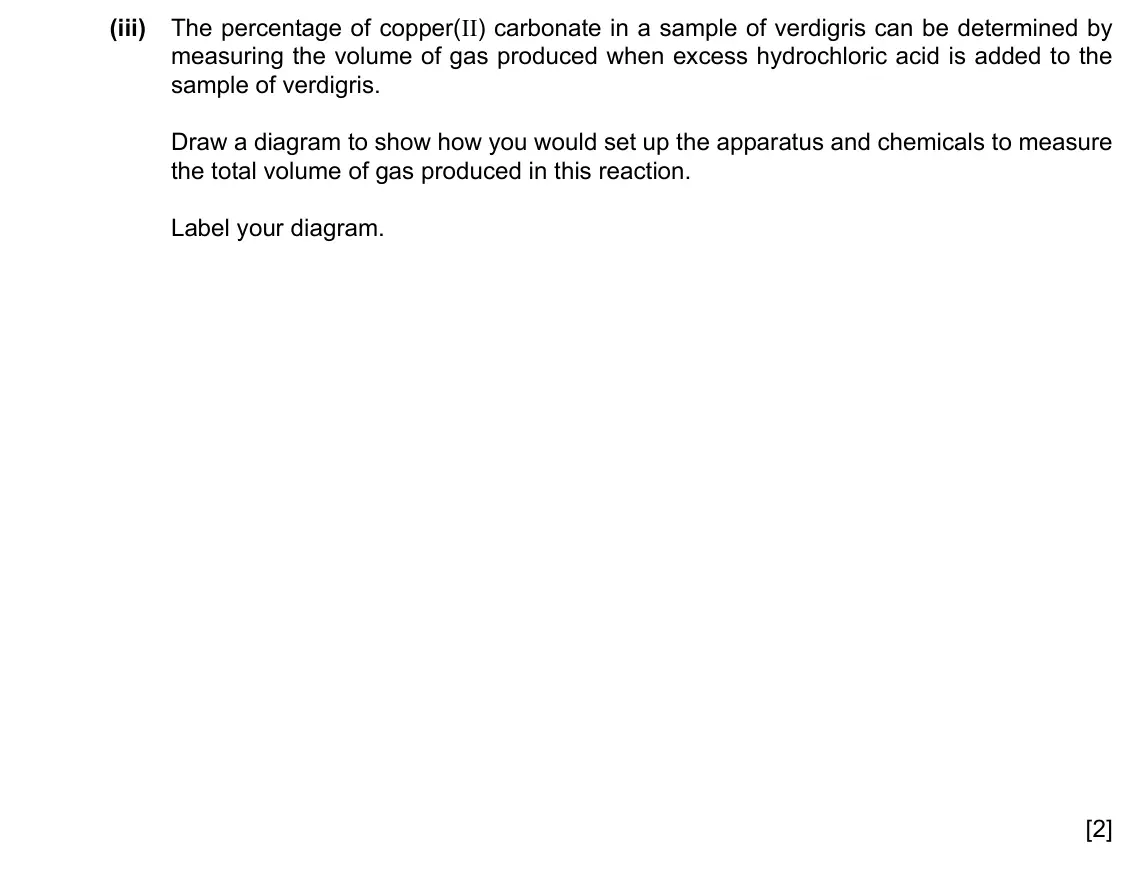
Q1(a)(iv)
The whole paper ↗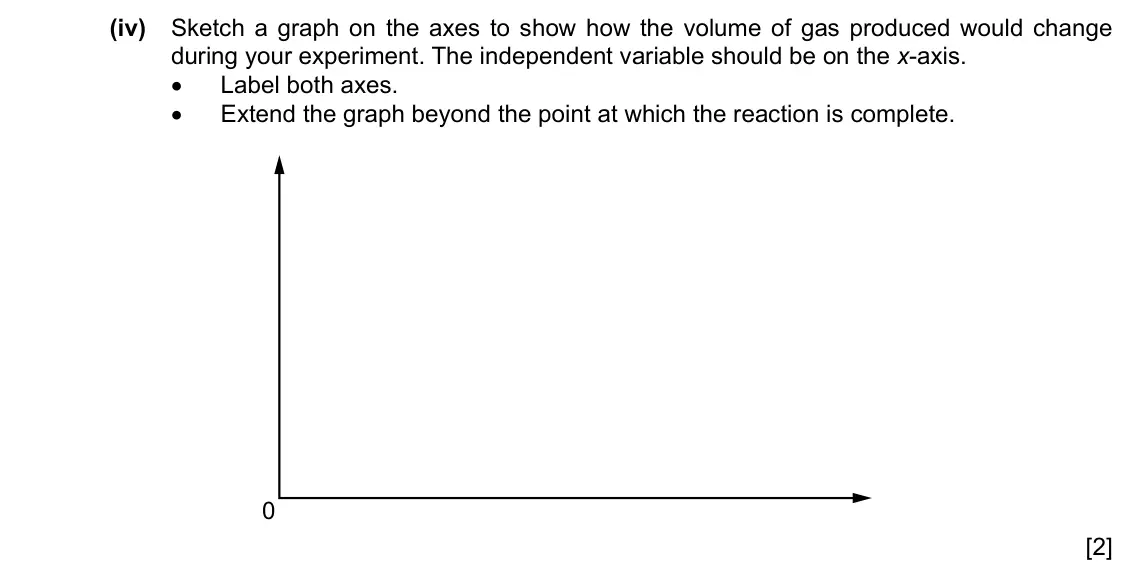
Q1(a)(v)
The whole paper ↗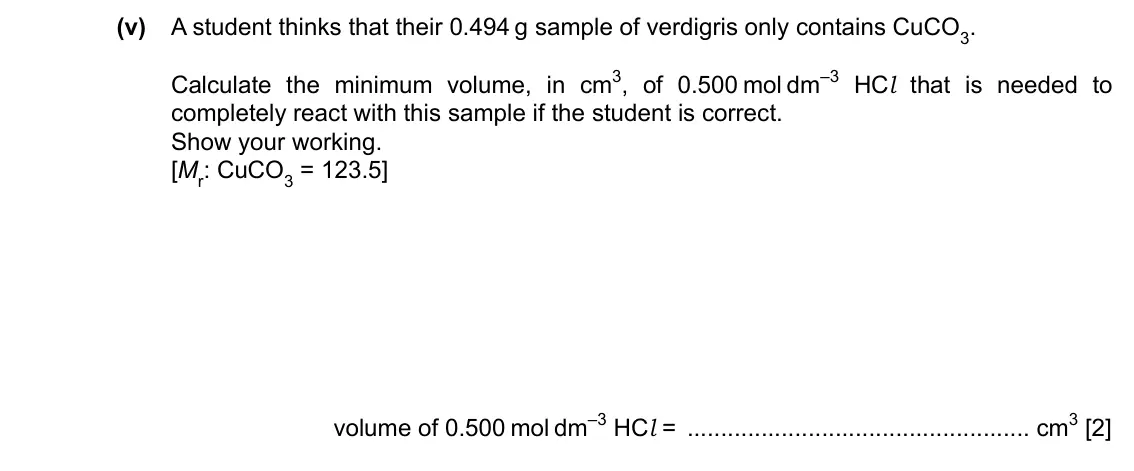
All 26 questions on Reacting masses and volumes (of solutions and gases), as a list
- June 2024, Paper 5, Q1(a)(i) (1 mark): Determine the mass, in g, of Na2S2O3•5H2O(s) required to prepare 500.0 cm3 of 0.00200 mol dm–3 Na2S2O3(aq). mass of Na2S2O3•5H2O(s) = g [1]
- June 2024, Paper 5, Q1(a)(ii) (1 mark): Identify the piece of apparatus that should be used to prepare 500.0 cm3 of 0.00200 mol dm–3 Na2S2O3(aq) after the required mass of Na2S2O3•5H2O(s) has been wei
- June 2024, Paper 5, Q1(b)(i) (1 mark): Calculate the percentage error in the measurement of 5.0 cm3 of alkaline aqueous potassium iodide by the syringe. Show your working. percentage error = [1]
- June 2024, Paper 5, Q1(b)(ii) (1 mark): Place one tick (✓) in each row in Table 1.1 to show the effect, if any, of using a larger volume of alkaline aqueous potassium iodide. Table 1.1 greater effect
- June 2024, Paper 5, Q1(c)(i) (2 marks): Preparing the clean burette before taking any readings. [2]
- June 2024, Paper 5, Q1(c)(ii) (2 marks): Carrying out the one accurate titration in step 6. [2]
- June 2024, Paper 5, Q1(d) (1 mark): Suggest why the reaction mixture is mixed well in steps 2–4. [1]
- June 2024, Paper 5, Q1(e) (2 marks): Draw a table for recording the titration results for the five samples in syringes A–E. [2]
- June 2024, Paper 5, Q1(f) (2 marks): The overall reaction taking place in the experiment is shown. O2(aq) + 4S2O3 2–(aq) + 4H+(aq) 2S4O6 2–(aq) + 2H2O(l) A student carries out the experiment and de
- June 2024, Paper 5, Q1(g)(i) (1 mark): Suggest why the student did not get a value of 0 mol dm–3. Assume the procedure was carried out correctly. [1]
- June 2024, Paper 5, Q1(g)(ii) (1 mark): Suggest how the value of 2.26 × 10⁻⁵ mol dm–3 could be used to improve the answer in (f). [1]
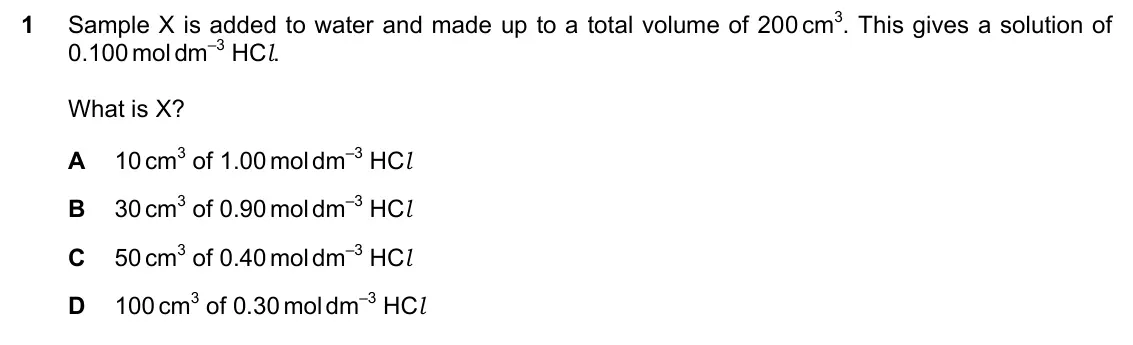
- June 2024, Paper 1, Q1 (1 mark): Sample X is added to water and made up to a total volume of 200 cm3. This gives a solution of 0.100 mol dm–3 HCl. What is X? A 10 cm3 of 1.00 mol dm–3 HCl B 30
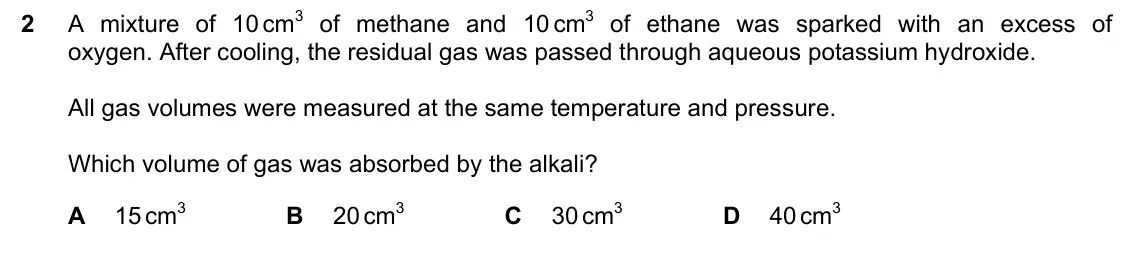
- June 2024, Paper 1, Q2 (1 mark): A mixture of 10 cm3 of methane and 10 cm3 of ethane was sparked with an excess of oxygen. After cooling, the residual gas was passed through aqueous potassium h
- June 2024, Paper 1, Q20 (1 mark): What is the total volume of gas produced, measured at room conditions, when 0.010 mol of anhydrous magnesium nitrate is completely decomposed by heating? A 240
- June 2024, Paper 2, Q6(c)(iii) (2 marks): Under certain conditions, 0.0020 mol of Q reacts with an excess of sodium to produce a total of 44.8 cm3 of gas at s.t.p. Calculate the number of hydroxyl group
- Specimen, Paper 5, Q1(a)(i) (1 mark): A student suggests that finding the volume of dilute hydrochloric acid required to react with a known mass of verdigris would be a suitable method to determine
- Specimen, Paper 5, Q1(a)(ii) (3 marks): The 10.0 mol dm–3 HCl is too concentrated for use in the experiment. Instead, a more dilute solution should be prepared. Describe how you would accurately prepa
- Specimen, Paper 5, Q1(a)(iii) (2 marks): The percentage of copper(II) carbonate in a sample of verdigris can be determined by measuring the volume of gas produced when excess hydrochloric acid is added
- Specimen, Paper 5, Q1(a)(iv) (2 marks): Sketch a graph on the axes to show how the volume of gas produced would change during your experiment. The independent variable should be on the x-axis. • Label
- Specimen, Paper 5, Q1(a)(v) (2 marks): A student thinks that their 0.494 g sample of verdigris only contains CuCO3. Calculate the minimum volume, in cm3, of 0.500 mol dm–3 HCl that is needed to compl
- Specimen, Paper 5, Q1(b)(i) (1 mark): Complete Table 1.1. [1]
- Specimen, Paper 5, Q1(b)(ii) (1 mark): Calculate the percentage uncertainty in titre 1. [1]
- Specimen, Paper 5, Q1(b)(iii) (3 marks): The student concludes that 24.15 cm3 of 0.400 mol dm–3 sulfuric acid completely reacts with 1.50 g of azurite. Calculate the percentage by mass of Cu3(CO3)2(OH)
- Specimen, Paper 5, Q1(b)(iv) (4 marks): Identify two possible problems with the student’s titration experiment and suggest improvements to it. problem 1 improvement 1 problem 2 improvement 2 [4] [Tota
- Specimen, Paper 1, Q33 (1 mark): A sample of 2.30 g of ethanol is mixed with an excess of aqueous acidified potassium dichromate(VI). The reaction mixture is then boiled under reflux for one ho
- Specimen, Paper 2, Q2(c)(ii) (1 mark): Calculate the amount, in moles, of C60 that reacts. amount of C60 = mol [1]
Questions, mark schemes and examiner’s reports are © Cambridge University Press & Assessment, from their published past papers. Plumi isn’t affiliated with any exam board. Want whole papers? Every CAIE A-Level Chemistry paper.
Rather write your answers by hand on iPad? Plumi marks them against the same mark schemes.