 plumi
Lattice energy and Born-Haber cycles: CAIE A‑Level Chemistry questions
Every CAIE A-Level Chemistry exam question on 23.1 Lattice energy and Born-Haber cycles, June 2024 and the specimen papers, with its mark scheme and examiner’s report.
Find questions312
Calculations
Q4(e)
The whole paper ↗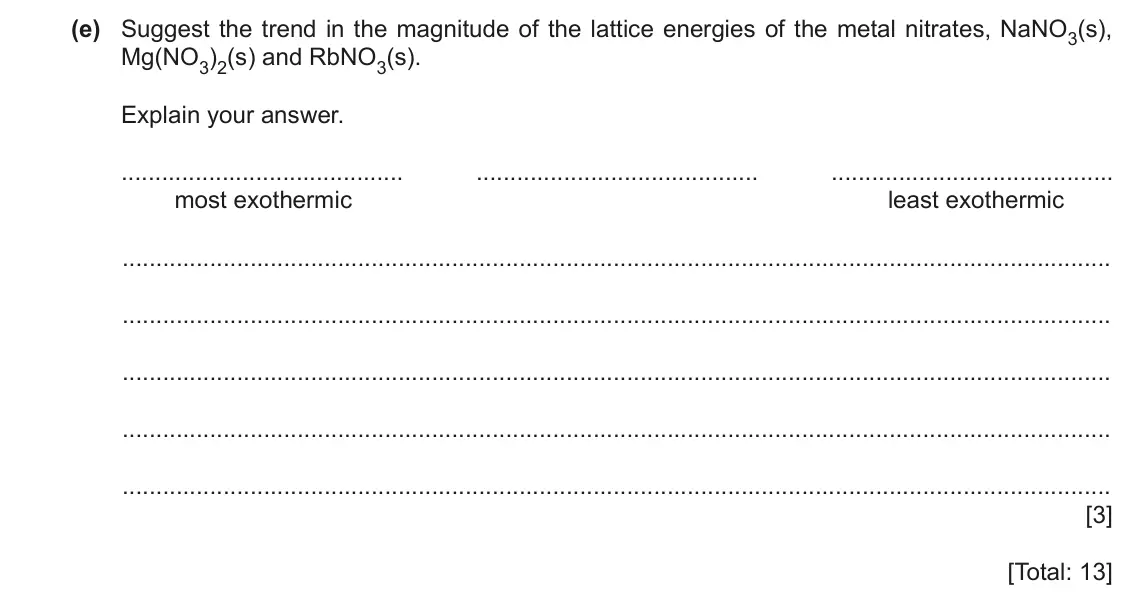
Q5(a)(i)
The whole paper ↗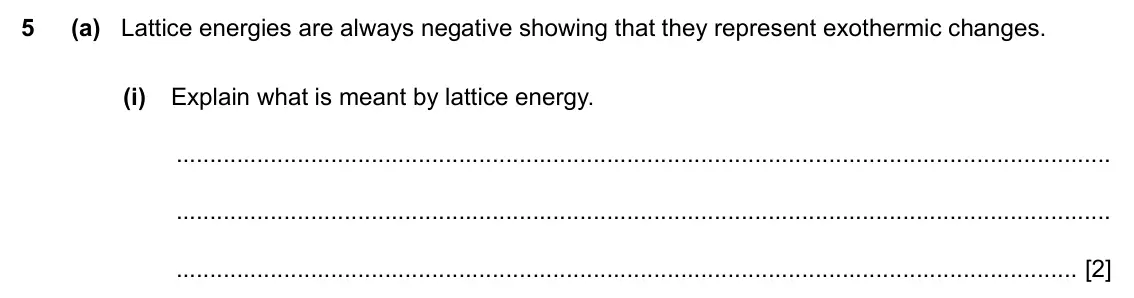
Q5(a)(ii)
The whole paper ↗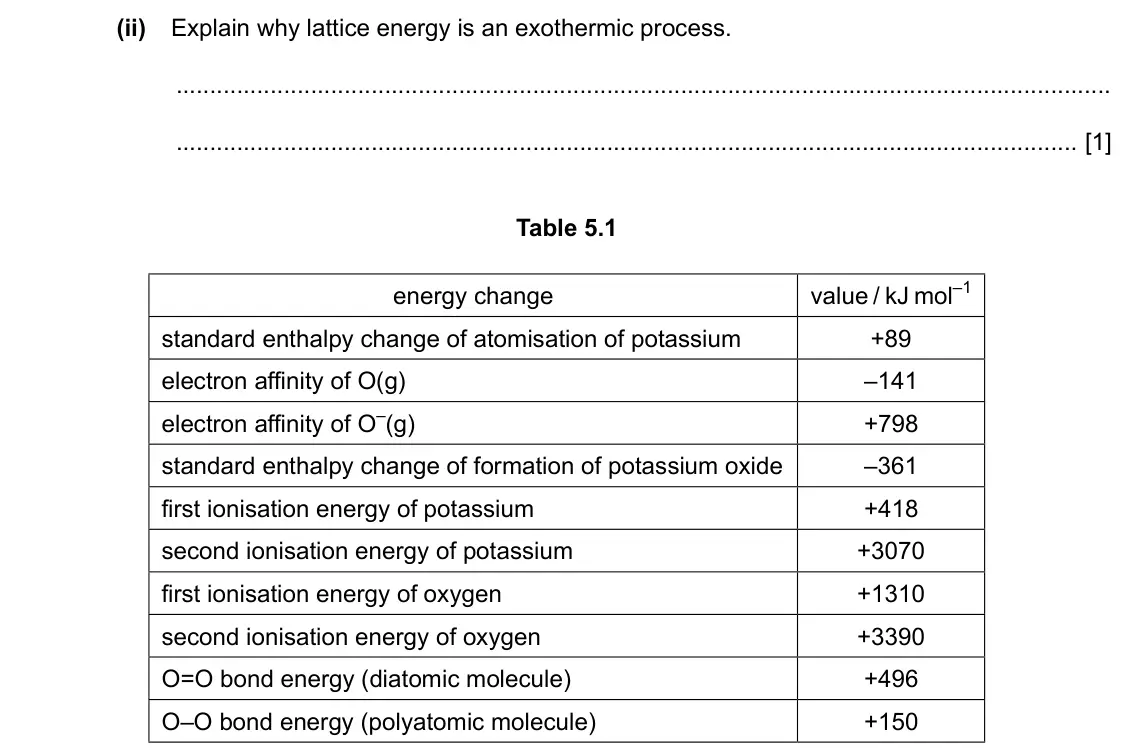
Q5(b)(i)
The whole paper ↗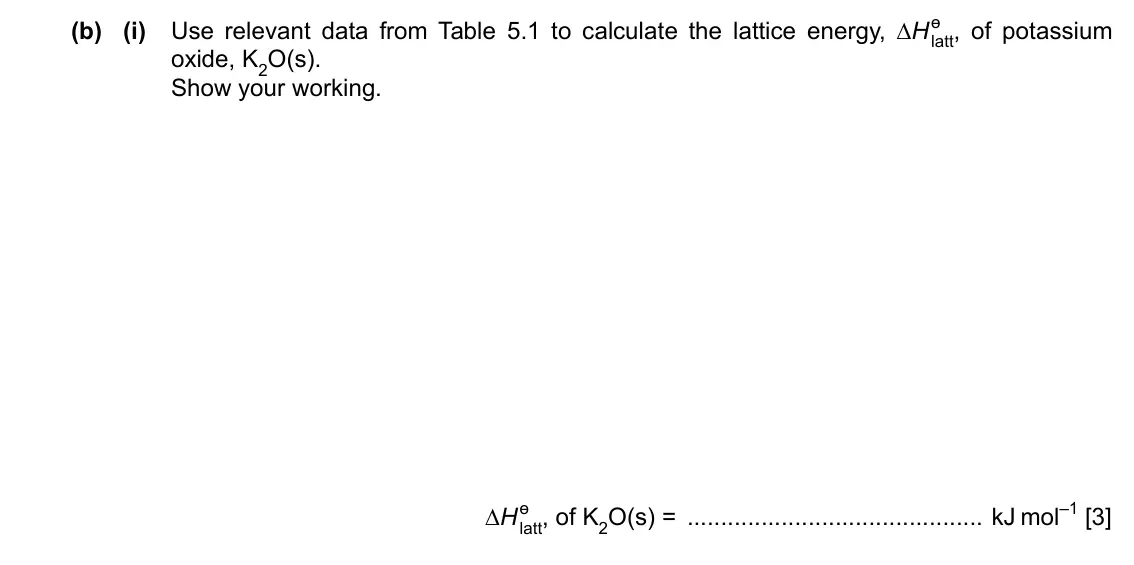
Q5(b)(ii)
The whole paper ↗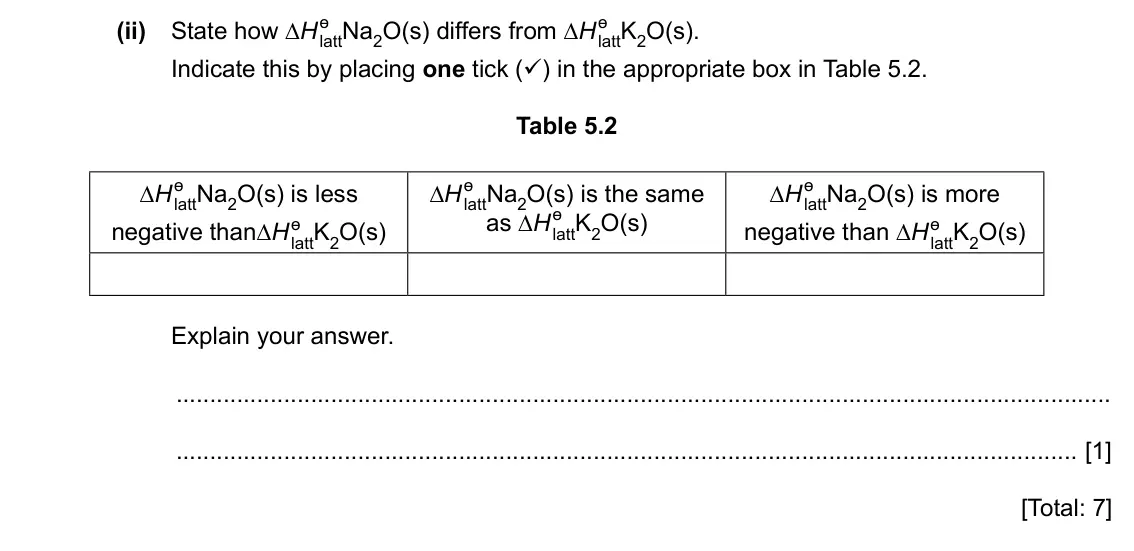
All 5 questions on Lattice energy and Born-Haber cycles, as a list
- June 2024, Paper 4, Q4(e) (3 marks): Suggest the trend in the magnitude of the lattice energies of the metal nitrates, NaNO3(s), Mg(NO3)2(s) and RbNO3(s). Explain your answer. most exothermic least
- Specimen, Paper 4, Q5(a)(i) (2 marks): Explain what is meant by lattice energy. [2]
- Specimen, Paper 4, Q5(a)(ii) (1 mark): Explain why lattice energy is an exothermic process. [1] Table 5.1 energy change value / kJ mol–1 standard enthalpy change of atomisation of potassium +89 elect
- Specimen, Paper 4, Q5(b)(i) (3 marks): Use relevant data from Table 5.1 to calculate the lattice energy, ∆H ɵ latt, of potassium oxide, K2O(s). Show your working. ∆H ɵ latt, of K2O(s) = kJ mol–1 [3]
- Specimen, Paper 4, Q5(b)(ii) (1 mark): State how ∆H ɵ lattNa2O(s) differs from ∆H ɵ lattK2O(s). Indicate this by placing one tick () in the appropriate box in Table 5.2. Table 5.2 ∆H ɵ lattNa2O(s) i
Questions, mark schemes and examiner’s reports are © Cambridge University Press & Assessment, from their published past papers. Plumi isn’t affiliated with any exam board. Want whole papers? Every CAIE A-Level Chemistry paper.
Rather write your answers by hand on iPad? Plumi marks them against the same mark schemes.