 plumi
Colour of complexes: CAIE A‑Level Chemistry questions
Every CAIE A-Level Chemistry exam question on 28.3 Colour of complexes, June 2024 and the specimen papers, with its mark scheme and examiner’s report.
Find questions312
Calculations
Q2(b)(i)
The whole paper ↗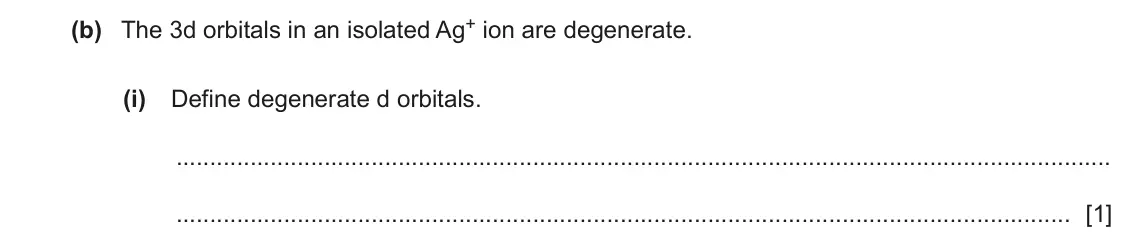
Q3(c)
The whole paper ↗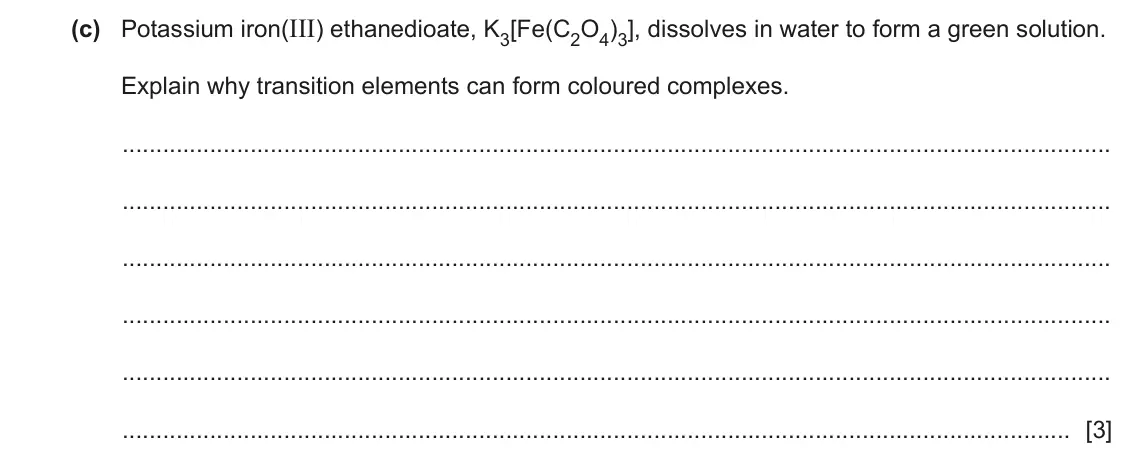
Q6(c)(ii)
The whole paper ↗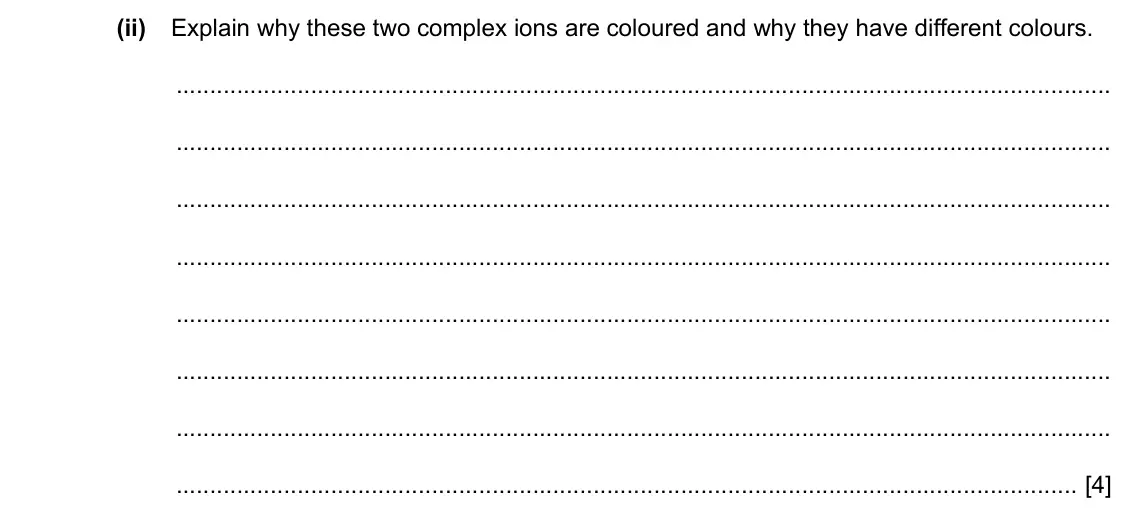
All 3 questions on Colour of complexes, as a list
- June 2024, Paper 4, Q2(b)(i) (1 mark): Define degenerate d orbitals. [1]
- June 2024, Paper 4, Q3(c) (3 marks): Potassium iron(III) ethanedioate, K3[Fe(C2O4)3], dissolves in water to form a green solution. Explain why transition elements can form coloured complexes. [3]
- Specimen, Paper 4, Q6(c)(ii) (4 marks): Explain why these two complex ions are coloured and why they have different colours. [4]
Questions, mark schemes and examiner’s reports are © Cambridge University Press & Assessment, from their published past papers. Plumi isn’t affiliated with any exam board. Want whole papers? Every CAIE A-Level Chemistry paper.
Rather write your answers by hand on iPad? Plumi marks them against the same mark schemes.