 plumi
Transport mechanisms: CAIE A‑Level Biology questions
Every CAIE A-Level Biology exam question on 7.2 Transport mechanisms, June 2024 and the specimen papers, with its mark scheme and examiner’s report.
Find questions240
Calculations
Q1(a)(i)
The whole paper ↗
Q1(a)(ii)
The whole paper ↗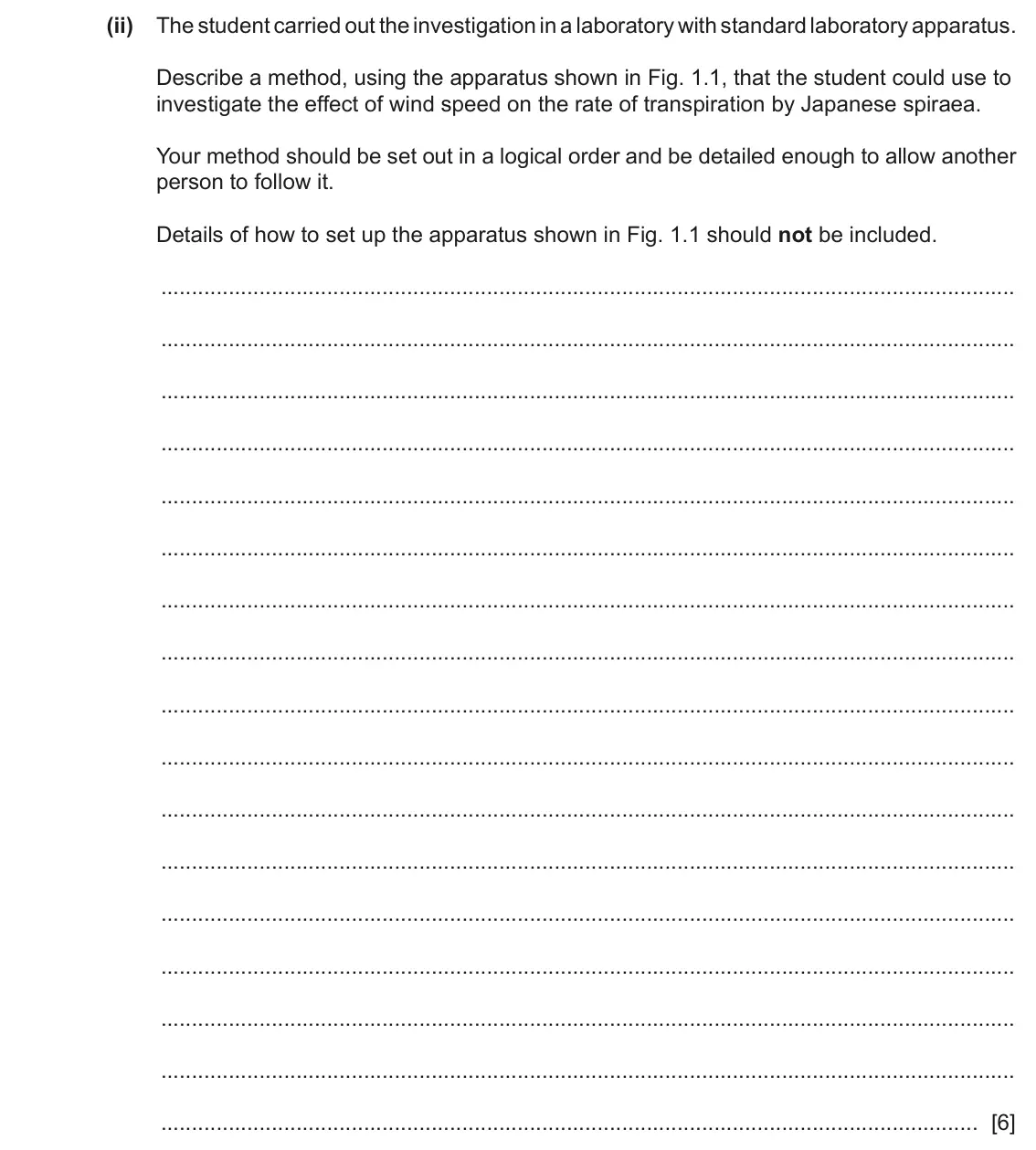
Q1(a)(iii)
The whole paper ↗
Q1(b)(i)
The whole paper ↗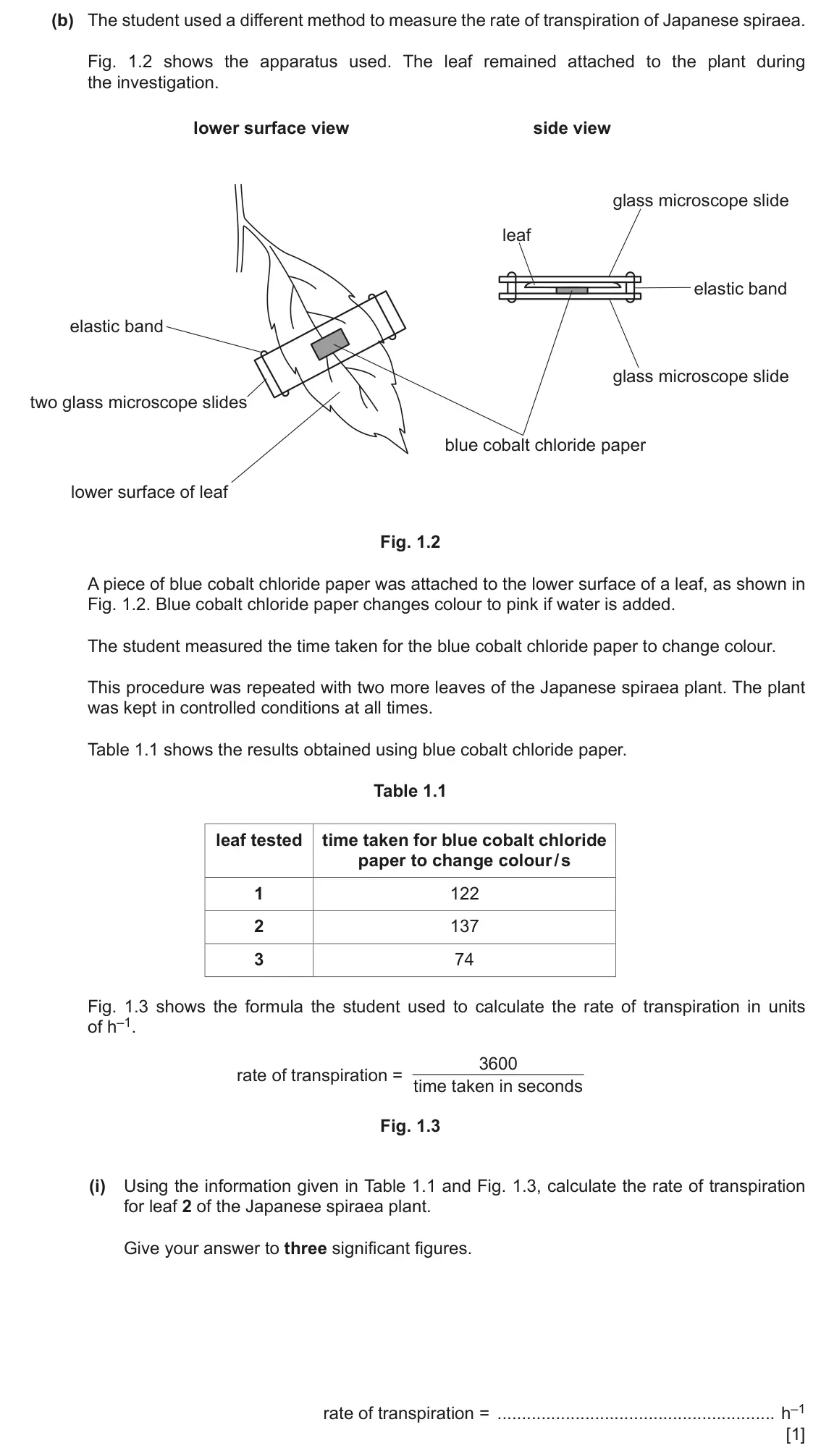
Q1(b)(ii)
The whole paper ↗
Q5(a)
The whole paper ↗

Q4(a)
The whole paper ↗
All 10 questions on Transport mechanisms, as a list
- June 2024, Paper 5, Q1(a)(i) (1 mark): Identify the independent variable in this investigation. [1]
- June 2024, Paper 5, Q1(a)(ii) (6 marks): The student carried out the investigation in a laboratory with standard laboratory apparatus. Describe a method, using the apparatus shown in Fig. 1.1, that the
- June 2024, Paper 5, Q1(a)(iii) (1 mark): Predict the effect of wind speed on the results of the investigation using the method you have given in (a)(ii). [1]
- June 2024, Paper 5, Q1(b)(i) (1 mark): The student used a different method to measure the rate of transpiration of Japanese spiraea. Fig. 1.2 shows the apparatus used. The leaf remained attached to t
- June 2024, Paper 5, Q1(b)(ii) (1 mark): To improve the validity of the results, the student decided to measure the time taken for blue cobalt chloride paper to change colour on a greater number of lea
- June 2024, Paper 2, Q5(a) (3 marks): Compare the results of the two species shown in Fig. 5.1. [3]
- Specimen, Paper 1, Q29 (1 mark): Sucrose moves from a phloem sieve tube element into a root cell. Which changes to the water potential and the volume of liquid in the phloem sieve tube element
- Specimen, Paper 1, Q30 (1 mark): Which statements about water movement in plants are correct? 1 Water can pass through cell walls containing layers of cellulose fibres. 2 Water can pass through
- Specimen, Paper 1, Q32 (1 mark): A maize crop is growing successfully in a field in which the water potential of the soil is –40 kPa. What is the most likely water potential of the cell sap in
- Specimen, Paper 2, Q4(a) (4 marks): Describe the pathways by which water passes from the soil to the cells of the cortex shown in Fig. 4.1. [4]
Questions, mark schemes and examiner’s reports are © Cambridge University Press & Assessment, from their published past papers. Plumi isn’t affiliated with any exam board. Want whole papers? Every CAIE A-Level Biology paper.
Rather write your answers by hand on iPad? Plumi marks them against the same mark schemes.