 plumi
Electromagnetic waves: AQA GCSE Physics questions
Every AQA GCSE Physics exam question on 4.6.2 Electromagnetic waves, 2018–2025, with its mark scheme and examiner’s report.
Find questions1,653
Calculations
Q01.1
The whole paper ↗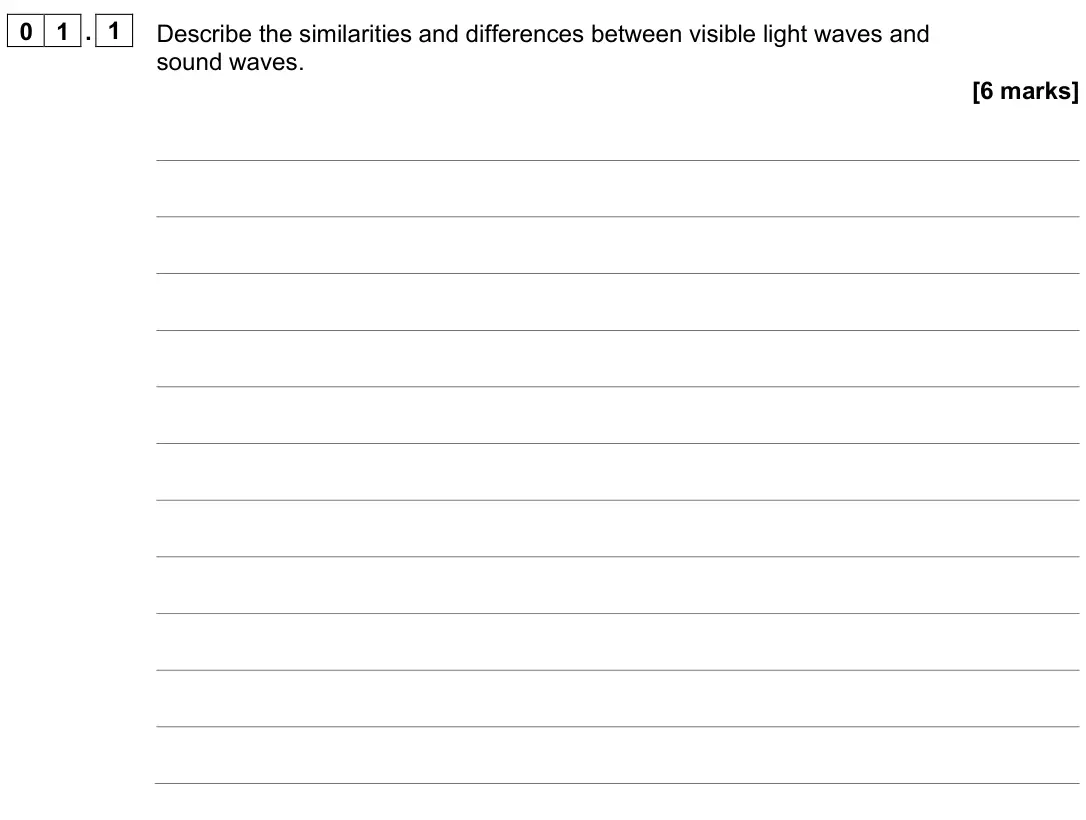
Q04.1
The whole paper ↗
Q04.2
The whole paper ↗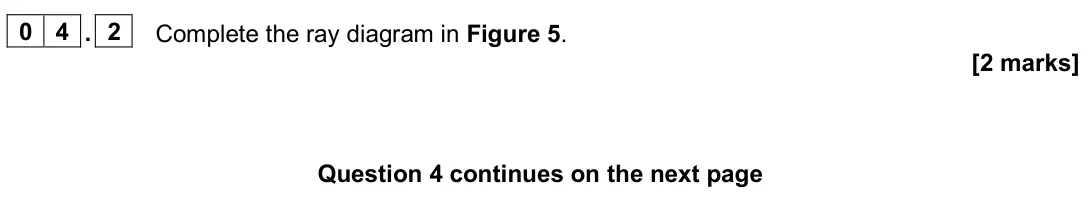
Q05.1
The whole paper ↗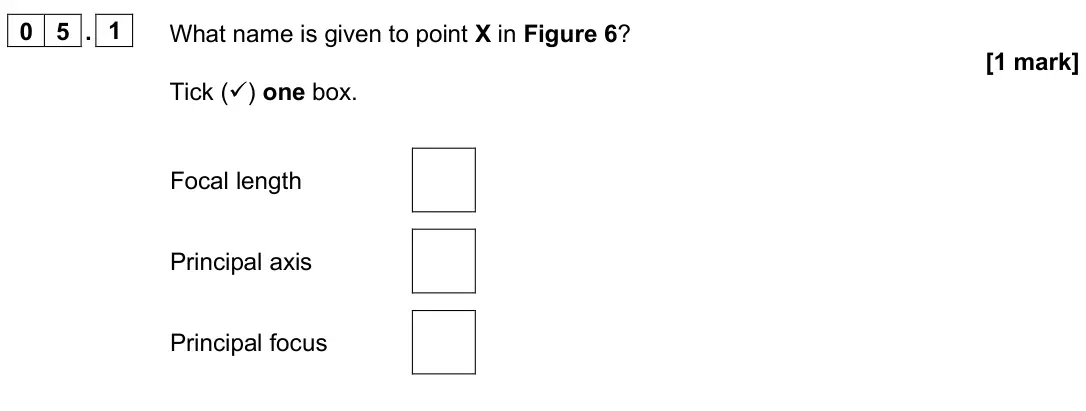
Q05.2
The whole paper ↗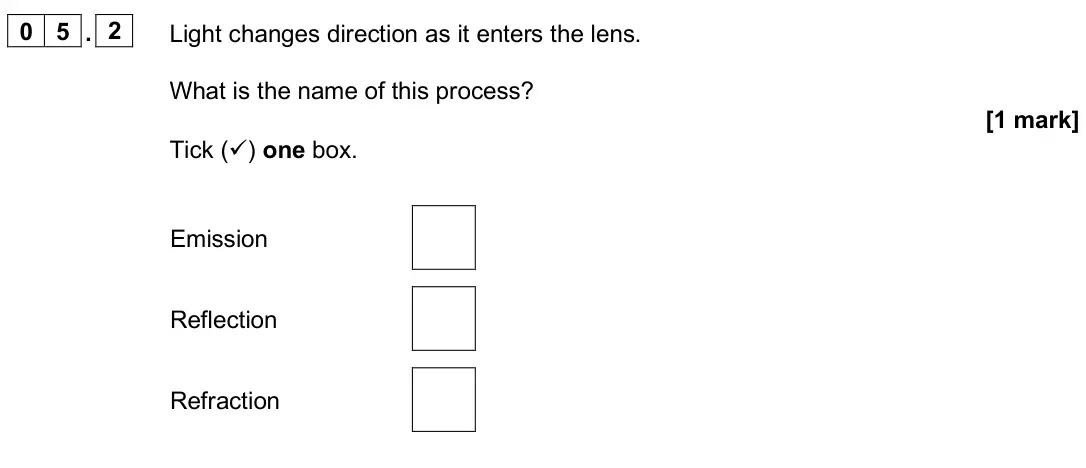
Q05.3
The whole paper ↗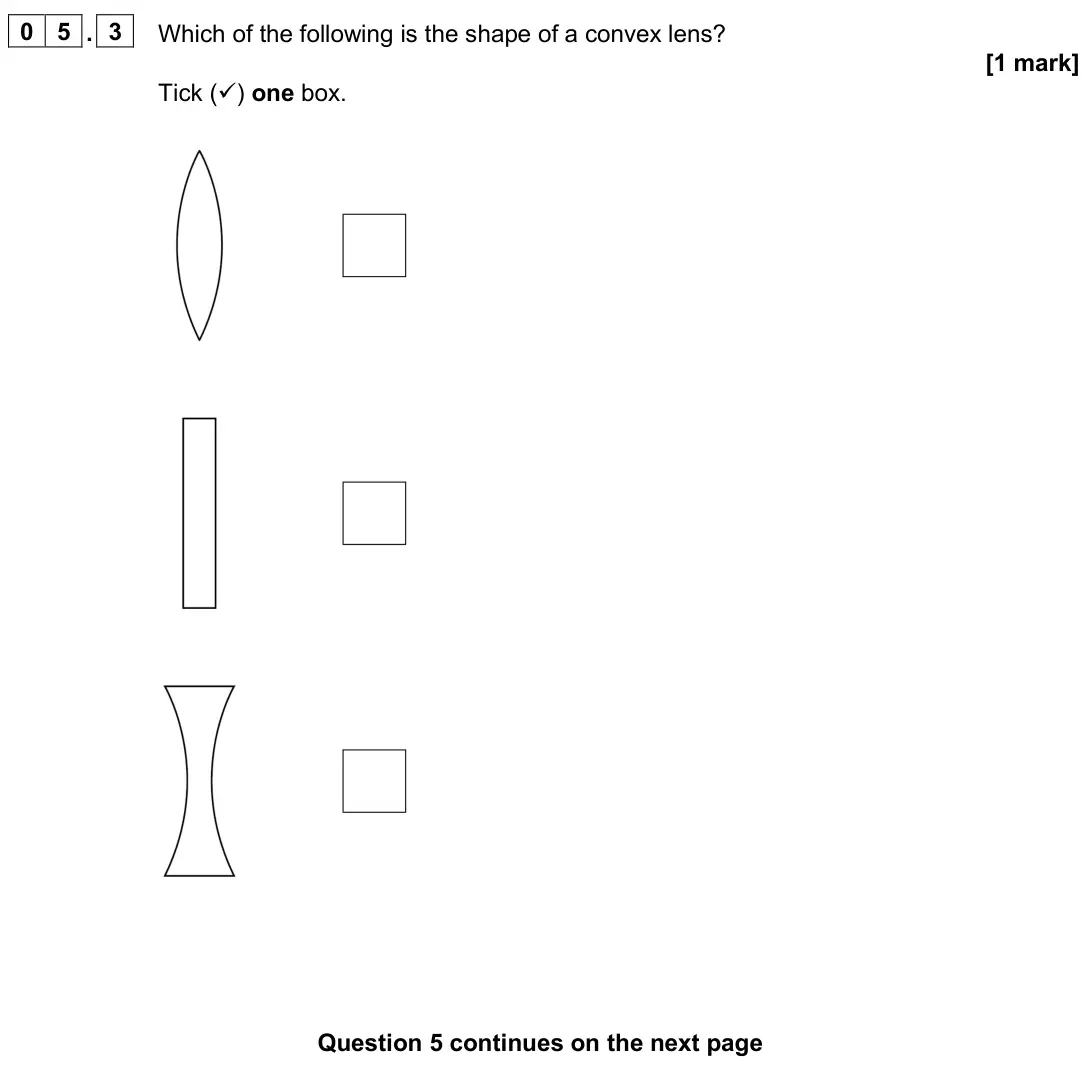
Q05.4
The whole paper ↗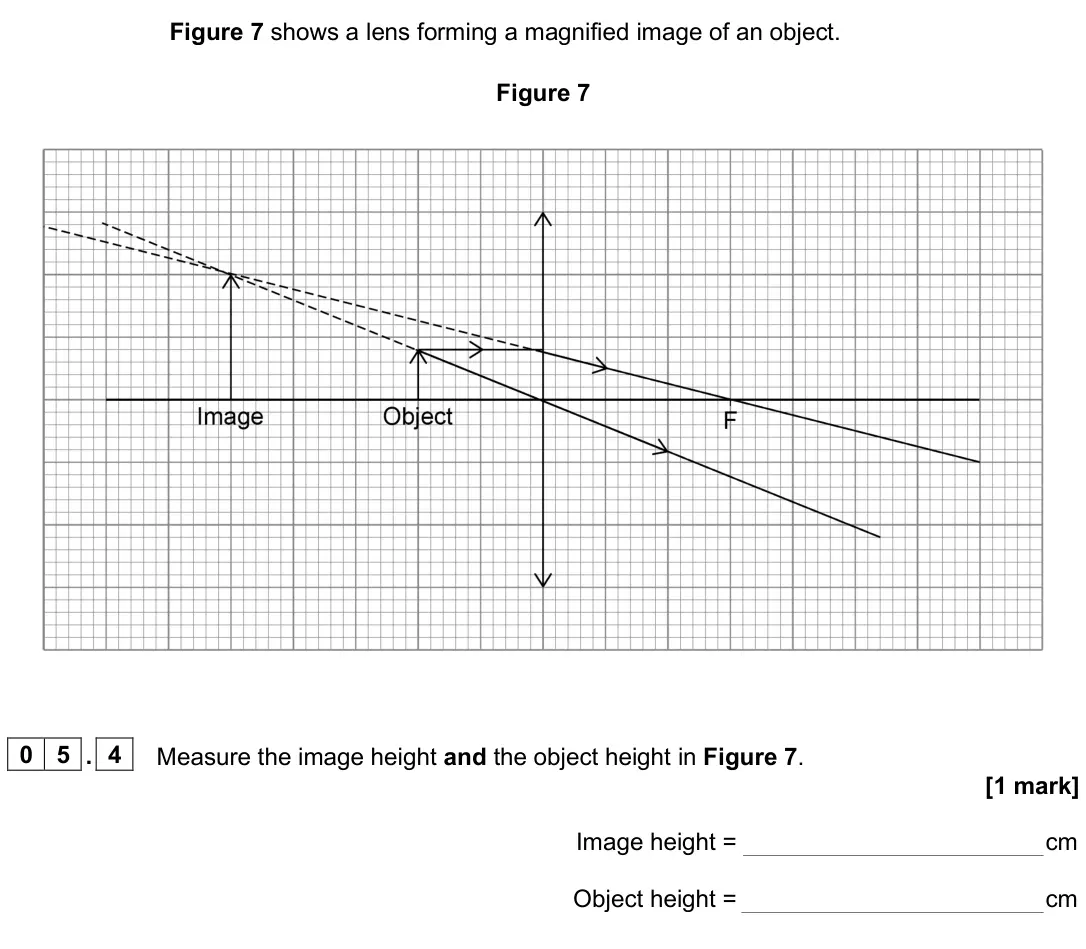
Q05.5
The whole paper ↗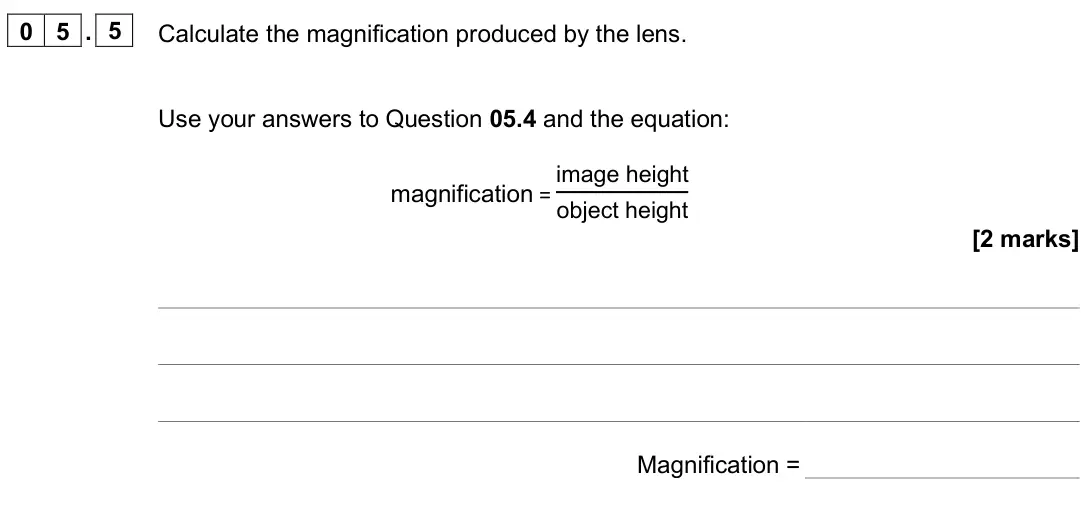
Q05.6
The whole paper ↗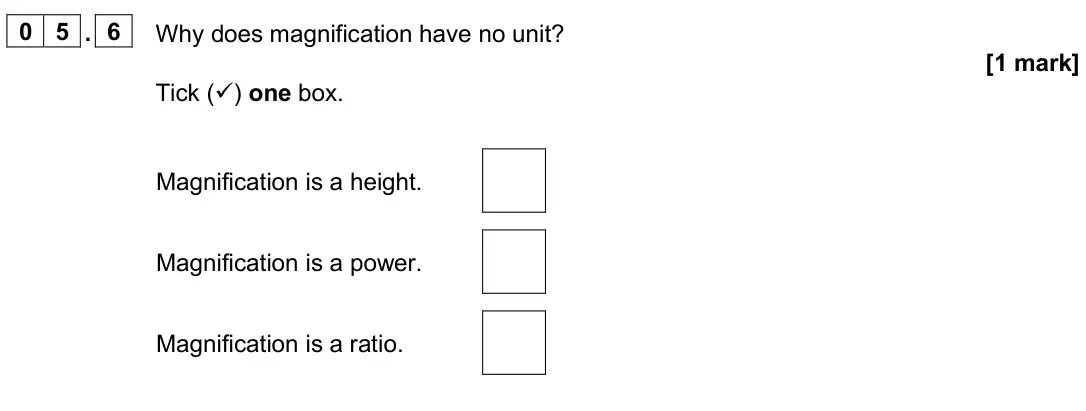
Q05.7
The whole paper ↗
Q08.1
The whole paper ↗
Q01.6
The whole paper ↗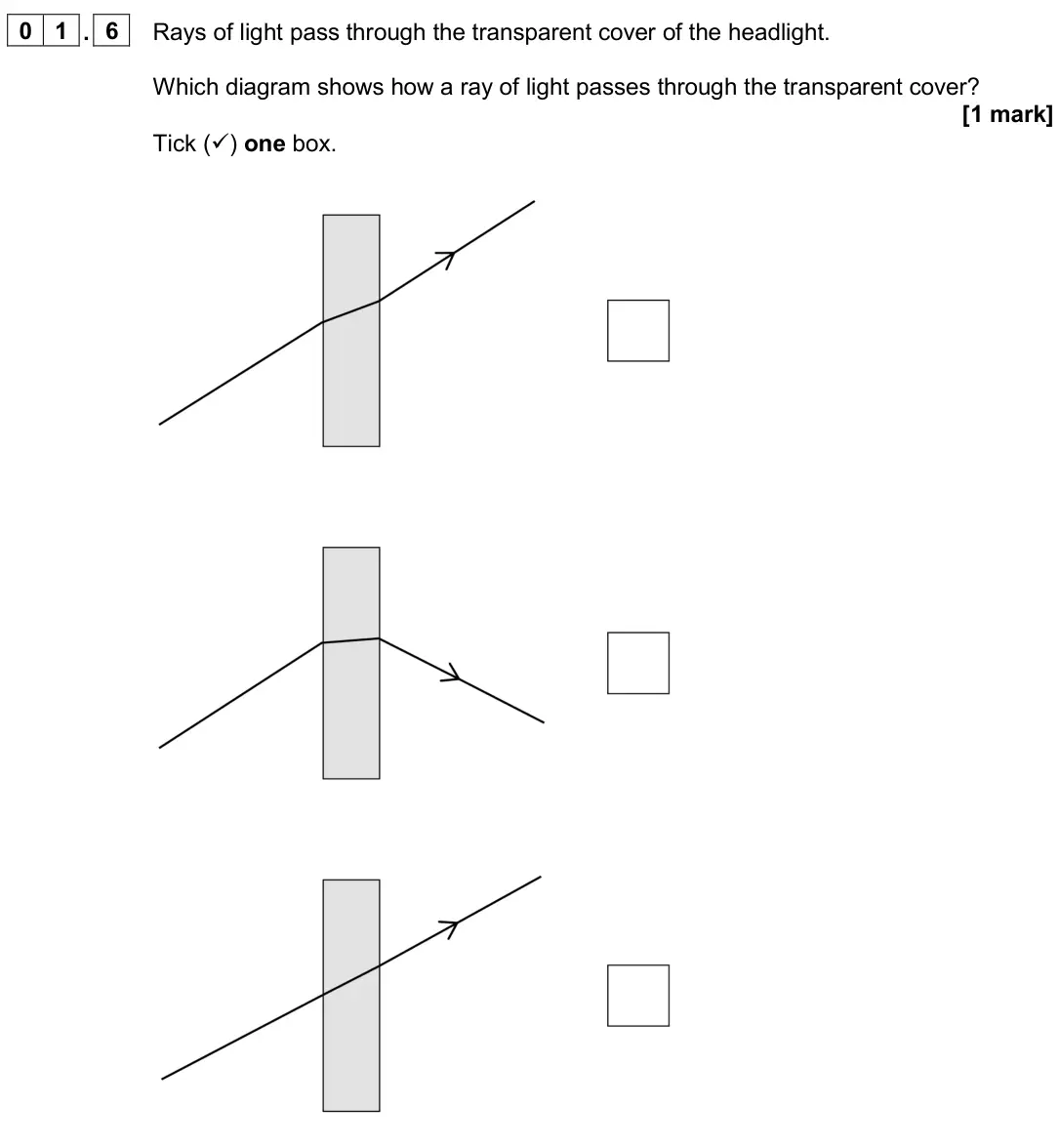
Q06.1
The whole paper ↗
Q06.2
The whole paper ↗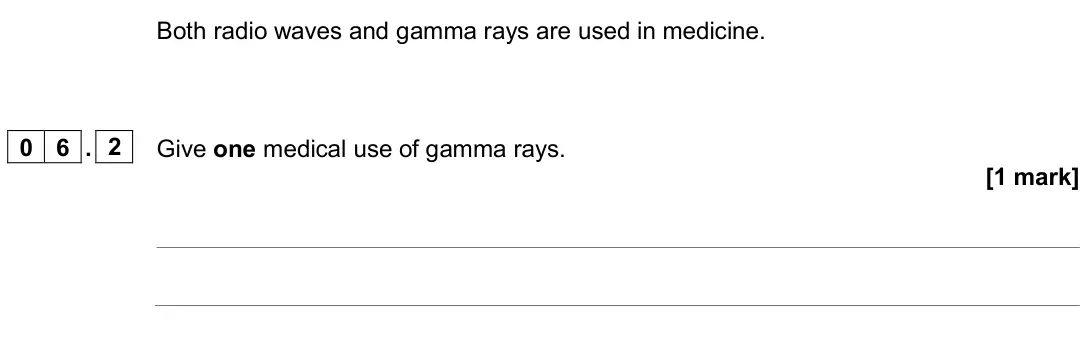
Q06.3
The whole paper ↗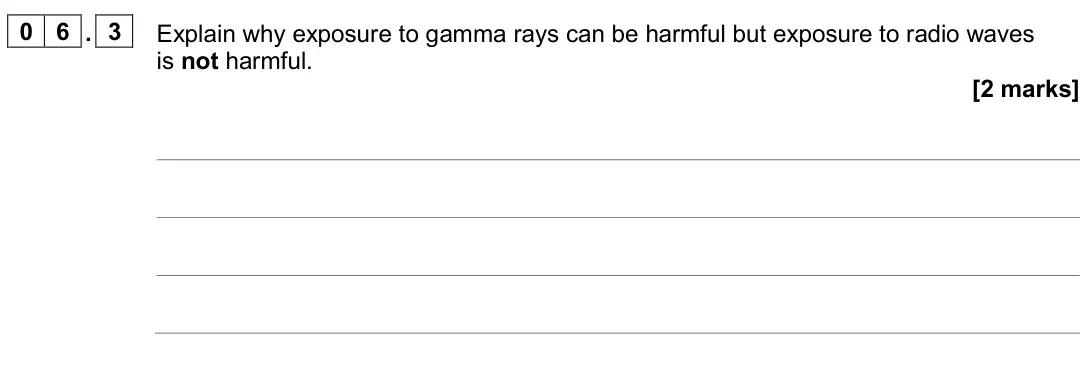
Q06.4
The whole paper ↗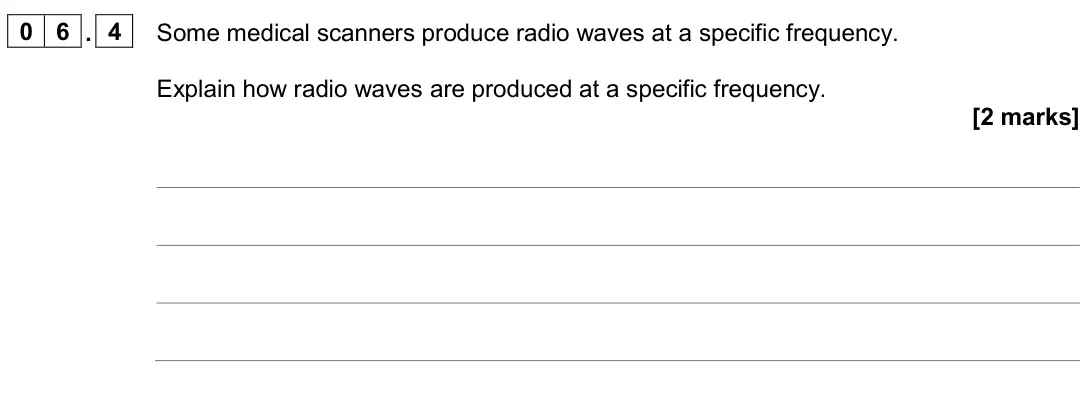
Q01.5
The whole paper ↗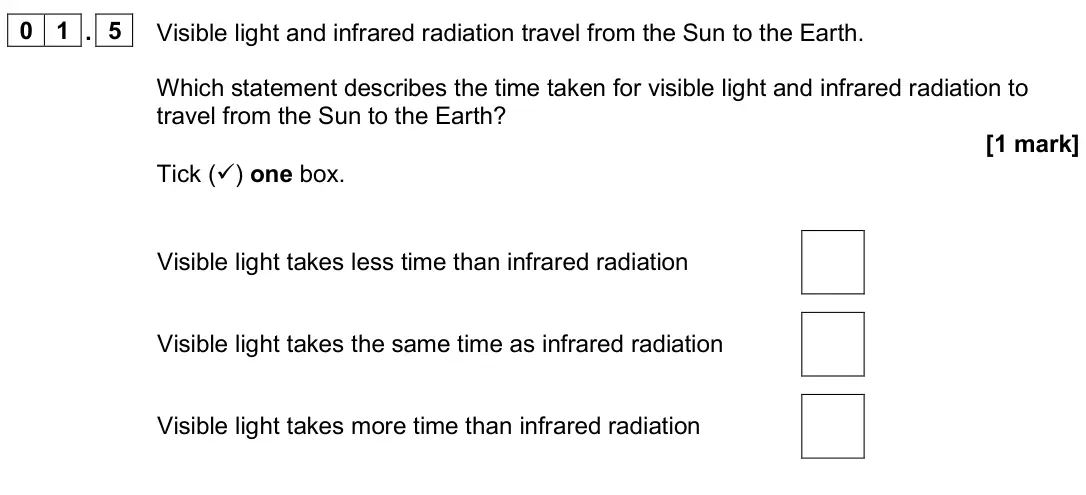
Q01.6
The whole paper ↗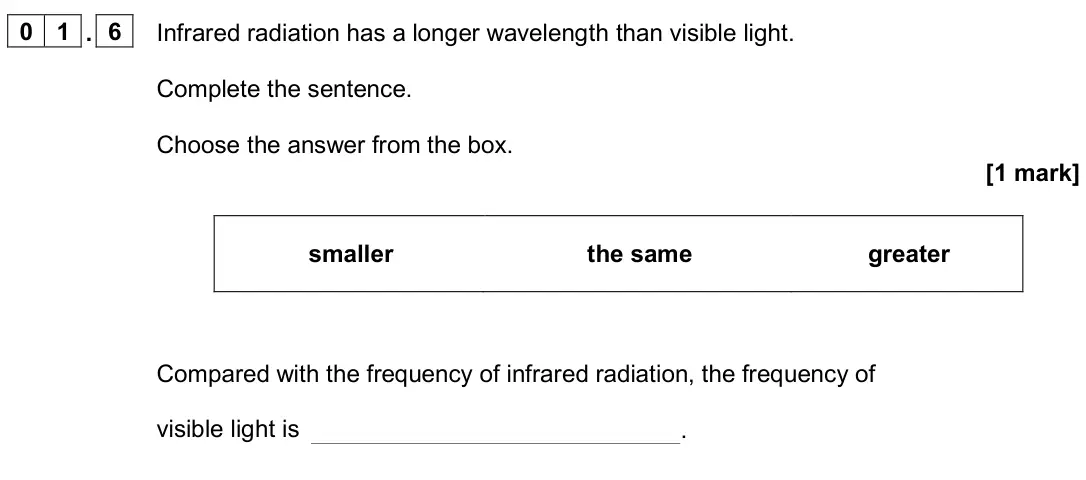
Q04.4
The whole paper ↗
Q06.1
The whole paper ↗
All 143 questions on Electromagnetic waves, as a list
- June 2025, Paper 2 Higher, Q01.1 (6 marks): Describe the similarities and differences between visible light waves and sound waves. [6 marks]
- June 2025, Paper 2 Higher, Q04.1 (1 mark): What type of lens is shown in Figure 5? [1 mark]
- June 2025, Paper 2 Higher, Q04.2 (2 marks): Complete the ray diagram in Figure 5. [2 marks]
- June 2025, Paper 2 Foundation, Q05.1 (1 mark): What name is given to point X in Figure 6? [1 mark] Tick () one box. Focal length Principal axis Principal focus
- June 2025, Paper 2 Foundation, Q05.2 (1 mark): Light changes direction as it enters the lens. What is the name of this process? [1 mark] Tick () one box. Emission Reflection Refraction
- June 2025, Paper 2 Foundation, Q05.3 (1 mark): Which of the following is the shape of a convex lens? [1 mark] Tick () one box.
- June 2025, Paper 2 Foundation, Q05.4 (1 mark): Measure the image height and the object height in Figure 7. [1 mark] Image height = cm Object height = cm
- June 2025, Paper 2 Foundation, Q05.5 (2 marks): Calculate the magnification produced by the lens. Use your answers to Question 05.4 and the equation: magnification = image height object height [2 marks] Magni
- June 2025, Paper 2 Foundation, Q05.6 (1 mark): Why does magnification have no unit? [1 mark] Tick () one box. Magnification is a height. Magnification is a power. Magnification is a ratio.
- June 2025, Paper 2 Foundation, Q05.7 (3 marks): Some reading glasses contain lenses made from blue glass. The blue glass acts as a filter. Describe what happens to white light incident on colourless glass and
- June 2025, Paper 2 Foundation, Q08.1 (6 marks): Describe the similarities and differences between visible light waves and sound waves. [6 marks]
- June 2024, Paper 2 Higher, Q01.6 (1 mark): Rays of light pass through the transparent cover of the headlight. Which diagram shows how a ray of light passes through the transparent cover? [1 mark] Tick (
- June 2024, Paper 2 Higher, Q06.1 (3 marks): Give three other similarities between radio waves and gamma rays. [3 marks] 1 2 3
- June 2024, Paper 2 Higher, Q06.2 (1 mark): Give one medical use of gamma rays. [1 mark]
- June 2024, Paper 2 Higher, Q06.3 (2 marks): Explain why exposure to gamma rays can be harmful but exposure to radio waves is not harmful. [2 marks]
- June 2024, Paper 2 Higher, Q06.4 (2 marks): Some medical scanners produce radio waves at a specific frequency. Explain how radio waves are produced at a specific frequency. [2 marks]
- June 2024, Paper 2 Foundation, Q01.5 (1 mark): Visible light and infrared radiation travel from the Sun to the Earth. Which statement describes the time taken for visible light and infrared radiation to trav
- June 2024, Paper 2 Foundation, Q01.6 (1 mark): Infrared radiation has a longer wavelength than visible light. Complete the sentence. Choose the answer from the box. [1 mark] smaller the same greater Compared
- June 2024, Paper 2 Foundation, Q04.4 (1 mark): Give one example of a transverse wave that can travel through a vacuum. [1 mark]
- June 2024, Paper 2 Foundation, Q06.1 (1 mark): Suggest one piece of equipment that can be used to detect infrared radiation. [1 mark]
- June 2024, Paper 2 Foundation, Q06.2 (1 mark): Which of the following values is a wavelength of red light? [1 mark] Tick () one box. 320 nm 410 nm 690 nm 750 nm Figure 10 is repeated below. Figure 10
- June 2024, Paper 2 Foundation, Q06.3 (2 marks): The eyes of a bee can detect electromagnetic radiation with wavelengths between 300 nm and 600 nm. Give two ways the radiation detected by the eyes of a bee is
- June 2024, Paper 2 Foundation, Q06.4 (2 marks): Complete the sentences. Choose the answers from the box. [2 marks] absorbed emitted reflected refracted When sunlight shines on a red flower, the red light is .
- June 2024, Paper 2 Foundation, Q06.5 (1 mark): A gardener looks at a red flower through a green filter. How does the flower appear to the gardener? [1 mark] Tick () one box. Black Green Red White
- June 2024, Paper 2 Foundation, Q06.6 (1 mark): The leaves of the plant reflect light. The leaves have a rough surface. What type of reflection happens at the leaf surface? [1 mark]
- June 2024, Paper 2 Foundation, Q08.6 (1 mark): Rays of light pass through the transparent cover of the headlight. Which diagram shows how a ray of light passes through the transparent cover? [1 mark] Tick (
- June 2023, Paper 2 Higher, Q01.2 (6 marks): The student wrote the following hypothesis: ‘The black-coloured flask will emit more infrared radiation than the silver-coloured flask during 10 minutes of cool
- June 2023, Paper 2 Higher, Q01.4 (1 mark): What was the dependent variable in this investigation? [1 mark]
- June 2023, Paper 2 Higher, Q01.5 (2 marks): Table 1 shows the results. Table 1 Surface colour of the cube Temperature increase after 10 minutes in °C Matt white 3.0 Shiny white 2.0 Matt black 6.5 Shiny bl
- June 2023, Paper 2 Higher, Q07.1 (1 mark): What name is given to reflection from a smooth surface? [1 mark] The student measured the angle of reflection for different angles of incidence. Table 2 shows t
- June 2023, Paper 2 Higher, Q07.6 (3 marks): Figure 20 shows what happens to wave fronts as they pass across the boundary between air and glass. Figure 20 Explain in terms of the wave fronts, why refractio
- June 2023, Paper 2 Foundation, Q05.3 (1 mark): Microwaves are electromagnetic waves used for mobile phone communications. Which other type of electromagnetic wave is also used for communications? [1 mark] Ti
- June 2023, Paper 2 Foundation, Q05.5 (1 mark): Mobile phone communications is only one of the uses for microwaves. Give one other use of microwaves. [1 mark]
- June 2023, Paper 2 Foundation, Q06.2 (3 marks): Figure 15 shows the beam of light incident on the glass block. Figure 15 Complete Figure 15 to show the path taken by the beam of light through the glass block
- June 2023, Paper 2 Foundation, Q06.5 (1 mark): Complete the sentence. [1 mark] When white light is incident on the red filter, all colours except for red are by the filter.
- June 2023, Paper 2 Foundation, Q08.1 (1 mark): Figure 20 shows parallel rays of light being refracted by a convex lens. Figure 20 What is the position marked ‘F’ called? [1 mark] Tick () one box. Focal leng
- June 2023, Paper 2 Foundation, Q08.2 (2 marks): Complete the ray diagram in Figure 21 to show how a concave lens forms the image of the object. Use an arrow to represent the image. [2 marks] Figure 21
- June 2023, Paper 2 Foundation, Q08.3 (2 marks): Figure 22 shows how a convex lens can be used to form a magnified image of an object. Figure 22 Give two ways that the image formed by the convex lens in Figure
- June 2023, Paper 2 Foundation, Q08.4 (3 marks): A convex lens is used as a magnifying glass to identify a symbol on the back of a silver spoon. The symbol has an actual height of 1.6 mm. The magnification pro
- June 2023, Paper 2 Foundation, Q09.2 (6 marks): The student wrote the following hypothesis: ‘The black-coloured flask will emit more infrared radiation than the silver-coloured flask during 10 minutes of cool
- June 2023, Paper 2 Foundation, Q09.4 (1 mark): What was the dependent variable in this investigation? [1 mark]
- June 2023, Paper 2 Foundation, Q09.5 (2 marks): Table 2 shows the results. Table 2 Surface colour of the cube Temperature increase after 10 minutes in °C Matt white 3.0 Shiny white 2.0 Matt black 6.5 Shiny bl
- June 2022, Paper 2 Foundation, Q05.1 (1 mark): How does the speed of ultraviolet in a vacuum compare to the speed of visible light in a vacuum? [1 mark] Tick () one box. Ultraviolet travels at a faster spee
- June 2022, Paper 2 Foundation, Q05.2 (2 marks): Figure 9 shows parts of the electromagnetic spectrum. Figure 9 Radio waves A B C D X-rays Gamma rays Which letters represent the positions of ultraviolet and vi
- June 2022, Paper 2 Foundation, Q05.3 (3 marks): Table 3 shows the range of wavelengths for different types of ultraviolet. Table 3 Type Range of wavelength in nanometres Ultraviolet A (UVA) 315–400 Ultraviole
- June 2022, Paper 2 Foundation, Q05.4 (4 marks): Explain the importance of the ozone layer in reducing the risk to people from all types of ultraviolet. Use Figure 10 and Table 4. [4 marks]
- June 2022, Paper 2 Foundation, Q05.5 (1 mark): The Sun emits visible light. A student concludes that visible light is not absorbed by the ozone layer. Give one piece of evidence that shows the student’s conc
- June 2022, Paper 2 Foundation, Q05.6 (2 marks): Figure 11 shows white light incident on a colour filter. Figure 11 Complete the sentence. Choose the answers from the box. [2 marks] absorbed radiated reflected
- November 2021, Paper 2 Higher, Q04.1 (1 mark): Figure 6 shows how a concave lens forms an image of an object. Figure 6 The image of the object in Figure 6 is upright. Give two other words that describe the i
- November 2021, Paper 2 Higher, Q04.2 (3 marks): Figure 7 shows an object near to a convex lens. Complete the ray diagram to show how the image is formed. Use an arrow to represent the image. [3 marks] Figure
- November 2021, Paper 2 Higher, Q04.3 (1 mark): Describe how the distance of the image from the lens decreases as the distance between the object and the lens increases. [1 mark]
- November 2021, Paper 2 Higher, Q04.4 (2 marks): The student measured the distance from the image to the lens four times. The distance between the object and the lens did not change. The 4 measurements from th
- November 2021, Paper 2 Higher, Q04.5 (3 marks): Figure 9 shows a spotlight containing a convex lens. A red filter is placed in front of the spotlight. The spotlight is directed at a blue object. Figure 9 Expl
- November 2021, Paper 2 Higher, Q05.1 (1 mark): Give one use of ultraviolet. [1 mark]
- November 2021, Paper 2 Higher, Q05.2 (1 mark): An ultraviolet wave has a wavelength of 300 nanometres. Which of the following is equal to 300 nanometres? [1 mark] Tick () one box. 3 × 10⁷ m 3 × 10⁻⁷ m 3 × 1
- November 2021, Paper 2 Higher, Q05.4 (1 mark): Table 1 gives the wavelength of an ultraviolet wave and three other electromagnetic waves. Table 1 Ultraviolet Wave E Wave F Wave G Wavelength in nanometres 300
- November 2021, Paper 2 Foundation, Q03.1 (1 mark): Figure 8 shows the position of three groups of the waves. Figure 8 Which letter shows the position of infrared? [1 mark] Tick () one box. A B C D
- November 2021, Paper 2 Foundation, Q03.2 (1 mark): Complete the sentence. Choose the answer from the box. [1 mark] a control the dependent the independent In this investigation the distance between each flask an
- November 2021, Paper 2 Foundation, Q03.3 (4 marks): The student wrote the hypothesis: ‘Surface colour of the flask affects the amount of infrared absorbed when the heater is switched on for five minutes.’ Describ
- November 2021, Paper 2 Foundation, Q03.4 (1 mark): Which one of the results for the black flask is anomalous? [1 mark]
- November 2021, Paper 2 Foundation, Q03.5 (1 mark): The anomalous result was caused by reading the thermometer incorrectly. What should the student do with the anomalous result? [1 mark]
- November 2021, Paper 2 Foundation, Q03.6 (1 mark): Calculate the mean temperature increase for the silver flask. [1 mark] Mean temperature increase = °C
- November 2021, Paper 2 Foundation, Q03.7 (1 mark): What conclusion can be made from Table 1? [1 mark] Tick () one box. Both flasks absorbed the same amount of infrared during the five minutes. The black flask a
- November 2021, Paper 2 Foundation, Q05.1 (1 mark): What type of lens is represented in Figure 14? [1 mark] Tick () one box. Concave Convex Diverging
- November 2021, Paper 2 Foundation, Q05.2 (1 mark): Measure the image height and the object height in Figure 14. [1 mark] Image height = cm Object height = cm
- November 2021, Paper 2 Foundation, Q05.3 (2 marks): Calculate the magnification produced by the lens. Use the equation: magnification = image height object height [2 marks] Magnification =
- November 2021, Paper 2 Foundation, Q05.4 (2 marks): Which two words describe the image in Figure 14? [2 marks] Tick () two boxes. Enlarged Inverted Real Upright Virtual
- November 2021, Paper 2 Foundation, Q05.5 (2 marks): The object was blue. A student looked at the blue object through a green filter. Complete the sentences. Choose answers from the box. [2 marks] black blue green
- November 2020, Paper 2 Higher, Q03.5 (1 mark): What property of the light wave changes when it is refracted? [1 mark] Tick () one box. Colour Frequency Velocity
- November 2020, Paper 2 Higher, Q04.1 (3 marks): Figure 5 is an incomplete ray diagram representing a visitor standing near the security lens. Complete Figure 5 to show how an image of the visitor is formed by
- November 2020, Paper 2 Higher, Q04.2 (1 mark): The visitor moves further away from the security lens in the door. How does the size of the image change? [1 mark] Tick () one box. Decreases Increases Stays t
- November 2020, Paper 2 Higher, Q06.2 (2 marks): The car aerial is connected to an electrical circuit in the car. Describe what happens in the electrical circuit when the car aerial absorbs radio waves. [2 mar
- November 2020, Paper 2 Foundation, Q04.1 (2 marks): Visible light is used for communications. Which other parts of the electromagnetic spectrum are used for communications? [2 marks] Tick () two boxes. Gamma ray
- November 2020, Paper 2 Foundation, Q04.4 (1 mark): Optical fibres need to be able to bend around corners without breaking. Suggest the property that optical fibres must have to allow them to bend around corners.
- November 2020, Paper 2 Foundation, Q04.5 (3 marks): The appearance of visible light can change when it interacts with different objects. Complete the sentences. Choose the answers from the box. Each answer may be
- November 2020, Paper 2 Foundation, Q06.1 (1 mark): Figure 10 shows the position of three types of wave in the electromagnetic spectrum. Figure 10 Which letter represents the position of X-rays in the electromagn
- November 2020, Paper 2 Foundation, Q06.2 (1 mark): Give one possible harmful consequence of receiving a dose of X-ray radiation. [1 mark]
- November 2020, Paper 2 Foundation, Q06.3 (2 marks): Compare the risk of harm to the patient of having an X-ray rather than a CT scan. [2 marks]
- November 2020, Paper 2 Foundation, Q06.4 (1 mark): Which of the following is the same as 6.0 millisieverts? [1 mark] Tick () one box. 0.60 sieverts 0.060 sieverts 0.0060 sieverts 0.00060 sieverts
- November 2020, Paper 2 Foundation, Q06.5 (2 marks): The patient received a total radiation dose of 2.5 millisieverts during one year. Calculate the percentage of this dose that came from one X-ray of the arm. Use
- June 2019, Paper 2 Higher, Q01.1 (1 mark): Figure 1 shows parallel rays of light being refracted by a convex lens. Figure 1 What is distance ‘X’ called? [1 mark]
- June 2019, Paper 2 Higher, Q01.2 (2 marks): Lenses can be used to form the image of an object. Complete the ray diagram in Figure 2 to show how a convex lens forms the image of the object. Use an arrow to
- June 2019, Paper 2 Higher, Q01.3 (2 marks): Give one similarity and one difference between the image formed by the convex lens and the image formed by the concave lens. [2 marks] Similarity Difference
- June 2019, Paper 2 Higher, Q01.4 (3 marks): A person uses a lens to read the letters on the back of a coin. The image height of the letters on the coin is 9.0 mm The magnification produced by the lens is
- June 2019, Paper 2 Higher, Q07.1 (1 mark): Figure 12 shows the electromagnetic spectrum. Figure 12 Which statement is correct for the direction of the arrow in Figure 12? [1 mark] Tick () one box. The w
- June 2019, Paper 2 Higher, Q07.2 (2 marks): Explain how the properties of X-rays make them suitable for the medical imaging of bones. [2 marks]
- June 2019, Paper 2 Higher, Q07.3 (1 mark): Boiling water is a hazard in this investigation. Suggest how the risk of harm could be reduced in this investigation. [1 mark]
- June 2019, Paper 2 Higher, Q07.4 (1 mark): What is the control variable in this investigation? [1 mark] Table 2 shows the results. Table 2 Type of surface Temperature in °C Matt black 68.0 Matt white 65.
- June 2019, Paper 2 Higher, Q07.5 (1 mark): The four temperature values in Table 2 cannot be used to show that the infrared detector gives precise readings. Give the reason why. [1 mark]
- June 2019, Paper 2 Higher, Q07.6 (2 marks): The student looked at the data in Table 2 and concluded: ‘A black surface always emits more infrared radiation than a white surface.’ Explain how using an infra
- June 2019, Paper 2 Foundation, Q04.1 (1 mark): Figure 11 shows the position of three types of wave in the electromagnetic spectrum. Figure 11 Which letter represents infrared in the electromagnetic spectrum?
- June 2019, Paper 2 Foundation, Q04.2 (1 mark): What is infrared used for? [1 mark] Tick () one box. Electrical heating Energy efficient lamps Satellite communications Sun tanning
- June 2019, Paper 2 Foundation, Q04.3 (1 mark): Complete the sentence. Choose the answer from the box. [1 mark] orange red yellow The image produced by an infrared camera of a person with a body temperature o
- June 2019, Paper 2 Foundation, Q04.4 (1 mark): Rescue workers use infrared cameras to search for people trapped under rubble after an earthquake. How does the image of a trapped person change if the person’s
- June 2019, Paper 2 Foundation, Q04.5 (1 mark): Complete the sentence. Choose the answer from the box. [1 mark] a control the dependent the independent In this investigation the type of surface is variable.
- June 2019, Paper 2 Foundation, Q04.6 (3 marks): Describe how the equipment shown in Figure 13 would be used to compare the infrared radiation emitted from the vertical surfaces of the cube. [3 marks] Table 1
- June 2019, Paper 2 Foundation, Q04.7 (1 mark): What is the resolution of the infrared detector? [1 mark] Tick () one box. 0.1 °C 1.0 °C 1.7 °C 68.0 °C
- June 2019, Paper 2 Foundation, Q04.8 (3 marks): Complete the bar chart to show all of the results. [3 marks]
- June 2019, Paper 2 Foundation, Q04.9 (1 mark): Give one conclusion that can be made from the results. [1 mark]
- June 2019, Paper 2 Foundation, Q05.1 (1 mark): In Figure 15, the angle of incidence is labelled with the letter i. Label the angle of refraction in Figure 15 with the letter r. [1 mark]
- June 2019, Paper 2 Foundation, Q05.2 (1 mark): Measure the angle of incidence in Figure 15. [1 mark] Angle of incidence = °
- June 2019, Paper 2 Foundation, Q05.3 (3 marks): Complete Figure 15 to show the path taken by the ray of light through the glass block and out into the air. [3 marks]
- June 2019, Paper 2 Foundation, Q08.1 (1 mark): Figure 20 shows parallel rays of light being refracted by a convex lens. Figure 20 What is distance ‘X’ called? [1 mark]
- June 2019, Paper 2 Foundation, Q08.2 (2 marks): Lenses can be used to form the image of an object. Complete the ray diagram in Figure 21 to show how a convex lens forms the image of the object. Use an arrow t
- June 2019, Paper 2 Foundation, Q08.3 (2 marks): Give one similarity and one difference between the image formed by the convex lens and the image formed by the concave lens. [2 marks] Similarity Difference
- June 2019, Paper 2 Foundation, Q08.4 (3 marks): A person uses a lens to read the letters on the back of a coin. The image height of the letters on the coin is 9.0 mm The magnification produced by the lens is
- June 2018, Paper 2 Higher, Q09.1 (1 mark): Which statement describes a scientific model? Tick one box. [1 mark] A small scale version of a real object. A way of guessing what will happen. An idea used to
- June 2018, Paper 2 Higher, Q09.2 (1 mark): Why do scientists sometimes have different models like the wave and particle models of light? [1 mark]
- June 2018, Paper 2 Higher, Q09.3 (4 marks): Sometimes an old scientific model is replaced by a new model. Explain why scientists replace an old scientific model with a new model. Include an example from P
- June 2018, Paper 2 Higher, Q09.4 (3 marks): Figure 16 shows what happens to the wave fronts as they pass the boundary between deep water and shallower water. Figure 16 Explain why refraction happens at th
- June 2018, Paper 2 Higher, Q09.5 (2 marks): Figure 17 shows the wave fronts travelling parallel to the boundary between deep water and shallower water. Figure 17 Explain why the wave fronts in Figure 17 d
- June 2018, Paper 2 Foundation, Q02.1 (1 mark): Which point on Figure 1 marks the position of the principal focus of the lens? Tick one box. [1 mark] A B C D
- June 2018, Paper 2 Foundation, Q02.2 (2 marks): Which two words describe the image? Tick two boxes. [2 marks] Enlarged Inverted Real Upright Virtual
- June 2018, Paper 2 Foundation, Q02.3 (4 marks): Calculate the magnification produced by the lens. Use the equation: magnification = image height object height [4 marks] Magnification =
- June 2018, Paper 2 Foundation, Q02.4 (1 mark): Complete the sentence. Choose an answer from the box. [1 mark] As the object is moved further away from the lens, the size of the image will . decrease increase
- June 2018, Paper 2 Foundation, Q05.1 (1 mark): Which one of the objects in Figure 5 is transparent? Tick one box. [1 mark] Figure 5
- June 2018, Paper 2 Foundation, Q05.2 (1 mark): Complete the sentence. Choose an answer from the box. [1 mark] An opaque object does not light. absorb reflect transmit
- June 2018, Paper 2 Foundation, Q05.3 (1 mark): Why does the T-shirt look white in white light? [1 mark]
- June 2018, Paper 2 Foundation, Q05.4 (2 marks): Explain how the colour of the baseball cap appears to change when the room lights at the party change from white to blue. [2 marks]
- June 2018, Paper 2 Foundation, Q05.5 (2 marks): In the investigation there are several variables. Draw one line from each variable to the correct description of that variable. [2 marks] Variable Description C
- June 2018, Paper 2 Foundation, Q05.6 (1 mark): What is the main hazard in this investigation? [1 mark]
- June 2018, Paper 2 Foundation, Q05.7 (1 mark): The drawing pin attached to the matt black metal sheet fell off first. What can be concluded from this result? [1 mark]
- June 2018, Paper 2 Foundation, Q08.1 (1 mark): Which position shows where visible light is in the spectrum? Tick one box. [1 mark] A B C D
- June 2018, Paper 2 Foundation, Q08.2 (1 mark): Which one of the statements about electromagnetic waves is correct? Tick one box. [1 mark] Radio waves have a higher frequency than X-rays. Radio waves have a l
- June 2018, Paper 2 Foundation, Q08.3 (1 mark): Give one possible danger of exposing your skin to ultraviolet radiation. [1 mark]
- June 2018, Paper 2 Foundation, Q08.4 (2 marks): Having an X-ray taken exposes a person to ionising radiation. Table 3 gives the average radiation dose for an X-ray of the chest and an X-ray of the upper diges
- Specimen, Paper 2 Higher, Q03.1 (2 marks): A student investigated how the magnification produced by a convex lens varies with the distance (d) between the object and the lens. The student used the appara
- Specimen, Paper 2 Higher, Q03.2: A student investigated how the magnification produced by a convex lens varies with the distance (d) between the object and the lens. The student used the appara
- Specimen, Paper 2 Higher, Q03.3 (2 marks): A student investigated how the magnification produced by a convex lens varies with the distance (d) between the object and the lens. The student used the appara
- Specimen, Paper 2 Higher, Q03.4 (2 marks): A student investigated how the magnification produced by a convex lens varies with the distance (d) between the object and the lens. The student used the appara
- Specimen, Paper 2 Higher, Q03.5 (2 marks): A student investigated how the magnification produced by a convex lens varies with the distance (d) between the object and the lens. The student used the appara
- Specimen, Paper 2 Higher, Q03.6 (3 marks): A student investigated how the magnification produced by a convex lens varies with the distance (d) between the object and the lens. The student used the appara
- Specimen, Paper 2 Higher, Q05.1 (6 marks): The data given in Table 3 was obtained from an investigation into the refraction of lig at an air to glass boundary. Table 3 Angle of incidence Angle of refract
- Specimen, Paper 2 Higher, Q05.2 (1 mark): The data given in Table 3 was obtained from an investigation into the refraction of lig at an air to glass boundary. Table 3 Angle of incidence Angle of refract
- Specimen, Paper 2 Foundation, Q06.1: Figure 10 shows an incomplete electromagnetic spectrum. Figure 10 0 6 A microwaves B C ultraviolet D gamma What name is given to the group of waves at the posit
- Specimen, Paper 2 Foundation, Q06.2 (3 marks): Figure 10 shows an incomplete electromagnetic spectrum. Figure 10 0 6 A microwaves B C ultraviolet D gamma Electromagnetic waves have many practical uses. Draw
- Specimen, Paper 2 Foundation, Q06.3 (1 mark): black body ionising nuclear
- Specimen, Paper 2 Foundation, Q12.1 (2 marks): A student investigated how the magnification produced by a convex lens varies with the distance (d) between the object and the lens. The student used the appara
- Specimen, Paper 2 Foundation, Q12.2 (1 mark): A student investigated how the magnification produced by a convex lens varies with the distance (d) between the object and the lens. The student used the appara
- Specimen, Paper 2 Foundation, Q12.3 (2 marks): A student investigated how the magnification produced by a convex lens varies with the distance (d) between the object and the lens. The student used the appara
- Specimen, Paper 2 Foundation, Q12.4 (2 marks): A student investigated how the magnification produced by a convex lens varies with the distance (d) between the object and the lens. The student used the appara
- Specimen, Paper 2 Foundation, Q12.5 (2 marks): A student investigated how the magnification produced by a convex lens varies with the distance (d) between the object and the lens. The student used the appara
- Specimen, Paper 2 Foundation, Q14 (6 marks): Copyright information Permission to reproduce all copyright material has been applied for. In some cases, efforts to contact copyright-holders may have been uns
Questions, mark schemes and examiner’s reports are © AQA, from their published past papers. Plumi isn’t affiliated with any exam board. Want whole papers? Every AQA GCSE Physics paper.
Rather write your answers by hand on iPad? Plumi marks them against the same mark schemes.