 plumi
The human nervous system: AQA GCSE Biology questions
Every AQA GCSE Biology exam question on 4.5.2 The human nervous system, 2018–2025, with its mark scheme and examiner’s report.
Find questions1,505
Calculations
Q07.1
The whole paper ↗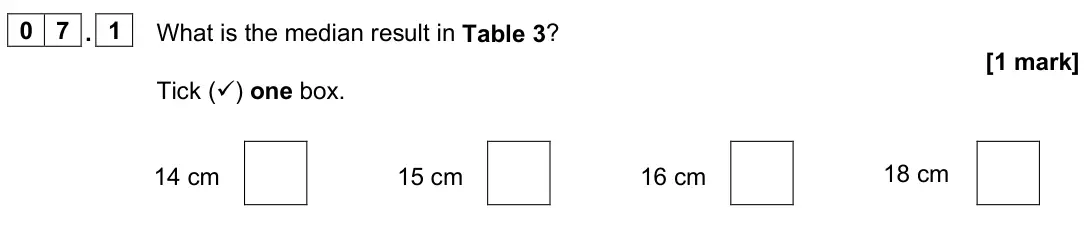
Q07.2
The whole paper ↗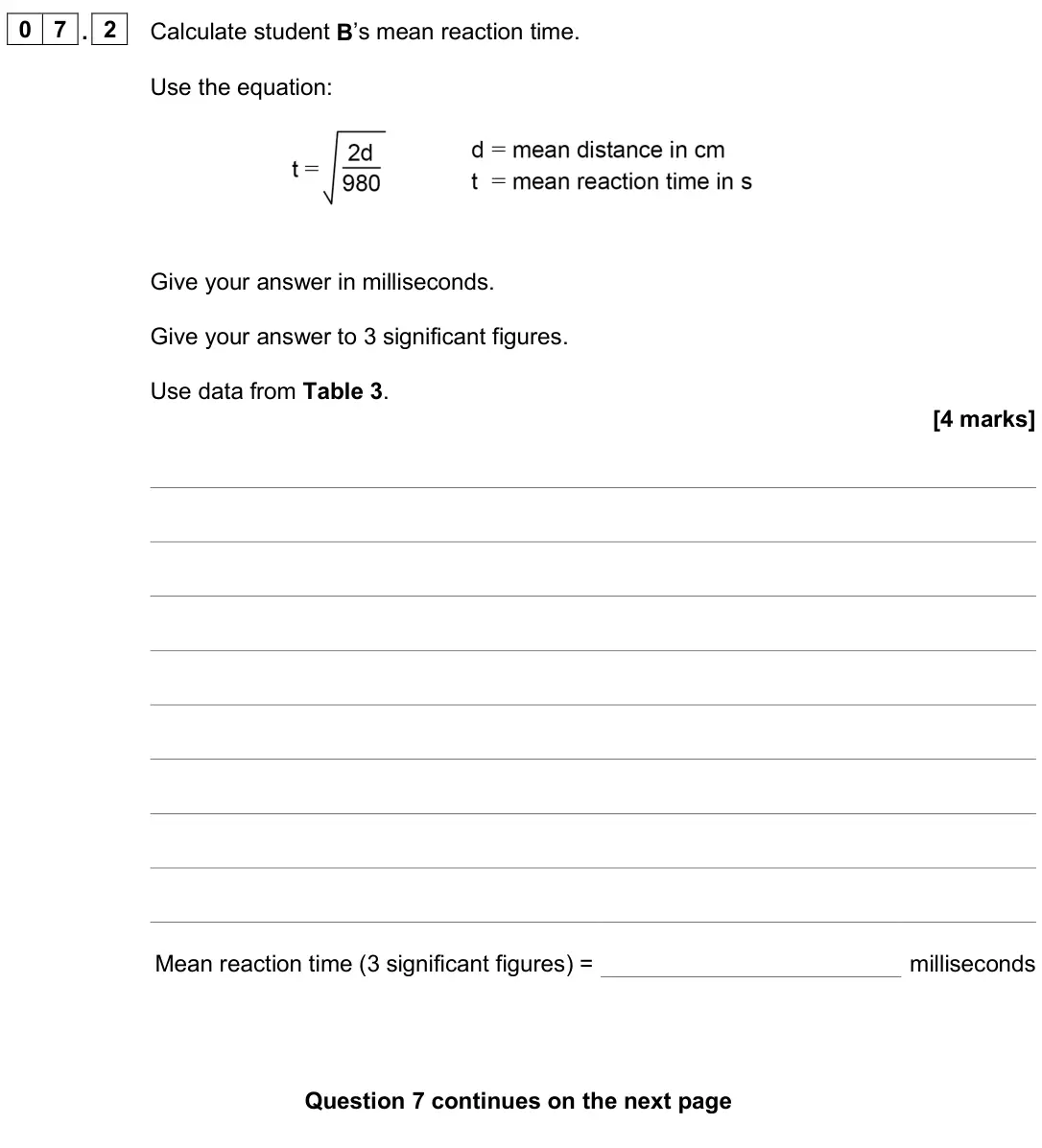
Q07.3
The whole paper ↗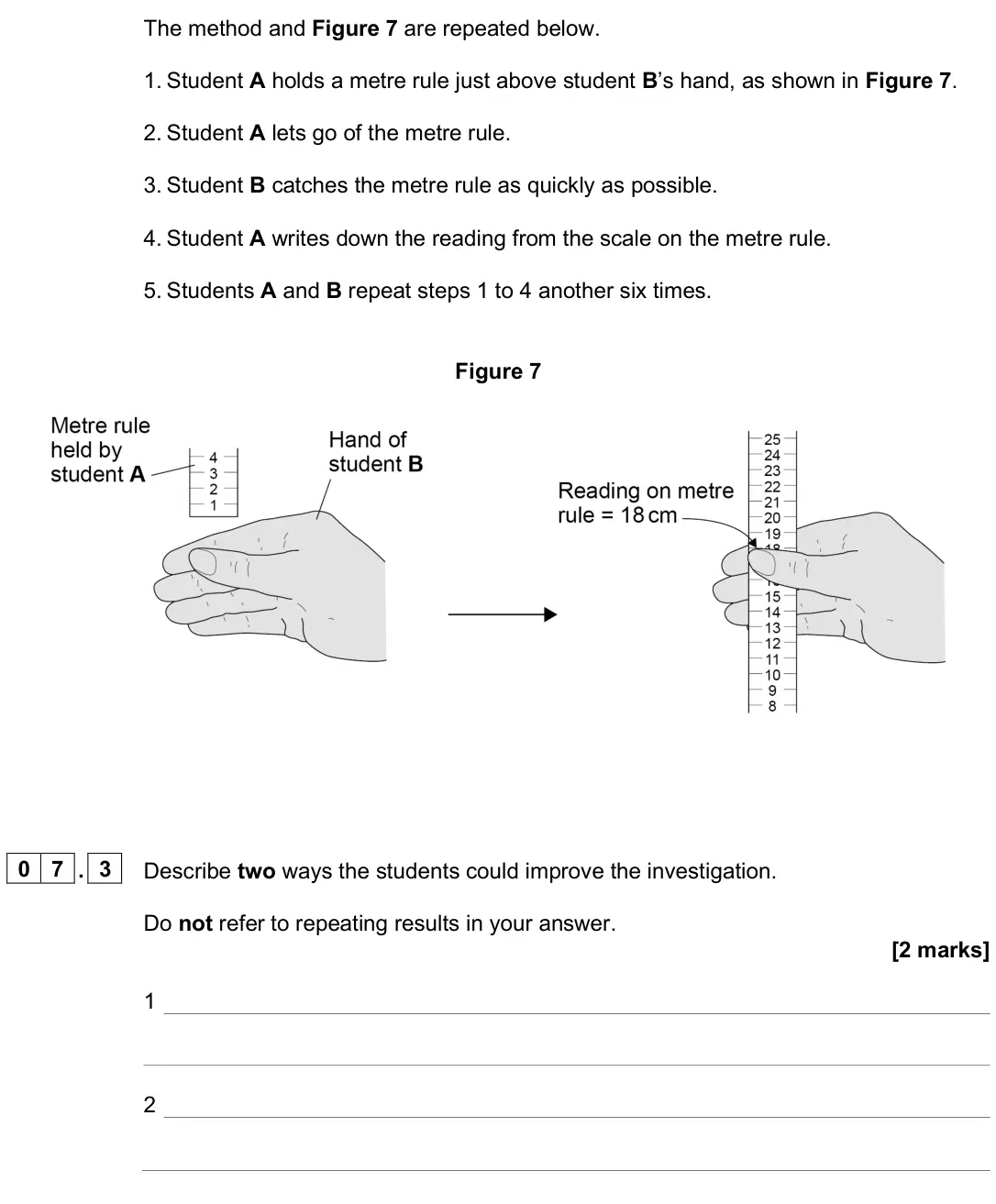
Q07.4
The whole paper ↗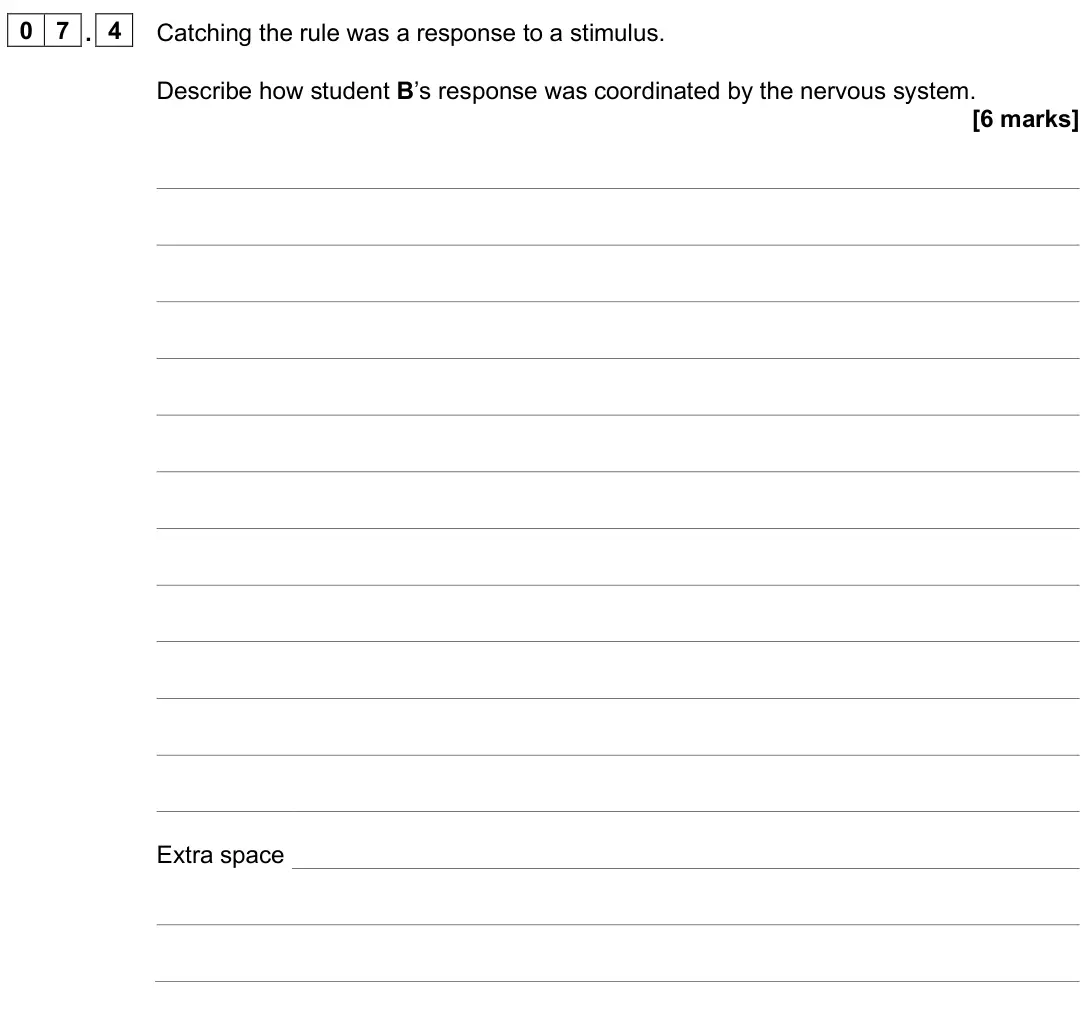
Q08.5
The whole paper ↗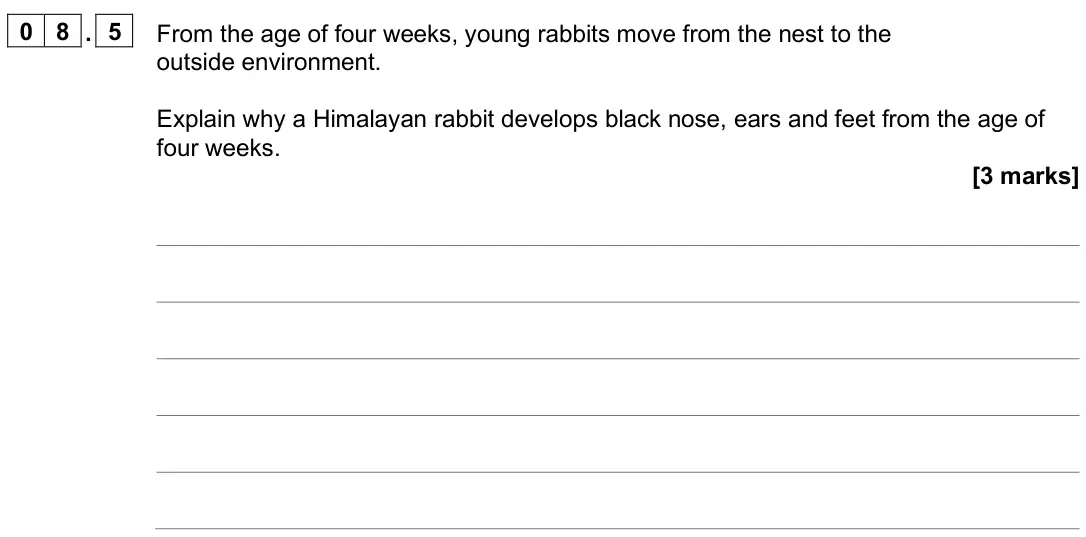
Q02.1
The whole paper ↗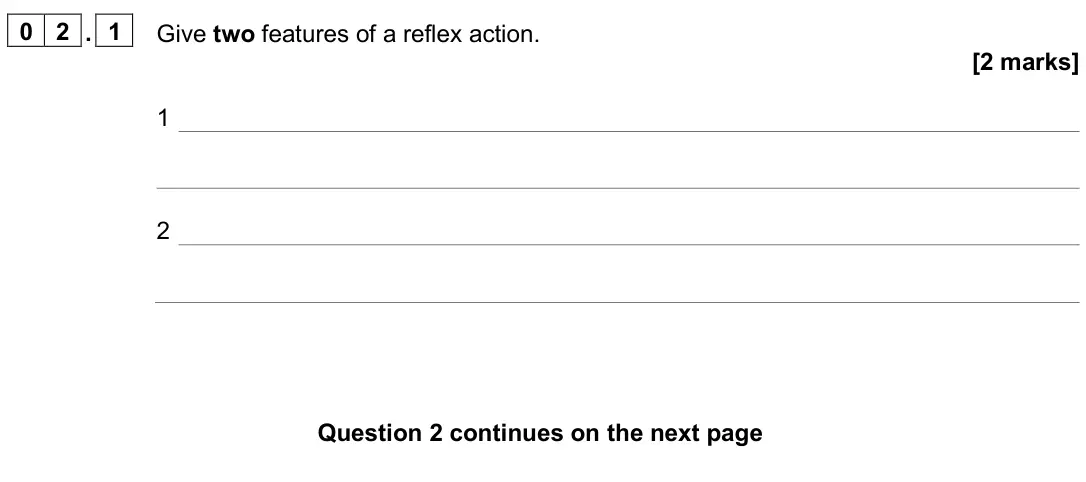
Q02.2
The whole paper ↗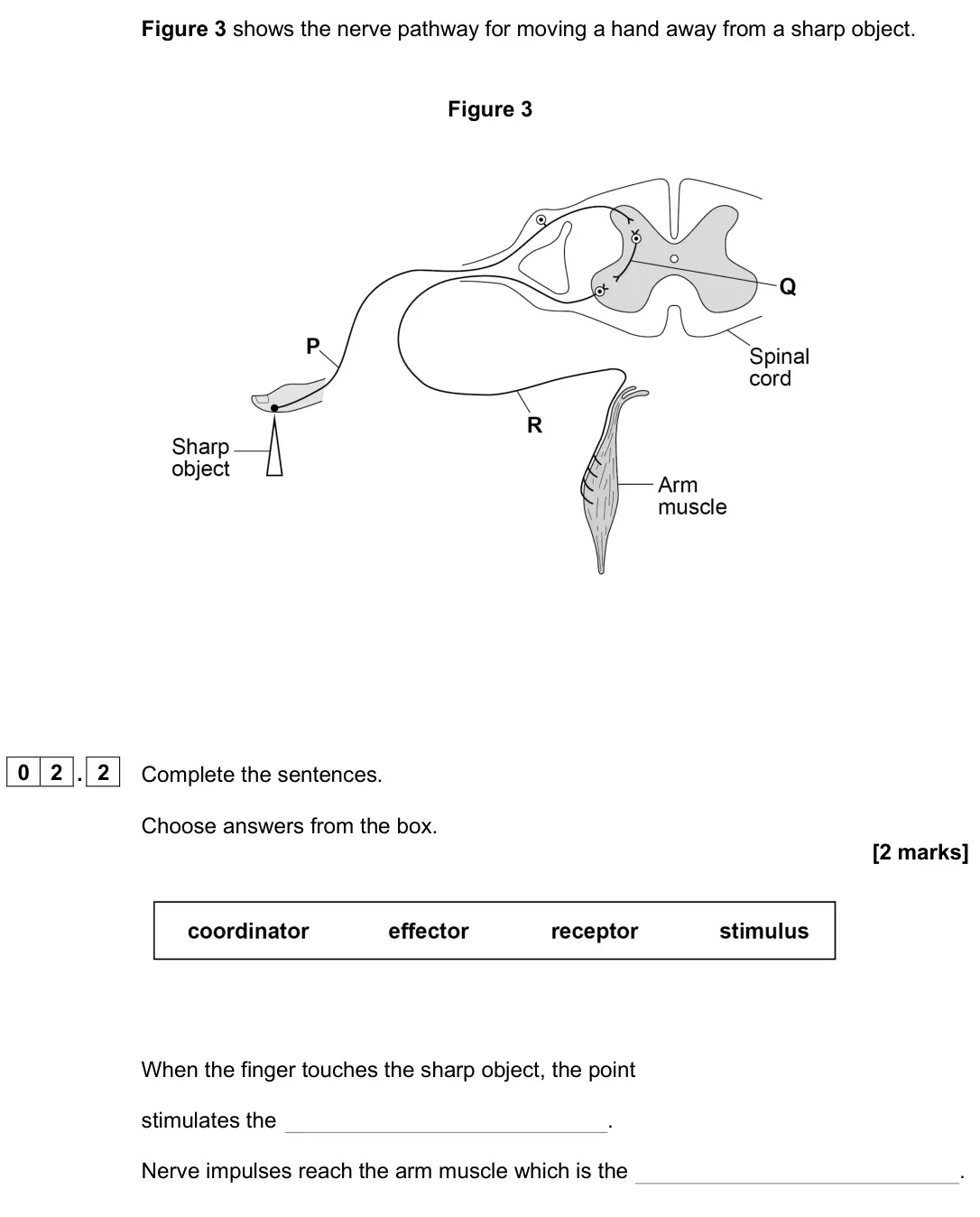
Q02.3
The whole paper ↗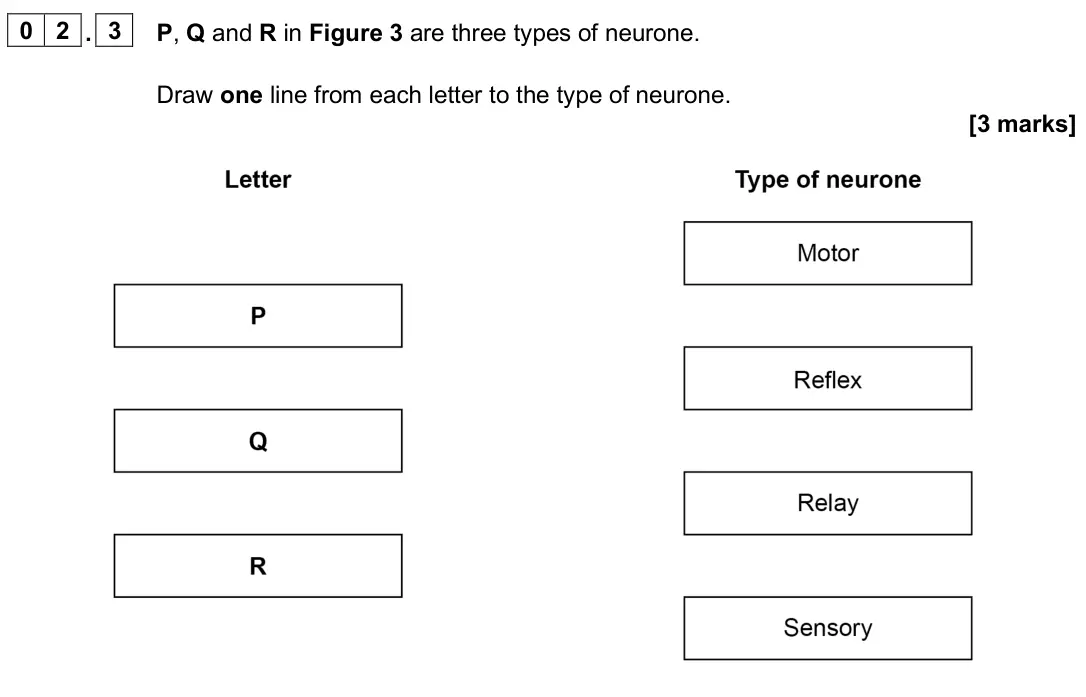
Q02.4
The whole paper ↗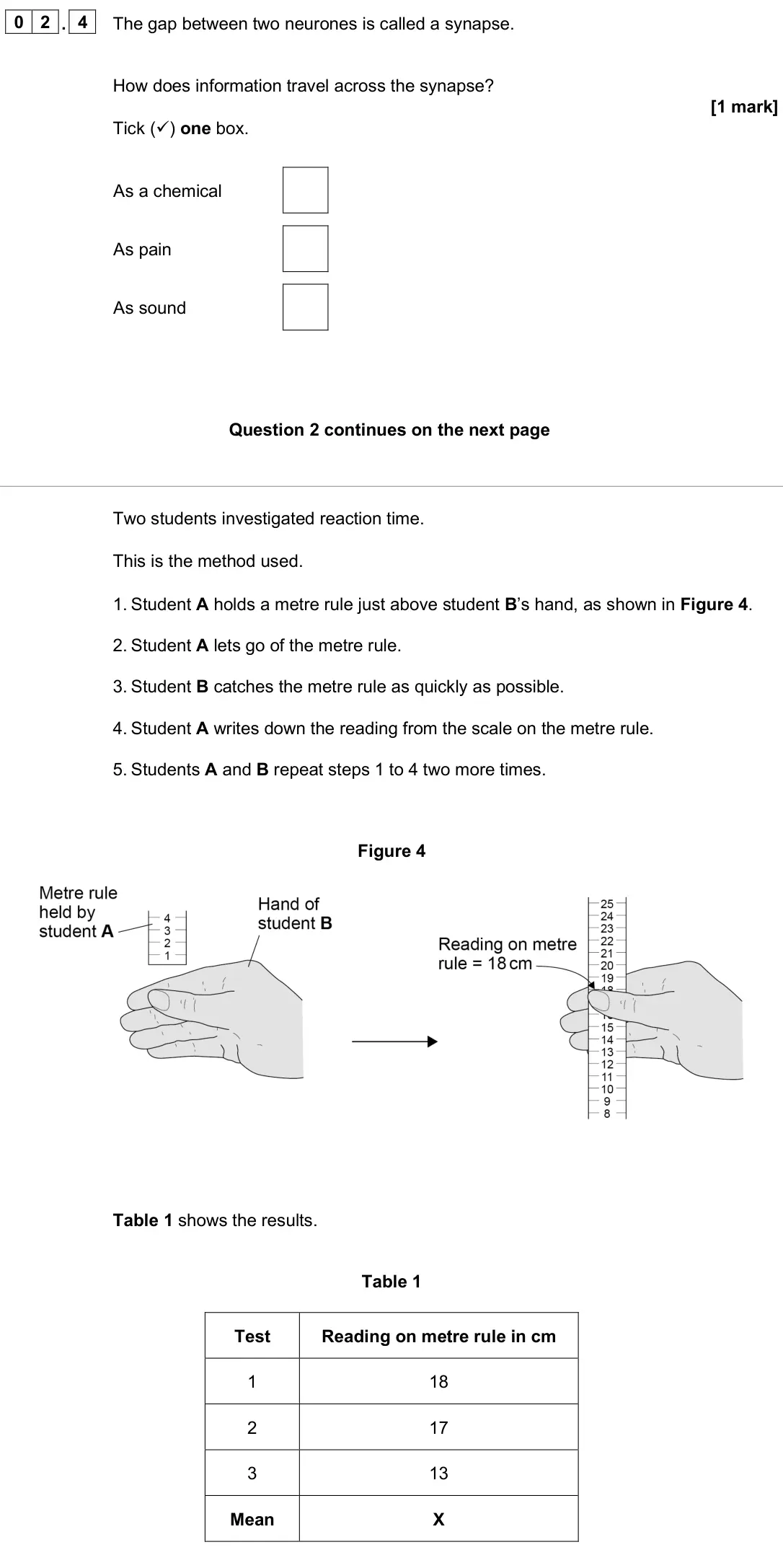
Q02.5
The whole paper ↗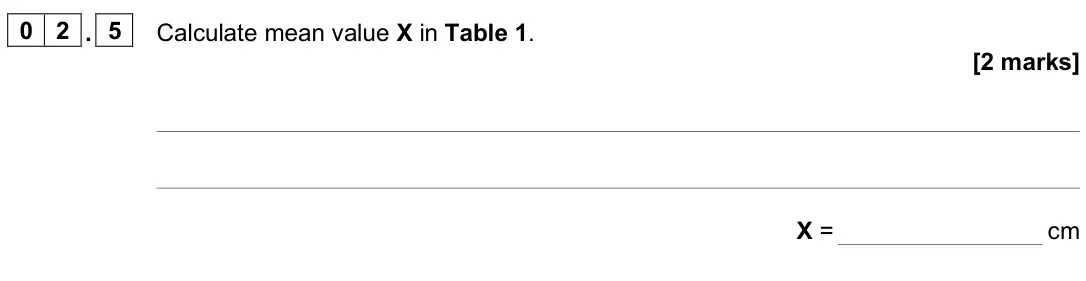
Q02.6
The whole paper ↗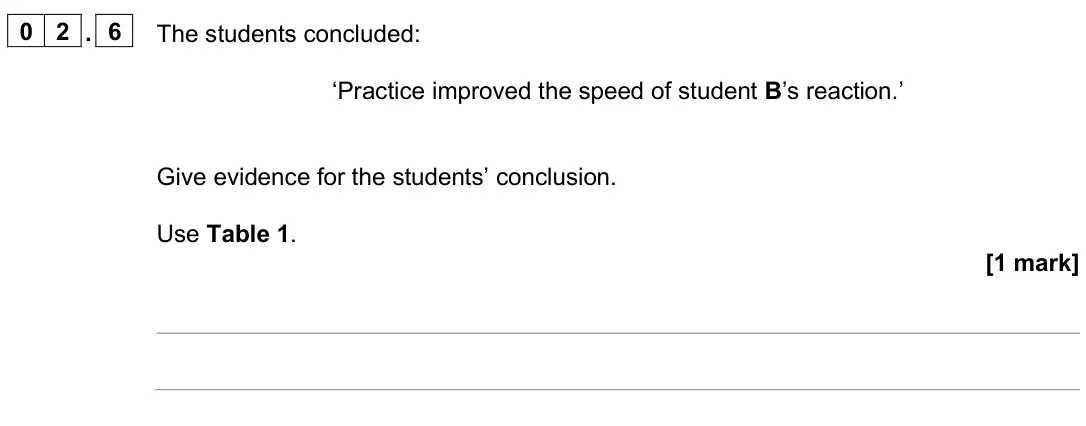
Q02.7
The whole paper ↗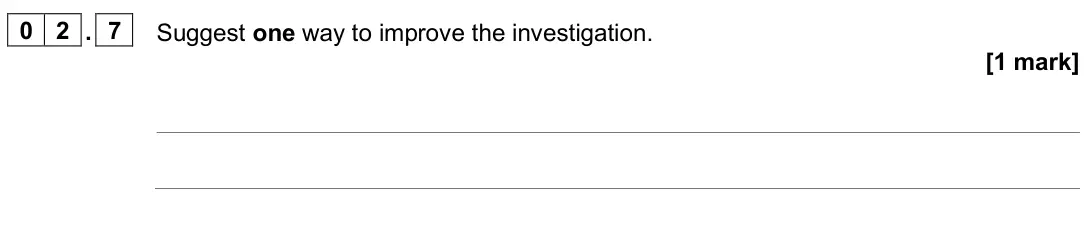
Q04.2
The whole paper ↗
Q05.1
The whole paper ↗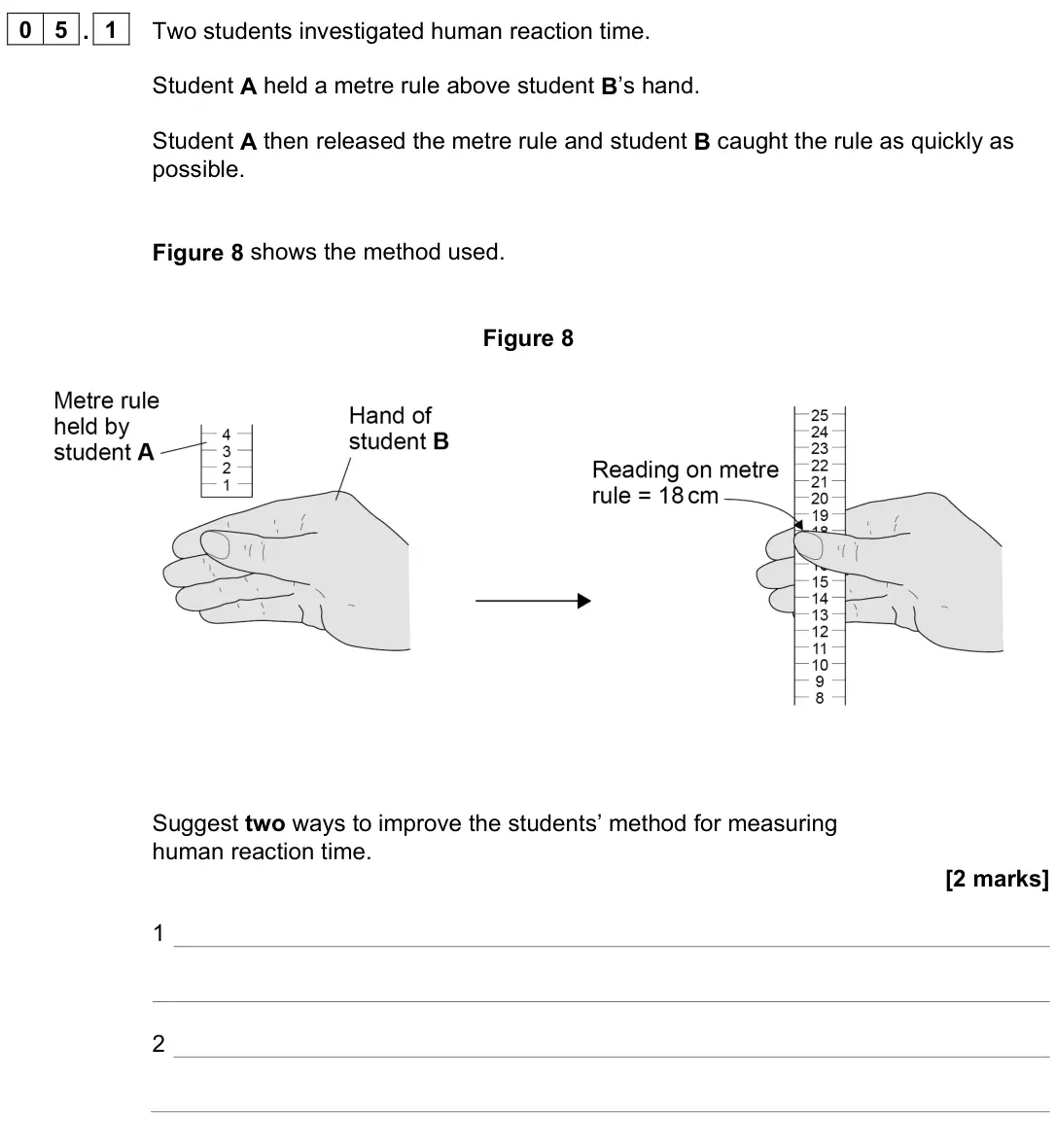
Q05.2
The whole paper ↗
Q01.1
The whole paper ↗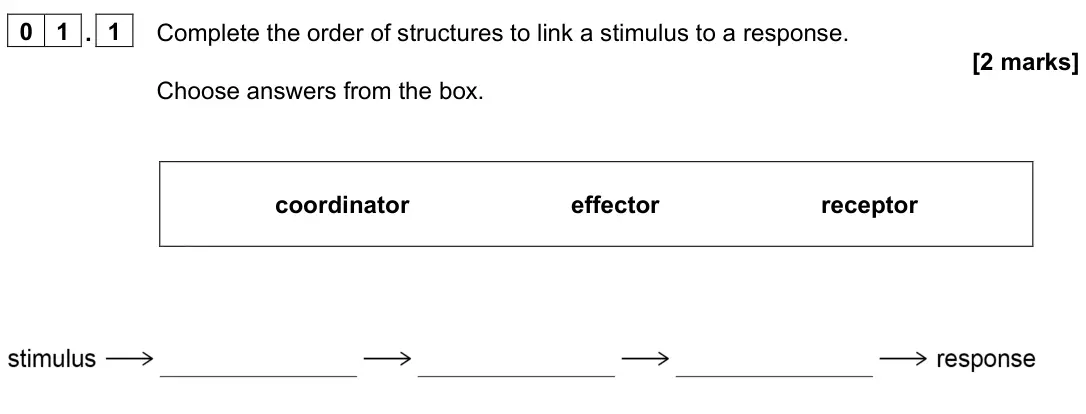
Q01.2
The whole paper ↗
Q01.3
The whole paper ↗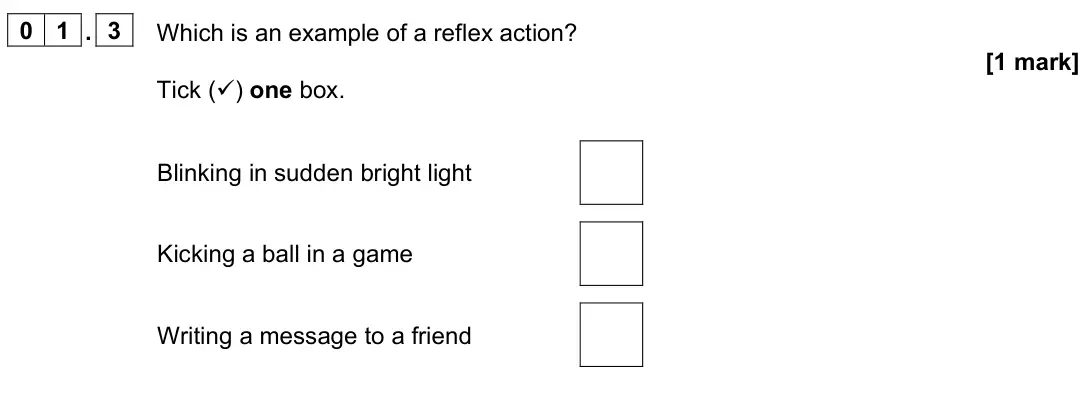
Q01.4
The whole paper ↗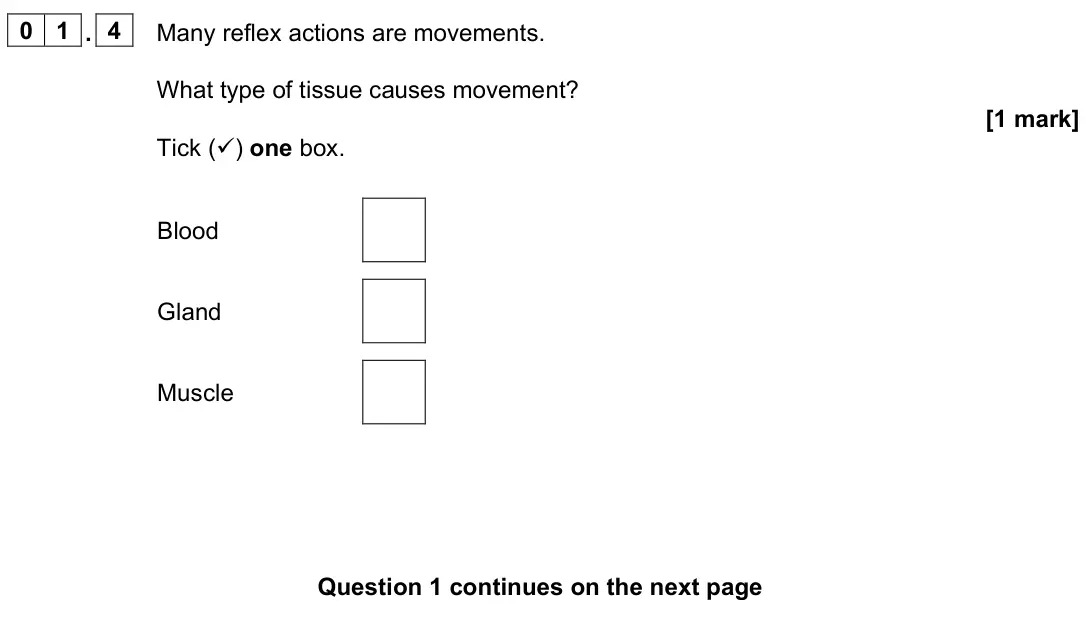
Q01.6
The whole paper ↗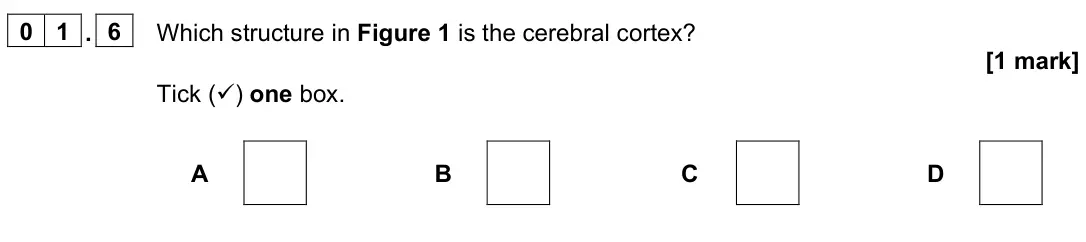
All 112 questions on The human nervous system, as a list
- June 2025, Paper 2 Higher, Q07.1 (1 mark): What is the median result in Table 3? [1 mark] Tick () one box. 14 cm 15 cm 16 cm 18 cm
- June 2025, Paper 2 Higher, Q07.2 (4 marks): Calculate student B’s mean reaction time. Use the equation: Give your answer in milliseconds. Give your answer to 3 significant figures. Use data from Table 3.
- June 2025, Paper 2 Higher, Q07.3 (2 marks): Describe two ways the students could improve the investigation. Do not refer to repeating results in your answer. [2 marks] 1 2
- June 2025, Paper 2 Higher, Q07.4 (6 marks): Catching the rule was a response to a stimulus. Describe how student B’s response was coordinated by the nervous system. [6 marks]
- June 2025, Paper 2 Higher, Q08.5 (3 marks): From the age of four weeks, young rabbits move from the nest to the outside environment. Explain why a Himalayan rabbit develops black nose, ears and feet from
- June 2025, Paper 2 Foundation, Q02.1 (2 marks): Give two features of a reflex action. [2 marks] 1 2
- June 2025, Paper 2 Foundation, Q02.2 (2 marks): Complete the sentences. Choose answers from the box. [2 marks] When the finger touches the sharp object, the point stimulates the . Nerve impulses reach the arm
- June 2025, Paper 2 Foundation, Q02.3 (3 marks): P, Q and R in Figure 3 are three types of neurone. Draw one line from each letter to the type of neurone. [3 marks]
- June 2025, Paper 2 Foundation, Q02.4 (1 mark): The gap between two neurones is called a synapse. How does information travel across the synapse? [1 mark] Tick () one box. As a chemical As pain As sound Two
- June 2025, Paper 2 Foundation, Q02.5 (2 marks): Calculate mean value X in Table 1. [2 marks] X = cm
- June 2025, Paper 2 Foundation, Q02.6 (1 mark): The students concluded: ‘Practice improved the speed of student B’s reaction.’ Give evidence for the students’ conclusion. Use Table 1. [1 mark]
- June 2025, Paper 2 Foundation, Q02.7 (1 mark): Suggest one way to improve the investigation. [1 mark]
- June 2025, Paper 2 Foundation, Q04.2 (1 mark): On another day, the person ran in a long-distance race. What would happen to the volume of water lost by sweating on the day of the race? [1 mark] Tick () one
- June 2024, Paper 2 Higher, Q05.1 (2 marks): Two students investigated human reaction time. Student A held a metre rule above student B’s hand. Student A then released the metre rule and student B caught t
- June 2024, Paper 2 Higher, Q05.2 (2 marks): Student B’s reaction is coordinated by the nervous system. Give two ways that coordination by the endocrine system is different from coordination by the nervous
- June 2024, Paper 2 Foundation, Q01.1 (2 marks): Complete the order of structures to link a stimulus to a response. [2 marks] Choose answers from the box. coordinator effector receptor
- June 2024, Paper 2 Foundation, Q01.2 (2 marks): Some human actions are reflex actions. What is a reflex action? [2 marks]
- June 2024, Paper 2 Foundation, Q01.3 (1 mark): Which is an example of a reflex action? [1 mark] Tick () one box. Blinking in sudden bright light Kicking a ball in a game Writing a message to a friend
- June 2024, Paper 2 Foundation, Q01.4 (1 mark): Many reflex actions are movements. What type of tissue causes movement? [1 mark] Tick () one box. Blood Gland Muscle
- June 2024, Paper 2 Foundation, Q01.6 (1 mark): Which structure in Figure 1 is the cerebral cortex? [1 mark] Tick () one box. A B C D
- June 2024, Paper 2 Foundation, Q01.7 (1 mark): What is the function of the cerebellum? [1 mark] Tick () one box. Balance Hearing Sight
- June 2024, Paper 2 Foundation, Q04.1 (2 marks): Label structures A and B on Figure 4. Choose answers from the box. [2 marks] cornea lens optic nerve sclera
- June 2024, Paper 2 Foundation, Q04.2 (1 mark): Complete the sentence. Choose the answer from the box. [1 mark] contract expand stretch To focus on a near object the ciliary muscles .
- June 2024, Paper 2 Foundation, Q04.3 (1 mark): Complete the sentence. Choose the answer from the box. [1 mark] longer thicker thinner To focus on a near object structure B in Figure 4 becomes .
- June 2024, Paper 2 Foundation, Q04.4 (1 mark): The eye in Figure 4 is looking at an object in dim light. Complete the sentence. Choose the answer from the box. [1 mark] iris retina suspensory ligaments
- June 2024, Paper 2 Foundation, Q04.5 (1 mark): The retina is sensitive to light. How does information from the retina reach the brain via structure A in Figure 4? [1 mark]
- June 2024, Paper 2 Foundation, Q04.6 (1 mark): Give the reason why the person cannot see the object clearly. [1 mark]
- June 2024, Paper 2 Foundation, Q04.7 (1 mark): Short sightedness can be corrected using spectacle lenses. Give one other way short sightedness can be corrected. Do not refer to spectacles in your answer. [1
- June 2023, Paper 2 Higher, Q02.1 (1 mark): Which term describes the adjustment of focus from the distant object to the near object? [1 mark] Tick () one box. Accommodation Adaptation Hyperopia Myopia Fi
- June 2023, Paper 2 Higher, Q02.2 (1 mark): Which structure in Figure 3 is where the image is focused? [1 mark] Tick () one box. A B C D E
- June 2023, Paper 2 Higher, Q02.3 (1 mark): Which structure in Figure 3 is a muscle that contracts when focusing on a near object? [1 mark] Tick () one box. A B C D E
- June 2023, Paper 2 Higher, Q02.4 (1 mark): What happens to the shape of the lens when focusing on a near object? [1 mark]
- June 2023, Paper 2 Higher, Q02.5 (2 marks): The eyes can function in dimly-lit areas and in brightly-lit areas. The iris contains muscles. Describe how muscles in the iris help the person to see clearly w
- June 2023, Paper 2 Higher, Q02.6 (4 marks): It is important to be able to react quickly. Many people think that drinking coffee decreases reaction time. Plan an investigation to test the effect of drinkin
- June 2023, Paper 2 Foundation, Q08.1 (1 mark): Which term describes the adjustment of focus from the distant object to the near object? [1 mark] Tick () one box. Accommodation Adaptation Hyperopia Myopia Fi
- June 2023, Paper 2 Foundation, Q08.2 (1 mark): Which structure in Figure 14 is where the image is focused? [1 mark] Tick () one box. A B C D E
- June 2023, Paper 2 Foundation, Q08.3 (1 mark): Which structure in Figure 14 is a muscle that contracts when focusing on a near object? [1 mark] Tick () one box. A B C D E
- June 2023, Paper 2 Foundation, Q08.4 (1 mark): What happens to the shape of the lens when focusing on a near object? [1 mark]
- June 2023, Paper 2 Foundation, Q08.5 (2 marks): The eyes can function in dimly-lit areas and in brightly-lit areas. The iris contains muscles. Describe how muscles in the iris help the person to see clearly w
- June 2023, Paper 2 Foundation, Q08.6 (4 marks): It is important to be able to react quickly. Many people think that drinking coffee decreases reaction time. Plan an investigation to test the effect of drinkin
- June 2022, Paper 2 Higher, Q08.1 (2 marks): Compare the variation in body temperature of the echidna in warm weather with the variation in body temperature of the human. Use data from Figure 11 and Figure
- June 2022, Paper 2 Higher, Q08.2 (2 marks): Explain why the decrease in body temperature is an advantage to the echidna during hibernation. [2 marks]
- June 2022, Paper 2 Higher, Q08.3 (2 marks): During hibernation the echidna wakes up several times. Each time the echidna wakes up it becomes active and its body temperature increases to over 30 °C. Explai
- June 2022, Paper 2 Higher, Q08.4 (3 marks): An echidna can dilate and constrict blood vessels in its skin. Explain how the dilation of blood vessels in the skin can help to decrease body temperature. [3 m
- June 2022, Paper 2 Higher, Q08.5 (3 marks): The athlete’s energy intake each day from food was 20 000 kJ. Evaporation of 1 cm3 of sweat requires 2.5 kJ of energy. 40% of the athlete’s daily energy intake
- June 2022, Paper 2 Higher, Q08.6 (1 mark): Suggest why the athlete was advised to take salt tablets each day. [1 mark]
- June 2022, Paper 2 Foundation, Q02.1 (1 mark): Which statement describes a reflex action? [1 mark] Tick () one box. A reflex action does not need a sense organ. A reflex action is a slow action. A reflex ac
- June 2022, Paper 2 Foundation, Q02.2 (3 marks): Draw one line from each part of the nerve pathway to the name of that part. Use Figure 3. [3 marks] Part of nerve pathway Name of part A B C Motor neurone Recep
- June 2022, Paper 2 Foundation, Q02.3 (2 marks): Which two human actions are reflexes? [2 marks] Tick () two boxes. Blinking when an insect flies into the eye Catching a ball in a playground game Playing a mu
- June 2022, Paper 2 Foundation, Q02.4 (2 marks): Calculate mean value X in Table 1. [2 marks] X = milliseconds
- June 2022, Paper 2 Foundation, Q02.5 (1 mark): There is an anomalous result for student R. Draw a ring around the anomalous result in Table 1. [1 mark]
- June 2022, Paper 2 Foundation, Q02.6 (2 marks): Give two factors that might affect a person’s reaction time. [2 marks] 1 2
- June 2022, Paper 2 Foundation, Q06.1 (1 mark): Give the lowest and highest body temperatures for the echidna shown in Figure 9. [1 mark] Lowest temperature = °C Highest temperature = °C
- June 2022, Paper 2 Foundation, Q06.2 (1 mark): How many times did the echidna wake up? Use information from Figure 9. [1 mark]
- June 2022, Paper 2 Foundation, Q06.3 (1 mark): Each time the echidna wakes up, it hunts for food. Suggest why the echidna needs to eat food several times during hibernation. [1 mark]
- June 2022, Paper 2 Foundation, Q06.4 (1 mark): During hibernation: • the echidna sleeps • the echidna’s body temperature decreases to below 5 °C • the echidna uses food stored in its body cells to provide en
- June 2022, Paper 2 Foundation, Q06.5 (1 mark): Most mammals use a lot of energy to evaporate sweat. The echidna does not sweat. Suggest one use of energy in the echidna’s body. [1 mark]
- June 2022, Paper 2 Foundation, Q06.6 (2 marks): On one day, the athlete lost 3 200 cm3 of water in sweat. Evaporation of 1 cm3 of sweat requires 2.5 kJ of energy. Calculate the energy the athlete used for eva
- June 2022, Paper 2 Foundation, Q06.7 (2 marks): On a different day the athlete used 6 000 kJ of energy to evaporate sweat. The athlete’s energy intake was 24 000 kJ. Calculate the percentage of the athlete’s
- June 2022, Paper 2 Foundation, Q06.8 (1 mark): Some days the athlete did not do any training and rested at home. What effect would resting have on the volume of sweat produced each day? [1 mark]
- November 2021, Paper 2 Higher, Q03.1 (1 mark): Give the reason why the person should not move during the investigation. [1 mark]
- November 2021, Paper 2 Higher, Q03.2 (1 mark): What is this person’s normal internal body temperature? [1 mark] Tick () one box. 36.8 °C 37.0 °C 37.4 °C The results show that when the ice-cold water was dru
- November 2021, Paper 2 Higher, Q03.3 (2 marks): Explain why the temperature near the brain decreased. [2 marks]
- November 2021, Paper 2 Higher, Q03.4 (1 mark): The thermoregulatory centre in the brain responds to the decrease in temperature. How does the thermoregulatory centre send information to sweat glands in the s
- November 2021, Paper 2 Higher, Q03.5 (2 marks): The rate of sweating changes between 24 minutes and 36 minutes. Explain how this change helps to maintain the person’s normal body temperature. [2 marks]
- November 2021, Paper 2 Higher, Q03.6 (1 mark): During exercise, the skin appears red. What causes the skin to appear red? [1 mark] Tick () one box. Blood vessels moving closer to the skin surface Constricti
- November 2021, Paper 2 Higher, Q06.1 (2 marks): What is meant by the term ‘reflex action’? [2 marks]
- November 2021, Paper 2 Higher, Q06.2 (6 marks): A woman’s hand accidentally touches a hot object. The woman moves her hand away rapidly. Describe how the woman’s nervous system coordinates the reflex action.
- November 2021, Paper 2 Higher, Q06.3 (3 marks): The endocrine system coordinates many internal functions of the body. Give three ways coordination by the endocrine system is different from coordination by the
- November 2021, Paper 2 Foundation, Q04.1 (3 marks): Label structures A, B and C on Figure 7. [3 marks] Choose answers from the box. cornea eyelid iris lens optic nerve
- November 2021, Paper 2 Foundation, Q04.2 (1 mark): How does the lens refract the light more? [1 mark] Tick () one box. By becoming longer By becoming thicker By becoming transparent
- November 2021, Paper 2 Foundation, Q04.3 (2 marks): Which two structures control the shape of the lens? [2 marks] Tick () two boxes. Ciliary muscles Cornea Iris Sclera Suspensory ligaments
- November 2021, Paper 2 Foundation, Q04.4 (1 mark): To form a clear image, the light rays entering the eye must focus on one structure in the eye. Name the structure. [1 mark]
- November 2021, Paper 2 Foundation, Q04.5: An insect flies near a person’s eye. The person blinks. This is a reflex action. Figure 8 shows the coordination system for this reflex action. Figure 8 Complet
- November 2021, Paper 2 Foundation, Q10.1 (1 mark): Give the reason why the person should not move during the investigation. [1 mark]
- November 2021, Paper 2 Foundation, Q10.2 (1 mark): What is this person’s normal internal body temperature? [1 mark] Tick () one box. 36.8 °C 37.0 °C 37.4 °C The results show that when the ice-cold water was dru
- November 2021, Paper 2 Foundation, Q10.3 (2 marks): Explain why the temperature near the brain decreased. [2 marks]
- November 2021, Paper 2 Foundation, Q10.4 (1 mark): The thermoregulatory centre in the brain responds to the decrease in temperature. How does the thermoregulatory centre send information to sweat glands in the s
- November 2021, Paper 2 Foundation, Q10.5 (2 marks): The rate of sweating changes between 24 minutes and 36 minutes. Explain how this change helps to maintain the person’s normal body temperature. [2 marks]
- November 2021, Paper 2 Foundation, Q10.6 (1 mark): During exercise, the skin appears red. What causes the skin to appear red? [1 mark] Tick () one box. Blood vessels moving closer to the skin surface Constricti
- November 2020, Paper 2 Higher, Q06.1 (1 mark): Which part of the brain becomes more active if a person balances on one leg instead of standing on two legs? [1 mark] Tick () one box. A B C D
- November 2020, Paper 2 Higher, Q06.2 (1 mark): Name the part of the brain that is responsible for making a decision. [1 mark]
- November 2020, Paper 2 Higher, Q06.3 (3 marks): In most MRI scanners the person being scanned needs to stay completely still. A functional MRI (fMRI) scanner allows a person to move while the scanner makes im
- November 2020, Paper 2 Higher, Q06.4 (3 marks): Describe how the brain receives information about light entering the eye. You should include the names of structures in your answer. [3 marks]
- November 2020, Paper 2 Higher, Q06.5 (6 marks): The eyes of some birds contain cells that detect ultraviolet (UV) light. UV light is reflected by some fruits and the urine of small mammals. Explain how birds
- November 2020, Paper 2 Foundation, Q04.2 (1 mark): What happens to the volume of water lost as sweat when a person runs a marathon? [1 mark]
- November 2020, Paper 2 Foundation, Q05.1 (3 marks): Label A, B and C on Figure 6. [3 marks] Choose answers from the box. cerebellum cerebral cortex medulla pituitary gland
- November 2020, Paper 2 Foundation, Q05.2 (1 mark): Which part of the brain controls balance when riding a bicycle? [1 mark] Tick () one box. Cerebellum Medulla Pituitary gland
- November 2020, Paper 2 Foundation, Q05.3 (1 mark): The ears send information about sound to the brain. Which word describes the brain? [1 mark] Tick () one box. Coordinator Effector Receptor Stimulus
- November 2020, Paper 2 Foundation, Q05.4 (1 mark): What type of cell carries impulses from the ears to the brain? [1 mark]
- November 2020, Paper 2 Foundation, Q05.5 (1 mark): Human eyes detect light. Which part of the eye has cells that detect light? [1 mark] Tick () one box. Iris Lens Retina
- November 2020, Paper 2 Foundation, Q05.6 (2 marks): The eyes of some birds have specialised cells to detect ultraviolet (UV) light. Some fruits reflect UV light. Explain why it is an advantage for birds to be abl
- November 2020, Paper 2 Foundation, Q05.7 (1 mark): What process occurs in the eye when the student looks at the trees instead of looking at the book? [1 mark] Tick () one box. Accommodation Magnification Reflec
- November 2020, Paper 2 Foundation, Q05.8 (1 mark): What change happens in the student’s eyes when they look up at the trees? [1 mark] Tick () one box. Light rays are refracted less More light is reflected The o
- November 2020, Paper 2 Foundation, Q05.9 (1 mark): The student cannot see the trees in focus. Name the common defect of the eye which causes distant objects to appear out of focus. [1 mark]
- Specimen, Paper 2 Higher, Q05.1: Describe the changes in the pupil and iris going from A to B in Figure 4. Explain how these changes occur. Refer to the changes in light level in your answer. [
- Specimen, Paper 2 Higher, Q05.2 (2 marks): Some people wear glasses to improve their vision. Figure 5 shows light entering the eye in a person with blurred vision. Figure 6 shows how this condition is co
- Specimen, Paper 2 Higher, Q06.1 (2 marks): Suggest two ways the students could improve the method to make sure the test would give valid results. [2 marks 1 2 0
- Specimen, Paper 2 Higher, Q06.2: What is the median result? [1 ma Tick one box. 106 115 116 117 123
- Specimen, Paper 2 Higher, Q06.3 (3 marks): The mean distance the ruler was dropped is 116 mm. Calculate the mean reaction time. [3 marks Use the equation: Give your answer to 3 significant figures Mean r
- Specimen, Paper 2 Higher, Q06.4 (2 marks): The students then measured Student A’s reaction time using a computer program. This is the method used. 1. The computer shows a red box at the start. 2. As soon
- Specimen, Paper 2 Higher, Q06.5: A woman has a head injury. Her symptoms include: • finding it difficult to name familiar objects • not being able to remember recent events. Suggest which part
- Specimen, Paper 2 Higher, Q06.6: A man has a head injury. He staggers and sways as he walks. Suggest which part of his brain has been damaged. [1 ma 3
- Specimen, Paper 2 Higher, Q08.2 (4 marks): Explain how the intensive farming of pigs increases the efficiency of food production. [4 marks 8 A newspaper reported that: ‘Food security is a serious problem
- Specimen, Paper 2 Foundation, Q07.1: Give two variables the students controlled in their investigation. [2 mar 1 2 3
- Specimen, Paper 2 Foundation, Q07.2 (1 mark): What is the reading shown in Figure 9? [1 mark Reading on ruler = cm
- Specimen, Paper 2 Foundation, Q07.3: Circle the anomalous result in Table 2 for Student A. [1 ma
- Specimen, Paper 2 Foundation, Q07.4: What is the median result for Student B? [1 ma Tick one box. 8 11 12 13 5
- Specimen, Paper 2 Foundation, Q07.5 (1 mark): Calculate the value of X in Table 2. [1 mark Mean distance ruler dropped = cm
- Specimen, Paper 2 Foundation, Q07.6 (2 marks): Figure 10 shows the scale used to convert distance of the ruler drop to reaction time. Figure 10 Calculate how much faster the reaction time of Student A was co
- Specimen, Paper 2 Foundation, Q07.7: What improvement could the students make to the method so the results are more valid? [1 ma Tick one box. Use alternate hands when catching the ruler Carry out
- Specimen, Paper 2 Foundation, Q07.8: Student A carried out a second investigation to see the effect of caffeine on the reflex action. Table 3 shows his results. Table 3 Test number Distance ruler d
Questions, mark schemes and examiner’s reports are © AQA, from their published past papers. Plumi isn’t affiliated with any exam board. Want whole papers? Every AQA GCSE Biology paper.
Rather write your answers by hand on iPad? Plumi marks them against the same mark schemes.