 plumi
Plant disease: AQA GCSE Biology questions
Every AQA GCSE Biology exam question on 4.3.3 Plant disease, 2018–2025, with its mark scheme and examiner’s report.
Find questions1,505
Calculations
Q04.6
The whole paper ↗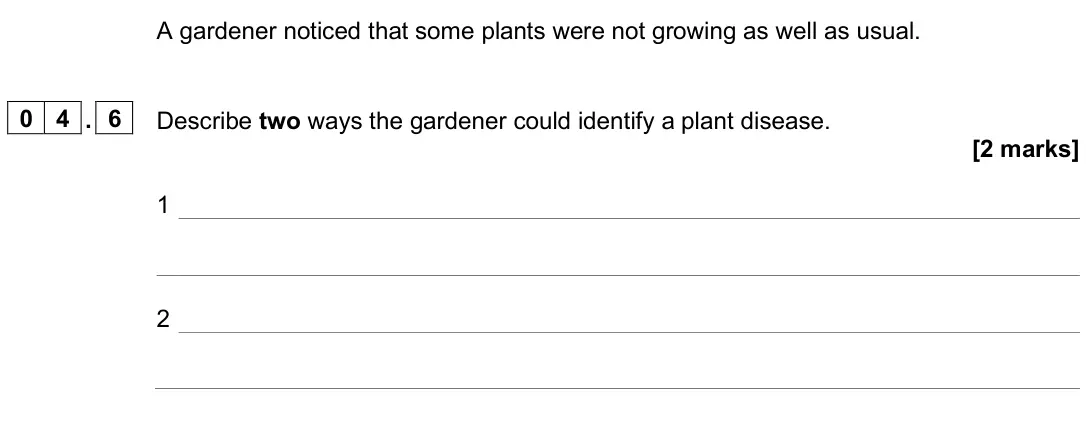
Q04.7
The whole paper ↗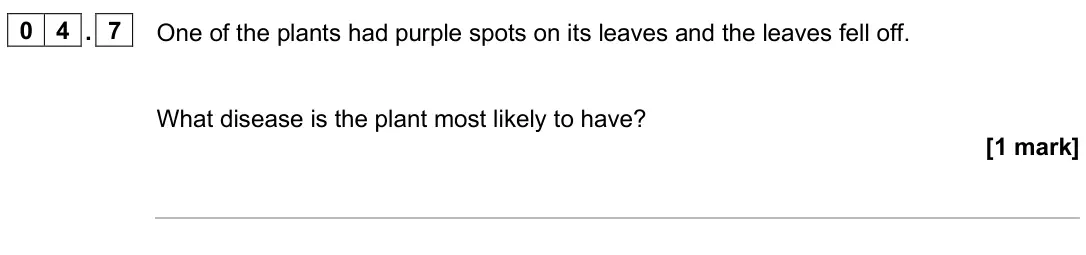
Q04.8
The whole paper ↗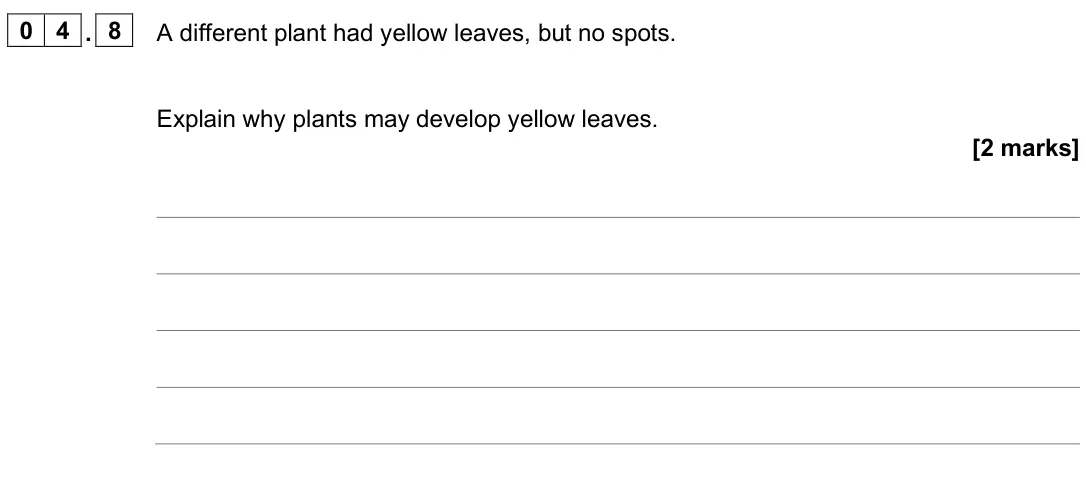
Q05.1
The whole paper ↗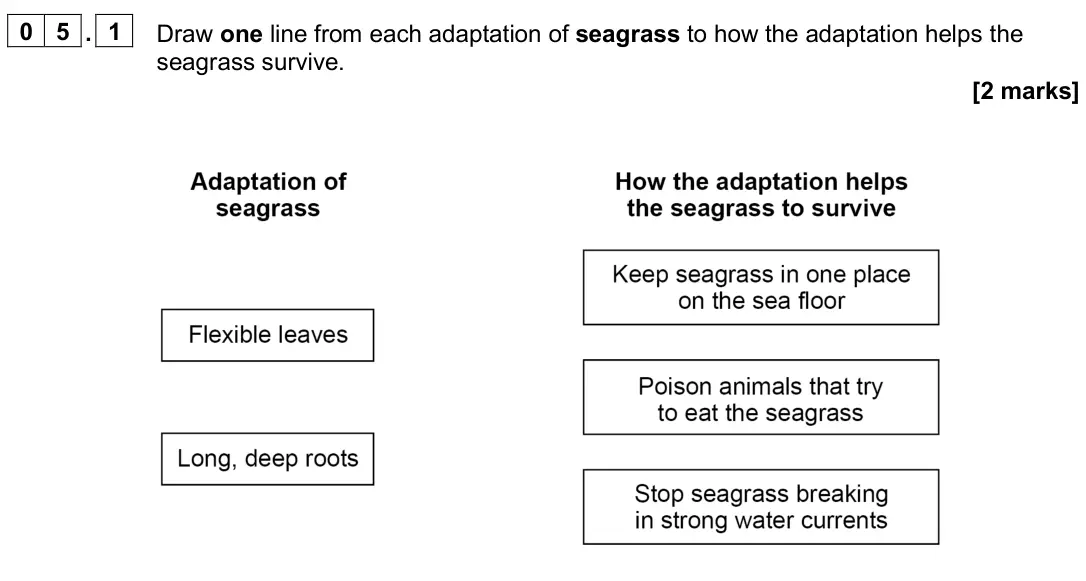
Q07.4
The whole paper ↗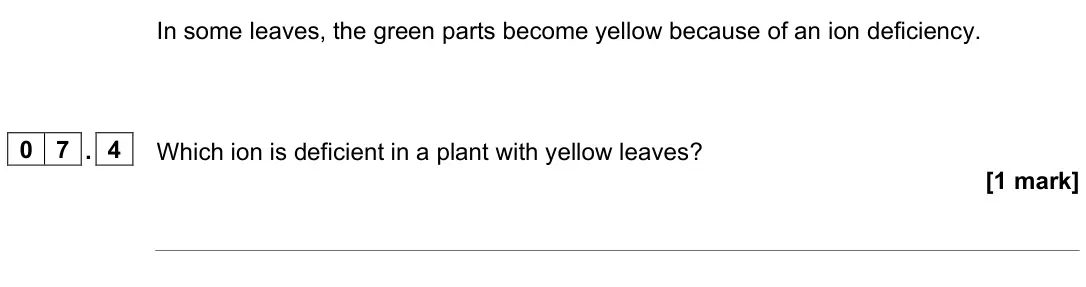
Q07.5
The whole paper ↗
Q01.5
The whole paper ↗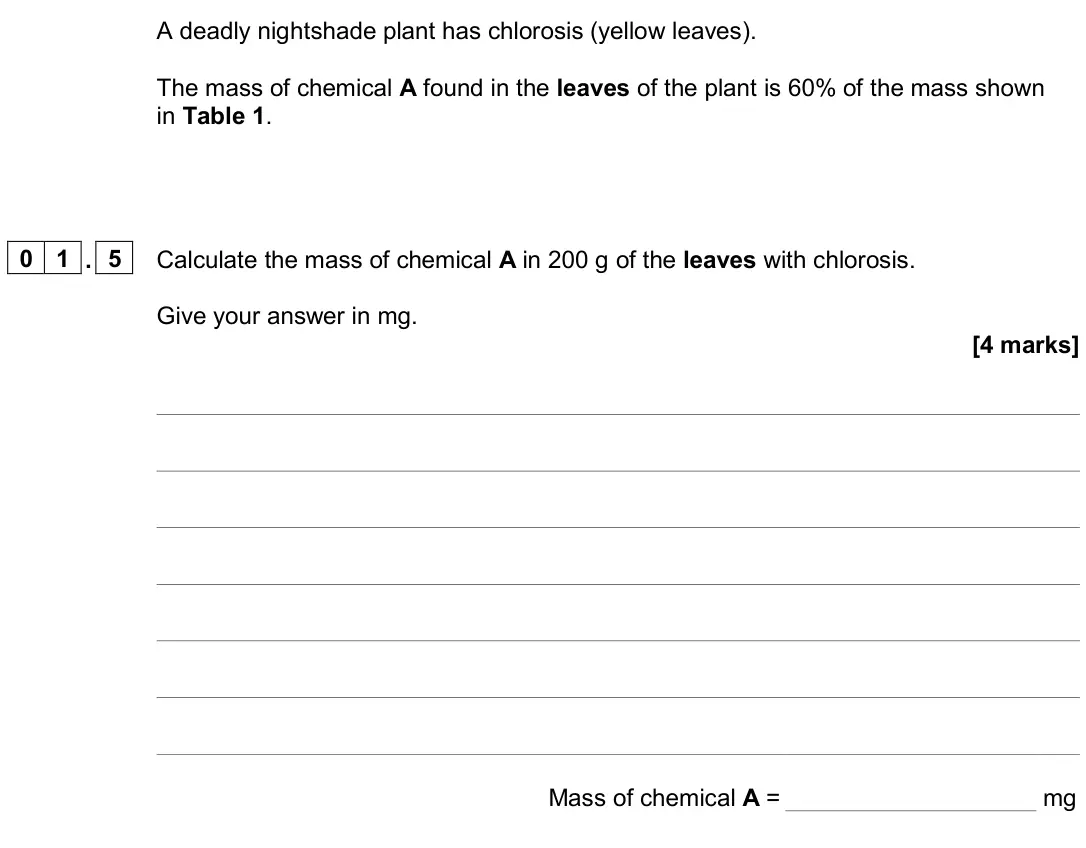
Q01.6
The whole paper ↗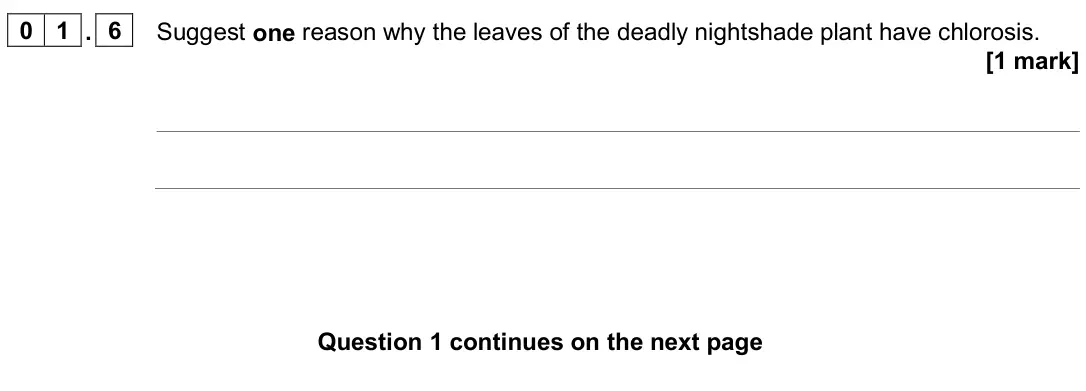
Q06.5
The whole paper ↗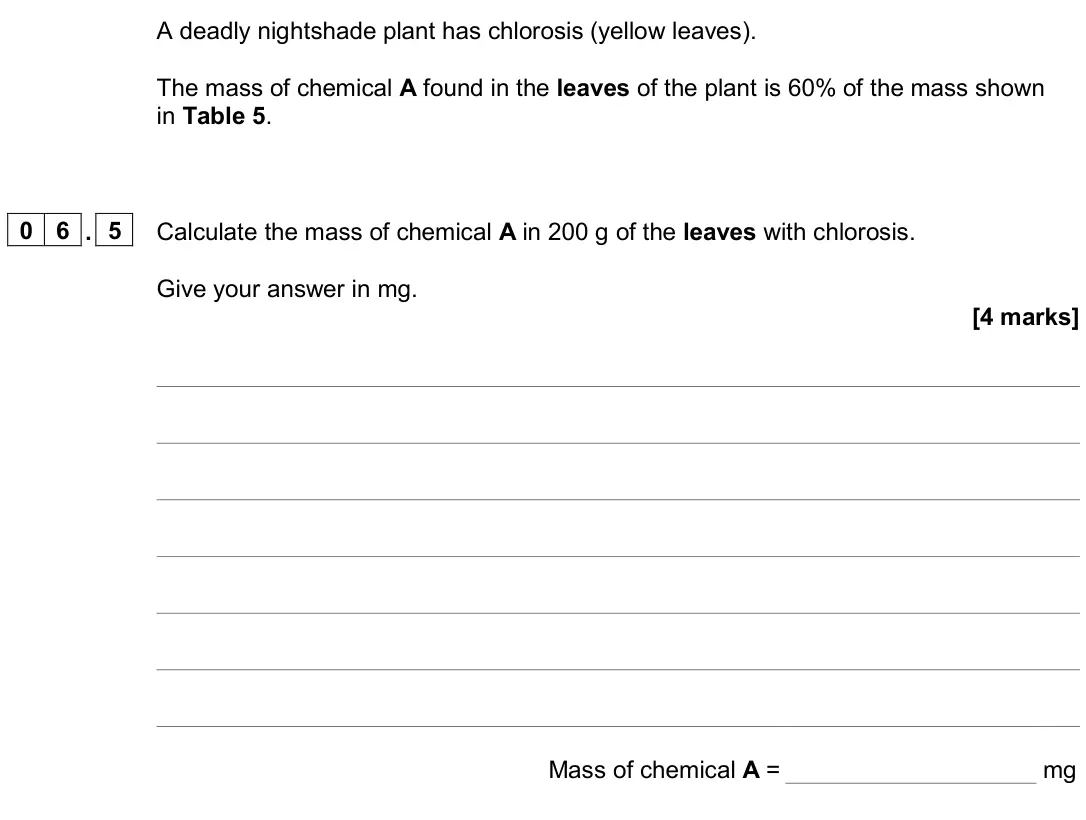
Q06.6
The whole paper ↗
Q04.1
The whole paper ↗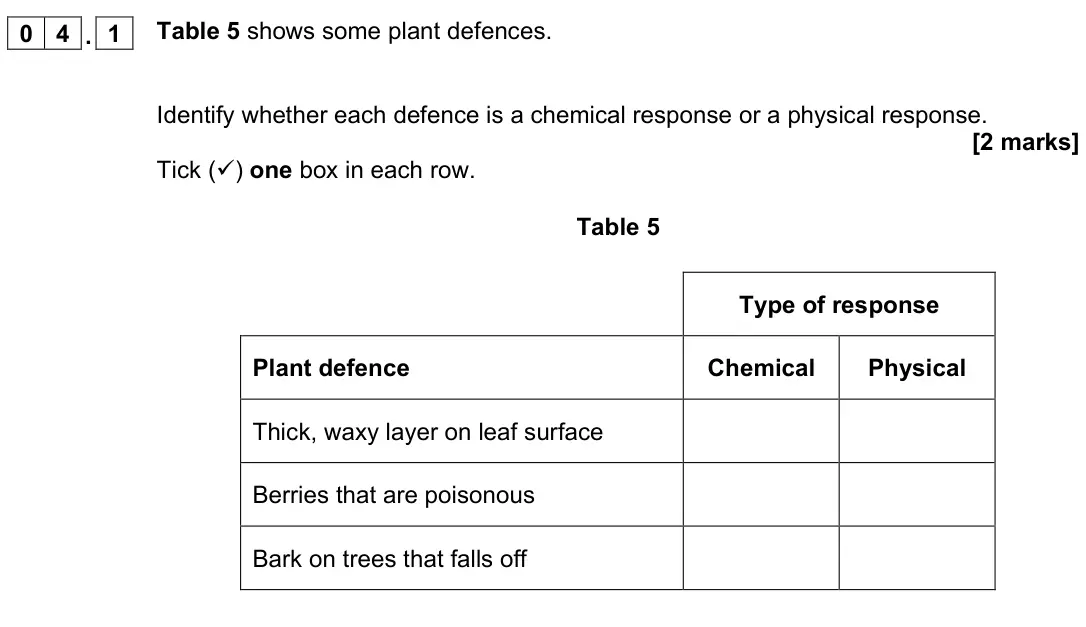
Q04.2
The whole paper ↗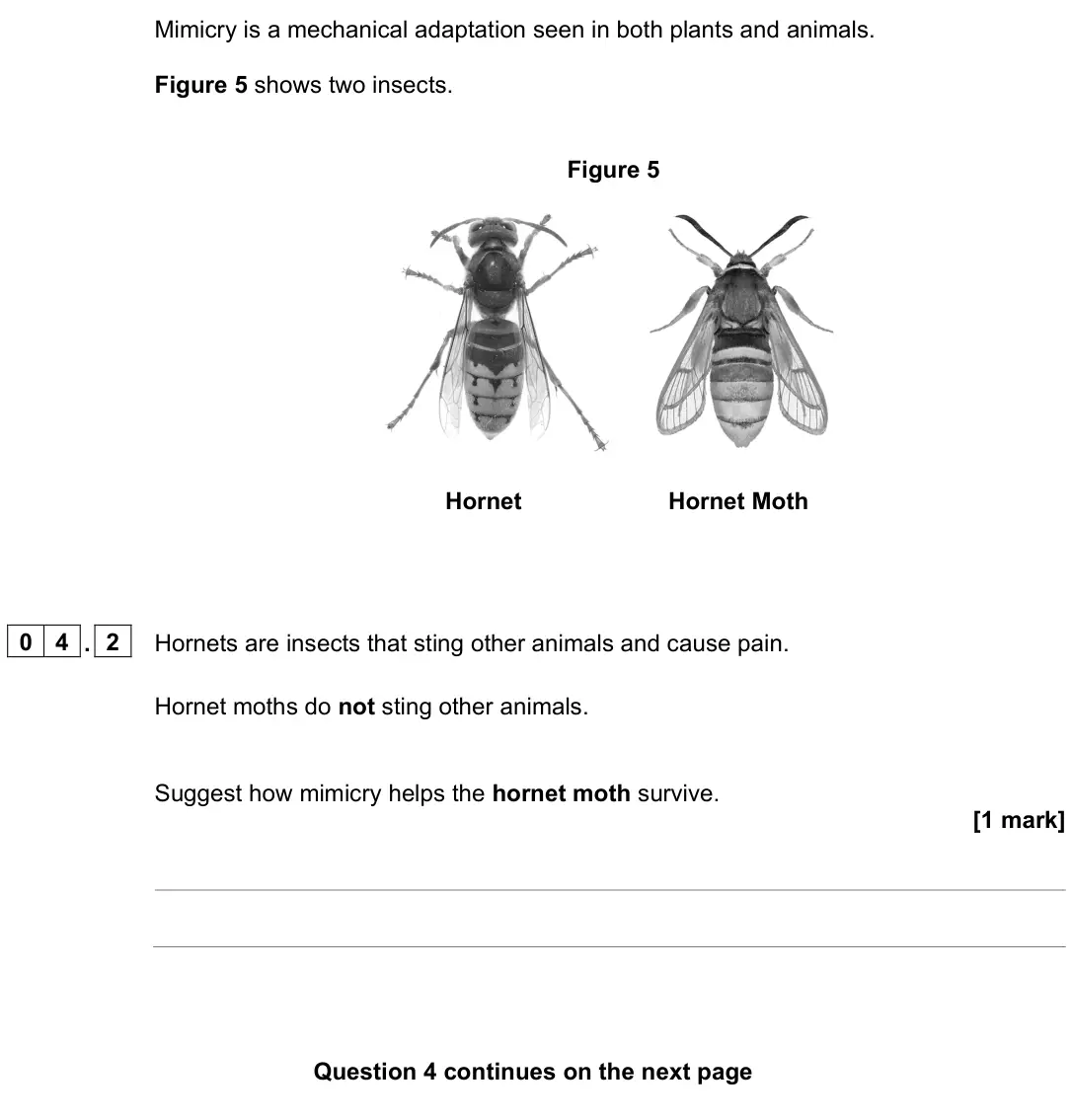
Q05.7
The whole paper ↗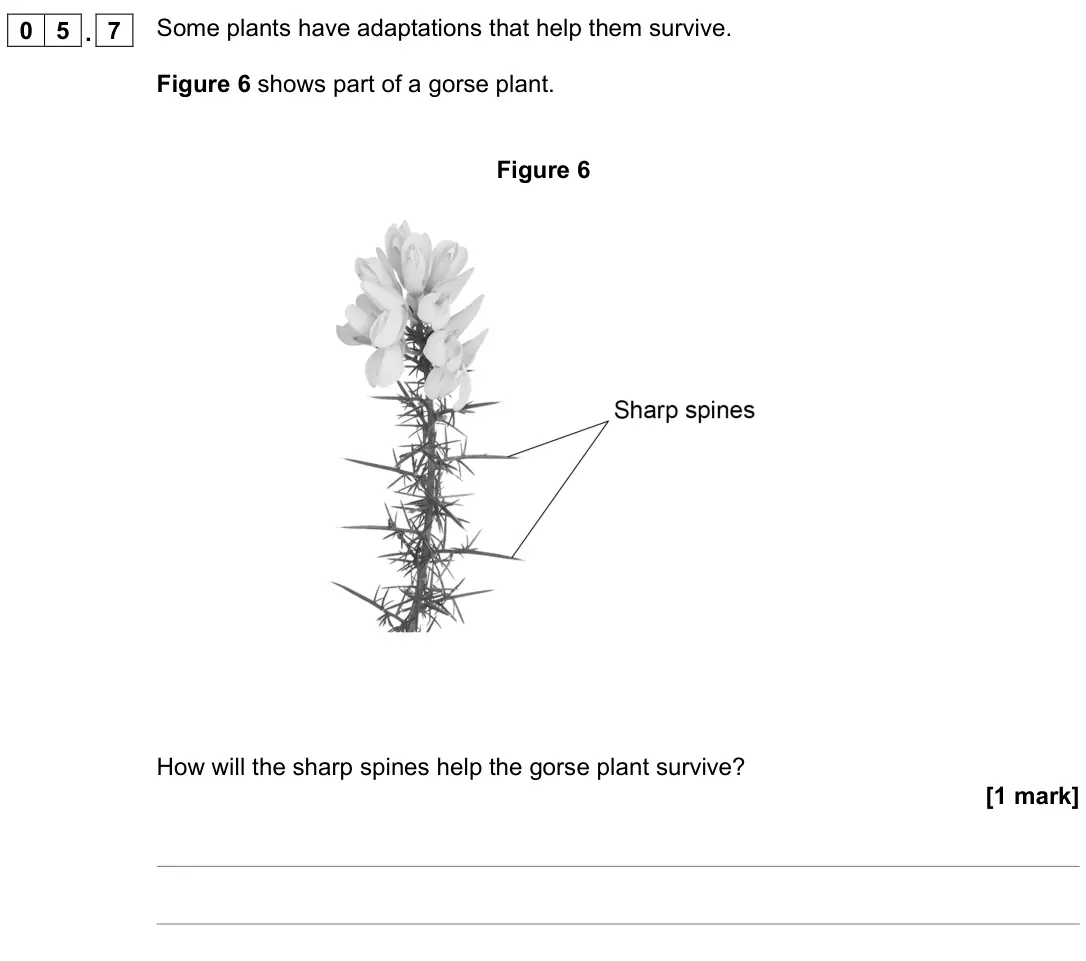
Q05.8
The whole paper ↗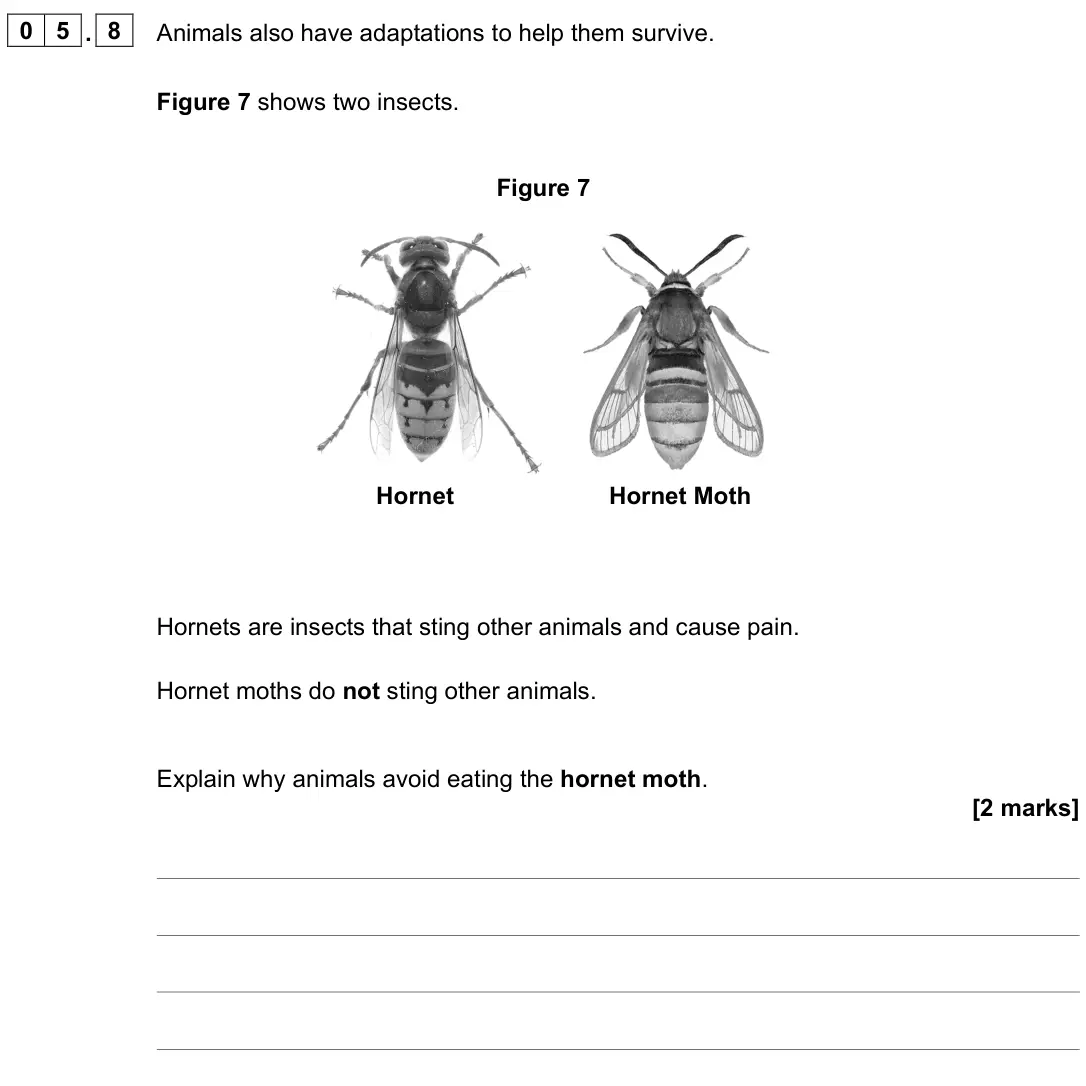
Q03.1
The whole paper ↗
Q03.2
The whole paper ↗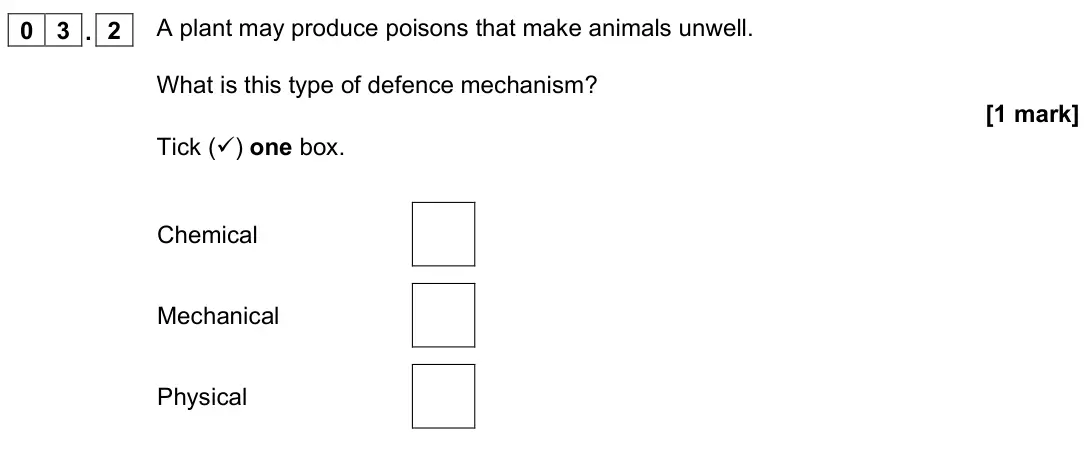
Q05.1
The whole paper ↗
Q05.2
The whole paper ↗
Q05.3
The whole paper ↗
Q05.4
The whole paper ↗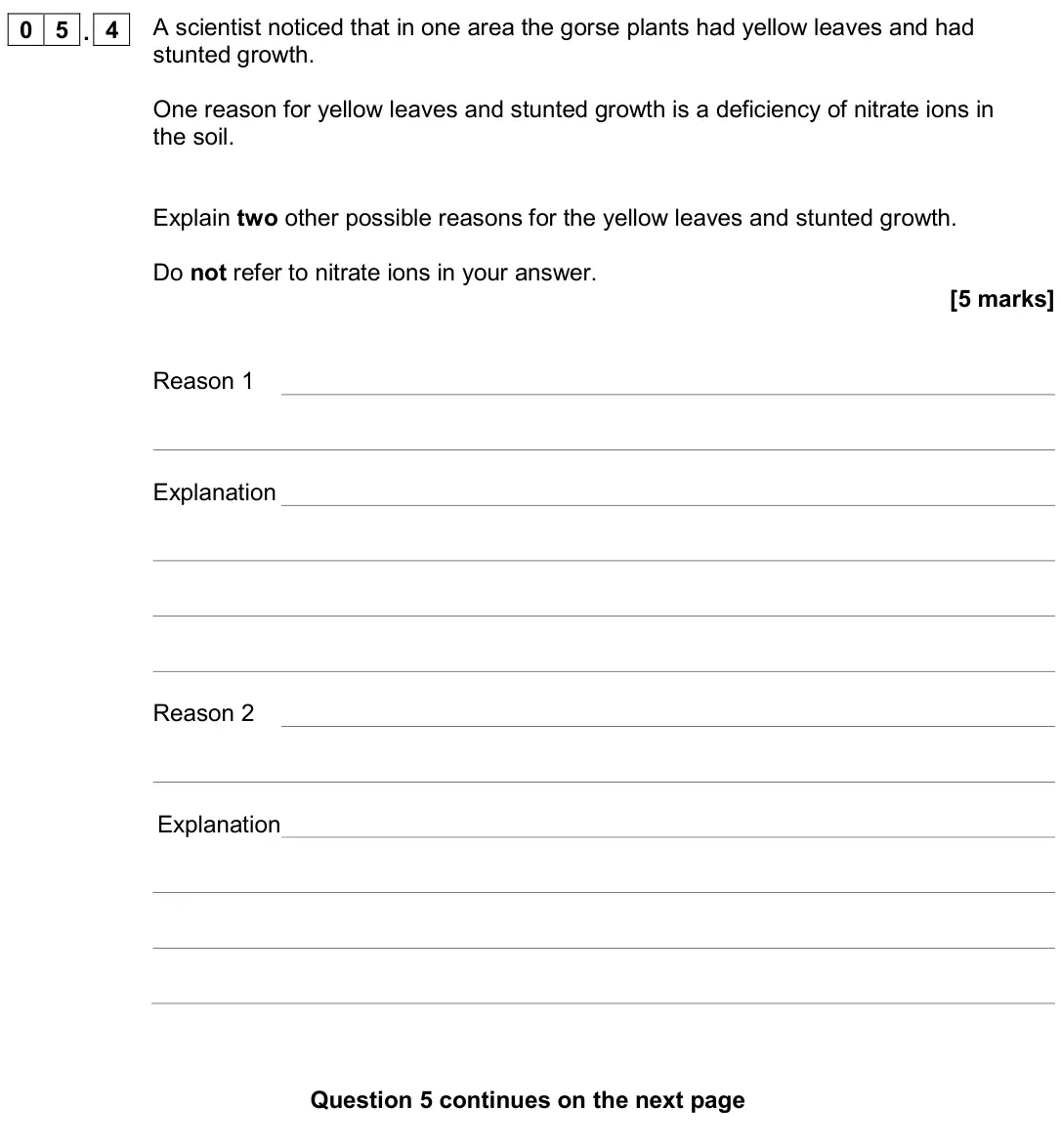
All 38 questions on Plant disease, as a list
- June 2025, Paper 1 Higher, Q04.6 (2 marks): Describe two ways the gardener could identify a plant disease. [2 marks] 1 2
- June 2025, Paper 1 Higher, Q04.7 (1 mark): One of the plants had purple spots on its leaves and the leaves fell off. What disease is the plant most likely to have? [1 mark]
- June 2025, Paper 1 Higher, Q04.8 (2 marks): A different plant had yellow leaves, but no spots. Explain why plants may develop yellow leaves. [2 marks]
- June 2025, Paper 1 Foundation, Q05.1 (2 marks): Draw one line from each adaptation of seagrass to how the adaptation helps the seagrass survive. [2 marks]
- June 2024, Paper 1 Higher, Q07.4 (1 mark): Which ion is deficient in a plant with yellow leaves? [1 mark]
- June 2024, Paper 1 Higher, Q07.5 (1 mark): Give the scientific term that describes the yellow colour of the leaves. [1 mark]
- June 2023, Paper 1 Higher, Q01.5 (4 marks): Calculate the mass of chemical A in 200 g of the leaves with chlorosis. Give your answer in mg. [4 marks] Mass of chemical A = mg
- June 2023, Paper 1 Higher, Q01.6 (1 mark): Suggest one reason why the leaves of the deadly nightshade plant have chlorosis. [1 mark]
- June 2023, Paper 1 Foundation, Q06.5 (4 marks): Calculate the mass of chemical A in 200 g of the leaves with chlorosis. Give your answer in mg. [4 marks] Mass of chemical A = mg
- June 2023, Paper 1 Foundation, Q06.6 (1 mark): Suggest one reason why the leaves of the deadly nightshade plant have chlorosis. [1 mark]
- June 2022, Paper 1 Higher, Q04.1 (2 marks): Table 5 shows some plant defences. Identify whether each defence is a chemical response or a physical response. [2 marks] Tick () one box in each row. Table 5
- June 2022, Paper 1 Higher, Q04.2 (1 mark): Hornets are insects that sting other animals and cause pain. Hornet moths do not sting other animals. Suggest how mimicry helps the hornet moth survive. [1 mark
- June 2022, Paper 1 Foundation, Q05.7 (1 mark): Some plants have adaptations that help them survive. Figure 6 shows part of a gorse plant. Figure 6 How will the sharp spines help the gorse plant survive? [1 m
- June 2022, Paper 1 Foundation, Q05.8 (2 marks): Animals also have adaptations to help them survive. Figure 7 shows two insects. Figure 7 Hornet Hornet Moth Hornets are insects that sting other animals and cau
- November 2021, Paper 1 Foundation, Q03.1 (1 mark): Give one adaptation shown in Figure 6 that helps to prevent the cactus from being eaten by animals. [1 mark]
- November 2021, Paper 1 Foundation, Q03.2 (1 mark): A plant may produce poisons that make animals unwell. What is this type of defence mechanism? [1 mark] Tick () one box. Chemical Mechanical Physical
- November 2020, Paper 1 Higher, Q05.1 (1 mark): The gorse plant has evolved to have sharp thorns. What type of defence response are thorns? [1 mark]
- November 2020, Paper 1 Higher, Q05.2 (1 mark): How do thorns defend the gorse plant? [1 mark]
- November 2020, Paper 1 Higher, Q05.3 (1 mark): The deadly nightshade plant has poisonous berries. What type of defence response are poisonous berries? [1 mark]
- November 2020, Paper 1 Higher, Q05.4 (5 marks): A scientist noticed that in one area the gorse plants had yellow leaves and had stunted growth. One reason for yellow leaves and stunted growth is a deficiency
- November 2020, Paper 1 Foundation, Q05.1 (1 mark): How will the poisonous berries help the deadly nightshade plant to survive? [1 mark]
- November 2020, Paper 1 Foundation, Q05.2 (1 mark): Which type of defence mechanism are the berries? [1 mark] Tick () one box. Chemical Mechanical Physical
- November 2020, Paper 1 Foundation, Q05.3 (1 mark): Suggest how the gorse plant is adapted to defend itself. [1 mark]
- June 2018, Paper 1 Higher, Q05.2 (5 marks): Plants infected with aphids may show symptoms of magnesium deficiency. Magnesium deficiency symptoms include: • yellow leaves • stunted growth. Explain how a de
- Specimen, Paper 1 Higher, Q02.1: All tools should be washed in disinfectant after using them on plants infected with TMV. Suggest why. [1 ma
- Specimen, Paper 1 Higher, Q02.4 (4 marks): TMV can cause plants to produce less chlorophyll. This causes leaf discoloration. Explain why plants with TMV have stunted growth. [4 marks 8
- Specimen, Paper 1 Higher, Q07.1: Some of the plants have a disease. Give two ways the gardener could identify the pathogen infecting the plants. [2 mar 1 2
- Specimen, Paper 1 Higher, Q07.2: Plants can become unhealthy if they do not have essential mineral ions. Describe the appearance of plants with: • nitrate deficiency • magnesium deficiency. [2
- Specimen, Paper 1 Higher, Q07.3 (4 marks): Plants need other mineral ions. • Potassium ions are needed for healthy root growth. • Phosphate ions are needed for healthy flowers and fruits. The gardener ma
- Specimen, Paper 1 Foundation, Q06.1 (3 marks): Explain how the nettle is adapted for defence and protection. [3 marks
- Specimen, Paper 1 Foundation, Q06.2: Which plant oil is the most effective at preventing the growth of bacteria? Give a reason for your answer. [2 mar Oil Reason 5
- Specimen, Paper 1 Foundation, Q06.3 (1 mark): The student tested tea tree oil using the same method. The results showed tea tree oil was the most effective at preventing bacterial growth. The student conclu
- Specimen, Paper 1 Foundation, Q08.1: Which plant was grown with no nitrate? [1 ma Tick one box. A B C D
- Specimen, Paper 1 Foundation, Q08.2: Which plant was grown with no magnesium? [1 ma Tick one box. A B C D 3
- Specimen, Paper 1 Foundation, Q08.3 (1 mark): Give one variable that was kept constant in this experiment. [1 mark
- Specimen, Paper 1 Foundation, Q08.4 (2 marks): Plants need other minerals for healthy growth such as potassium ions and phosphate ions. A farmer wanted to compare the percentage of minerals in two types of m
- Specimen, Paper 1 Foundation, Q10.1: All tools should be washed in disinfectant after using them on plants infected with TMV. Suggest why. [1 ma
- Specimen, Paper 1 Foundation, Q10.4 (4 marks): TMV can cause plants to produce less chlorophyll. This causes leaf discoloration. Explain why plants with TMV have stunted growth. [4 marks 38
Questions, mark schemes and examiner’s reports are © AQA, from their published past papers. Plumi isn’t affiliated with any exam board. Want whole papers? Every AQA GCSE Biology paper.
Rather write your answers by hand on iPad? Plumi marks them against the same mark schemes.