 plumi
Forensic psychology: AQA A‑Level Psychology questions
Every AQA A-Level Psychology exam question on 4.3.9 Forensic psychology, 2020–2025, with its mark scheme and examiner’s report.
Find questions669
Calculations










All 26 questions on Forensic psychology, as a list
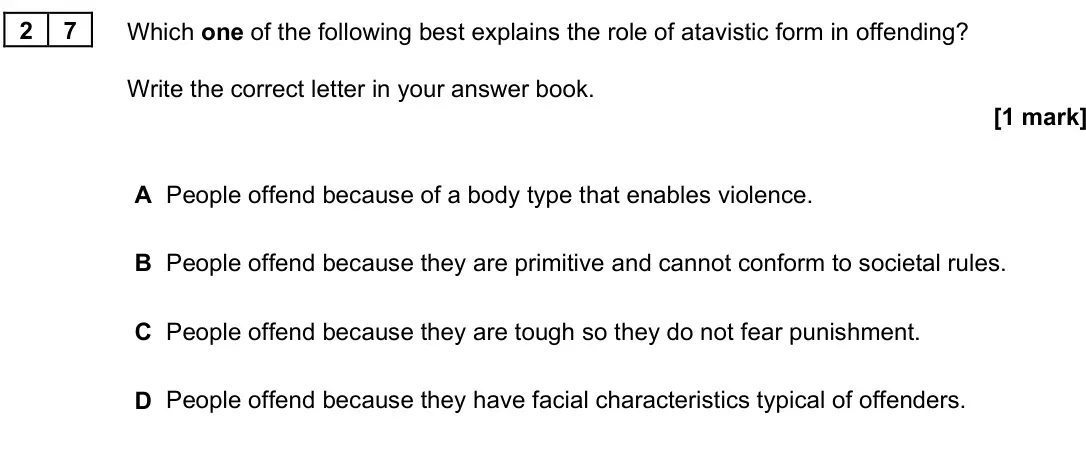
- June 2025, Paper 3, Q27 (1 mark): Which one of the following best explains the role of atavistic form in offending? Write the correct letter in your answer book. [1 mark] A People offend because
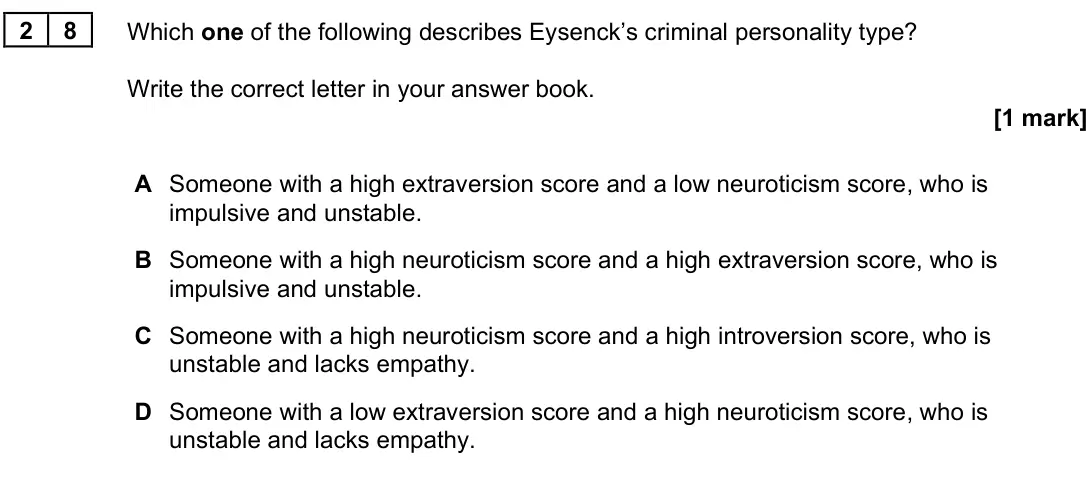
- June 2025, Paper 3, Q28 (1 mark): Which one of the following describes Eysenck’s criminal personality type? Write the correct letter in your answer book. [1 mark] A Someone with a high extravers
- June 2025, Paper 3, Q29 (2 marks): Briefly outline one aim of custodial sentencing. [2 marks]
- June 2025, Paper 3, Q30 (4 marks): Briefly evaluate custodial sentencing as a way of dealing with offending behaviour. [4 marks]
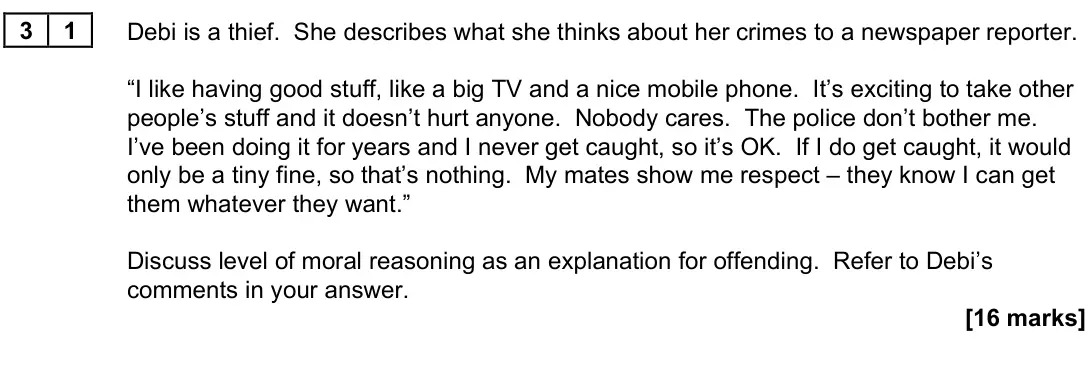
- June 2025, Paper 3, Q31 (16 marks): Debi is a thief. She describes what she thinks about her crimes to a newspaper reporter. “I like having good stuff, like a big TV and a nice mobile phone. It’s
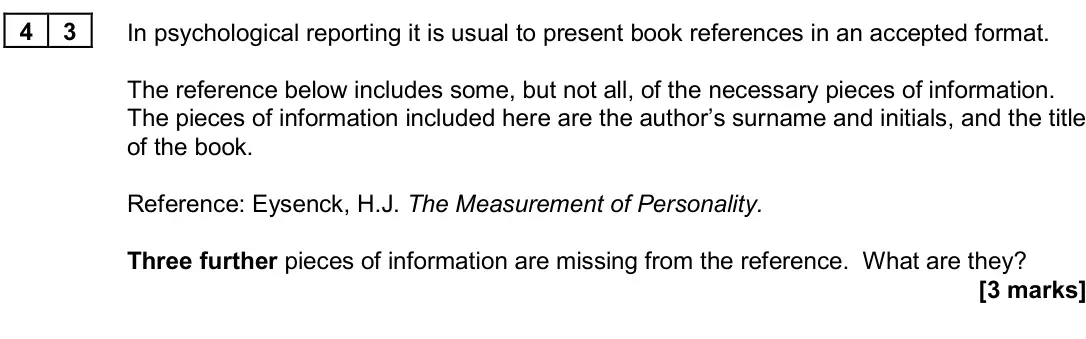
- June 2024, Paper 3, Q43 (3 marks): In psychological reporting it is usual to present book references in an accepted format. The reference below includes some, but not all, of the necessary pieces
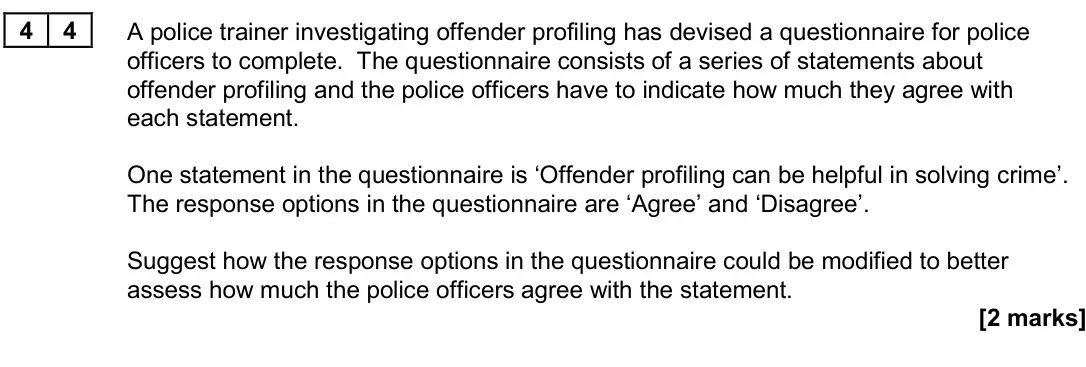
- June 2024, Paper 3, Q44 (2 marks): A police trainer investigating offender profiling has devised a questionnaire for police officers to complete. The questionnaire consists of a series of stateme
- June 2024, Paper 3, Q45 (3 marks): Outline Eysenck’s theory of the criminal personality. [3 marks]
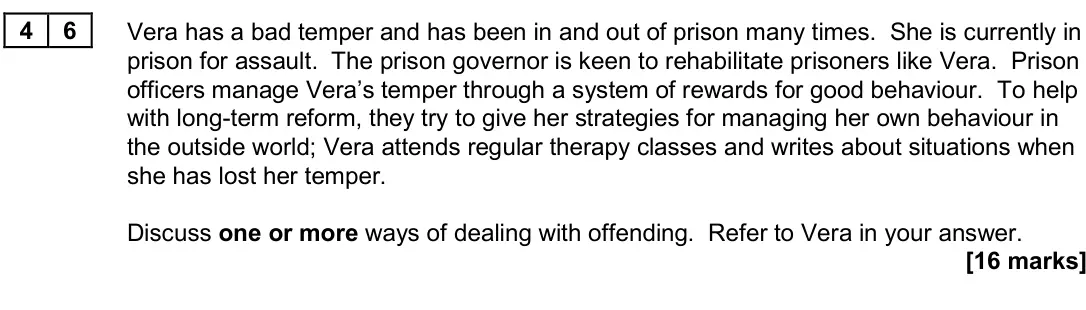
- June 2024, Paper 3, Q46 (16 marks): Vera has a bad temper and has been in and out of prison many times. She is currently in prison for assault. The prison governor is keen to rehabilitate prisoner
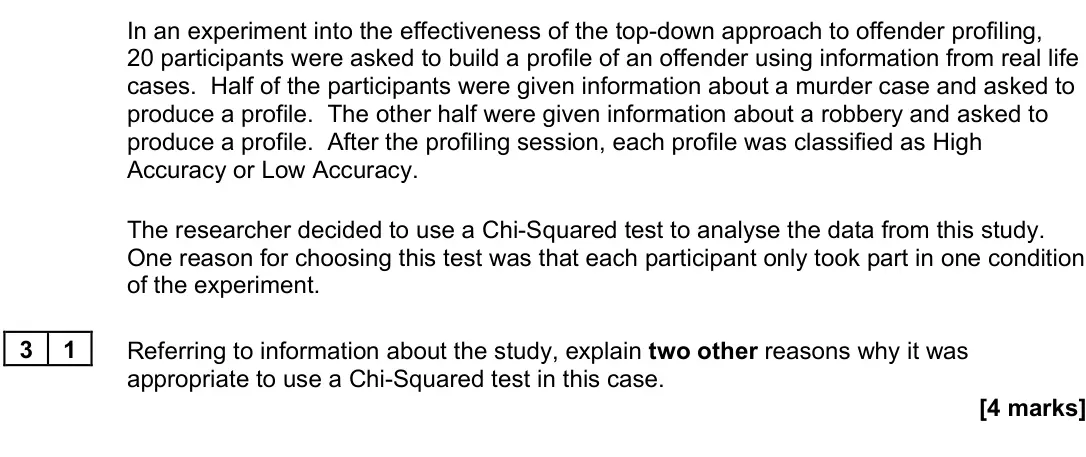
- June 2023, Paper 3, Q31 (4 marks): Referring to information about the study, explain two other reasons why it was appropriate to use a Chi-Squared test in this case. [4 marks]
- June 2023, Paper 3, Q32 (4 marks): Using your knowledge of the top-down approach to offender profiling, explain the likely outcome of the study. [4 marks]
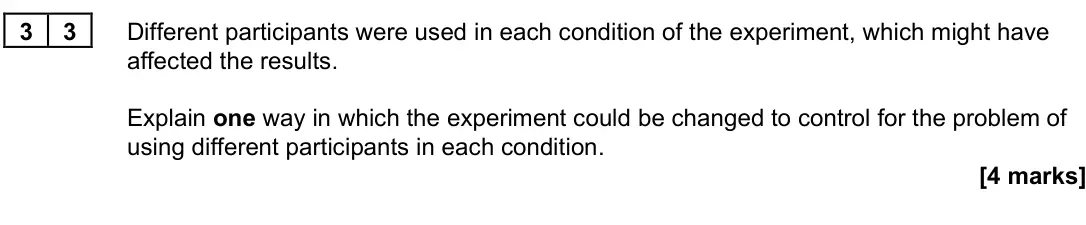
- June 2023, Paper 3, Q33 (4 marks): Different participants were used in each condition of the experiment, which might have affected the results. Explain one way in which the experiment could be ch
- June 2023, Paper 3, Q34 (6 marks): Describe how cognitive distortions might be involved in offending behaviour. [6 marks]
- June 2023, Paper 3, Q35 (6 marks): Evaluate the role of cognitive distortions in offending. [6 marks]
- June 2022, Paper 3, Q34 (4 marks): Outline the bottom-up approach to offender profiling. [4 marks]
- June 2022, Paper 3, Q35 (4 marks): Briefly evaluate the bottom-up approach to offender profiling. [4 marks]
- June 2022, Paper 3, Q36 (16 marks): Discuss psychodynamic explanations of offending. [16 marks]
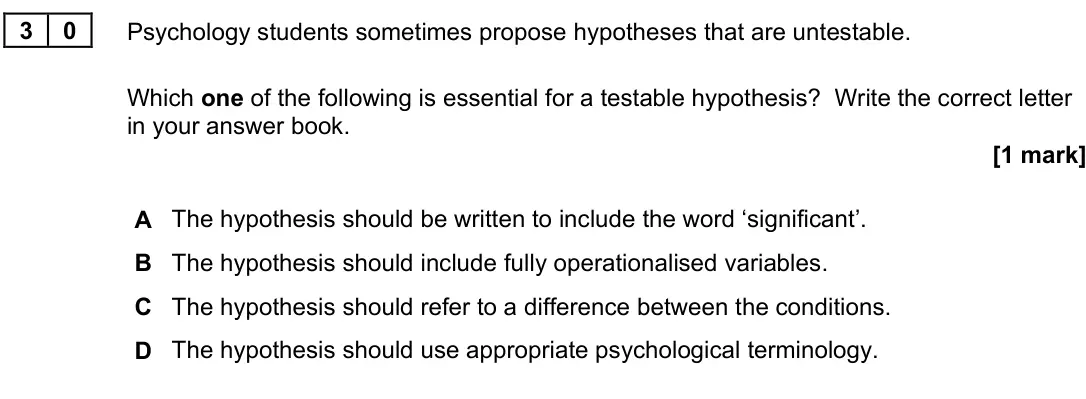
- November 2021, Paper 3, Q30 (1 mark): Psychology students sometimes propose hypotheses that are untestable. Which one of the following is essential for a testable hypothesis? Write the correct lette
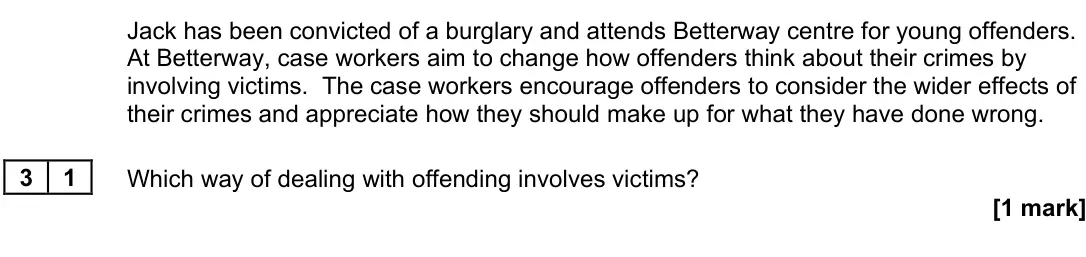
- November 2021, Paper 3, Q31 (1 mark): Which way of dealing with offending involves victims? [1 mark]
- November 2021, Paper 3, Q32 (4 marks): Referring to your answer to Question 31, describe what a case worker might recommend in order for Jack to deal with his offending. [4 marks]
- November 2021, Paper 3, Q33 (2 marks): Outline one limitation of the way of dealing with offending you have described in your answer to Question 32. [2 marks]
- November 2021, Paper 3, Q34 (16 marks): Describe and evaluate one or more of the following biological explanations for offending: atavistic form, genetics, neural. [16 marks]
- November 2020, Paper 3, Q33 (6 marks): Describe psychodynamic explanation(s) for offending behaviour. [6 marks]
- November 2020, Paper 3, Q34 (4 marks): Peter is talking about his offending. Peter says, “I don’t know why it happens. Sometimes when I hear people telling stupid jokes in a bar, I just get cross and
- November 2020, Paper 3, Q35 (6 marks): Outline one strength and one limitation of anger management as a way of dealing with offending. [6 marks]
- November 2020, Paper 3, Q36 (8 marks): Discuss neural explanations for offending behaviour. [8 marks]
Questions, mark schemes and examiner’s reports are © AQA, from their published past papers. Plumi isn’t affiliated with any exam board. Want whole papers? Full past papers.
Rather write your answers by hand on iPad? Plumi marks them against the same mark schemes.