 plumi
Attachment: AQA A‑Level Psychology questions
Every AQA A-Level Psychology exam question on 4.1.3 Attachment, 2020–2025, with its mark scheme and examiner’s report.
Find questions669
Calculations
All 50 questions on Attachment, as a list
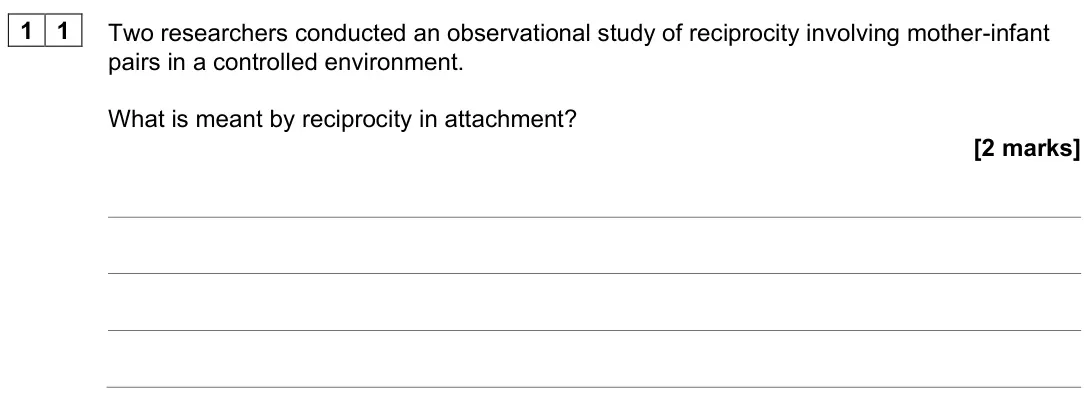
- June 2025, Paper 1, Q11 (2 marks): Two researchers conducted an observational study of reciprocity involving mother-infant pairs in a controlled environment. What is meant by reciprocity in attac
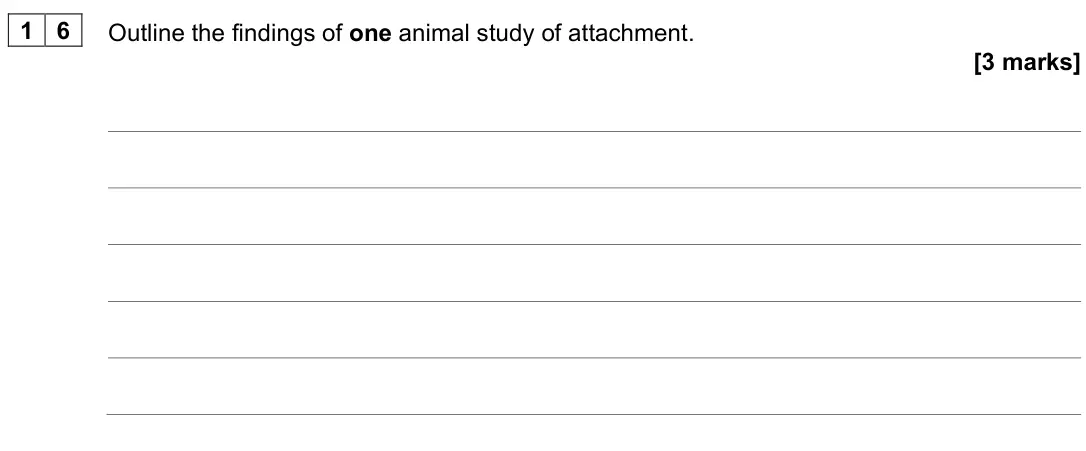
- June 2025, Paper 1, Q16 (3 marks): Outline the findings of one animal study of attachment. [3 marks]
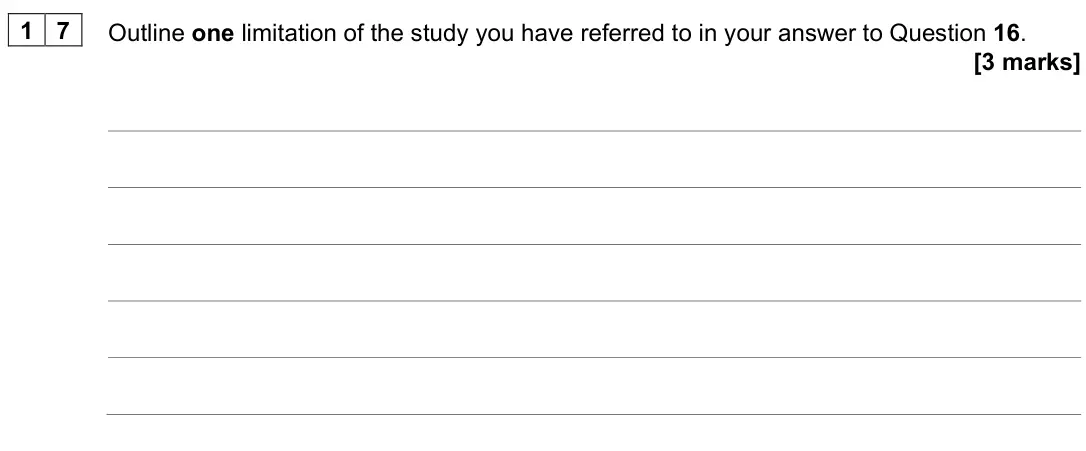
- June 2025, Paper 1, Q17 (3 marks): Outline one limitation of the study you have referred to in your answer to Question 16. [3 marks]
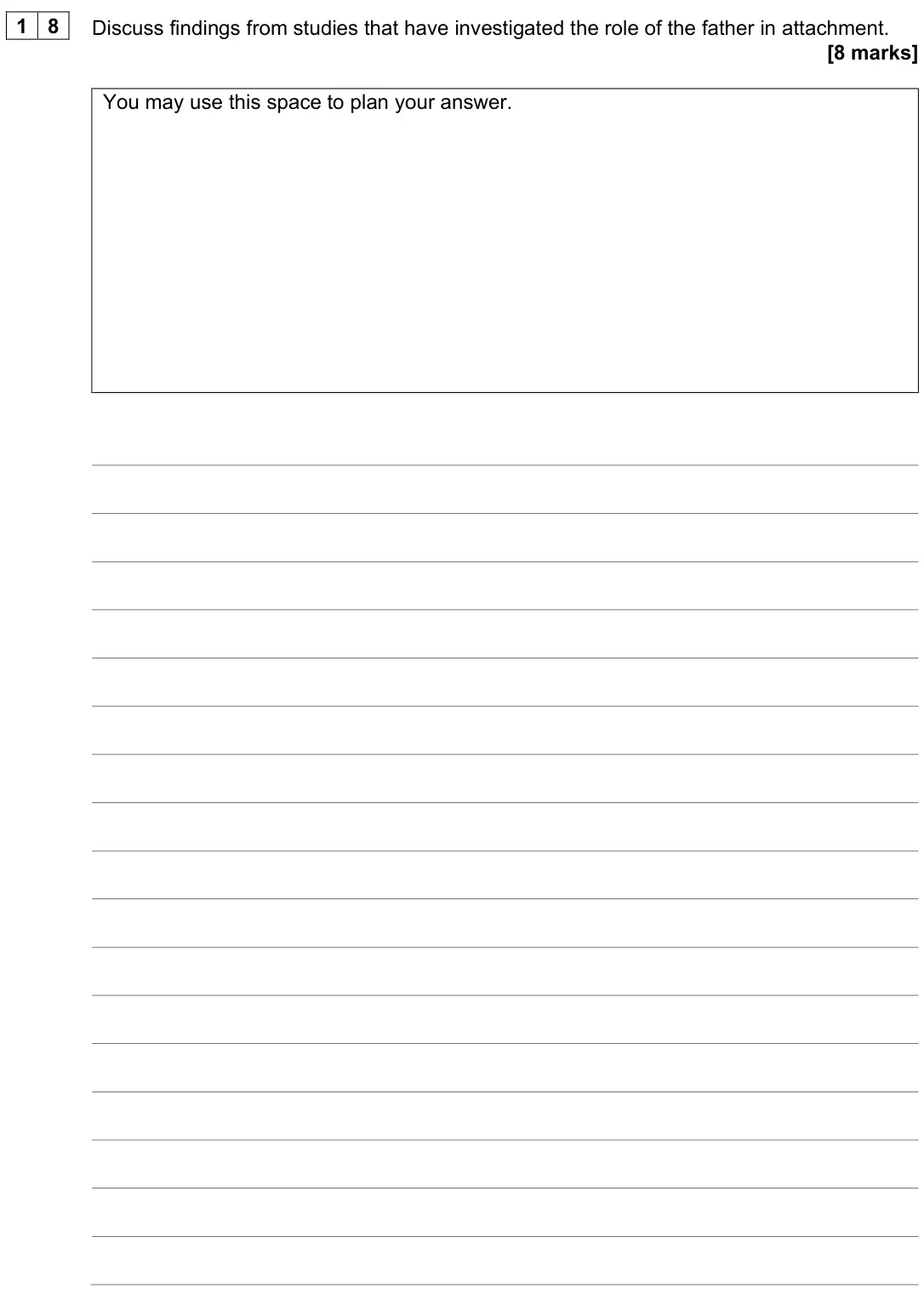
- June 2025, Paper 1, Q18 (8 marks): Discuss findings from studies that have investigated the role of the father in attachment. [8 marks] You may use this space to plan your answer.
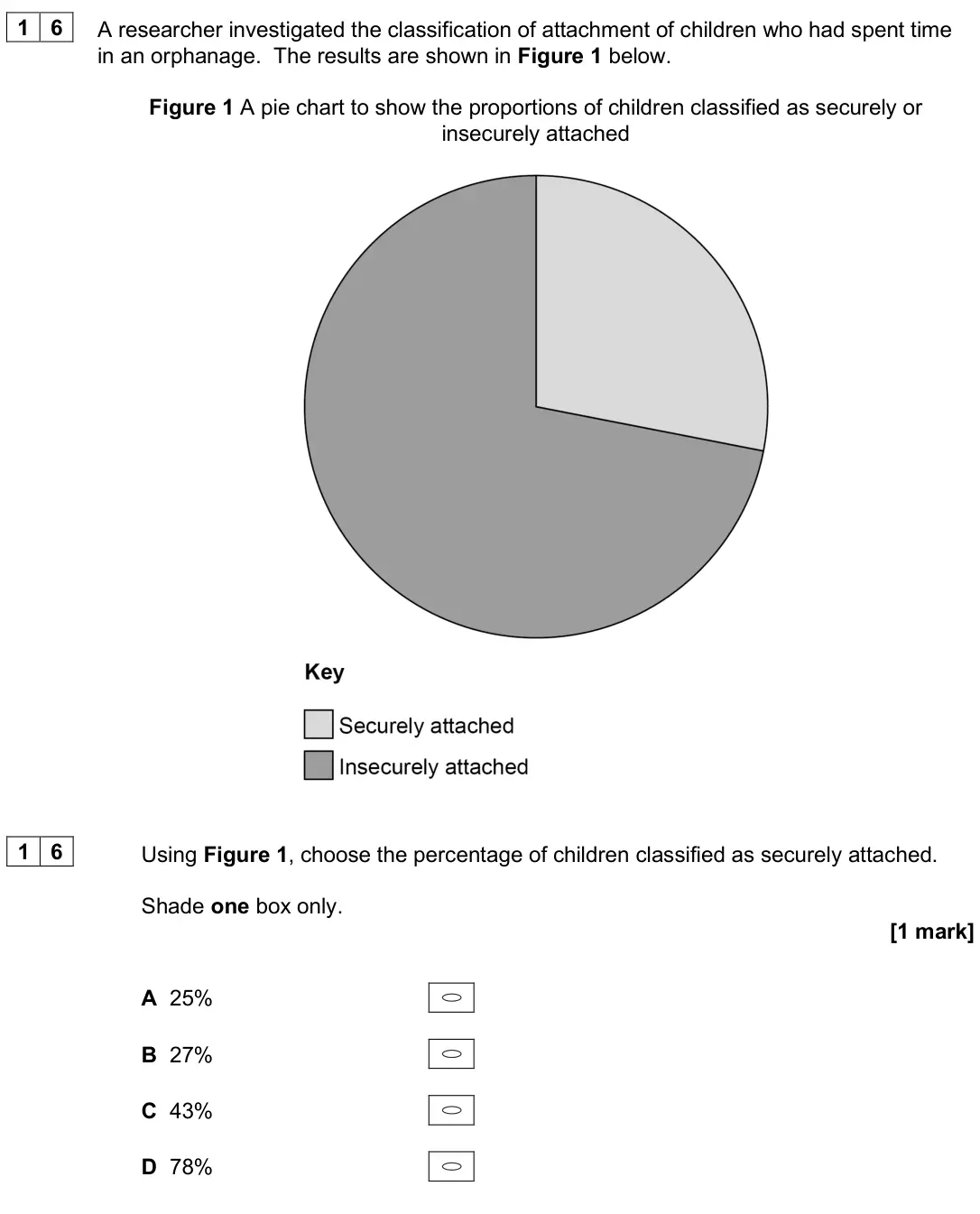
- June 2025, AS Paper 1, Q16 (1 mark): A researcher investigated the classification of attachment of children who had spent time in an orphanage. The results are shown in Figure 1 below. Figure 1 A p
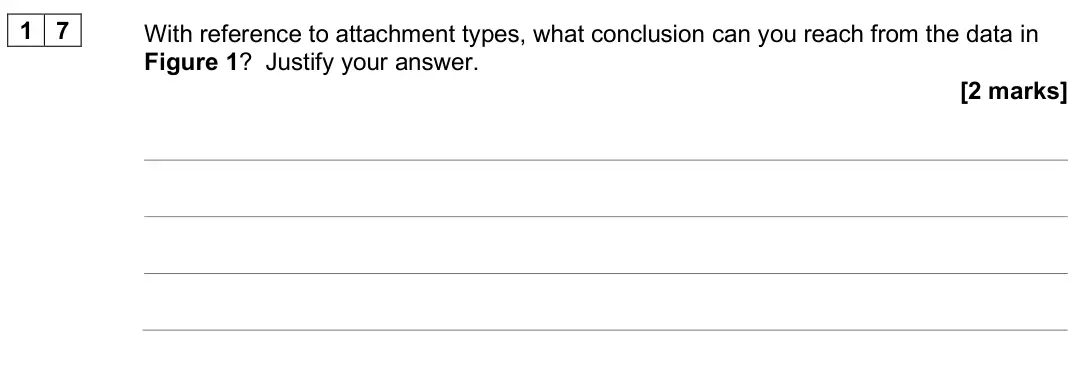
- June 2025, AS Paper 1, Q17 (2 marks): With reference to attachment types, what conclusion can you reach from the data in Figure 1? Justify your answer. [2 marks]
- June 2025, AS Paper 1, Q18 (1 mark): Name one stage of attachment that Schaffer identified. [1 mark]
- June 2025, AS Paper 1, Q19 (3 marks): Outline one other stage of attachment that Schaffer identified. [3 marks]
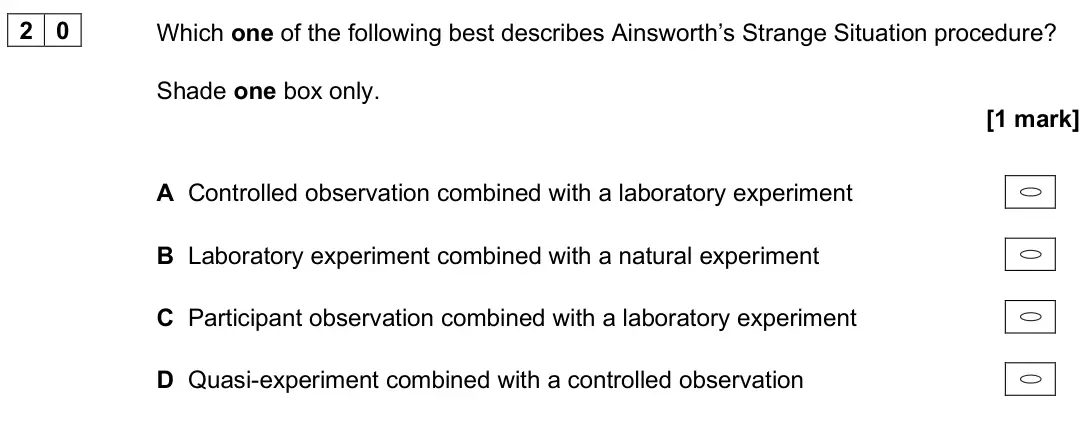
- June 2025, AS Paper 1, Q20 (1 mark): Which one of the following best describes Ainsworth’s Strange Situation procedure? Shade one box only. [1 mark] A Controlled observation combined with a laborat
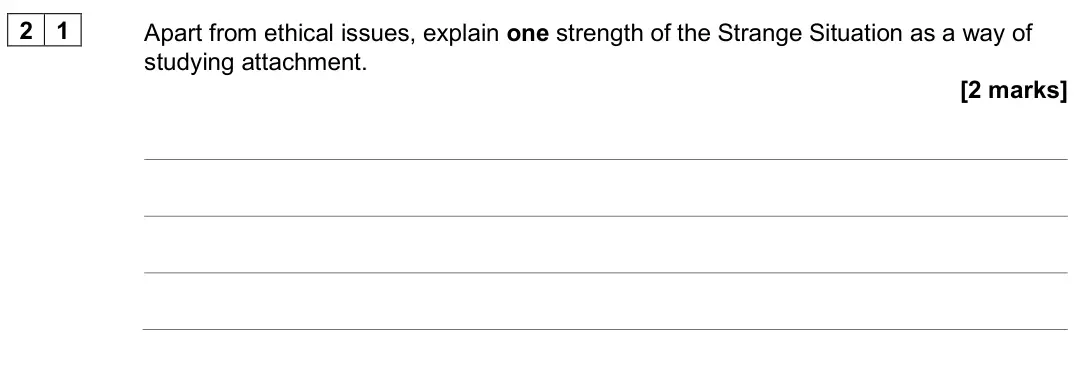
- June 2025, AS Paper 1, Q21 (2 marks): Apart from ethical issues, explain one strength of the Strange Situation as a way of studying attachment. [2 marks]
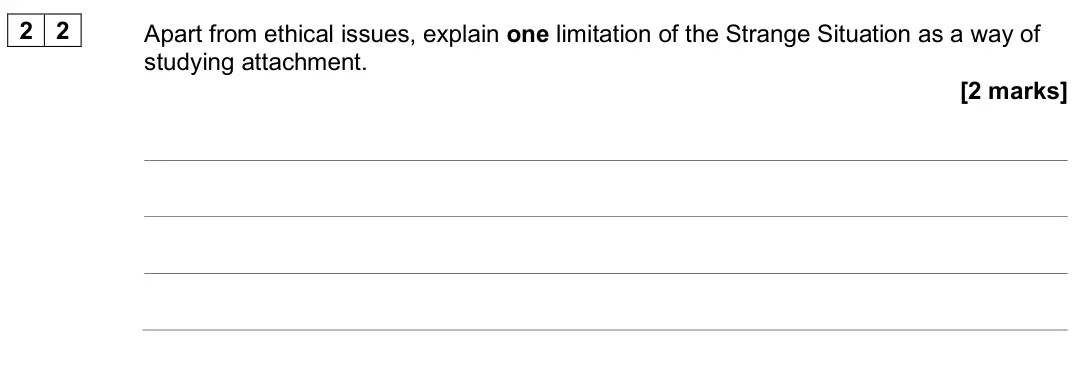
- June 2025, AS Paper 1, Q22 (2 marks): Apart from ethical issues, explain one limitation of the Strange Situation as a way of studying attachment. [2 marks]
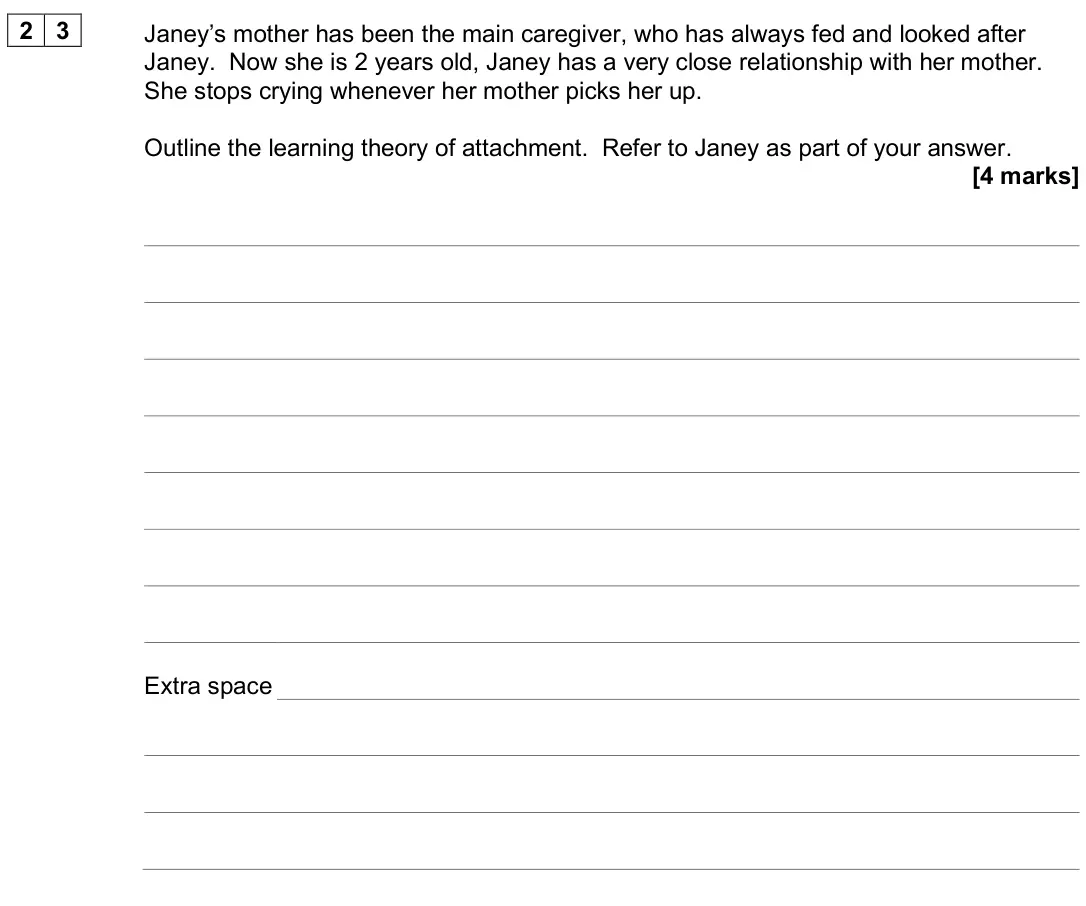
- June 2025, AS Paper 1, Q23 (4 marks): Janey’s mother has been the main caregiver, who has always fed and looked after Janey. Now she is 2 years old, Janey has a very close relationship with her moth
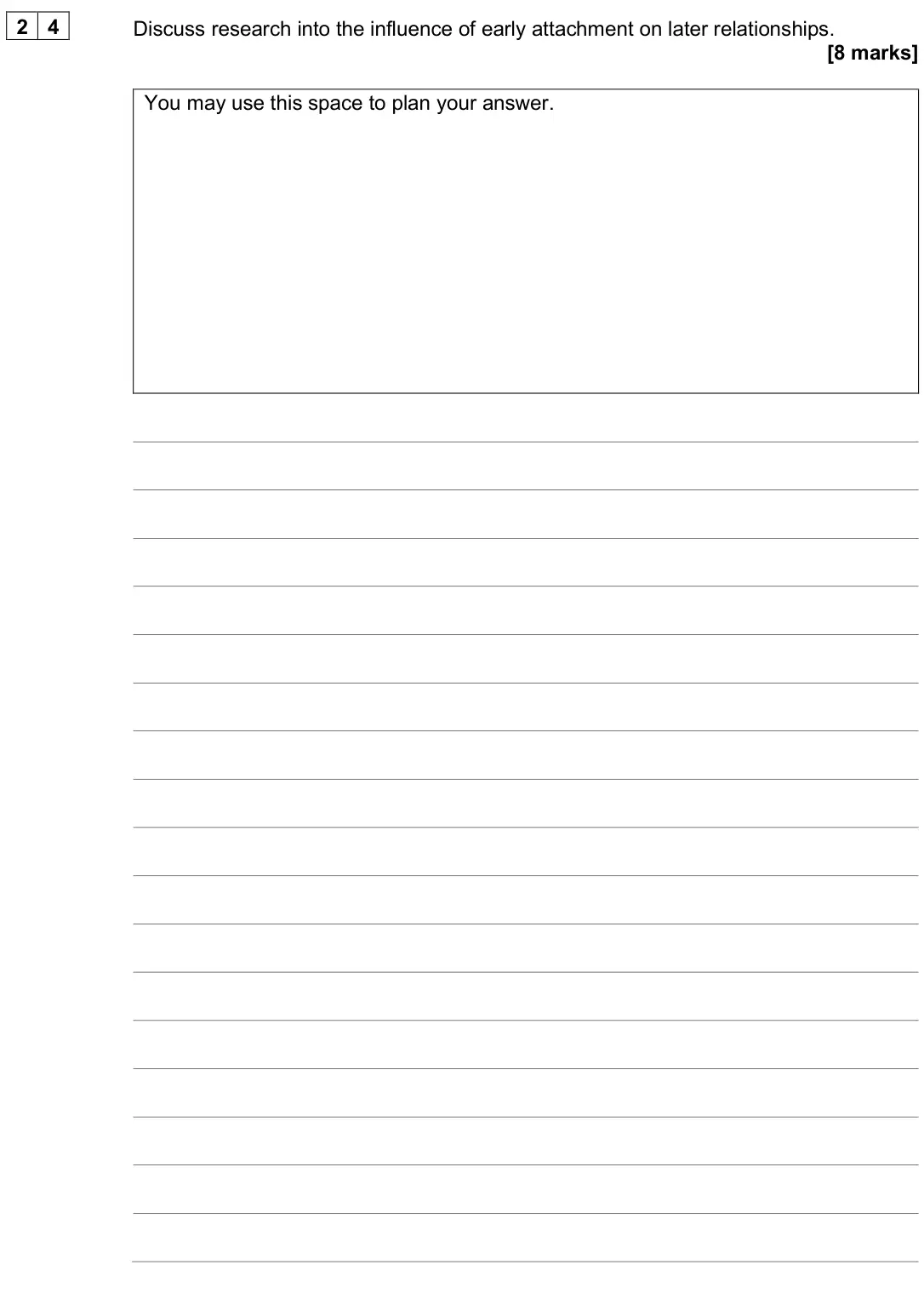
- June 2025, AS Paper 1, Q24 (8 marks): Discuss research into the influence of early attachment on later relationships. [8 marks] You may use this space to plan your answer.
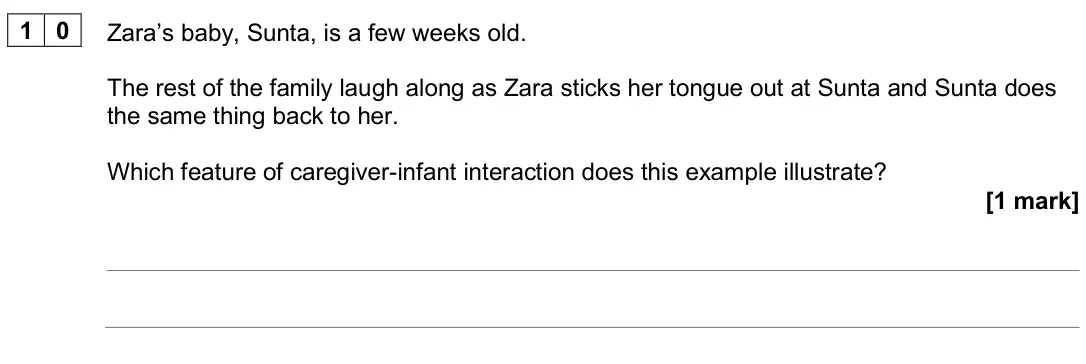
- June 2024, Paper 1, Q10 (1 mark): Zara’s baby, Sunta, is a few weeks old. The rest of the family laugh along as Zara sticks her tongue out at Sunta and Sunta does the same thing back to her. Whi
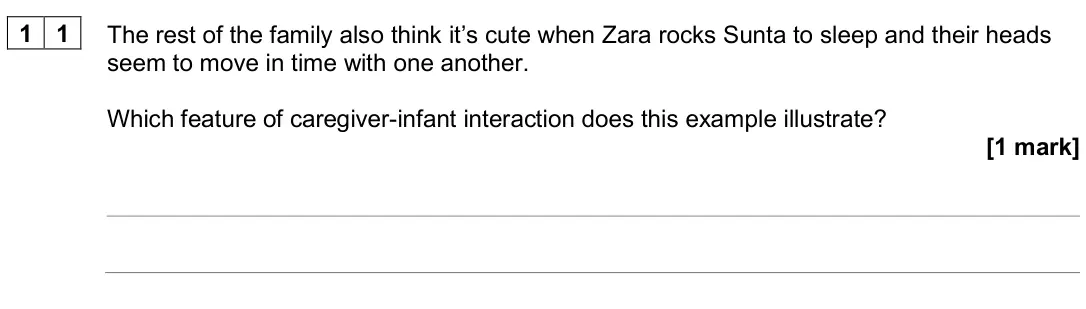
- June 2024, Paper 1, Q11 (1 mark): The rest of the family also think it’s cute when Zara rocks Sunta to sleep and their heads seem to move in time with one another. Which feature of caregiver-inf
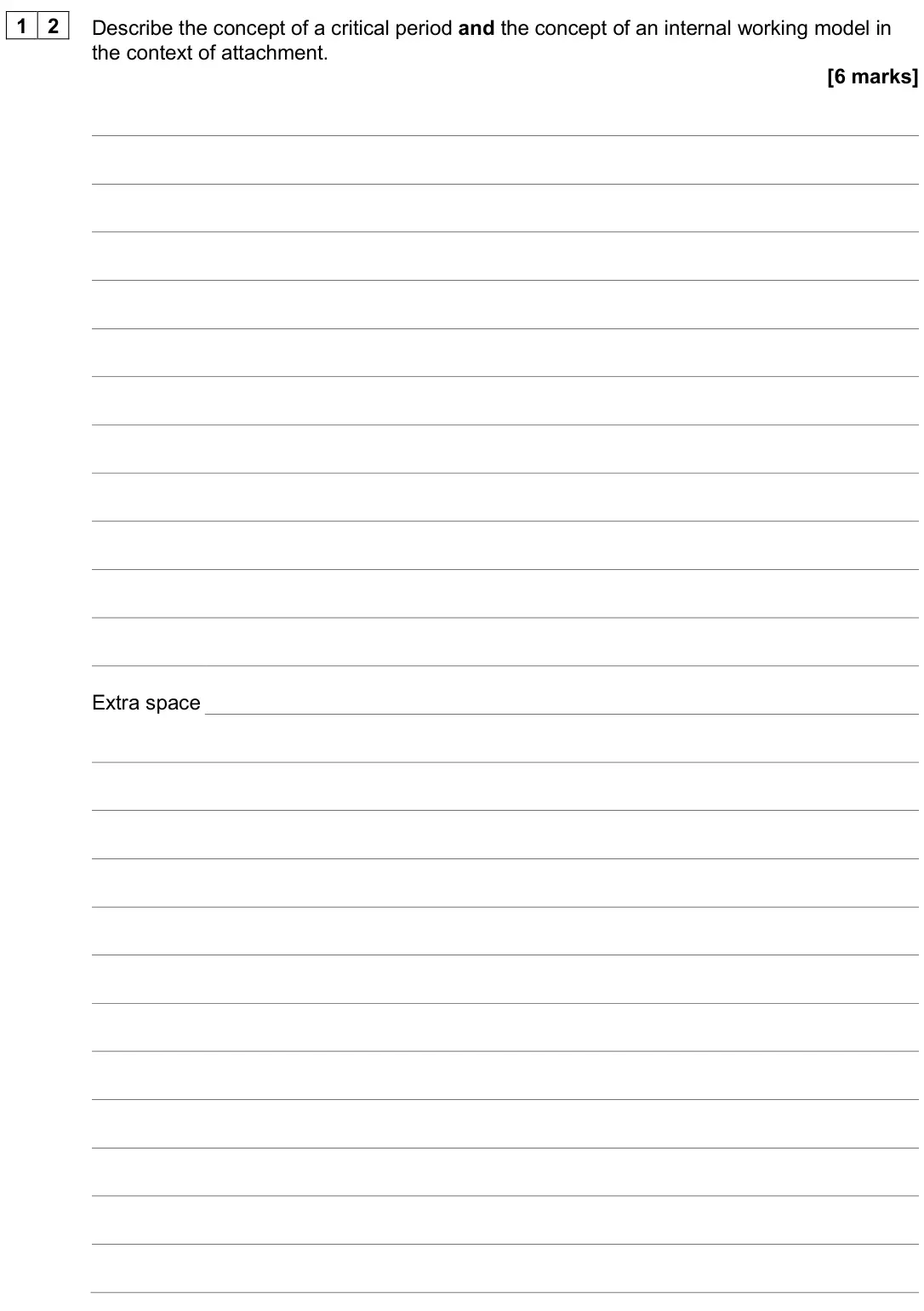
- June 2024, Paper 1, Q12 (6 marks): Describe the concept of a critical period and the concept of an internal working model in the context of attachment. [6 marks]
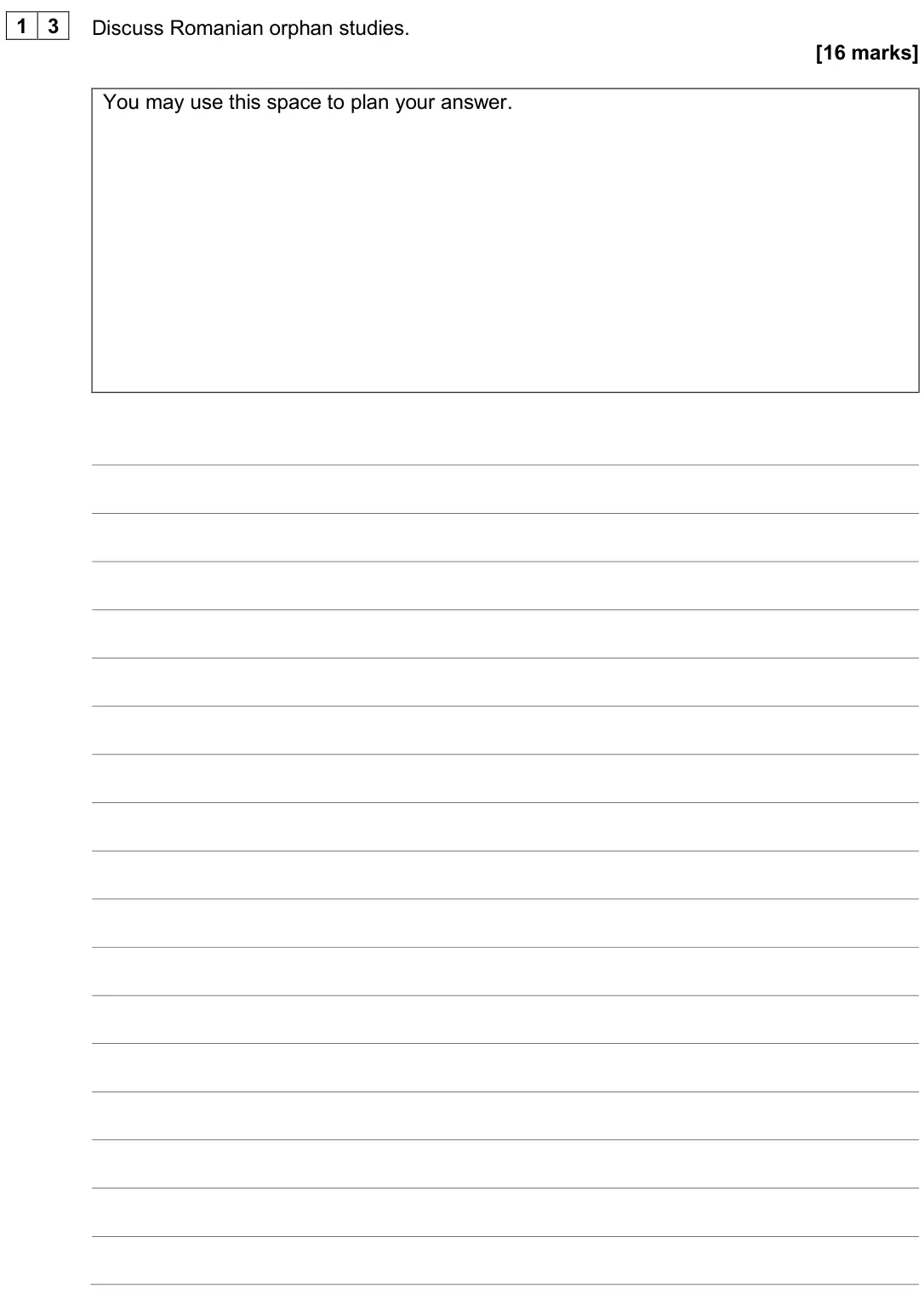
- June 2024, Paper 1, Q13 (16 marks): Discuss Romanian orphan studies. [16 marks] You may use this space to plan your answer.
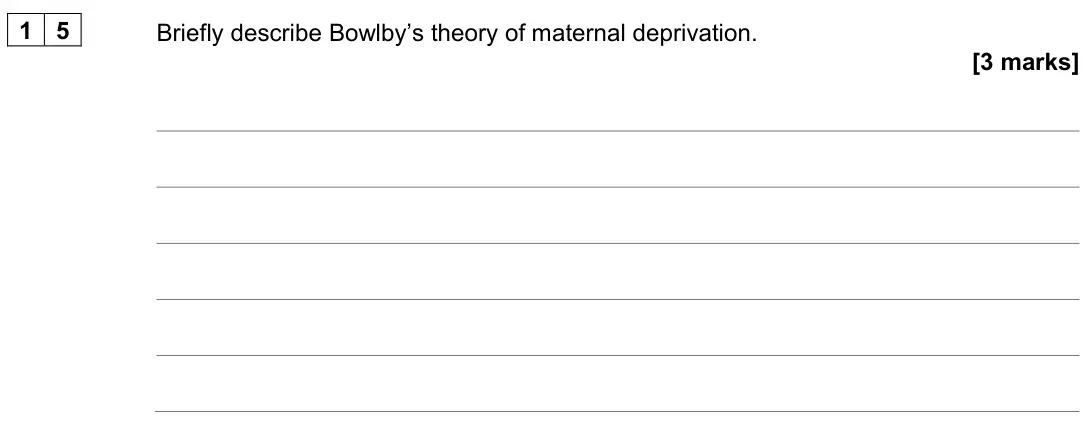
- June 2024, AS Paper 1, Q15 (3 marks): Briefly describe Bowlby’s theory of maternal deprivation. [3 marks]
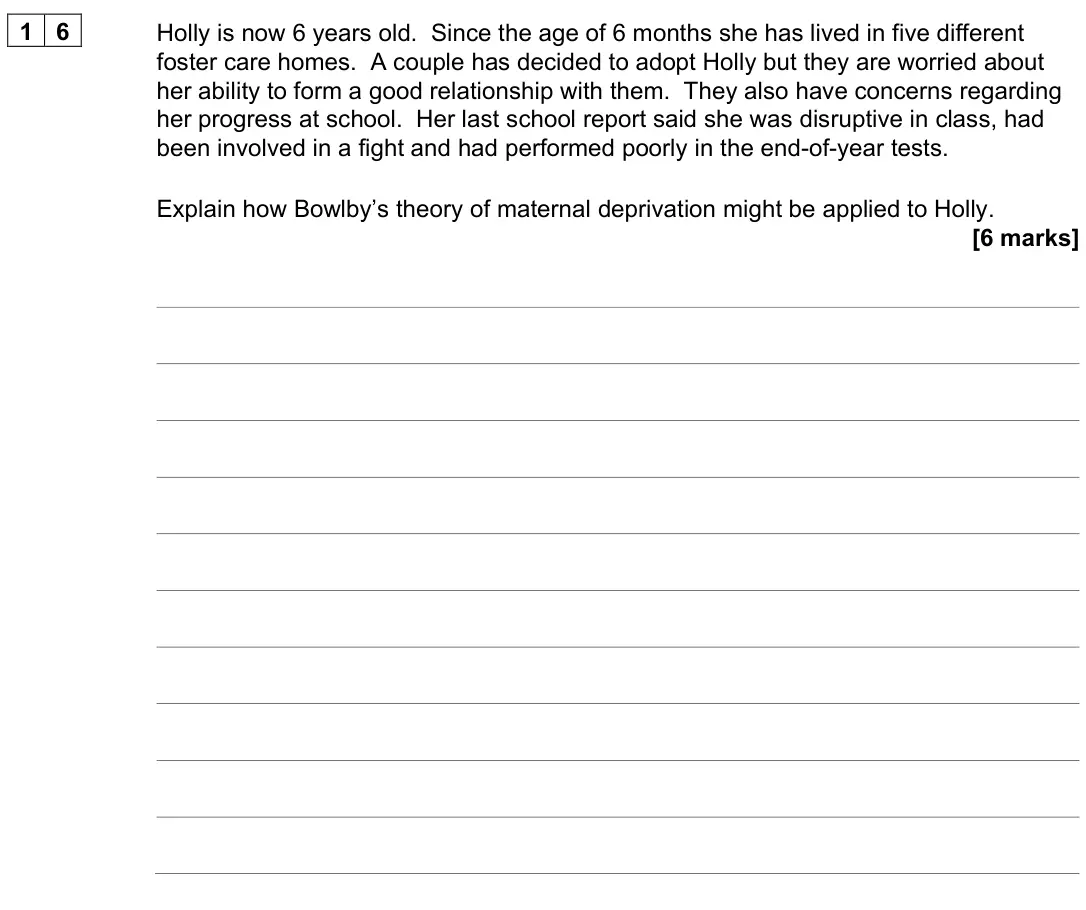
- June 2024, AS Paper 1, Q16 (6 marks): Holly is now 6 years old. Since the age of 6 months she has lived in five different foster care homes. A couple has decided to adopt Holly but they are worried
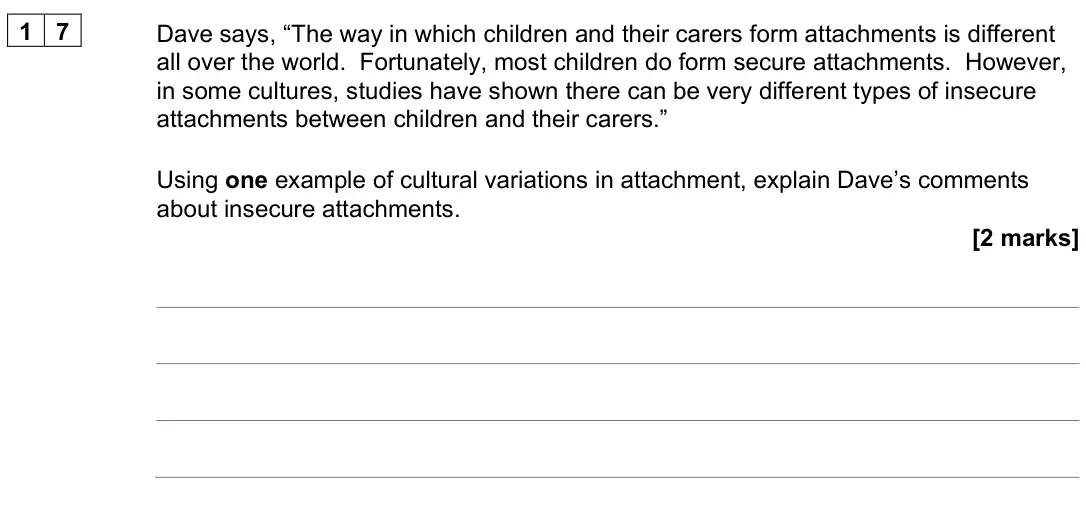
- June 2024, AS Paper 1, Q17 (2 marks): Dave says, “The way in which children and their carers form attachments is different all over the world. Fortunately, most children do form secure attachments.
- June 2024, AS Paper 1, Q18 (1 mark): Give one limitation of van Ijzendoorn’s research into cultural variations in attachment. [1 mark]
- June 2024, AS Paper 1, Q19 (12 marks): Discuss learning theory as an explanation of attachment. [12 marks] You may use this space to plan your answer.
- June 2023, Paper 1, Q08 (4 marks): Outline the learning theory of attachment. [4 marks]
- June 2023, Paper 1, Q09 (4 marks): Outline Van Ijzendoorn’s investigation of cultural variations in attachment. [4 marks]
- June 2023, Paper 1, Q10 (16 marks): Discuss Bowlby’s theory of maternal deprivation. Refer to Ryan in your answer. [16 marks] You may use this space to plan your answer.
- June 2023, AS Paper 1, Q13 (4 marks): Explain the role of the internal working model in Bowlby’s monotropic theory of attachment. [4 marks]
- June 2023, AS Paper 1, Q14 (6 marks): In the 1990s, many children were found living in poor-quality orphanages in Romania. Cema and her sister Katti lived in one of these orphanages from birth but w
- June 2023, AS Paper 1, Q15 (2 marks): Briefly explain one economic implication of the findings of research into the role of the father in attachment. [2 marks]
- June 2023, AS Paper 1, Q16 (12 marks): Discuss the learning theory explanation of attachment. [12 marks] You may use this space to plan your answer.
- June 2022, Paper 1, Q09 (2 marks): Which two of the following attachment concepts were not introduced by Bowlby? Shade two boxes only. [2 marks] A Affectionless psychopathy B Critical period C In
- June 2022, Paper 1, Q10 (2 marks): Outline one example of cultural variation in attachment. [2 marks]
- June 2022, Paper 1, Q11 (4 marks): Lenny is being interviewed for a TV dating show. He describes his approach to relationships: “My friends would say I’m scared of commitment and need to settle d
- June 2022, Paper 1, Q12 (16 marks): Outline Lorenz’s and Harlow’s animal studies of attachment. Discuss what these studies might tell us about human attachment. [16 marks] You may use this space t
- June 2022, AS Paper 1, Q10 (4 marks): Describe the learning theory explanation of attachment. [4 marks]
- June 2022, AS Paper 1, Q11 (4 marks): Outline how Harlow studied attachment using animals. [4 marks]
- June 2022, AS Paper 1, Q12 (4 marks): Other than ethical issues, explain one limitation of using animals to study attachment in humans. [4 marks]
- June 2022, AS Paper 1, Q13 (4 marks): Some psychologists have criticised the way attachment has been measured or studied using the Strange Situation technique because it is not realistic. Briefly ex
- June 2022, AS Paper 1, Q14 (8 marks): Discuss Bowlby’s theory of maternal deprivation. [8 marks] You may use this space to plan your answer.
- November 2021, Paper 1, Q09 (1 mark): Annie feeds her newborn baby regularly and they have formed a strong bond. According to the learning theory of attachment, before any attachment had been formed
- November 2021, Paper 1, Q10 (1 mark): According to the learning theory of attachment, now she has formed an attachment with her baby, Annie is best described as: Shade one box only. [1 mark] A a con
- November 2021, Paper 1, Q11 (2 marks): Outline one difference in attachment behaviours shown by infants who have an insecure-avoidant attachment and infants who have an insecure-resistant attachment.
- November 2021, Paper 1, Q12 (5 marks): These different attachment types were first identified in Ainsworth’s ‘Strange Situation’. Evaluate the procedure known as the ‘Strange Situation’. [5 marks]
- November 2021, Paper 1, Q14 (8 marks): Discuss the influence of early attachment on childhood relationships. Refer to the likely results of the study in Question 13 in your answer. [8 marks]
- November 2020, Paper 1, Q11.1 (1 mark): Identify the attachment type that Annie’s mother is describing. [1 mark]
- November 2020, Paper 1, Q11.2 (4 marks): Distinguish between two other types of attachment. [4 marks]
- November 2020, Paper 1, Q13 (16 marks): Discuss research into caregiver-infant interactions in humans. [16 marks] You may use this space to plan your answer.
- November 2020, AS Paper 1, Q11 (1 mark): In van Ijzendoorn’s research on cross-cultural variations in attachment, which one of the following countries had the highest number of insecure-resistant child
- November 2020, AS Paper 1, Q12 (5 marks): Describe how Lorenz studied attachment in animals. [5 marks]
- November 2020, AS Paper 1, Q13 (6 marks): Schaffer identified stages of attachment. Which of Schaffer’s stages best matches the behaviour shown by each child? In each case, explain your answer. [6 marks
- November 2020, AS Paper 1, Q14 (12 marks): Discuss research into the influence of early attachment on adult relationships. [12 marks] You may use this space to plan your answer.
Questions, mark schemes and examiner’s reports are © AQA, from their published past papers. Plumi isn’t affiliated with any exam board. Want whole papers? Full past papers.
Rather write your answers by hand on iPad? Plumi marks them against the same mark schemes.