 plumi
The discovery of the electron: AQA A‑Level Physics questions
Every AQA A-Level Physics exam question on 3.12.1 The discovery of the electron, 2016–2025, with its mark scheme and examiner’s report.
Find questions2,714
Calculations
Q01.1
The whole paper ↗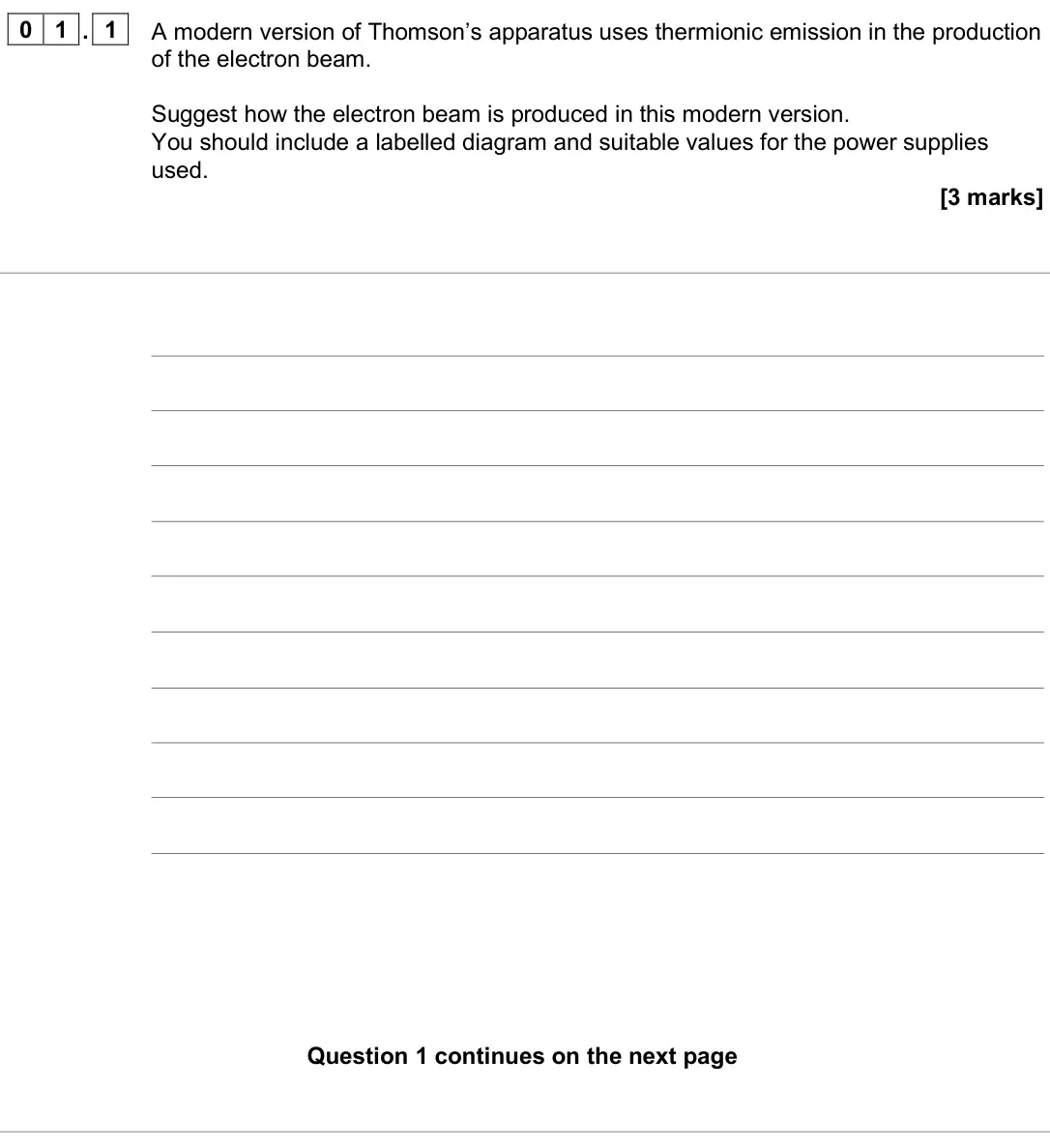
Q01.2
The whole paper ↗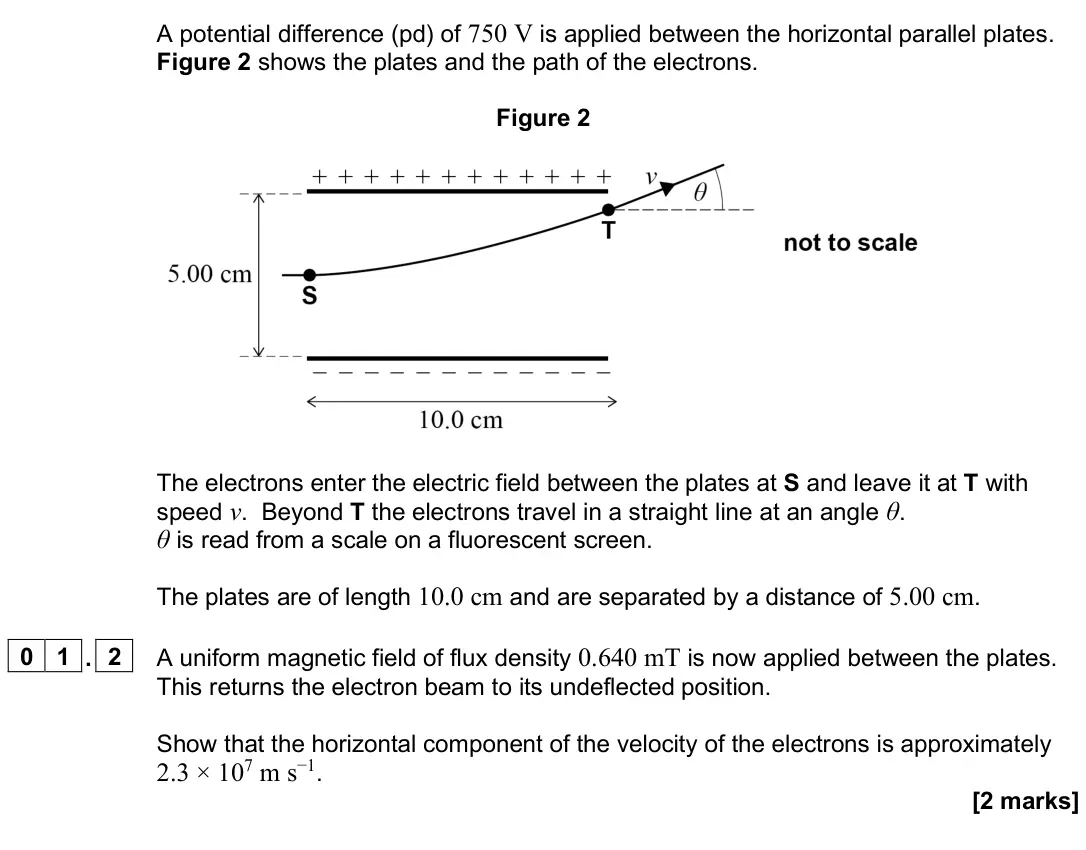
Q01.3
The whole paper ↗
Q01.4
The whole paper ↗
Q01.5
The whole paper ↗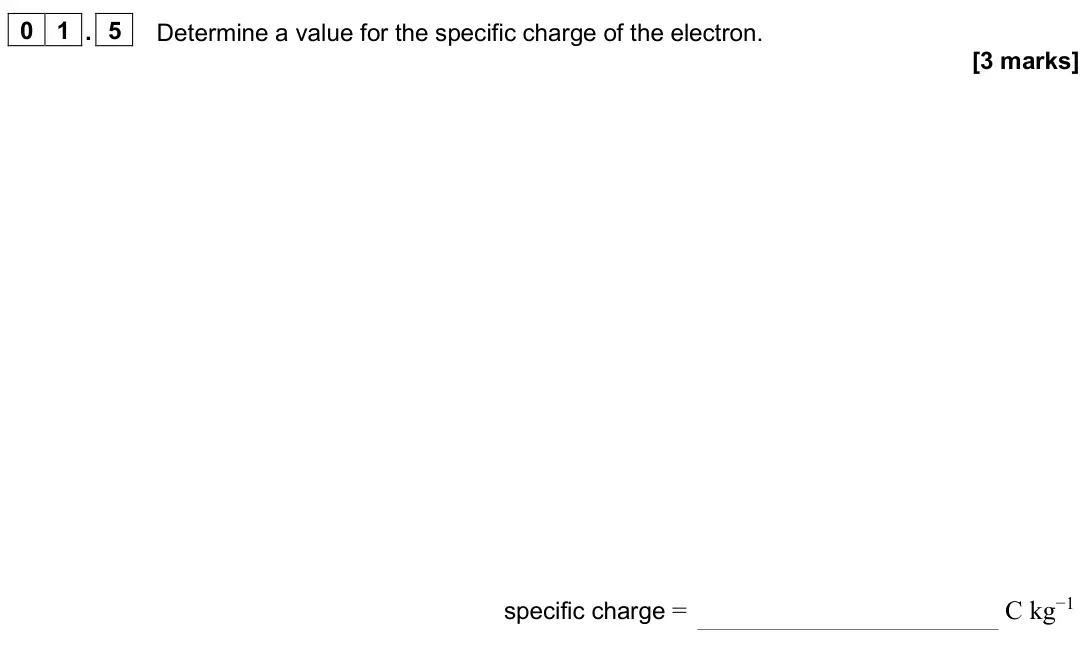
Q01.6
The whole paper ↗
Q01.7
The whole paper ↗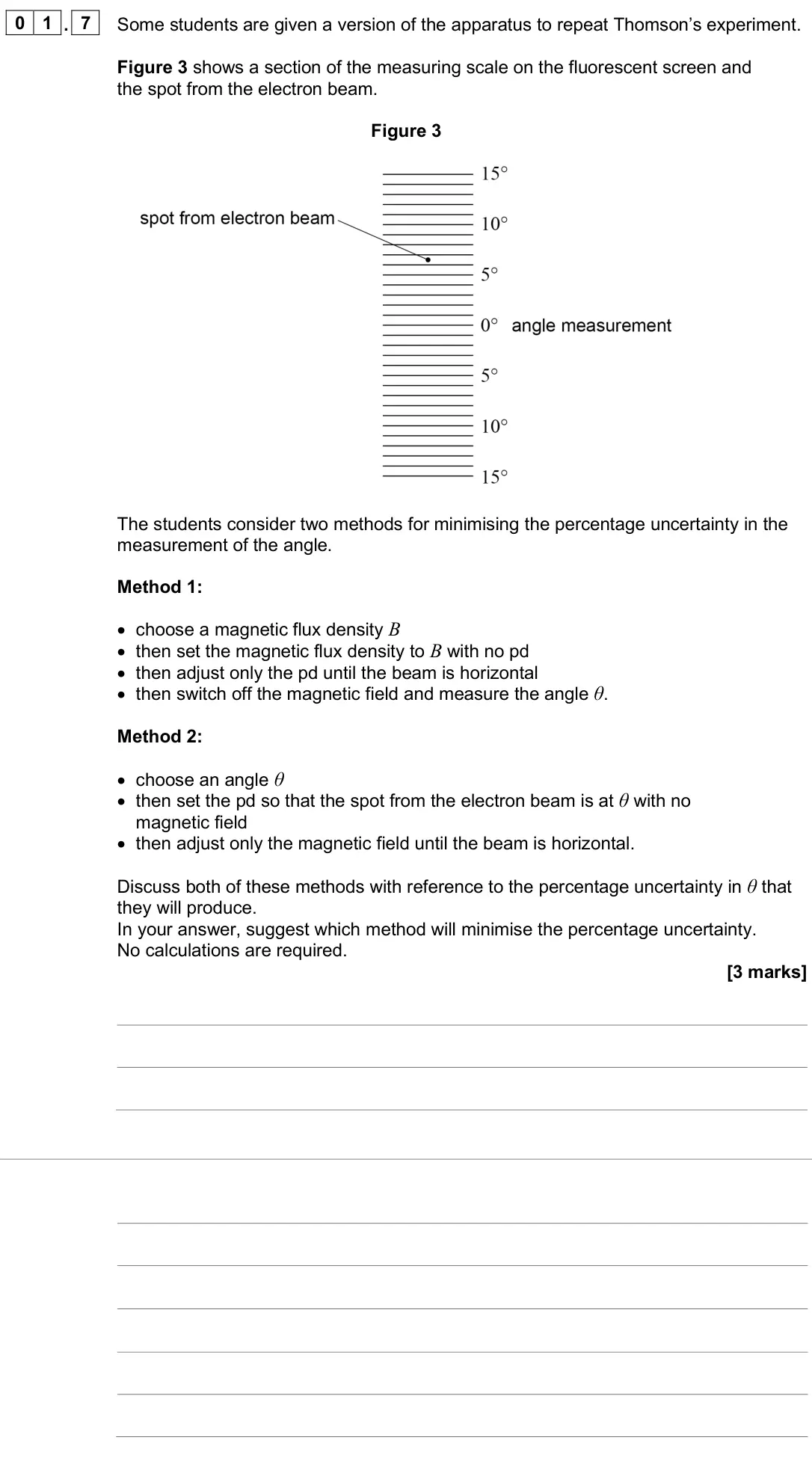
Q01.1
The whole paper ↗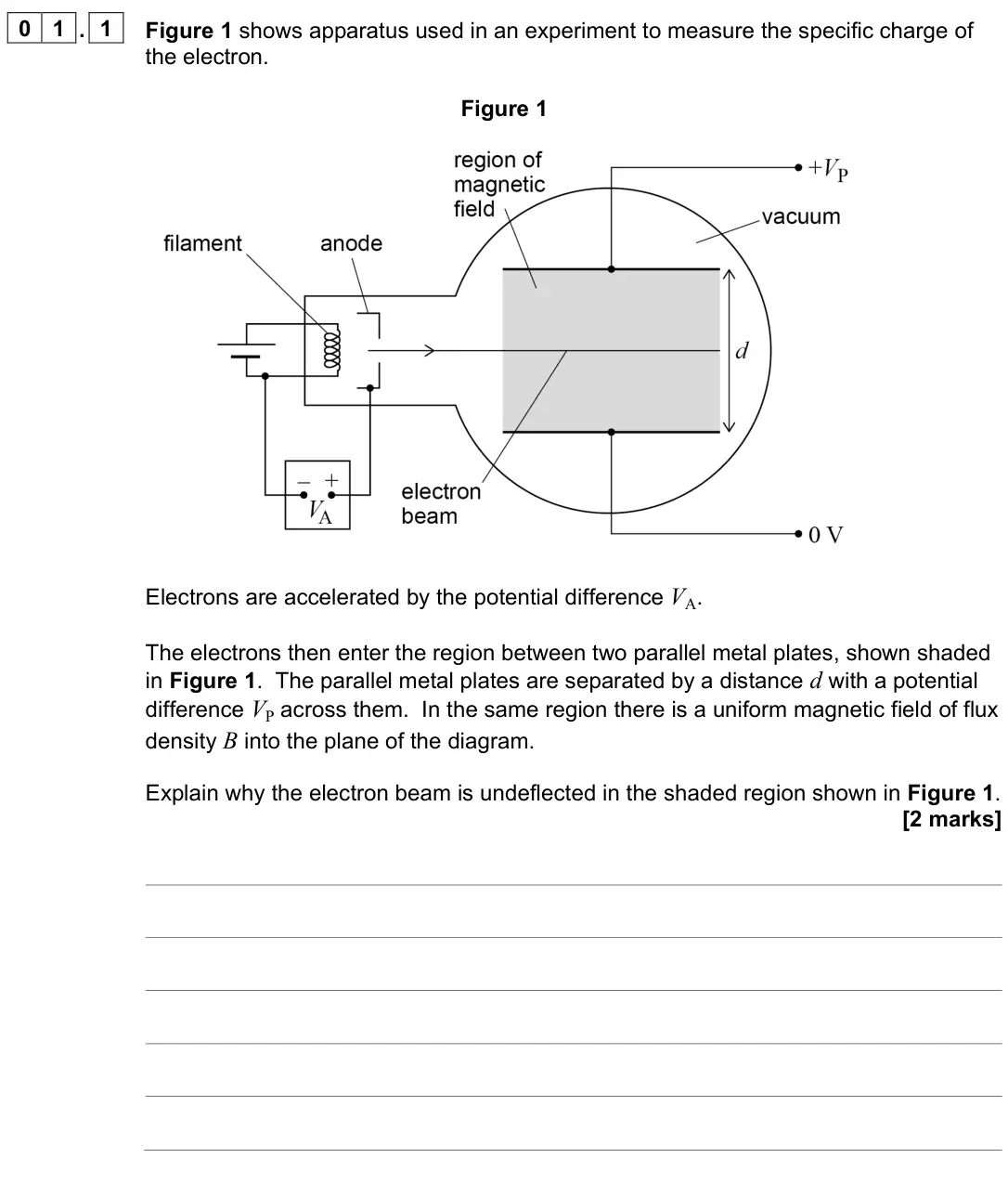
Q01.2
The whole paper ↗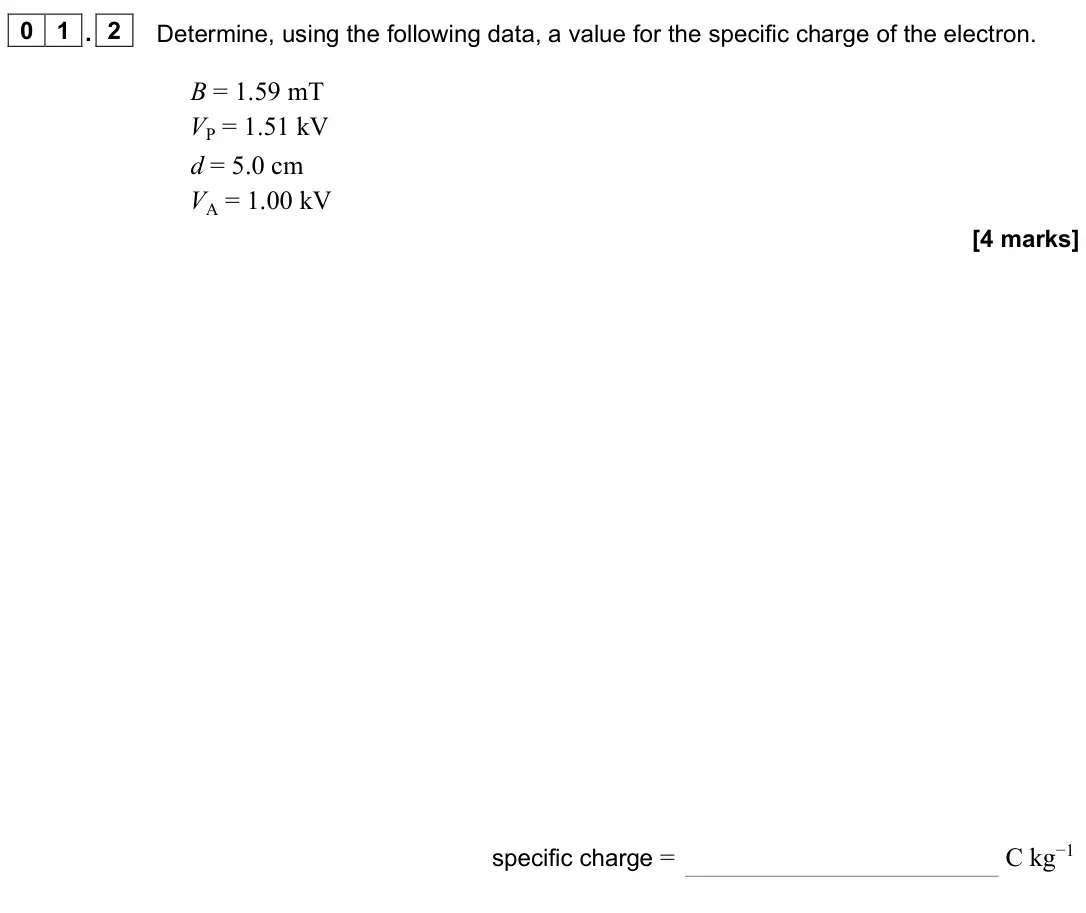
Q02.1
The whole paper ↗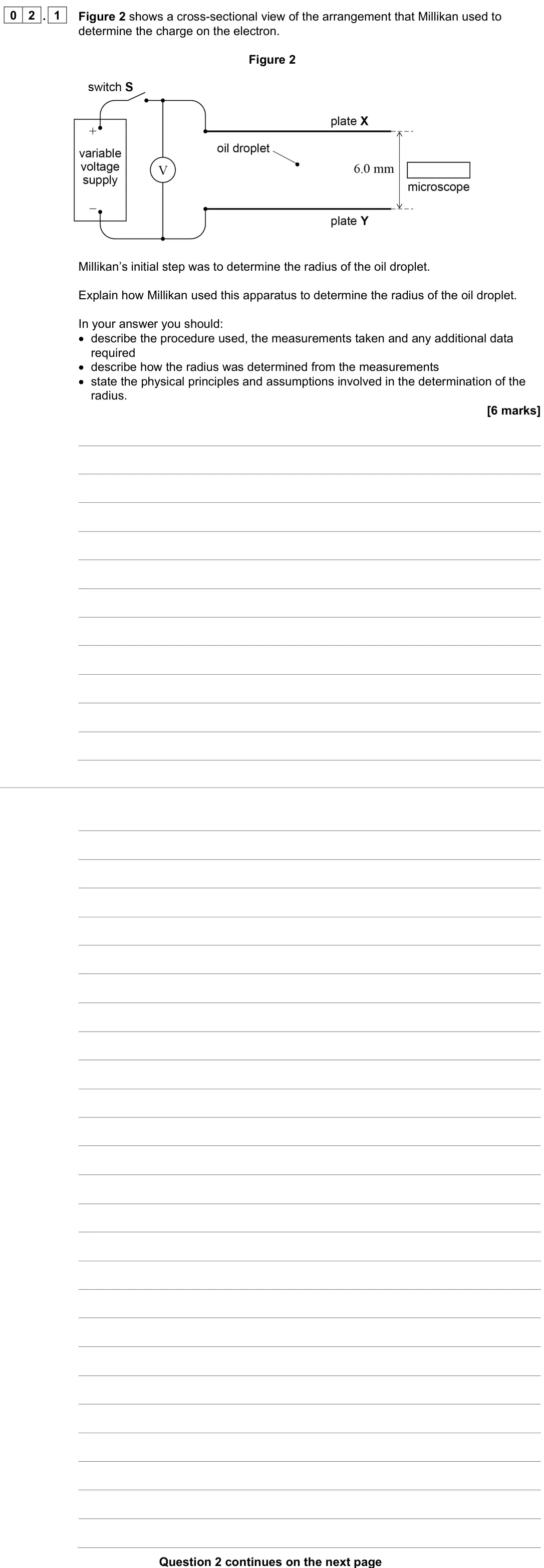
Q02.2
The whole paper ↗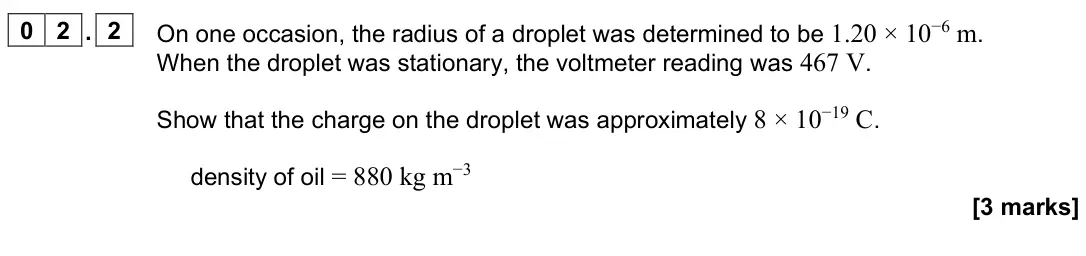
Q02.3
The whole paper ↗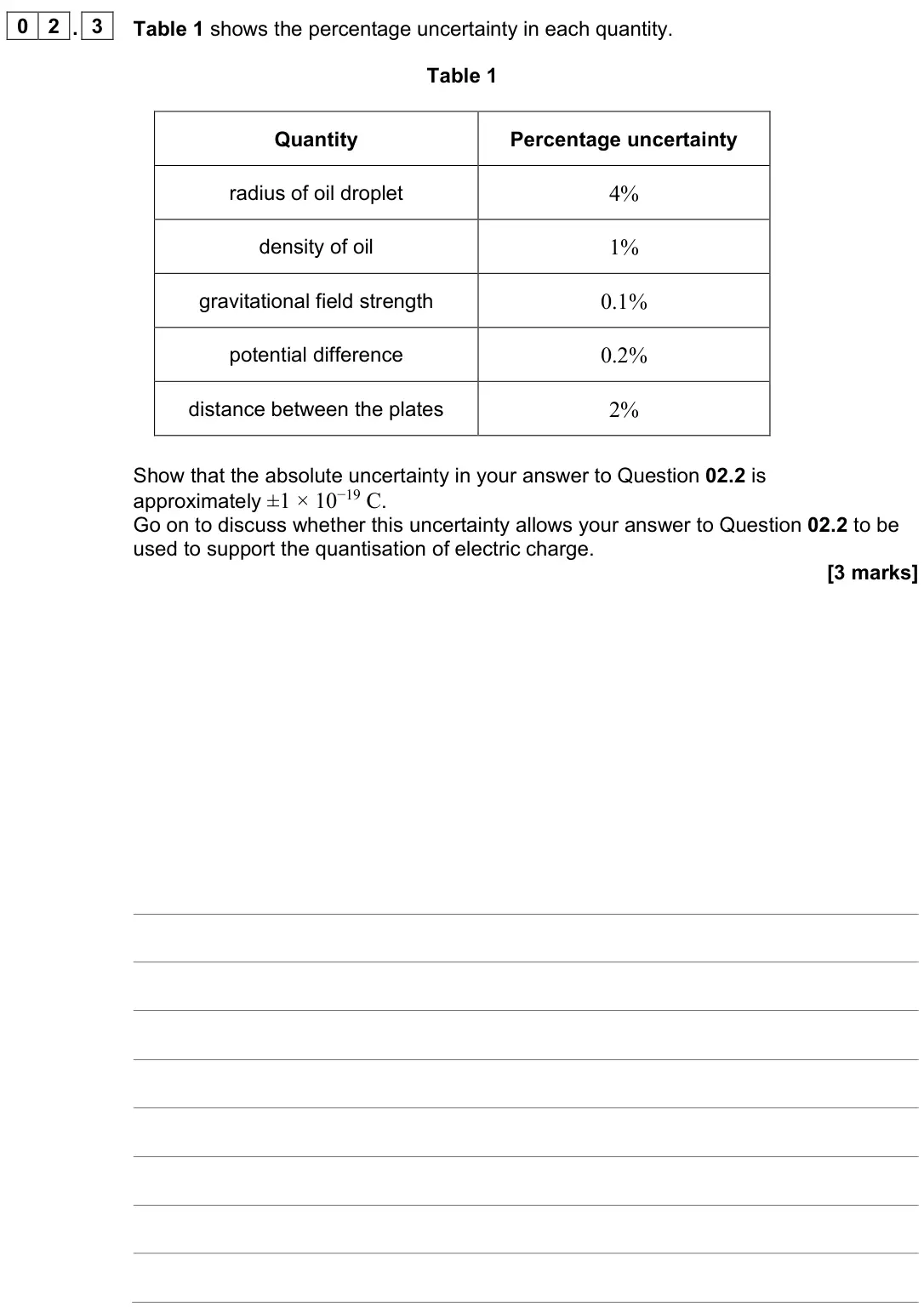
Q01.1
The whole paper ↗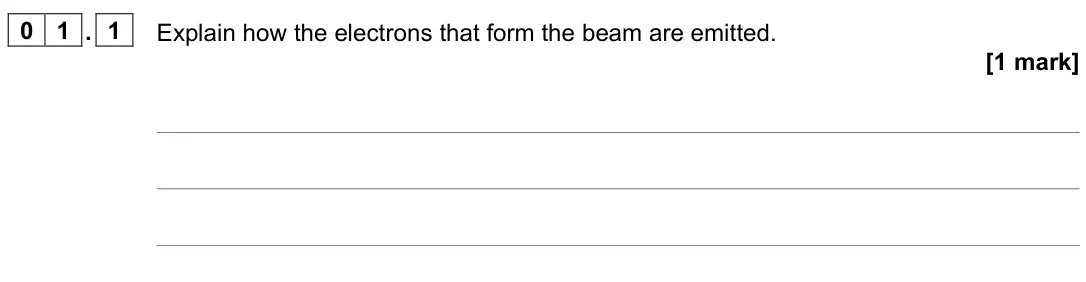
Q01.2
The whole paper ↗
Q01.4
The whole paper ↗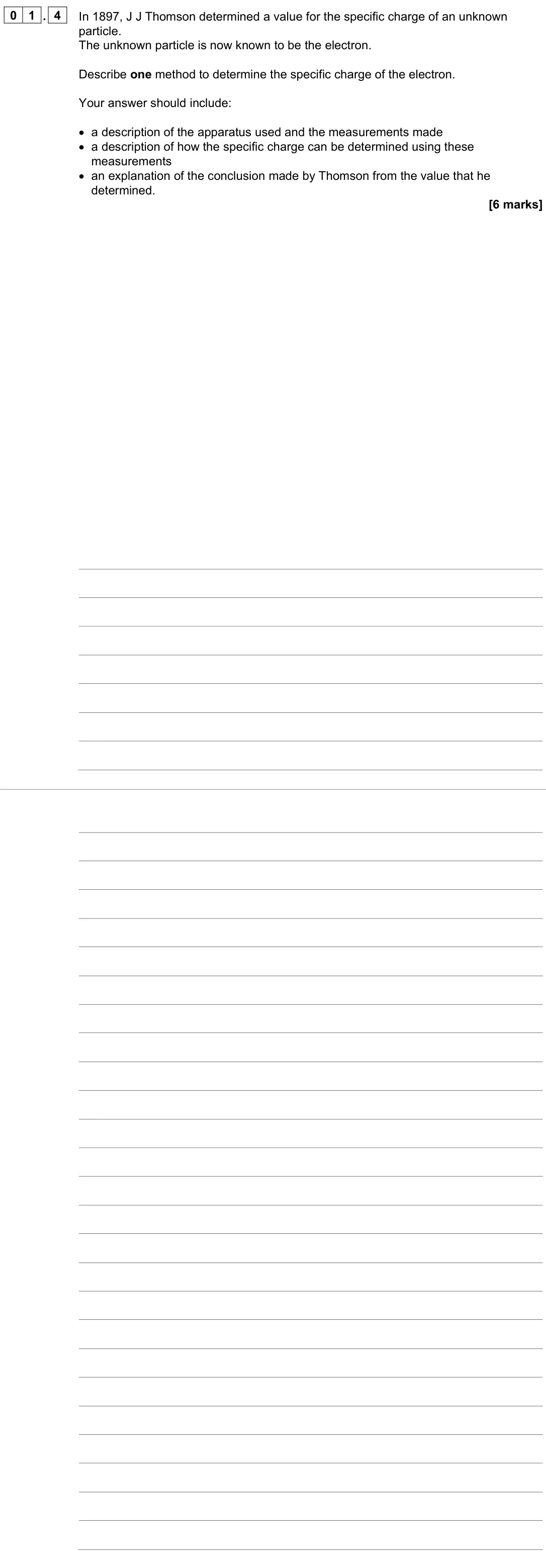
Q02.1
The whole paper ↗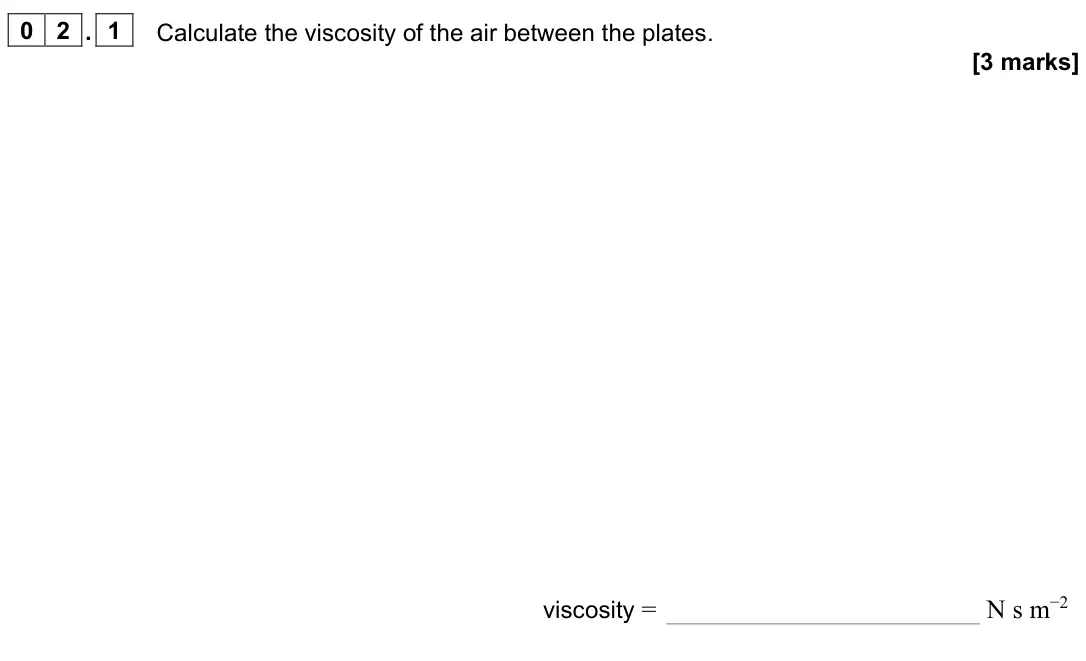
Q02.2
The whole paper ↗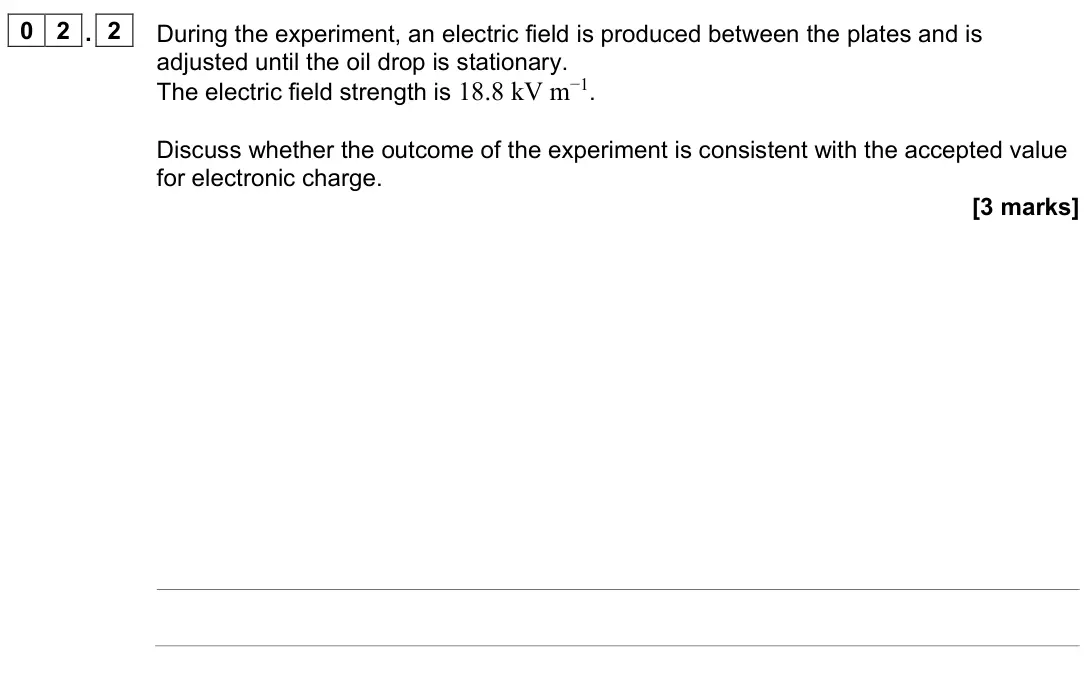
Q02.1
The whole paper ↗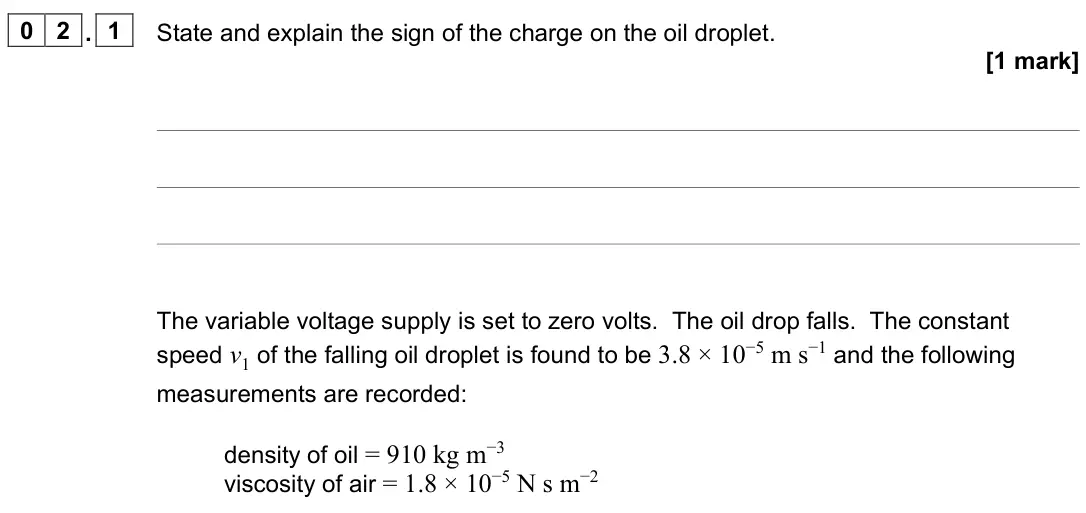
Q02.2
The whole paper ↗
Q02.3
The whole paper ↗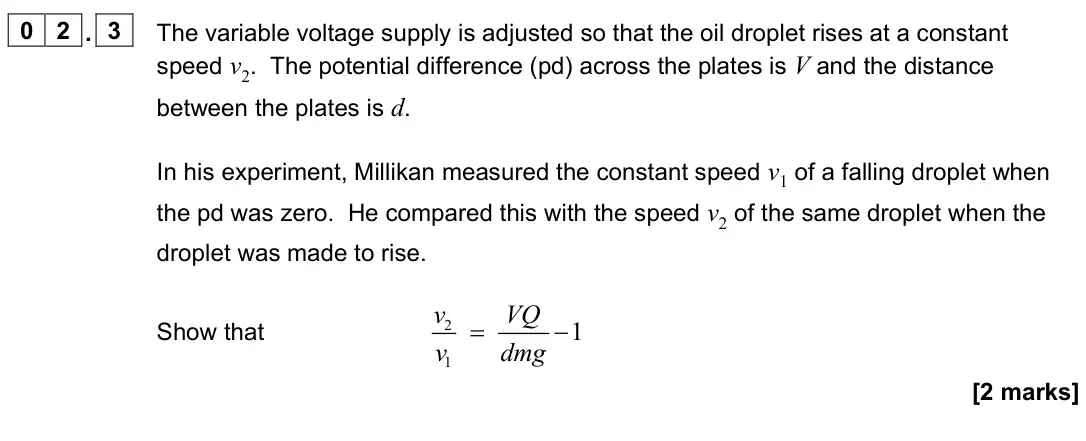
All 38 questions on The discovery of the electron, as a list
- June 2025, Paper 3 Turning points, Q01.1 (3 marks): A modern version of Thomson’s apparatus uses thermionic emission in the production of the electron beam. Suggest how the electron beam is produced in this moder
- June 2025, Paper 3 Turning points, Q01.2 (2 marks): A uniform magnetic field of flux density 0.640 mT is now applied between the plates. This returns the electron beam to its undeflected position. Show that the h
- June 2025, Paper 3 Turning points, Q01.3 (1 mark): Show that the vertical component of the velocity of the electrons at T is approximately 1.1 × 10⁷ m s−1. [1 mark]
- June 2025, Paper 3 Turning points, Q01.4 (2 marks): Show that the vertical acceleration of the electrons between the plates is approximately 2.5 × 10¹⁵ m s−2. [2 marks]
- June 2025, Paper 3 Turning points, Q01.5 (3 marks): Determine a value for the specific charge of the electron. [3 marks] specific charge = C kg−1
- June 2025, Paper 3 Turning points, Q01.6 (2 marks): Explain the significance of the result of Thomson’s determination. [2 marks]
- June 2025, Paper 3 Turning points, Q01.7 (3 marks): Some students are given a version of the apparatus to repeat Thomson’s experiment. Figure 3 shows a section of the measuring scale on the fluorescent screen and
- June 2024, Paper 3 Turning points, Q01.1 (2 marks): Figure 1 shows apparatus used in an experiment to measure the specific charge of the electron. Figure 1 Electrons are accelerated by the potential difference VA
- June 2024, Paper 3 Turning points, Q01.2 (4 marks): Determine, using the following data, a value for the specific charge of the electron. B = 1.59 mT VP = 1.51 kV d = 5.0 cm VA = 1.00 kV [4 marks] specific charge
- June 2024, Paper 3 Turning points, Q02.1 (6 marks): Figure 2 shows a cross-sectional view of the arrangement that Millikan used to determine the charge on the electron. Figure 2 Millikan’s initial step was to det
- June 2024, Paper 3 Turning points, Q02.2 (3 marks): On one occasion, the radius of a droplet was determined to be 1.20 × 10⁻⁶ m. When the droplet was stationary, the voltmeter reading was 467 V. Show that the cha
- June 2024, Paper 3 Turning points, Q02.3 (3 marks): Table 1 shows the percentage uncertainty in each quantity. Table 1 Quantity Percentage uncertainty radius of oil droplet 4% density of oil 1% gravitational fiel
- June 2023, Paper 3 Turning points, Q01.1 (1 mark): Explain how the electrons that form the beam are emitted. [1 mark]
- June 2023, Paper 3 Turning points, Q01.2 (1 mark): Show that the maximum speed of the electrons in the beam is about 1.3 × 10⁷ m s−1. [1 mark]
- June 2023, Paper 3 Turning points, Q01.4 (6 marks): In 1897, J J Thomson determined a value for the specific charge of an unknown particle. The unknown particle is now known to be the electron. Describe one metho
- June 2023, Paper 3 Turning points, Q02.1 (3 marks): Calculate the viscosity of the air between the plates. [3 marks] viscosity = N s m−2
- June 2023, Paper 3 Turning points, Q02.2 (3 marks): During the experiment, an electric field is produced between the plates and is adjusted until the oil drop is stationary. The electric field strength is 18.8 kV
- June 2022, Paper 3 Turning points, Q02.1 (1 mark): State and explain the sign of the charge on the oil droplet. [1 mark] The variable voltage supply is set to zero volts. The oil drop falls. The constant speed v
- June 2022, Paper 3 Turning points, Q02.2 (3 marks): Show that the mass m of the oil droplet is about 8 × 10⁻¹⁶ kg. [3 marks]
- June 2022, Paper 3 Turning points, Q02.3 (2 marks): The variable voltage supply is adjusted so that the oil droplet rises at a constant speed v2. The potential difference (pd) across the plates is V and the dista
- June 2022, Paper 3 Turning points, Q02.4 (3 marks): The following measurements are made for the droplet in Question 02.2 when it is rising at constant speed. V = 715 V v2 = 1.1 × 10⁻⁴ m s−1 The separation of the
- June 2022, Paper 3 Turning points, Q02.5 (3 marks): After Millikan published his results, it was found that he had used a value for the viscosity of air that was smaller than the actual value. Discuss the effect
- November 2021, Paper 3 Turning points, Q01.1 (4 marks): Explain how high-speed electrons are produced in the apparatus in Figure 1. In your answer you should: • name parts A and B • discuss the purposes of potential
- November 2020, Paper 3 Turning points, Q01.1 (2 marks): When correct connections are made to a high-voltage power supply, a cathode ray is produced. The cathode ray hits the centre of the fluorescent screen. Describe
- November 2020, Paper 3 Turning points, Q01.2 (1 mark): P and Q are metal plates that can be attached to a second power supply. In an experiment, a potential difference (pd) is applied across P and Q so that P is pos
- November 2020, Paper 3 Turning points, Q01.3 (3 marks): Changes are made to the apparatus so that the particles in the cathode ray travel with a greater speed as they pass between plates P and Q. Explain how the cath
- November 2020, Paper 3 Turning points, Q01.4 (2 marks): Using the apparatus in Figure 1, Thomson determined the specific charge of the particles in the cathode rays. Thomson compared this result with the specific cha
- June 2019, Paper 3 Turning points, Q01.1 (2 marks): Identify the forces acting on the stationary droplet. In your answer you should state the relationship between the forces. The upthrust on the droplet due to th
- June 2019, Paper 3 Turning points, Q01.2 (3 marks): The potential difference between the plates is changed to zero and the droplet falls at a terminal velocity of 1.0 × 10⁻⁴ m s−1. The density of the oil is 880 k
- June 2019, Paper 3 Turning points, Q01.3 (3 marks): The potential difference between the plates is restored to its initial value and the droplet becomes stationary. The charge on the droplet is −4.8 × 10⁻¹⁹ C. A
- June 2018, Paper 3 Turning points, Q01.1 (3 marks): Describe the process that releases the electrons emitted at the filament. [3 marks]
- June 2018, Paper 3 Turning points, Q01.2 (2 marks): Table 1 shows the data collected when determining the specific charge of the electron by the method shown in Figure 1. Table 1 potential difference V that accel
- June 2018, Paper 3 Turning points, Q01.3 (2 marks): Using data from Table 1, calculate a value for the specific charge of the electron. Give your answer to an appropriate number of significant figures. [2 marks]
- June 2018, Paper 3 Turning points, Q01.4 (2 marks): At the time when Thomson measured the specific charge of the particles in cathode rays, the largest specific charge known was that of the hydrogen ion. State ho
- June 2017, Paper 3 Turning points, Q01.1 (2 marks): Explain how this experiment led Crookes to conclude that cathode rays are particles and that these particles caused the movement of the paddle. [2 marks]
- June 2017, Paper 3 Turning points, Q01.2 (3 marks): Later experiments showed that cathode rays are electrons in motion. Explain how cathode rays are produced in a gas discharge tube. [3 marks]
- June 2017, Paper 3 Turning points, Q01.3 (2 marks): In a particular gas discharge tube, air molecules inside the tube are absorbed by the walls of the tube. Suggest the effect that this absorption may have on the
- June 2017, Paper 3 Turning points, Q03.1 (1 mark): What is the process by which electrons are produced in an electron gun? Tick () the correct box. [1 mark] Beta particle emission Electron diffraction Photoelec
Questions, mark schemes and examiner’s reports are © AQA, from their published past papers. Plumi isn’t affiliated with any exam board. Want whole papers? Every AQA A-Level Physics paper.
Rather write your answers by hand on iPad? Plumi marks them against the same mark schemes.