 plumi
Torque and angular acceleration: AQA A‑Level Physics questions
AQA A-Level Physics past-paper questions on 3.11.1.4 Torque and angular acceleration, 2008–2025, with mark schemes and examiner’s reports where available.
Paper
All papers
Exam
All years
Calculations
Q01.4
The whole paper ↗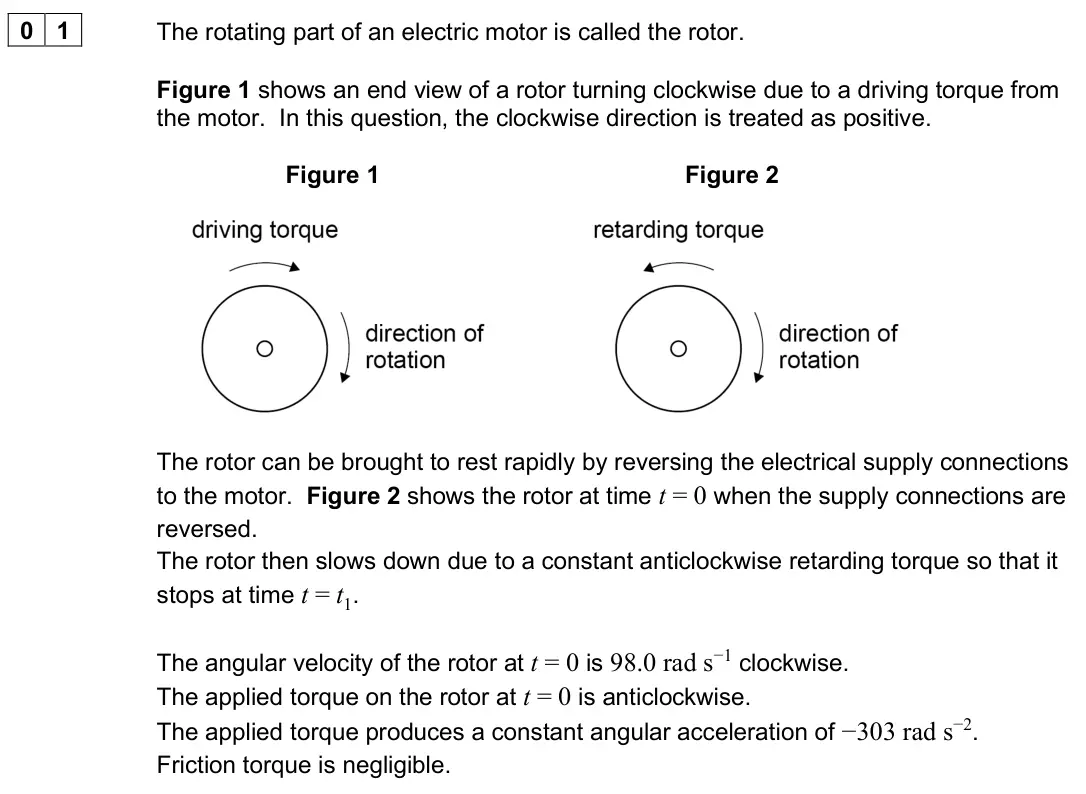
Q02.2
The whole paper ↗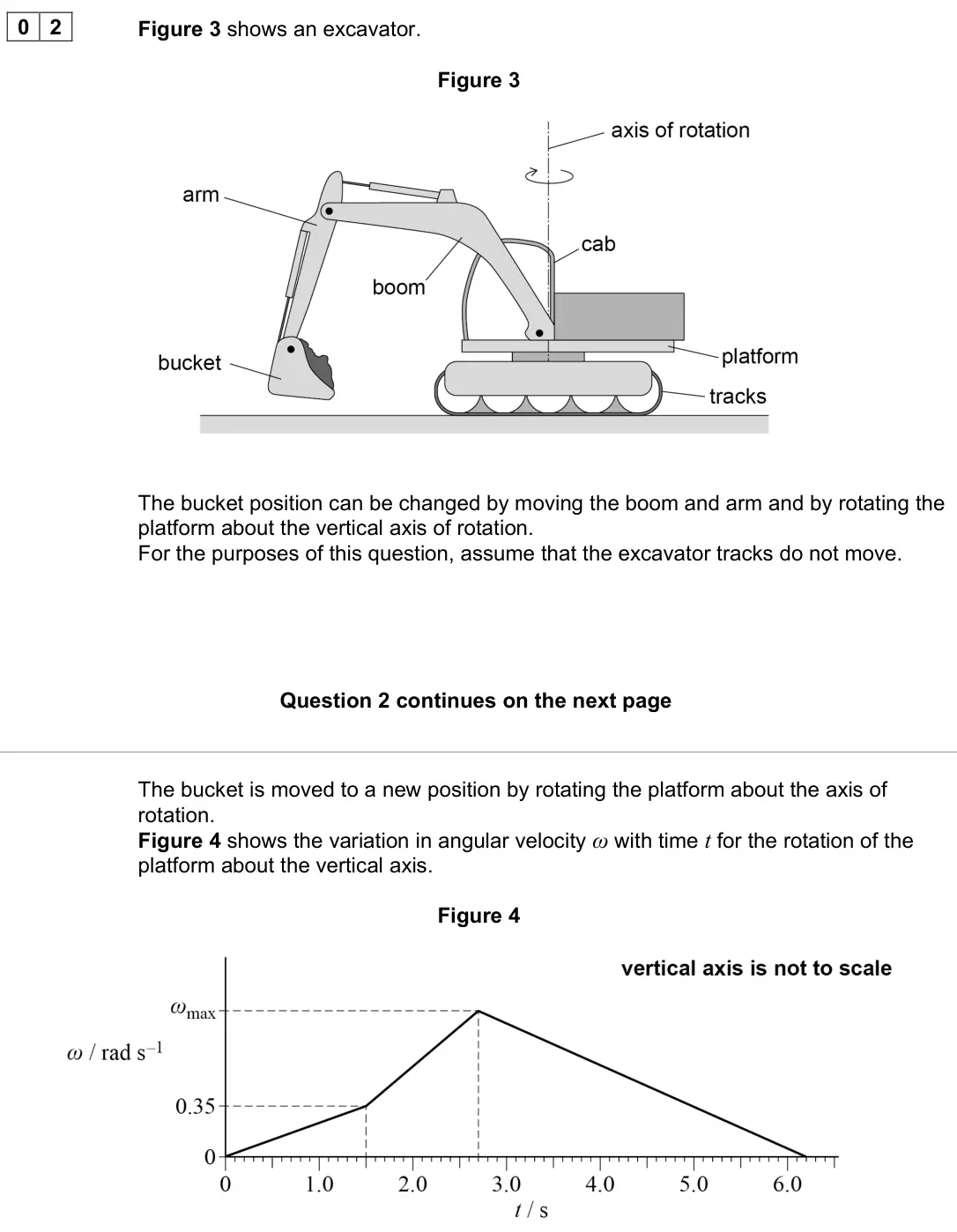
Q01.1
The whole paper ↗Q02.1
The whole paper ↗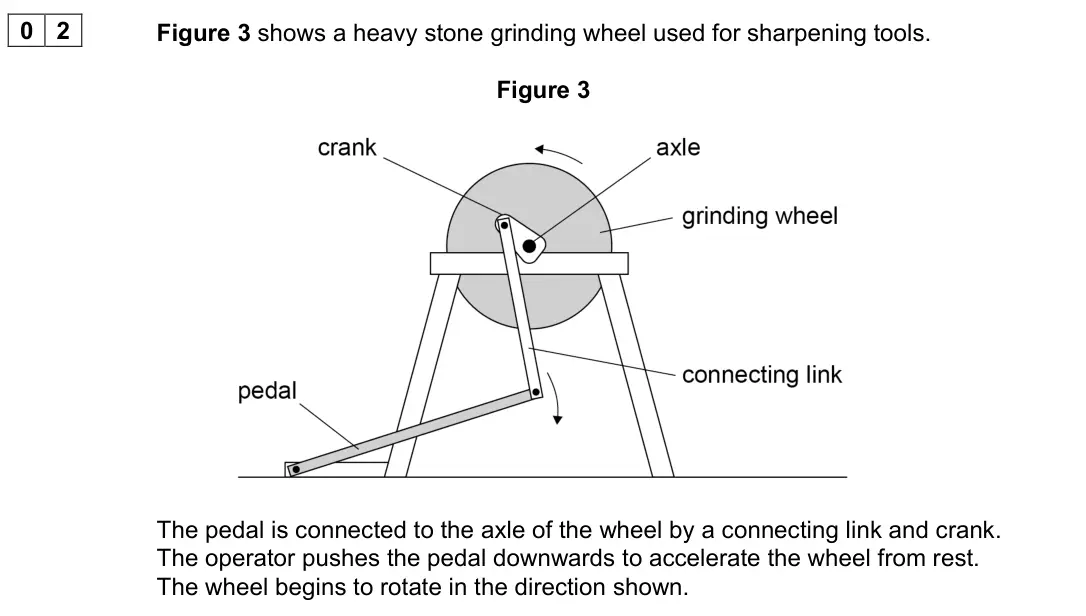
Q02.3
The whole paper ↗Q02.4
The whole paper ↗Q01.3
The whole paper ↗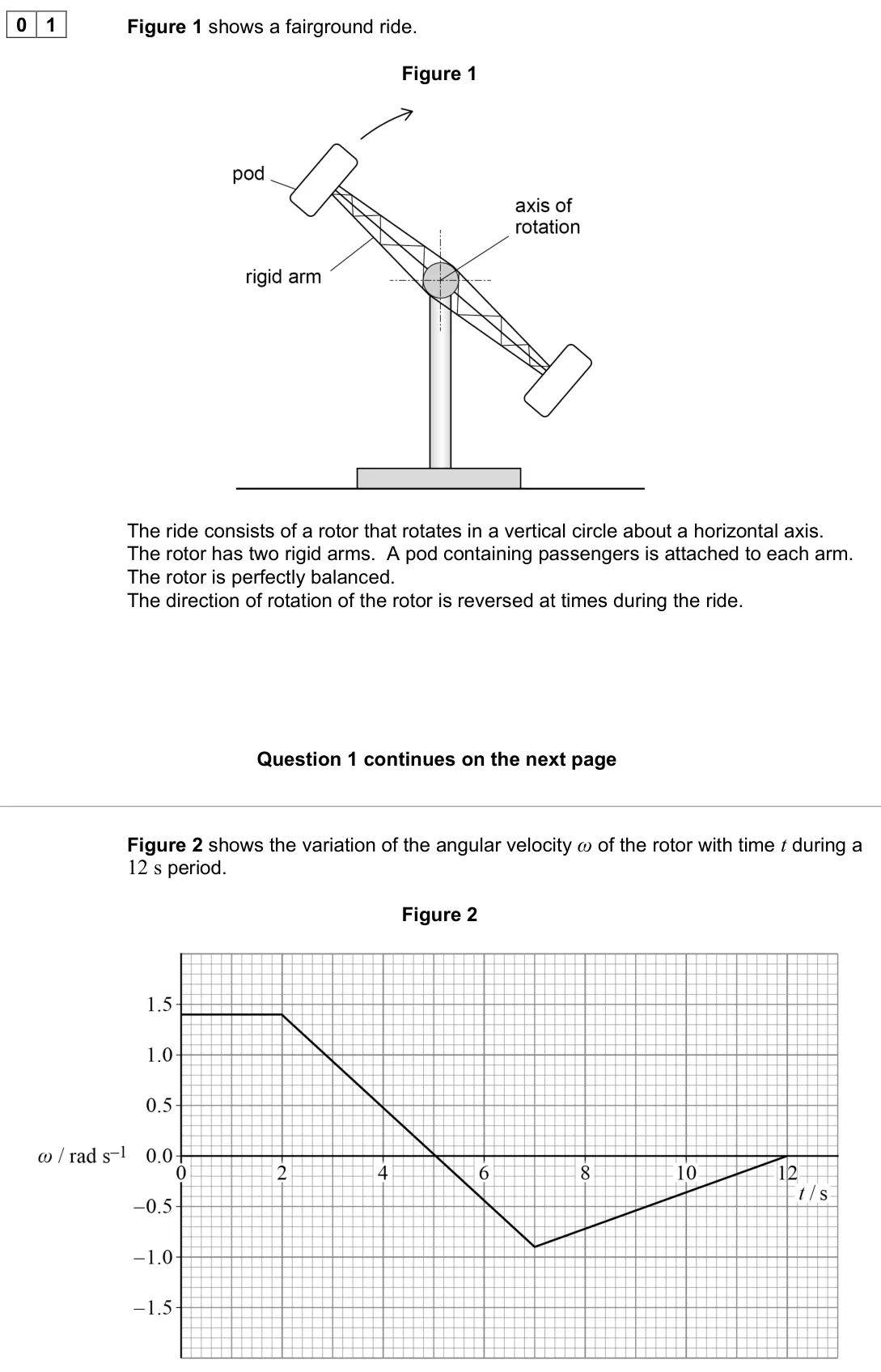
Q01.5
The whole paper ↗Q02.2
The whole paper ↗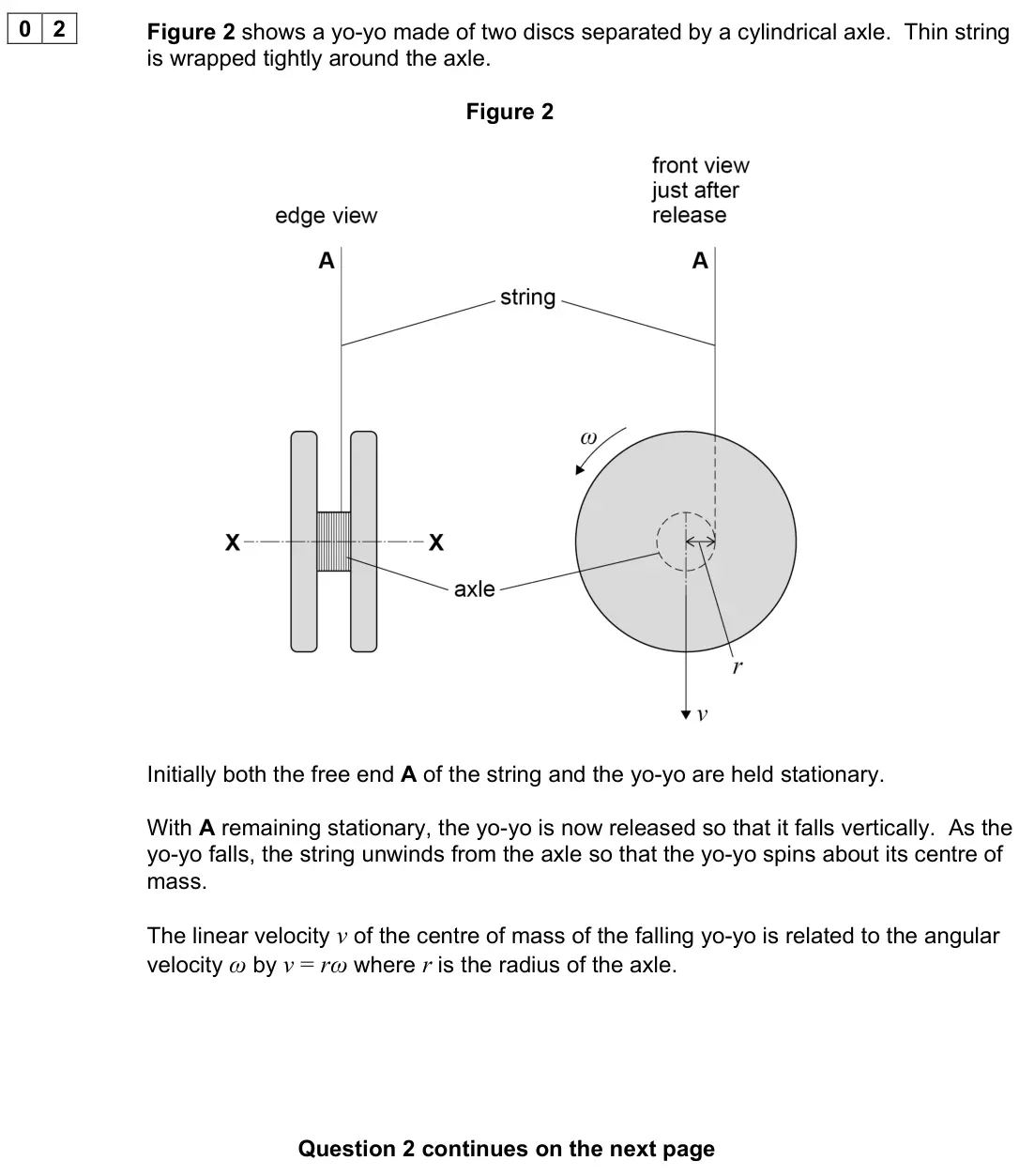
Q01.2
The whole paper ↗Q01.3
The whole paper ↗Q02.3
The whole paper ↗Q02.3
The whole paper ↗Q01.1
The whole paper ↗Q01.4
The whole paper ↗Q02.1
The whole paper ↗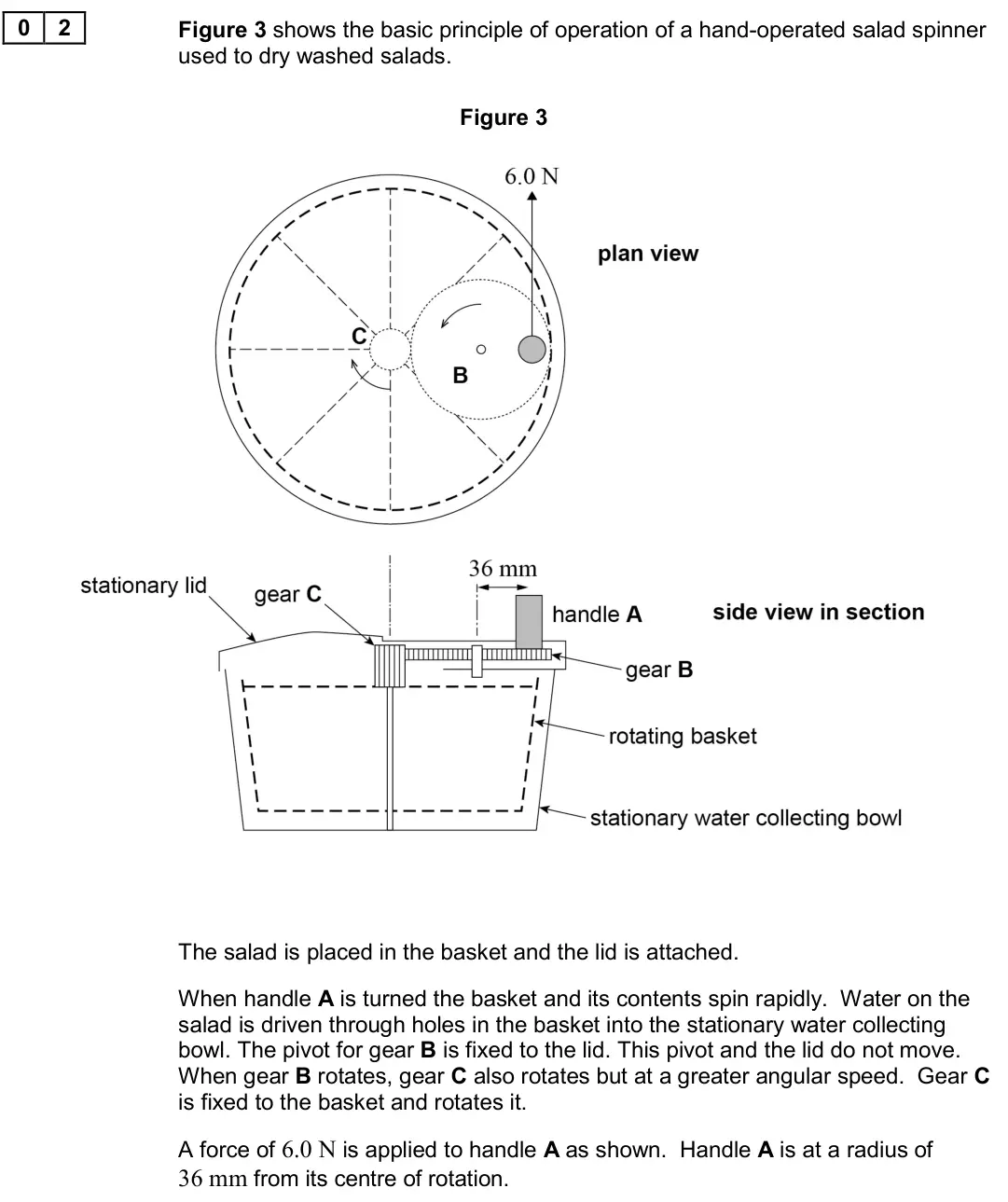
Q02.3
The whole paper ↗Q02.3
The whole paper ↗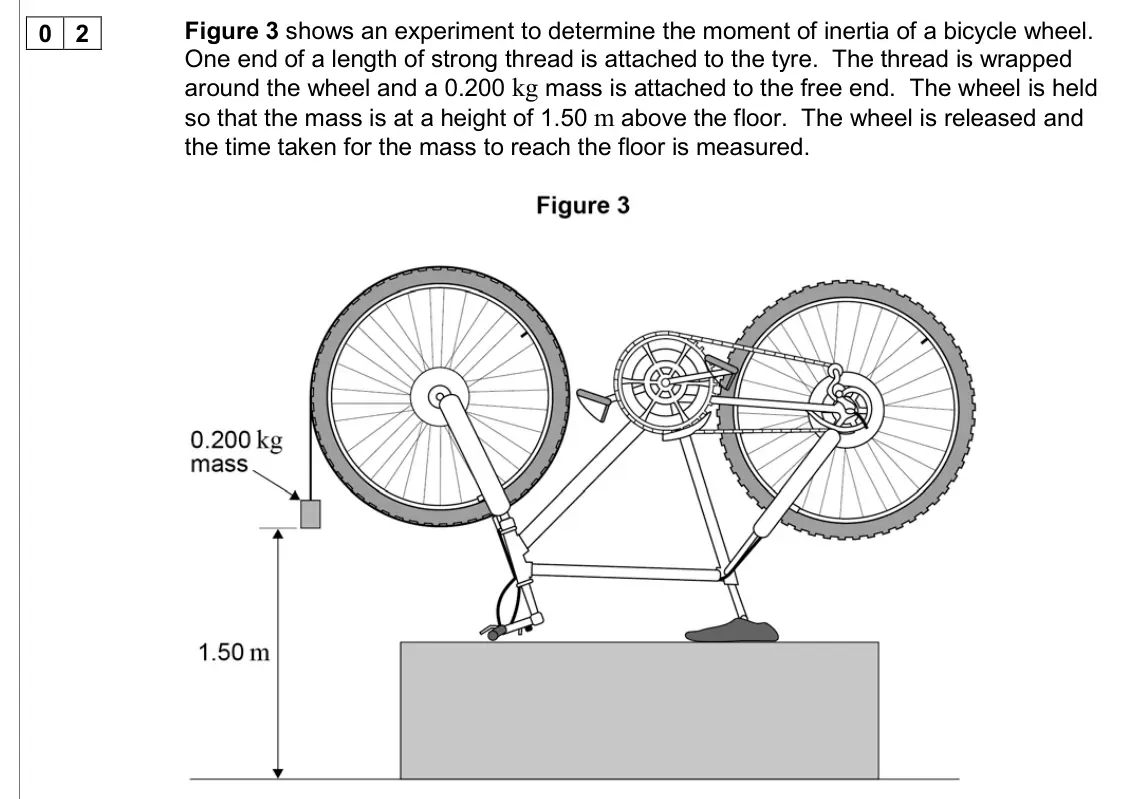
Q1(a)
The whole paper ↗
Q1(b)(i)
The whole paper ↗
All 31 questions on Torque and angular acceleration, as a list
- June 2025, Paper 3 Engineering physics, Q01.4 (3 marks): Another way of quickly stopping the motor is to use a disc brake. The motor is brought to rest by switching off the power supply and then forcing two brake pads
- June 2024, Paper 3 Engineering physics, Q02.2 (3 marks): Torque must be applied to the platform to change its angular velocity and to overcome friction at the platform bearing. Show that the torque applied to the plat
- June 2023, Paper 3 Engineering physics, Q01.1 (2 marks): One equation used in translational dynamics is: force = mass × acceleration State in words the equivalent equation used in rotational dynamics. [2 marks]
- June 2023, Paper 3 Engineering physics, Q02.1 (2 marks): Explain why the torque applied to the axle varies as the operator pushes downwards on the pedal. [2 marks]
- June 2023, Paper 3 Engineering physics, Q02.3 (2 marks): The connecting link breaks. At this instant the angular speed of the wheel is 13.8 rad s−1. It takes 15.0 s for the wheel to come to rest. The frictional torque
- June 2023, Paper 3 Engineering physics, Q02.4 (2 marks): Figure 4 also shows a tool being sharpened by pressing it on the edge of the rotating wheel. The tool applies a tangential force F on the wheel. A torque of 3.1
- June 2022, Paper 3 Engineering physics, Q01.3 (3 marks): Calculate the maximum torque applied by the driving mechanism to the rotor during the 12 s period. [3 marks] maximum torque = N m
- June 2022, Paper 3 Engineering physics, Q01.5 (1 mark): Which graph best shows the variation of the torque T applied to the rotor for the 12 s period? Tick () one box. A copy of Figure 2 is provided to help you. [1
- November 2021, Paper 3 Engineering physics, Q02.2 (3 marks): The yo-yo falls further until all the string is unwound. The yo-yo then ‘sleeps’. This means the yo-yo continues to rotate in a loose loop of string as shown in
- November 2020, Paper 3 Engineering physics, Q01.2 (4 marks): A student does an experiment using the apparatus shown in Figure 1. Figure 1 A solid disc pulley of mass M and radius R is supported in bearings which have negl
- November 2020, Paper 3 Engineering physics, Q01.3 (3 marks): The student repeats the experiment using a spoked pulley of the same mass and radius, as shown in Figure 2. Figure 2 Compare the acceleration of the load in thi
- November 2020, Paper 3 Engineering physics, Q02.3 (3 marks): Table 2 gives information about two clutches, C and D. C and D provide different constant frictional torques during slipping at the clutch discs. Table 2 Clutch
- June 2018, Paper 3 Engineering physics, Q02.3 (3 marks): The student goes on to determine the moment of inertia of the flywheel. The magnet is removed and the flywheel is made to spin. Measurements show that the flywh
- June 2017, Paper 3 Engineering physics, Q01.1 (2 marks): There is an analogy between quantities in rotational and translational dynamics. Complete Table 1, stating in words the quantities in rotational dynamics that a
- June 2017, Paper 3 Engineering physics, Q01.4 (3 marks): At time X in Figure 2 the motor that is driving the jib is disengaged. A constant braking torque is then applied to bring the jib to a standstill from its maxim
- June 2017, Paper 3 Engineering physics, Q02.1 (1 mark): Calculate the input torque. [1 mark] torque = N m
- June 2017, Paper 3 Engineering physics, Q02.3 (2 marks): It takes 2.1 s for the empty basket to reach an angular speed of 76 rad s–1. The torque on gear C is a constant 0.054 N m during this time. Frictional losses ar
- Specimen, Paper 3 Engineering physics, Q02.3 (2 marks): Figure 3 shows an experiment to determine the moment of inertia of a bicycle wheel One end of a length of strong thread is attached to the tyre. The thread is w
- June 2016, PHYA5 Applied physics (old spec), Q1(a) (2 marks): Each water jet exerts a constant force of 0.11 N on its arm at 45º to the horizontal. Show that the torque exerted on the spinner by the jets of water is about
- June 2016, PHYA5 Applied physics (old spec), Q1(b)(i) (2 marks): Explain why, when the water tap is turned on, the spinner accelerates initially but then reaches a constant angular speed. Assume that, when the tap is turned o
- June 2015, PHYA5 Applied physics (old spec), Q1(a)(i) (2 marks): Show that the drum accelerates for about 8 s. [2 marks]
- June 2015, PHYA5 Applied physics (old spec), Q1(b)(i) (1 mark): In practice, at the start of the cycle the acceleration will not remain constant. Draw on Figure 2 a line to show how the initial part of the graph will change.
- June 2015, PHYA5 Applied physics (old spec), Q1(b)(ii) (2 marks): Explain your reasons for the line you have drawn. [2 marks]
- June 2013, PHYA5 Applied physics (old spec), Q1(a)(ii) (1 mark): Calculate the magnitude of the frictional torque acting at the turntable bearings. torque Nm (1 mark)
- June 2012, PHYA5 Applied physics (old spec), Q2(a)(i) (1 mark): Calculate the torque on the saw blade resulting from the horizontal force on the wood. answer = Nm (1 mark)
- June 2012, PHYA5 Applied physics (old spec), Q2(b) (3 marks): Immediately after cutting the wood the motor is switched off. The time taken for the saw blade to come to rest is 8.5s. Calculate the moment of inertia of the r
- June 2012, PHYA5 Applied physics (old spec), Q3(b) (6 marks): The dynamo has a low moment of inertia. l Explain why the engine torque varies over a cycle. l Explain why, in terms of kinetic energy or angular momentum, it i
- June 2011, PHYA5 Applied physics (old spec), Q2(b)(iii) (2 marks): Calculate the decelerating torque on the flywheel, stating an appropriate unit. answer = (2 marks)
- June 2010, PHYA5 Applied physics (old spec), Q2(a)(i) (2 marks): Calculate the torque on the grinding wheel, giving an appropriate unit. answer = (2 marks)
- June 2008, PHA7W (2008 spec), Q2(a) (5 marks): 2 (a) The string is wrapped 30 times around the axle. Measurements show that it takes 2.1 s for the string to unwind from rest. 2 (a) (i) Show that the angular
- June 2008, PHA7W (2008 spec), Q2(b) (1 mark): 2 (b) After the string left the axle it took 72 s for the disc to come to rest. This shows that there is a small frictional torque acting at the bearings. Calcu
Questions, mark schemes and examiner’s reports are © AQA, from their published past papers. Plumi isn’t affiliated with any exam board. Want whole papers? AQA A-Level Physics past papers.
The Plumi iPad app also offers exam-style questions with AI feedback on your handwritten working.