 plumi
Thermal physics: AQA A‑Level Physics questions
Every AQA A-Level Physics exam question on 3.6.2 Thermal physics, 2016–2025, with its mark scheme and examiner’s report.
Find questions2,714
Calculations
Q02.1
The whole paper ↗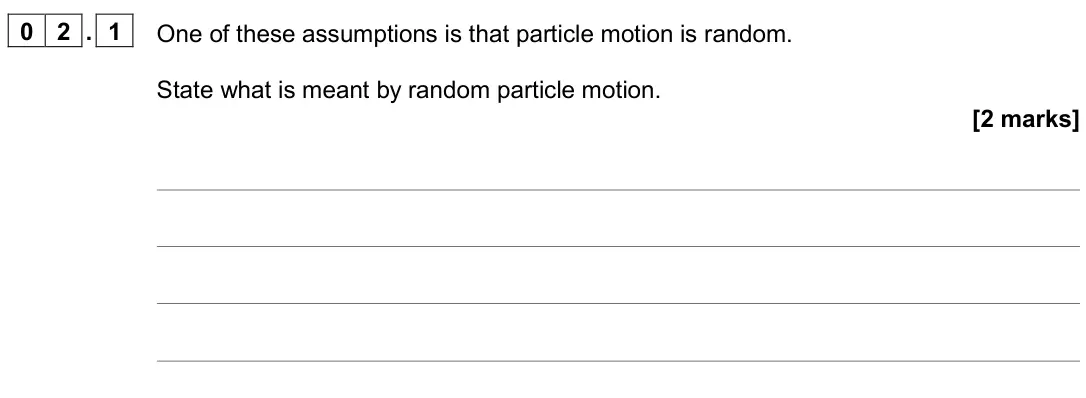
Q02.2
The whole paper ↗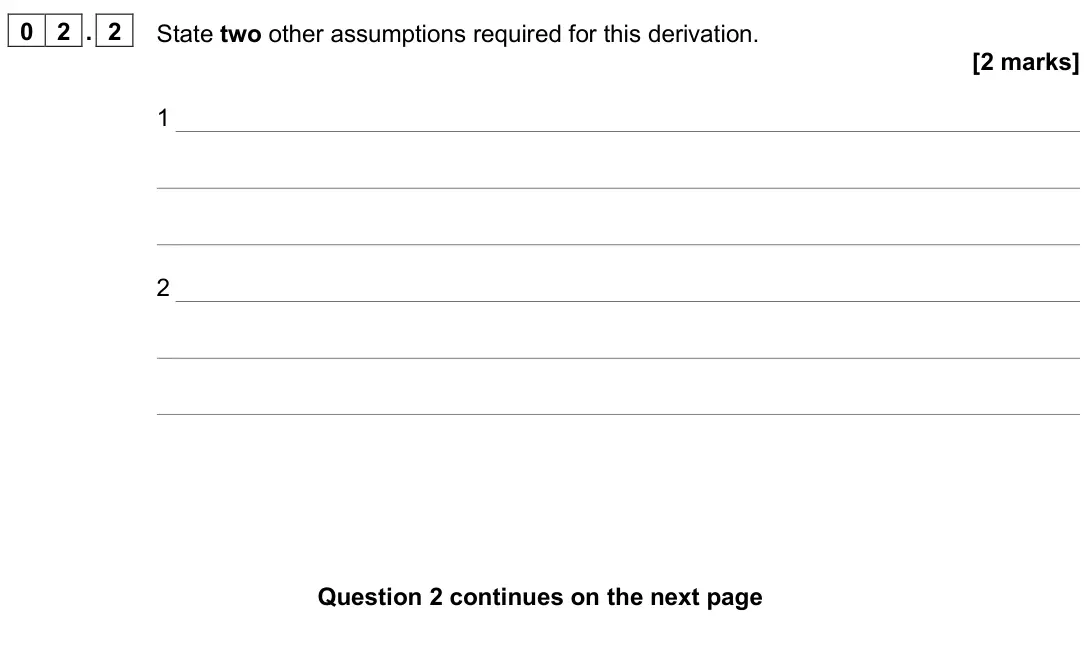
Q02.3
The whole paper ↗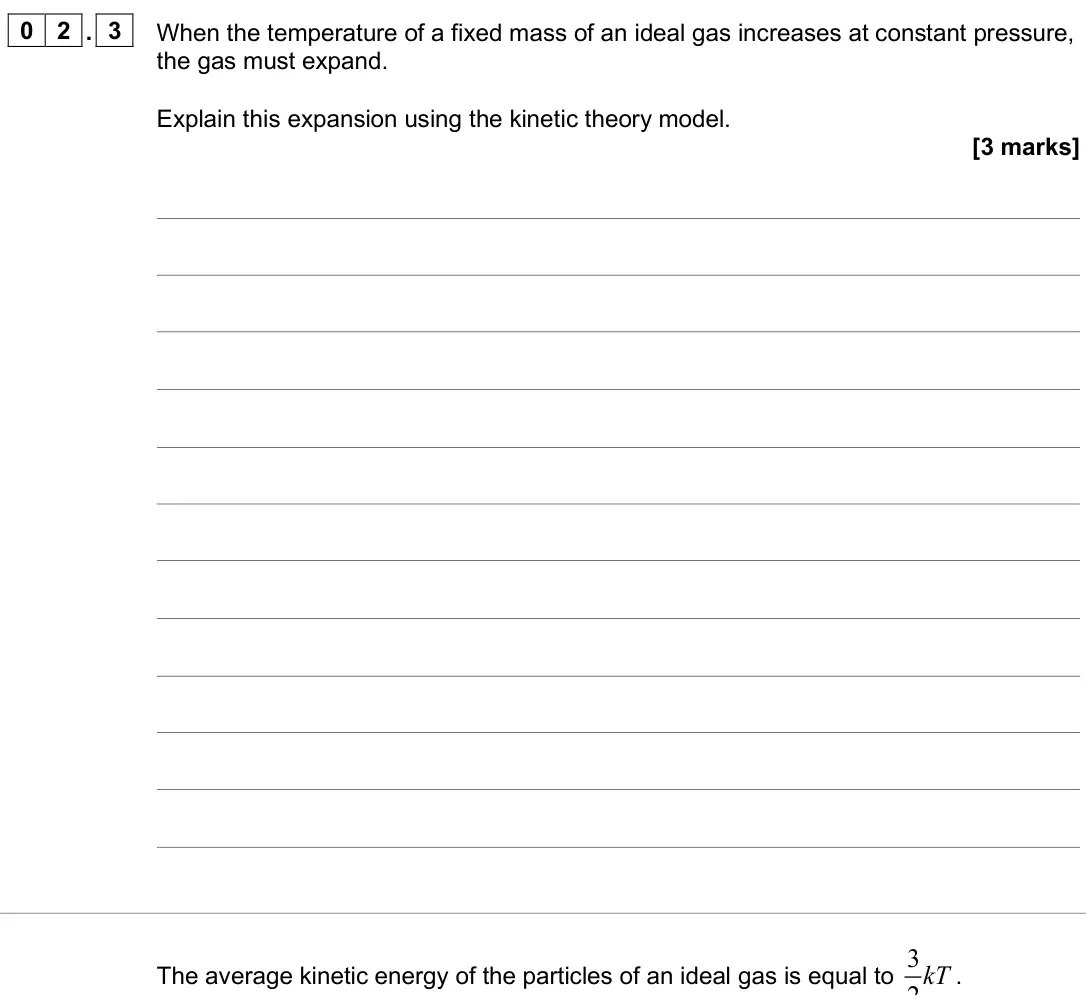
Q02.4
The whole paper ↗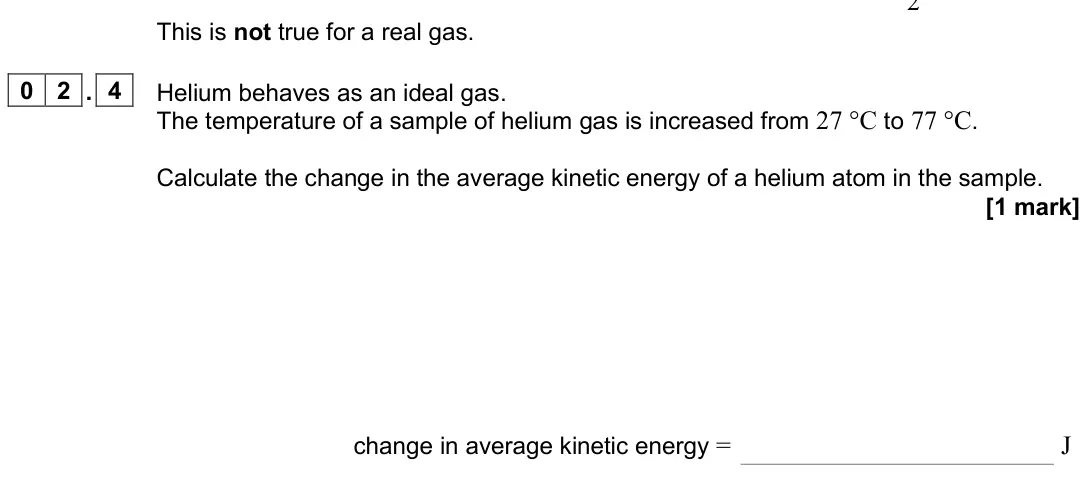
Q02.5
The whole paper ↗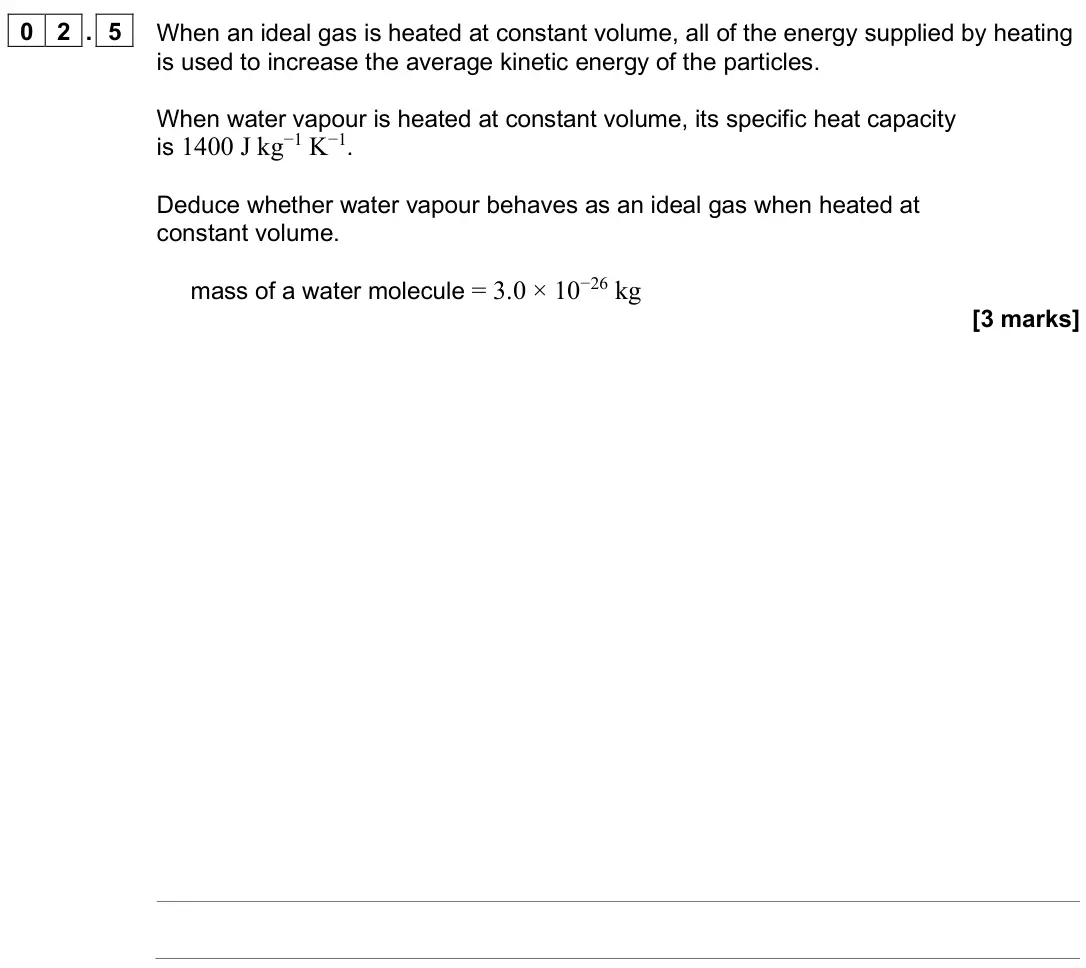
Q03.3
The whole paper ↗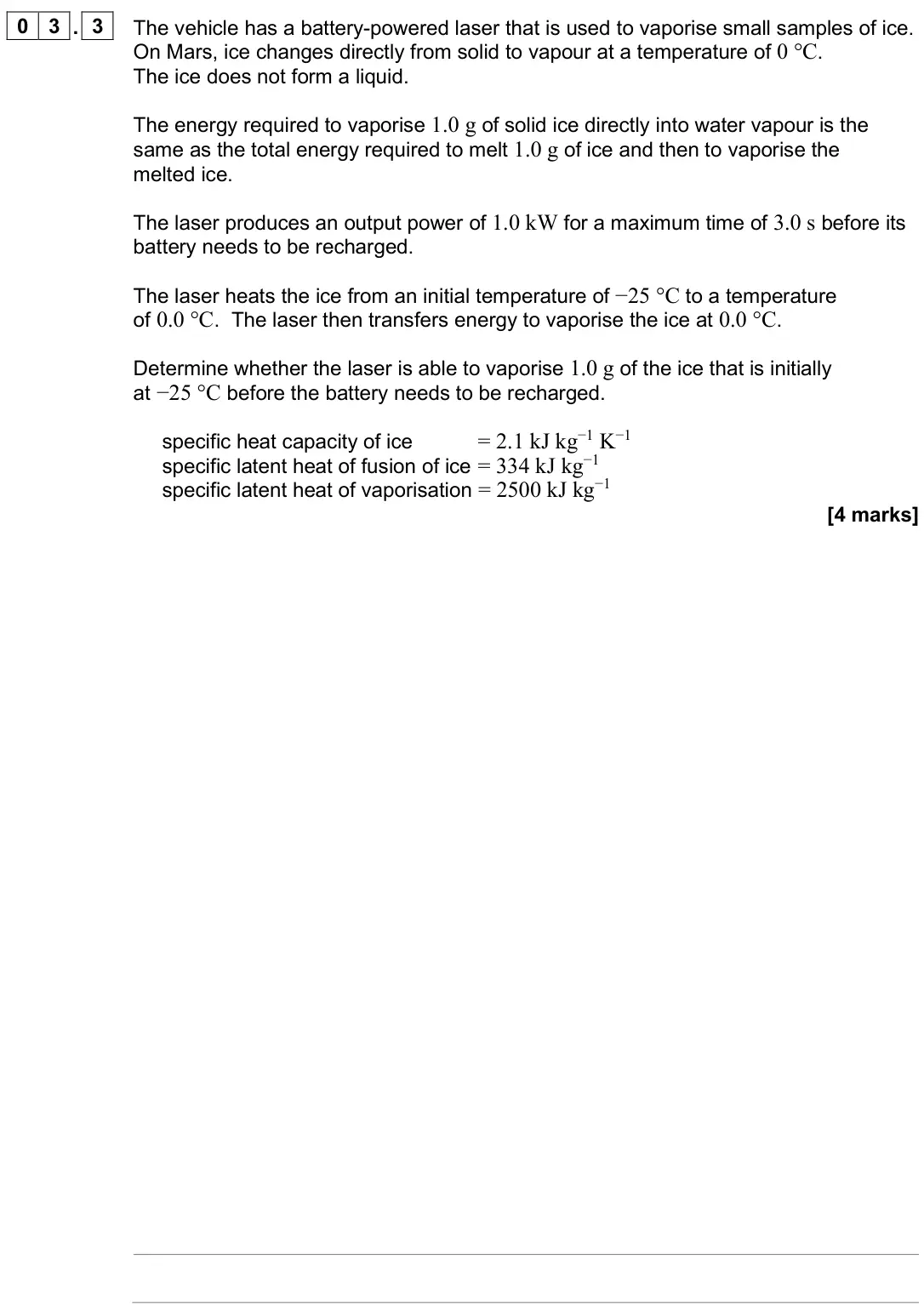
Q01.1
The whole paper ↗
Q01.2
The whole paper ↗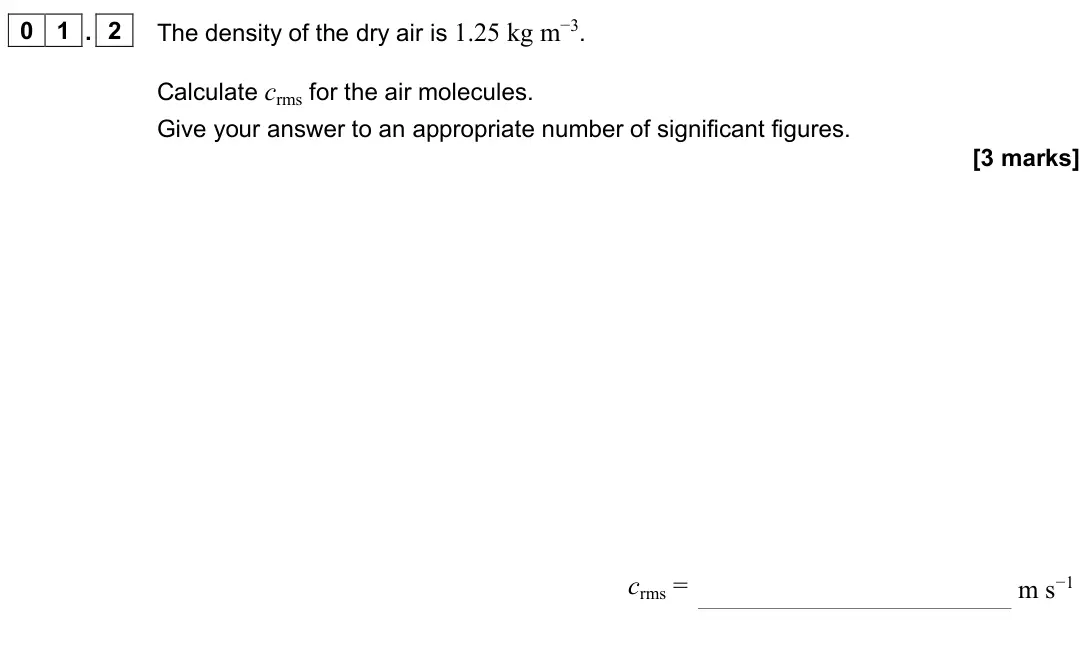
Q01.3
The whole paper ↗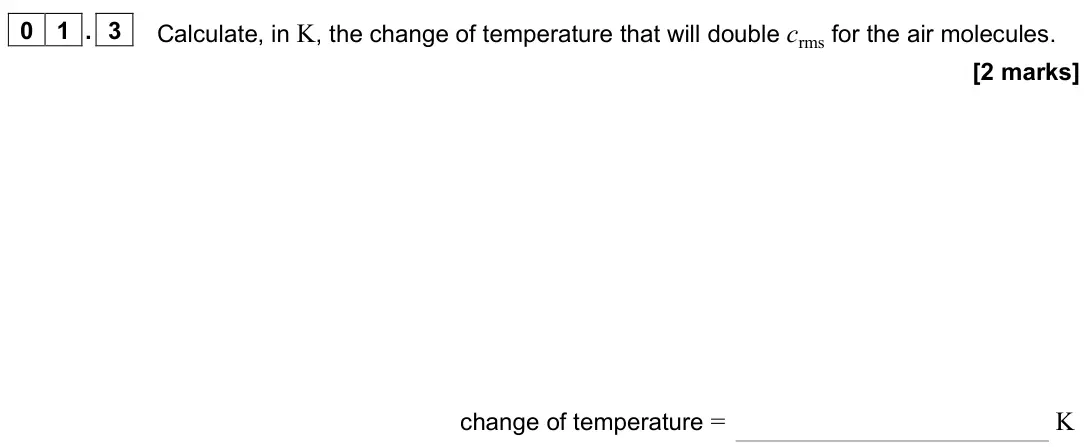
Q01.4
The whole paper ↗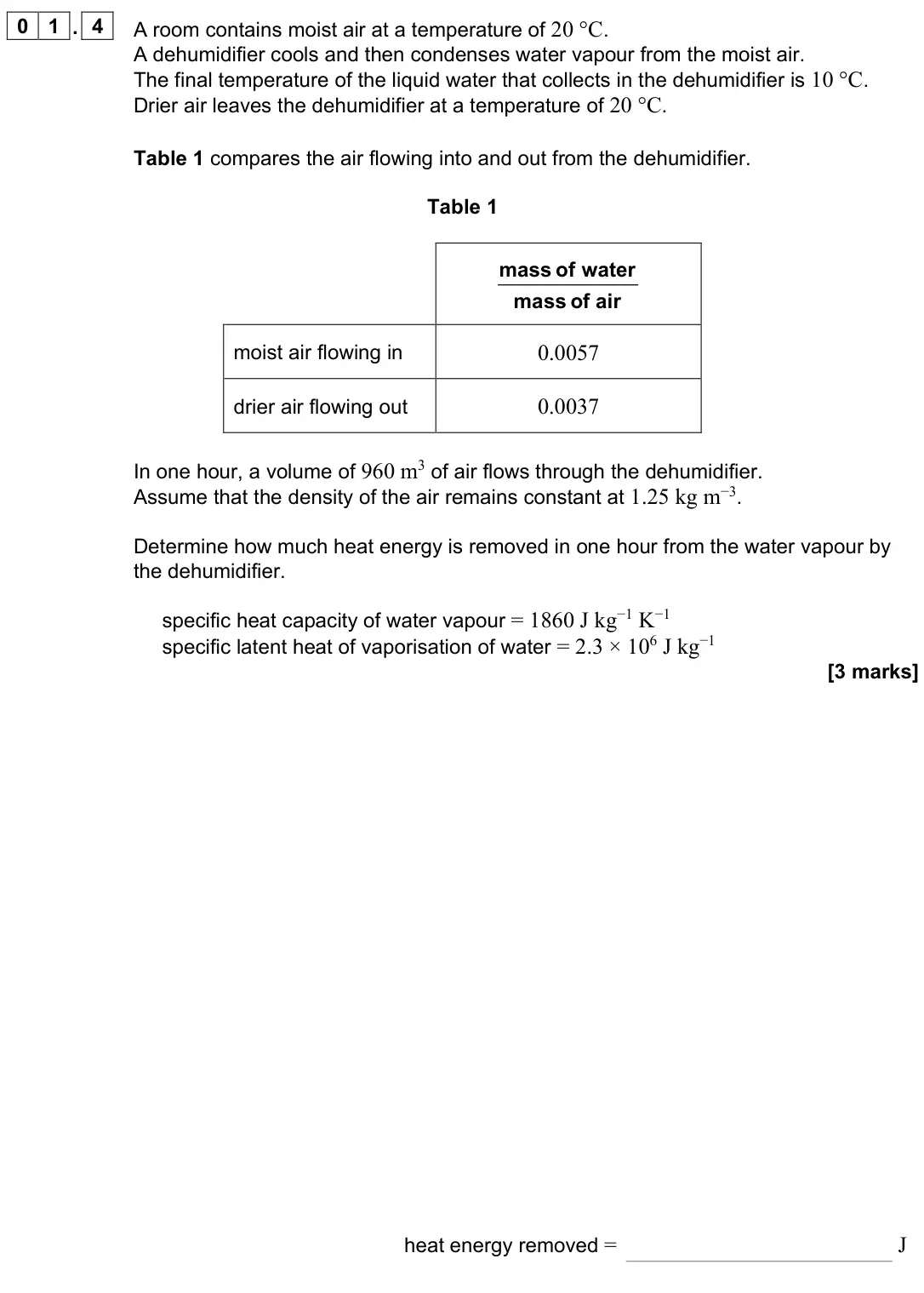
Q01.1
The whole paper ↗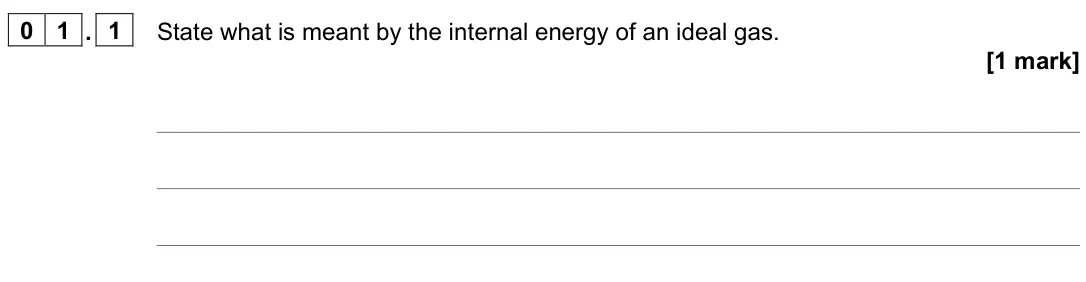
Q01.2
The whole paper ↗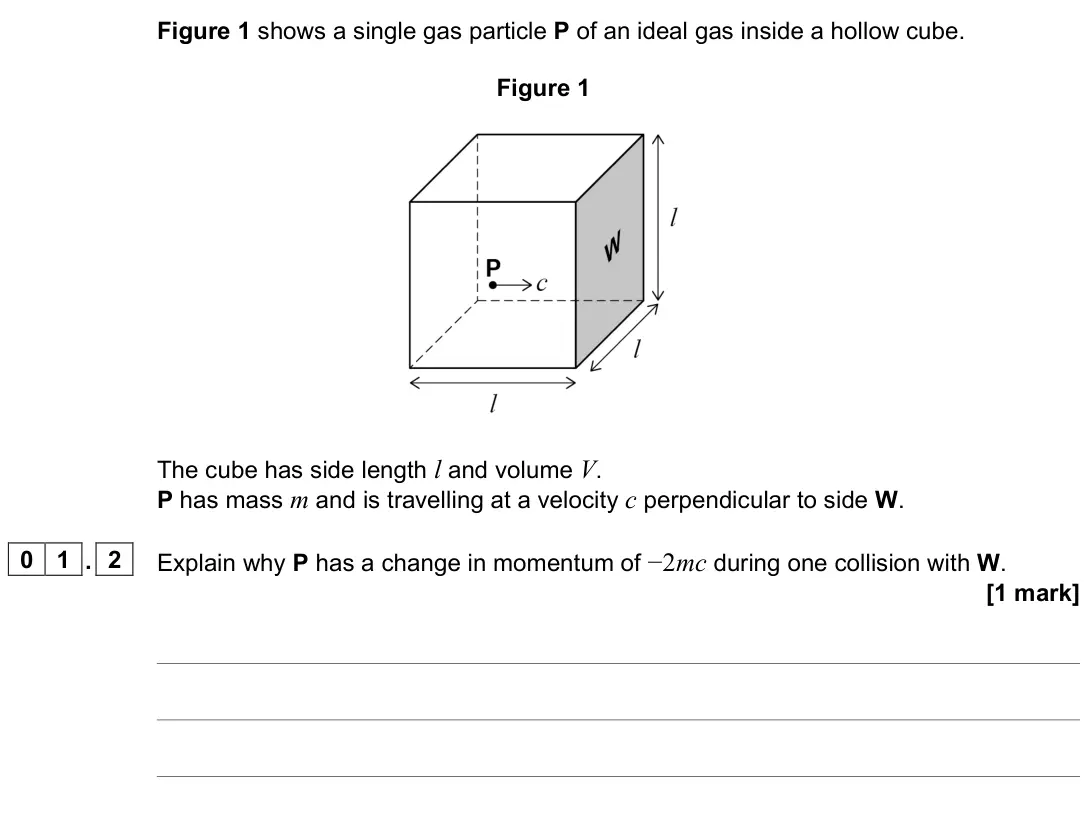
Q01.3
The whole paper ↗
Q01.4
The whole paper ↗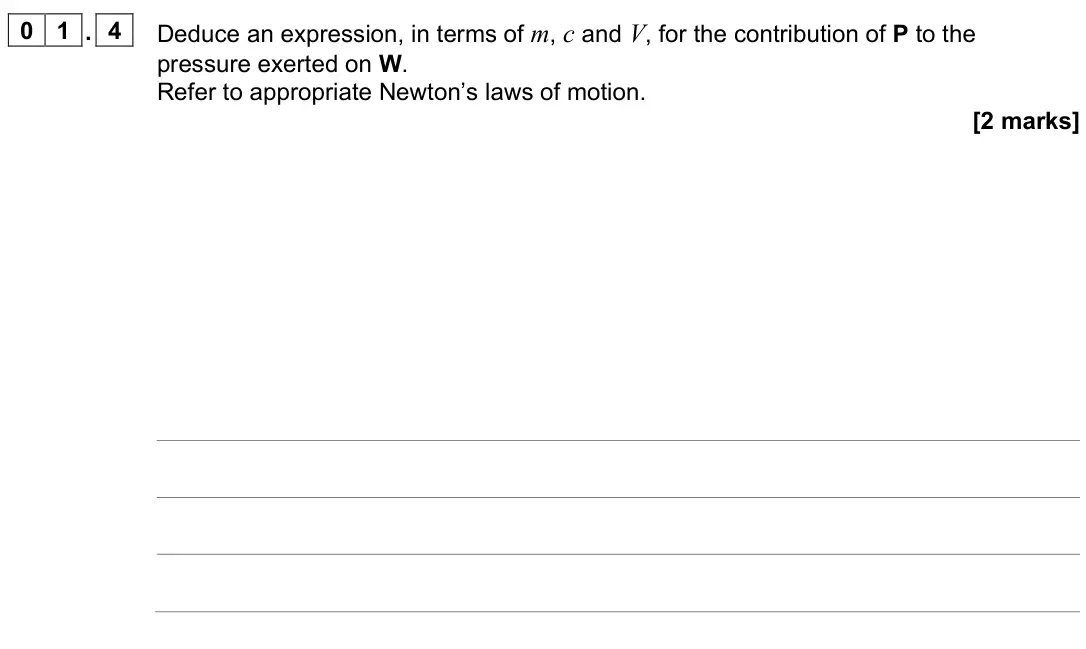
All 99 questions on Thermal physics, as a list
- June 2025, Paper 2, Q02.1 (2 marks): One of these assumptions is that particle motion is random. State what is meant by random particle motion. [2 marks]
- June 2025, Paper 2, Q02.2 (2 marks): State two other assumptions required for this derivation. [2 marks] 1 2
- June 2025, Paper 2, Q02.3 (3 marks): When the temperature of a fixed mass of an ideal gas increases at constant pressure, the gas must expand. Explain this expansion using the kinetic theory model.
- June 2025, Paper 2, Q02.4 (1 mark): Helium behaves as an ideal gas. The temperature of a sample of helium gas is increased from 27 °C to 77 °C. Calculate the change in the average kinetic energy o
- June 2025, Paper 2, Q02.5 (3 marks): When an ideal gas is heated at constant volume, all of the energy supplied by heating is used to increase the average kinetic energy of the particles. When wate
- June 2025, Paper 2, Q03.3 (4 marks): The vehicle has a battery-powered laser that is used to vaporise small samples of ice. On Mars, ice changes directly from solid to vapour at a temperature of 0
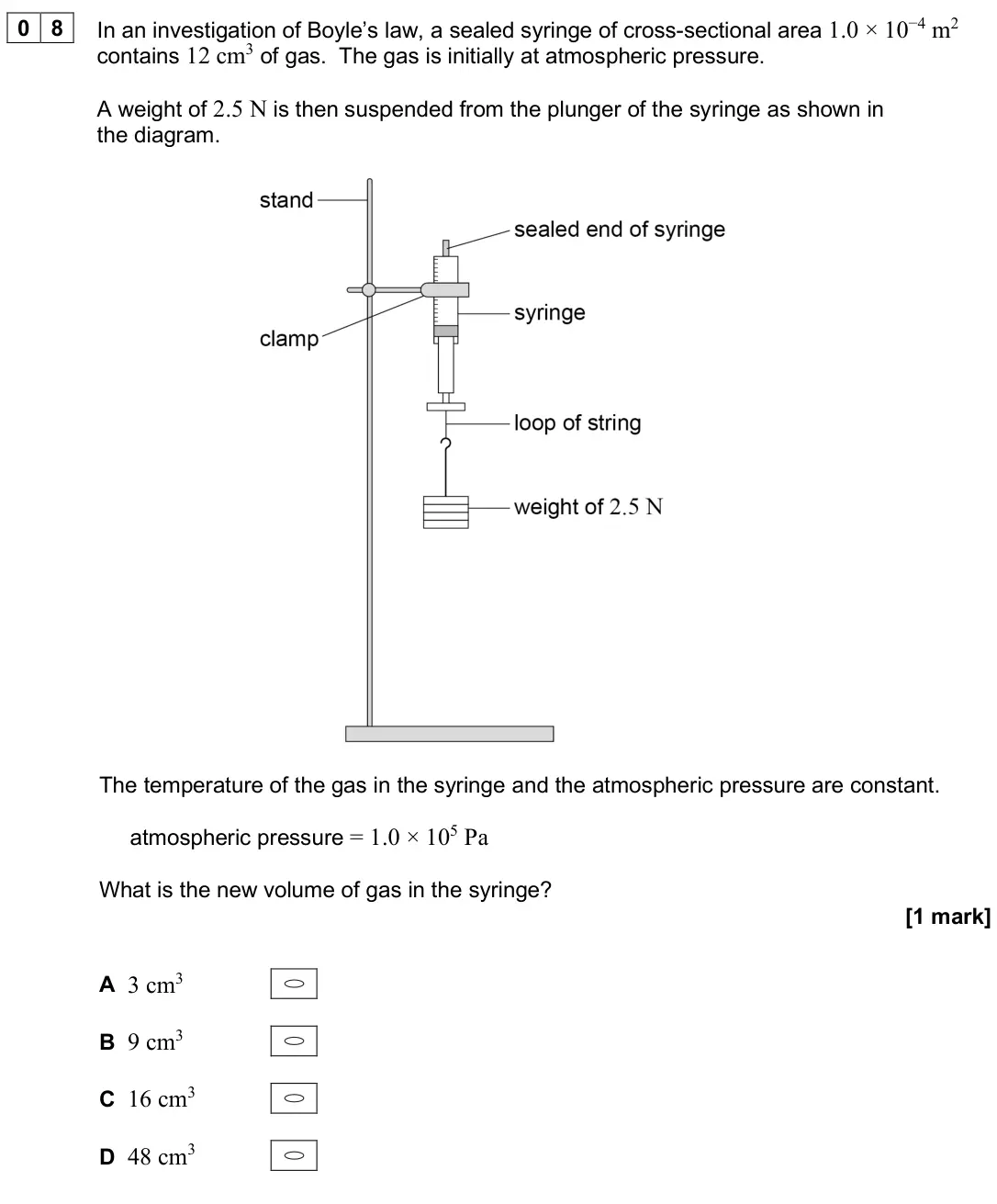
- June 2025, Paper 2, Q08 (1 mark): In an investigation of Boyle’s law, a sealed syringe of cross-sectional area 1.0 × 10⁻⁴ m2 contains 12 cm3 of gas. The gas is initially at atmospheric pressure.
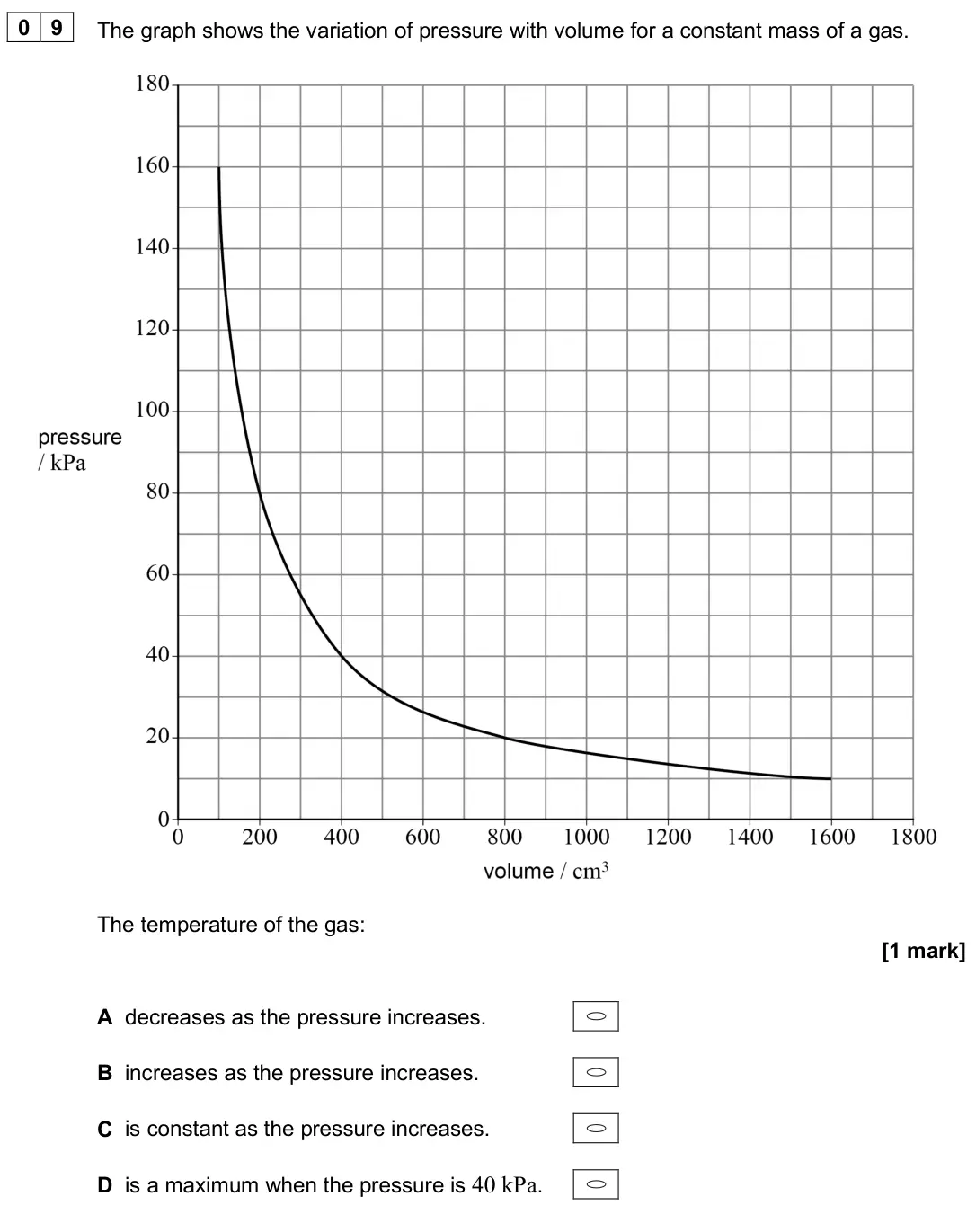
- June 2025, Paper 2, Q09 (1 mark): The graph shows the variation of pressure with volume for a constant mass of a gas. The temperature of the gas: [1 mark] A decreases as the pressure increases.
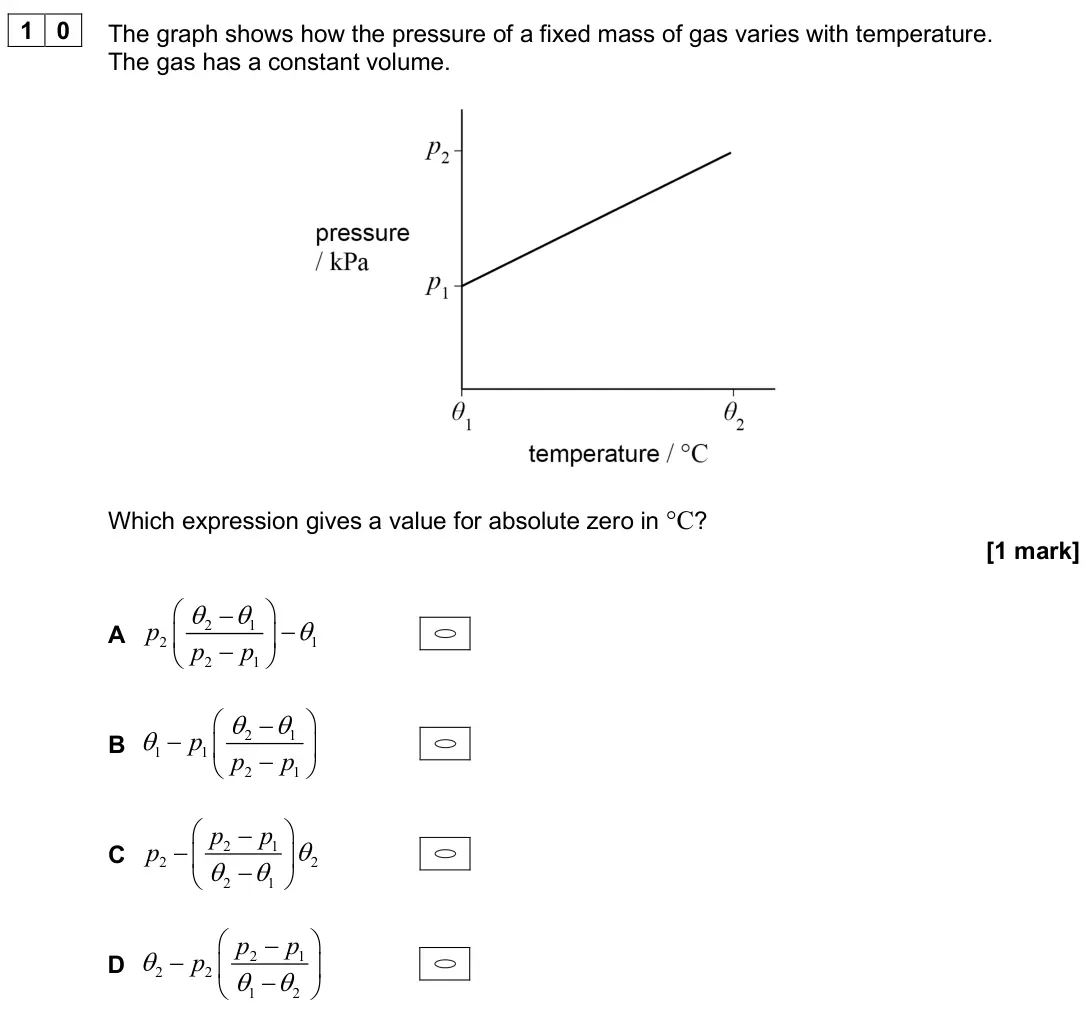
- June 2025, Paper 2, Q10 (1 mark): The graph shows how the pressure of a fixed mass of gas varies with temperature. The gas has a constant volume. Which expression gives a value for absolute zero
- June 2024, Paper 2, Q01.1 (1 mark): Show that the amount of air in each cubic metre is about 40 mol. [1 mark]
- June 2024, Paper 2, Q01.2 (3 marks): The density of the dry air is 1.25 kg m−3. Calculate crms for the air molecules. Give your answer to an appropriate number of significant figures. [3 marks] crm
- June 2024, Paper 2, Q01.3 (2 marks): Calculate, in K, the change of temperature that will double crms for the air molecules. [2 marks] change of temperature = K
- June 2024, Paper 2, Q01.4 (3 marks): A room contains moist air at a temperature of 20 °C. A dehumidifier cools and then condenses water vapour from the moist air. The final temperature of the liqui
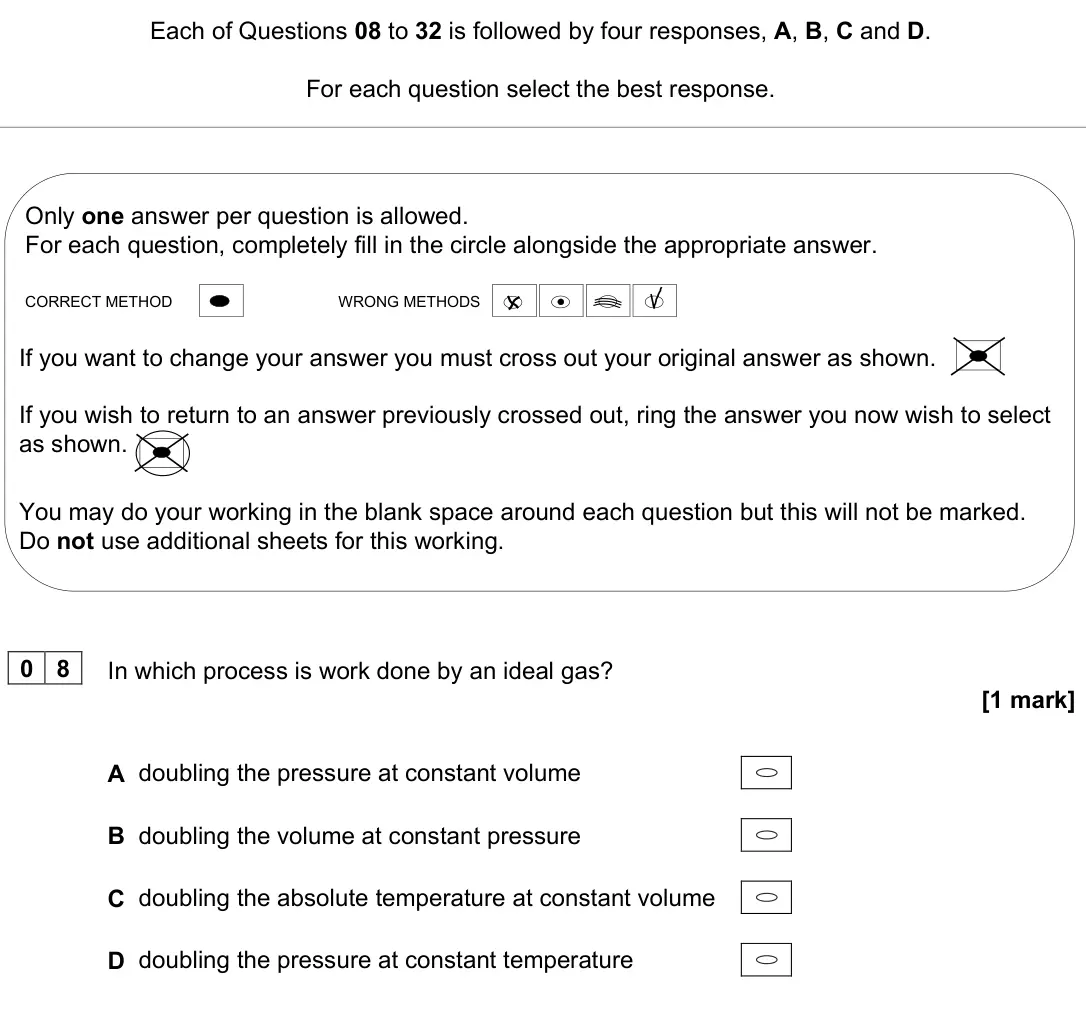
- June 2024, Paper 2, Q08 (1 mark): [multiple choice] In which process is work done by an ideal gas? [1 mark] A doubling the pressure at constant volume B doubling the volume at constant pressure
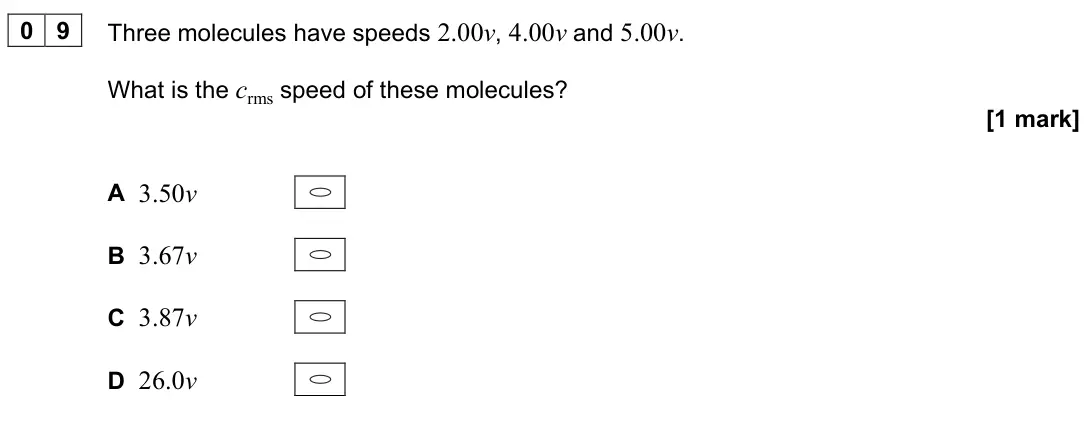
- June 2024, Paper 2, Q09 (1 mark): Three molecules have speeds 2.00v, 4.00v and 5.00v. What is the crms speed of these molecules? [1 mark] A 3.50v B 3.67v C 3.87v D 26.0v
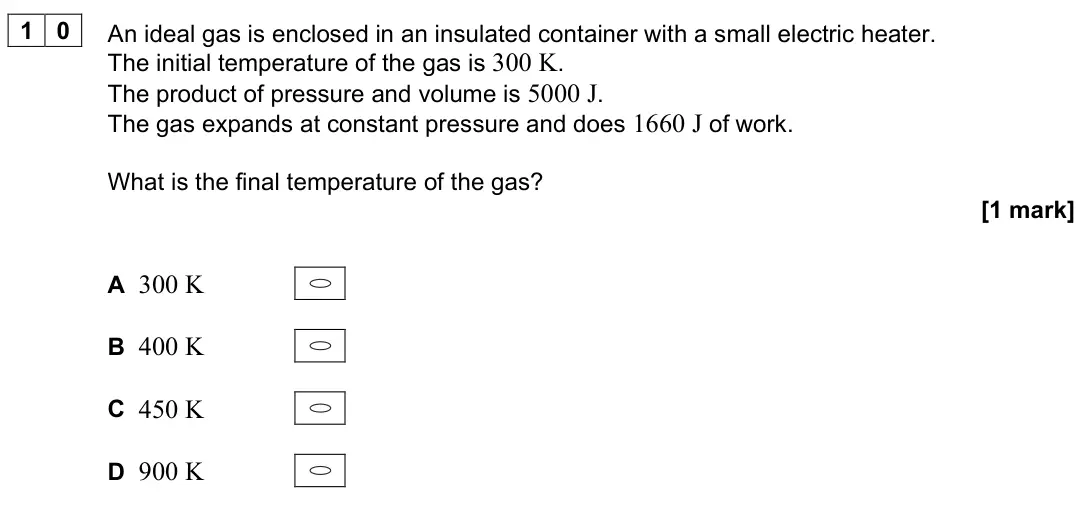
- June 2024, Paper 2, Q10 (1 mark): An ideal gas is enclosed in an insulated container with a small electric heater. The initial temperature of the gas is 300 K. The product of pressure and volume
- June 2023, Paper 2, Q01.1 (1 mark): State what is meant by the internal energy of an ideal gas. [1 mark]
- June 2023, Paper 2, Q01.2 (1 mark): Explain why P has a change in momentum of −2mc during one collision with W. [1 mark]
- June 2023, Paper 2, Q01.3 (1 mark): P collides repeatedly with W. Show that the frequency f of collisions is 2 c l . [1 mark]
- June 2023, Paper 2, Q01.4 (2 marks): Deduce an expression, in terms of m, c and V, for the contribution of P to the pressure exerted on W. Refer to appropriate Newton’s laws of motion. [2 marks]
- June 2023, Paper 2, Q02.1 (5 marks): The mass of the wheel is measured when the gas in the tyre is at a pressure of 1.01 × 10⁵ Pa. More of the same gas is added to the tyre and the mass of the whee
- June 2023, Paper 2, Q02.2 (2 marks): Motorsport regulations specify a minimum amount of gas in the tyre. The amount of gas in the tyre is checked by measuring the pressure before the wheel is put o
- June 2023, Paper 2, Q08 (1 mark): [multiple choice] A 1000 W heater is 75% efficient. The heater is used to increase the temperature of some water from 10 °C to 85 °C in 7 hours. What mass of wa
- June 2023, Paper 2, Q09 (1 mark): Which can lead to a value for the absolute zero of temperature? [1 mark] A Boyle’s law B Brownian motion C Charles’s law D Rutherford scattering
- June 2022, Paper 2, Q01.1 (2 marks): The metal plate has a mass of 1.2 kg and is initially at a temperature of 20 °C. The heater is switched on. After a time t the metal plate reaches its working t
- June 2022, Paper 2, Q01.2 (3 marks): The metal plate is maintained at its working temperature. Water at 20 °C drips continuously onto the metal plate. Steam at 100 °C emerges continuously from the
- June 2022, Paper 2, Q02.1 (2 marks): In the kinetic theory model, it is assumed that there are many identical particles moving at random. State two other assumptions made in deriving the equation p
- June 2022, Paper 2, Q02.2 (3 marks): Explain why molecules of a gas exert a force on the walls of a container. Refer to Newton’s laws of motion in your answer. [3 marks]
- June 2022, Paper 2, Q02.3 (3 marks): A sealed flask of volume 0.35 m3 contains an ideal gas at a pressure of 220 kPa. The mean kinetic energy of the gas molecules is 6.7 × 10⁻²¹ J. Calculate the am
- June 2022, Paper 2, Q02.4 (2 marks): Figure 2 shows the variation of pressure with volume for a fixed mass of an ideal gas at constant absolute temperature T. Draw, on Figure 2, the graph for the s
- June 2022, Paper 2, Q07 (1 mark): [multiple choice] An ideal gas, initially at 300 K, is compressed to half its original volume. It is then cooled at constant volume until the pressure is restor
- June 2022, Paper 2, Q08 (1 mark): A fixed volume of an ideal gas is heated. Which row gives quantities that double when the kelvin temperature of the gas doubles? [1 mark] A rms speed of the mol
- June 2022, Paper 3A, Q04.1 (2 marks): Show that y is not inversely proportional to M. Use data points from Figure 10. [2 marks] Figure 10
- June 2022, Paper 3A, Q04.2 (3 marks): The masses are removed and the cylinder is inverted. P moves downwards without friction before coming to rest, as shown in Figure 11. Figure 11 Explain why P do
- June 2022, Paper 3A, Q04.3 (4 marks): The mass of P is 0.350 kg. Deduce y when the cylinder is in the inverted position shown in Figure 11. Draw a line of best fit on Figure 10 to arrive at your ans
- June 2022, Paper 3A, Q04.5 (3 marks): Figure 13 shows data obtained using the apparatus in Figure 12. Figure 13 Explain why the gradient of the graph in Figure 13 confirms that the air obeys Boyle’s
- June 2022, Paper 3A, Q04.6 (3 marks): The largest pressure that can be read from the pressure gauge is 3.4 × 10⁵ Pa. Determine, using Figure 13, the volume V corresponding to this pressure. [3 marks
- June 2022, Paper 3A, Q04.7 (2 marks): State one property of the air that must not change during the experiment. Go on to suggest how this can be achieved. [2 marks]
- November 2021, Paper 2, Q03.1 (1 mark): Explain why the drum must be in a vacuum. [1 mark]
- November 2021, Paper 2, Q03.3 (3 marks): The speed of the atom in Question 03.2 is equal to crms, the root mean square speed of the atoms of the gas in the oven. The molar mass of the gas is 0.209 kg m
- November 2021, Paper 2, Q03.4 (2 marks): The oven temperature is kept constant during the experiment but the pressure in the oven decreases as atoms leave through the exit hole. Explain, using the kine
- November 2021, Paper 2, Q03.5 (1 mark): The pressure of gas in the oven is initially 5.0 × 10⁴ Pa. The volume of the oven is 2.7 × 10⁻² m3. During the experiment the pressure in the oven decreases to
- November 2021, Paper 2, Q03.6 (2 marks): Atoms enter the drum every time S passes the exit hole. The detector darkens at the point where an atom strikes it. After a time, the detector is removed from t
- November 2021, Paper 2, Q07 (1 mark): [multiple choice] A solar panel transfers energy at a rate of 1.2 kW to liquid passing through it. The liquid has a specific heat capacity of 4.0 kJ kg−1 K−1. W
- November 2021, Paper 2, Q08 (1 mark): A gas occupies a volume V. Its particles have a root mean square speed (crms) of u. The gas is compressed at constant temperature to a volume 0.5V. What is the
- November 2021, Paper 2, Q09 (1 mark): A fixed mass of gas is heated at constant volume. The graph is drawn for this process. What do x and y represent? [1 mark] x y A pressure in Pa temperature in º
- November 2021, Paper 2, Q10 (1 mark): Three particles are travelling in the same plane with velocities as shown in the vector diagram. What is the root mean square speed of the particles? [1 mark] A
- November 2020, Paper 2, Q01.1 (1 mark): State the melting temperature of M. [1 mark] temperature = °C
- November 2020, Paper 2, Q01.2 (1 mark): Explain how the energy transferred to the sample changes the arrangement of the atoms during the time interval tA to tB. [1 mark]
- November 2020, Paper 2, Q01.3 (2 marks): State what happens to the potential energy of the atoms and to the kinetic energy of the atoms during the time interval tA to tB. [2 marks]
- November 2020, Paper 2, Q01.4 (1 mark): Describe how the motion of the atoms changes during the time interval tB to tC. [1 mark]
- November 2020, Paper 2, Q01.5 (3 marks): The sample has a mass of 0.25 kg. Determine the specific heat capacity of M when in the liquid state. State an appropriate SI unit for your answer. [3 marks] sp
- November 2020, Paper 2, Q01.6 (2 marks): Table 1 shows the specific latent heats of fusion l for elements that are liquid at similar temperatures to M. Table 1 Element Caesium Gallium Mercury Rubidium
- November 2020, Paper 2, Q07 (1 mark): [multiple choice] When an ideal gas at a temperature of 27 °C is suddenly compressed to one quarter of its volume, the pressure increases by a factor of 7 What
- November 2020, Paper 2, Q08 (1 mark): The diagram shows two flasks X and Y connected by a thin tube of negligible volume. The flasks contain an ideal gas. The volume of X is twice the volume of Y. W
- November 2020, Paper 2, Q09 (1 mark): A sample P of an ideal gas contains 1 mol at an absolute temperature T. A second sample Q of an ideal gas contains 2 3 mol at an absolute temperature 2T. The to
- November 2020, Paper 2, Q10 (1 mark): An ideal gas is contained in a cubical box of side length a. The gas has N molecules each of mass m. What is the pressure exerted by the gas on the walls of the
- November 2020, Paper 2, Q11 (1 mark): Which statement is true about an experiment where Brownian motion is demonstrated using smoke particles in air? [1 mark] A The experiment makes it possible to s
- June 2019, Paper 2, Q01.1 (5 marks): The nitrogen is heated from 70 K and is completely turned into a gas after 890 s. Calculate the specific heat capacity of liquid nitrogen. Give an appropriate u
- June 2019, Paper 2, Q01.2 (4 marks): The work done by the nitrogen in the cylinder when expanding due to a change of state is X. The energy required to change the state of the nitrogen from a liqui
- June 2019, Paper 2, Q02.1 (2 marks): State what is meant by the internal energy of a gas. [2 marks]
- June 2019, Paper 2, Q02.2 (2 marks): Absolute zero of temperature can be interpreted in terms of the ideal gas laws or the kinetic energy of particles in an ideal gas. Describe these two interpreta
- June 2019, Paper 2, Q02.3 (3 marks): A mixture of argon atoms and helium atoms is in a cylinder enclosed with a piston. The mixture is at a temperature of 310 K. Calculate the root mean square spee
- June 2019, Paper 2, Q02.4 (1 mark): Compare the mean kinetic energy of the argon atoms and the helium atoms in the mixture. [1 mark]
- June 2019, Paper 2, Q02.5 (3 marks): Explain, in terms of the kinetic theory model, why a pressure is exerted by the gas on the piston. [3 marks]
- June 2019, Paper 2, Q02.6 (3 marks): The mixture of gases in the cylinder stays the same. Explain, using the kinetic theory model, two changes that can be made independently to reduce the pressure
- June 2019, Paper 2, Q07 (1 mark): [multiple choice] Brownian motion [1 mark] A makes it possible to see the motion of air molecules. B is caused by the collisions of smoke particles. C is caused
- June 2019, Paper 2, Q25 (1 mark): Which is not an assumption about gas particles in the kinetic theory model for a gas? [1 mark] A They collide elastically with the container walls. B They have
- June 2018, Paper 2, Q01.1 (2 marks): Explain what is meant by specific latent heat of fusion. [2 marks]
- June 2018, Paper 2, Q01.2 (3 marks): Figure 1 shows how the temperature of the water is maintained in a hot tub. Figure 1 The hot tub system has a volume of 4.5 m3 and is filled with water at a tem
- June 2018, Paper 2, Q01.3 (2 marks): The pump can circulate the water at different speeds. When working at higher speeds the rise in temperature is greater. Explain why. Again assume that no heat i
- June 2018, Paper 2, Q08 (1 mark): [multiple choice] The graph shows the variation of pressure p with temperature for a fixed mass of an ideal gas at constant volume. What is the gradient of the
- June 2018, Paper 2, Q09 (1 mark): Two flasks X and Y are filled with an ideal gas and are connected by a tube of negligible volume compared to that of the flasks. The volume of X is twice the vo
- June 2018, Paper 2, Q10 (1 mark): The average mass of an air molecule is 4.8 × 10⁻²⁶ kg What is the mean square speed of an air molecule at 750 K? [1 mark] A 3.3 × 10⁵ m2 s–2 B 4.3 × 10⁵ m2 s–2
- June 2018, Paper 2, Q11 (1 mark): A transparent illuminated box contains small smoke particles and air. The smoke particles are observed to move randomly when viewed through a microscope. What i
- June 2018, Paper 2, Q12 (1 mark): The diagram shows a gas particle about to collide elastically with a wall. Which diagram shows the correct change in momentum ∆mv that occurs during the collisi
- June 2018, Paper 3A, Q03.1 (2 marks): Explain why the volume of the air in the flask in Figure 9c is less than the volume of the air in the flask in Figure 9d. [2 marks]
- June 2018, Paper 3A, Q03.2 (2 marks): Explain why Charles’s Law can be applied to compare the air in the flask in Figure 9a with the air in the flask in Figure 9d. [2 marks]
- June 2018, Paper 3A, Q03.3 (3 marks): The flask is removed from water bath C and the valve and stopper are removed. The volume of the water in the flask is V1 The flask is then completely refilled w
- June 2018, Paper 3A, Q03.4 (3 marks): Plot on Figure 11 points to show the volume V and the temperature θ of the air in the flask when • the flask is as shown in Figure 9a • the flask is as shown in
- June 2018, Paper 3A, Q03.5 (1 mark): Add a best fit line to your graph in Figure 11 to show how V should vary with θ according to Charles’s Law. [1 mark]
- June 2018, Paper 3A, Q03.6 (3 marks): Determine the value of absolute zero in °C using your graph in Figure 11. [3 marks] value of absolute zero = °C
- June 2017, Paper 2, Q01.1 (1 mark): A number of assumptions are made when explaining the behaviour of a gas using the molecular kinetic theory model. State one assumption about the size of molecul
- June 2017, Paper 2, Q01.2 (2 marks): Calculate the number of gas molecules trapped in the cylinder using information from the initial situation at A. [2 marks] number of molecules =
- June 2017, Paper 2, Q01.3 (2 marks): Calculate, in K, the change in temperature of the gas during the compression that occurs between A and B. [2 marks] change in temperature = K
- June 2017, Paper 2, Q01.4 (2 marks): Deduce whether the temperature of the gas changes during the compression from B to C. [2 marks]
- June 2017, Paper 2, Q01.5 (3 marks): Compare the work done on the gas during the change from A to B with that from B to C on Figure 1. [3 marks]
- June 2017, Paper 2, Q08 (1 mark): [multiple choice] A continuous stream of water falls through a vertical distance of 100 m. Assume no thermal energy is transferred to the surroundings. The spec
- June 2017, Paper 2, Q09 (1 mark): A student measures the power of a microwave oven. He places 200 g of water at 23 °C into the microwave and heats it on full power for 1 minute. When he removes
- June 2017, Paper 2, Q10 (1 mark): The composition of a carbon dioxide (CO2) molecule is one atom of C 6 12 and two atoms of O 8 16 . What is the number of molecules of CO2 in 2.2 kg of the gas?
- June 2017, Paper 2, Q11 (1 mark): What is the total internal energy of 2.4 mol of an ideal gas which has a temperature of 15 °C? [1 mark] A 6.0 × 10⁻²¹ J B 1.4 × 10⁻²⁰ J C 4.5 × 10² J D 8.6 × 10
- Specimen, Paper 2, Q03.1 (2 marks): State two assumptions made about the motion of the molecules in a gas in the derivation of the kinetic theory of gases equation. [2 marks] 0 3 . 1
- Specimen, Paper 2, Q03.2 (3 marks): Use the kinetic theory of gases to explain why the pressure inside a football increases when the temperature of the air inside it rises. Assume that the volume
- Specimen, Paper 2, Q03.3 (6 marks): The ‘laws of football’ require the ball to have a circumference between 680 mm and 700 mm. The pressure of the air in the ball is required to be between 0.60 ×
- Specimen, Paper 2, Q07 (1 mark): Only one answer per question is allowed. For each answer completely fill in the circle alongside the appropriate answer. If you want to change your answer you m
- Specimen, Paper 2, Q23 (1 mark): A liquid flows continuously through a chamber that contains an electric heater. When the steady state is reached, the liquid leaving the chamber is at a higher
- Specimen, Paper 2, Q24 (1 mark): The temperature of a hot liquid in a container falls at a rate of 2 K per minute just before it begins to solidify. The temperature then remains steady for 20 m
- Specimen, Paper 2, Q25 (1 mark): A fixed mass of gas occupies a volume V. The temperature of the gas increases so that the root mean square velocity of the gas molecules is doubled. What will t
- Specimen, Paper 2, Q26 (1 mark): X and Y are two gas bottles that are connected by a tube that has negligible volume compared with the volume of each bottle. Initially the valve W is closed. X
Questions, mark schemes and examiner’s reports are © AQA, from their published past papers. Plumi isn’t affiliated with any exam board. Want whole papers? Every AQA A-Level Physics paper.
Rather write your answers by hand on iPad? Plumi marks them against the same mark schemes.