 plumi
Periodic motion: AQA A‑Level Physics questions
Every AQA A-Level Physics exam question on 3.6.1 Periodic motion, 2016–2025, with its mark scheme and examiner’s report.
Find questions2,714
Calculations
Q03.1
The whole paper ↗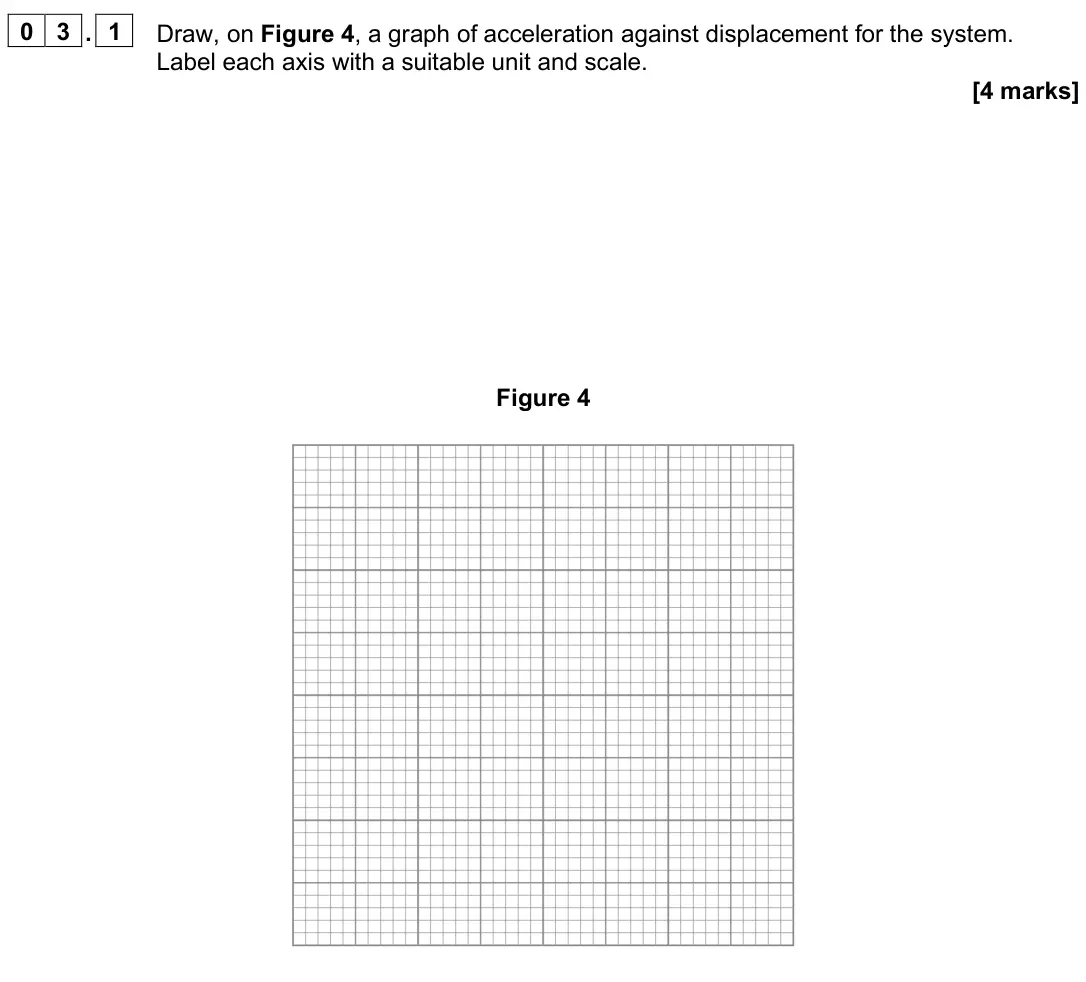
Q03.2
The whole paper ↗
Q07.1
The whole paper ↗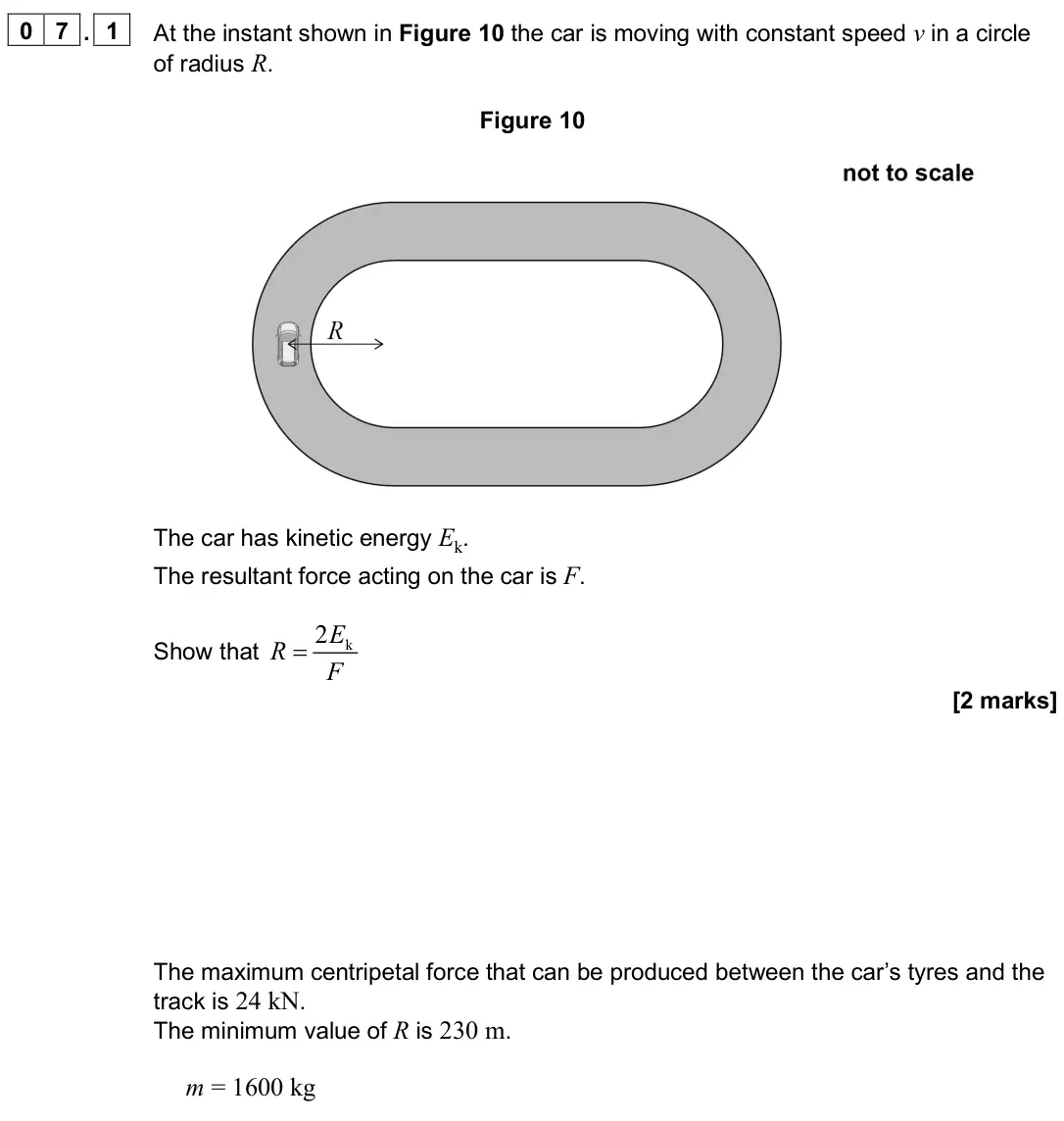
Q07.2
The whole paper ↗
Q07.3
The whole paper ↗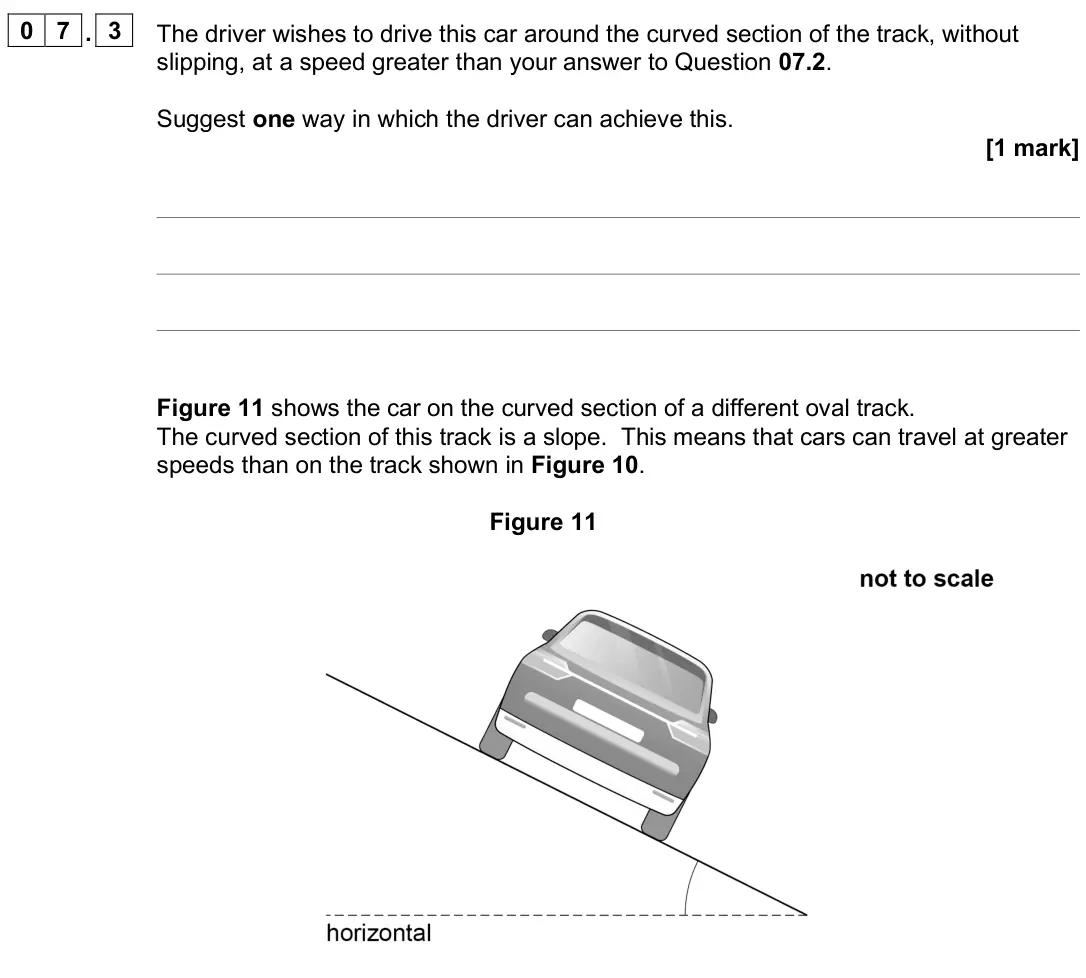
Q07.4
The whole paper ↗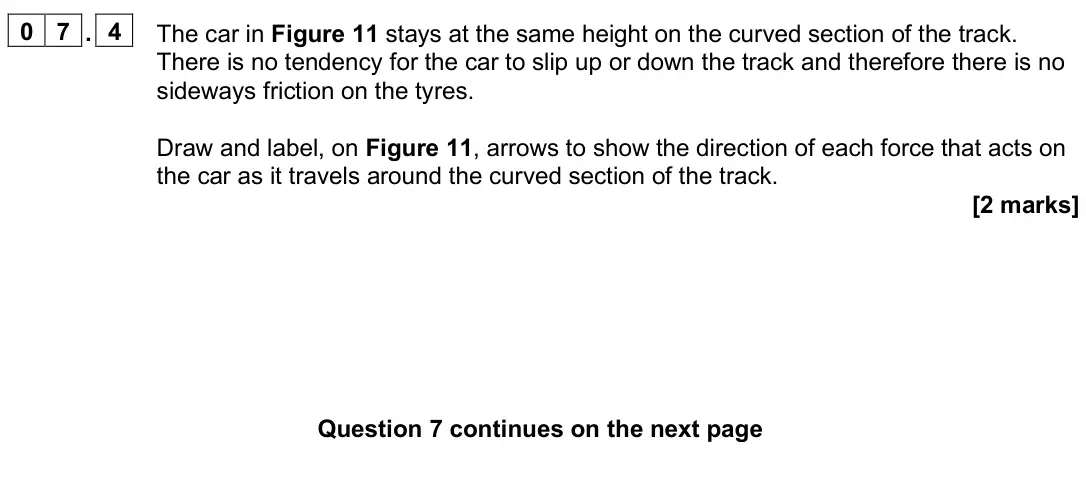
Q07.5
The whole paper ↗
Q04.3
The whole paper ↗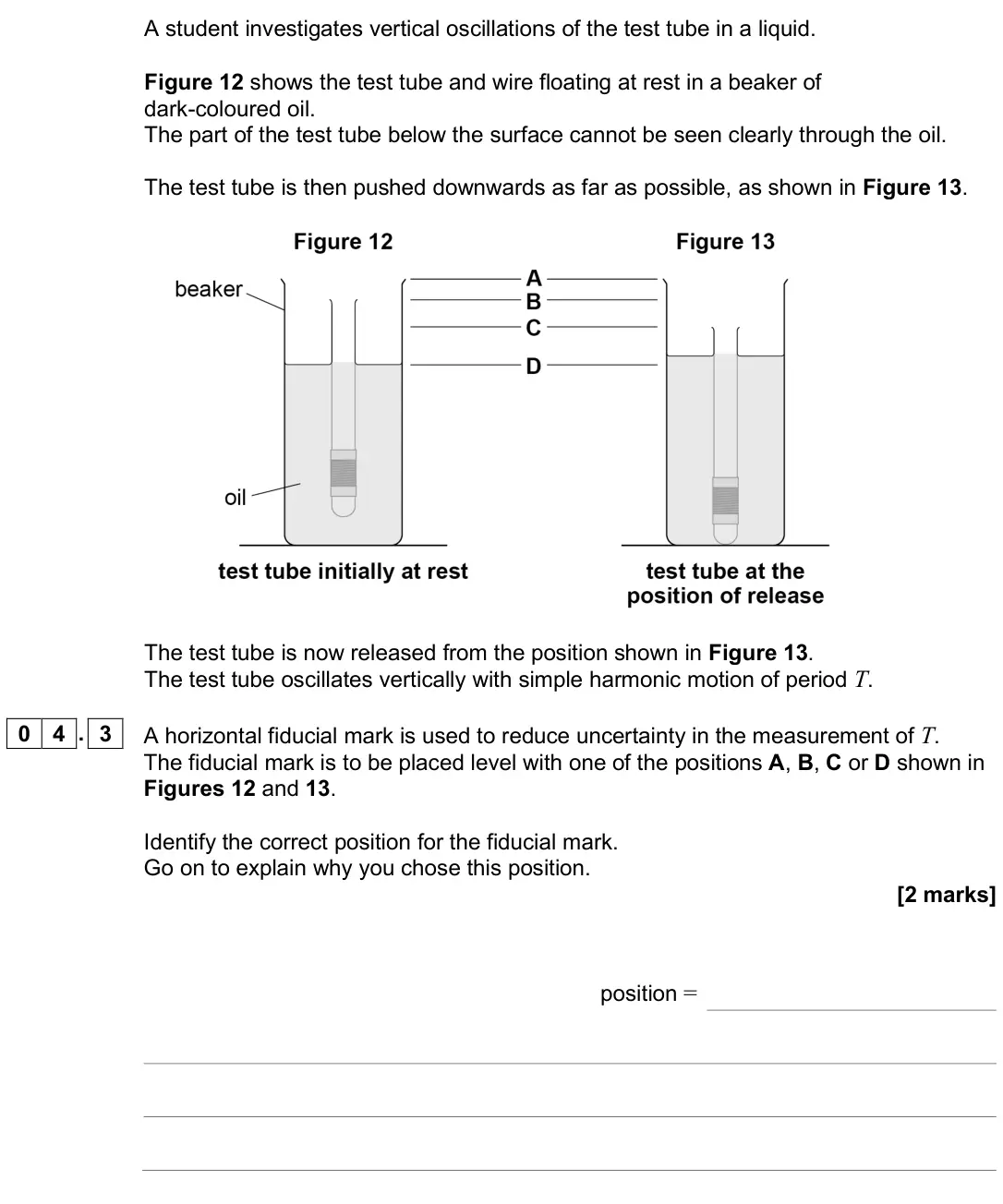
Q04.4
The whole paper ↗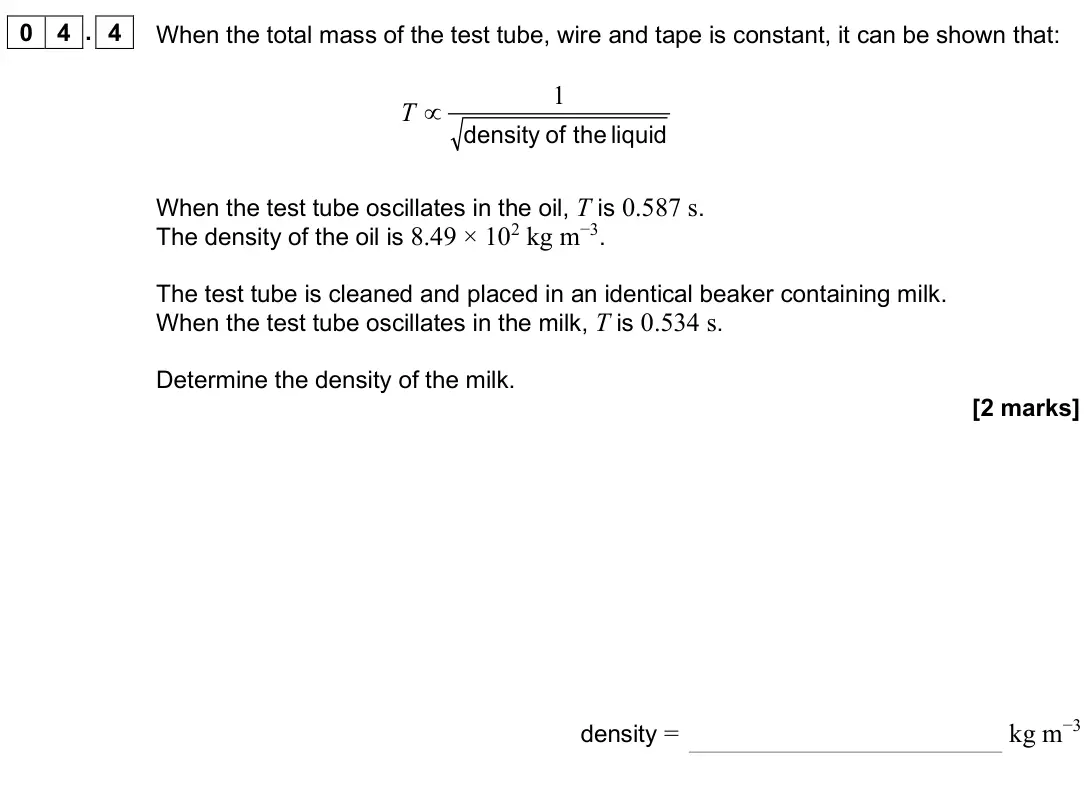
Q04.5
The whole paper ↗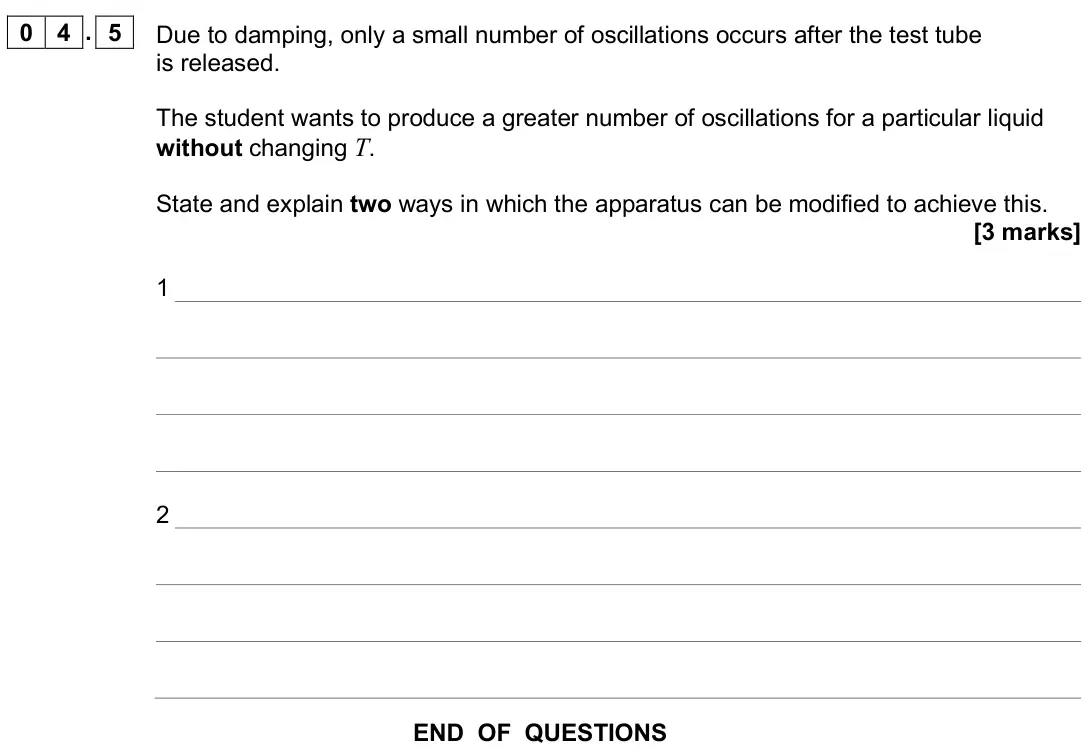
Q06.1
The whole paper ↗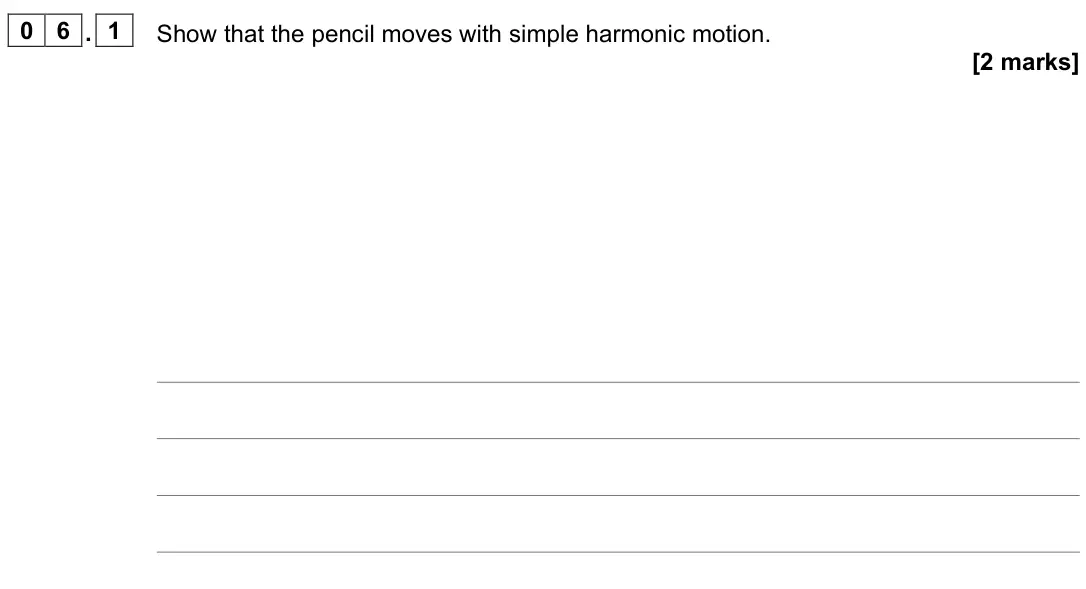
Q06.2
The whole paper ↗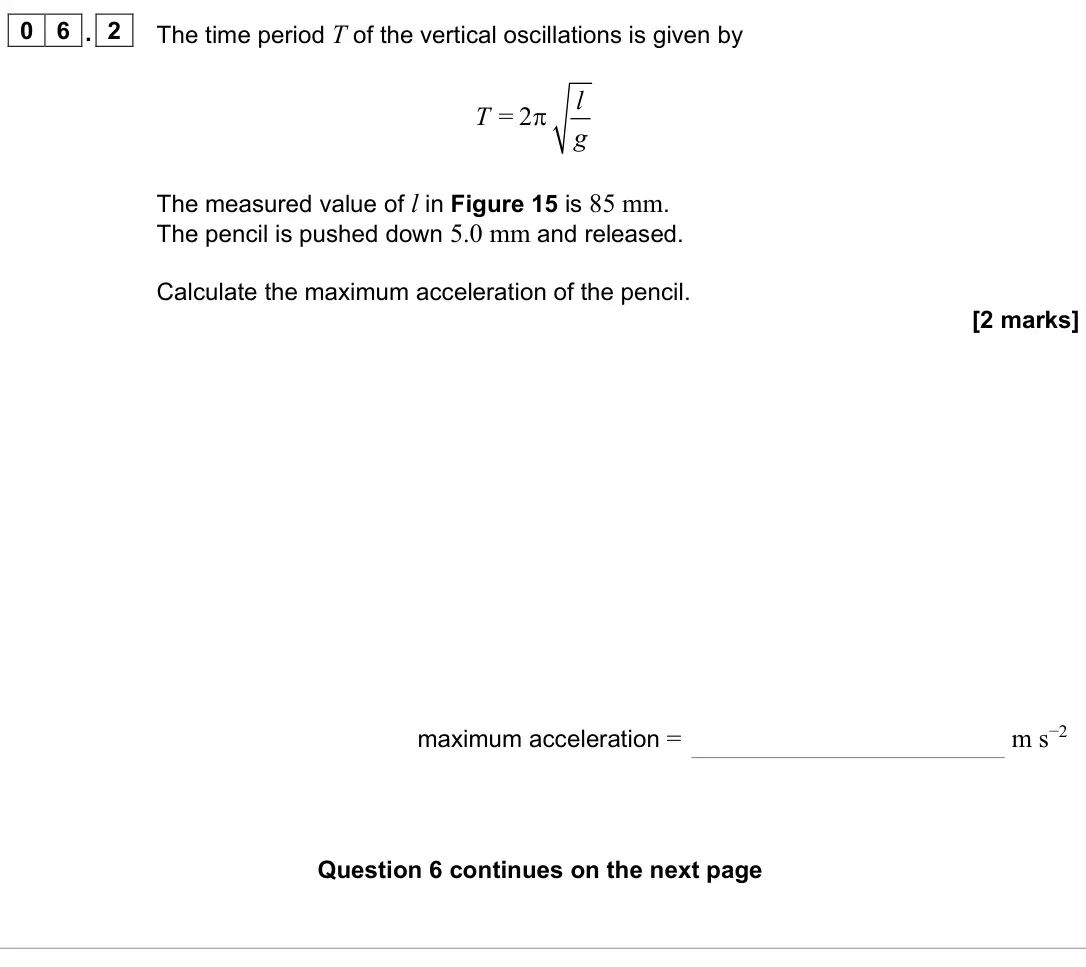
All 71 questions on Periodic motion, as a list
- June 2025, Paper 1, Q03.1 (4 marks): Draw, on Figure 4, a graph of acceleration against displacement for the system. Label each axis with a suitable unit and scale. [4 marks] Figure 4
- June 2025, Paper 1, Q03.2 (1 mark): Label, with a P, a point on your graph where the mass has 50% of its maximum kinetic energy. [1 mark]
- June 2025, Paper 1, Q07.1 (2 marks): At the instant shown in Figure 10 the car is moving with constant speed v in a circle of radius R. Figure 10 The car has kinetic energy Ek. The resultant force
- June 2025, Paper 1, Q07.2 (1 mark): The car just starts to slip when it travels on the track in a circular path of radius 230 m. Deduce the speed of the car. [1 mark] speed = m s−1
- June 2025, Paper 1, Q07.3 (1 mark): The driver wishes to drive this car around the curved section of the track, without slipping, at a speed greater than your answer to Question 07.2. Suggest one
- June 2025, Paper 1, Q07.4 (2 marks): The car in Figure 11 stays at the same height on the curved section of the track. There is no tendency for the car to slip up or down the track and therefore th
- June 2025, Paper 1, Q07.5 (2 marks): A car has a greater maximum speed on a sloped track than on a horizontal track of the same radius. Explain why. [2 marks]
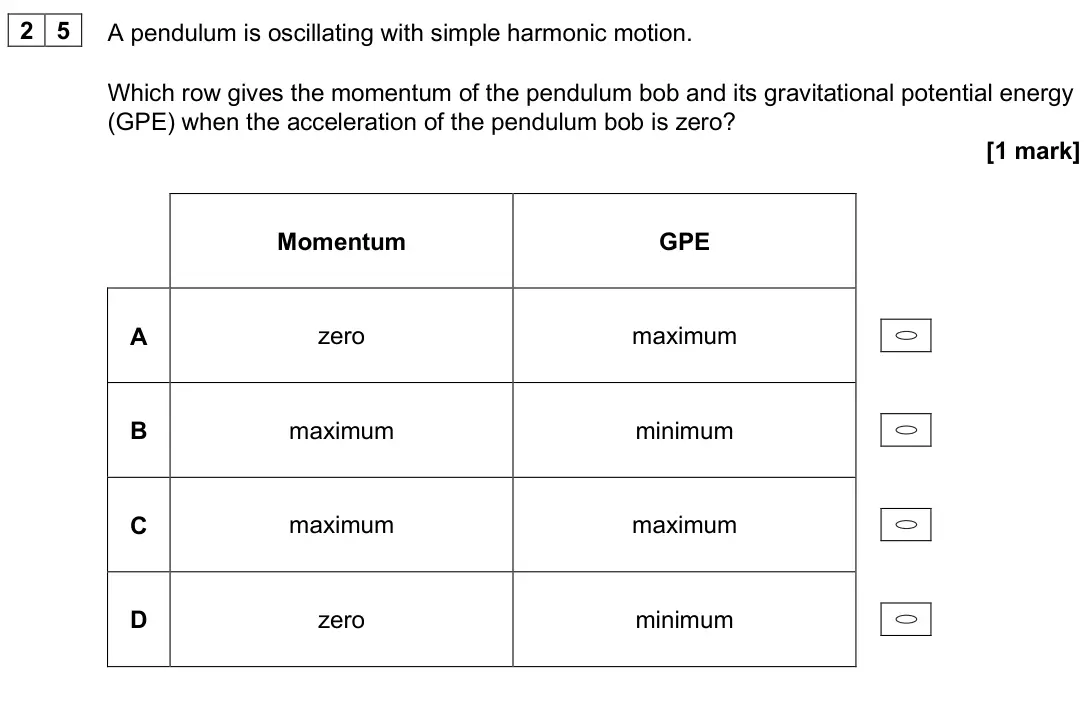
- June 2025, Paper 1, Q25 (1 mark): A pendulum is oscillating with simple harmonic motion. Which row gives the momentum of the pendulum bob and its gravitational potential energy (GPE) when the ac
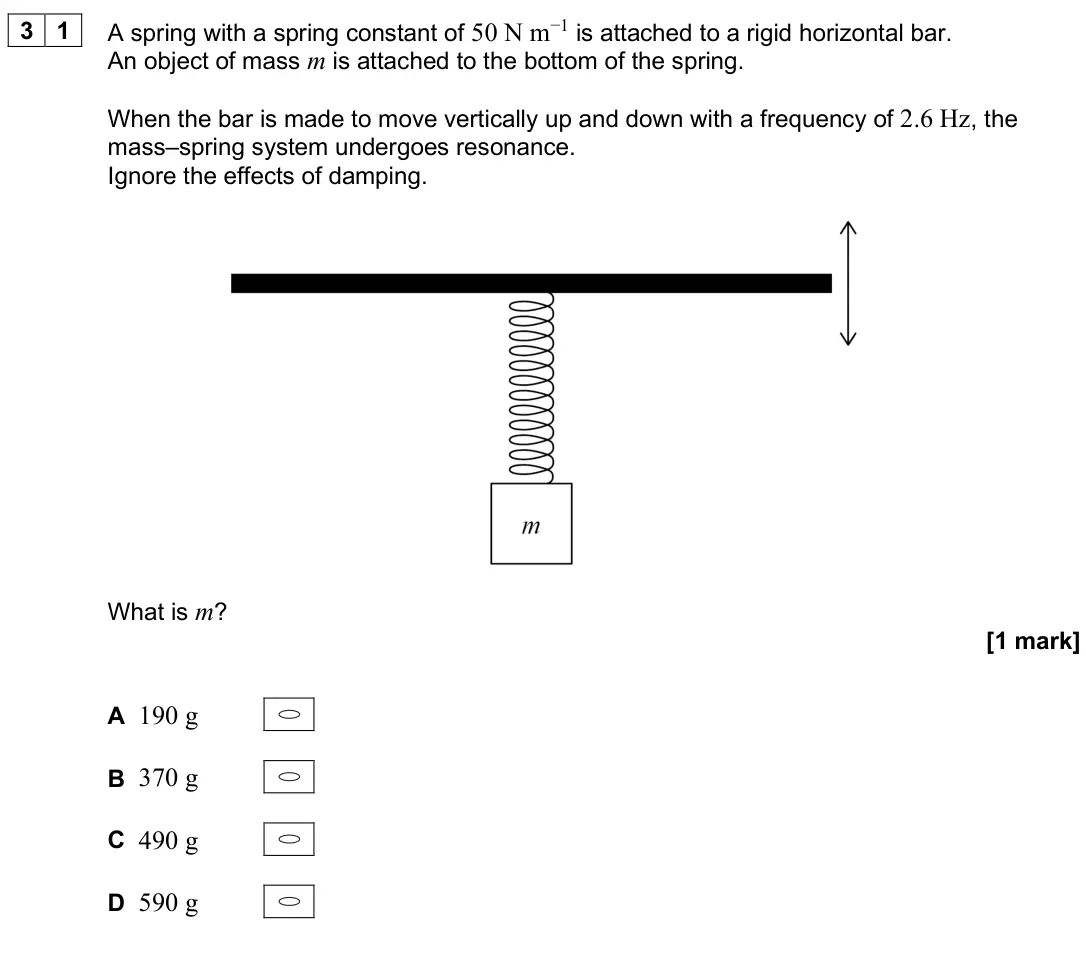
- June 2025, Paper 1, Q31 (1 mark): A spring with a spring constant of 50 N m−1 is attached to a rigid horizontal bar. An object of mass m is attached to the bottom of the spring. When the bar is
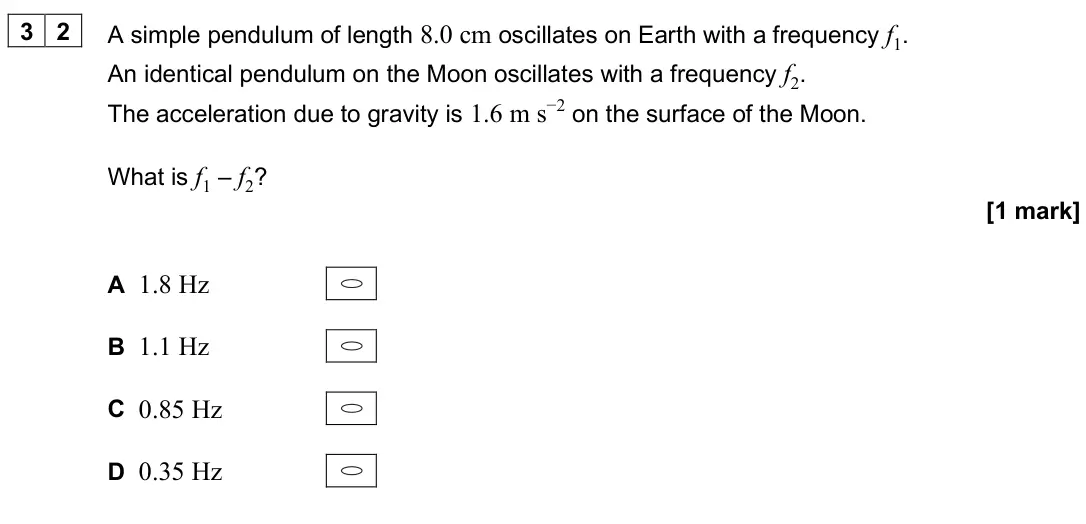
- June 2025, Paper 1, Q32 (1 mark): A simple pendulum of length 8.0 cm oscillates on Earth with a frequency f1. An identical pendulum on the Moon oscillates with a frequency f2. The acceleration d
- June 2025, Paper 3A, Q04.3 (2 marks): A horizontal fiducial mark is used to reduce uncertainty in the measurement of T. The fiducial mark is to be placed level with one of the positions A, B, C or D
- June 2025, Paper 3A, Q04.4 (2 marks): When the total mass of the test tube, wire and tape is constant, it can be shown that: 1 T ∝ density of the liquid When the test tube oscillates in the oil, T i
- June 2025, Paper 3A, Q04.5 (3 marks): Due to damping, only a small number of oscillations occurs after the test tube is released. The student wants to produce a greater number of oscillations for a
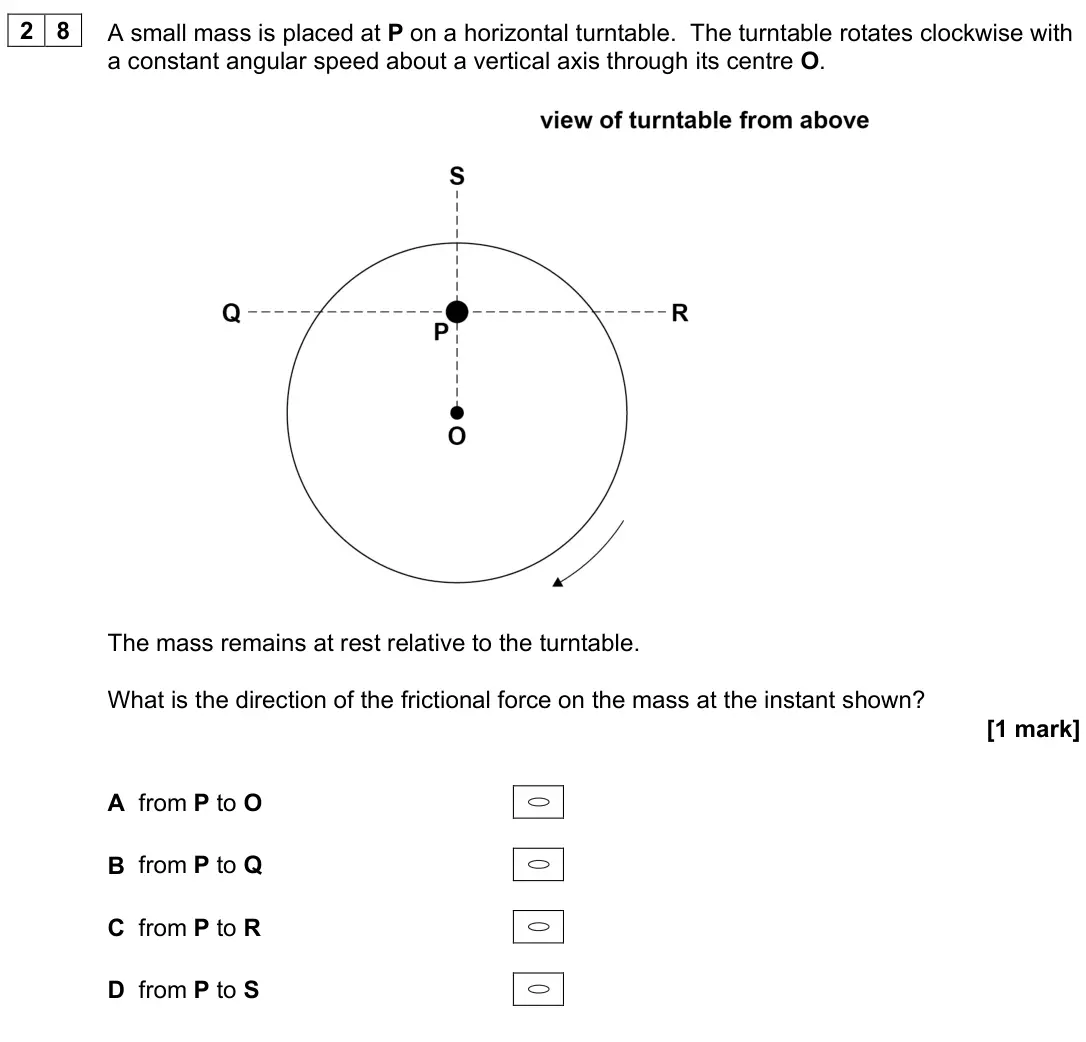
- June 2024, Paper 1, Q28 (1 mark): A small mass is placed at P on a horizontal turntable. The turntable rotates clockwise with a constant angular speed about a vertical axis through its centre O.
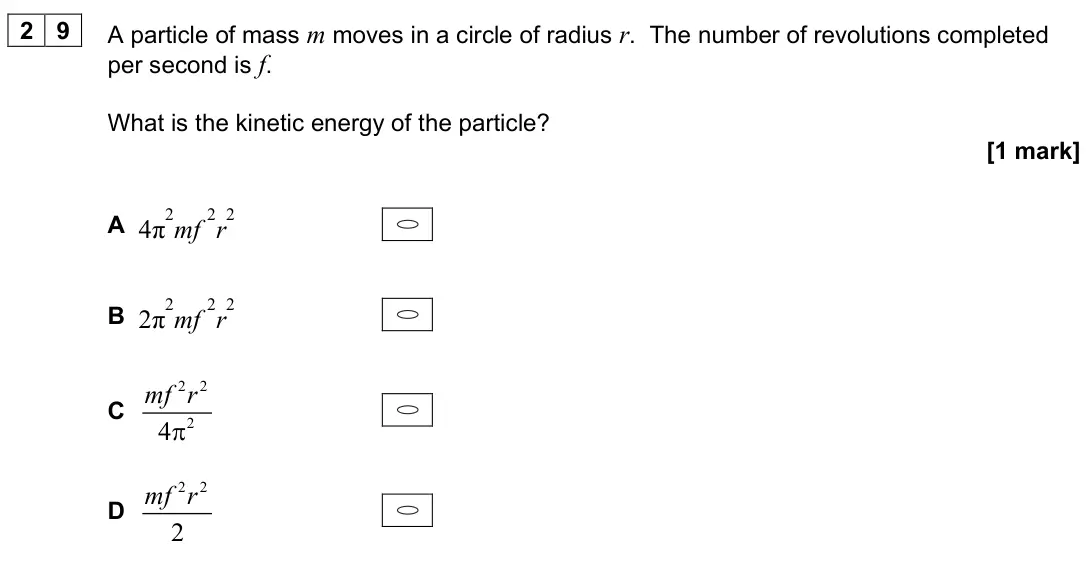
- June 2024, Paper 1, Q29 (1 mark): A particle of mass m moves in a circle of radius r. The number of revolutions completed per second is f. What is the kinetic energy of the particle? [1 mark] A
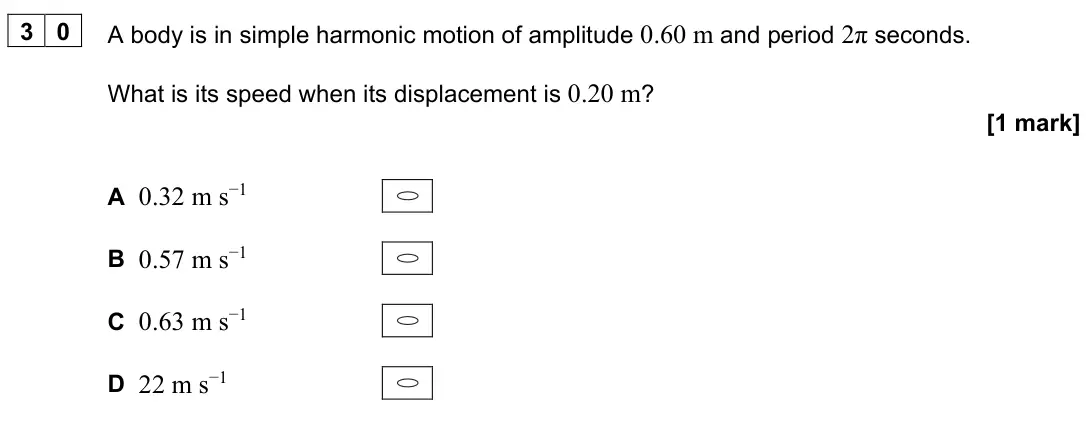
- June 2024, Paper 1, Q30 (1 mark): A body is in simple harmonic motion of amplitude 0.60 m and period 2π seconds. What is its speed when its displacement is 0.20 m? [1 mark] A 0.32 m s−1 B 0.57 m
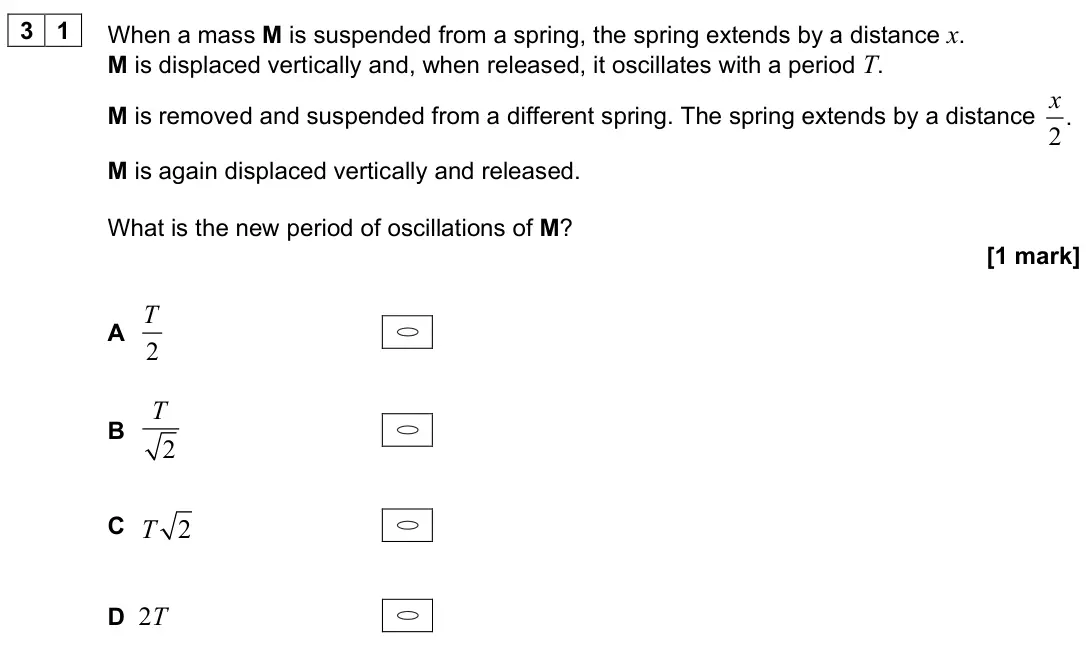
- June 2024, Paper 1, Q31 (1 mark): When a mass M is suspended from a spring, the spring extends by a distance x. M is displaced vertically and, when released, it oscillates with a period T. M is
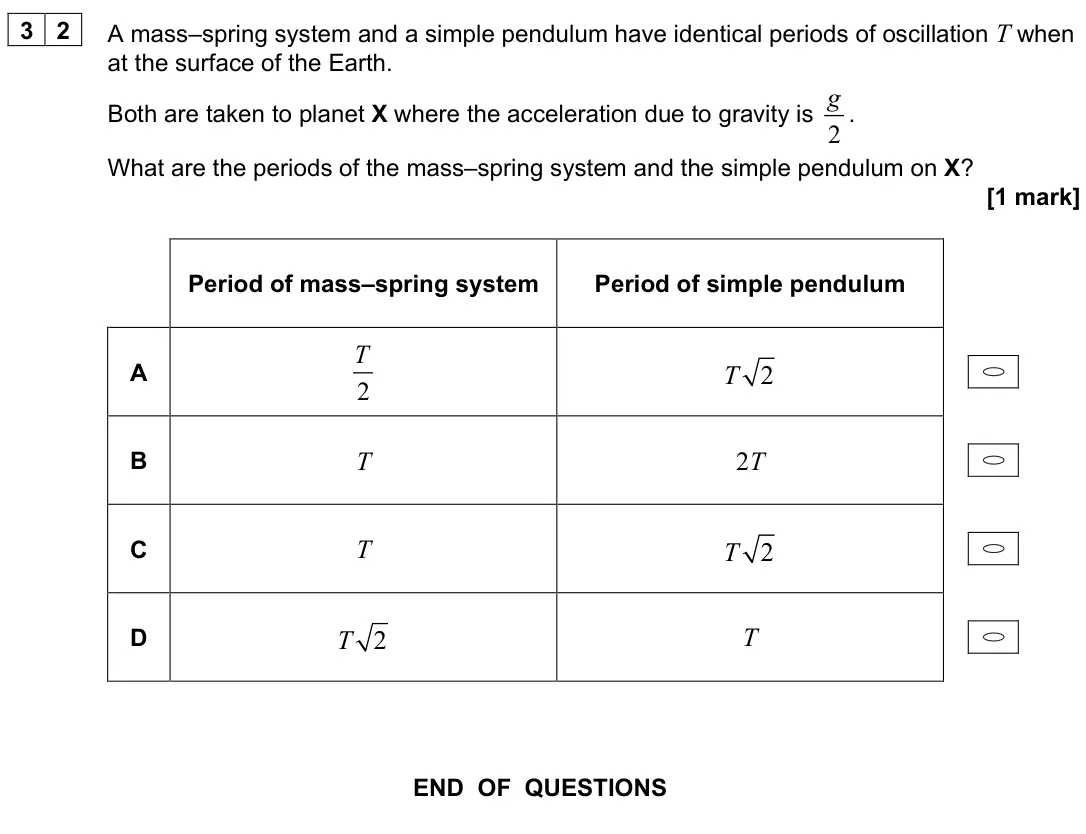
- June 2024, Paper 1, Q32 (1 mark): A mass–spring system and a simple pendulum have identical periods of oscillation T when at the surface of the Earth. Both are taken to planet X where the accele
- June 2023, Paper 1, Q06.1 (2 marks): Show that the pencil moves with simple harmonic motion. [2 marks]
- June 2023, Paper 1, Q06.2 (2 marks): The time period T of the vertical oscillations is given by = 2 l T g π The measured value of l in Figure 15 is 85 mm. The pencil is pushed down 5.0 mm and relea
- June 2023, Paper 1, Q06.3 (2 marks): Explain what is meant by resonance. [2 marks]
- June 2023, Paper 1, Q06.4 (3 marks): Figure 16 shows a ship moving through continuous waves of wavelength 118 m and velocity 14.2 m s−1. The ship is moving steadily at 8.0 m s−1 relative to the sea
- June 2023, Paper 1, Q28 (1 mark): Two circular discs made of card rotate at constant speed on a common axle. The discs are 2.00 m apart. An air-gun pellet is fired parallel to the axle. The pell
- June 2023, Paper 1, Q30 (1 mark): When an aircraft turns in a horizontal circular path, it banks at an angle θ. The aircraft has mass m and travels at constant speed v in a horizontal circular p
- June 2023, Paper 1, Q31 (1 mark): A mass, attached to two springs, oscillates horizontally between P and Q. The motion of the system is simple harmonic. Which quantity has its magnitude at a min
- June 2022, Paper 1, Q05.1 (2 marks): Calculate the time taken for the turntable to complete one revolution. [2 marks] time = s
- June 2022, Paper 1, Q05.2 (1 mark): Figure 10 shows a plan view of the turntable and block. The turntable rotates in a clockwise direction. Draw an arrow on Figure 10 to show the direction of the
- June 2022, Paper 1, Q05.3 (2 marks): The mass of the block is 0.12 kg. Calculate the magnitude of the resultant force on the block. [2 marks] magnitude of force = N
- June 2022, Paper 1, Q05.4 (2 marks): Describe, with reference to one of Newton’s laws of motion, the evidence that a resultant force is acting on the block. [2 marks]
- June 2022, Paper 1, Q05.5 (2 marks): The teacher adjusts the angular speed of the turntable so that the block completes one rotation every 2.50 s. She sets up a simple pendulum above the centre of
- June 2022, Paper 1, Q05.6 (2 marks): A lamp is used to project shadow images of the block and pendulum bob on a screen. Both shadows appear to move with SHM across the screen. Figure 11 shows the i
- June 2022, Paper 1, Q31 (1 mark): A particle performs simple harmonic motion with a time period of 1.4 s and an amplitude of 12 mm. What is the maximum speed of the particle? [1 mark] A 8.6 mm s
- November 2021, Paper 1, Q04.1 (2 marks): As the spacecraft rotates, a force that imitates the effect of gravity acts on an astronaut who is in contact with the floor. Explain why. [2 marks]
- November 2021, Paper 1, Q04.2 (2 marks): The forces exerted on A and B by the connecting rod have the same magnitude. mA is the mass of A mB is the mass of B Show, by considering the centripetal forces
- November 2021, Paper 1, Q04.3 (2 marks): In this spacecraft mA < mB. Deduce whether the centre of mass of A or the centre of mass of B rotates with a greater linear speed. [2 marks]
- November 2021, Paper 1, Q30 (1 mark): A simple pendulum and a mass−spring system each have a time period T on the Earth. They are taken to the surface of a planet where the acceleration due to gravi
- November 2021, Paper 1, Q31 (1 mark): A particle of mass m is oscillating with simple harmonic motion. The period of the oscillation is T and the amplitude is A. What is the maximum kinetic energy o
- November 2021, Paper 2, Q03.2 (2 marks): Show that the atom is moving at a speed of about 500 m s−1. [2 marks]
- November 2020, Paper 1, Q04.5 (4 marks): At bends on motorways the road is sloped so that a car is less likely to slide out of its lane when travelling at a high speed. Figure 7 shows a car of mass 120
- November 2020, Paper 1, Q24 (1 mark): A particle of mass m undergoes simple harmonic motion with amplitude A and frequency f. What is the total energy of the particle? [1 mark] A 2πmfA2 B 2π2mf 2A2
- November 2020, Paper 1, Q25 (1 mark): A mass of 0.90 kg is suspended from the lower end of a light spring of stiffness 80 N m−1. When the mass is displaced vertically and released, it undergoes vert
- November 2020, Paper 1, Q30 (1 mark): The period of a simple pendulum is doubled when the pendulum length is increased by 1.8 m. What is the original length of the pendulum? [1 mark] A 0.45 m B 0.60
- November 2020, Paper 3A, Q01.1 (2 marks): The card can be used as a fiducial mark to reduce uncertainty in the measurement of T. Annotate Figure 1 to show a suitable position for the fiducial mark. Expl
- November 2020, Paper 3A, Q01.2 (2 marks): The period of the pendulum is constant for small-amplitude oscillations. Figure 2 shows an arrangement used to determine the maximum amplitude that can be consi
- November 2020, Paper 3A, Q01.3 (3 marks): Figure 3 shows some of the results of the experiment. Figure 3 Estimate, using Figure 3, the expected percentage increase in T when AR increases from 0.35 m to
- November 2020, Paper 3A, Q01.5 (1 mark): Table 2 shows results for An and the corresponding value of ln(An / m) for certain values of n. Table 2 n An / m ln(An / m) 2 0.238 −1.435 4 0.225 7 0.212 −1.55
- November 2020, Paper 3A, Q01.6 (2 marks): Plot on Figure 4 a graph of ln(An / m) against n. [2 marks] Figure 4
- November 2020, Paper 3A, Q01.7 (2 marks): It can be shown that An = A0 δ −n where A0 is the amplitude of release of the pendulum δ is a constant called the damping factor. Explain how to find δ from you
- June 2019, Paper 1, Q06.1 (1 mark): State the time, in milliseconds, when P is moving at its maximum positive velocity. [1 mark] time = ms
- June 2019, Paper 1, Q06.2 (3 marks): Calculate the maximum acceleration of P. [3 marks] acceleration = m s–2
- June 2019, Paper 1, Q28 (1 mark): An object of mass m moves in a circle of radius r. It completes n revolutions every second. What is the kinetic energy of the object? [1 mark] A 2 2 2 8π mn r B
- June 2019, Paper 1, Q29 (1 mark): The graph shows the variation of displacement d with time t for a particle moving with simple harmonic motion of period T. Which graph shows the variation of ki
- June 2019, Paper 1, Q30 (1 mark): Two pendulums A and B oscillate with simple harmonic motion. The time period of A is 2.00 s and the time period of B is 1.98 s. A and B are released in phase. W
- June 2019, Paper 1, Q31 (1 mark): The frequency of oscillation of a vertical spring is f when the mass hanging from the spring is m. What is the relationship between f and m? [1 mark] A 1 2 f m
- June 2019, Paper 1, Q32 (1 mark): A metal panel is driven to vibrate at different frequencies. The amplitude a of the vibration is measured at each frequency. The graph shows the variation of am
- June 2018, Paper 1, Q05.1 (2 marks): Show that the linear speed of the acrobats is about 4.5 m s−1 [2 marks]
- June 2018, Paper 1, Q05.2 (3 marks): Determine the tension in each rope that supports the acrobats. [3 marks] tension = N
- June 2018, Paper 1, Q05.3 (3 marks): Discuss the consequences for the forces acting on the pole when one acrobat has a much greater mass than the other. [3 marks]
- June 2018, Paper 1, Q29 (1 mark): A body performs simple harmonic motion. What is the phase difference between the variation of displacement with time and the variation of acceleration with time
- June 2018, Paper 1, Q30 (1 mark): An object of mass 0.15 kg performs simple harmonic motion. It oscillates with amplitude 55 mm and frequency 0.80 Hz What is the maximum value of its kinetic ene
- June 2018, Paper 1, Q31 (1 mark): Which graph shows how the gravitational potential energy Ep of a simple pendulum varies with displacement s from the equilibrium position? [1 mark] A B C D Copy
- June 2017, Paper 1, Q07.1 (4 marks): Deduce the spring constant k for spring A and the mass m suspended from it. [4 marks] k = N m–1 m = kg
- June 2017, Paper 1, Q07.2 (2 marks): Calculate the frequency at which the mass attached to spring B oscillates with maximum amplitude. [2 marks] frequency = Hz
- June 2017, Paper 1, Q07.3 (4 marks): Figure 11 shows how the amplitude of the oscillations of the mass varies with frequency for spring A. Figure 11 The investigation is repeated with the mass atta
- June 2017, Paper 1, Q30 (1 mark): A bob of mass 0.50 kg is suspended from the end of a piece of string 0.45 m long. The bob is rotated in a vertical circle at a constant rate of 120 revolutions
- June 2017, Paper 1, Q31 (1 mark): Which graph best shows how the kinetic energy of a simple pendulum varies with displacement from the equilibrium position? [1 mark] A B C D
- June 2017, Paper 1, Q32 (1 mark): The graph shows how the displacement of a particle performing simple harmonic motion varies with time. Which statement is not correct? [1 mark] A The speed of t
- Specimen, Paper 1, Q29 (1 mark): A string passes through a smooth thin tube. Masses m and M are attached to the ends of the string. The tube is moved so that the mass m travels in a horizontal
- Specimen, Paper 1, Q30 (1 mark): The frequency of a body moving with simple harmonic motion is doubled. If the amplitude remains the same which of the following is also doubled? [1 mark] A The
- Specimen, Paper 1, Q31 (1 mark): A particle oscillates with undamped simple harmonic motion. The acceleration of the particle [1 mark] A is always in the opposite direction to its velocity. B d
- Specimen, Paper 2, Q21 (1 mark): A simple pendulum and a mass-spring system have the same oscillation frequency f at the surface of the Earth. The pendulum and the mass-spring system are taken
Questions, mark schemes and examiner’s reports are © AQA, from their published past papers. Plumi isn’t affiliated with any exam board. Want whole papers? Every AQA A-Level Physics paper.
Rather write your answers by hand on iPad? Plumi marks them against the same mark schemes.