 plumi
Single dish radio telescopes, I-R, U-V and X-ray telescopes: AQA A‑Level Physics questions
AQA A-Level Physics past-paper questions on 3.9.1.3 Single dish radio telescopes, I-R, U-V and X-ray telescopes, 2008–2025, with mark schemes and examiner’s reports where available.
Paper
All papers
Exam
All years
Calculations
Q05.2
The whole paper ↗Q05.3
The whole paper ↗Q01.3
The whole paper ↗Q01.2
The whole paper ↗
Q2(c)(i)
The whole paper ↗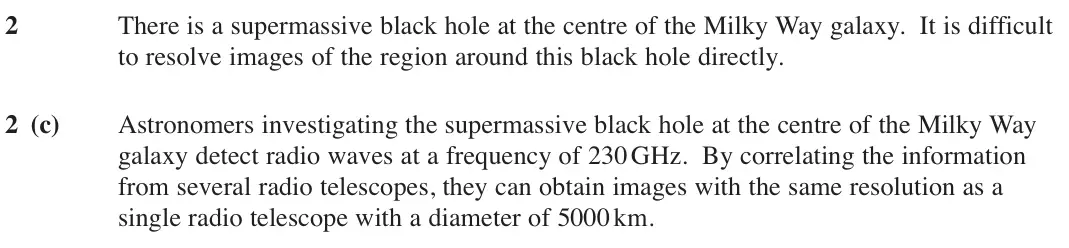
Q2(c)
The whole paper ↗
Q3(a)
The whole paper ↗
All 7 questions on Single dish radio telescopes, I-R, U-V and X-ray telescopes, as a list
- November 2021, Paper 3 Astrophysics, Q05.2 (3 marks): A telescope uses wavelengths in the range 90 nm to 120 nm. Explain why this telescope must be located in space. Go on to discuss one advantage that this telesco
- November 2021, Paper 3 Astrophysics, Q05.3 (3 marks): Table 1 shows information about two telescopes. Table 1 Telescope Diameter / m Dish shape Arecibo 305 spherical Lovell 76 parabolic Each telescope detects radio
- June 2019, Paper 3 Astrophysics, Q01.3 (6 marks): Table 1 contains information about two telescopes, A and B. Each telescope is planned to be the biggest of its type in the world. Table 1 Telescope A B Type Opt
- Specimen, Paper 3 Astrophysics, Q01.2 (6 marks): The concave mirrors used in some reflecting telescopes can suffer from spherical aberration. 0 1 The International Ultraviolet Explorer (IUE) and the Gran Teles
- June 2013, PHYA5 Astrophysics (old spec), Q2(c)(i) (2 marks): Calculate the minimum angular separation which could be resolved by a radio telescope of diameter 5000km detecting waves of frequency 230GHz. angular separation
- June 2012, PHYA5 Astrophysics (old spec), Q2(c) (6 marks): Different types of telescope are used to detect the various parts of the electromagnetic spectrum. Discuss with reference to three different parts of the electr
- June 2010, PHYA5 Astrophysics (old spec), Q3(a) (1 mark): Explain why X-ray telescopes need to be in orbit. (1 mark)
Questions, mark schemes and examiner’s reports are © AQA, from their published past papers. Plumi isn’t affiliated with any exam board. Want whole papers? AQA A-Level Physics past papers.
The Plumi iPad app also offers exam-style questions with AI feedback on your handwritten working.