 plumi
Refraction, diffraction and interference: AQA A‑Level Physics questions
Every AQA A-Level Physics exam question on 3.3.2 Refraction, diffraction and interference, 2016–2025, with its mark scheme and examiner’s report.
Find questions2,714
Calculations
Q02.1
The whole paper ↗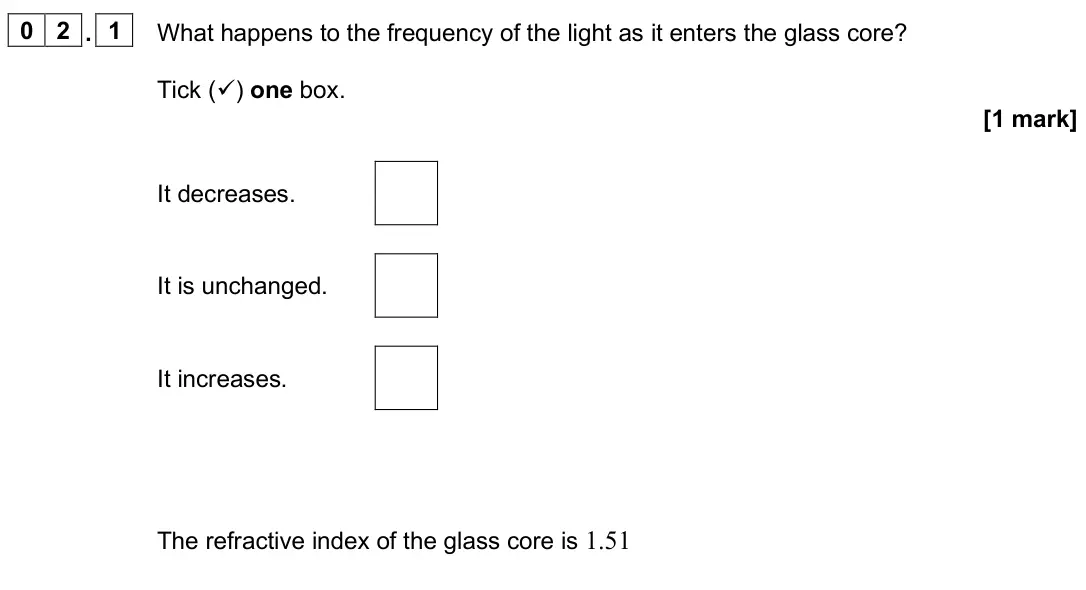
Q02.2
The whole paper ↗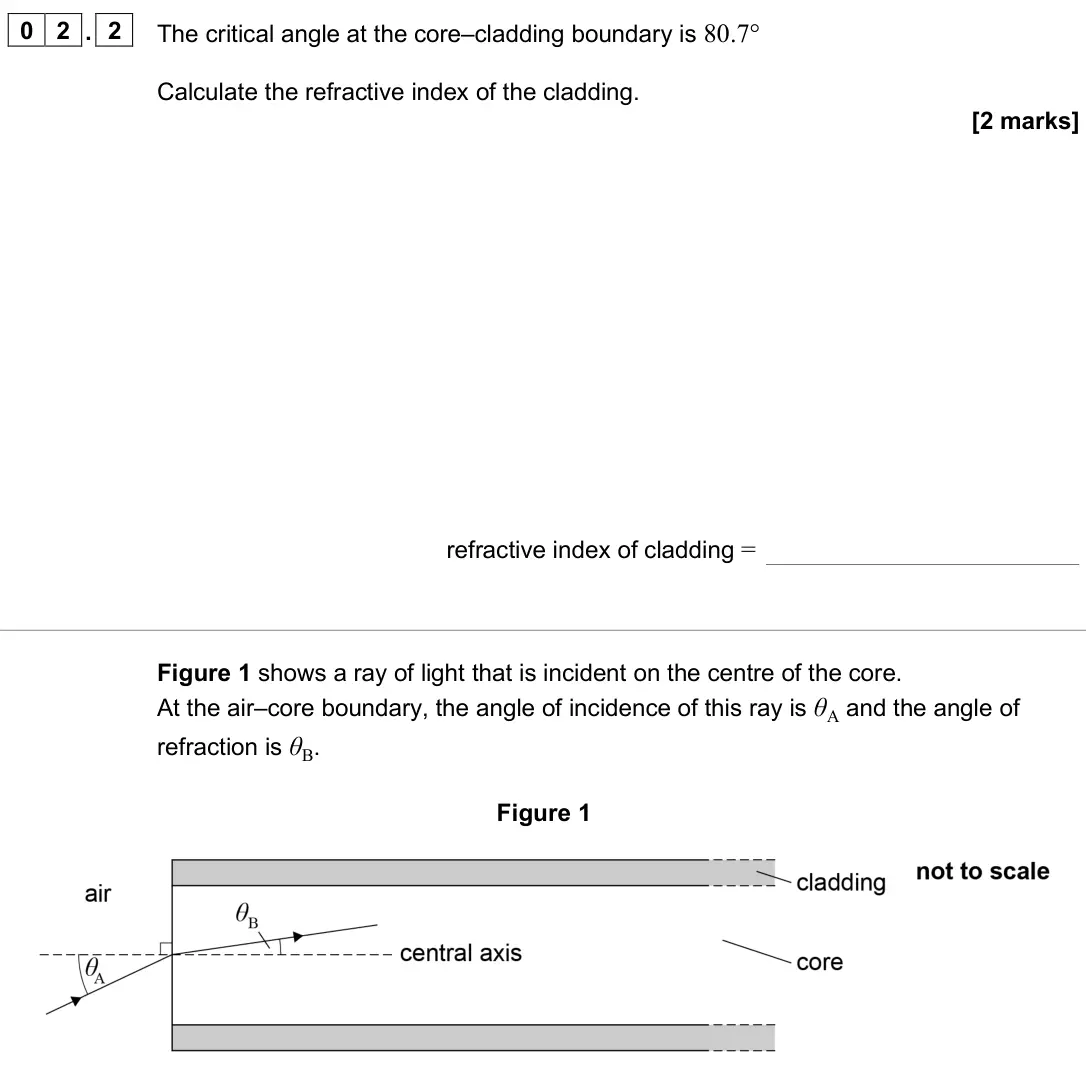
Q02.3
The whole paper ↗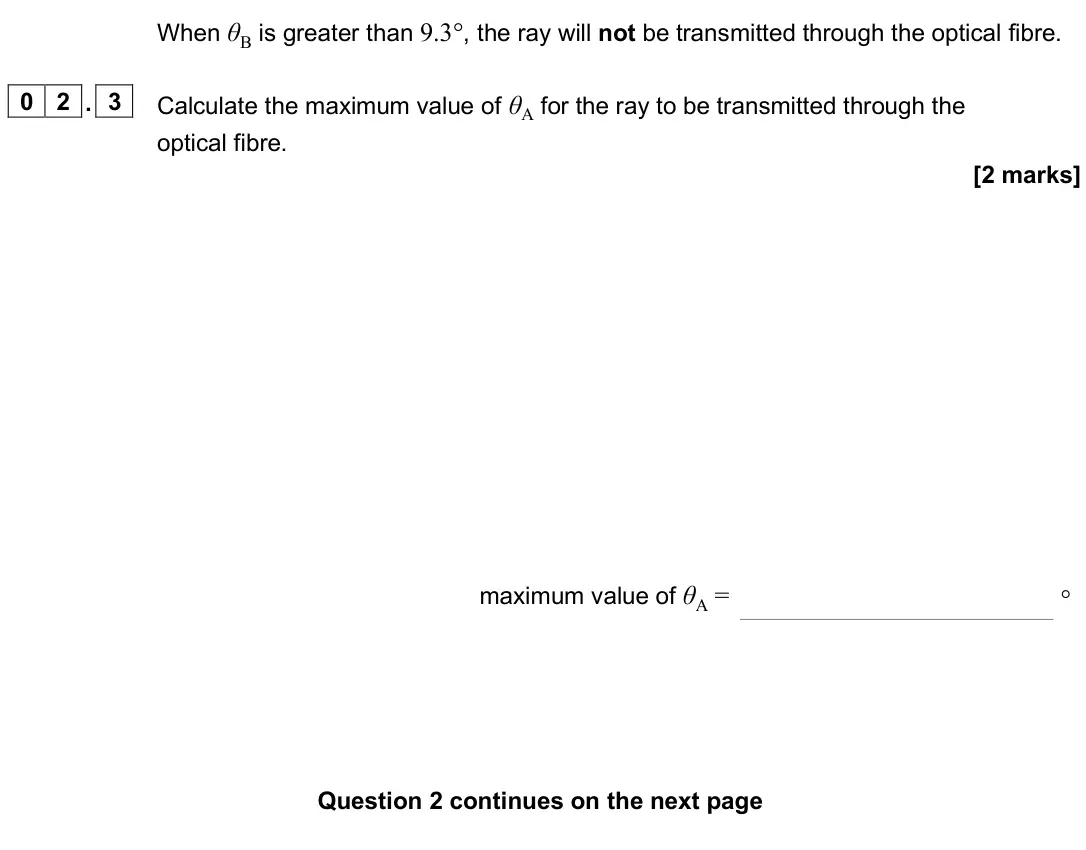
Q02.4
The whole paper ↗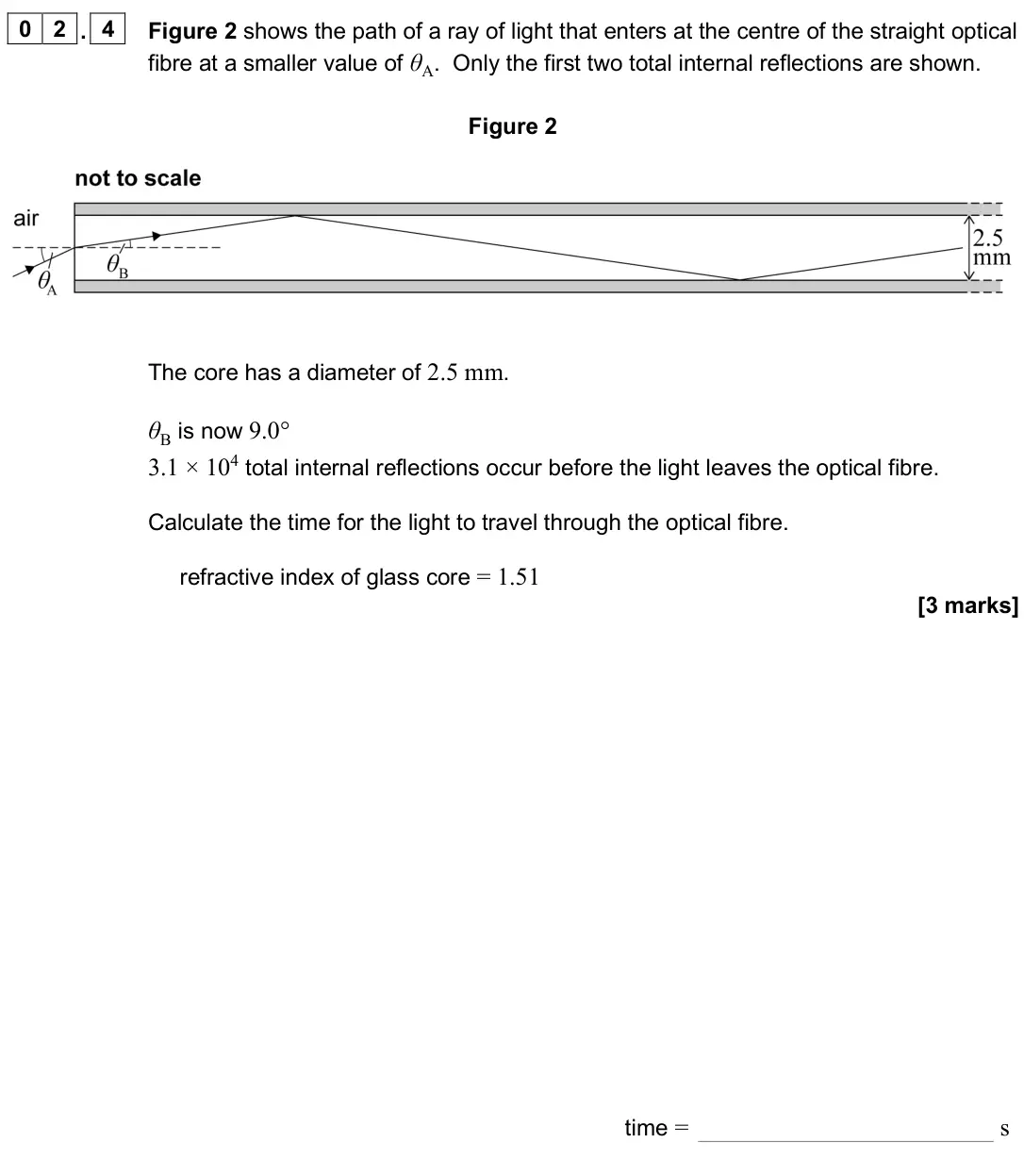
Q01.1
The whole paper ↗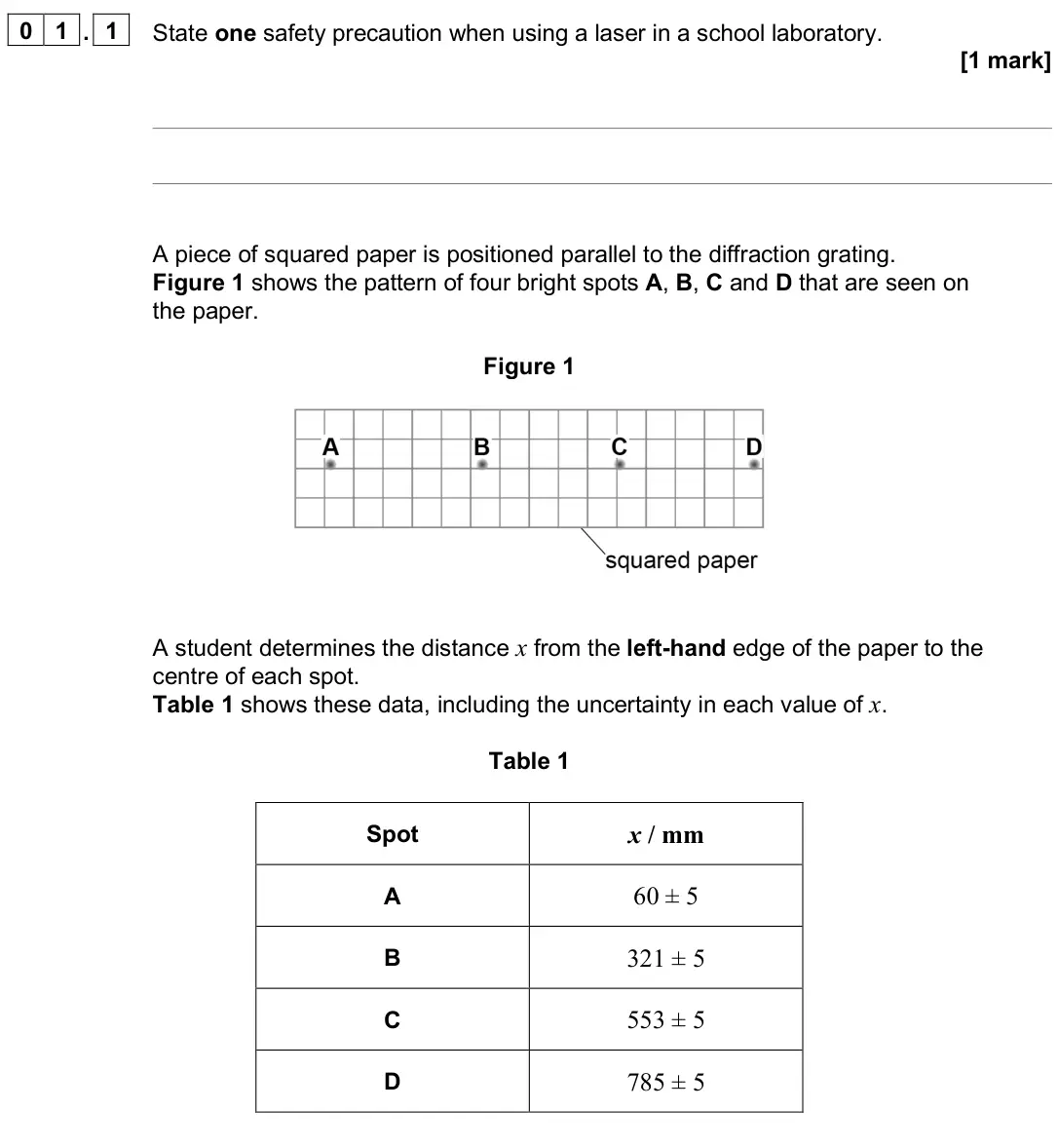
Q01.2
The whole paper ↗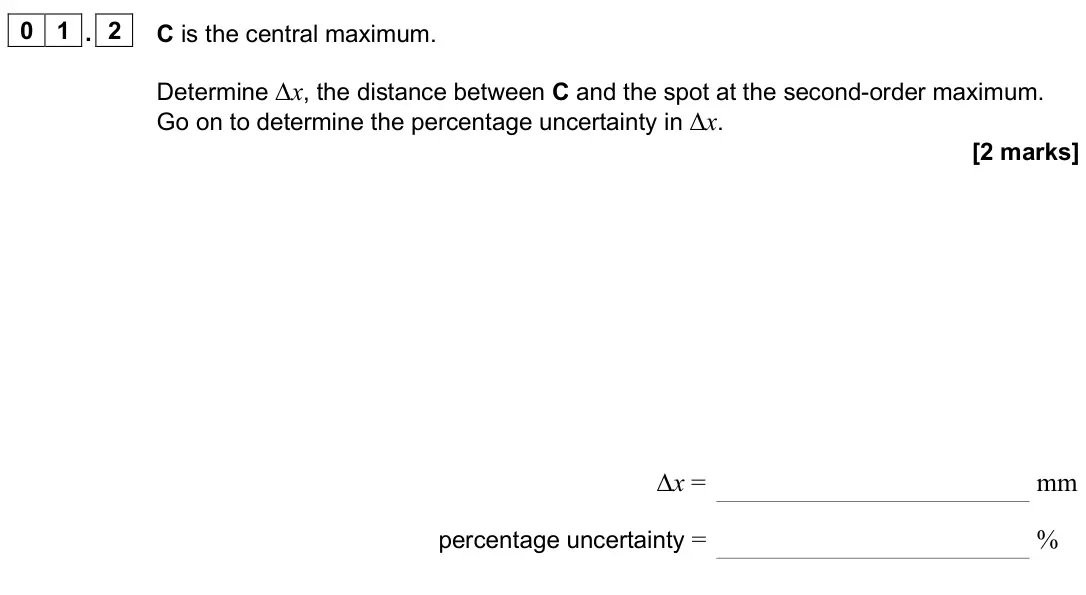
Q01.3
The whole paper ↗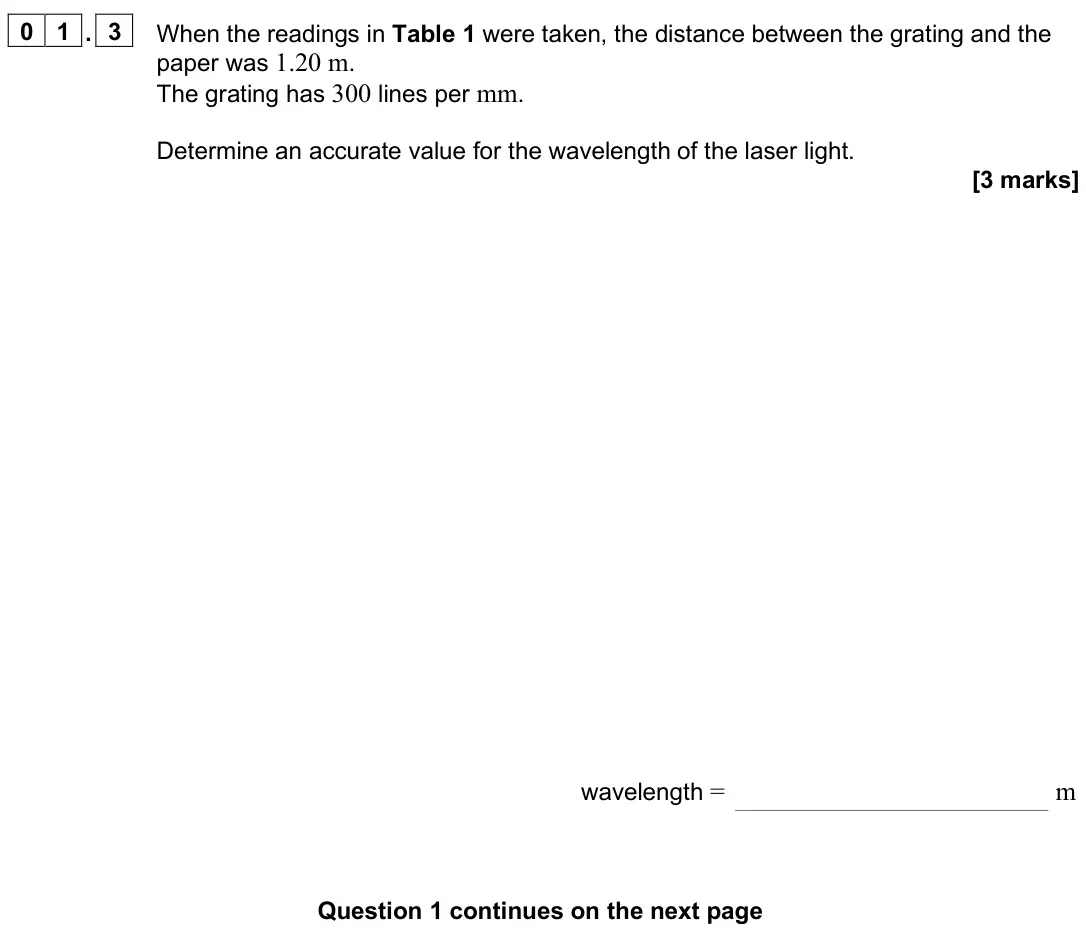
Q01.4
The whole paper ↗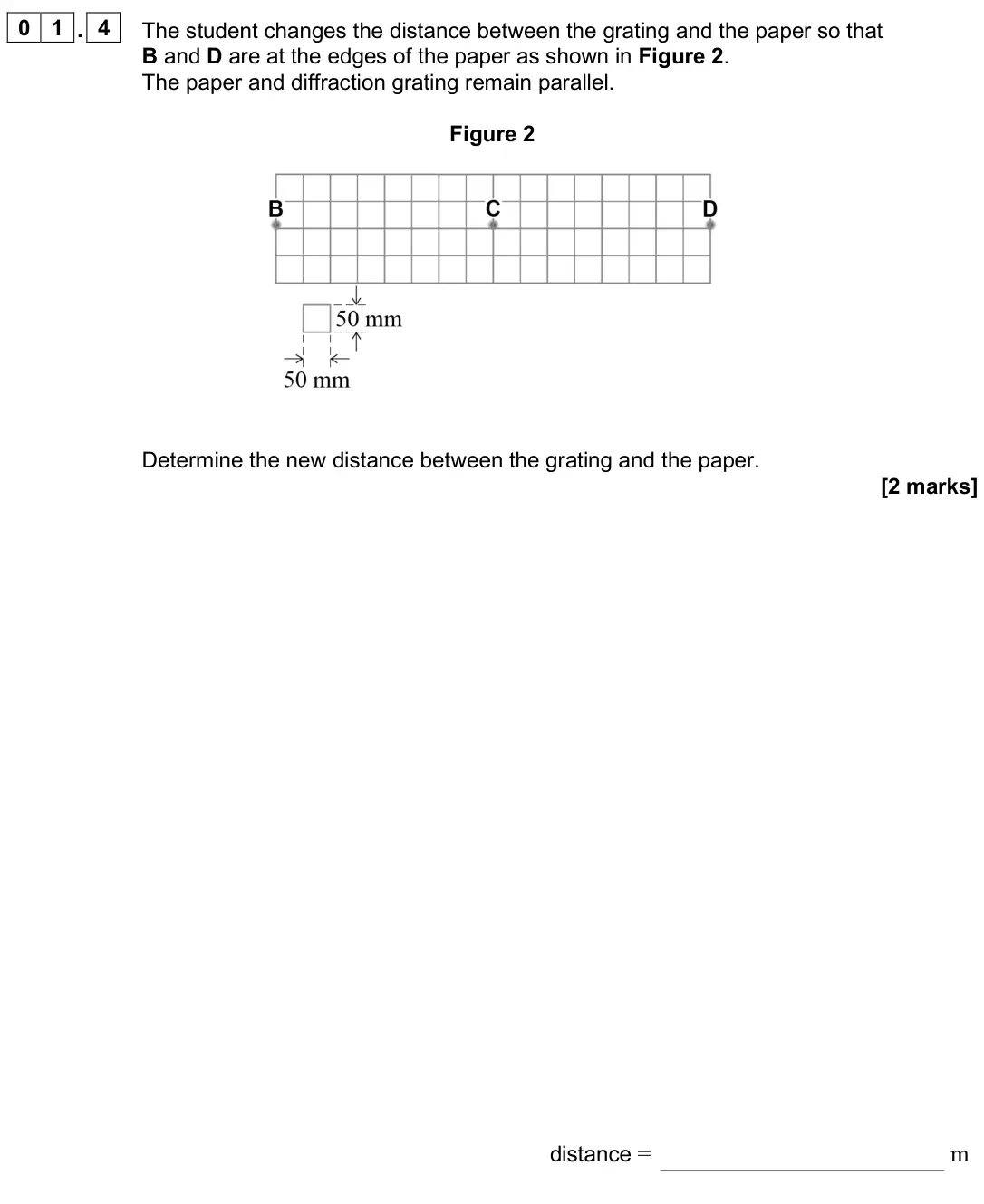
Q03.1
The whole paper ↗
Q03.2
The whole paper ↗
Q03.3
The whole paper ↗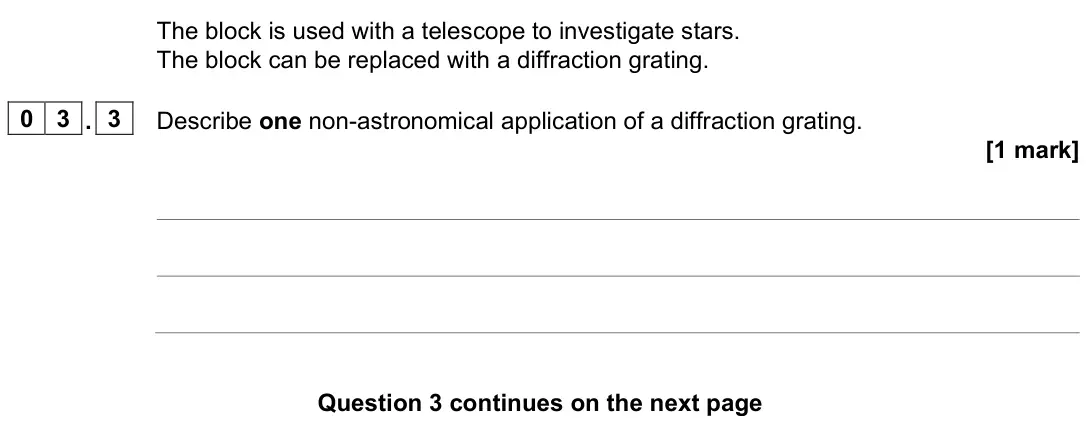
Q03.4
The whole paper ↗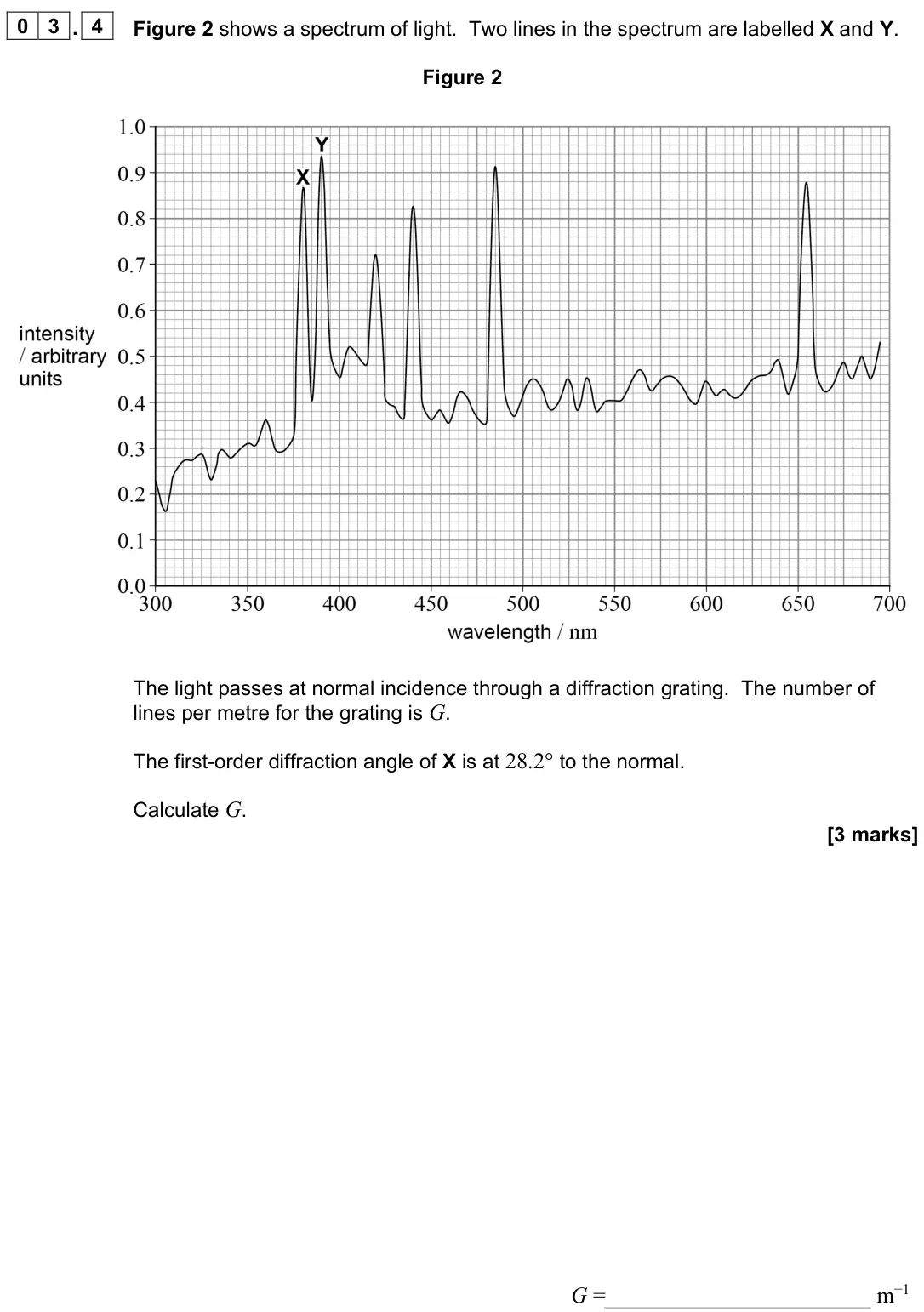
Q03.5
The whole paper ↗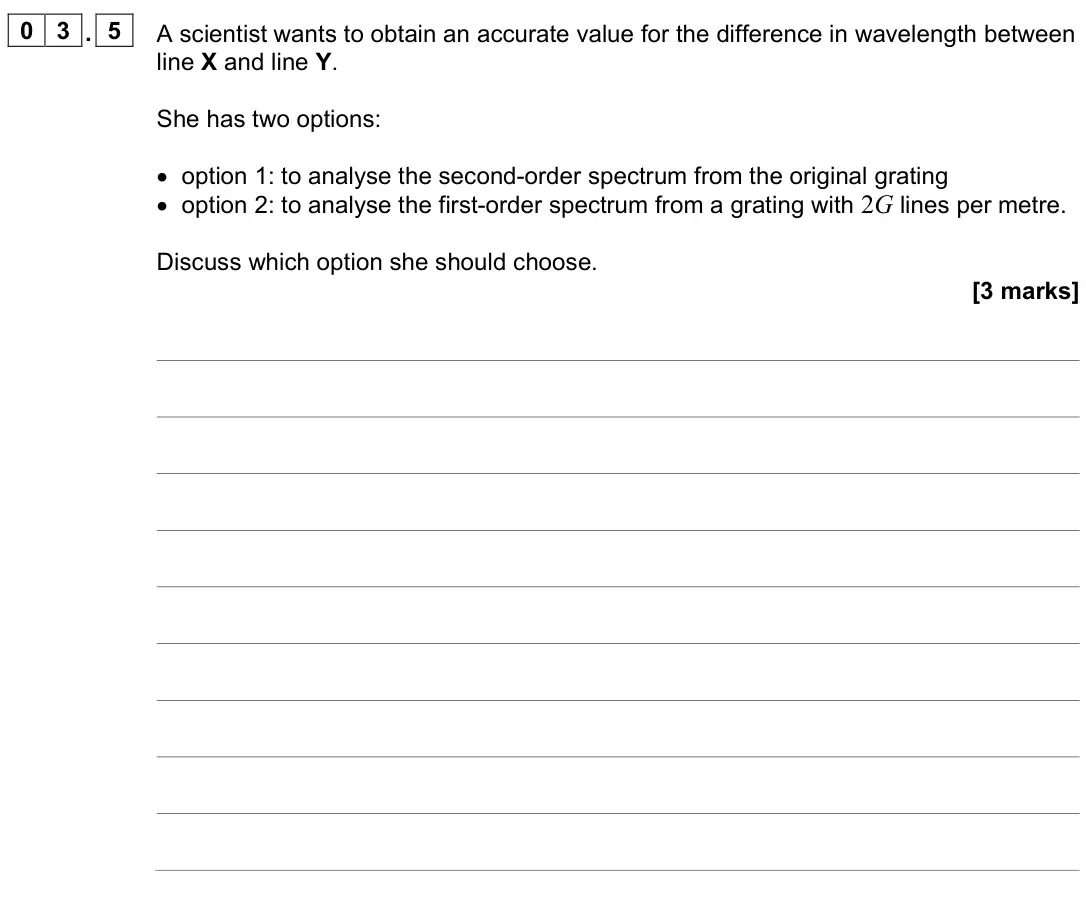
All 163 questions on Refraction, diffraction and interference, as a list
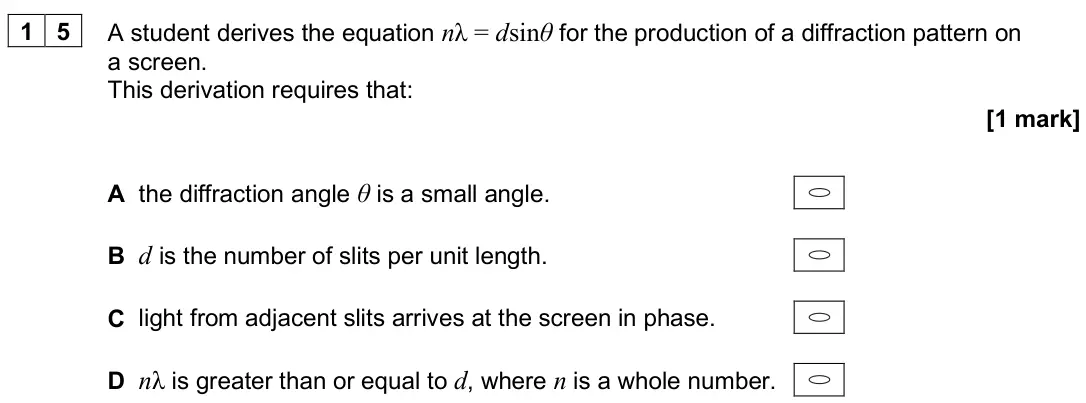
- June 2025, Paper 1, Q15 (1 mark): A student derives the equation nλ = dsinθ for the production of a diffraction pattern on a screen. This derivation requires that: [1 mark] A the diffraction ang
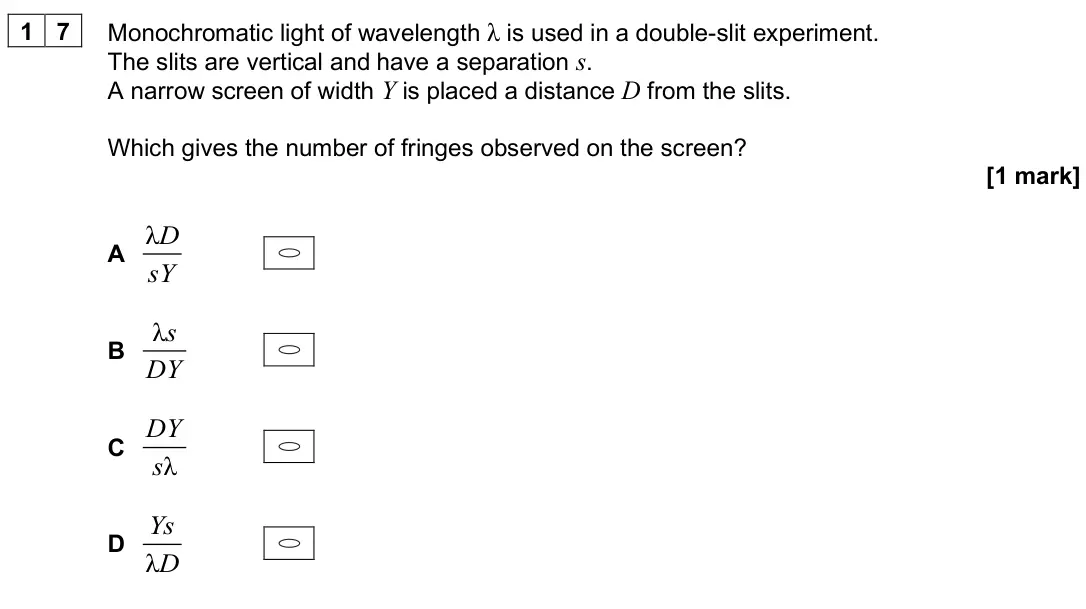
- June 2025, Paper 1, Q17 (1 mark): Monochromatic light of wavelength λ is used in a double-slit experiment. The slits are vertical and have a separation s. A narrow screen of width Y is placed a
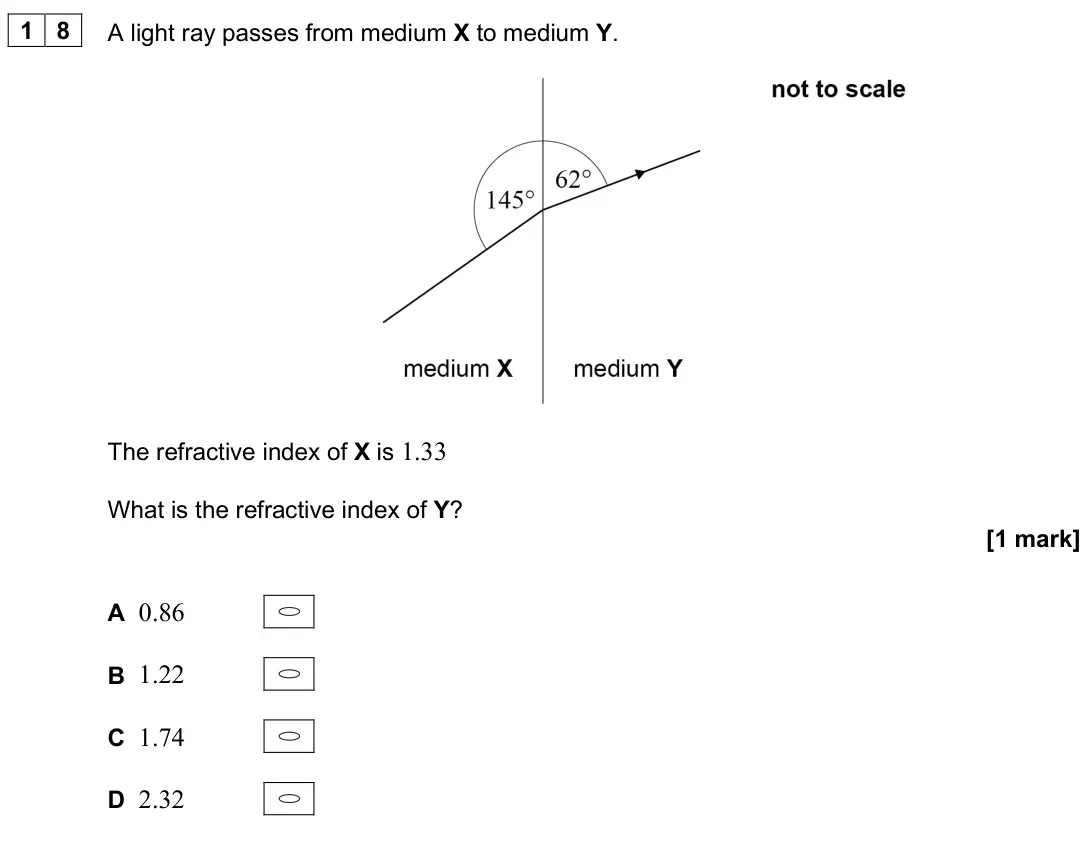
- June 2025, Paper 1, Q18 (1 mark): A light ray passes from medium X to medium Y. The refractive index of X is 1.33 What is the refractive index of Y? [1 mark] A 0.86 B 1.22 C 1.74 D 2.32
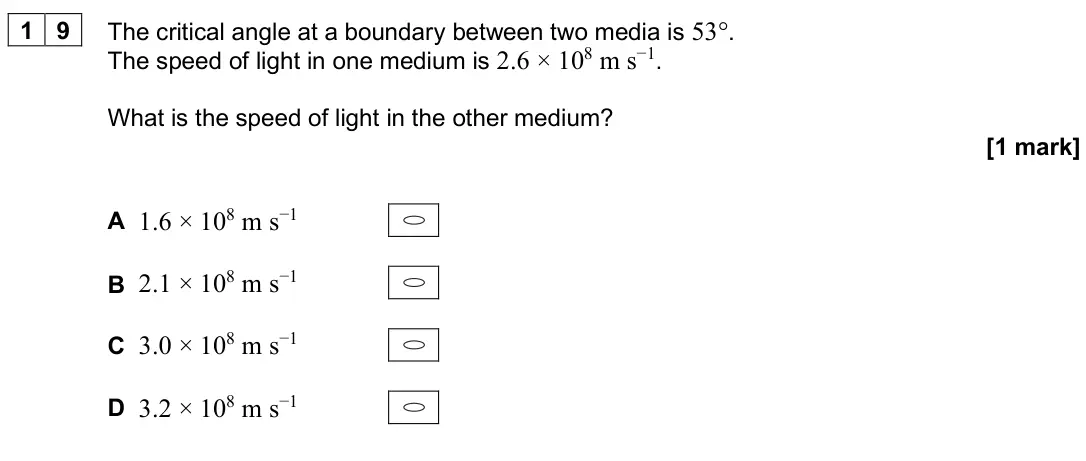
- June 2025, Paper 1, Q19 (1 mark): The critical angle at a boundary between two media is 53°. The speed of light in one medium is 2.6 × 10⁸ m s−1. What is the speed of light in the other medium?
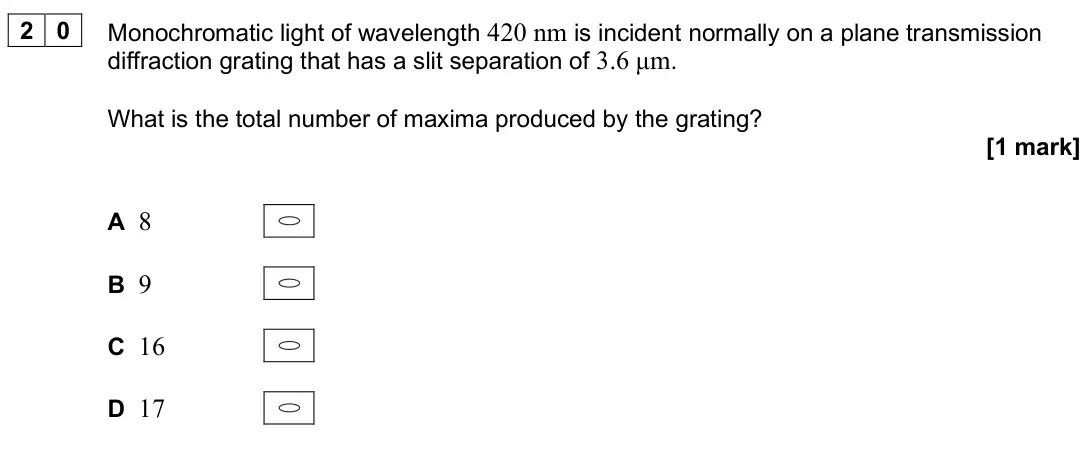
- June 2025, Paper 1, Q20 (1 mark): Monochromatic light of wavelength 420 nm is incident normally on a plane transmission diffraction grating that has a slit separation of 3.6 μm. What is the tota
- June 2025, AS Paper 1, Q02.1 (1 mark): What happens to the frequency of the light as it enters the glass core? Tick () one box. [1 mark] It decreases. It is unchanged. It increases. The refractive i
- June 2025, AS Paper 1, Q02.2 (2 marks): The critical angle at the core–cladding boundary is 80.7° Calculate the refractive index of the cladding. [2 marks] refractive index of cladding = Figure 1 show
- June 2025, AS Paper 1, Q02.3 (2 marks): Calculate the maximum value of θA for the ray to be transmitted through the optical fibre. [2 marks] maximum value of θA = °
- June 2025, AS Paper 1, Q02.4 (3 marks): Figure 2 shows the path of a ray of light that enters at the centre of the straight optical fibre at a smaller value of θA. Only the first two total internal re
- June 2025, AS Paper 2, Q01.1 (1 mark): State one safety precaution when using a laser in a school laboratory. [1 mark] A piece of squared paper is positioned parallel to the diffraction grating. Figu
- June 2025, AS Paper 2, Q01.2 (2 marks): C is the central maximum. Determine ∆x, the distance between C and the spot at the second-order maximum. Go on to determine the percentage uncertainty in ∆x. [2
- June 2025, AS Paper 2, Q01.3 (3 marks): When the readings in Table 1 were taken, the distance between the grating and the paper was 1.20 m. The grating has 300 lines per mm. Determine an accurate valu
- June 2025, AS Paper 2, Q01.4 (2 marks): The student changes the distance between the grating and the paper so that B and D are at the edges of the paper as shown in Figure 2. The paper and diffraction
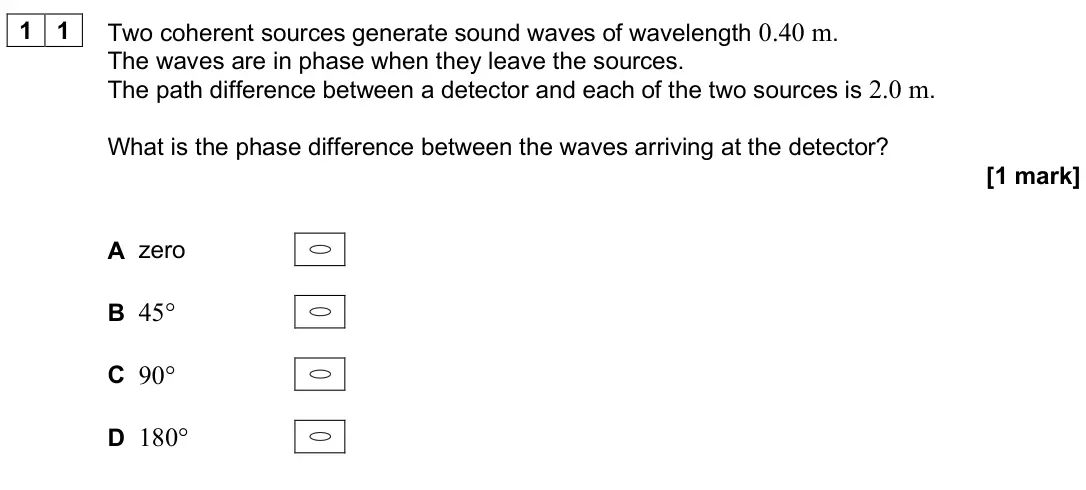
- June 2025, AS Paper 2, Q11 (1 mark): Two coherent sources generate sound waves of wavelength 0.40 m. The waves are in phase when they leave the sources. The path difference between a detector and e
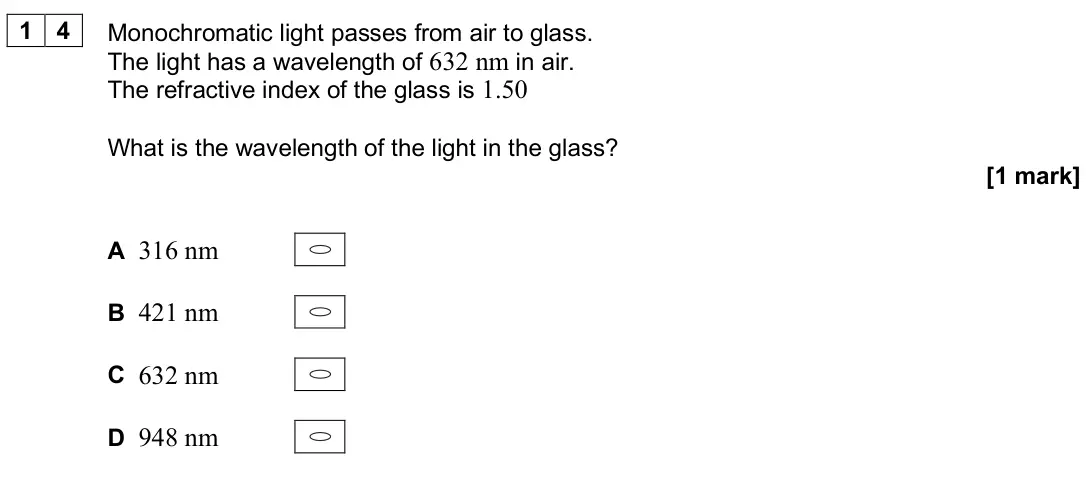
- June 2025, AS Paper 2, Q14 (1 mark): Monochromatic light passes from air to glass. The light has a wavelength of 632 nm in air. The refractive index of the glass is 1.50 What is the wavelength of t
- June 2024, Paper 1, Q03.1 (1 mark): Complete, on Figure 1, the path of the ray of light inside the block. [1 mark]
- June 2024, Paper 1, Q03.2 (2 marks): Deduce which prism, A or B, has the greater refractive index. [2 marks]
- June 2024, Paper 1, Q03.3 (1 mark): Describe one non-astronomical application of a diffraction grating. [1 mark]
- June 2024, Paper 1, Q03.4 (3 marks): Figure 2 shows a spectrum of light. Two lines in the spectrum are labelled X and Y. Figure 2 The light passes at normal incidence through a diffraction grating.
- June 2024, Paper 1, Q03.5 (3 marks): A scientist wants to obtain an accurate value for the difference in wavelength between line X and line Y. She has two options: • option 1: to analyse the second
- June 2024, Paper 1, Q16 (1 mark): Point sources of sound of the same frequency are placed at S1 and S2. A sound detector is moved slowly along the line PQ. Consecutive maxima of sound intensity
- June 2024, Paper 1, Q17 (1 mark): Monochromatic light is used in a Young’s double-slit interference experiment after passing through a single slit. The resulting fringe pattern is observed on a
- June 2024, AS Paper 2, Q04.1 (3 marks): Deduce the relationship between d and the wavelength λ of light that produces a bright fringe. [3 marks]
- June 2024, AS Paper 2, Q04.2 (2 marks): 0 4 Figure 13 shows an arrangement used to determine the thickness of metal foil using interference of light. Figure 13 Two thin glass plates are separated by t
- June 2024, AS Paper 2, Q04.3 (3 marks): The space between the plates is now filled with water. The same light source is used, and t and l remain the same as before. Deduce how the distance s will chan
- June 2024, AS Paper 2, Q07 (1 mark): Monochromatic light of wavelength 520 nm is incident normally on a diffraction grating. The third-order maximum occurs at a diffraction angle θ. Light of wavele
- June 2024, AS Paper 2, Q15 (1 mark): Sources M1 and M2 emit coherent microwaves of wavelength 5.0 cm. When M1 and M2 are very close, a maximum of intensity occurs at a point D that is 1.0 m away. M
- June 2024, AS Paper 2, Q21 (1 mark): The cladding of a step-index optical fibre [1 mark] A must not be transparent. B must have a higher refractive index than the core. C reduces signal loss. D red
- June 2023, Paper 1, Q04.1 (1 mark): Show that the glass used to make the prism has a refractive index of about 1.5 [1 mark]
- June 2023, Paper 1, Q04.2 (2 marks): Explain why the ray emerges parallel to the incident ray. [2 marks]
- June 2023, Paper 1, Q04.3 (3 marks): Draw on Figure 8 the path of the ray of light as it continues inside the prism and emerges from the longest side. [3 marks]
- June 2023, Paper 1, Q04.4 (4 marks): When the angle of incidence is greater than θ, some of the light escapes the prism through one of the shorter sides. Assume that the refractive index is 1.5 and
- June 2023, Paper 1, Q04.5 (4 marks): A manufacturer wants to make a prism with a larger value of θ. Two alternative changes to the original design of the prism are suggested: 1. use a prism of the
- June 2023, Paper 1, Q16 (1 mark): A double slit with a separation s is illuminated by light of wavelength λ. Fringes with spacing w are produced on a screen placed a distance D from the slits. T
- June 2023, Paper 1, Q17 (1 mark): A single narrow slit is illuminated with monochromatic light and a diffraction pattern is produced. The slit width is increased. What happens to the width and b
- June 2023, AS Paper 1, Q02.1 (3 marks): Figure 2 shows how A and B vary with time at the upper surface. Figure 2 In the layer, the light has a wavelength of 356 nm. The thickness of the layer is 89 nm
- June 2023, AS Paper 1, Q02.4 (4 marks): 89 nm is the minimum thickness that will produce a phase difference of 137° between A and B. Calculate the refractive index of the material of the layer. [4 mar
- June 2023, AS Paper 2, Q04.1 (1 mark): Explain why the light ray in Figure 12 does not change direction as it enters the block. [1 mark]
- June 2023, AS Paper 2, Q04.2 (2 marks): The refractometer is calibrated using a drop of liquid. When θ = 15°, light is partially refracted at the glass–liquid boundary. Calculate the angle of refracti
- June 2023, AS Paper 2, Q04.3 (2 marks): Explain why the intensity of the light ray on the screen increases at T. [2 marks]
- June 2023, AS Paper 2, Q04.4 (2 marks): The liquid is replaced with a drop of sugar solution. The refractive index of the sugar solution is greater than 1.33 Deduce how this change affects the positio
- June 2023, AS Paper 2, Q04.5 (3 marks): The refractometer in Figure 13 is used to determine the concentration of a sugar solution. Figure 14 shows the variation of refractive index with concentration
- June 2023, AS Paper 2, Q05 (1 mark): [multiple choice] Light of wavelength λ is incident normally on a diffraction grating. The separation between adjacent slits is equal to 5λ. What is the smalles
- June 2023, AS Paper 2, Q06 (1 mark): S1 and S2 are coherent sources of microwaves that produce waves of the same amplitude. A microwave detector gives a zero reading when placed at a point that is
- June 2023, AS Paper 2, Q25 (1 mark): A central diffraction maximum is observed when monochromatic light of wavelength λ passes through a single slit of width s. Which combination of changes to λ an
- June 2022, Paper 1, Q06.1 (1 mark): Explain how the path of the ray shows that the refractive index of A is greater than the refractive index of B. [1 mark]
- June 2022, Paper 1, Q06.2 (2 marks): Show that the angle of refraction of the ray in B is about 60°. [2 marks]
- June 2022, Paper 1, Q06.3 (3 marks): Draw, on Figure 12, the path of the ray immediately after it reaches P. Justify your answer with calculations. [3 marks] END OF SECTION A Section B
- June 2022, Paper 1, Q20 (1 mark): Light of wavelength 5.2 × 10⁻⁷ m is used in a Young’s double-slit experiment. The distance from the slits to the screen is 1.5 m. The width of ten fringes is 3.
- June 2022, Paper 1, Q21 (1 mark): Monochromatic light of wavelength 5.8 × 10⁻⁷ m is incident normally on a plane transmission diffraction grating that has a slit separation of 2.5 × 10⁻⁶ m. How
- June 2022, AS Paper 1, Q03.2 (2 marks): A and B reflect and return to the satellite. The travel time is the time between the emission of a pulse and its return to the satellite. The difference in the
- June 2022, AS Paper 1, Q03.3 (2 marks): Calculate the refractive index of the ice. [2 marks] refractive index =
- June 2022, AS Paper 1, Q03.4 (2 marks): Calculate the wavelength of the infrared radiation when it is inside the ice sheet. [2 marks] wavelength = m
- June 2022, AS Paper 2, Q03.3 (2 marks): A second loudspeaker receives the same data from the mobile phone. The two loudspeakers act as coherent sources of sound waves. State the two conditions require
- June 2022, AS Paper 2, Q03.4 (2 marks): Show that the difference between the path lengths AM and BM is approximately 0.3 m. [2 marks]
- June 2022, AS Paper 2, Q03.5 (2 marks): The speed of sound is 340 m s−1. Determine the frequency of the sound waves. [2 marks] frequency = Hz
- June 2022, AS Paper 2, Q19 (1 mark): Monochromatic visible light is incident normally on a plane transmission diffraction grating that has 4.8 × 10⁵ lines m−1. First-order maxima are observed at an
- June 2022, AS Paper 2, Q20 (1 mark): Which combination produces the smallest modal dispersion in an optical fibre? [1 mark] Refractive index of core Refractive index of cladding A 1.5 1.4 B 1.4 1.5
- November 2021, Paper 1, Q02.3 (1 mark): Suggest why Young’s double-slit equation should not be used to determine the wavelength. [1 mark]
- November 2021, Paper 1, Q02.4 (3 marks): The wavelength is known to be about 3 cm. Deduce whether this practical arrangement is suitable for a determination of a value for the wavelength. [3 marks]
- November 2021, Paper 1, Q03.1 (1 mark): Calculate the speed of the light ray in the optical fibre. [1 mark] speed = m s−1
- November 2021, Paper 1, Q03.2 (3 marks): Calculate A, in degrees, for the optical fibre shown in Figure 4. [3 marks] A = degrees
- November 2021, Paper 1, Q03.3 (3 marks): A ray is incident on the optical fibre at angle A. The optical fibre is now bent, as shown in Figure 5. Figure 5 Draw, on Figure 5, what happens to the ray with
- November 2021, Paper 1, Q19 (1 mark): A diffraction grating is illuminated normally. The second-order maximum for light of wavelength 650 nm occurs at the same angle as the third-order maximum for l
- November 2021, Paper 3A, Q02.1 (3 marks): Light from LR is incident normally on a plane diffraction grating. The fifth-order maximum for light of wavelength p occurs at a diffraction angle of 76.3°. Det
- November 2021, Paper 3A, Q02.2 (1 mark): Suggest one possible disadvantage of using the fifth-order maximum to determine N. [1 mark]
- November 2021, AS Paper 1, Q02.1 (1 mark): Light of wavelength λ travels from each illuminated slit, producing maxima on the screen. State the path difference between light from adjacent slits when this
- November 2021, AS Paper 1, Q02.2 (3 marks): Explain how light from the diffraction grating forms a maximum on the screen. [3 marks]
- November 2021, AS Paper 1, Q02.3 (2 marks): Deduce the combination of disc and laser pointer that will produce the greatest possible number of interference maxima. [2 marks]
- November 2021, AS Paper 1, Q02.4 (3 marks): The student uses the CD and laser pointer B as shown in Figure 4. A diffraction pattern is produced on the screen. Laser pointer B and the CD are in fixed posit
- November 2021, AS Paper 1, Q07.1 (2 marks): Explain what is meant by modal dispersion in an optical fibre. [2 marks] Figure 15 shows a ray of light incident on the central axis of an optical fibre at an a
- November 2021, AS Paper 1, Q07.2 (1 mark): Show that the horizontal component of the velocity of the pulse is approximately 1.9 × 10⁸ m s−1. [1 mark]
- November 2021, AS Paper 1, Q07.3 (3 marks): The frequency of the blue light in the pulse is 720 THz. Calculate the speed of the blue light in the core of the optical fibre. [3 marks] speed = m s−1
- November 2021, AS Paper 1, Q07.4 (2 marks): Two pulses of monochromatic light are incident normally on the air−core boundary. They then travel along the central axis of the core. One pulse consists of blu
- November 2021, AS Paper 1, Q07.5 (1 mark): Another two pulses, identical to the pulses in Question 07.4, are incident on the central axis of the optical fibre and travel along its length. However, the pu
- November 2021, AS Paper 2, Q18 (1 mark): A ray of light is incident on the internal boundary of a rectangular glass block in air. Part of the light refracts out of the block at an angle of 30°. Some of
- November 2021, AS Paper 2, Q19 (1 mark): In a Young’s double-slit experiment, monochromatic light is incident on two narrow slits and the resulting interference pattern is observed on a screen. Which c
- November 2020, Paper 1, Q03.1 (2 marks): Explain why the two loudspeakers are coherent sources of sound waves. [2 marks]
- November 2020, Paper 1, Q03.2 (3 marks): The student faces the two loudspeakers at point A. Point A is at equal distances from P and Q. He then moves to point B, at right angles to the line OA, still f
- November 2020, Paper 1, Q03.3 (3 marks): The student records the following data: separation of the two loudspeakers = 0.30 m distance OA = 2.25 m distance from A to B = 0.95 m Show that the path differ
- November 2020, Paper 1, Q03.4 (1 mark): The frequency of the sound wave is 2960 Hz. Calculate the speed of sound from the student’s data. [1 mark] speed of sound = m s−1
- November 2020, Paper 1, Q03.5 (3 marks): The student moves his head to point C as shown in Figure 4. The emitted frequency of the sound from the loudspeakers is then gradually decreased. Figure 4 Discu
- November 2020, Paper 1, Q14 (1 mark): A monochromatic light wave travels from glass into air. Which row shows what happens to the wavelength, speed and photon energy? [1 mark] Wavelength Speed Photo
- November 2020, Paper 1, Q19 (1 mark): Monochromatic light is incident normally on a diffraction grating that has 4.50 × 10⁵ lines m−1. The angle between the second-order diffraction maxima is 44°. W
- November 2020, AS Paper 2, Q01.1 (1 mark): State why the emergent ray does not change direction as it leaves the block. [1 mark]
- November 2020, AS Paper 2, Q01.2 (4 marks): The student draws an arrow on the paper to mark the incident ray. She marks the path of the emergent ray with crosses A, B and C. She removes the block from the
- November 2020, AS Paper 2, Q01.3 (1 mark): The refractive index n of the block is given by 2 0 2 1 R R n R R − = − Determine n. [1 mark] n =
- November 2020, AS Paper 2, Q03.4 (3 marks): The camera’s signal is transmitted as a series of pulses through an optical fibre. Table 2 shows data for two optical fibres X and Y. Both optical fibres are id
- November 2020, AS Paper 2, Q14 (1 mark): Light of wavelength is incident normally on two parallel slits of separation s. Fringes of spacing w are seen on a screen at a distance D from the slits. Which
- November 2020, AS Paper 2, Q15 (1 mark): A narrow beam of monochromatic light is incident normally to a diffraction grating. The first-order diffracted beam makes an angle of 20° with the normal to the
- November 2020, AS Paper 2, Q16 (1 mark): The speed of light decreases by 40% when it travels from air into a transparent medium. What is the refractive index of the medium? [1 mark] A 0.6 B 1.4 C 1.7 D
- June 2019, Paper 1, Q02.1 (1 mark): Suggest how the design ensures that there is no deviation of the ray as it enters the first prism. [1 mark]
- June 2019, Paper 1, Q02.2 (2 marks): Suggest two features of the design that ensure that there is no deviation of the ray as it leaves the first prism and enters the windscreen glass. [2 marks] 1 2
- June 2019, Paper 1, Q02.3 (2 marks): The refractive index of the windscreen glass is 1.52 Explain why the ray follows the path shown inside the windscreen glass in Figure 1. Support your answer wit
- June 2019, Paper 1, Q02.4 (2 marks): When it starts to rain, water droplets form on the outside of the windscreen as shown in Figure 2. Figure 2 The refractive index of water is 1.33 Explain why th
- June 2019, Paper 1, Q02.5 (2 marks): The refractive index of the windscreen glass can vary by a few per cent across the thickness of the glass. Discuss how this variation may affect the path of the
- June 2019, Paper 1, Q02.6 (2 marks): A different design has the LED and the detector further apart. The ray undergoes more reflections inside the windscreen glass before reaching the detector. Disc
- June 2019, Paper 1, Q03.1 (2 marks): Describe the pattern produced on the screen. [2 marks]
- June 2019, Paper 1, Q03.2 (2 marks): The green filter is replaced with a red filter. Describe the change in the pattern produced on the screen. [2 marks]
- June 2019, Paper 1, Q03.3 (2 marks): A diffraction grating is placed between the red filter and the screen. The diffraction grating has 500 lines per millimetre. Light is incident normally on the g
- June 2019, Paper 1, Q03.4 (2 marks): In practice, the filter transmits red light with wavelengths in the range 600 nm to 700 nm. Suggest how this affects the appearance of the maxima. [2 marks]
- June 2019, AS Paper 1, Q04.1 (2 marks): Explain why the laser beam stays inside the stream of water. [2 marks]
- June 2019, AS Paper 1, Q04.2 (3 marks): Calculate the speed of the laser light in the water. Give your answer to an appropriate number of significant figures. [3 marks] speed = m s–1
- June 2019, AS Paper 1, Q04.3 (1 mark): Calculate the critical angle for the water−air boundary. [1 mark] critical angle = degrees
- June 2019, AS Paper 1, Q04.4 (6 marks): Tyndall’s experiment led to the development of optical fibres. Figure 5 shows a step-index optical fibre. Figure 5 Discuss the properties of a step-index optica
- June 2019, AS Paper 1, Q04.5 (2 marks): Scientists use optical fibres to monitor earthquakes. Light travelling through an optical fibre can be reflected by impurities in the fibre, as shown in Figure
- June 2019, AS Paper 2, Q01.4 (1 mark): Eye protection should be used to prevent eye damage when using a laser. Describe one other safety measure to minimise the risk of eye damage when using a laser
- June 2019, AS Paper 2, Q01.5 (1 mark): Figure 2 shows the experimental arrangement with y, the perpendicular distance between the diffraction grating and the screen, equal to 1.280 m. Table 2 shows s
- June 2019, AS Paper 2, Q01.6 (2 marks): Spot E is the second-order maximum. The diffraction grating has 3.00 × 10⁵ lines per metre. Calculate the wavelength of the laser light. [2 marks] wavelength =
- June 2019, AS Paper 2, Q01.7 (2 marks): The student plans to repeat the experiment using the same diffraction grating and laser. State and explain one way the student can change the experimental arran
- June 2019, AS Paper 2, Q18 (1 mark): In a Young’s double-slit experiment, the spacing of the double slits is s and the distance between the slits and the screen on which fringes are formed is D. Wh
- June 2019, AS Paper 2, Q19 (1 mark): Monochromatic electromagnetic radiation of wavelength 5.8 × 10⁻⁷ m is incident normally on a diffraction grating with 3.0 × 10⁵ lines per metre. What is the hig
- June 2019, AS Paper 2, Q20 (1 mark): Which characteristics of monochromatic light change when the light passes from air into glass? [1 mark] A Speed, wavelength and frequency. B Speed and frequency
- June 2019, AS Paper 2, Q21 (1 mark): Which is a description of the pattern produced when monochromatic light passes through a very narrow slit? [1 mark] A A series of equally-spaced light and dark
- June 2018, Paper 1, Q15 (1 mark): In the diagram, P is the source of a wave of frequency 50 Hz The wave travels to R by two routes, P → Q → R and P → R. The speed of the wave is 30 m s−1 What is
- June 2018, Paper 1, Q16 (1 mark): Light from a point source passes through a single slit and is then incident on a double-slit arrangement. An interference pattern is observed on the screen. Wha
- June 2018, Paper 1, Q17 (1 mark): A diffraction grating has 500 lines per mm. When monochromatic light is incident normally on the grating the third-order spectral line is formed at an angle of
- June 2018, Paper 1, Q18 (1 mark): An electromagnetic wave enters a fibre-optic cable from air. On entering the cable, the wave slows down to three-fifths of its original speed. What is the refra
- June 2018, Paper 1, Q19 (1 mark): The diagram shows part of the path of a ray of light through a right-angled prism. The prism is made of glass of refractive index 1.5 The incident light ray is
- June 2018, AS Paper 1, Q07.1 (2 marks): Describe the interference pattern that is seen on the white screen. [2 marks]
- June 2018, AS Paper 1, Q07.2 (4 marks): A filter transmits only green light of wavelength and red light of wavelength 1.2 This filter is placed between the light source and the single slit. Describe t
- June 2018, AS Paper 1, Q07.3 (6 marks): A student decides to use the apparatus shown in Figure 8 to determine the wavelength of red light using a filter that transmits only red light. The student sugg
- June 2018, AS Paper 2, Q04.1 (3 marks): Figure 9 shows an incident ray of light being partially reflected at the boundary between glass A and glass B. The refractive index nA of glass A is 1.461 The s
- June 2018, AS Paper 2, Q04.2 (3 marks): Figure 10 shows a cross-sectional view of an optical fibre strain gauge. Figure 10 A maximum intensity of the reflected light is produced due to superposition o
- June 2018, AS Paper 2, Q04.3 (2 marks): Figure 12 shows the relationship between λR and the strain in two optical fibre strain gauges P and Q. The engineer wishes to measure small accelerations in ano
- June 2018, AS Paper 2, Q15 (1 mark): A ray of light is incident on a glass–air boundary of a rectangular block as shown. The refractive index of this glass is 1.5 The refractive index of air is 1.0
- June 2018, AS Paper 2, Q16 (1 mark): Rays of light are incident at the same angle θ on the core–cladding boundary of optical fibres P and Q. The cores of P and Q have the same refractive index n. P
- June 2018, AS Paper 2, Q18 (1 mark): A diffraction grating is illuminated normally with light of wavelength 6.5 × 10⁻⁷ m When a screen is 1.5 m from the grating, the distance between the zero and f
- June 2017, Paper 1, Q03.1 (1 mark): The angle of refraction of the ray at the plane surface is 90°. Refractive index of the glass used = 1.6 Calculate the angle of incidence of the ray on the flat
- June 2017, Paper 1, Q03.2 (2 marks): A thin film of liquid is placed on the flat surface of the glass block as shown in Figure 3. Figure 3 The angle of incidence is changed so that the angle of ref
- June 2017, Paper 1, Q03.3 (3 marks): The source of green light is changed for one that contains only red and blue light. For any material red light has a lower refractive index than green light, an
- June 2017, Paper 1, Q16 (1 mark): When a monochromatic light source is incident on two slits of the same width an interference pattern is produced. One slit is then covered with opaque black pap
- June 2017, Paper 1, Q17 (1 mark): When light of wavelength 5.0 × 10⁻⁷ m is incident normally on a diffraction grating the fourth-order maximum is observed at an angle of 30°. What is the number
- June 2017, Paper 3A, Q01.1 (1 mark): The ammeter reading depends on the superposition of waves travelling directly to R and other waves that reach R after reflection from M. State the phase differe
- June 2017, Paper 3A, Q01.2 (1 mark): Explain why the minimum reading is not zero when the distance x is measured. [1 mark]
- June 2017, Paper 3A, Q01.3 (2 marks): When M is moved further away the reading increases to a maximum then decreases to a minimum. At the first minimum position, a student labels the minimum n = 1 a
- June 2017, Paper 3A, Q01.5 (2 marks): Determine using your results for Gmax and Gmin. [2 marks] = m Figure 4
- June 2017, Paper 3A, Q01.7 (2 marks): Explain how the graph in Figure 4 can be used to obtain the value of y. You are not required to determine y. [2 marks]
- June 2017, AS Paper 1, Q04.1 (3 marks): Explain why the signal strength falls to a minimum between B and C, and between C and D. [3 marks]
- June 2017, AS Paper 1, Q04.2 (3 marks): Determine the frequency of the microwaves that are transmitted. [3 marks] frequency = Hz
- June 2017, AS Paper 1, Q04.3 (2 marks): The intensity of the waves passing through each slit is the same. Explain why the minimum intensity between C and D is not zero. [2 marks]
- June 2017, AS Paper 2, Q23 (1 mark): Which row shows the change in velocity, frequency and wavelength of an electromagnetic wave as it travels from an optically less dense to an optically more dens
- June 2017, AS Paper 2, Q24 (1 mark): The diagram shows a ray of light travelling in air and incident on a glass block of refractive index 1.5 What is the angle of refraction in the glass? [1 mark]
- June 2017, AS Paper 2, Q25 (1 mark): Intensity maxima are produced on a screen when a parallel beam of monochromatic light is incident on a diffraction grating. Light of a longer wavelength can be
- June 2017, AS Paper 2, Q27 (1 mark): Light of wavelength 500 nm is passed through a diffraction grating which has 400 lines per mm. What is the angular separation between the two second-order maxim
- June 2016, AS Paper 2, Q14 (1 mark): In a diffraction-grating experiment the maxima are produced on a screen. What causes the separation of the maxima of the diffraction pattern to decrease? [1 mar
- June 2016, AS Paper 2, Q15 (1 mark): White light passes through a single narrow slit and illuminates a screen. What is observed on the screen? [1 mark] A a set of equally spaced white fringes B a c
- June 2016, AS Paper 2, Q16 (1 mark): Which of the following is correct when total internal reflection occurs? [1 mark] A The angle of incidence is less than the critical angle. B The light meets an
- June 2016, AS Paper 2, Q17 (1 mark): What is the speed of light in glass of refractive index 1.42? [1 mark] A 4.26 × 10⁷ m s–1 B 2.11 × 10⁸ m s–1 C 3.00 × 10⁸ m s–1 D 4.73 × 10⁸ m s–1
- Specimen, Paper 1, Q05.1 (3 marks): Describe the structure of a step-index optical fibre outlining the purpose of the core and the cladding. [3 marks] 0 5 . 1
- Specimen, Paper 1, Q05.2 (2 marks): A signal is to be transmitted along an optical fibre of length 1200 m. The signal consists of a square pulse of white light and this is transmitted along the ce
- Specimen, Paper 1, Q05.3 (2 marks): Discuss two changes that could be made to reduce the effect described in part 5.2. [2 marks] 0 5 . 3
- Specimen, Paper 1, Q06.1 (1 mark): Read through the following passage and answer the questions that follow it. Measuring the speed of sound in air 5 10 After the wave nature of sound had been ide
- Specimen, Paper 1, Q13 (1 mark): Monochromatic light may be characterised by its speed, frequency and wavelength. Which of the following quantities change when monochromatic light passes from a
- Specimen, Paper 1, Q17 (1 mark): Monochromatic light of wavelength 490 nm falls normally on a diffraction grating that has 6 x 10⁵ lines per metre. Which one of the following is correct? [1 mar
- Specimen, Paper 2, Q06.3 (3 marks): Read the following passage and answer the questions that follow Satellites used for telecommunications are usually in geostationary orbits. Using suitable dishe
- Specimen, Paper 3A, Q03.1: Figure 4 shows how the refractive index n of a type of glass varies with the wavelength of light λ passing through the glass. The data for plotting the graph we
- Specimen, Paper 3A, Q03.2 (3 marks): Figure 4 shows how the refractive index n of a type of glass varies with the wavelength of light λ passing through the glass. The data for plotting the graph we
- Specimen, Paper 3A, Q03.3 (3 marks): Figure 4 shows how the refractive index n of a type of glass varies with the wavelength of light λ passing through the glass. The data for plotting the graph we
- Specimen, Paper 3A, Q03.4 (3 marks): Figure 4 shows how the refractive index n of a type of glass varies with the wavelength of light λ passing through the glass. The data for plotting the graph we
- Specimen, Paper 3A, Q03.5: Figure 4 shows how the refractive index n of a type of glass varies with the wavelength of light λ passing through the glass. The data for plotting the graph we
- Specimen, Paper 3A, Q03.6: Figure 4 shows how the refractive index n of a type of glass varies with the wavelength of light λ passing through the glass. The data for plotting the graph we
- Specimen, Paper 3A, Q03.7 (3 marks): Figure 4 shows how the refractive index n of a type of glass varies with the wavelength of light λ passing through the glass. The data for plotting the graph we
Questions, mark schemes and examiner’s reports are © AQA, from their published past papers. Plumi isn’t affiliated with any exam board. Want whole papers? Every AQA A-Level Physics paper.
Rather write your answers by hand on iPad? Plumi marks them against the same mark schemes.