 plumi
Progressive and stationary waves: AQA A‑Level Physics questions
Every AQA A-Level Physics exam question on 3.3.1 Progressive and stationary waves, 2016–2025, with its mark scheme and examiner’s report.
Find questions2,714
Calculations
Q02.1
The whole paper ↗
Q02.2
The whole paper ↗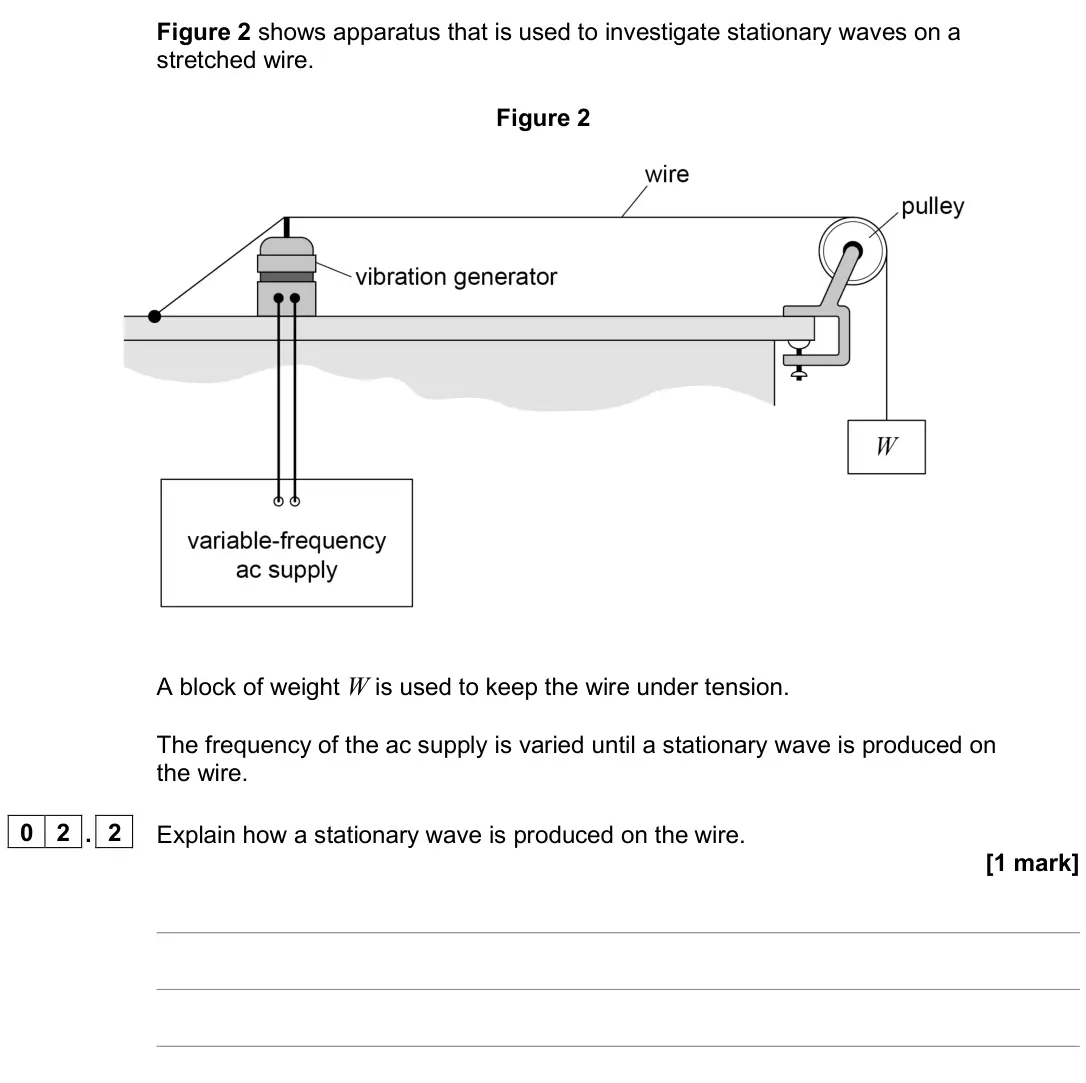
Q02.3
The whole paper ↗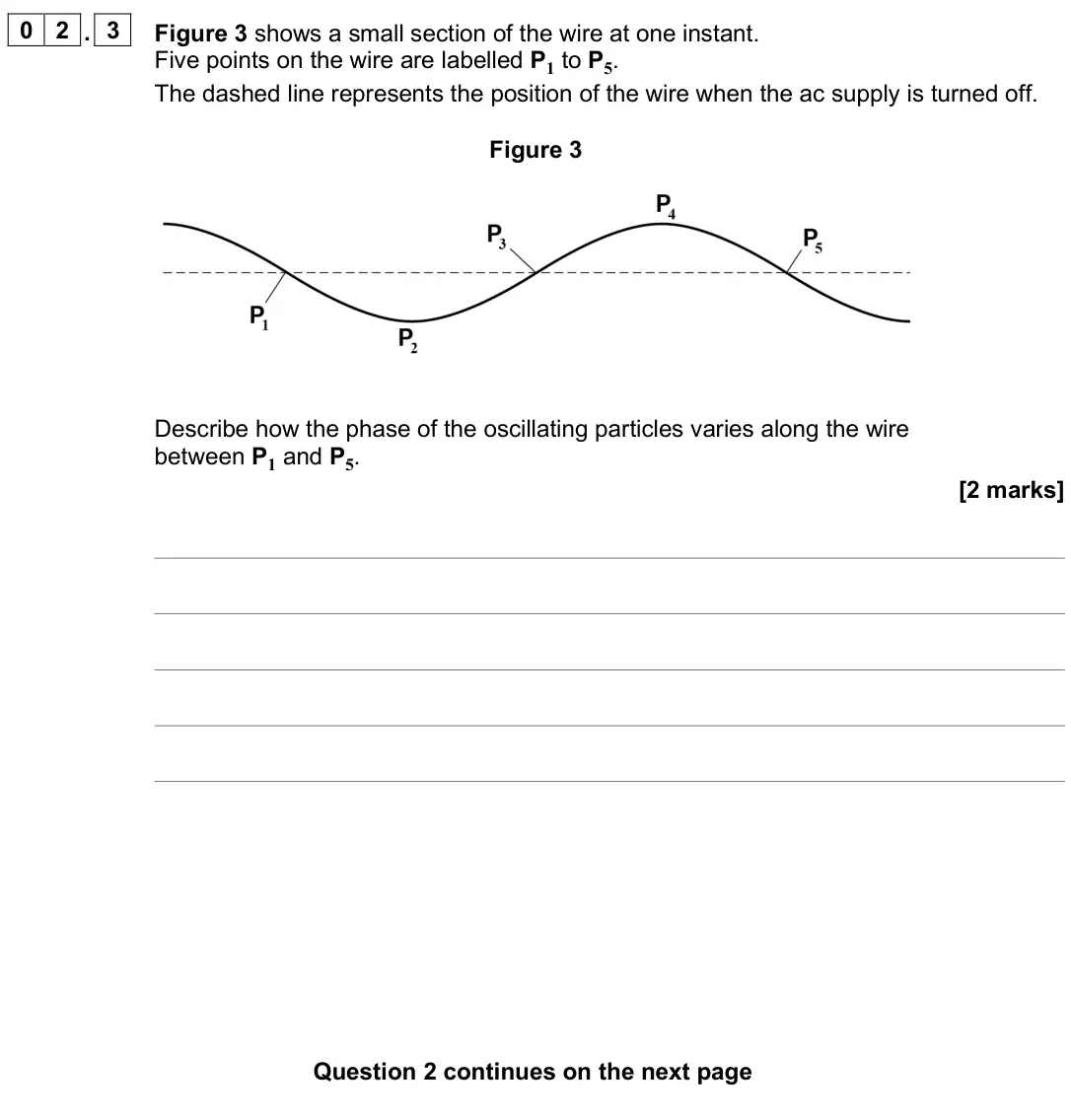
Q02.4
The whole paper ↗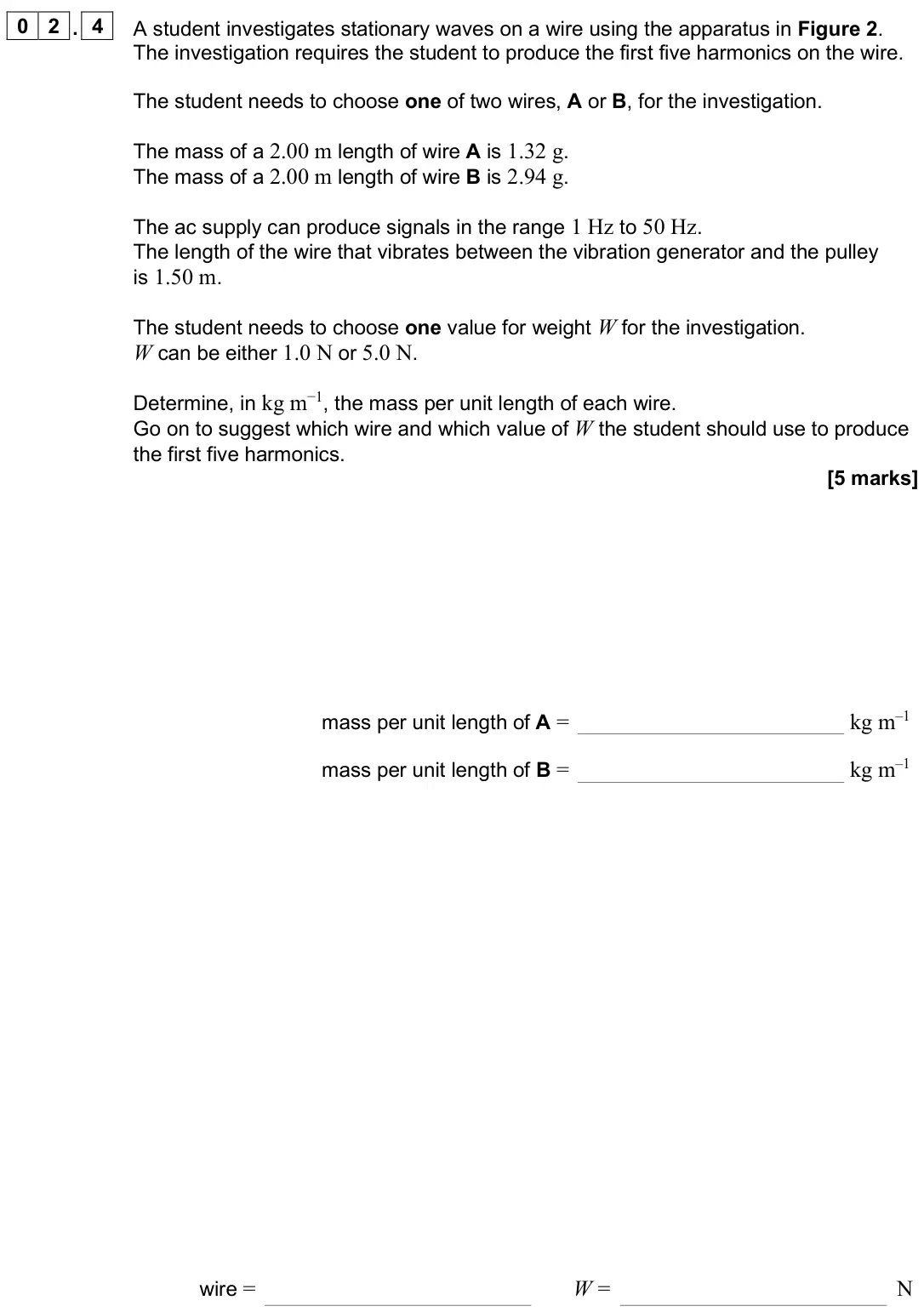
Q01.1
The whole paper ↗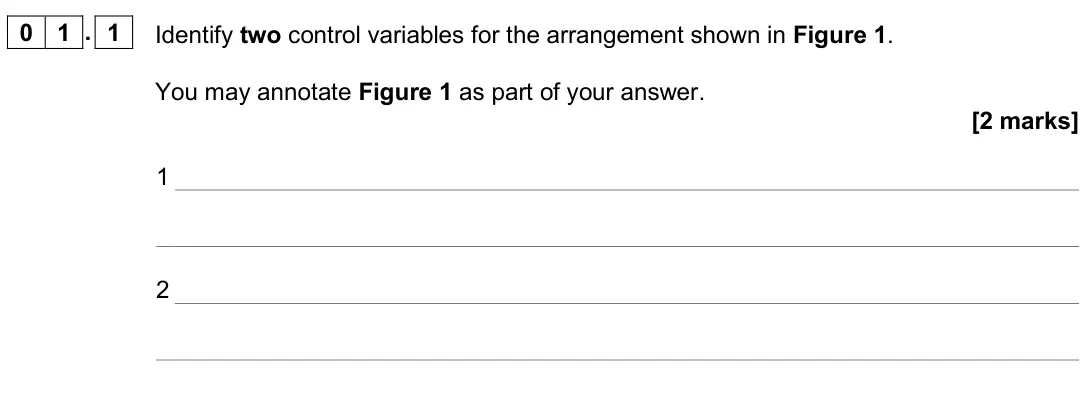
Q01.2
The whole paper ↗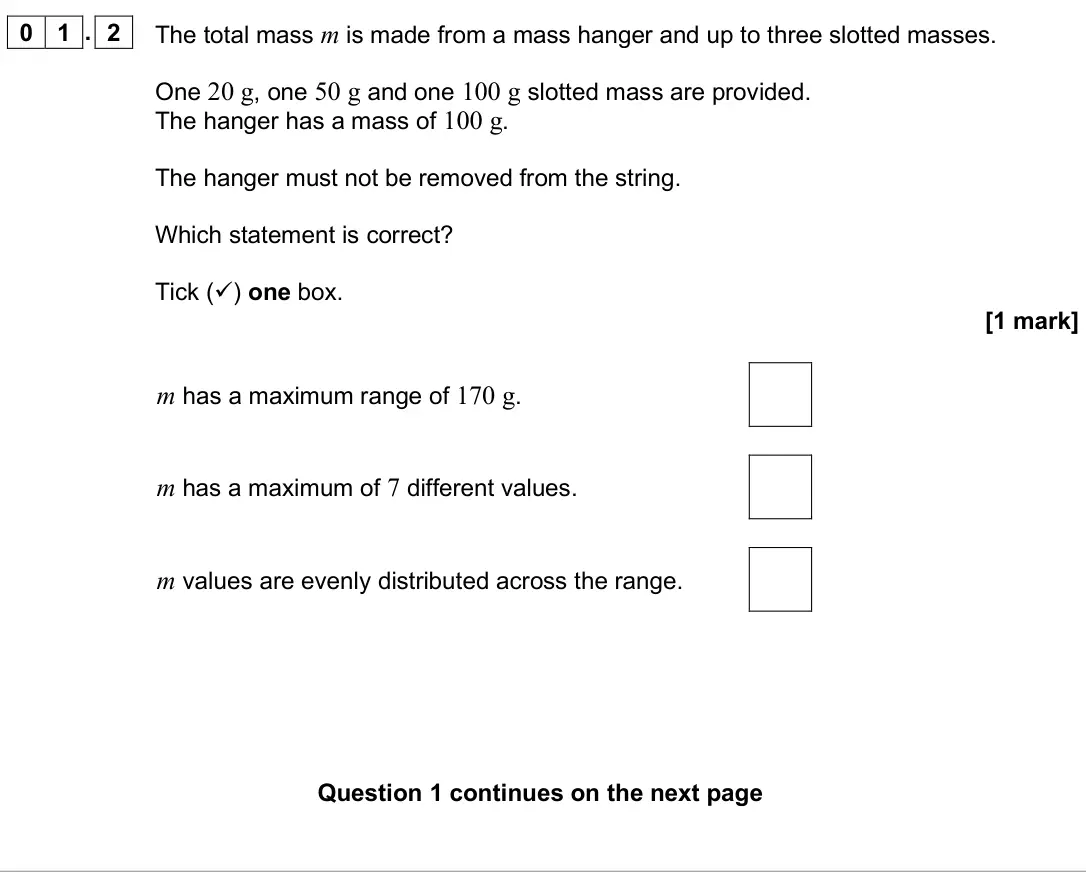
Q01.4
The whole paper ↗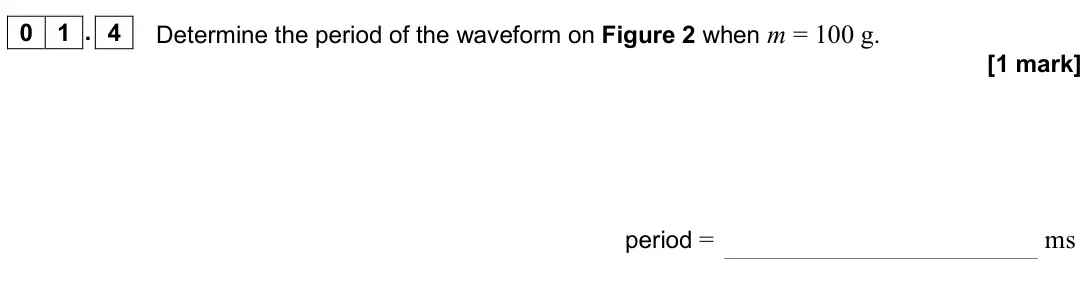
Q01.5
The whole paper ↗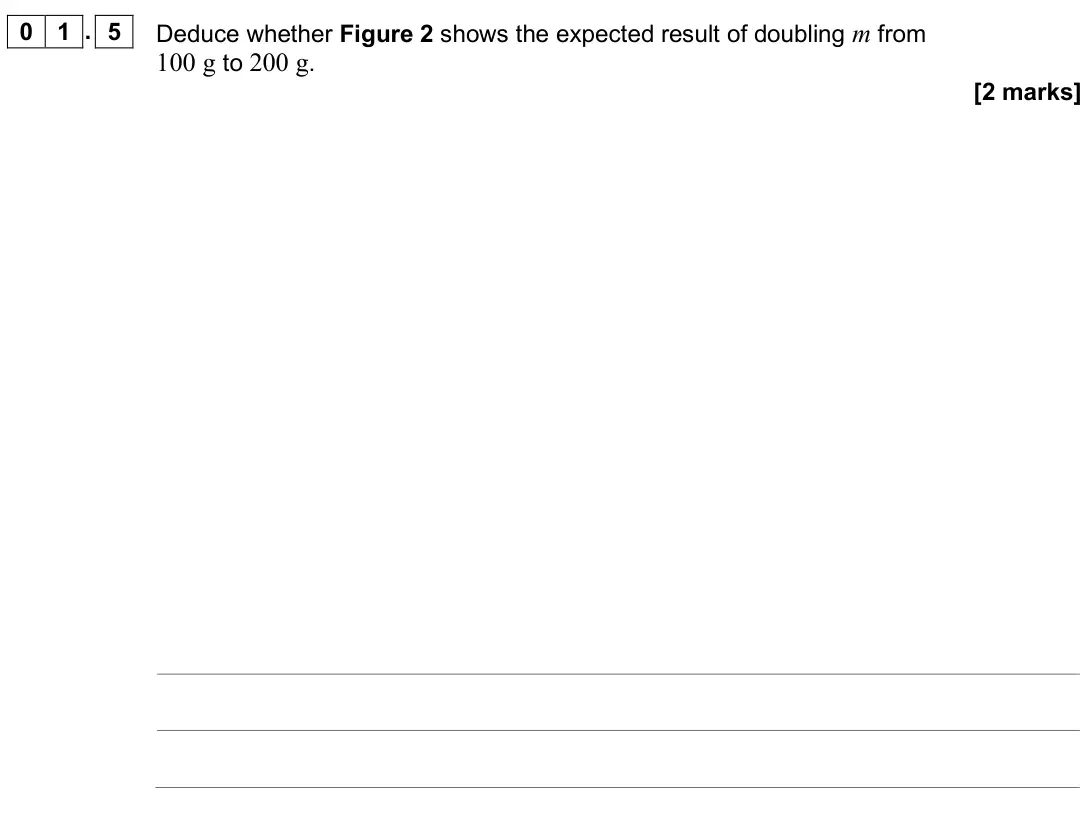
Q07.1
The whole paper ↗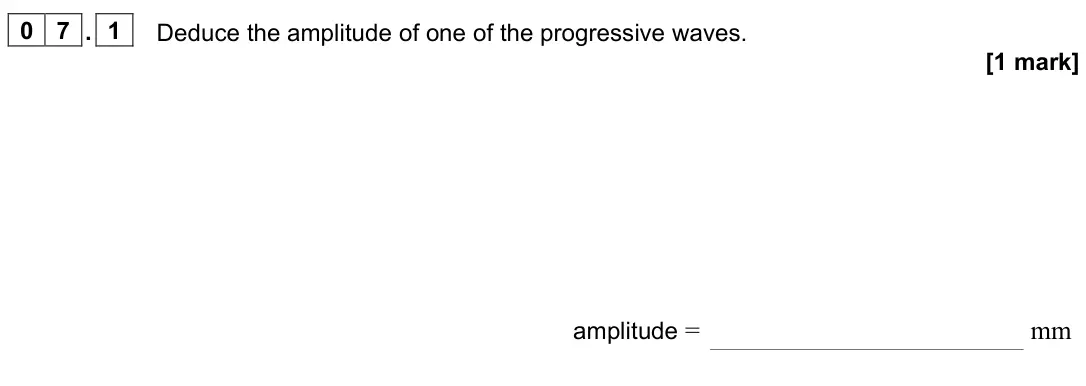
Q07.2
The whole paper ↗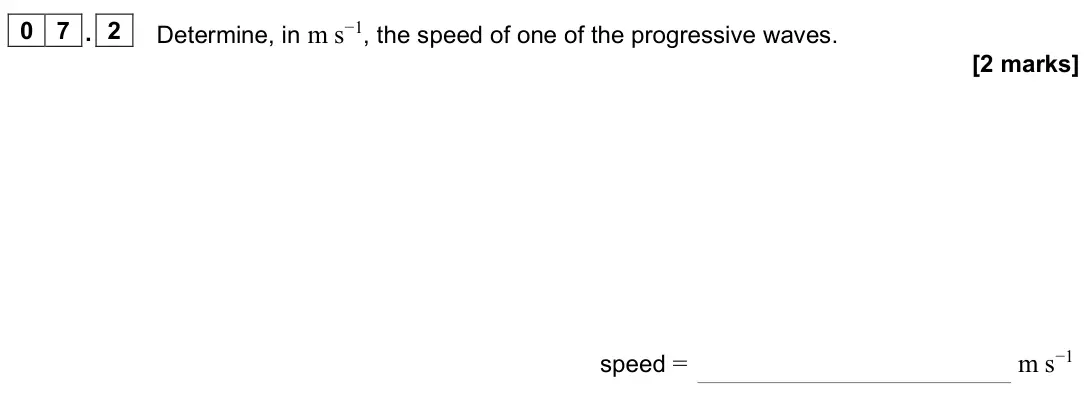
Q07.3
The whole paper ↗
Q07.4
The whole paper ↗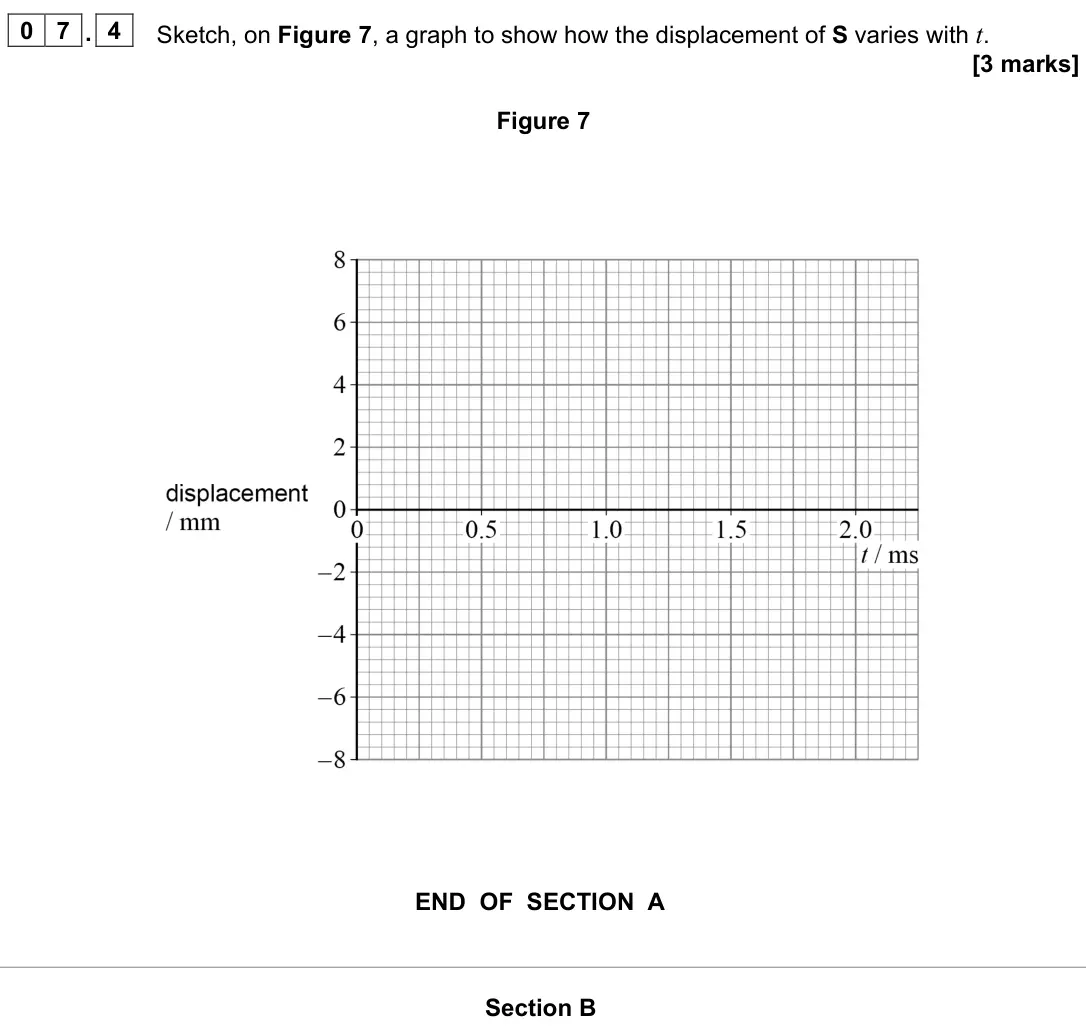
All 124 questions on Progressive and stationary waves, as a list
- June 2025, Paper 1, Q02.1 (2 marks): State what is meant by a transverse wave. [2 marks]
- June 2025, Paper 1, Q02.2 (1 mark): Explain how a stationary wave is produced on the wire. [1 mark]
- June 2025, Paper 1, Q02.3 (2 marks): Figure 3 shows a small section of the wire at one instant. Five points on the wire are labelled P1 to P5. The dashed line represents the position of the wire wh
- June 2025, Paper 1, Q02.4 (5 marks): A student investigates stationary waves on a wire using the apparatus in Figure 2. The investigation requires the student to produce the first five harmonics on
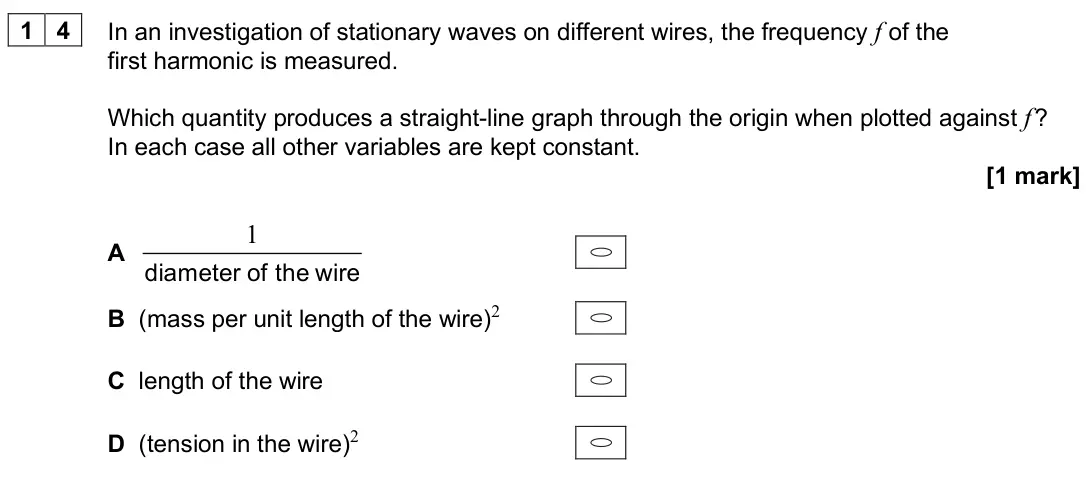
- June 2025, Paper 1, Q14 (1 mark): In an investigation of stationary waves on different wires, the frequency f of the first harmonic is measured. Which quantity produces a straight-line graph thr
- June 2025, Paper 3A, Q01.1 (2 marks): Identify two control variables for the arrangement shown in Figure 1. You may annotate Figure 1 as part of your answer. [2 marks] 1 2
- June 2025, Paper 3A, Q01.2 (1 mark): The total mass m is made from a mass hanger and up to three slotted masses. One 20 g, one 50 g and one 100 g slotted mass are provided. The hanger has a mass of
- June 2025, Paper 3A, Q01.4 (1 mark): Determine the period of the waveform on Figure 2 when m = 100 g. [1 mark] period = ms
- June 2025, Paper 3A, Q01.5 (2 marks): Deduce whether Figure 2 shows the expected result of doubling m from 100 g to 200 g. [2 marks]
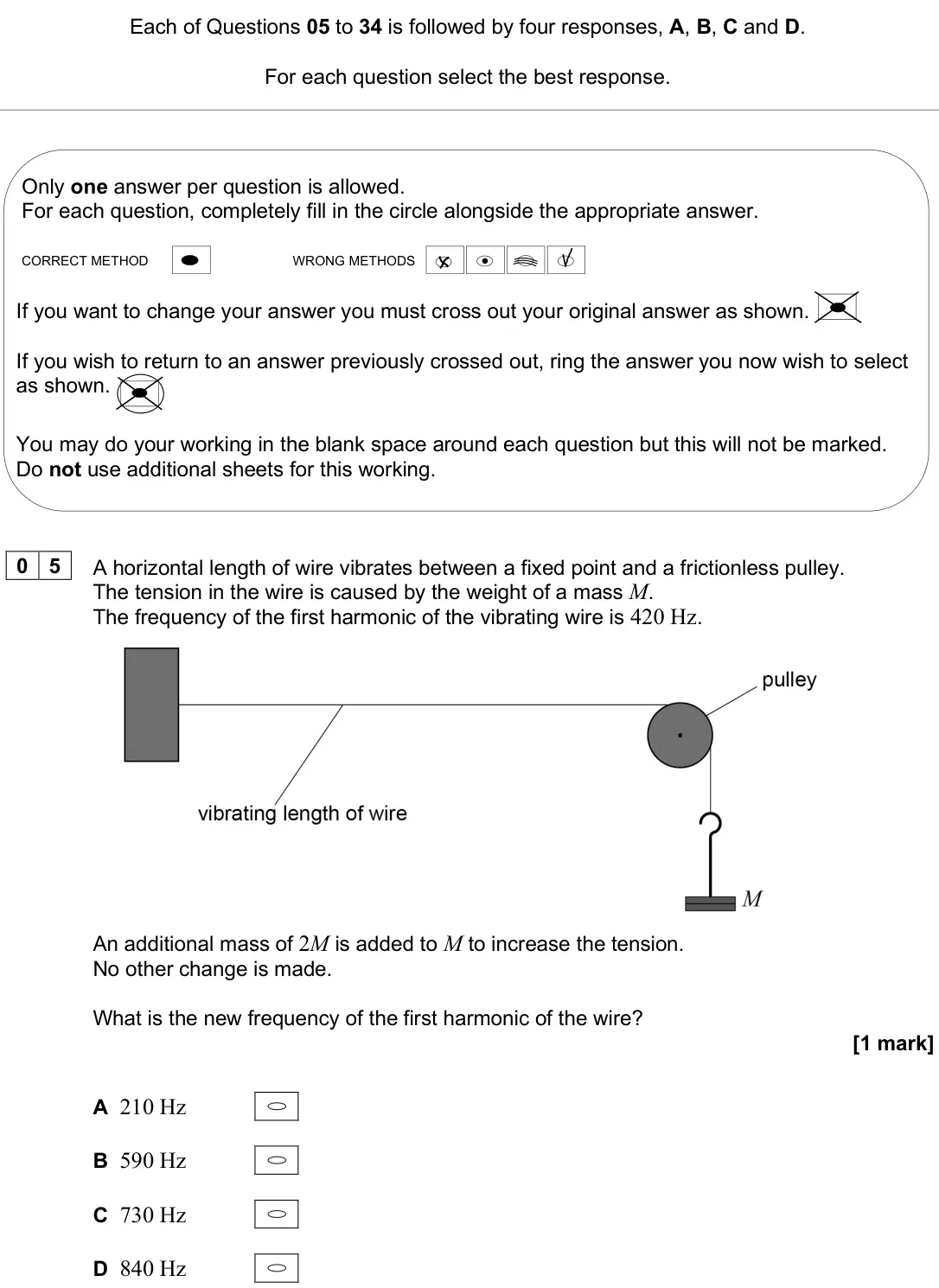
- June 2025, AS Paper 2, Q05 (1 mark): [multiple choice] A horizontal length of wire vibrates between a fixed point and a frictionless pulley. The tension in the wire is caused by the weight of a mas
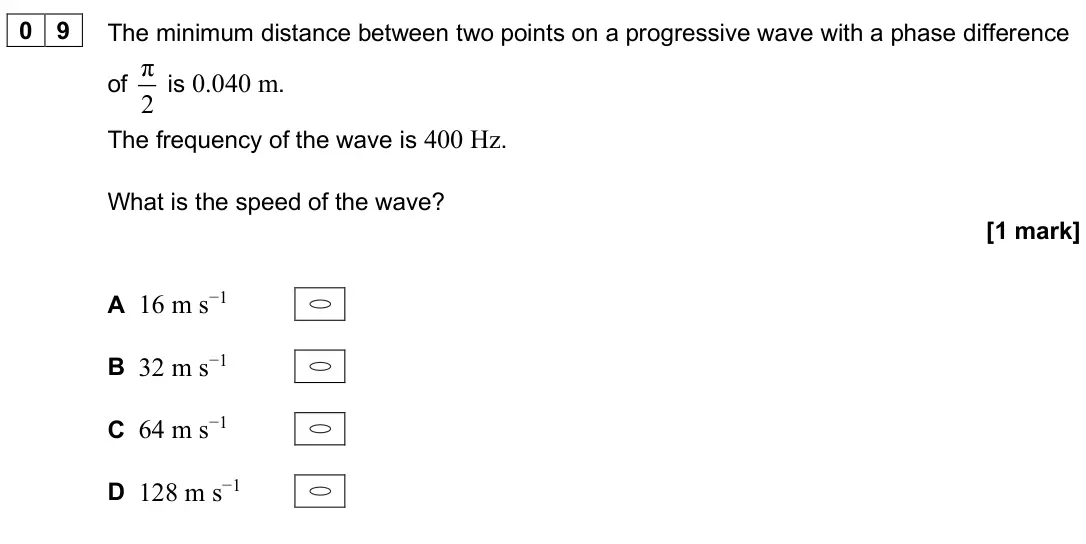
- June 2025, AS Paper 2, Q09 (1 mark): The minimum distance between two points on a progressive wave with a phase difference of π 2 is 0.040 m. The frequency of the wave is 400 Hz. What is the speed
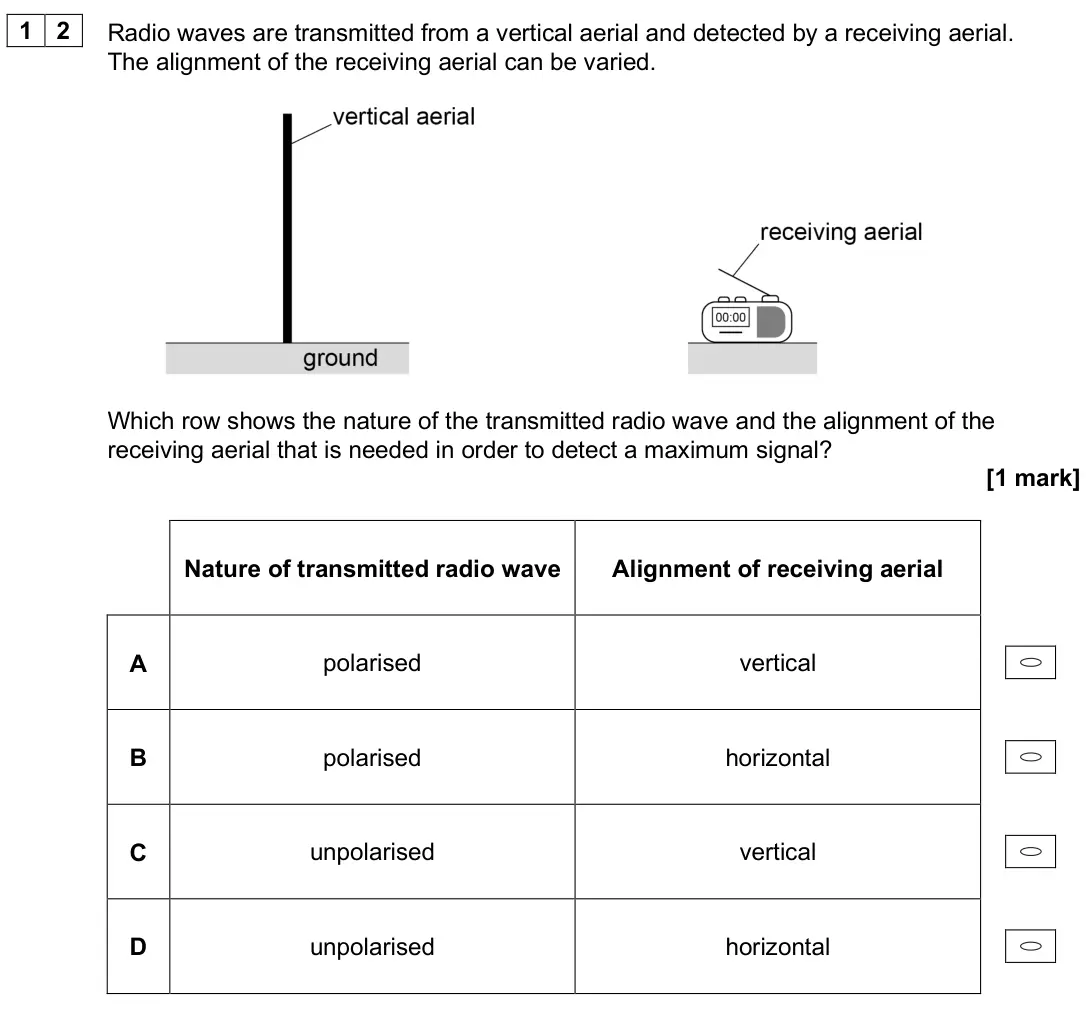
- June 2025, AS Paper 2, Q12 (1 mark): Radio waves are transmitted from a vertical aerial and detected by a receiving aerial. The alignment of the receiving aerial can be varied. Which row shows the
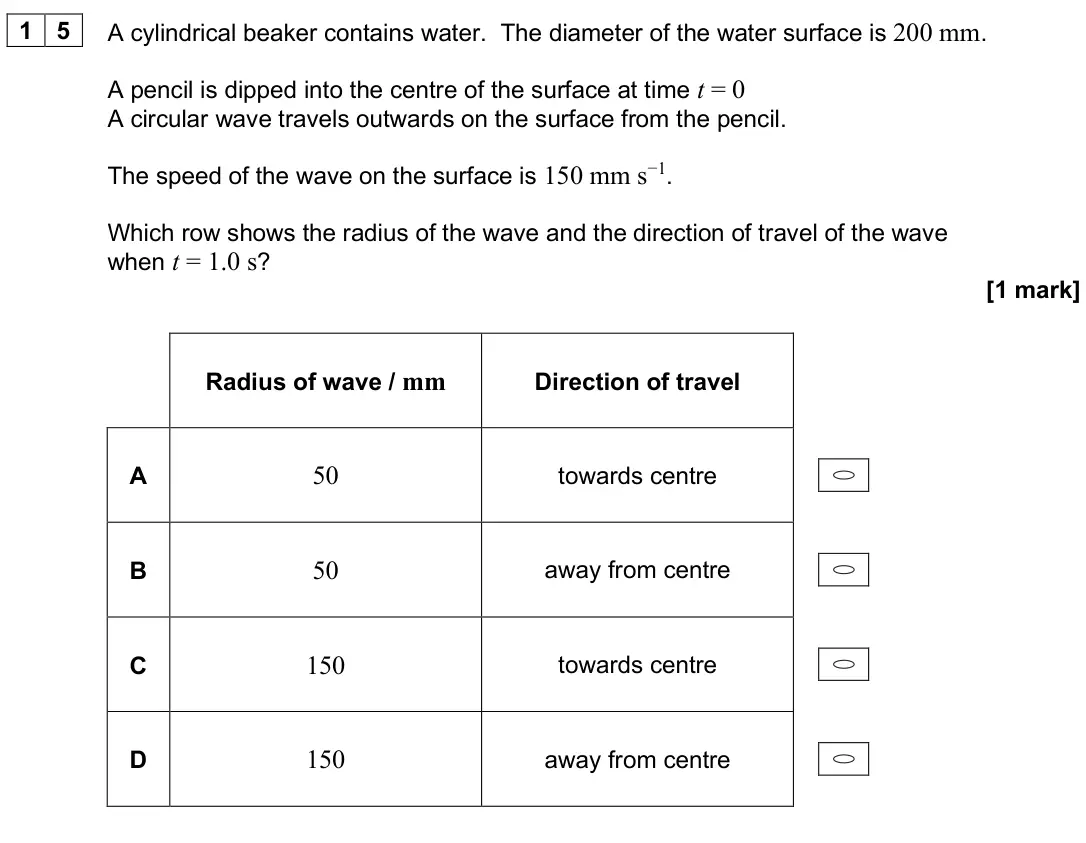
- June 2025, AS Paper 2, Q15 (1 mark): A cylindrical beaker contains water. The diameter of the water surface is 200 mm. A pencil is dipped into the centre of the surface at time t = 0 A circular wav
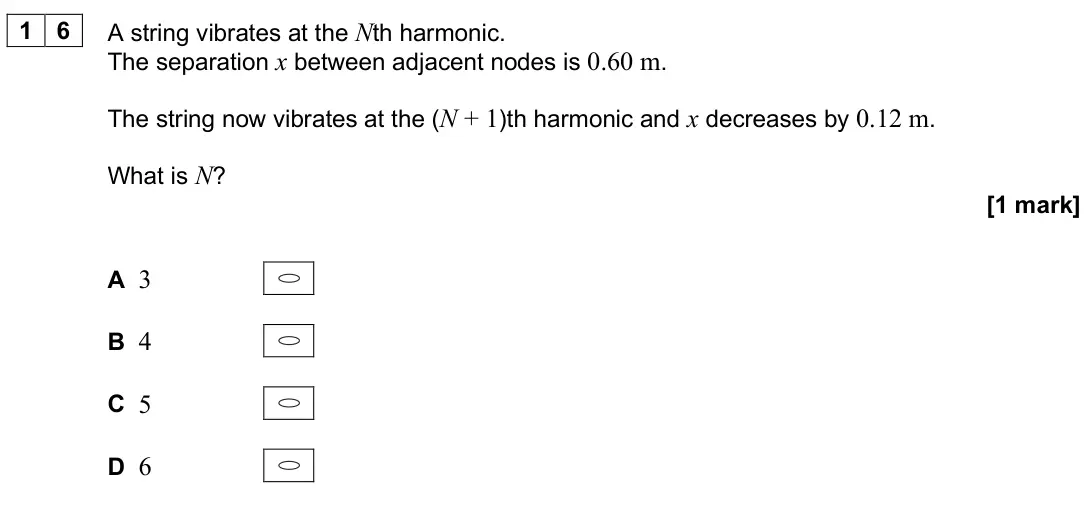
- June 2025, AS Paper 2, Q16 (1 mark): A string vibrates at the Nth harmonic. The separation x between adjacent nodes is 0.60 m. The string now vibrates at the (N + 1)th harmonic and x decreases by 0
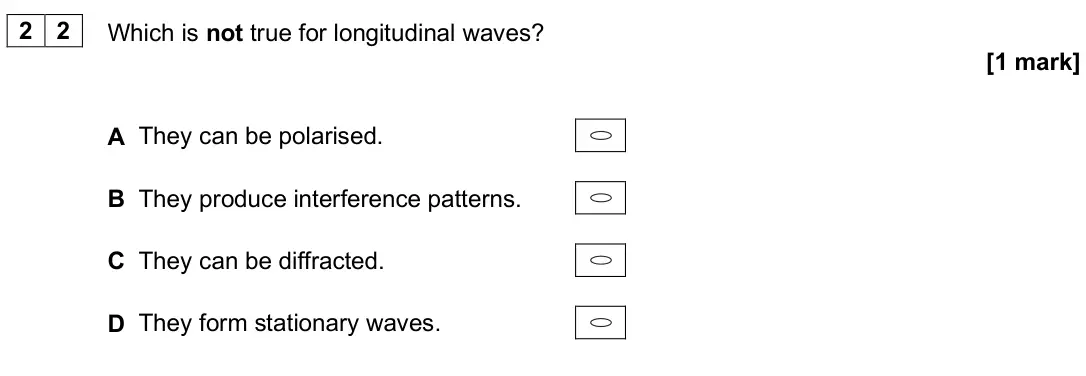
- June 2025, AS Paper 2, Q22 (1 mark): Which is not true for longitudinal waves? [1 mark] A They can be polarised. B They produce interference patterns. C They can be diffracted. D They form stationa
- June 2024, Paper 1, Q07.1 (1 mark): Deduce the amplitude of one of the progressive waves. [1 mark] amplitude = mm
- June 2024, Paper 1, Q07.2 (2 marks): Determine, in m s−1, the speed of one of the progressive waves. [2 marks] speed = m s−1
- June 2024, Paper 1, Q07.3 (1 mark): State the phase relationship between the two waves when t = 0 [1 mark]
- June 2024, Paper 1, Q07.4 (3 marks): Sketch, on Figure 7, a graph to show how the displacement of S varies with t. [3 marks] Figure 7 END OF SECTION A Section B
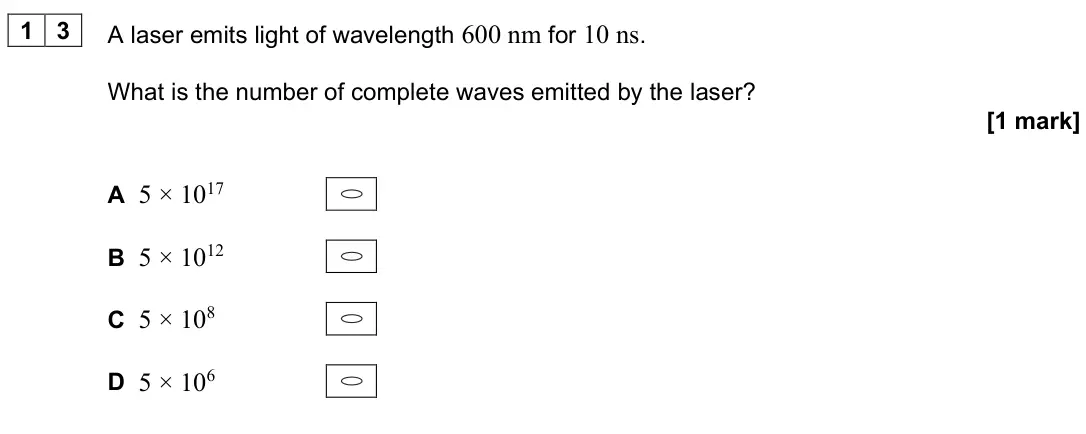
- June 2024, Paper 1, Q13 (1 mark): A laser emits light of wavelength 600 nm for 10 ns. What is the number of complete waves emitted by the laser? [1 mark] A 5 × 10¹⁷ B 5 × 10¹² C 5 × 10⁸ D 5 × 10
- June 2024, Paper 1, Q14 (1 mark): A detector measures the intensity of light from a source S1. Polaroid material is placed between source S1 and the detector. When the material is rotated throug
- June 2024, Paper 1, Q15 (1 mark): A loudspeaker producing a single-frequency sound is mounted above a tube filled with water. A tap at the bottom of the tube is opened to allow the water to run
- June 2024, AS Paper 1, Q03.1 (2 marks): The frequency of the first harmonic is 147 Hz. Calculate the speed of the wave travelling in the string. [2 marks] speed of wave = m s−1
- June 2024, AS Paper 1, Q03.2 (3 marks): The tension in the string is 71 N. Calculate the mass of the string between X and Y. [3 marks] mass = kg
- June 2024, AS Paper 1, Q03.3 (3 marks): Draw, on Figure 5, the stationary wave that produces the harmonic f3. Label the positions of all nodes N and all antinodes A. [3 marks] Figure 5
- June 2024, AS Paper 1, Q03.4 (3 marks): The string is vibrating freely. The player then touches the string lightly at its midpoint Z as shown in Figure 6. This prevents the string from vibrating at Z.
- June 2024, AS Paper 2, Q30 (1 mark): A stationary wave is formed due to superposition between a progressive wave and its reflection. Both the progressive wave and its reflection are polarised. Whic
- June 2024, AS Paper 2, Q32 (1 mark): Which row is correct for both a progressive wave and a stationary wave? [1 mark] Progressive wave Stationary wave A Some of the particles do not vibrate. All th
- June 2023, Paper 1, Q14 (1 mark): A string with a length of 1.2 m vibrates at its second harmonic. The diagram shows the displacement–time graph for a point on the string. What are the wavelengt
- June 2023, Paper 1, Q15 (1 mark): A standing wave is created on a string. Which statement about the two waves that create the standing wave is not correct? [1 mark] A They have the same frequenc
- June 2023, Paper 3A, Q01.1 (1 mark): What is the maximum duty cycle of the stroboscope? Tick () one box. [1 mark] 6.0 × 10⁻⁵ 3.0 × 10⁻⁴ 9.0 × 10⁻³ 4.5 × 10⁻²
- June 2023, AS Paper 1, Q02.2 (2 marks): Calculate the resultant of the waves at time P in Figure 3. [2 marks] resultant =
- June 2023, AS Paper 1, Q02.3 (3 marks): The phase difference between A and B shown in Figure 3 is 137°. Show that the time interval labelled t in Figure 3 is approximately 8 × 10⁻¹⁶ s. [3 marks]
- June 2023, AS Paper 1, Q03 (6 marks): A student sits near a lake on a sunny day. Some sunlight is reflected from the surface of the lake. Sunlight is also reflected from objects submerged beneath th
- June 2023, AS Paper 2, Q01.4 (2 marks): The wires used in the experiment are made of the same metal so that ρ is a control variable. State two other control variables in the experiment. [2 marks] 1 2
- June 2023, AS Paper 2, Q01.5 (2 marks): The student suggests that 1 f d ∝ . Deduce, using data points from Figure 3, whether this suggestion is correct. [2 marks]
- June 2023, AS Paper 2, Q01.6 (2 marks): Another student repeats the experiment with the mass of M doubled. Explain how this student’s plotted data compare with Figure 3. [2 marks]
- June 2023, AS Paper 2, Q07 (1 mark): Powder is spread along the inside of an air-filled pipe that is closed at one end. A loudspeaker is placed at the other end. At certain sound frequencies a stat
- June 2023, AS Paper 2, Q17 (1 mark): Two aerials A1 and A2 receive radio waves from the same distant transmitter T. The waves have a frequency of 88 MHz. The phase difference between the waves rece
- June 2023, AS Paper 2, Q24 (1 mark): A stationary wave of wavelength λ is produced on a string. What are the phase difference and the distance between adjacent antinodes? [1 mark] Phase difference
- June 2022, Paper 1, Q18 (1 mark): A longitudinal wave of frequency 660 Hz travels through a medium. The wave speed is 330 m s−1. Which statement describes the motion of a particle in the wave? [
- June 2022, Paper 1, Q19 (1 mark): The frequency of the first harmonic of a standing wave on a string is f. The tension in the string is T. The tension is increased to 4T without changing the len
- June 2022, Paper 3A, Q01.1 (1 mark): Which control on the oscilloscope should be used to centre the trace vertically on the screen? Tick () one box. [1 mark] X-shift Y-gain Y-shift
- June 2022, Paper 3A, Q01.2 (3 marks): The distance between L and R in Figure 1 is 0.870 m. Deduce the speed of sound in the steel rod. [3 marks] speed of sound = m s−1
- June 2022, Paper 3A, Q01.3 (4 marks): A student repeats the experiment using a steel rod of twice the length. Explain: • how using the longer rod affects the waveform displayed • any changes needed
- June 2022, AS Paper 1, Q03.1 (2 marks): The frequency of the infrared radiation is 3.8 × 10¹⁴ Hz. Each pulse has a duration of 6.0 ns. Calculate the number of cycles in each pulse. [2 marks] number of
- June 2022, AS Paper 2, Q03.2 (2 marks): A mobile phone transmits data to the loudspeaker using microwaves. The data are processed at the loudspeaker to produce sound waves. Microwaves and sound waves
- June 2022, AS Paper 2, Q11 (1 mark): A narrow beam of light is incident on a sheet of Polaroid material. The intensity of the transmitted beam is a maximum. The Polaroid sheet is rotated about the
- June 2022, AS Paper 2, Q15 (1 mark): Two points P and Q on a progressive wave are separated by distance d. The phase difference between P and Q is θ rad. What is the wavelength? [1 mark] A 2 d π B
- June 2022, AS Paper 2, Q16 (1 mark): A long spring is used to demonstrate wave motion. The spring lies horizontally on a table. One end of the spring is attached to a wall. The free end of the spri
- June 2022, AS Paper 2, Q17 (1 mark): A stretched wire vibrates between two fixed points. The frequency of the first harmonic of the vibrating wire is 300 Hz. Without making any other change, the te
- June 2022, AS Paper 2, Q18 (1 mark): A stationary wave forms on a uniform string. Which statement is correct? [1 mark] A The amplitude of oscillations is a maximum at the nodes. B The distance betw
- November 2021, Paper 1, Q02.1 (3 marks): Explain how the apparatus can be used to demonstrate that the waves from T are vertically polarised. [3 marks]
- November 2021, Paper 1, Q02.2 (4 marks): Explain what happens to the signal detected by R as M is moved slowly towards X. [4 marks]
- November 2021, Paper 1, Q17 (1 mark): The diagrams show the displacement–distance graph for a wave and the displacement–time graph for a point in the wave. Which is correct for this wave? [1 mark] A
- November 2021, Paper 1, Q18 (1 mark): The diagram shows a stationary wave on a string at one instant in time. P, Q and R are three points on the string. Which row is correct? [1 mark] A P is in anti
- November 2021, AS Paper 2, Q01.1 (2 marks): Draw a line of best fit for these data. [2 marks]
- November 2021, AS Paper 2, Q01.2 (1 mark): State a value for the position of P. [1 mark] position of P = cm
- November 2021, AS Paper 2, Q01.3 (2 marks): The absolute uncertainty in identifying any minimum current is ± 0.2 cm. Determine the percentage uncertainty in the distance PQ. [2 marks] percentage uncertain
- November 2021, AS Paper 2, Q01.4 (3 marks): Deduce the frequency of the microwaves produced by T. [3 marks] frequency = Hz
- November 2021, AS Paper 2, Q01.5 (1 mark): Figure 4 shows D placed at a position where the current is a maximum. Figure 4 The student rotates D by 90°, without changing its distance from T, to the positi
- November 2021, AS Paper 2, Q15 (1 mark): A progressive wave travels along a rope in the direction M to N. X marks a point on the rope. The wave has a frequency of 5.0 Hz, a wavelength of 1.0 m and an a
- November 2021, AS Paper 2, Q17 (1 mark): The diagram shows a string stretched between two fixed points O and R which are 120 cm apart. P and Q are points on the string. OP = 30 cm OQ = 90 cm At a certa
- November 2020, Paper 1, Q15 (1 mark): A wave travels across the surface of water. The diagram shows how the displacement of water particles at the surface varies with distance. Which row correctly d
- November 2020, Paper 1, Q16 (1 mark): The diagram shows the cross-section of a progressive transverse wave travelling at 24 cm s−1 on water. The amplitude of the wave is 2.0 cm and the frequency is
- November 2020, Paper 1, Q17 (1 mark): Unpolarised light travels through two polarising filters X and Y and is then incident on a screen. When X and Y are arranged as shown, there is a maximum intens
- November 2020, Paper 1, Q18 (1 mark): Stationary waves are set up on a rope of length 1.0 m fixed at both ends. Which statement is not correct? [1 mark] A The first harmonic has a wavelength of 2.0
- November 2020, AS Paper 1, Q06.1 (2 marks): The string is made to vibrate at the second harmonic. Compare the motion of P with that of Q. [2 marks]
- November 2020, AS Paper 1, Q06.2 (2 marks): The frequency of the vibration generator is increased, and a higher harmonic of the stationary wave is formed. Figure 9 shows the string between P and Q at an i
- November 2020, AS Paper 1, Q06.3 (3 marks): The instantaneous position of the string in Figure 9 can be explained by the superposition of two waves. The instantaneous positions of these waves between P an
- November 2020, AS Paper 1, Q06.4 (1 mark): Figure 11 shows the positions of the two waves between P and Q a short time later. Figure 11 Draw, on Figure 12, the appearance of the string between P and Q at
- November 2020, AS Paper 1, Q06.5 (2 marks): Annotate (with an A) the positions of any antinodes on your drawing in Figure 12. [2 marks]
- November 2020, AS Paper 1, Q06.6 (3 marks): The frequency of the vibration generator is reduced until the first harmonic is observed in the string, as shown in Figure 13. Figure 13 The string in Figure 13
- November 2020, AS Paper 2, Q12 (1 mark): A wave travels along a water surface. The variation with time of the displacement of a water particle at the surface is shown. What properties of the wave are r
- November 2020, AS Paper 2, Q13 (1 mark): Two points on a progressive wave are out of phase by 0.41 rad. What is this phase difference? [1 mark] A 23° B 47° C 74° D 148°
- June 2019, Paper 1, Q06.3 (1 mark): The loudspeaker creates variations in pressure and produces a sound wave in the air around it. State the type of wave produced and describe the motion of the pa
- June 2019, Paper 3A, Q03.1 (2 marks): The output potential difference (pd) of the signal generator is displayed on the oscilloscope, as shown in Figure 16. Figure 16 The time-base setting of the osc
- June 2019, Paper 3A, Q03.2 (2 marks): A metre ruler is placed next to the bridges supporting the wire, as shown in Figure 17. Figure 17 Determine the wavelength of the stationary wave shown in Figur
- June 2019, Paper 3A, Q03.3 (1 mark): The stationary wave is formed by two waves of frequency f and wavelength travelling with speed c in opposite directions. Determine c. [1 mark] c = m s−1
- June 2019, Paper 3A, Q03.4 (2 marks): Determine, in kg m−1, the mass per unit length of the wire. [2 marks] mass per unit length = kg m−1
- June 2019, AS Paper 1, Q04.6 (2 marks): The waves caused by earthquakes can be longitudinal or transverse. Describe the difference between longitudinal waves and transverse waves. [2 marks]
- June 2019, AS Paper 2, Q15 (1 mark): A sonar transmitter on a ship produces pulses of sound waves. Each pulse of sound waves contains 12 complete oscillations. The frequency of these waves is 8.0 k
- June 2019, AS Paper 2, Q16 (1 mark): Which gives the regions of the electromagnetic spectrum in order of increasing wavelength? [1 mark] A X-rays, ultraviolet, infrared, radio waves B X-rays, micro
- June 2019, AS Paper 2, Q17 (1 mark): The frequency of the first harmonic of a wire fixed at both ends is 300 Hz. The tension in the wire is now doubled. What is the frequency of the first harmonic
- June 2018, Paper 1, Q03.1 (3 marks): Explain how a stationary wave is produced when a stretched string is plucked. [3 marks]
- June 2018, Paper 1, Q03.2 (2 marks): The vibrating length of one of the strings of a violin is 0.33 m When the tension in the string is 25 N, the string vibrates with a first-harmonic frequency of
- June 2018, Paper 1, Q03.3 (1 mark): Determine the speed at which waves travel along the string in question 03.2 when it vibrates with a first-harmonic frequency of 370 Hz [1 mark] speed of waves =
- June 2018, Paper 1, Q03.4 (4 marks): Figure 6 shows how the tension in the string in question 03.2 varies with the extension of the string. Figure 6 The string with its initial tension of 25 N is v
- June 2018, Paper 3 Turning points, Q02.1 (3 marks): Sketch a graph on Figure 4 to show how the amplitude detected by the dipole receiver varies with angle of rotation as the receiver is turned through 360° Start
- June 2018, AS Paper 2, Q17 (1 mark): The fundamental frequency f is the lowest frequency heard when a stretched string is vibrating. The string is now lightly touched one third of the way along its
- June 2018, AS Paper 2, Q19 (1 mark): Two points on a progressive wave have a phase difference of rad The speed of the wave is 340 m s−1 What is the frequency of the wave when the minimum distance b
- June 2017, Paper 1, Q02.1 (2 marks): Show that the data in Table 1 are consistent with the relationship f ∝ √T where T is the tension in the nylon string. [2 marks]
- June 2017, Paper 1, Q02.2 (3 marks): The nylon string used has a density of 1150 kg m–3 and a uniform diameter of 5.0 × 10⁻⁴ m. Determine the length l of the string used. [3 marks] l = m
- June 2017, Paper 1, Q02.3 (2 marks): The student uses the relationship in question 02.1 to predict frequencies for tensions that are much larger than those used in the original experiment. Explain
- June 2017, Paper 1, Q13 (1 mark): The graph shows how the vertical height of a travelling wave varies with distance along the path of the wave. The speed of the wave is 20 cm s–1. What is the pe
- June 2017, Paper 1, Q14 (1 mark): Which statement is not correct for ultrasound and X-rays? [1 mark] A Both can be refracted B Both can be diffracted C Both can be polarised D Both can be reflec
- June 2017, Paper 1, Q15 (1 mark): A stationary wave is set up on a stretched string of length l and diameter d. Another stationary wave is also set up on a second string made from the same mater
- June 2017, Paper 3A, Q02.1 (1 mark): Determine the peak-to-peak voltage V of the waveform shown in Figure 8. [1 mark] V = V
- June 2017, Paper 3A, Q02.2 (2 marks): Determine the frequency f of the waveform shown in Figure 8. [2 marks] f = Hz Figure 7 Figure 8
- June 2017, AS Paper 1, Q04.4 (3 marks): The vertical aerial is placed at position B and is rotated slowly through 90° until it lies along the direction AE. State and explain the effect on the signal s
- June 2017, AS Paper 1, Q05.3 (4 marks): When wind blows, stationary waves can be formed on the aerial wire. Explain how stationary waves are produced and why only waves of specific frequencies can for
- June 2017, AS Paper 1, Q05.5 (2 marks): Calculate the frequency of the wave when the third harmonic is formed on the aerial wire. [2 marks] frequency = Hz
- June 2017, AS Paper 1, Q05.6 (1 mark): Sketch, on Figure 7, the standing wave on the wire when the third harmonic is formed. [1 mark] Figure 7
- June 2017, AS Paper 2, Q03.1 (3 marks): Show that the wavelength of the light is 600 nm. [3 marks]
- June 2017, AS Paper 2, Q03.2 (2 marks): Determine the phase difference, in rad, between the incident and reflected waves shown in Figure 9. [2 marks] phase difference = rad
- June 2017, AS Paper 2, Q10 (1 mark): Which row correctly shows electromagnetic radiations in order of decreasing wavelength? [1 mark] A gamma > ultraviolet > microwave B ultraviolet > gamma > micro
- June 2017, AS Paper 2, Q11 (1 mark): Which statement is correct about the properties of an unpolarised electromagnetic wave as it passes through a polariser? [1 mark] A The wave remains unchanged.
- June 2017, AS Paper 2, Q14 (1 mark): A uniform wire, fixed at both ends, is plucked in the middle so that it vibrates at the first harmonic as shown. What is the phase difference between the oscill
- June 2016, AS Paper 1, Q02.1 (2 marks): Suggest how stationary waves are formed in the microwave oven. [2 marks]
- June 2016, AS Paper 1, Q02.2 (2 marks): The student removes the turntable and places a bar of chocolate on the floor of the oven. He then switches the oven on for about one minute. When the chocolate
- June 2016, AS Paper 1, Q02.3 (5 marks): Calculate, by making suitable measurements on Figure 4, the frequency of the microwaves used by the oven. [5 marks] frequency = ____________________ Hz
- June 2016, AS Paper 1, Q02.4 (1 mark): Explain why most microwave ovens contain a rotating turntable on which the food is placed during cooking. [1 mark]
- June 2016, AS Paper 2, Q12 (1 mark): What is the phase difference between two points 0.16 m apart on a progressive sound wave of frequency 256 Hz? [1 mark] speed of sound = 330 m s–1 A π 8 B π 6 C
- June 2016, AS Paper 2, Q13 (1 mark): The frequency of the first harmonic of a standing wave on a wire is 𝑓. The length of the wire and tension in the wire are both doubled. What is the frequency of
- Specimen, Paper 1, Q06.2 (1 mark): Read through the following passage and answer the questions that follow it. Measuring the speed of sound in air 5 10 After the wave nature of sound had been ide
- Specimen, Paper 1, Q06.3 (1 mark): Read through the following passage and answer the questions that follow it. Measuring the speed of sound in air 5 10 After the wave nature of sound had been ide
- Specimen, Paper 1, Q06.4 (2 marks): Read through the following passage and answer the questions that follow it. Measuring the speed of sound in air 5 10 After the wave nature of sound had been ide
- Specimen, Paper 1, Q06.5 (1 mark): Read through the following passage and answer the questions that follow it. Measuring the speed of sound in air 5 10 After the wave nature of sound had been ide
- Specimen, Paper 1, Q06.6 (2 marks): Read through the following passage and answer the questions that follow it. Measuring the speed of sound in air 5 10 After the wave nature of sound had been ide
- Specimen, Paper 1, Q06.7 (2 marks): END OF SECTION A Section B Each of Questions 7 to 31 is followed by four responses, A, B, C, and D. For each question select the best response.
- Specimen, Paper 1, Q08 (1 mark): When comparing X-rays with UV radiation, which statement is correct? [1 mark] A X-rays have a lower frequency. B X-rays travel faster in a vacuum. C X-rays do n
- Specimen, Paper 1, Q12 (1 mark): The diagram shows two pulses on a string travelling towards each other. Which of the following diagrams shows the shape of the string when the pulses have passe
- Specimen, Paper 1, Q28 (1 mark): Which one of the following provides direct experimental evidence that light is a transverse wave motion rather than a longitudinal wave motion? [1 mark] A Two l
- Specimen, Paper 2, Q06.5 (4 marks): Section B Each of Questions 7 to 31 is followed by four responses, A, B, C, and D
Questions, mark schemes and examiner’s reports are © AQA, from their published past papers. Plumi isn’t affiliated with any exam board. Want whole papers? Every AQA A-Level Physics paper.
Rather write your answers by hand on iPad? Plumi marks them against the same mark schemes.