 plumi
Radionuclide imaging and therapy: AQA A‑Level Physics questions
Every AQA A-Level Physics exam question on 3.10.6 Radionuclide imaging and therapy, 2016–2025, with its mark scheme and examiner’s report.
Find questions2,714
Calculations
Q02.1
The whole paper ↗
Q02.2
The whole paper ↗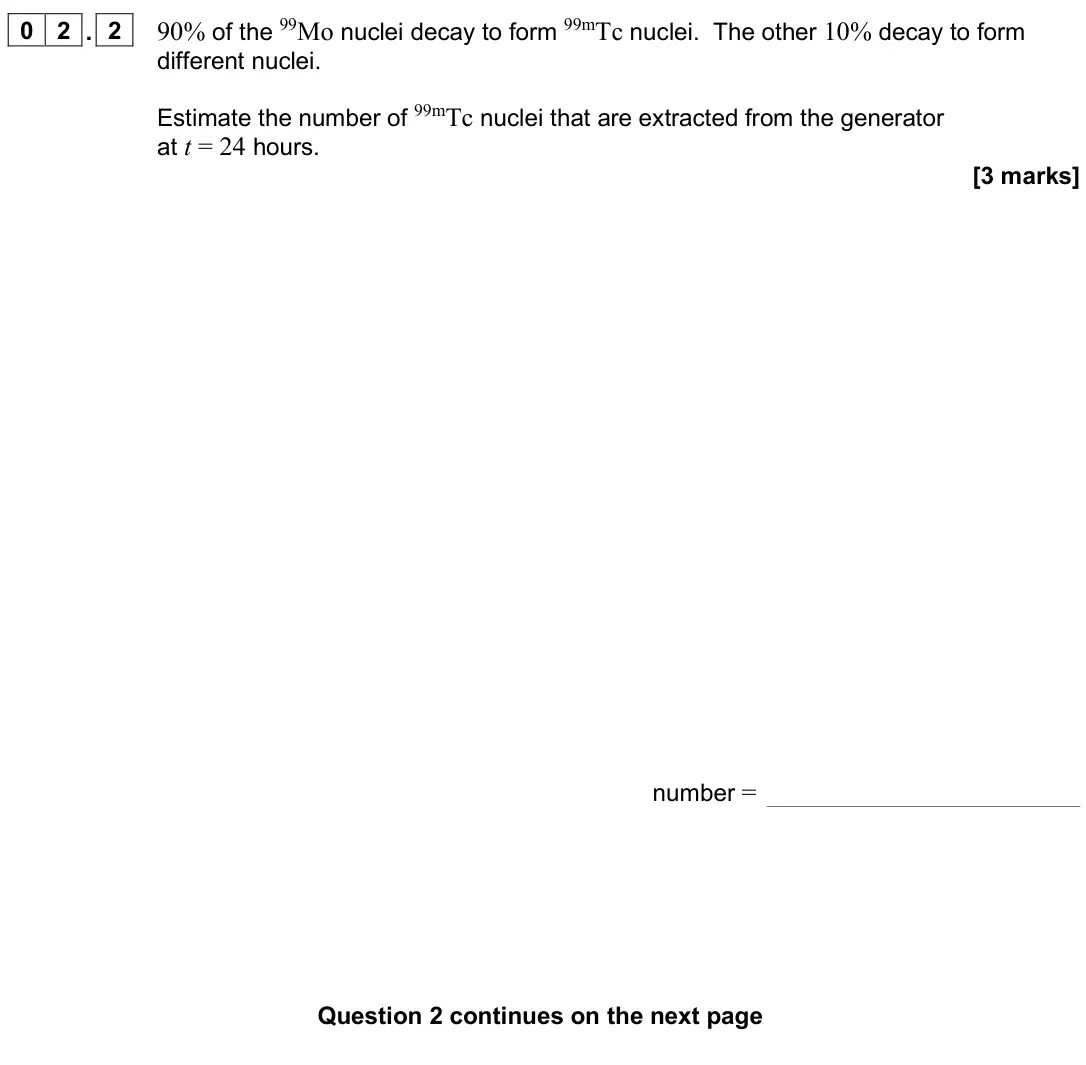
Q02.3
The whole paper ↗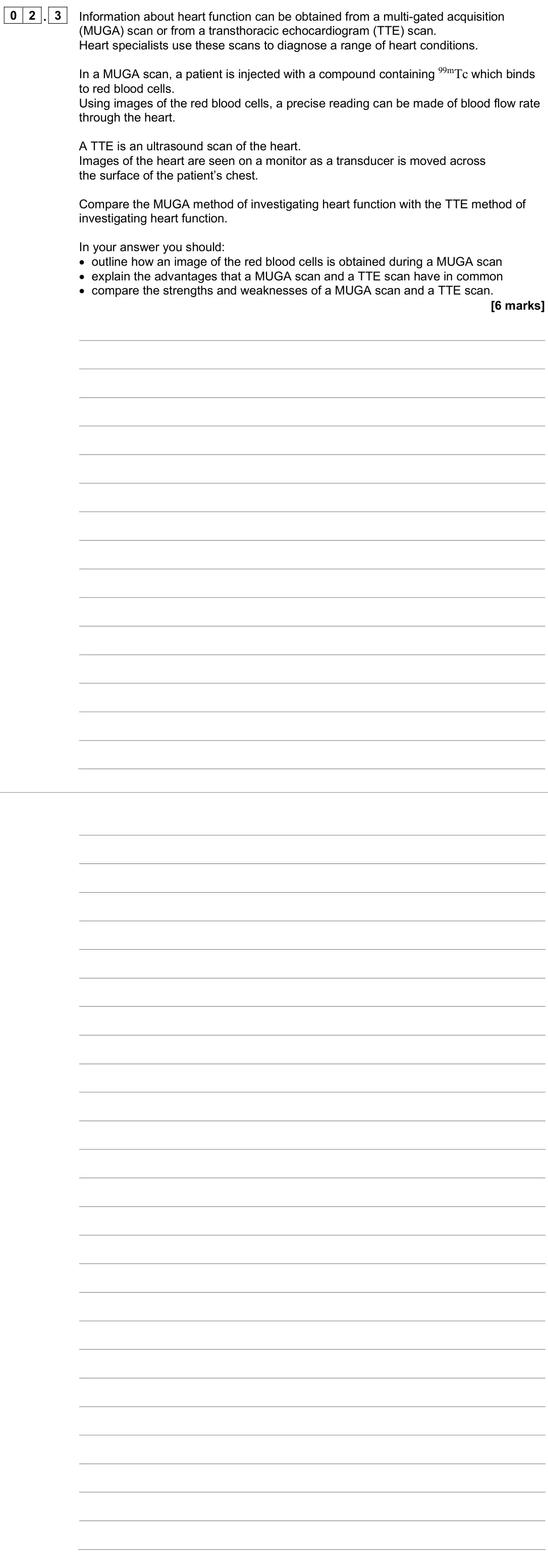
Q04.1
The whole paper ↗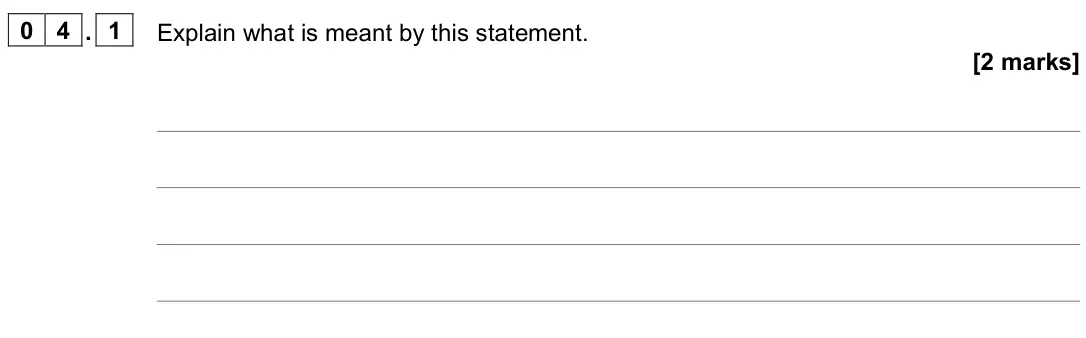
Q04.2
The whole paper ↗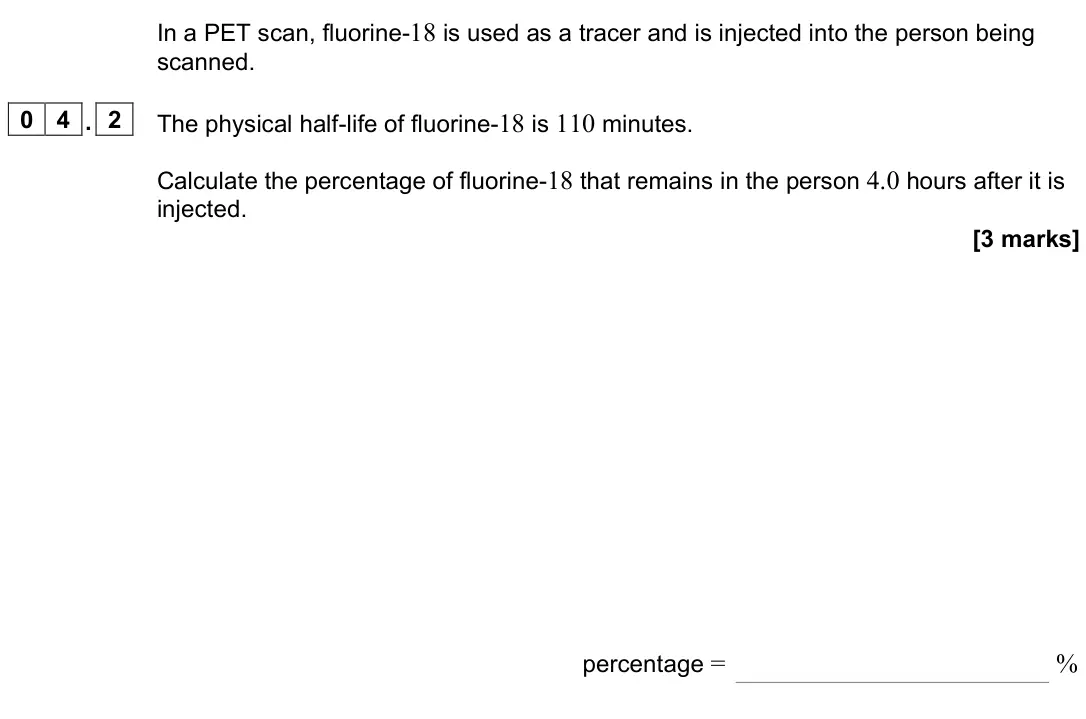
Q04.3
The whole paper ↗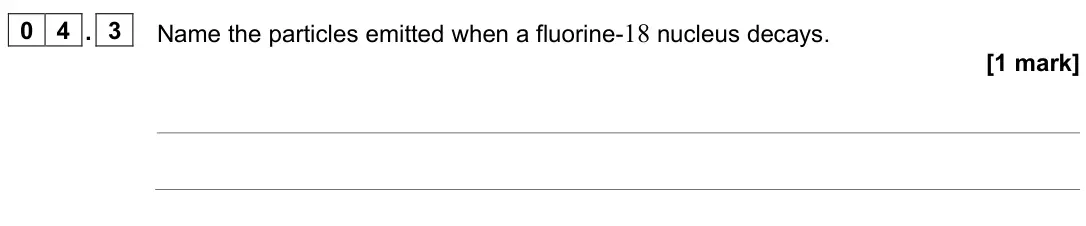
Q04.4
The whole paper ↗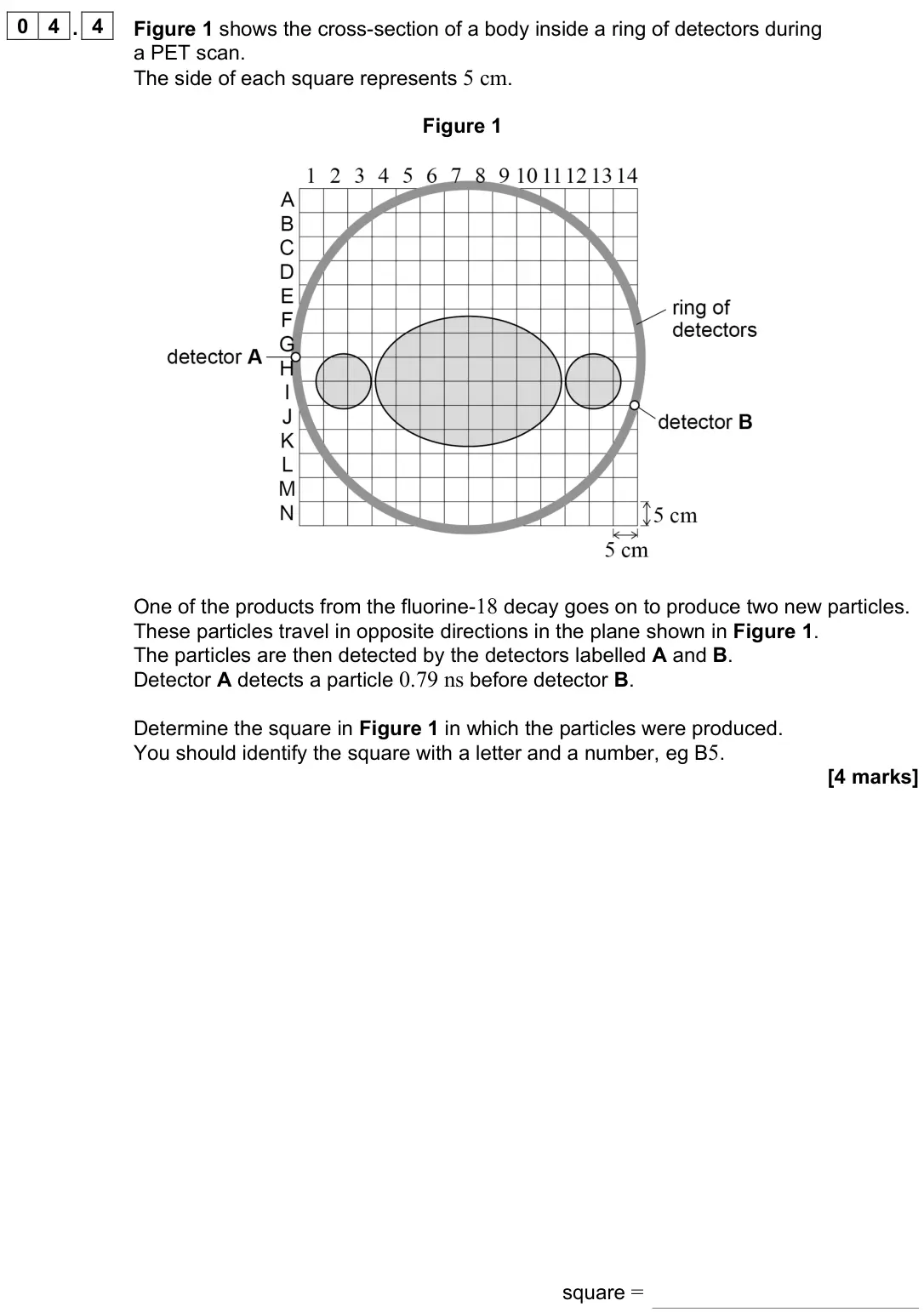
Q01.1
The whole paper ↗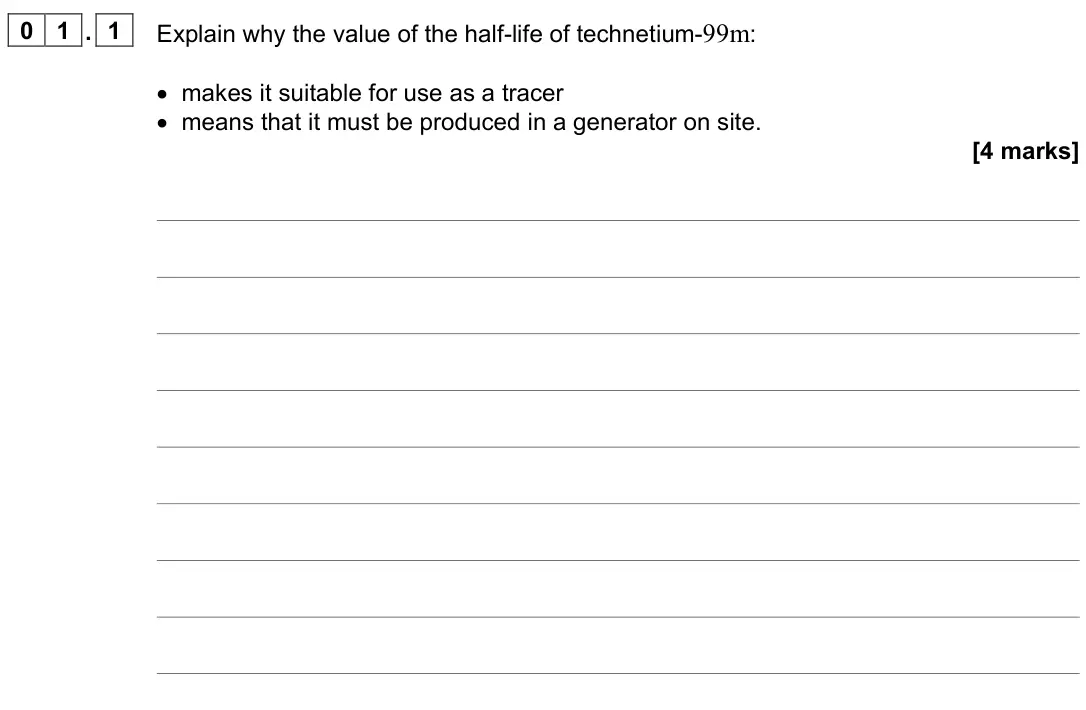
Q01.2
The whole paper ↗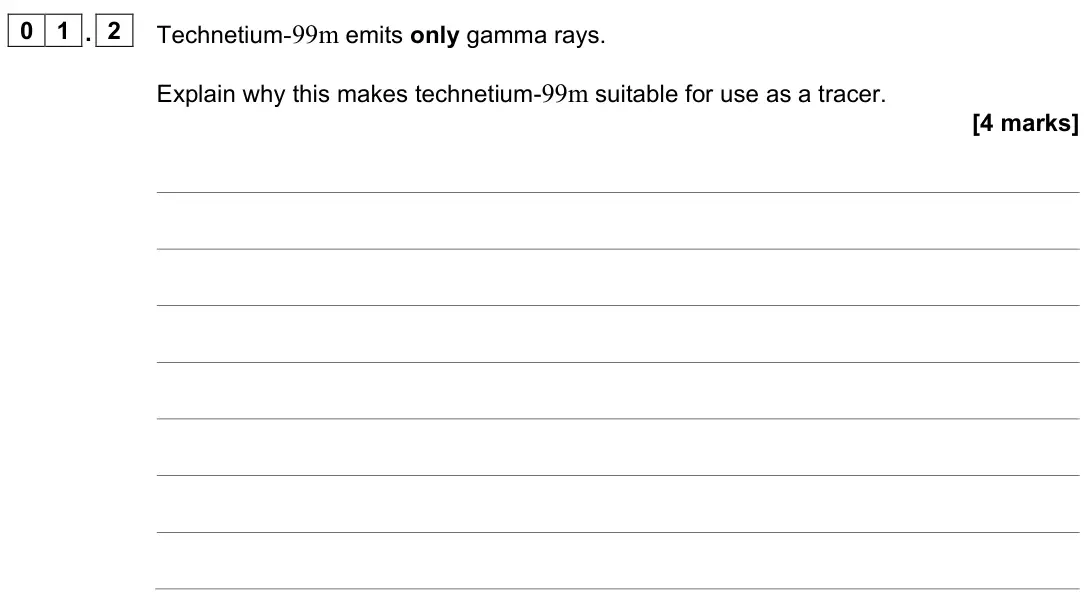
Q01.3
The whole paper ↗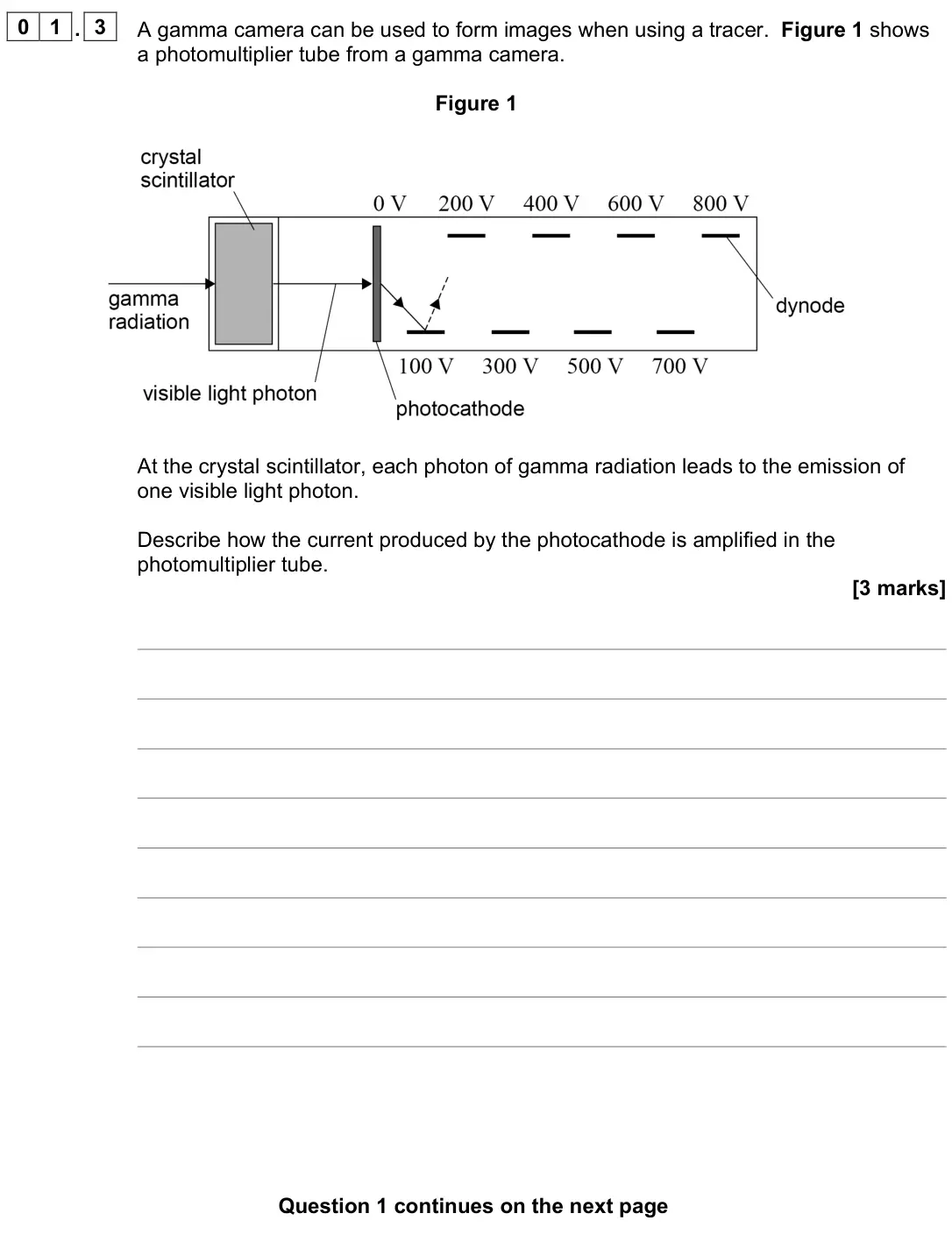
Q01.4
The whole paper ↗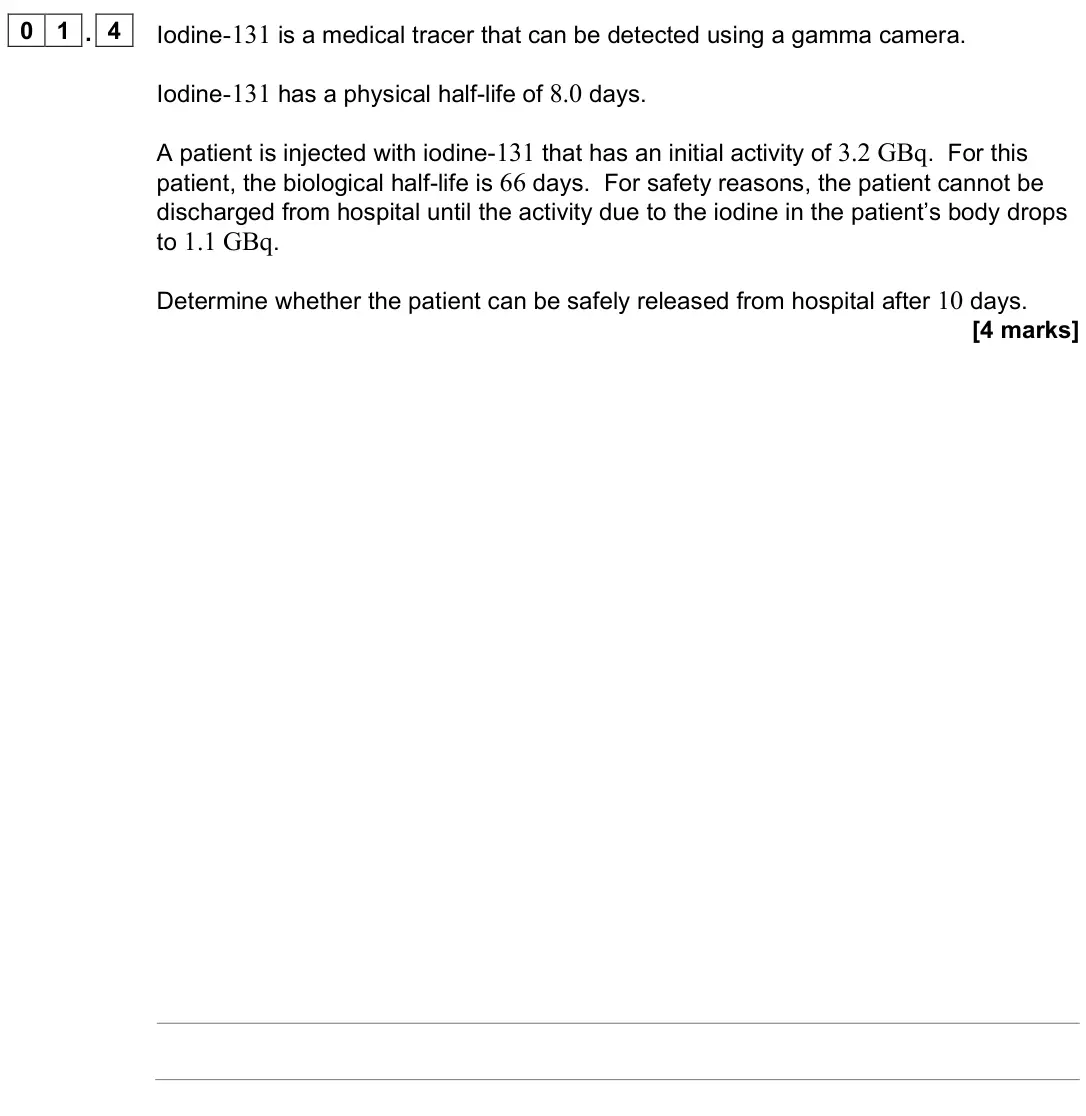
Q03.1
The whole paper ↗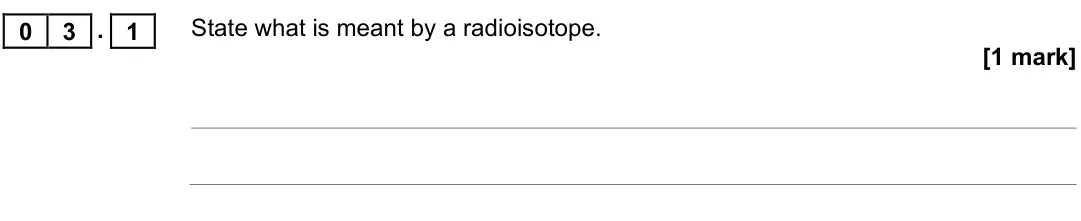
Q03.2
The whole paper ↗
Q03.3
The whole paper ↗
Q03.4
The whole paper ↗
Q03.5
The whole paper ↗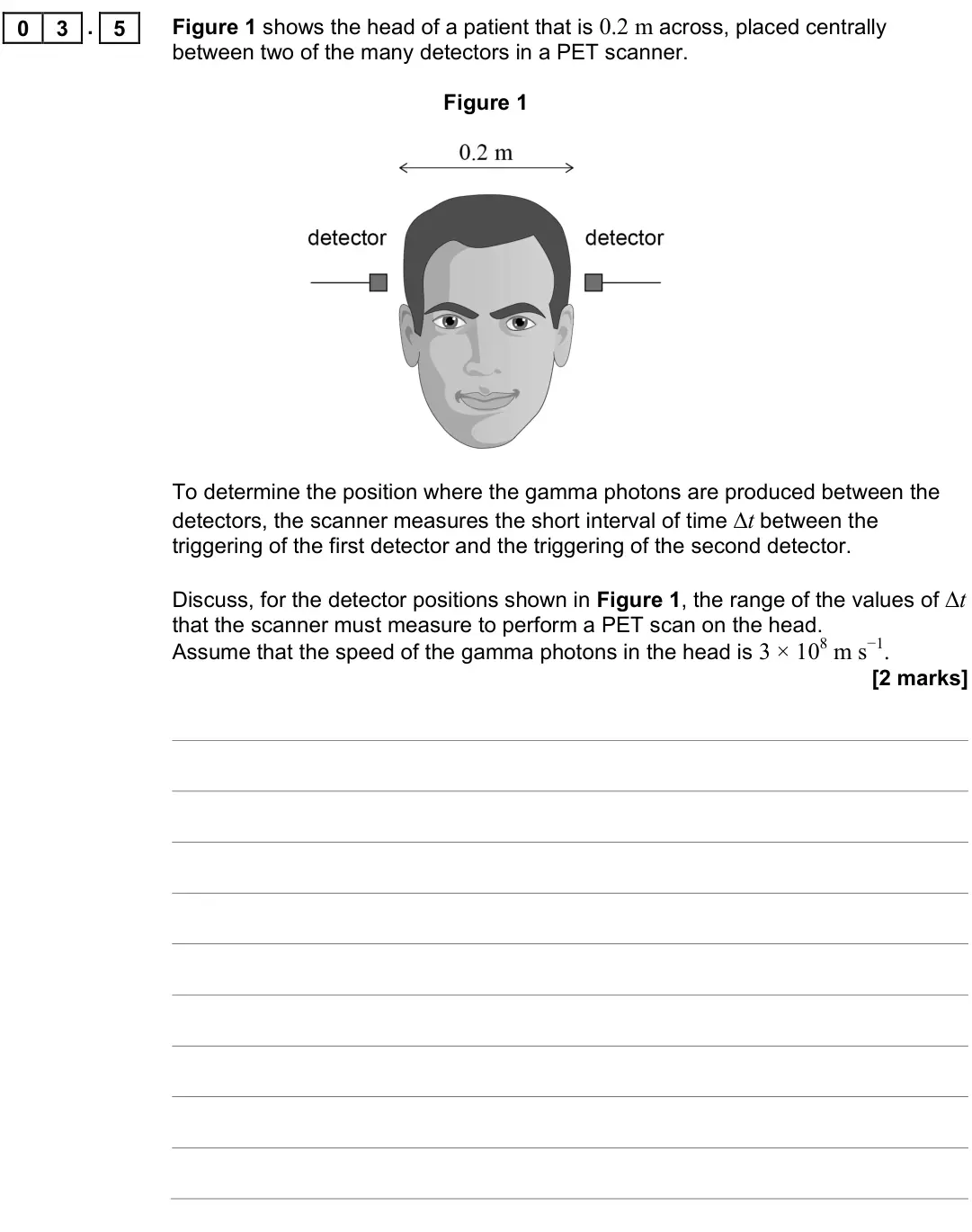
Q04.1
The whole paper ↗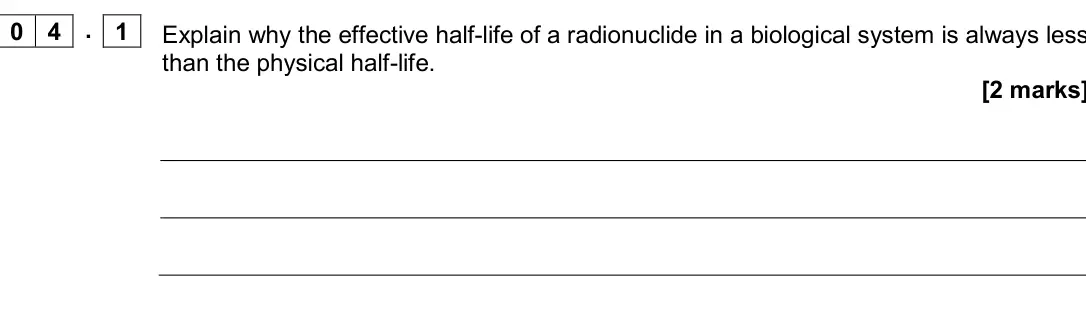
Q04.2
The whole paper ↗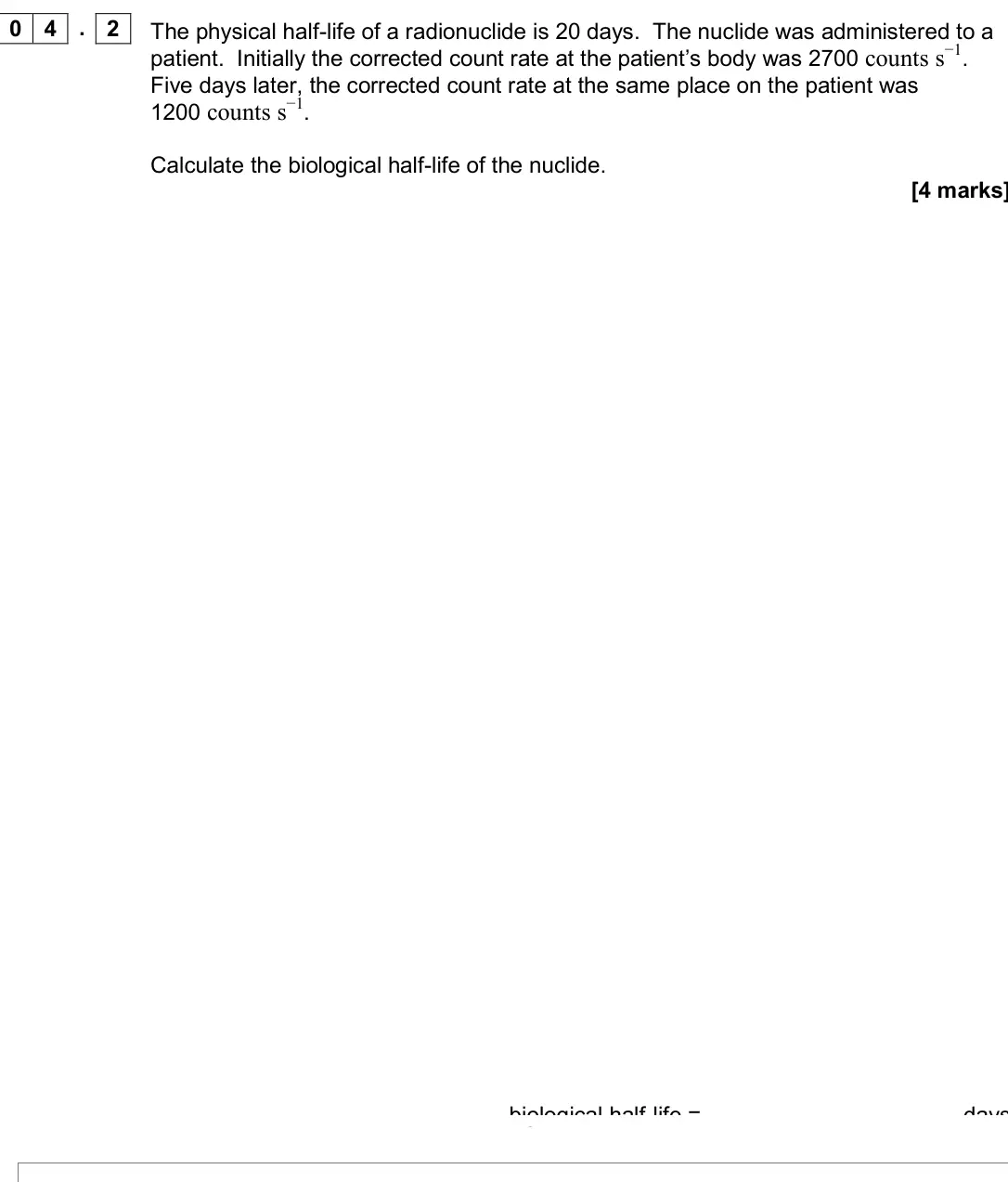
All 21 questions on Radionuclide imaging and therapy, as a list
- June 2025, Paper 3 Medical physics, Q02.1 (2 marks): Show that about 6 × 10¹⁵ nuclei of 99Mo decay between t = 0 and t = 24 hours. decay constant for 99Mo = 2.8 × 10⁻⁶ s−1 [2 marks]
- June 2025, Paper 3 Medical physics, Q02.2 (3 marks): 90% of the 99Mo nuclei decay to form 99mTc nuclei. The other 10% decay to form different nuclei. Estimate the number of 99mTc nuclei that are extracted from the
- June 2025, Paper 3 Medical physics, Q02.3 (6 marks): Information about heart function can be obtained from a multi-gated acquisition (MUGA) scan or from a transthoracic echocardiogram (TTE) scan. Heart specialists
- June 2024, Paper 3 Medical physics, Q04.1 (2 marks): Explain what is meant by this statement. [2 marks]
- June 2024, Paper 3 Medical physics, Q04.2 (3 marks): The physical half-life of fluorine-18 is 110 minutes. Calculate the percentage of fluorine-18 that remains in the person 4.0 hours after it is injected. [3 mark
- June 2024, Paper 3 Medical physics, Q04.3 (1 mark): Name the particles emitted when a fluorine-18 nucleus decays. [1 mark]
- June 2024, Paper 3 Medical physics, Q04.4 (4 marks): Figure 1 shows the cross-section of a body inside a ring of detectors during a PET scan. The side of each square represents 5 cm. Figure 1 One of the products f
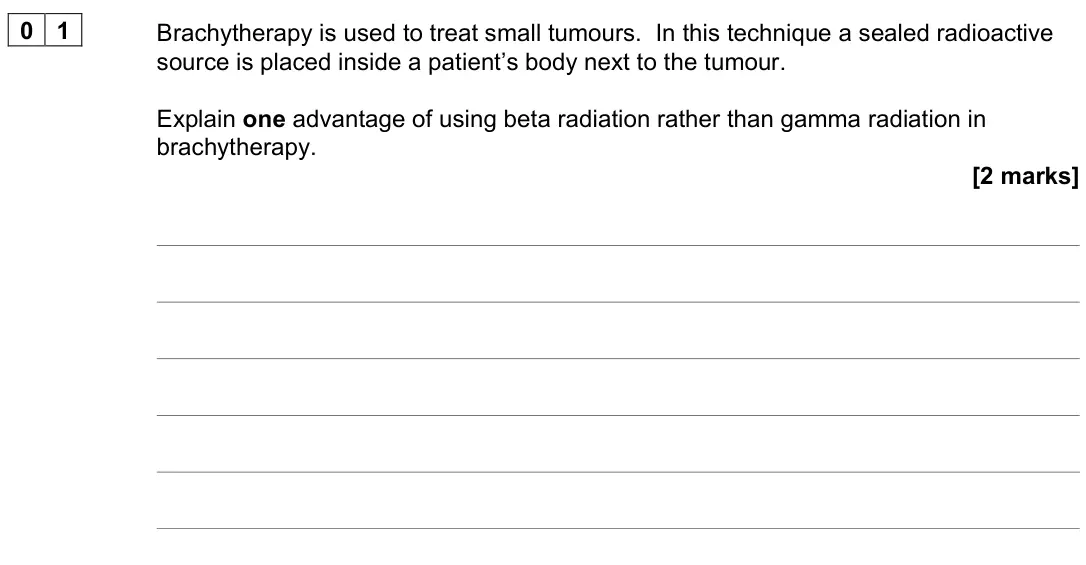
- June 2023, Paper 3 Medical physics, Q01 (2 marks): Brachytherapy is used to treat small tumours. In this technique a sealed radioactive source is placed inside a patient’s body next to the tumour. Explain one ad
- November 2021, Paper 3 Medical physics, Q01.1 (4 marks): Explain why the value of the half-life of technetium-99m: • makes it suitable for use as a tracer • means that it must be produced in a generator on site. [4 ma
- November 2021, Paper 3 Medical physics, Q01.2 (4 marks): Technetium-99m emits only gamma rays. Explain why this makes technetium-99m suitable for use as a tracer. [4 marks]
- November 2021, Paper 3 Medical physics, Q01.3 (3 marks): A gamma camera can be used to form images when using a tracer. Figure 1 shows a photomultiplier tube from a gamma camera. Figure 1 At the crystal scintillator,
- November 2021, Paper 3 Medical physics, Q01.4 (4 marks): Iodine-131 is a medical tracer that can be detected using a gamma camera. Iodine-131 has a physical half-life of 8.0 days. A patient is injected with iodine-131
- June 2017, Paper 3 Medical physics, Q03.1 (1 mark): State what is meant by a radioisotope. [1 mark]
- June 2017, Paper 3 Medical physics, Q03.2 (1 mark): The radionuclide used in the PET scan has a physical half-life of 110 minutes. The radionuclide is excreted from the body with a biological half-life of 185 min
- June 2017, Paper 3 Medical physics, Q03.3 (3 marks): Discuss what might be a suitable length of time for the patient to relax between injecting the radionuclide and moving the patient into the PET scanner. [3 mark
- June 2017, Paper 3 Medical physics, Q03.4 (2 marks): The decay of the radionuclide results in the emission of a positron. Two of the detectors, directly opposite to each other, are triggered as they each receive a
- June 2017, Paper 3 Medical physics, Q03.5 (2 marks): Figure 1 shows the head of a patient that is 0.2 m across, placed centrally between two of the many detectors in a PET scanner. Figure 1 To determine the positi
- Specimen, Paper 3 Medical physics, Q03 (6 marks): Positron Emission Tomography (PET) and ultrasound scans are both used in medica diagnosis. Compare the quality of the information obtained from these scans in t
- Specimen, Paper 3 Medical physics, Q04.1 (2 marks): Explain why the effective half-life of a radionuclide in a biological system is always less than the physical half-life. [2 marks] 0 4 . 1
- Specimen, Paper 3 Medical physics, Q04.2 (4 marks): The physical half-life of a radionuclide is 20 days. The nuclide was administered to a patient. Initially the corrected count rate at the patient’s body was 270
- Specimen, Paper 3 Medical physics, Q04.3 (4 marks): Table 1 gives the properties of two radionuclides. Table 1 Technetium 99 m Iodine 131 emitted radiation gamma beta− and gamma half-life / hours 6.0 190 energy o
Questions, mark schemes and examiner’s reports are © AQA, from their published past papers. Plumi isn’t affiliated with any exam board. Want whole papers? Every AQA A-Level Physics paper.
Rather write your answers by hand on iPad? Plumi marks them against the same mark schemes.