 plumi
Physics of the eye: AQA A‑Level Physics questions
Every AQA A-Level Physics exam question on 3.10.1 Physics of the eye, 2016–2025, with its mark scheme and examiner’s report.
Find questions2,714
Calculations
Q01.1
The whole paper ↗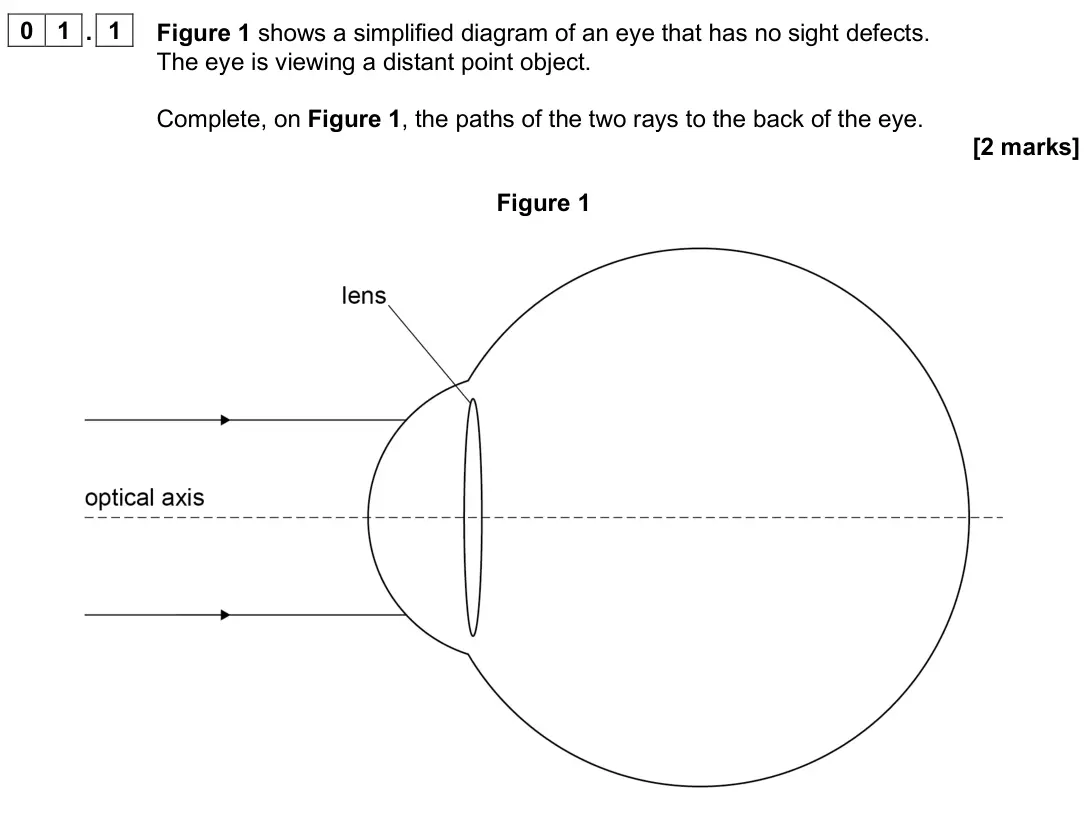
Q01.2
The whole paper ↗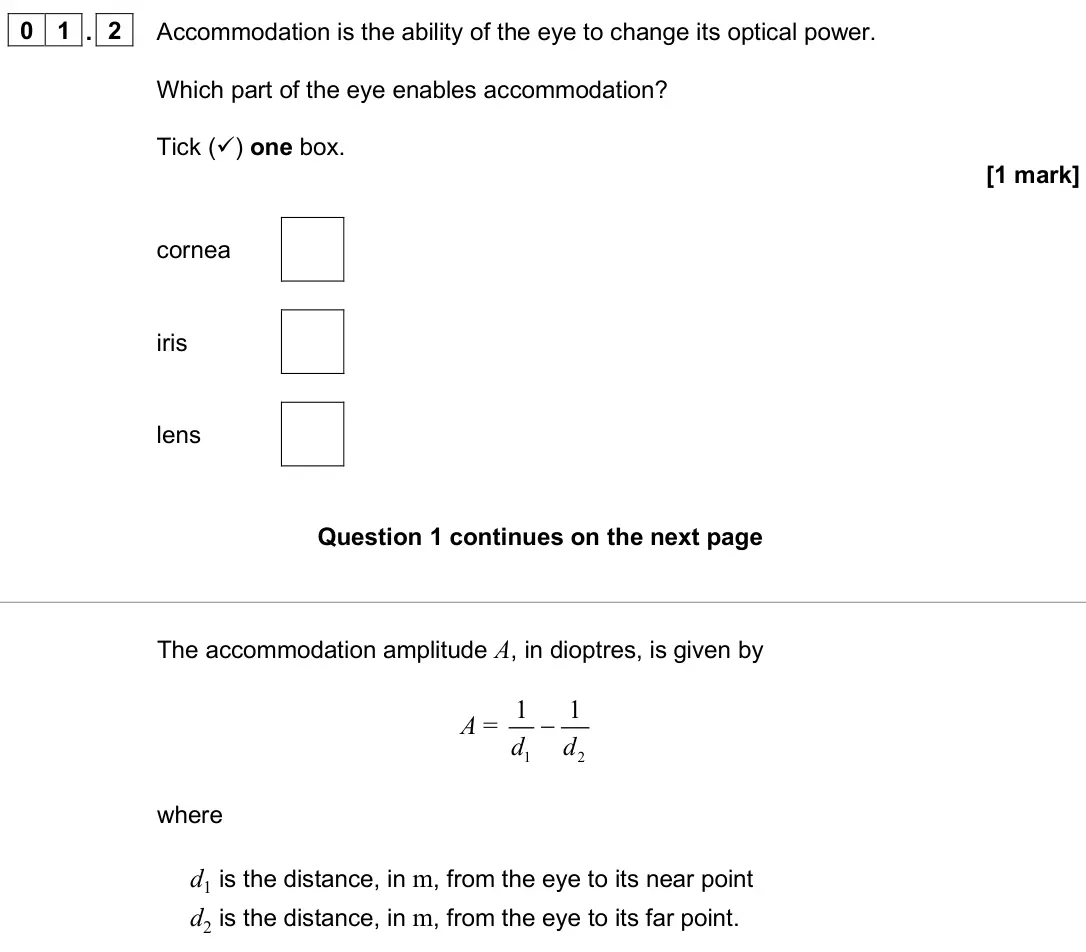
Q01.3
The whole paper ↗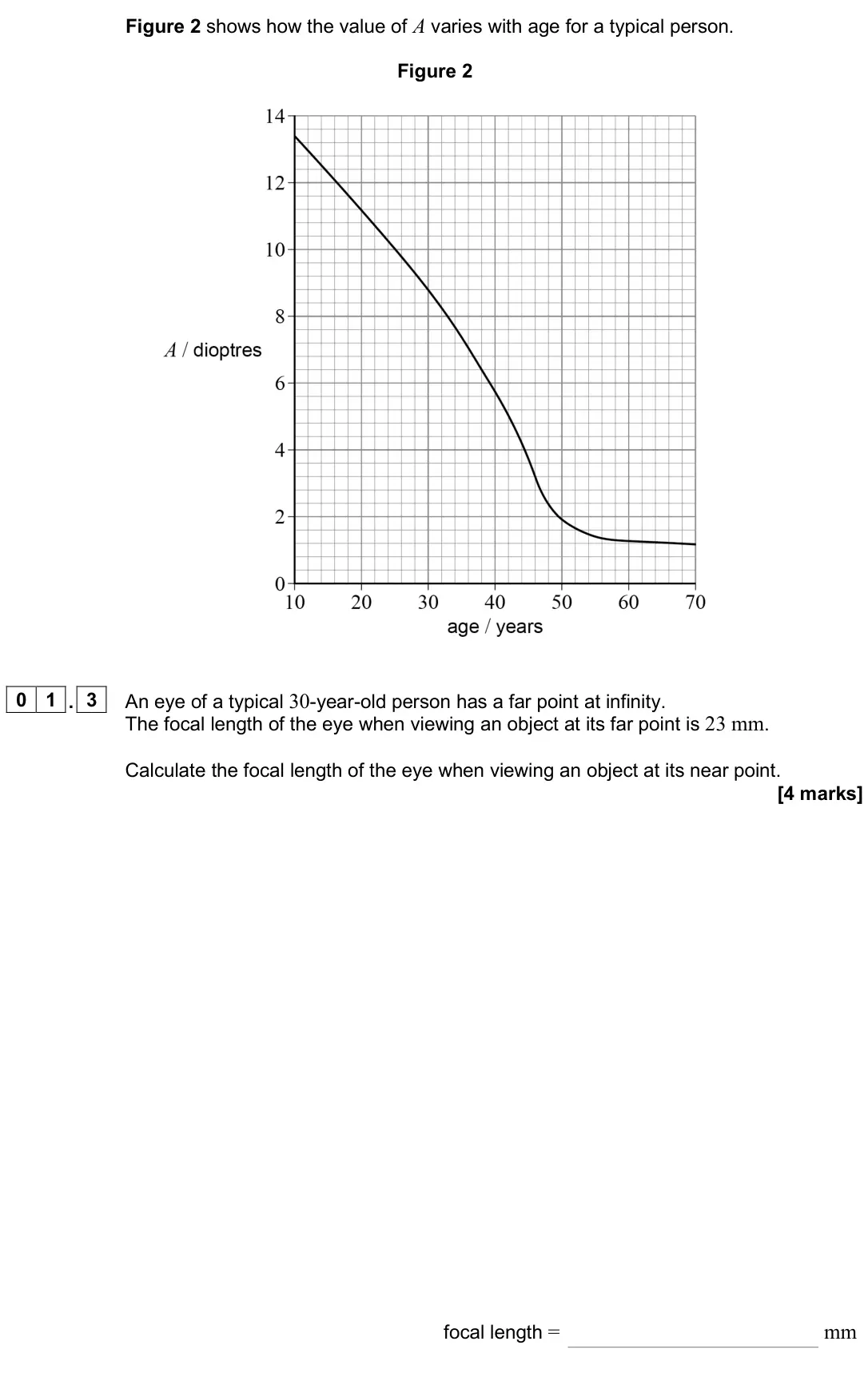
Q01.4
The whole paper ↗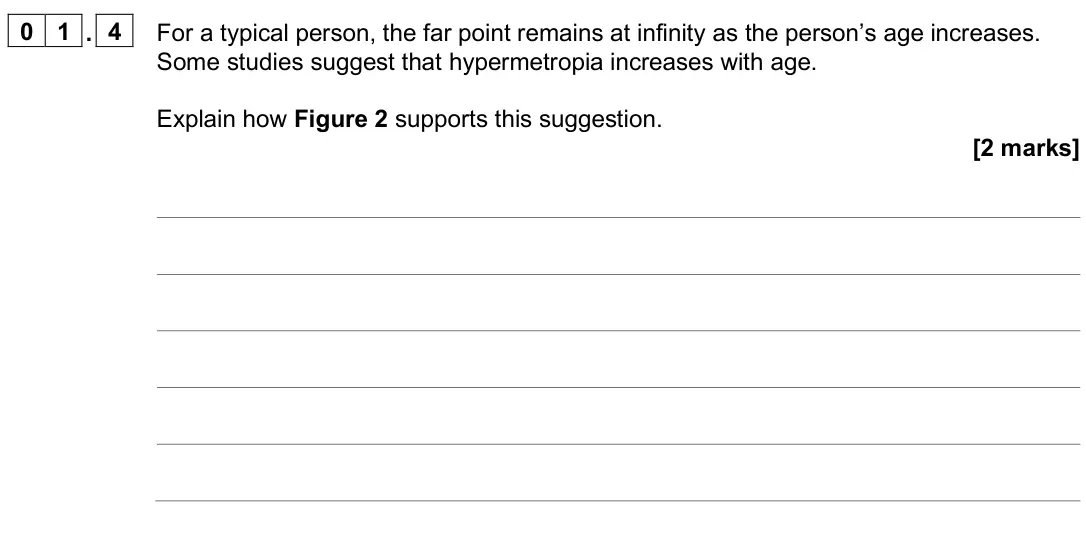
Q01.1
The whole paper ↗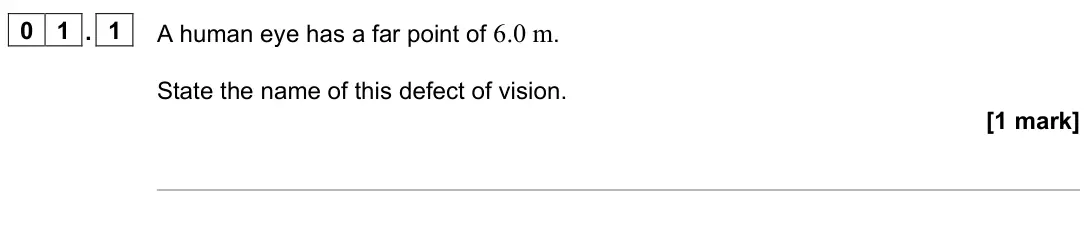
Q01.2
The whole paper ↗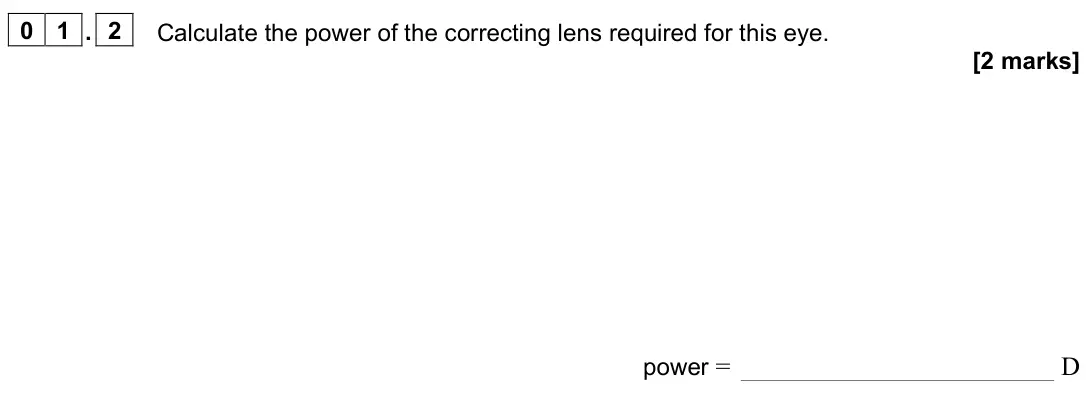
Q01.3
The whole paper ↗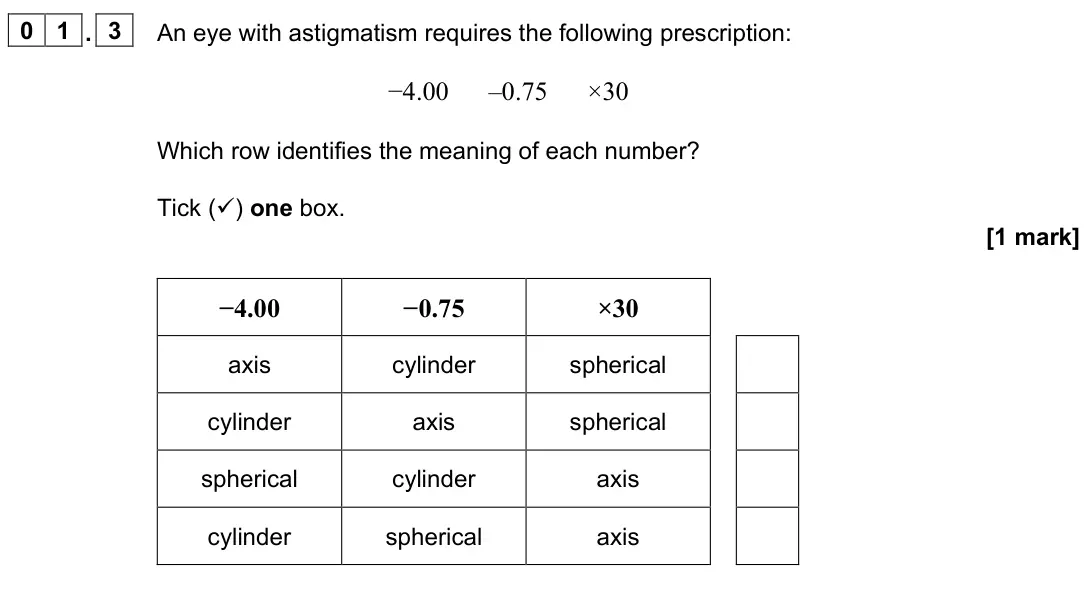
Q02.1
The whole paper ↗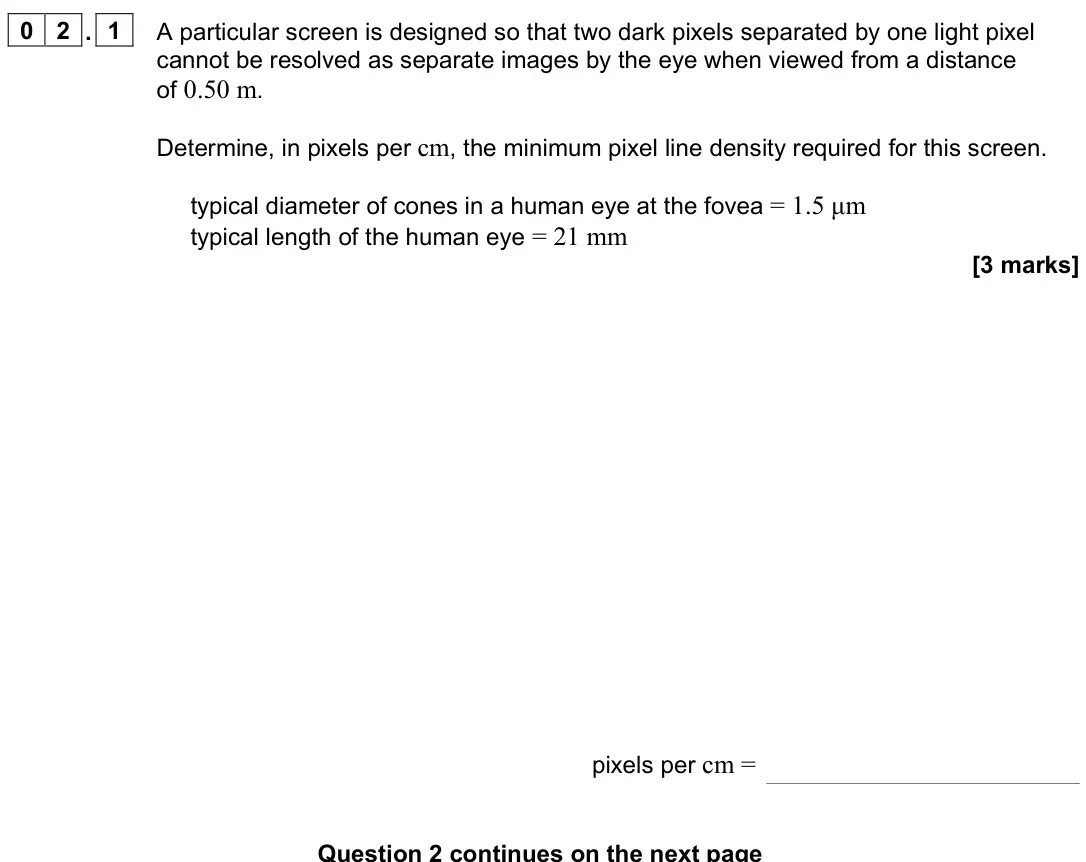
Q02.2
The whole paper ↗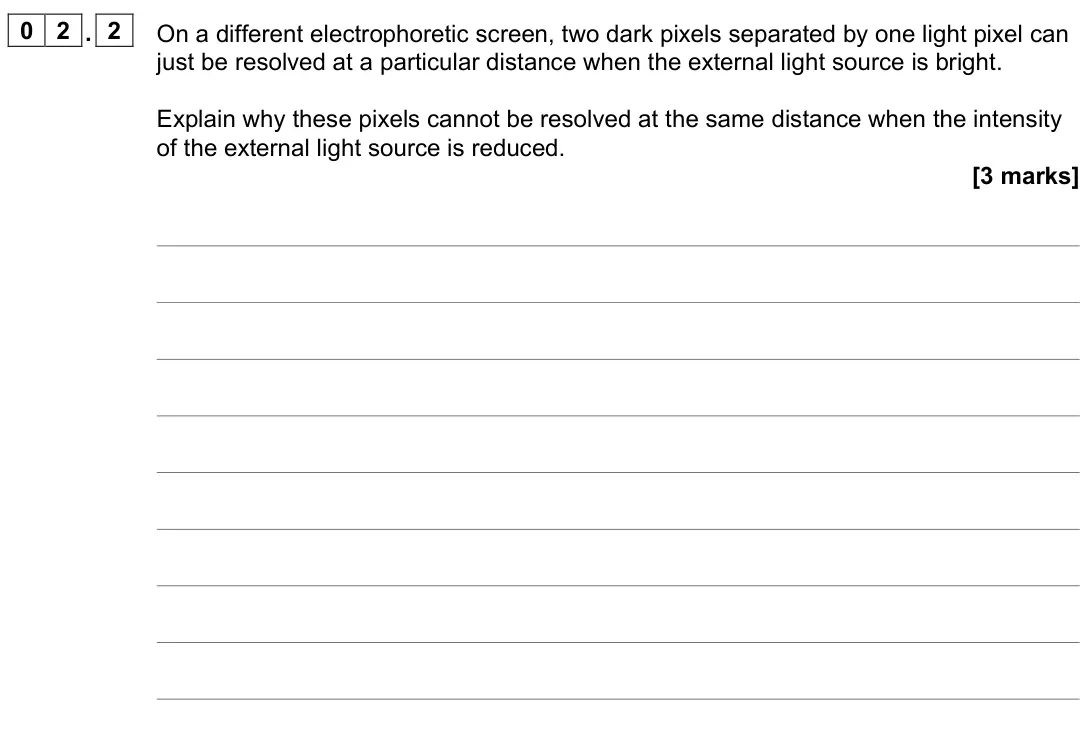
Q02.3
The whole paper ↗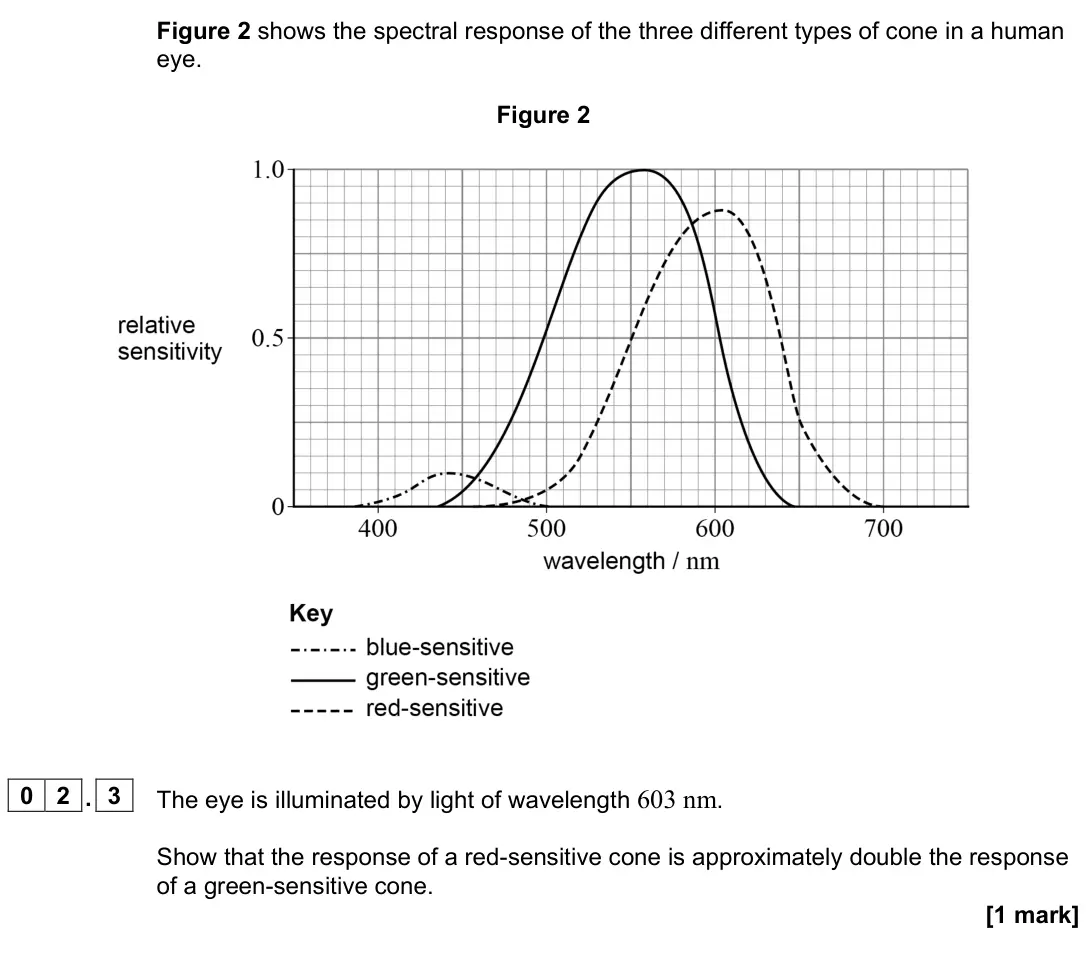
Q02.4
The whole paper ↗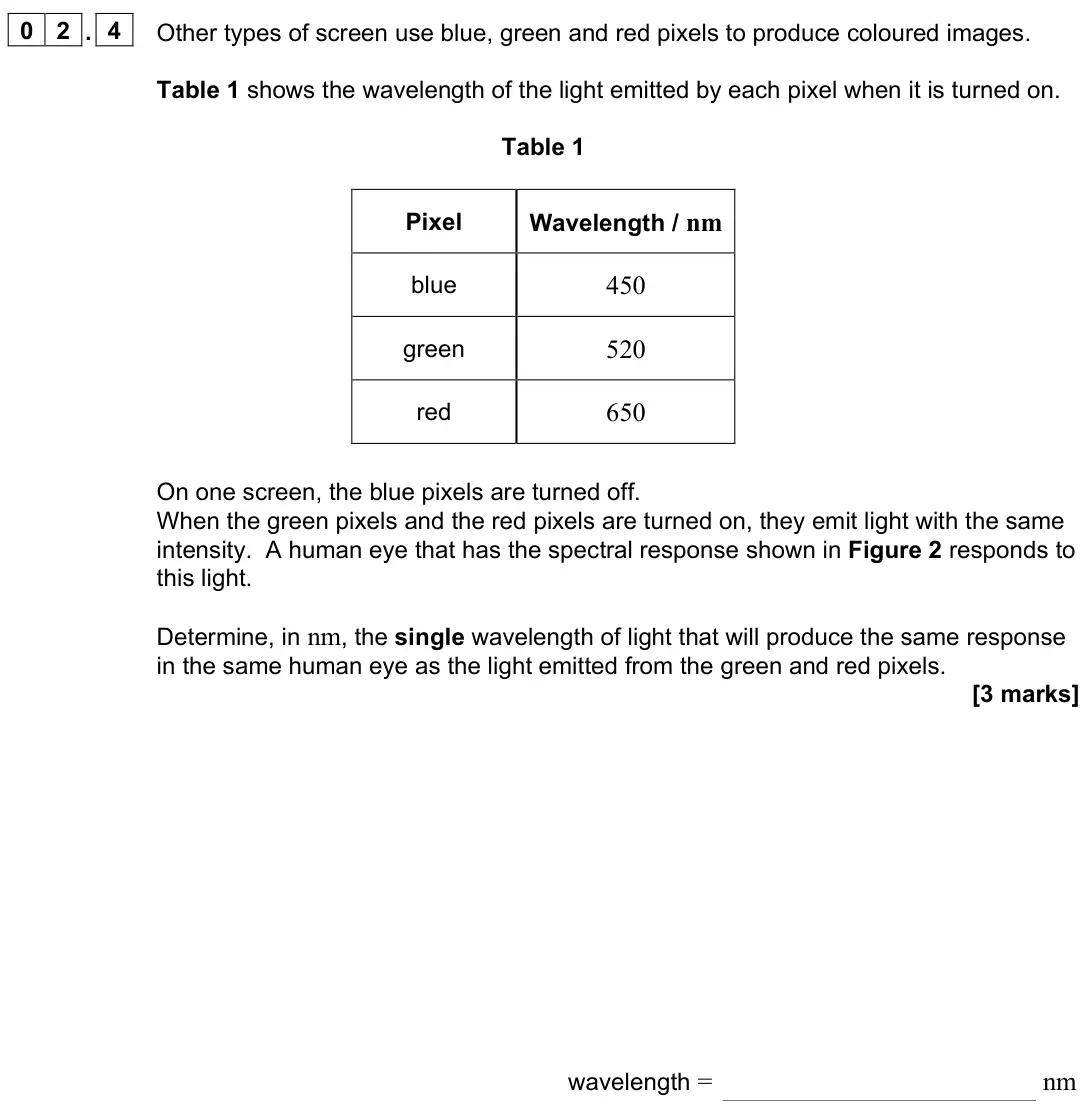
Q01.1
The whole paper ↗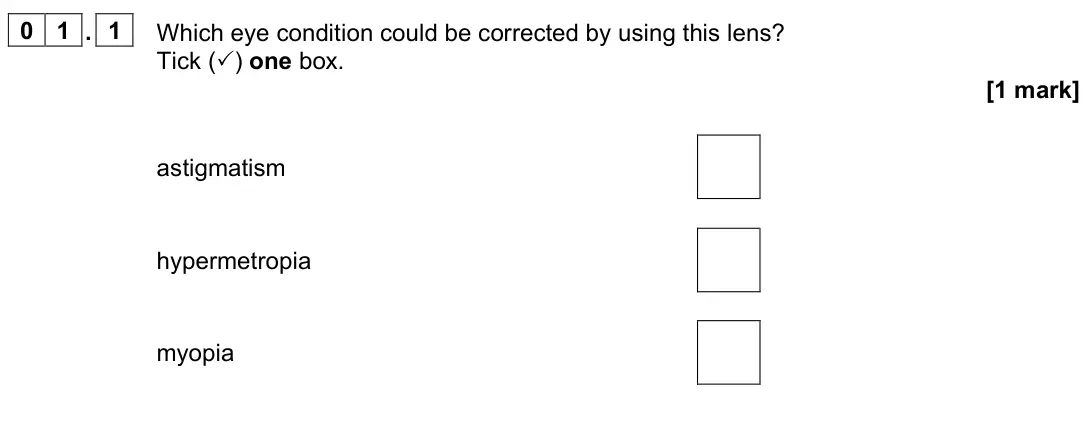
Q01.2
The whole paper ↗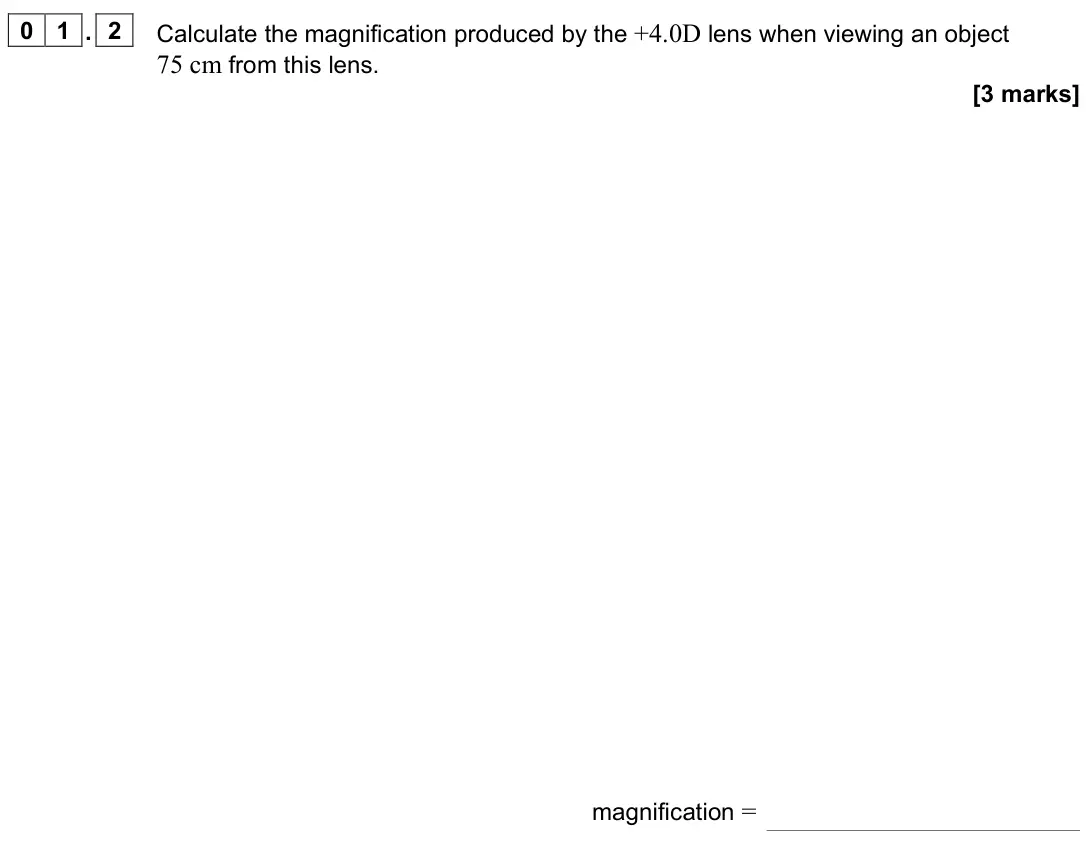
Q01.3
The whole paper ↗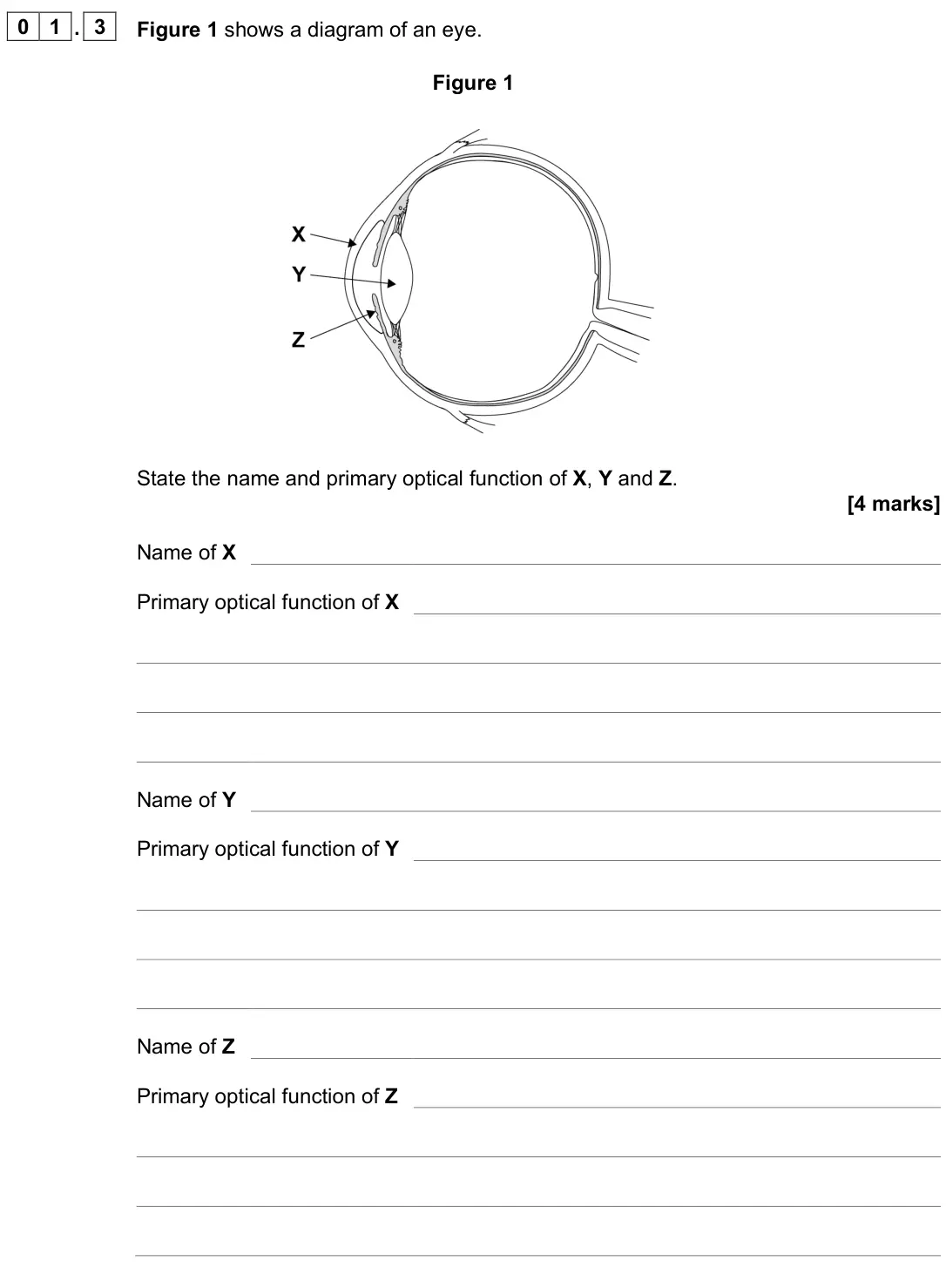
Q05.1
The whole paper ↗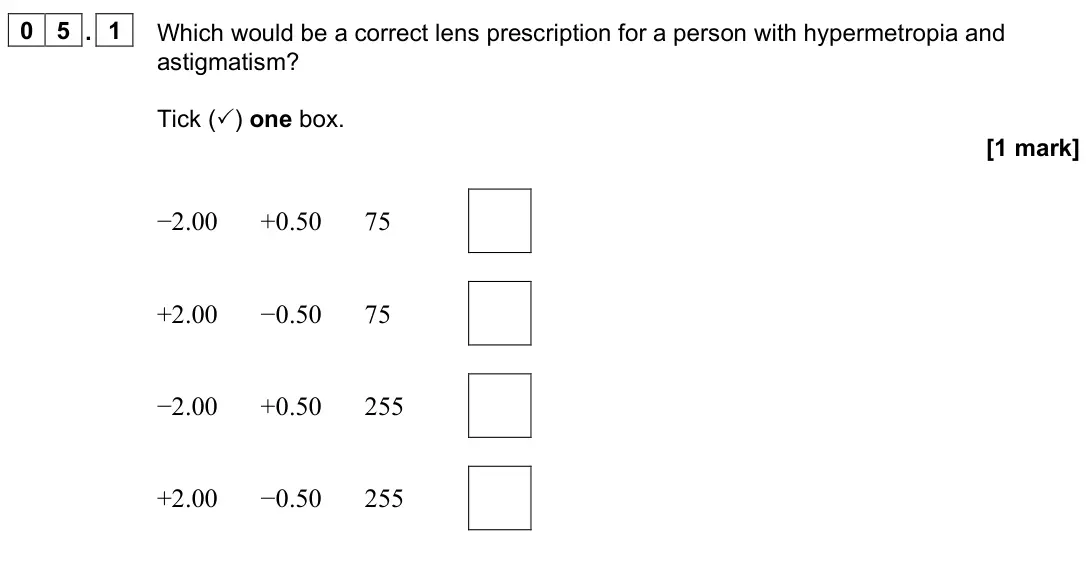
Q05.2
The whole paper ↗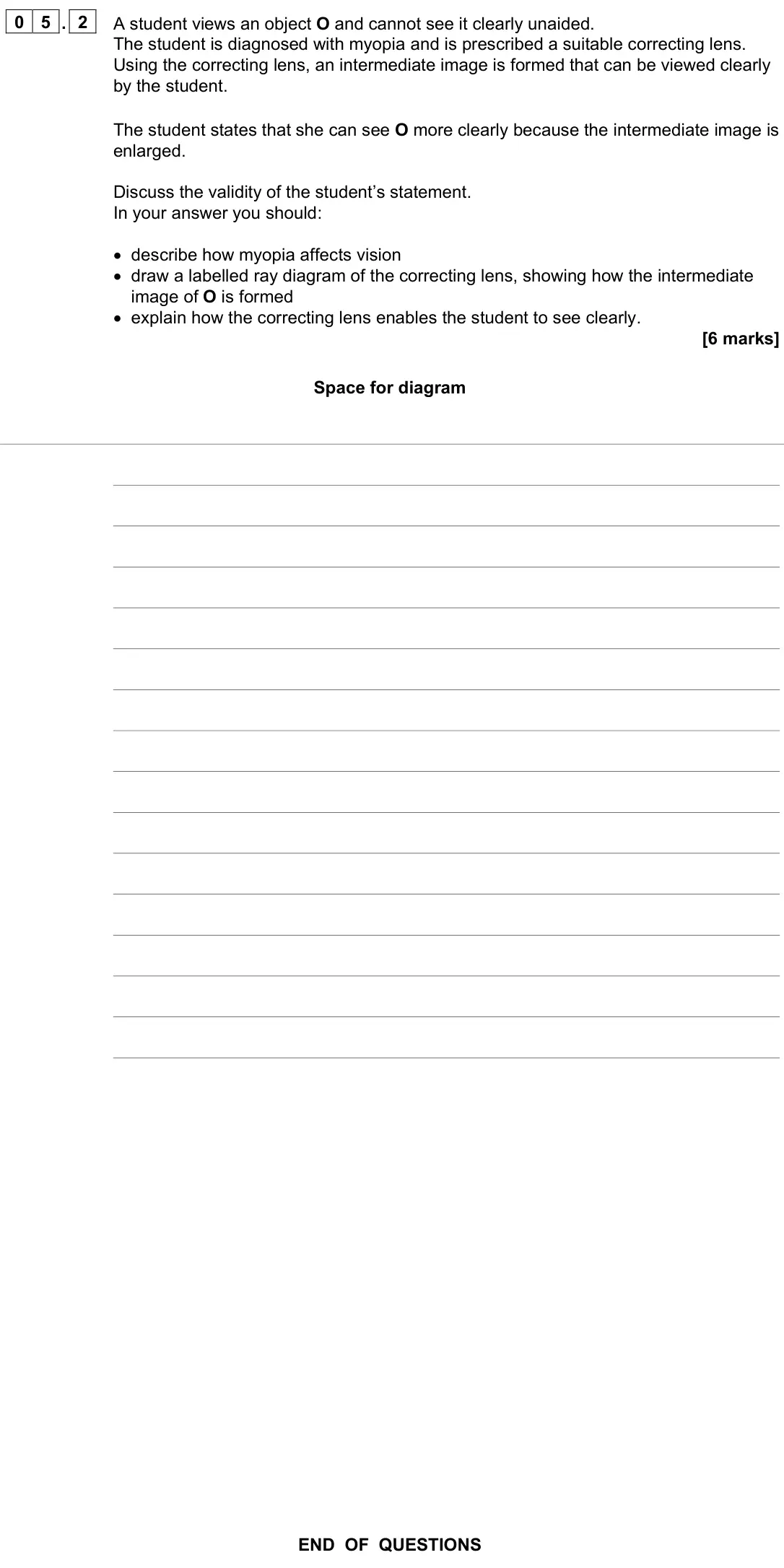
Q01.1
The whole paper ↗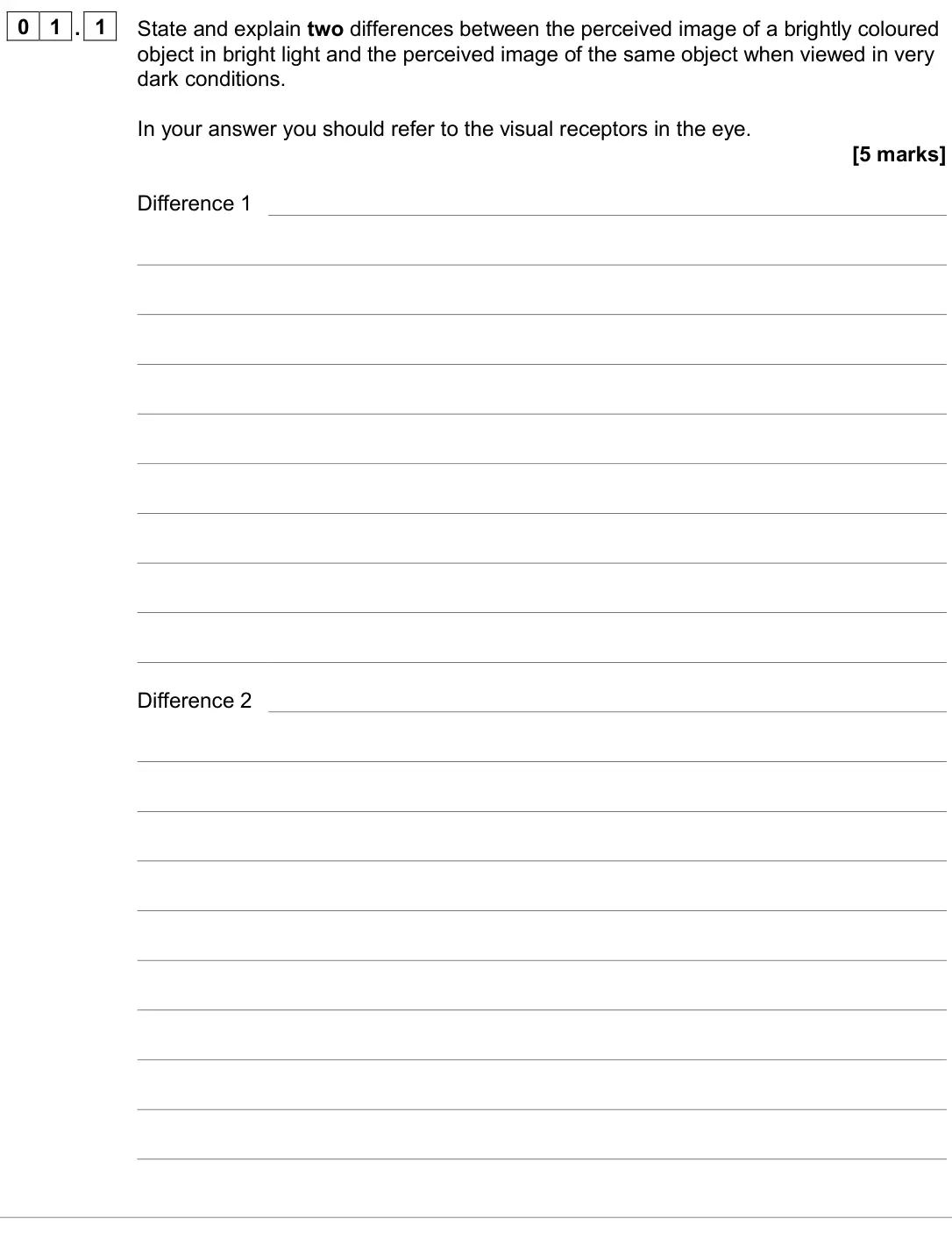
Q01.2
The whole paper ↗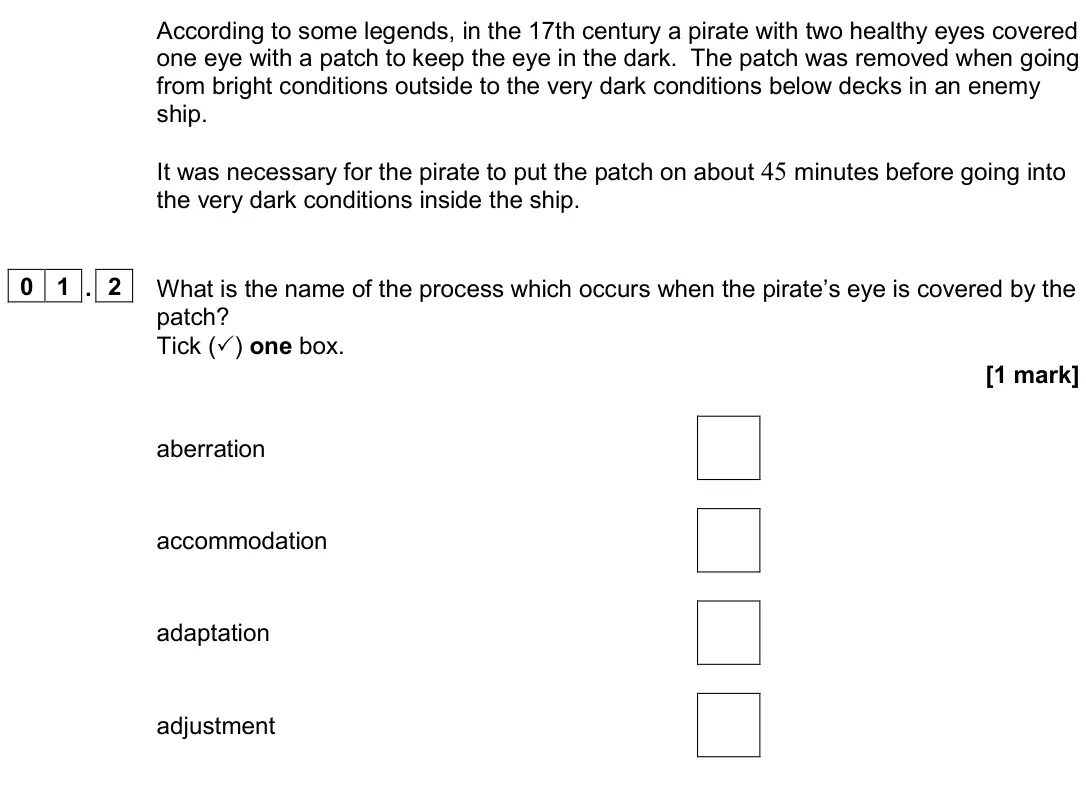
Q01.3
The whole paper ↗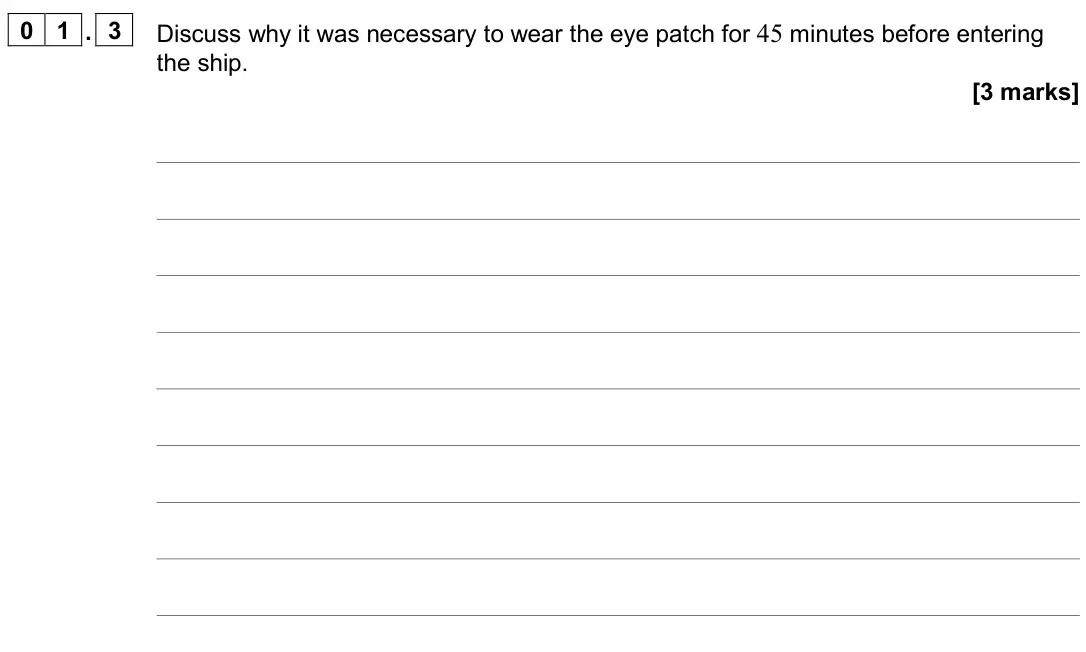
Q01.1
The whole paper ↗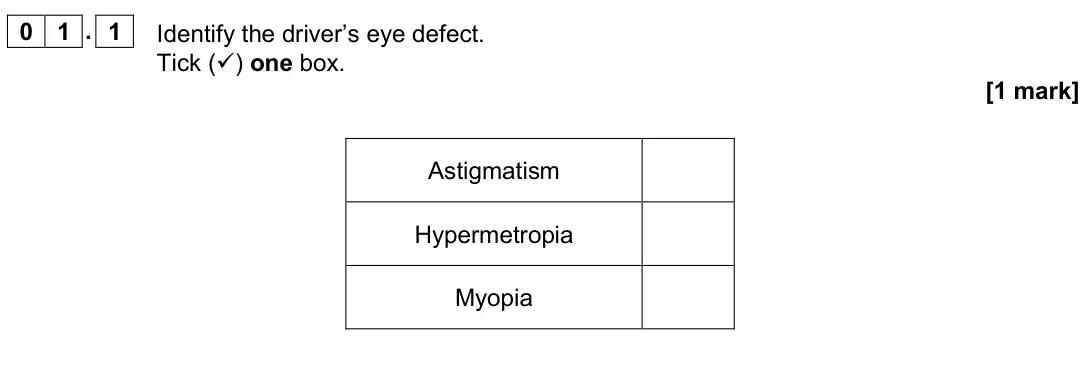
All 33 questions on Physics of the eye, as a list
- June 2025, Paper 3 Medical physics, Q01.1 (2 marks): Figure 1 shows a simplified diagram of an eye that has no sight defects. The eye is viewing a distant point object. Complete, on Figure 1, the paths of the two
- June 2025, Paper 3 Medical physics, Q01.2 (1 mark): Accommodation is the ability of the eye to change its optical power. Which part of the eye enables accommodation? Tick () one box. [1 mark] cornea iris lens Th
- June 2025, Paper 3 Medical physics, Q01.3 (4 marks): An eye of a typical 30-year-old person has a far point at infinity. The focal length of the eye when viewing an object at its far point is 23 mm. Calculate the
- June 2025, Paper 3 Medical physics, Q01.4 (2 marks): For a typical person, the far point remains at infinity as the person’s age increases. Some studies suggest that hypermetropia increases with age. Explain how F
- June 2024, Paper 3 Medical physics, Q01.1 (1 mark): A human eye has a far point of 6.0 m. State the name of this defect of vision. [1 mark]
- June 2024, Paper 3 Medical physics, Q01.2 (2 marks): Calculate the power of the correcting lens required for this eye. [2 marks] power = D
- June 2024, Paper 3 Medical physics, Q01.3 (1 mark): An eye with astigmatism requires the following prescription: −4.00 –0.75 ×30 Which row identifies the meaning of each number? Tick () one box. [1 mark] −4.00 −
- June 2023, Paper 3 Medical physics, Q02.1 (3 marks): A particular screen is designed so that two dark pixels separated by one light pixel cannot be resolved as separate images by the eye when viewed from a distanc
- June 2023, Paper 3 Medical physics, Q02.2 (3 marks): On a different electrophoretic screen, two dark pixels separated by one light pixel can just be resolved at a particular distance when the external light source
- June 2023, Paper 3 Medical physics, Q02.3 (1 mark): The eye is illuminated by light of wavelength 603 nm. Show that the response of a red-sensitive cone is approximately double the response of a green-sensitive c
- June 2023, Paper 3 Medical physics, Q02.4 (3 marks): Other types of screen use blue, green and red pixels to produce coloured images. Table 1 shows the wavelength of the light emitted by each pixel when it is turn
- June 2022, Paper 3 Medical physics, Q01.1 (1 mark): Which eye condition could be corrected by using this lens? Tick () one box. [1 mark] astigmatism hypermetropia myopia
- June 2022, Paper 3 Medical physics, Q01.2 (3 marks): Calculate the magnification produced by the +4.0D lens when viewing an object 75 cm from this lens. [3 marks] magnification =
- June 2022, Paper 3 Medical physics, Q01.3 (4 marks): Figure 1 shows a diagram of an eye. Figure 1 State the name and primary optical function of X, Y and Z. [4 marks] Name of X Primary optical function of X Name o
- November 2021, Paper 3 Medical physics, Q05.1 (1 mark): Which would be a correct lens prescription for a person with hypermetropia and astigmatism? Tick () one box. [1 mark] −2.00 +0.50 75 +2.00 −0.50 75 −2.00 +0.50
- November 2021, Paper 3 Medical physics, Q05.2 (6 marks): A student views an object O and cannot see it clearly unaided. The student is diagnosed with myopia and is prescribed a suitable correcting lens. Using the corr
- November 2020, Paper 3 Medical physics, Q01.1 (5 marks): State and explain two differences between the perceived image of a brightly coloured object in bright light and the perceived image of the same object when view
- November 2020, Paper 3 Medical physics, Q01.2 (1 mark): What is the name of the process which occurs when the pirate’s eye is covered by the patch? Tick () one box. [1 mark] aberration accommodation adaptation adjus
- November 2020, Paper 3 Medical physics, Q01.3 (3 marks): Discuss why it was necessary to wear the eye patch for 45 minutes before entering the ship. [3 marks]
- June 2019, Paper 3 Medical physics, Q01.1 (1 mark): Identify the driver’s eye defect. Tick () one box. [1 mark] Astigmatism Hypermetropia Myopia
- June 2019, Paper 3 Medical physics, Q01.2 (4 marks): Figure 1 shows the position of a number plate at a distance of 20.5 m in front of the driver’s unaided eye. Figure 2 shows the same situation and the position o
- June 2019, Paper 3 Medical physics, Q01.3 (5 marks): An optician considers the use of three different lenses, A, B and C, for use by the driver when driving. Power of A = ─2.18D Power of B = ─1.77D Power of C = +1
- June 2018, Paper 3 Medical physics, Q02.1 (4 marks): The fovea in a typical human eye consists of cones which have an average diameter of 1.5 × 10⁻⁶ m An eye looks directly at two point sources of light which are
- June 2018, Paper 3 Medical physics, Q02.2 (3 marks): Three types of cone are present at the fovea. On Figure 2 sketch and clearly label three curves to show how the relative light absorption of each type of cone v
- June 2017, Paper 3 Medical physics, Q01.1 (2 marks): Explain why the unaided defective eye cannot form a clearly focused image of the object placed 24 cm from the eye. [2 marks]
- June 2017, Paper 3 Medical physics, Q01.2 (3 marks): An object is placed 24 cm from the spectacle lens. Calculate the distance of the image formed from the spectacle lens. Give your answer to a suitable number of
- June 2017, Paper 3 Medical physics, Q01.3 (1 mark): What is the name for the position where the image is formed by the spectacle lens? Tick () the correct answer. [1 mark] The eye’s aided far point The eye’s aid
- June 2017, Paper 3 Medical physics, Q01.4 (3 marks): Draw a ray diagram to show how this spectacle lens forms an image of the object placed 24 cm from the spectacle lens. On your diagram clearly label the object,
- Specimen, Paper 3 Medical physics, Q01.1 (2 marks): State what is meant by the principal focus and the power of a converging lens. [2 mark 0 1 . 1
- Specimen, Paper 3 Medical physics, Q01.2 (2 marks): Complete the ray diagram below to show the formation of an image of a real object O by a diverging lens. Label the image clearly. [2 mark 0 1 . 2
- Specimen, Paper 3 Medical physics, Q01.3: State the defect of vision that would be corrected using a diverging lens. [1 mar 0 1 . 3
- Specimen, Paper 3 Medical physics, Q01.4 (2 marks): A diverging lens of focal length −0.33 m is used to view a real object placed 0.25 m from the lens. Calculate the distance from the lens to the image. [2 marks]
- Specimen, Paper 3 Medical physics, Q01.5 (2 marks): Two point sources of light are viewed by a normal eye and their images are formed at the fovea. State, in terms of the active receptors, the conditions necessar
Questions, mark schemes and examiner’s reports are © AQA, from their published past papers. Plumi isn’t affiliated with any exam board. Want whole papers? Every AQA A-Level Physics paper.
Rather write your answers by hand on iPad? Plumi marks them against the same mark schemes.