 plumi
Particles: AQA A‑Level Physics questions
Every AQA A-Level Physics exam question on 3.2.1 Particles, 2016–2025, with its mark scheme and examiner’s report.
Find questions2,714
Calculations
Q01.1
The whole paper ↗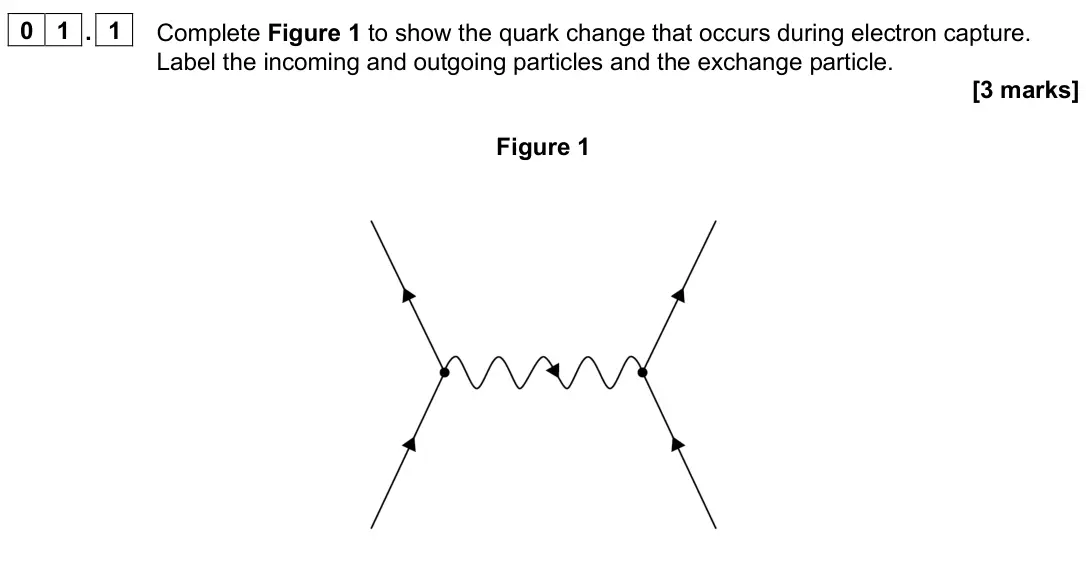
Q01.2
The whole paper ↗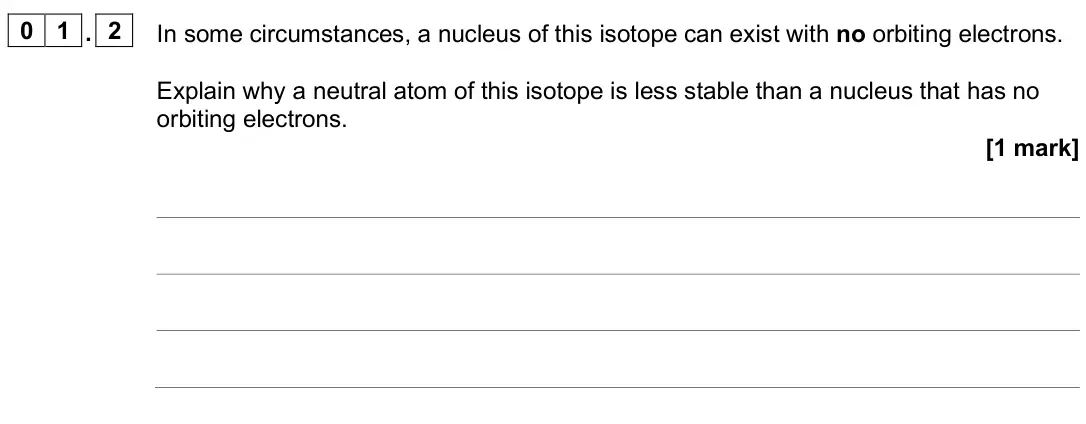
Q01.3
The whole paper ↗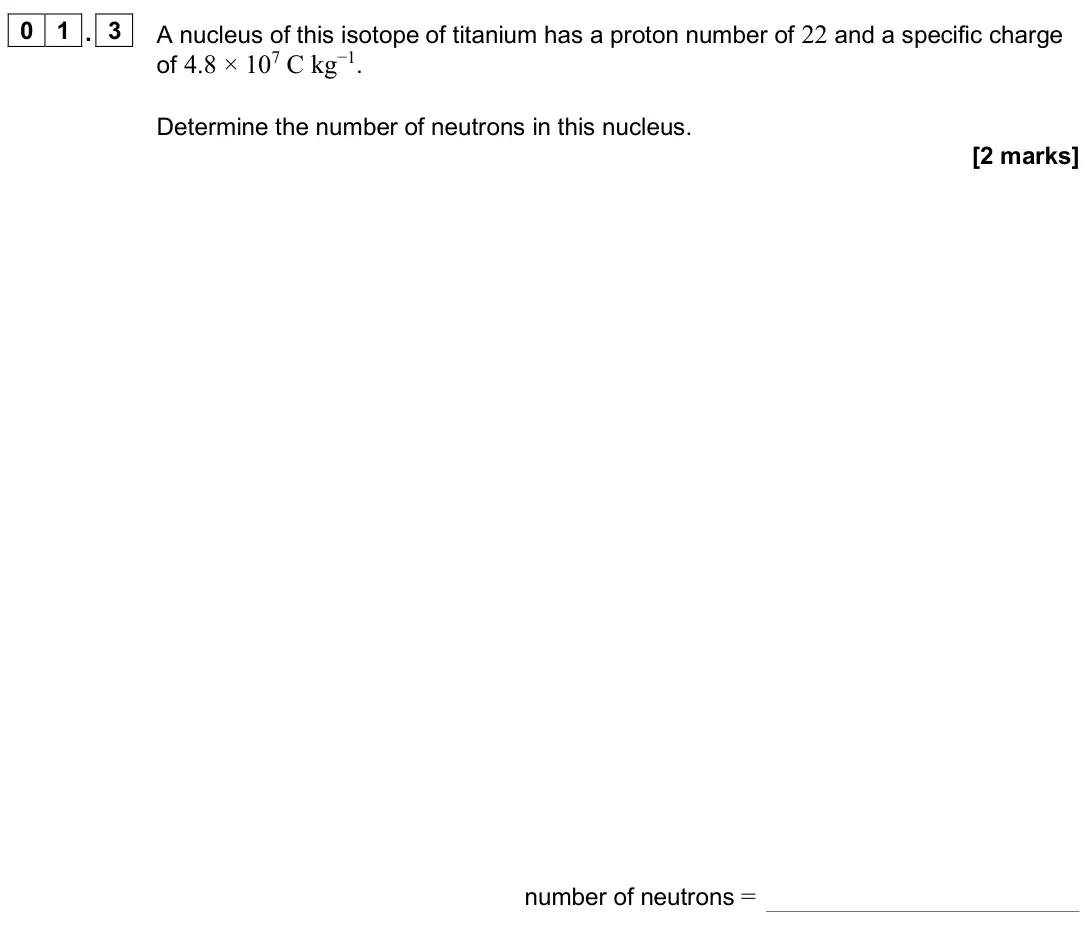
Q01.1
The whole paper ↗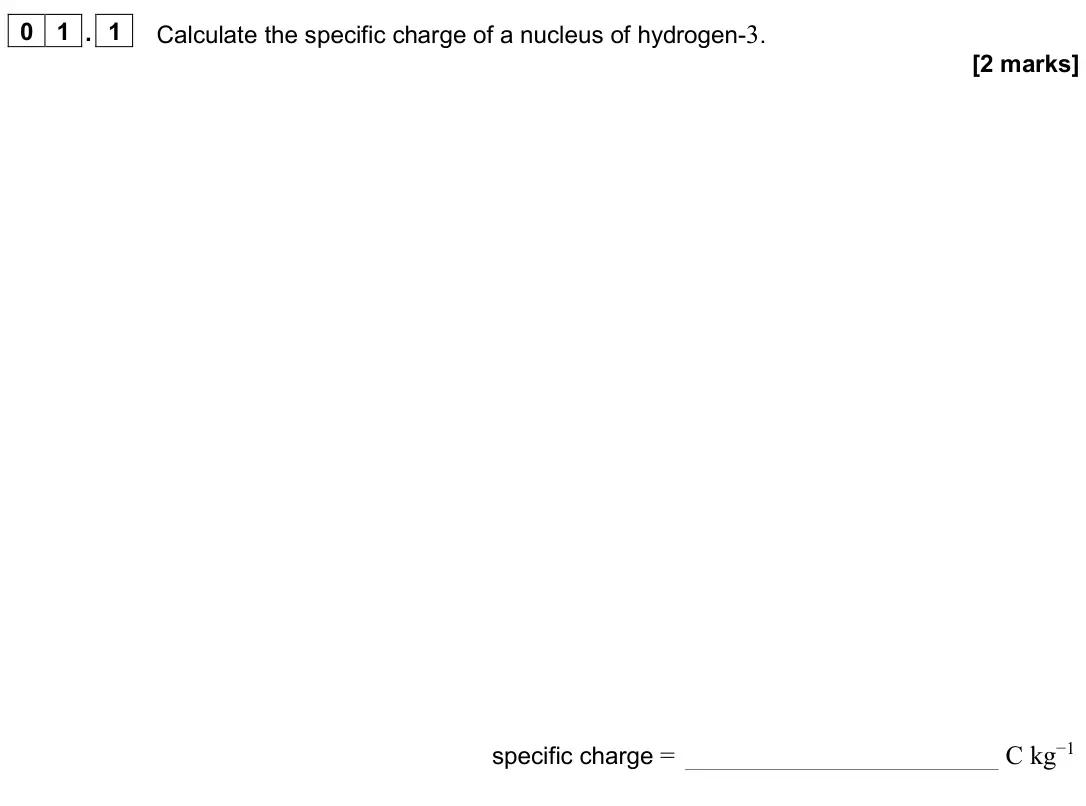
Q01.2
The whole paper ↗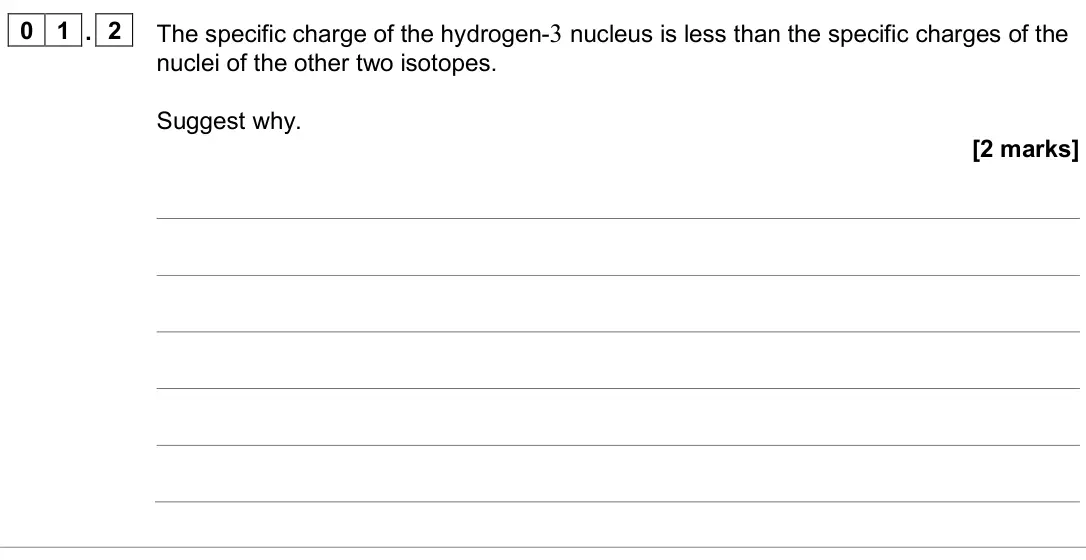
Q01.3
The whole paper ↗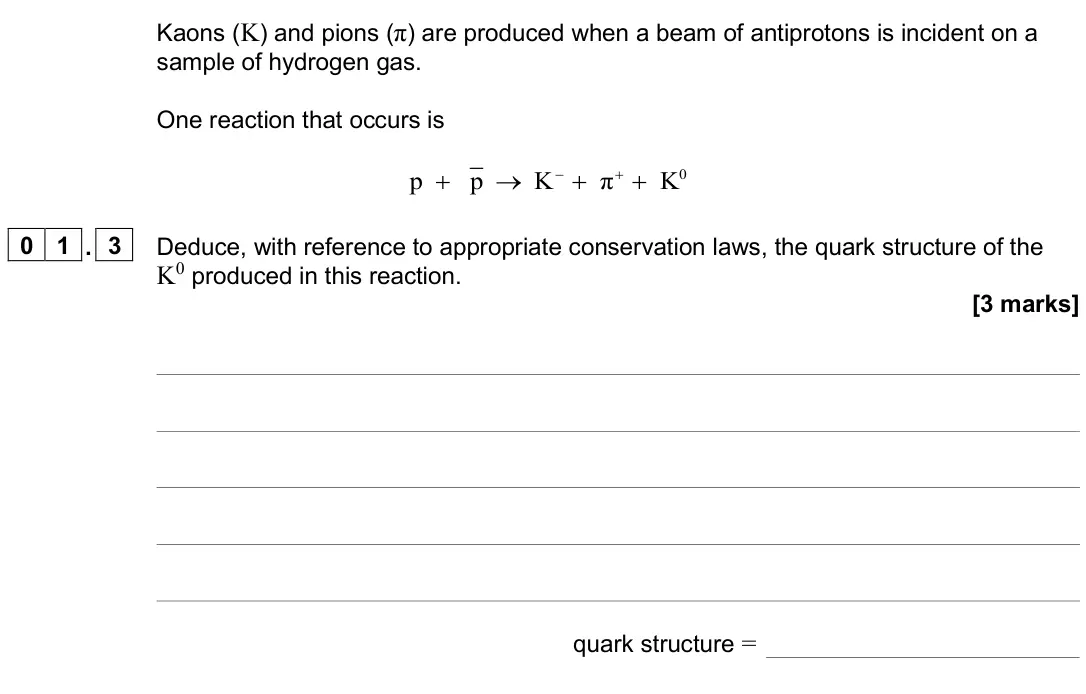
Q01.4
The whole paper ↗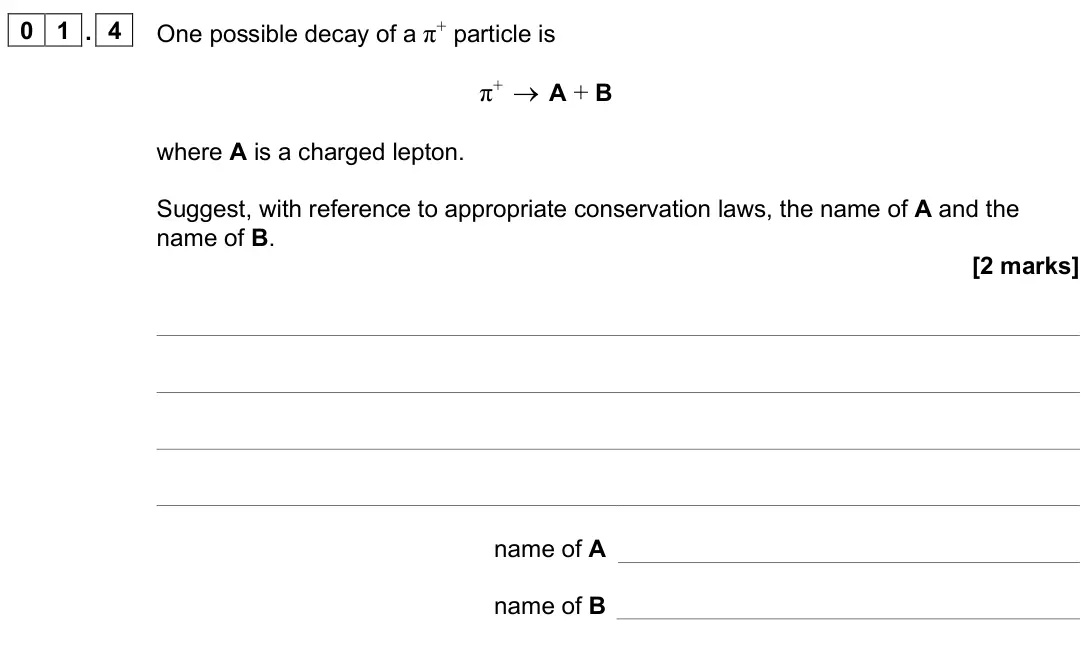
Q01.1
The whole paper ↗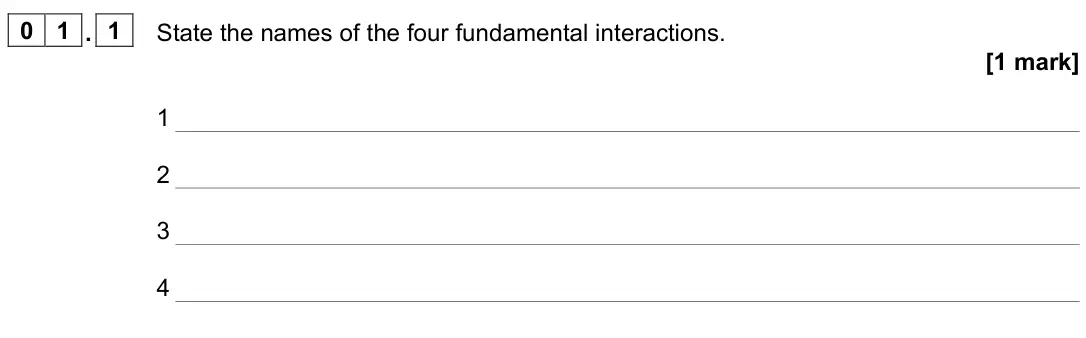
Q01.2
The whole paper ↗
Q01.3
The whole paper ↗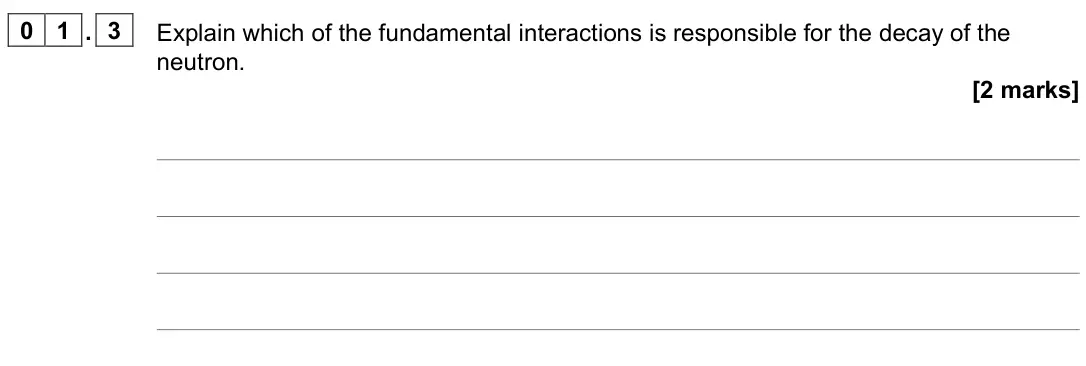
Q01.4
The whole paper ↗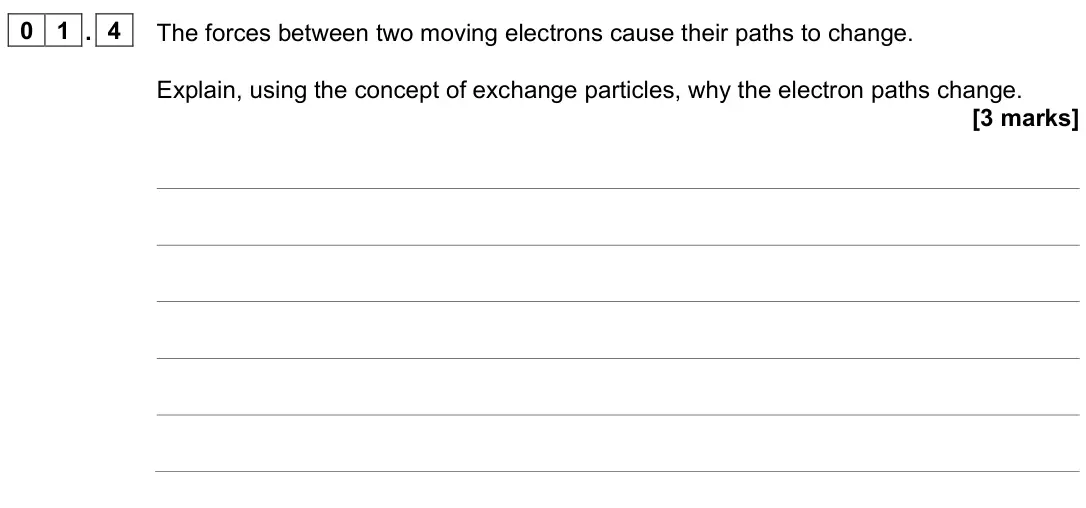
Q02.1
The whole paper ↗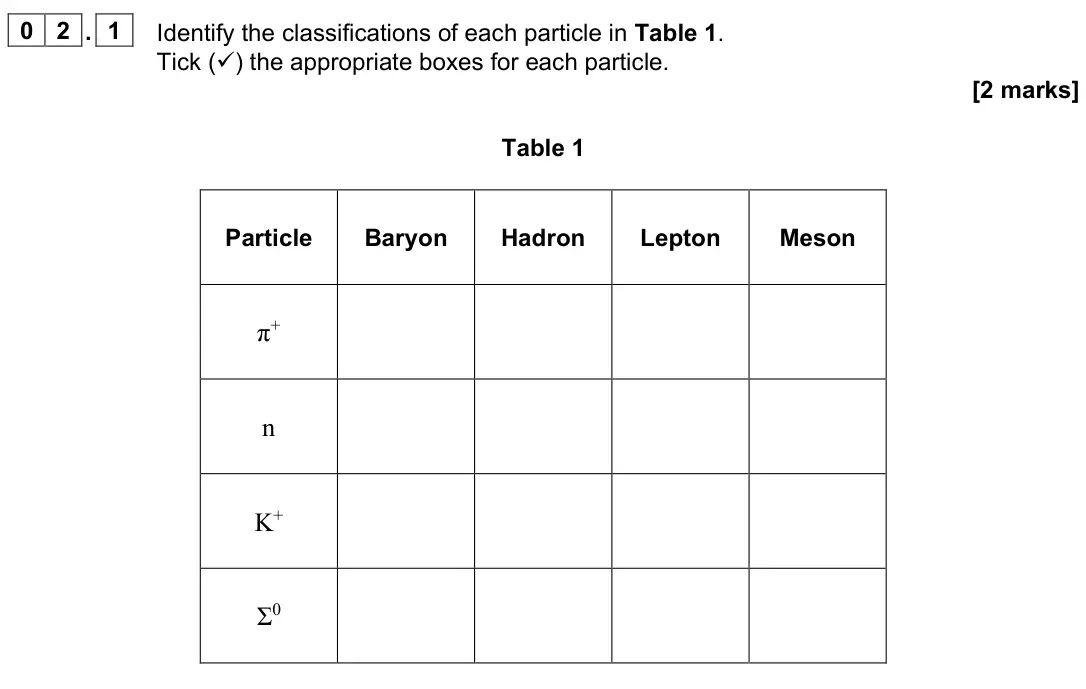
Q02.2
The whole paper ↗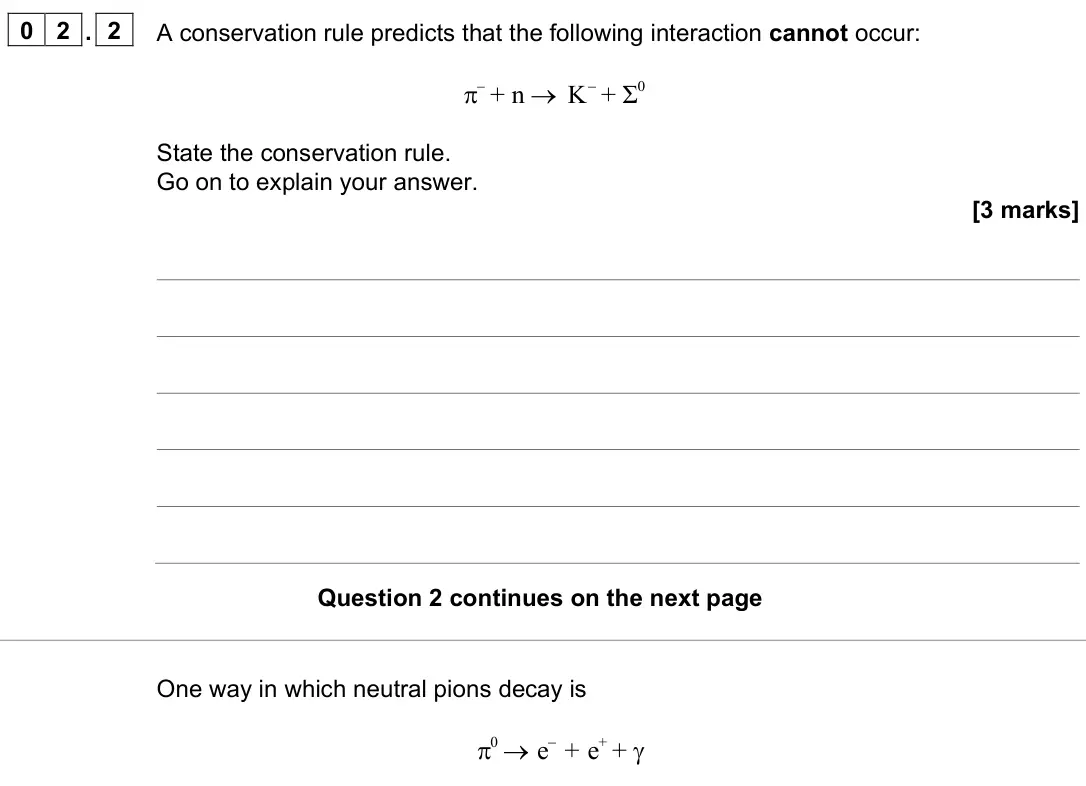
Q02.3
The whole paper ↗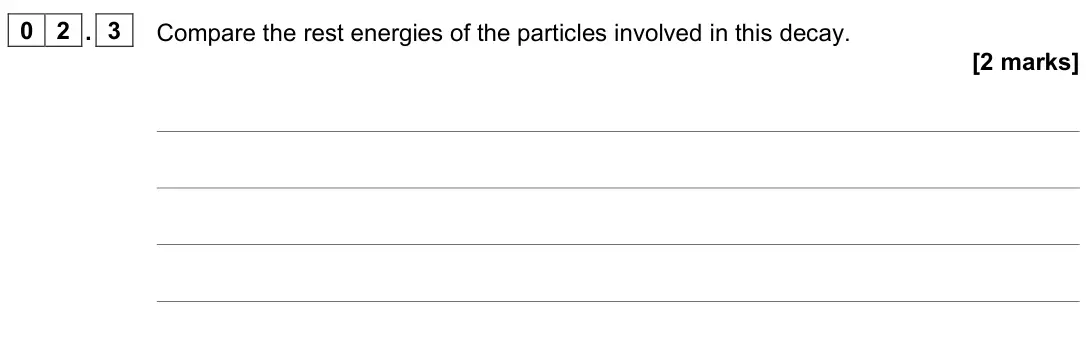
Q02.4
The whole paper ↗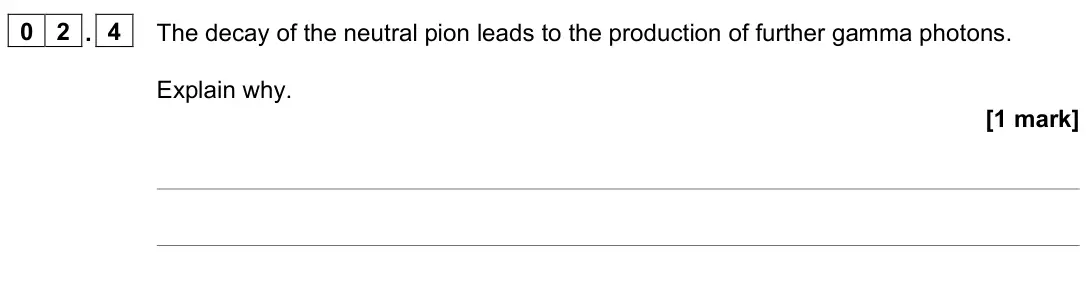
All 160 questions on Particles, as a list
- June 2025, Paper 1, Q01.1 (3 marks): Complete Figure 1 to show the quark change that occurs during electron capture. Label the incoming and outgoing particles and the exchange particle. [3 marks] F
- June 2025, Paper 1, Q01.2 (1 mark): In some circumstances, a nucleus of this isotope can exist with no orbiting electrons. Explain why a neutral atom of this isotope is less stable than a nucleus
- June 2025, Paper 1, Q01.3 (2 marks): A nucleus of this isotope of titanium has a proton number of 22 and a specific charge of 4.8 × 10⁷ C kg−1. Determine the number of neutrons in this nucleus. [2
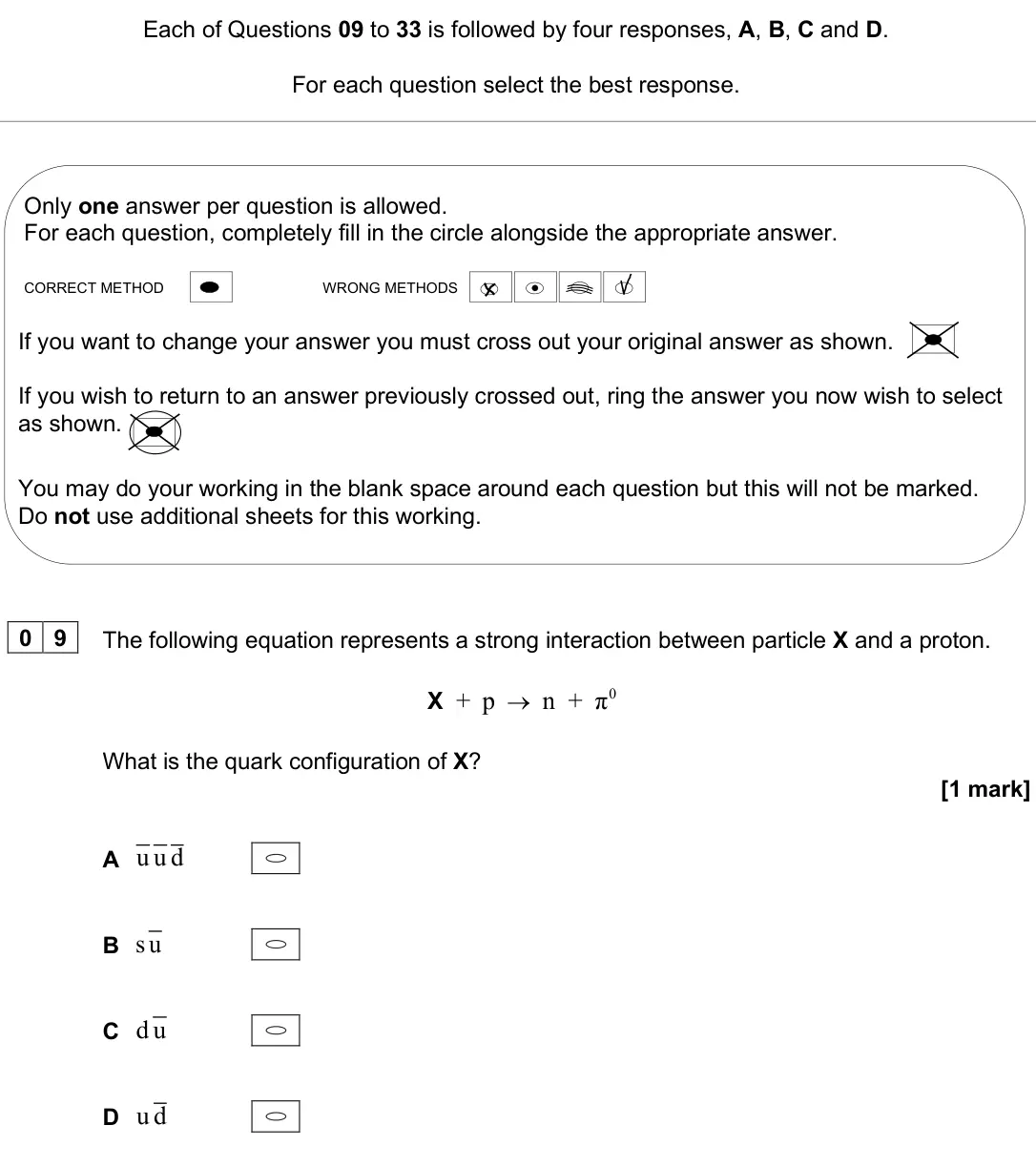
- June 2025, Paper 1, Q09 (1 mark): [multiple choice] The following equation represents a strong interaction between particle X and a proton. 0 + p n + π → X What is the quark configuration of X?
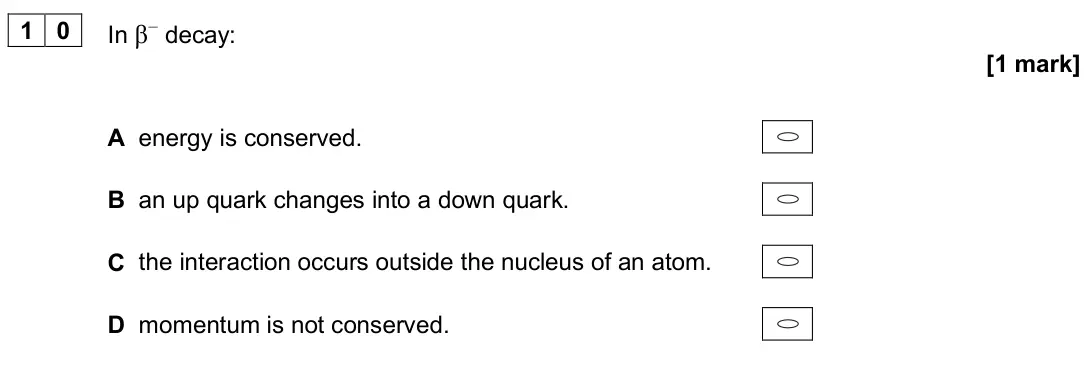
- June 2025, Paper 1, Q10 (1 mark): In β− decay: [1 mark] A energy is conserved. B an up quark changes into a down quark. C the interaction occurs outside the nucleus of an atom. D momentum is not
- June 2025, AS Paper 1, Q01.1 (2 marks): Calculate the specific charge of a nucleus of hydrogen-3. [2 marks] specific charge = C kg−1
- June 2025, AS Paper 1, Q01.2 (2 marks): The specific charge of the hydrogen-3 nucleus is less than the specific charges of the nuclei of the other two isotopes. Suggest why. [2 marks]
- June 2025, AS Paper 1, Q01.3 (3 marks): Deduce, with reference to appropriate conservation laws, the quark structure of the K0 produced in this reaction. [3 marks] quark structure =
- June 2025, AS Paper 1, Q01.4 (2 marks): One possible decay of a π+ particle is π+ → A + B where A is a charged lepton. Suggest, with reference to appropriate conservation laws, the name of A and the n
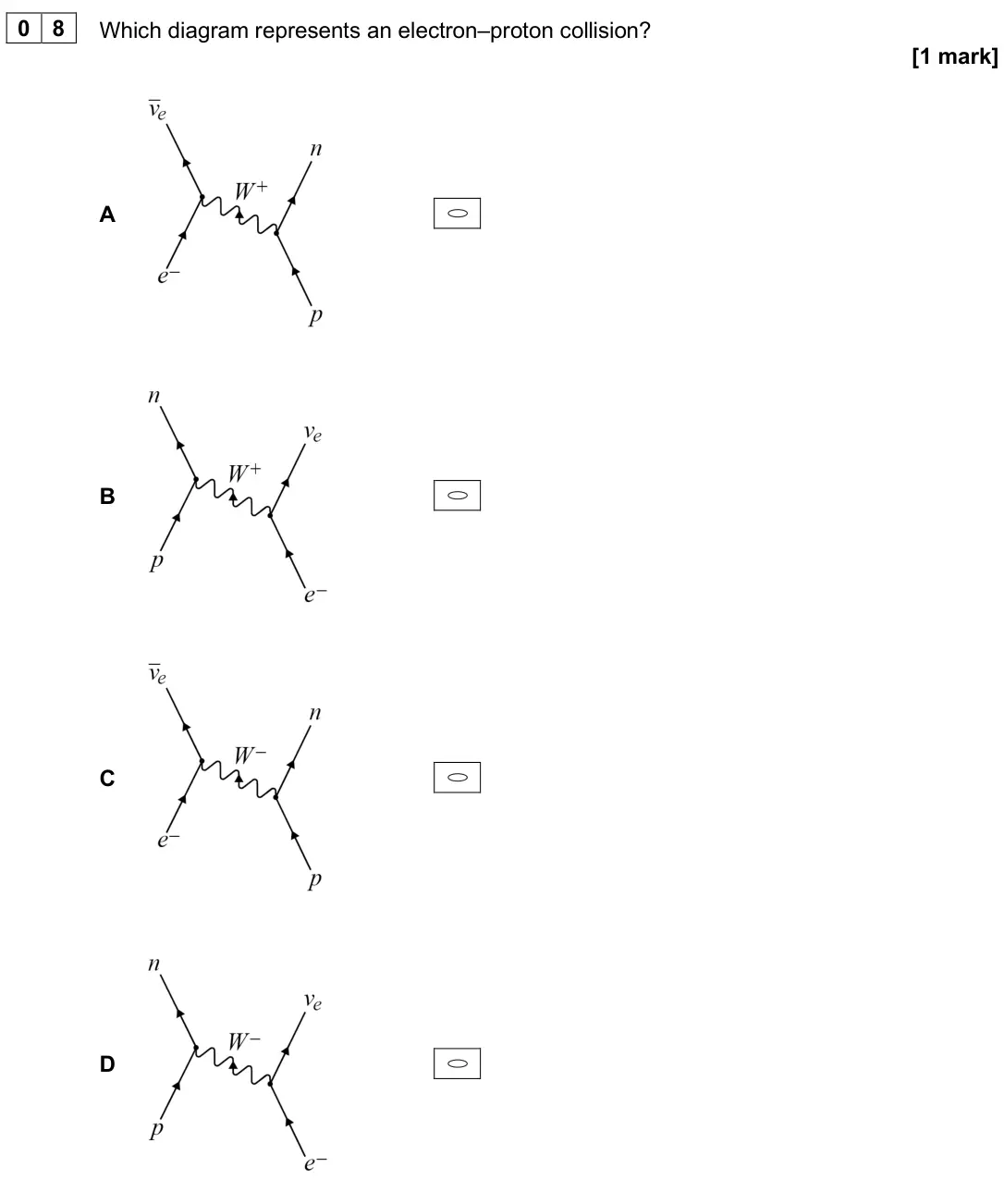
- June 2025, AS Paper 2, Q08 (1 mark): Which diagram represents an electron–proton collision? [1 mark] A B C D
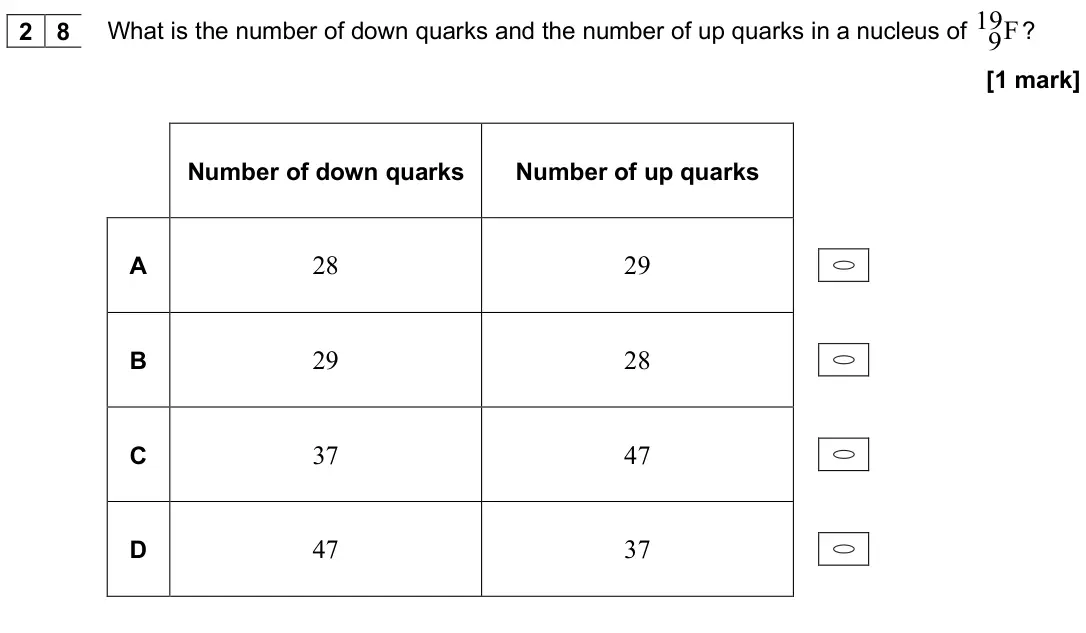
- June 2025, AS Paper 2, Q28 (1 mark): What is the number of down quarks and the number of up quarks in a nucleus of 19F 9 ? [1 mark] Number of down quarks Number of up quarks A 28 29 B 29 28 C 37 47
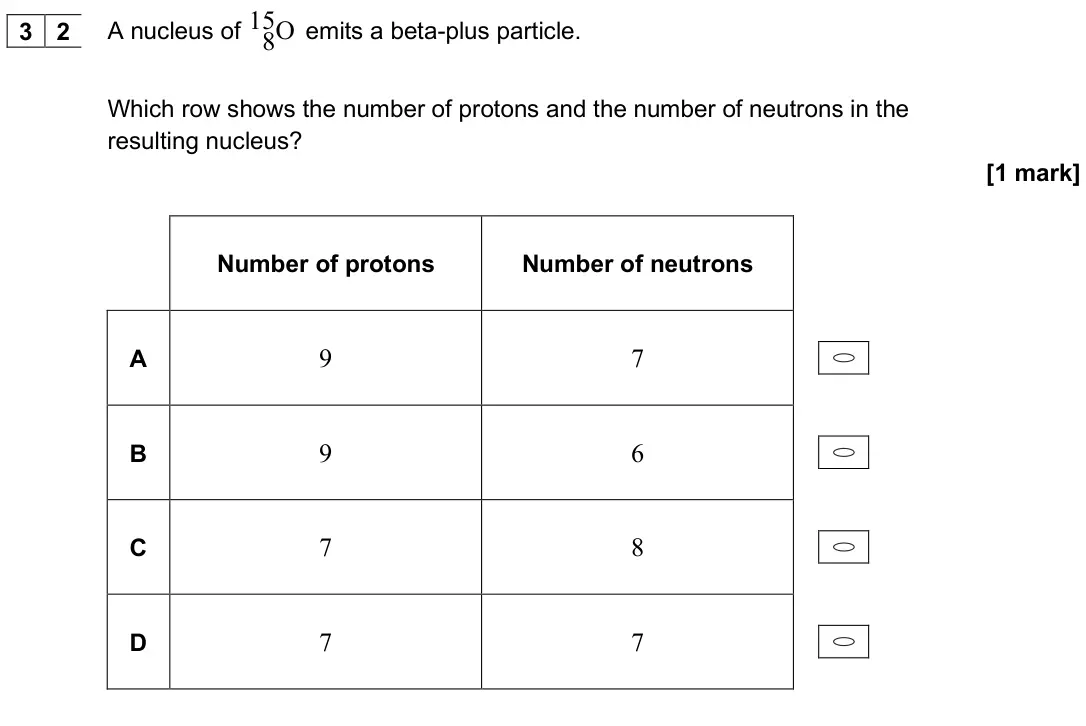
- June 2025, AS Paper 2, Q32 (1 mark): A nucleus of 15O 8 emits a beta-plus particle. Which row shows the number of protons and the number of neutrons in the resulting nucleus? [1 mark] Number of pro
- June 2024, Paper 1, Q01.1 (1 mark): State the names of the four fundamental interactions. [1 mark] 1 2 3 4
- June 2024, Paper 1, Q01.2 (1 mark): State the products of the decay of a free neutron. [1 mark]
- June 2024, Paper 1, Q01.3 (2 marks): Explain which of the fundamental interactions is responsible for the decay of the neutron. [2 marks]
- June 2024, Paper 1, Q01.4 (3 marks): The forces between two moving electrons cause their paths to change. Explain, using the concept of exchange particles, why the electron paths change. [3 marks]
- June 2024, Paper 1, Q02.1 (2 marks): Identify the classifications of each particle in Table 1. Tick () the appropriate boxes for each particle. [2 marks] Table 1 Particle Baryon Hadron Lepton Meso
- June 2024, Paper 1, Q02.2 (3 marks): A conservation rule predicts that the following interaction cannot occur: 0 + n Σ + − − π →Κ State the conservation rule. Go on to explain your answer. [3 marks
- June 2024, Paper 1, Q02.3 (2 marks): Compare the rest energies of the particles involved in this decay. [2 marks]
- June 2024, Paper 1, Q02.4 (1 mark): The decay of the neutral pion leads to the production of further gamma photons. Explain why. [1 mark]
- June 2024, Paper 1, Q02.5 (1 mark): The Standard Model is a theory that classifies elementary particles. Evidence for the theory has been collected since about 1950. However, the term Standard Mod
- June 2024, Paper 1, Q08 (1 mark): [multiple choice] Which nuclear change results in the nucleus with the greatest specific charge? [1 mark] A the alpha decay of a 209Po 82 nucleus B the beta-min
- June 2024, AS Paper 1, Q01.1 (2 marks): Explain, with reference to appropriate conservation laws, why the electron is emitted in this interaction. [2 marks]
- June 2024, AS Paper 1, Q01.2 (2 marks): Calculate the specific charge of the argon-37 nucleus. [2 marks] specific charge = C kg−1
- June 2024, AS Paper 1, Q01.3 (4 marks): In a different interaction, the argon-37 nucleus interacts with an electron. Figure 1 represents the interaction of a quark in a baryon of the nucleus. Figure 1
- June 2024, AS Paper 1, Q01.4 (6 marks): The argon-37 nucleus decays into a stable nucleus. Describe the nature of the forces that act between nucleons and how these forces can maintain nuclear stabili
- June 2024, AS Paper 2, Q05 (1 mark): [multiple choice] A sequence of radioactive decays starts with nuclide P and ends with an isotope of P. Which is a possible sequence for these decays? [1 mark]
- June 2024, AS Paper 2, Q08 (1 mark): The alpha particle, positron and proton have different charge-to-mass ratios. Which row shows the particles that have the greatest and the smallest value of thi
- June 2024, AS Paper 2, Q16 (1 mark): The quark structure of the antiparticle of the K+ meson is [1 mark] A us B ud C us D ds
- June 2023, Paper 1, Q01.1 (1 mark): Deduce the quark structure of a Λ0. [1 mark]
- June 2023, Paper 1, Q01.2 (2 marks): State and explain which interaction is involved in this decay. [2 marks]
- June 2023, Paper 1, Q01.3 (1 mark): An antiparticle of the neutral lambda particle decays into a neutral pion and particle X. Identify X. [1 mark]
- June 2023, Paper 1, Q01.5 (1 mark): The discovery of particles such as the Λ0 is made by large international research teams. Suggest one reason for this. [1 mark]
- June 2023, Paper 1, Q09 (1 mark): A nucleus contains N neutrons and Z protons. Which combination of N and Z gives a nucleus with the greatest specific charge? [1 mark] N Z A 6 5 B 8 7 C 16 13 D
- June 2023, Paper 1, Q10 (1 mark): Which statement about muons is correct? [1 mark] A They consist of a quark and an antiquark. B They include pions and kaons. C They are subject to the strong in
- June 2023, Paper 1, Q11 (1 mark): The diagram represents a quark change in which an electron antineutrino is produced. What are E, F and G? [1 mark] E F G A up quark down quark β− B down quark u
- June 2023, AS Paper 1, Q01.1 (2 marks): Complete Table 1. [2 marks]
- June 2023, AS Paper 1, Q01.2 (2 marks): Calculate, in J, the rest energy of the Ω−. [2 marks] rest energy = J
- June 2023, AS Paper 1, Q01.3 (2 marks): Suggest how energy is conserved in this interaction. Refer to the rest energies of the particles in Table 1. [2 marks]
- June 2023, AS Paper 1, Q01.4 (4 marks): Deduce the quark structure of the Λ0 particle. [4 marks] quark structure of Λ0 =
- June 2023, AS Paper 1, Q01.6 (1 mark): The negative pion π− decays. Which row shows the particles that could be created in this decay? Tick () one box. [1 mark] μ− + νμ e e + v − e e + ν − e + e + e
- June 2023, AS Paper 2, Q14 (1 mark): An electron and a positron annihilate each other. Which quantity is not conserved in the annihilation? [1 mark] A electric charge B kinetic energy C lepton numb
- June 2023, AS Paper 2, Q15 (1 mark): Which exchange particle transfers charge during electron capture? [1 mark] A meson B pion C virtual photon D W boson
- June 2023, AS Paper 2, Q16 (1 mark): A free neutron decays to produce a proton and [1 mark] A an electron and an antineutrino. B an electron and a neutrino. C a positron and an antineutrino. D a po
- June 2023, AS Paper 2, Q23 (1 mark): The concept of exchange particles was introduced to explain forces between elementary particles. This concept requires that exchange particles have [1 mark] A c
- June 2022, Paper 1, Q01.2 (2 marks): A 3 2He nucleus can be produced by the decay of a tritium nucleus 3 1H. State and explain which exchange particle is responsible for this decay. [2 marks]
- June 2022, Paper 1, Q02.1 (1 mark): State the change of quark character in β− decay. [1 mark]
- June 2022, Paper 1, Q02.2 (2 marks): Figure 2 shows the distribution of kinetic energies of β− particles from the decay of carbon-14. Figure 2 Explain how Figure 2 supports the existence of the ant
- June 2022, Paper 1, Q02.3 (1 mark): Identify particle X. [1 mark]
- June 2022, Paper 1, Q02.4 (3 marks): The positron released in this interaction is annihilated when it encounters an electron. A pair of gamma photons is then produced. Particle X can be absorbed by
- June 2022, Paper 1, Q10 (1 mark): What is the specific charge of a 13 6C nucleus? [1 mark] A 4.4 × 10⁷ C kg–1 B 5.2 × 10⁷ C kg–1 C 8.3 × 10⁷ C kg–1 D 2.1 × 10⁸ C kg–1
- June 2022, Paper 1, Q11 (1 mark): Which row describes the variation with distance of the strong nuclear force? [1 mark] Attractive Repulsive A beyond 3 fm from 0.5 fm to 3 fm B from 0.5 fm to 3
- June 2022, Paper 1, Q12 (1 mark): Which statement is correct? [1 mark] A All strange particles are mesons. B Strange particles are always created in pairs. C Strangeness can only change in stron
- June 2022, Paper 1, Q13 (1 mark): Which combination of quarks is possible? [1 mark] A sd B sū C sūd D ud
- June 2022, AS Paper 1, Q01.1 (2 marks): Complete Table 1 to show the baryon number B, charge Q and strangeness S for the particles in this interaction. [2 marks] Table 1 π+ p Σ+ Y B 0 Q +1 +1 +1 S +1
- June 2022, AS Paper 1, Q01.2 (1 mark): Which particle in Table 1 has the quark structure uus? Tick () one box. [1 mark] π+ p Σ+ Y
- June 2022, AS Paper 1, Q01.3 (3 marks): Deduce which particle, π+ or Y, has the greater charge-to-mass ratio. Justify your conclusion. [3 marks]
- June 2022, AS Paper 1, Q02.1 (2 marks): In the experiment, the gas is ionised by a beam of electrons. Explain how the beam of electrons causes a particle of the gas to have a charge of +1e. [2 marks]
- June 2022, AS Paper 1, Q02.2 (2 marks): Bromine has a proton number of 35 The two isotopes in the sample have different nucleon numbers. Calculate the number of neutrons for the isotope that has the g
- June 2022, AS Paper 1, Q02.3 (2 marks): Deduce the percentage of each isotope in the gas. Justify your conclusion. [2 marks]
- June 2022, AS Paper 2, Q05 (1 mark): [multiple choice] Which row has the largest value for specific charge of the particle in column ? specific charge of the particle in column X Y [1 mark] X Y A e
- June 2022, AS Paper 2, Q08 (1 mark): Which diagram represents the process of electron capture? [1 mark] A B C D A B C D
- June 2022, AS Paper 2, Q09 (1 mark): Which row is correct? [1 mark] Name of particle Classification Quark structure A antineutron meson uu d B positive kaon baryon u s C antiproton baryon uu d D po
- June 2022, AS Paper 2, Q10 (1 mark): An alpha particle and a nucleus of boron 10B 5 interact to form an unstable nucleus and a free neutron. The unstable nucleus decays by positron emission to form
- November 2021, Paper 1, Q01.1 (3 marks): Determine the number of neutrons in nucleus X. [3 marks] number of neutrons =
- November 2021, Paper 1, Q01.3 (2 marks): The π+ decays to produce a positron and an electron neutrino. Show how the conservation laws apply to this decay. [2 marks]
- November 2021, Paper 1, Q01.4 (2 marks): The K+ decays to produce an anti-muon and a muon neutrino. Explain how strangeness applies in this decay. [2 marks]
- November 2021, Paper 1, Q01.5 (2 marks): Write an equation for a K+ decay that involves only hadrons. [2 marks]
- November 2021, Paper 1, Q09 (1 mark): The gravitational force is one of the four fundamental forces. The ticks in the table match particles with the other fundamental forces. In which row is the par
- November 2021, Paper 1, Q11 (1 mark): The diagram represents a particle interaction. Which row identifies particles E, F and G? [1 mark] E F G A up quark down quark neutrino B down quark up quark ne
- November 2021, Paper 1, Q12 (1 mark): The quark combination of a particle is sū. Which is true for this particle? [1 mark] A It has a baryon number of 1 B It has a charge of −1.6 × 10⁻¹⁹ C. C It is
- November 2021, AS Paper 1, Q01.1 (1 mark): Identify the number of neutrons in a nucleus of polonium-210 ( ) 210Po 84 . Tick () one box. [1 mark] 84 126 210 294
- November 2021, AS Paper 1, Q01.2 (2 marks): A polonium-210 nucleus is formed when a stationary nucleus of bismuth-210 decays. A beta-minus (β−) particle is emitted in this decay. Outline, with reference t
- November 2021, AS Paper 1, Q01.3 (2 marks): Explain how the data in Figure 1 support the hypothesis that a third particle is produced during β− decay. [2 marks]
- November 2021, AS Paper 1, Q01.4 (2 marks): This third particle is an electron antineutrino. Explain why an electron antineutrino, rather than an electron neutrino, is produced during β− decay. [2 marks]
- November 2021, AS Paper 1, Q01.5 (2 marks): A large tank of water is used as part of an electron antineutrino detector. An electron antineutrino νതe enters the tank and interacts with a proton (p). Figure
- November 2021, AS Paper 1, Q01.6 (3 marks): The positron produced in the interaction in Figure 2 slows down and collides with a lepton in a molecule of water. Describe the process that occurs when the pos
- November 2021, AS Paper 1, Q01.7 (3 marks): The range of the electromagnetic interaction is infinite. Table 1 gives the range of the strong nuclear interaction and the range of the weak nuclear interactio
- November 2021, AS Paper 2, Q06 (1 mark): [multiple choice] An atom of oxygen-15 ( ) 15O 8 gains two electrons to form an ion. What is the specific charge of the ion? [1 mark] A −1.3 × 10⁷ C kg−1 B −2.4
- November 2021, AS Paper 2, Q07 (1 mark): Which is an exchange particle for the weak interaction? [1 mark] A lepton B photon C pion D W+
- November 2021, AS Paper 2, Q08 (1 mark): A particular baryon has a quark structure dss and decays by the weak interaction. What are possible decay products of this baryon? The quark structure of Λ0 is
- November 2021, AS Paper 2, Q09 (1 mark): A muon and an antimuon annihilate to produce the minimum number of photons. What is the maximum wavelength of the photons? [1 mark] A 5.9 × 10⁻¹⁵ m B 1.2 × 10⁻¹
- November 2021, AS Paper 2, Q12 (1 mark): Which row describes the nature of the strong nuclear force between two nucleons at separations of 0.25 fm, 2.0 fm and 8.0 fm? [1 mark] At a separation of 0.25 f
- November 2021, AS Paper 2, Q14 (1 mark): What are the products when a free neutron decays? [1 mark] A p + e− + ev B p + e+ + ev C p + e− + ev D p + e+ + ev
- November 2021, AS Paper 2, Q35 (1 mark): Which shows the classification of particles? [1 mark] A B C D A B C D
- November 2020, Paper 1, Q01.1 (2 marks): Determine whether the following reaction is a possible decay for the neutral pion π0. π0 → e− + μ+ + ev [2 marks]
- November 2020, Paper 1, Q01.2 (1 mark): State the two possible quark configurations of a π0. [1 mark] 1 2
- November 2020, Paper 1, Q01.3 (2 marks): A student suggests that the kaon K0 and the anti-kaon K0 തതതത are the same particle. Discuss whether this suggestion is correct. [2 marks]
- November 2020, Paper 1, Q01.4 (4 marks): The nucleus is held together by a force. It was predicted that a particle exists that is responsible for this force. The particle itself must experience this fo
- November 2020, AS Paper 1, Q01.1 (2 marks): Determine the lepton number, strangeness and charge of particle X. [2 marks] lepton number = strangeness = charge =
- November 2020, AS Paper 1, Q01.2 (1 mark): Identify particle X. [1 mark]
- November 2020, AS Paper 1, Q01.3 (1 mark): A possible decay of a negative pion is π− → e− + Y What is particle Y? Tick () one box. [1 mark] νതe ve π0 n 0 1
- November 2020, AS Paper 1, Q01.4 (6 marks): Some subatomic particles are classified as hadrons. There are two classes of hadrons. Discuss the nature of hadrons. Your answer should include: • the identifyi
- November 2020, AS Paper 1, Q04.1 (1 mark): The sample is ionised, producing ions each with a charge of +1.6 × 10⁻¹⁹ C. The specific charge of an ion of X is 8.7 × 10⁶ C kg–1. Calculate the mass of an ion
- November 2020, AS Paper 1, Q04.2 (2 marks): Determine the number of nucleons in a nucleus of X. mass of a nucleon = 1.7 × 10⁻²⁷ kg [2 marks] number of nucleons =
- November 2020, AS Paper 1, Q04.3 (2 marks): Compare the nuclear compositions of X and Y. [2 marks]
- November 2020, AS Paper 1, Q04.4 (2 marks): Ions of Y have the same charge as ions of X. State and explain how the specific charge of an ion of X compares with that of an ion of Y. [2 marks]
- November 2020, AS Paper 1, Q04.5 (3 marks): Table 1 contains data about two completely ionised samples of pure boron. Each sample contains only isotopes X and Y. Table 1 Sample number Number of ions in sa
- November 2020, AS Paper 2, Q06 (1 mark): Which diagram represents electron capture? [1 mark] A B C D A B C D
- November 2020, AS Paper 2, Q08 (1 mark): What is the number of up quarks and down quarks in a Be 4 9 nucleus? [1 mark] Number of up quarks Number of down quarks A 11 16 B 13 14 C 14 13 D 16 11
- November 2020, AS Paper 2, Q09 (1 mark): Which decay of a positive kaon (K+) particle is possible? [1 mark] A K+ → π0 + e+ + v e B K+ → p + vμ C K+ → π+ + π+ + π0 D K+ → μ+ + vμ
- June 2019, Paper 1, Q01.1 (1 mark): Two isotopes of iodine are 125 53 I and 131 53 I. Determine, for these two isotopes, the difference between the constituents of the nuclei. [1 mark]
- June 2019, Paper 1, Q01.2 (1 mark): A 131 53 I nuclide undergoes beta (β–) decay to form a xenon nuclide. State the nucleon number of the xenon nuclide. [1 mark]
- June 2019, Paper 1, Q01.3 (2 marks): A 125 53 I nuclide decays by electron capture to form a tellurium nuclide. State two differences between the constituents of the iodine nucleus and the telluriu
- June 2019, Paper 1, Q01.4 (3 marks): Internal conversion is a process in which a nucleus in an excited state can release its excess energy. In internal conversion all of the excess energy is transf
- June 2019, Paper 1, Q08 (1 mark): [multiple choice] The process of beta plus (β+) decay can be represented by Which row identifies particles X and Y? [1 mark] X Y A W+ e B W+ e C W– e D W– e
- June 2019, AS Paper 1, Q01.1 (2 marks): Deuterium is an isotope of hydrogen. Its nucleus contains one proton and one neutron. Calculate the specific charge of the deuterium nucleus. [2 marks] specific
- June 2019, AS Paper 1, Q01.2 (1 mark): The proton and neutron in the deuterium nucleus are held together by the strong nuclear force. Which is an exchange particle of the strong nuclear force? Tick (
- June 2019, AS Paper 1, Q01.3 (3 marks): The deuterium nucleus is stable. Describe how the variation of the strong nuclear force with distance contributes to the stability of the deuterium nucleus. [3
- June 2019, AS Paper 1, Q01.4 (3 marks): Tritium is an isotope of hydrogen. Its nucleus contains one proton and two neutrons. Tritium undergoes radioactive decay. Three modes of radioactive decay are •
- June 2019, AS Paper 1, Q06.1 (2 marks): State what is meant by an antiparticle. [2 marks]
- June 2019, AS Paper 1, Q06.2 (2 marks): Complete Table 2 with the names of the antiparticles in an atom of antihydrogen. [2 marks] Table 2 Name of particle Name of antiparticle proton electron
- June 2019, AS Paper 1, Q06.3 (3 marks): The particles in antihydrogen can be made by pair production. Calculate the total minimum energy, in J, needed to produce the particles in one atom of antihydro
- June 2019, AS Paper 2, Q03.1 (2 marks): In preparing for a PET scan of a patient’s brain, a small sample of a substance containing unstable nuclei is injected into the patient. A positron is emitted w
- June 2019, AS Paper 2, Q03.2 (2 marks): The positron interacts with an electron, resulting in annihilation. As a result, gamma photons are produced. The energy of each gamma photon is 0.52 MeV. Calcul
- June 2019, AS Paper 2, Q03.3 (1 mark): Figure 5 shows a cross-sectional view of the patient’s head inside a ring of gamma detectors during the PET scan. Figure 5 A positron and an electron meet and a
- June 2019, AS Paper 2, Q03.4 (2 marks): Explain your answer to question 03.3. [2 marks]
- June 2019, AS Paper 2, Q06 (1 mark): Which is a graph of neutron number N plotted against proton number Z for the isotopes of a given element? [1 mark] A B C D A B C D
- June 2019, AS Paper 2, Q08 (1 mark): Which row gives a particle with its quark combination and category? [1 mark] Particle Quark combination Category A Negative pion dū baryon B Positive pion ud ha
- June 2019, AS Paper 2, Q09 (1 mark): Which row gives the numbers of baryons and leptons in an atom of C 6 12 ? [1 mark] Number of baryons Number of leptons A 6 6 B 12 6 C 6 12 D 18 0
- June 2019, AS Paper 2, Q10 (1 mark): A muon [1 mark] A is subject to the strong interaction. B can decay into an electron only. C is a stable particle. D is subject to the weak interaction.
- June 2018, Paper 1, Q09 (1 mark): Fluoride ions are produced by the addition of a single electron to an atom of fluorine F 9 19 . What is the magnitude of specific charge of the fluoride ion? [1
- June 2018, Paper 1, Q10 (1 mark): Two gamma photons are produced when a muon and an antimuon annihilate each other. What is the minimum frequency of the gamma radiation that could be produced? [
- June 2018, Paper 1, Q11 (1 mark): The Σ0 baryon, composed of the quark combination uds, is produced through the strong interaction between a π+ meson and a neutron. π+ + n → Σ0 + X What is the q
- June 2018, Paper 1, Q12 (1 mark): An iodine nucleus decays into a nucleus of Xe−131, a beta-minus particle and particle Y. I → Xe + e −1 0 54 131 53 131 + Y Which is a property of particle Y? [1
- June 2018, AS Paper 1, Q01.1 (3 marks): Describe the interaction that is responsible for keeping protons and neutrons together in a stable nucleus. You should include details of the properties of the
- June 2018, AS Paper 1, Q01.2 (3 marks): Nuclei can decay by alpha decay and by beta decay. In alpha decay only one particle is emitted but in beta decay there are two emitted particles. Explain how ba
- June 2018, AS Paper 1, Q01.3 (2 marks): Kaons are mesons that can be produced by the strong interaction between pions and protons. The equation shows a reaction in which a kaon and a lambda particle a
- June 2018, AS Paper 1, Q01.4 (1 mark): The kaon decays by the weak interaction. The equation shows an example of kaon decay. K0 →π++ π– State one feature of this decay that shows it is an example of
- June 2018, AS Paper 1, Q01.5 (2 marks): There have been considerable advances in our understanding of particle physics over the past 100 years. Explain why it is necessary for many teams of scientists
- June 2018, AS Paper 2, Q03.1 (2 marks): Show that the velocity of an alpha particle with kinetic energy 8.1 × 10⁻¹³ J is approximately 2 × 10⁷ m s–1 specific charge of an alpha particle = 4.81 × 10⁷ C
- June 2018, AS Paper 2, Q05 (1 mark): [multiple choice] The graph of neutron number against proton number shows three nuclei P, Q and R. Which row identifies an isotope of P and the nucleon number o
- June 2018, AS Paper 2, Q07 (1 mark): The partially completed diagram represents electron capture. Which row identifies the exchange particle Q and the quark structure of particle R? [1 mark] Partic
- June 2018, AS Paper 2, Q08 (1 mark): The decay of a neutral kaon K0 is given by the equation e 0 K X Y → + +v What are X and Y? [1 mark] X and Y A e+ and e– B μ+ and e– C π+ and e– D π– and e+
- June 2017, Paper 1, Q01.1 (2 marks): The decay is represented by this equation: K 19 40 + e −1 0 → Ar + Complete the equation to show the decay by filling in the gaps. [2 marks]
- June 2017, Paper 1, Q01.2 (2 marks): Explain which fundamental interaction is responsible for the decay in question 01.1. [2 marks]
- June 2017, Paper 1, Q01.4 (3 marks): The potassium isotope can also decay by a second decay process to form a calcium-40 nuclide ( Ca 20 40 ). Suggest how the emissions from a nucleus of decaying p
- June 2017, Paper 1, Q08 (1 mark): [multiple choice] An atom of N 7 16 gains 3 electrons. What is the specific charge of the ion? [1 mark] A 1.80 × 10⁷ C kg–1 B −1.80 × 10⁷ C kg–1 C 4.19 × 10⁷ C
- June 2017, Paper 1, Q09 (1 mark): Which diagram represents the process of beta-plus decay? [1 mark] A B C D
- June 2017, AS Paper 1, Q01.1 (1 mark): Deduce the name of particle X. [1 mark]
- June 2017, AS Paper 1, Q01.2 (1 mark): State the type of interaction that occurs in this decay. [1 mark]
- June 2017, AS Paper 1, Q01.3 (1 mark): State the class of particles to which the W− belongs. [1 mark]
- June 2017, AS Paper 1, Q01.4 (2 marks): Show clearly how charge and baryon number are conserved in this interaction. You should include reference to all the particles, including the quarks, in your an
- June 2017, AS Paper 1, Q01.5 (1 mark): Name the only stable baryon. [1 mark]
- June 2017, AS Paper 1, Q01.6 (1 mark): A muon is an unstable particle. State the names of the particles that are produced when a muon decays. [1 mark]
- June 2017, AS Paper 2, Q04.1 (2 marks): The mass of a Xe+ ion is 2.18 × 10⁻²⁵ kg. Calculate the specific charge of a Xe+ ion. Give an appropriate unit for your answer. [2 marks] specific charge = unit
- June 2017, AS Paper 2, Q06 (1 mark): Which row shows the correct interactions experienced by a hadron or a lepton? [1 mark] Particle Strong interaction Weak interaction A Hadron Yes Yes B Lepton Ye
- June 2017, AS Paper 2, Q08 (1 mark): When a nucleus of the radioactive isotope Ni 28 65 decays, a β‾ particle and an electron antineutrino are emitted. How many protons and neutrons are there in th
- June 2017, AS Paper 2, Q13 (1 mark): What interactions are involved in the production of a strange particle and its decay into non-strange particles? [1 mark] Production Decay A strong weak B stron
- June 2016, AS Paper 1, Q06.1 (2 marks): State what is meant by isotopes. [2 marks]
- June 2016, AS Paper 1, Q06.2 (2 marks): Explain why two photons are formed instead of a single photon when a helium nucleus annihilates with the anti-helium nucleus. [2 marks]
- June 2016, AS Paper 1, Q06.3 (4 marks): Calculate, using data from the passage, the maximum frequency of the photons produced in this annihilation of a He 2 4 nucleus. [4 marks] frequency = __________
- June 2016, AS Paper 1, Q06.4 (2 marks): Complete this equation for the possible decay of an antineutron. [2 marks]
- June 2016, AS Paper 1, Q06.5 (1 mark): What interaction would be responsible for the decay in Question 6.4? Tick () the correct answer in the right-hand column. [1 mark] if correct electromagnetic
- June 2016, AS Paper 2, Q06 (1 mark): Which equation shows the process of annihilation? [1 mark] A 𝜋−+ 𝜋→𝛾 B p + p →𝛾+ 𝛾 C 𝛽−+ p →𝛾 D 𝛾+ 𝛾→𝛽+ + 𝛽−
- June 2016, AS Paper 2, Q07 (1 mark): Which of the following is not made of quarks? [1 mark] A kaon B muon C neutron D pion
- June 2016, AS Paper 2, Q08 (1 mark): What is the quark structure for antiprotons? [1 mark] A uതdത B dതdതs̅ C dതdതuത D uതuതdത
- June 2016, AS Paper 2, Q09 (1 mark): The equation represents the weak interaction between a negative pion and a proton. 𝜋−+ p →K0 + X What is the charge, baryon number and strangeness of particle X
- Specimen, Paper 1, Q01.1 (2 marks): A common type of smoke detector contains a very small amount of americium-241, Am 95 241 0 1 Determine the number of each type of nucleon in one americium-241 n
- Specimen, Paper 1, Q01.2 (2 marks): A common type of smoke detector contains a very small amount of americium-241, Am 95 241 0 1 Americium-241 is produced in nuclear reactors through the decay of
Questions, mark schemes and examiner’s reports are © AQA, from their published past papers. Plumi isn’t affiliated with any exam board. Want whole papers? Every AQA A-Level Physics paper.
Rather write your answers by hand on iPad? Plumi marks them against the same mark schemes.