 plumi
Electromagnetic radiation and quantum phenomena: AQA A‑Level Physics questions
Every AQA A-Level Physics exam question on 3.2.2 Electromagnetic radiation and quantum phenomena, 2016–2025, with its mark scheme and examiner’s report.
Find questions2,714
Calculations
Q08.3
The whole paper ↗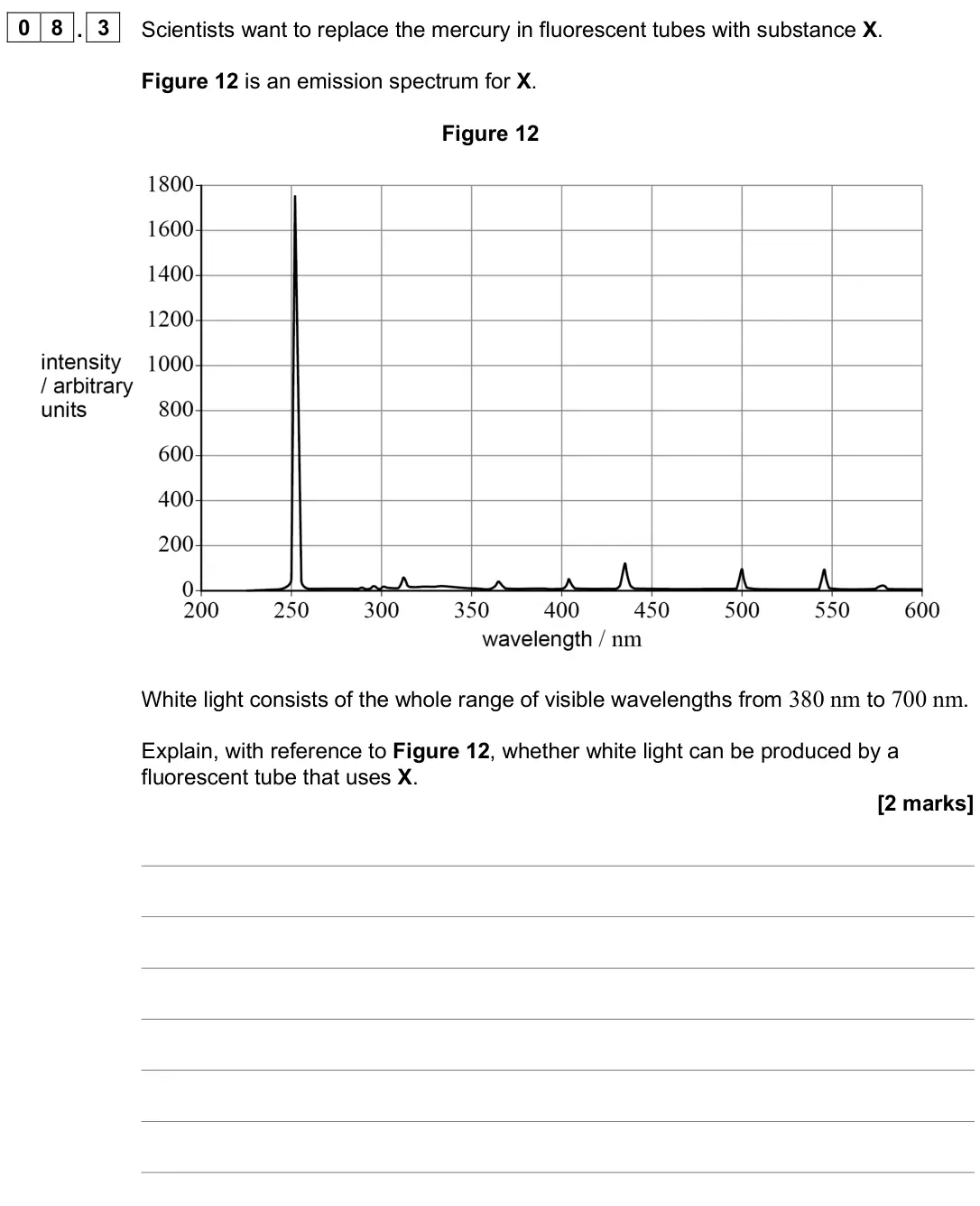
Q08.4
The whole paper ↗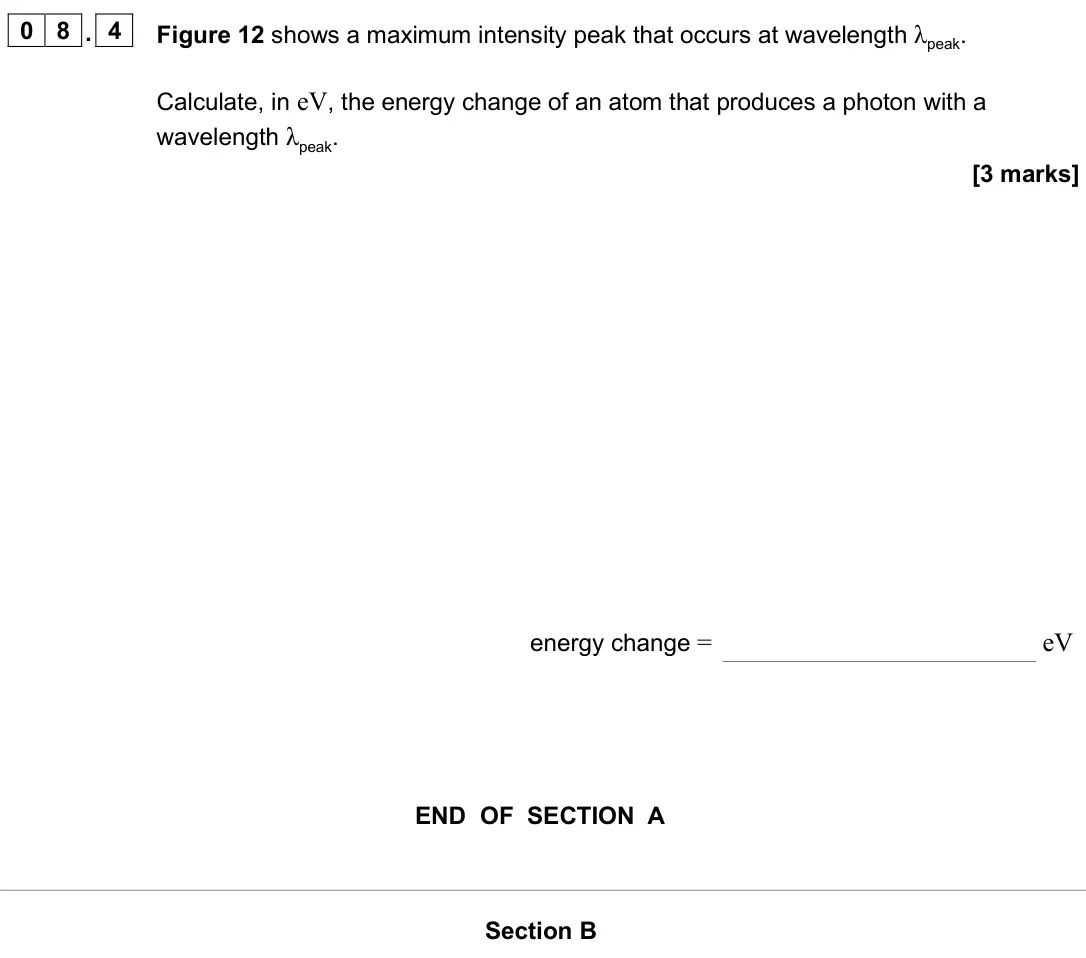
Q03.1
The whole paper ↗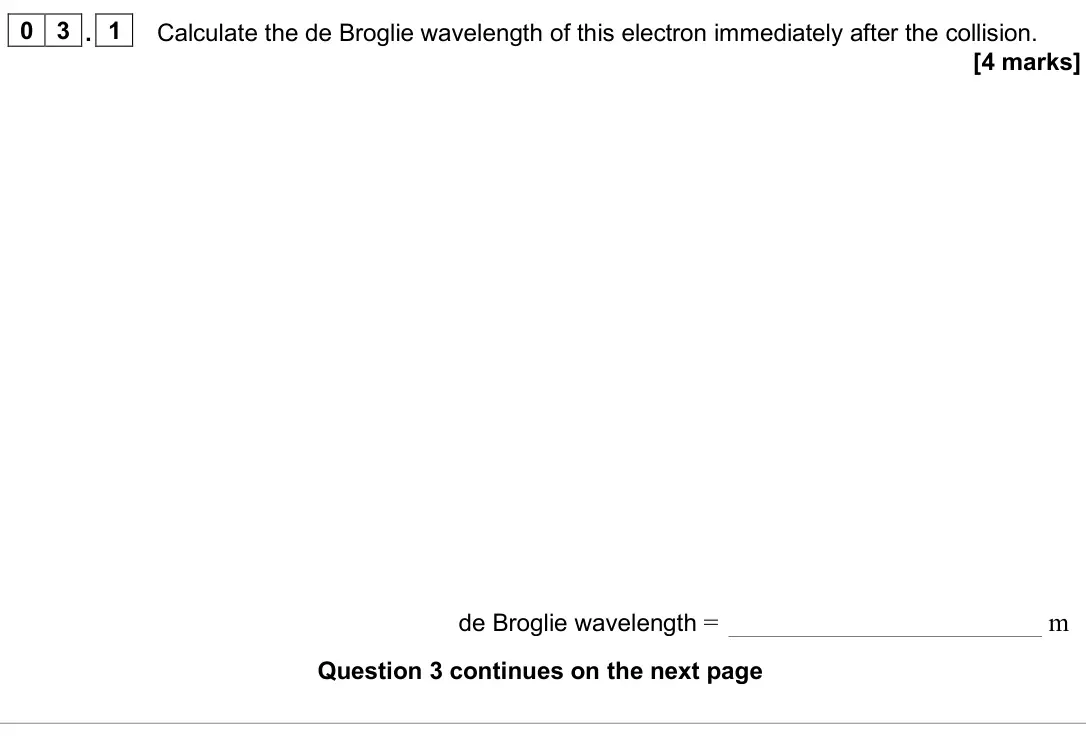
Q03.2
The whole paper ↗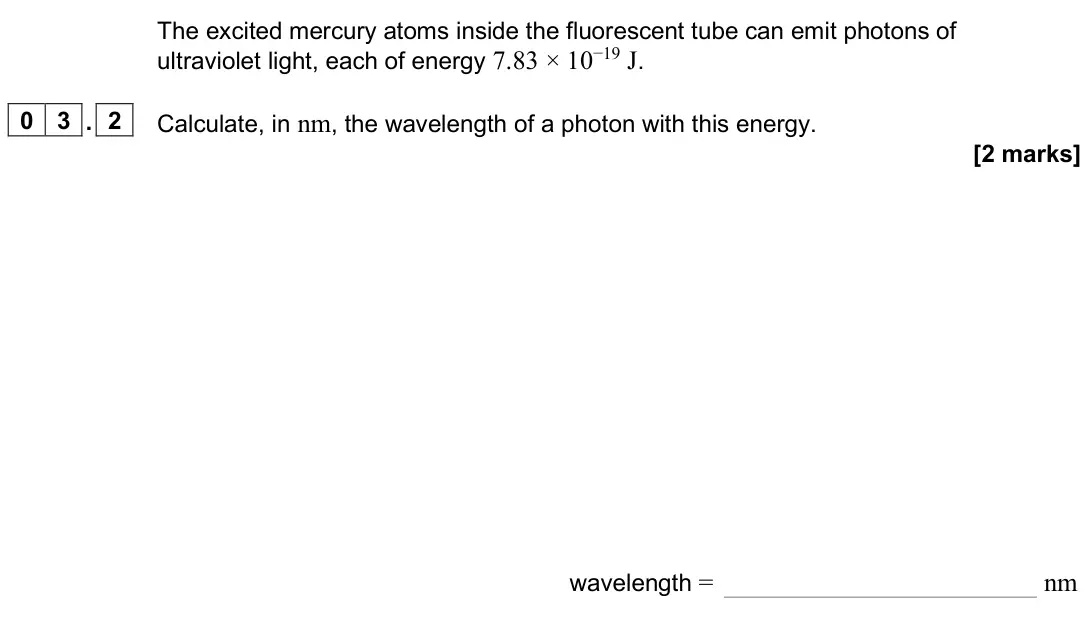
Q03.3
The whole paper ↗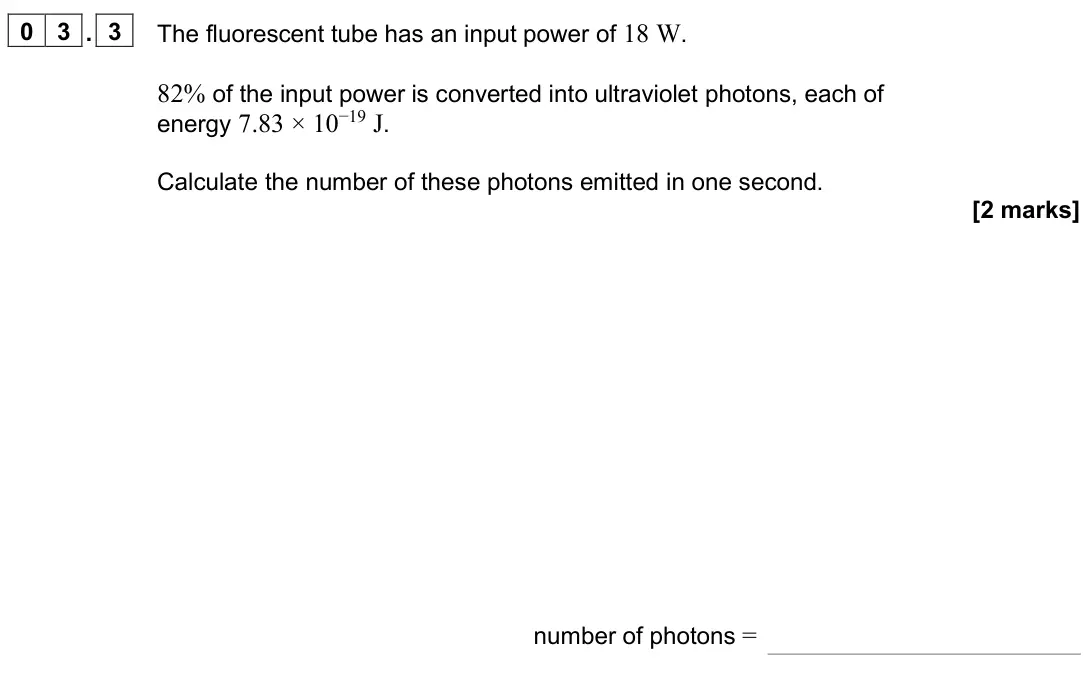
Q03.4
The whole paper ↗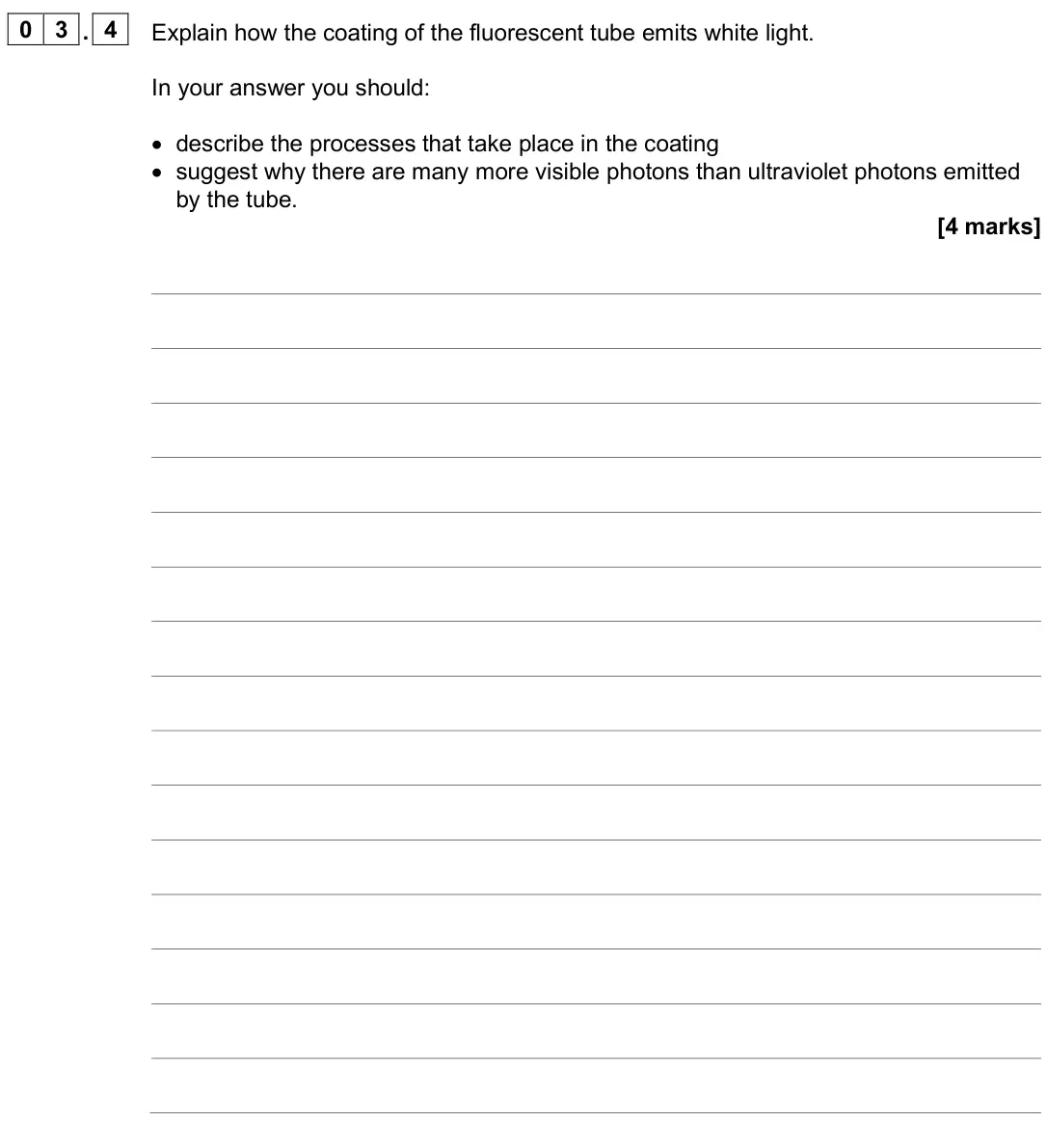
Q07.1
The whole paper ↗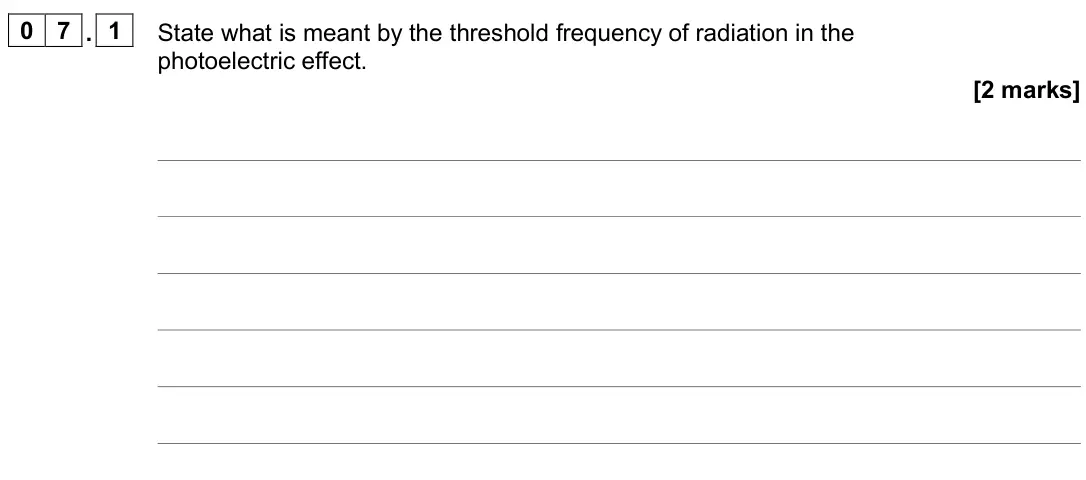
Q07.2
The whole paper ↗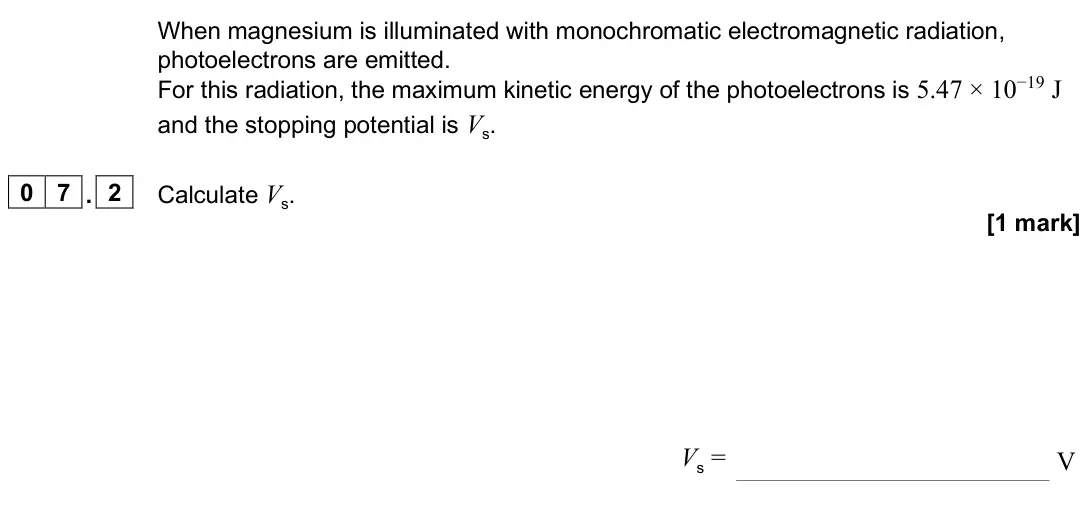
Q07.3
The whole paper ↗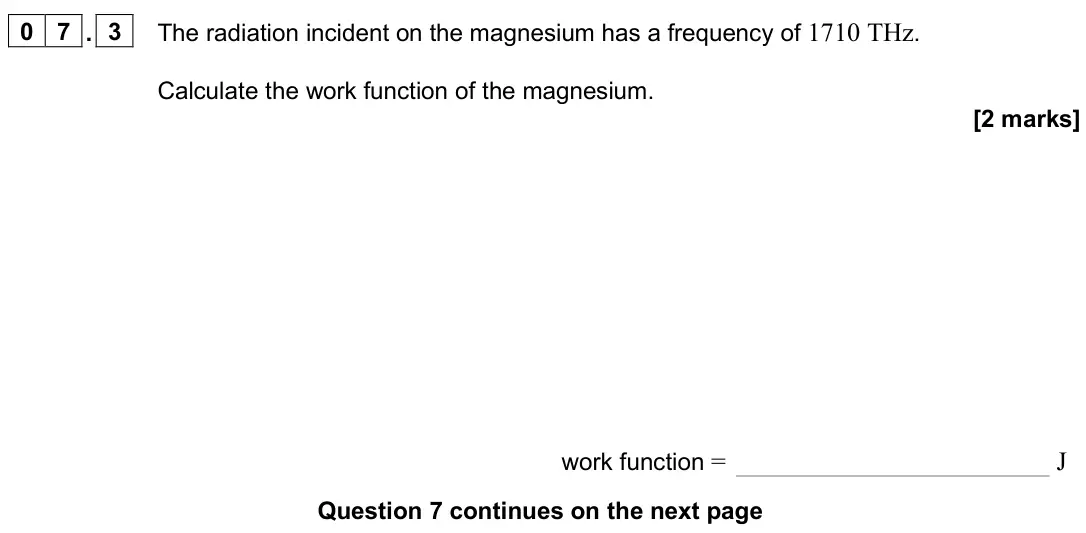
Q07.4
The whole paper ↗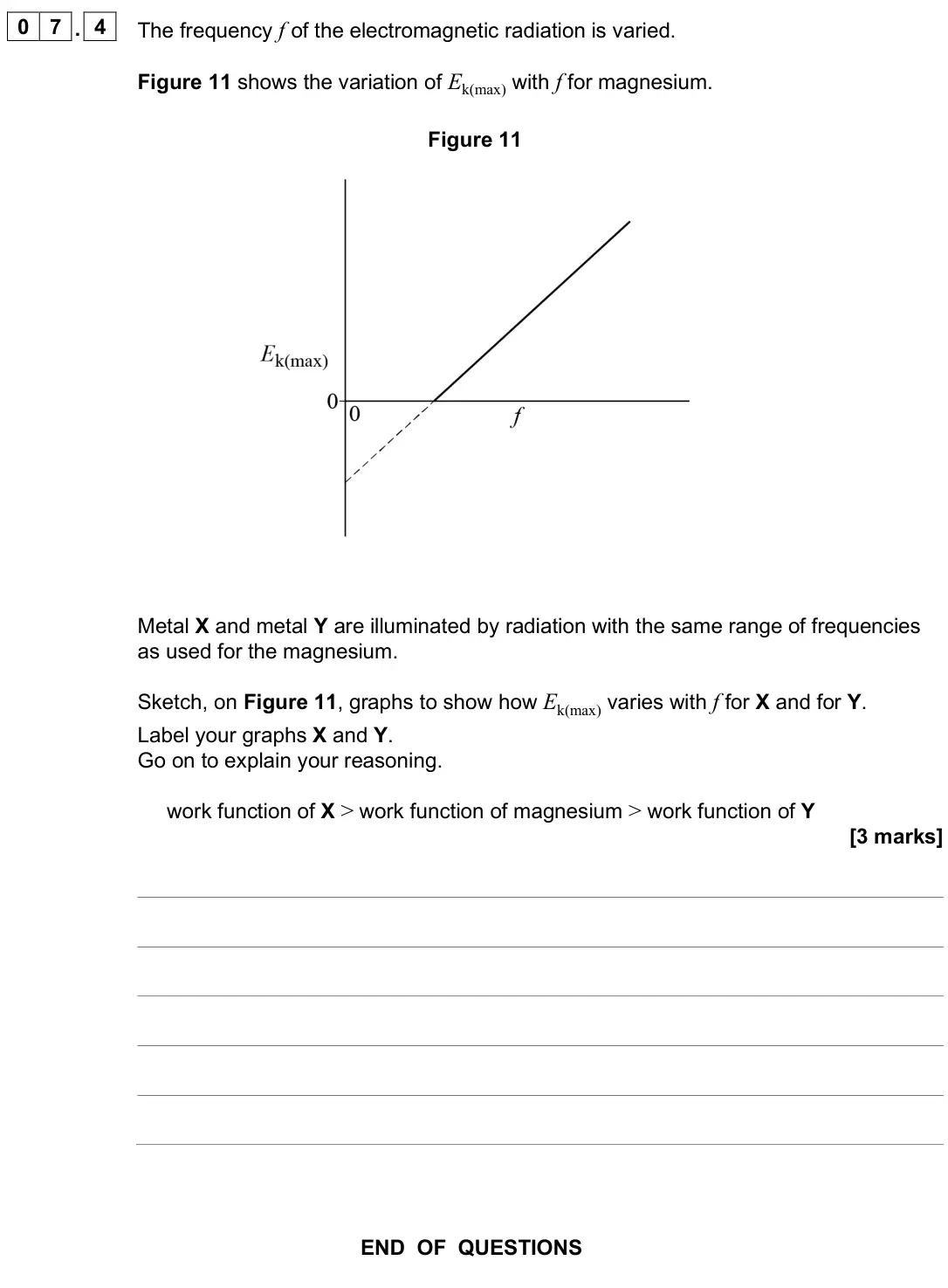
All 115 questions on Electromagnetic radiation and quantum phenomena, as a list
- June 2025, Paper 1, Q08.3 (2 marks): Scientists want to replace the mercury in fluorescent tubes with substance X. Figure 12 is an emission spectrum for X. Figure 12 White light consists of the who
- June 2025, Paper 1, Q08.4 (3 marks): Figure 12 shows a maximum intensity peak that occurs at wavelength λpeak. Calculate, in eV, the energy change of an atom that produces a photon with a wavelengt
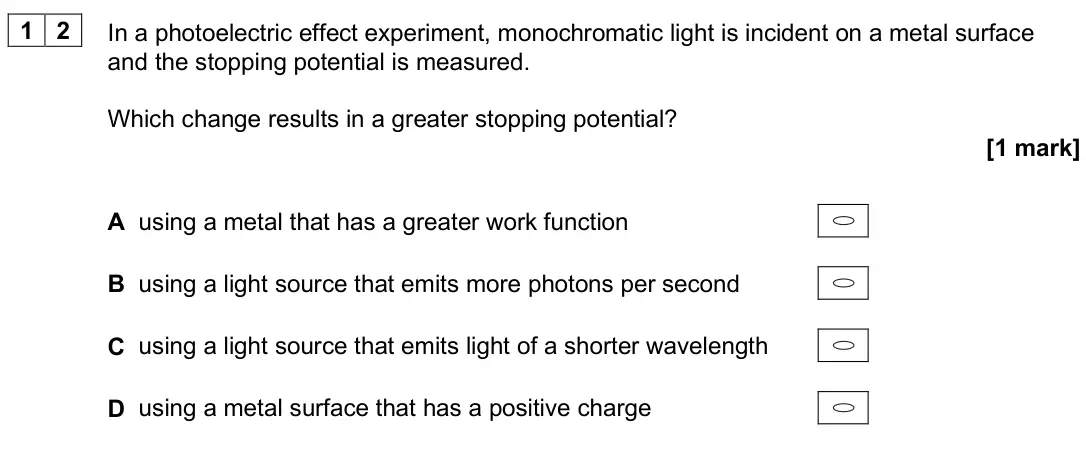
- June 2025, Paper 1, Q12 (1 mark): In a photoelectric effect experiment, monochromatic light is incident on a metal surface and the stopping potential is measured. Which change results in a great
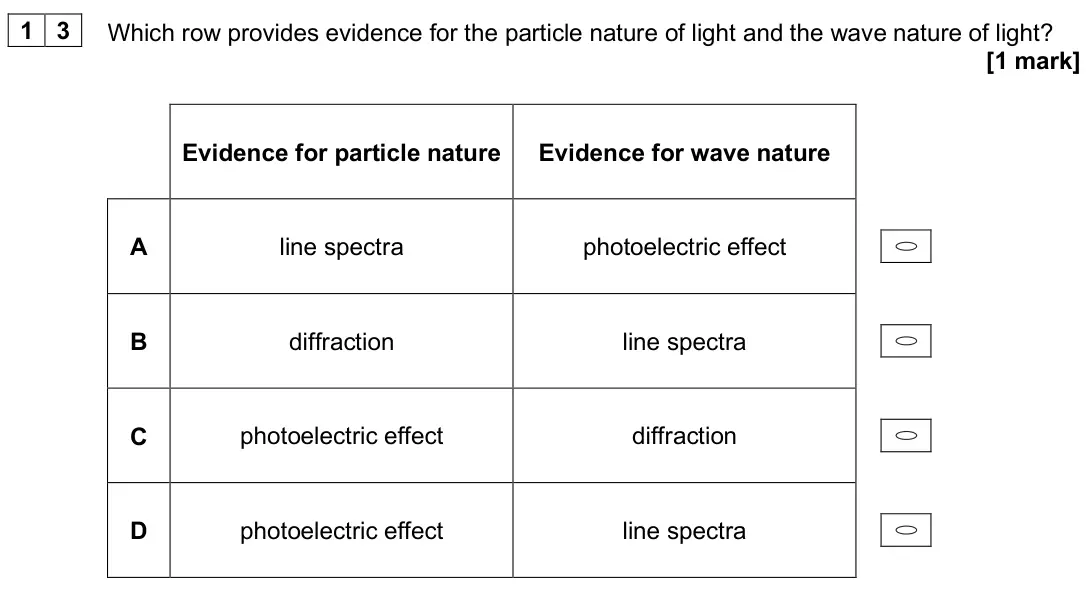
- June 2025, Paper 1, Q13 (1 mark): Which row provides evidence for the particle nature of light and the wave nature of light? [1 mark] Evidence for particle nature Evidence for wave nature A line
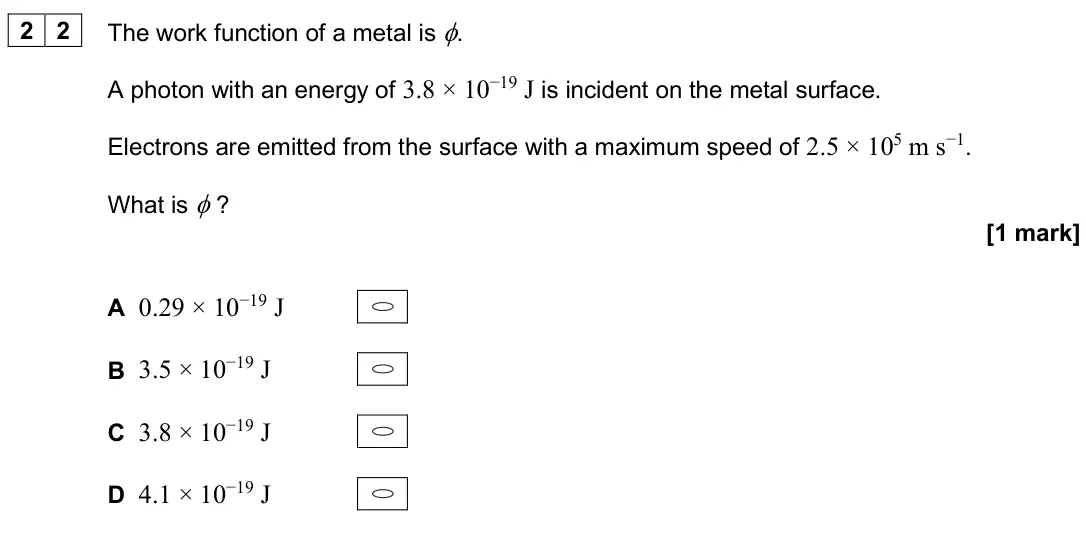
- June 2025, Paper 1, Q22 (1 mark): The work function of a metal is . A photon with an energy of 3.8 × 10⁻¹⁹ J is incident on the metal surface. Electrons are emitted from the surface with a maxim
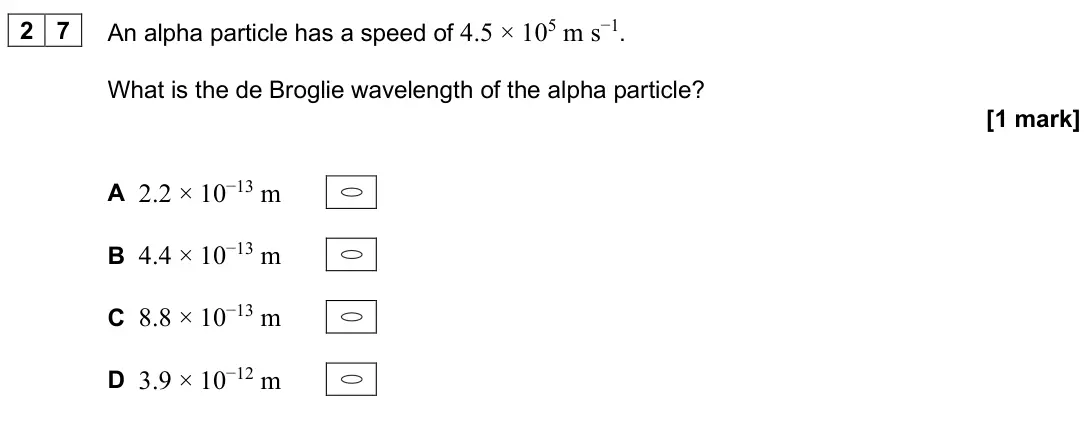
- June 2025, Paper 1, Q27 (1 mark): An alpha particle has a speed of 4.5 × 10⁵ m s−1. What is the de Broglie wavelength of the alpha particle? [1 mark] A 2.2 × 10⁻¹³ m B 4.4 × 10⁻¹³ m C 8.8 × 10⁻¹
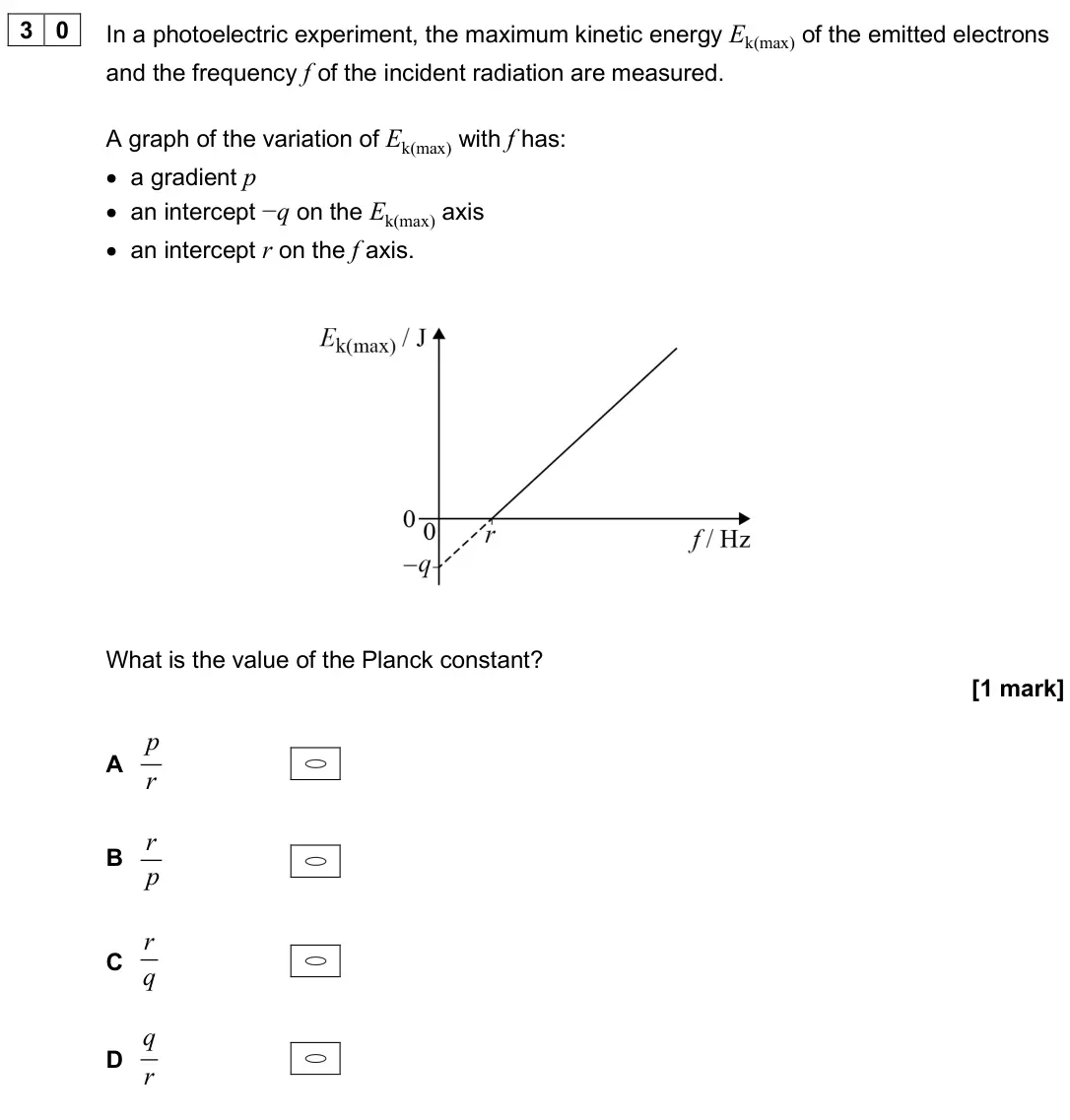
- June 2025, Paper 1, Q30 (1 mark): In a photoelectric experiment, the maximum kinetic energy Ek(max) of the emitted electrons and the frequency f of the incident radiation are measured. A graph o
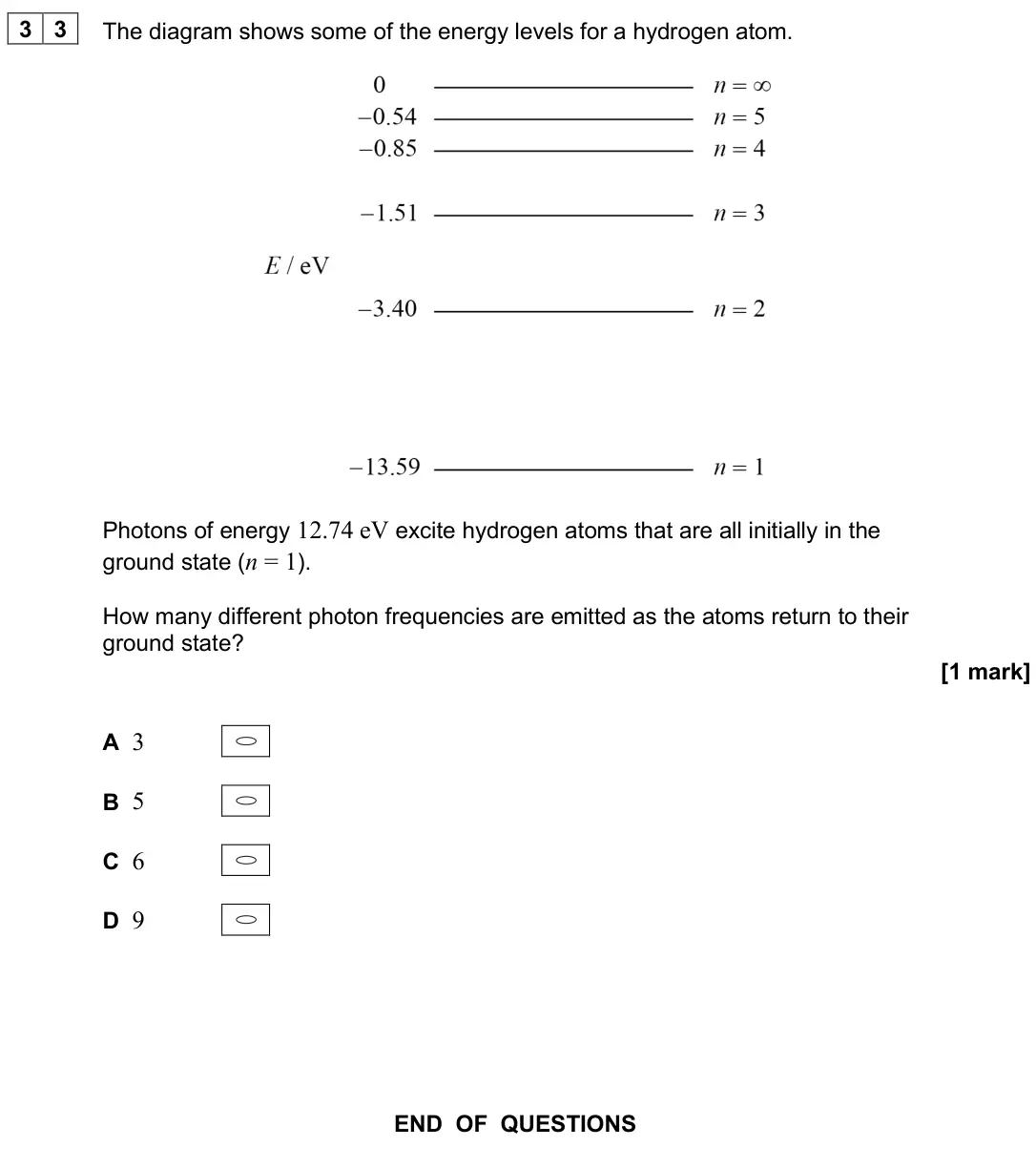
- June 2025, Paper 1, Q33 (1 mark): The diagram shows some of the energy levels for a hydrogen atom. Photons of energy 12.74 eV excite hydrogen atoms that are all initially in the ground state (n
- June 2025, AS Paper 1, Q03.1 (4 marks): Calculate the de Broglie wavelength of this electron immediately after the collision. [4 marks] de Broglie wavelength = m
- June 2025, AS Paper 1, Q03.2 (2 marks): Calculate, in nm, the wavelength of a photon with this energy. [2 marks] wavelength = nm
- June 2025, AS Paper 1, Q03.3 (2 marks): The fluorescent tube has an input power of 18 W. 82% of the input power is converted into ultraviolet photons, each of energy 7.83 × 10⁻¹⁹ J. Calculate the numb
- June 2025, AS Paper 1, Q03.4 (4 marks): Explain how the coating of the fluorescent tube emits white light. In your answer you should: • describe the processes that take place in the coating • suggest
- June 2025, AS Paper 1, Q07.1 (2 marks): State what is meant by the threshold frequency of radiation in the photoelectric effect. [2 marks]
- June 2025, AS Paper 1, Q07.2 (1 mark): Calculate Vs. [1 mark] Vs = V
- June 2025, AS Paper 1, Q07.3 (2 marks): The radiation incident on the magnesium has a frequency of 1710 THz. Calculate the work function of the magnesium. [2 marks] work function = J
- June 2025, AS Paper 1, Q07.4 (3 marks): The frequency f of the electromagnetic radiation is varied. Figure 11 shows the variation of Ek(max) with f for magnesium. Figure 11 Metal X and metal Y are ill
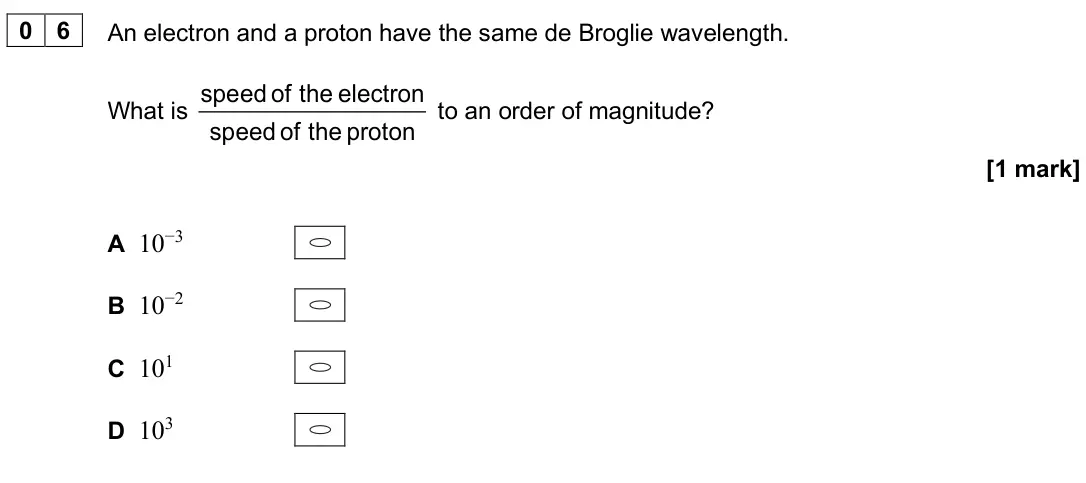
- June 2025, AS Paper 2, Q06 (1 mark): An electron and a proton have the same de Broglie wavelength. What is speed of the electron speed of the proton to an order of magnitude? [1 mark] A 10−3 B 10−2
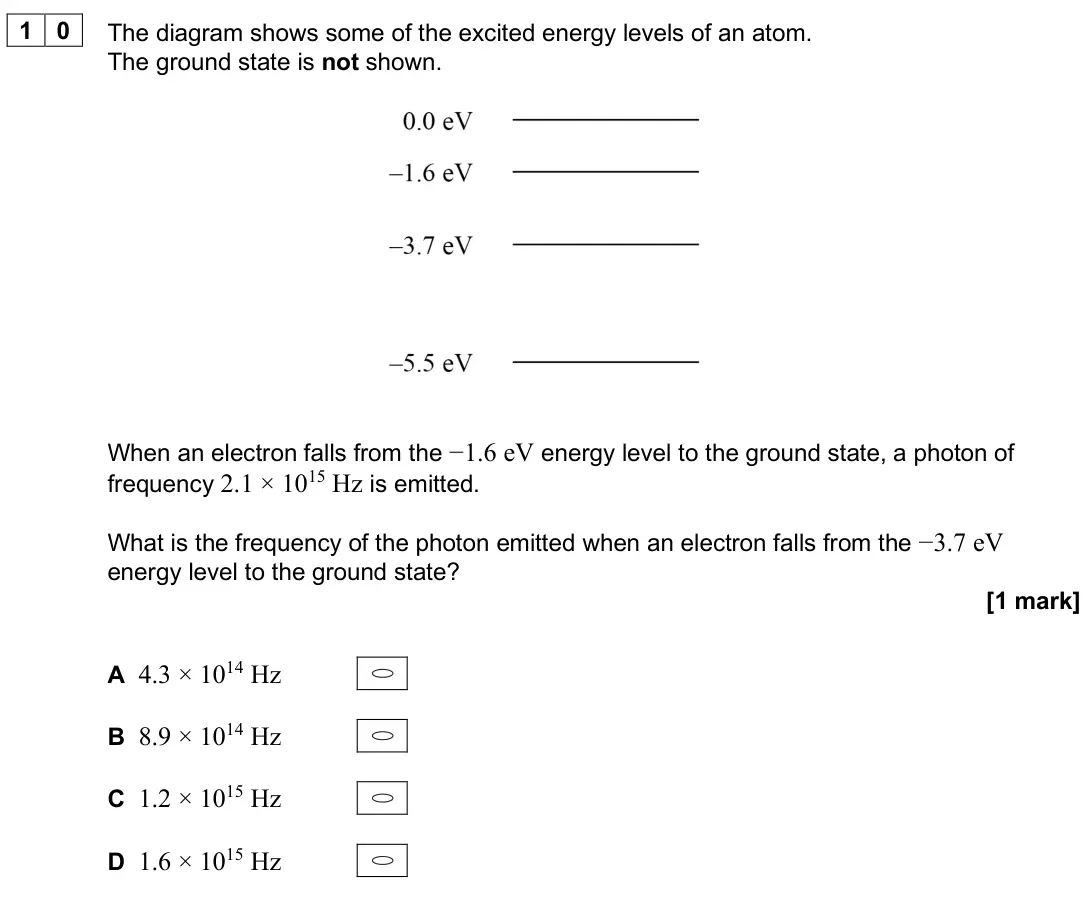
- June 2025, AS Paper 2, Q10 (1 mark): The diagram shows some of the excited energy levels of an atom. The ground state is not shown. When an electron falls from the −1.6 eV energy level to the groun
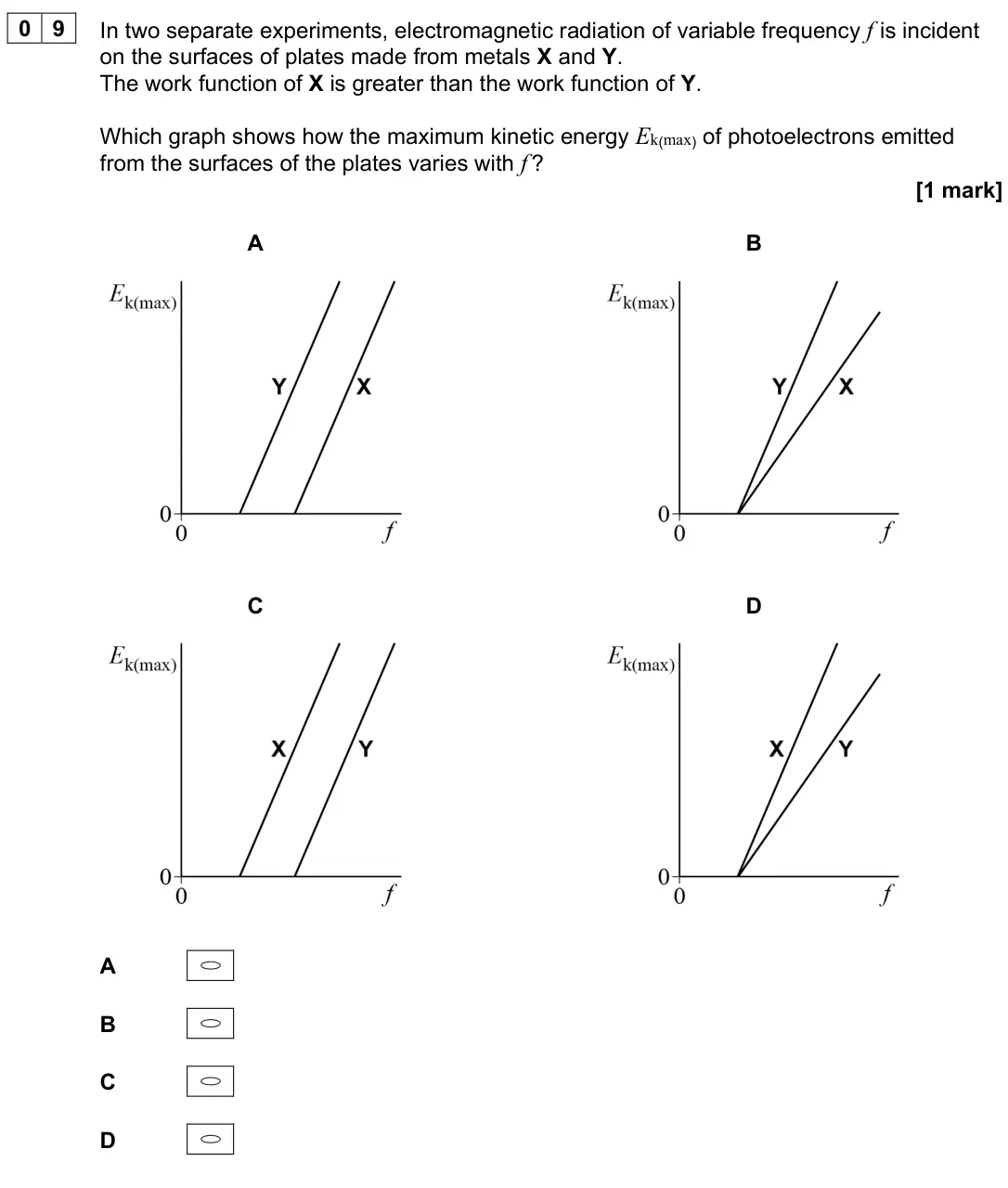
- June 2024, Paper 1, Q09 (1 mark): In two separate experiments, electromagnetic radiation of variable frequency f is incident on the surfaces of plates made from metals X and Y. The work function
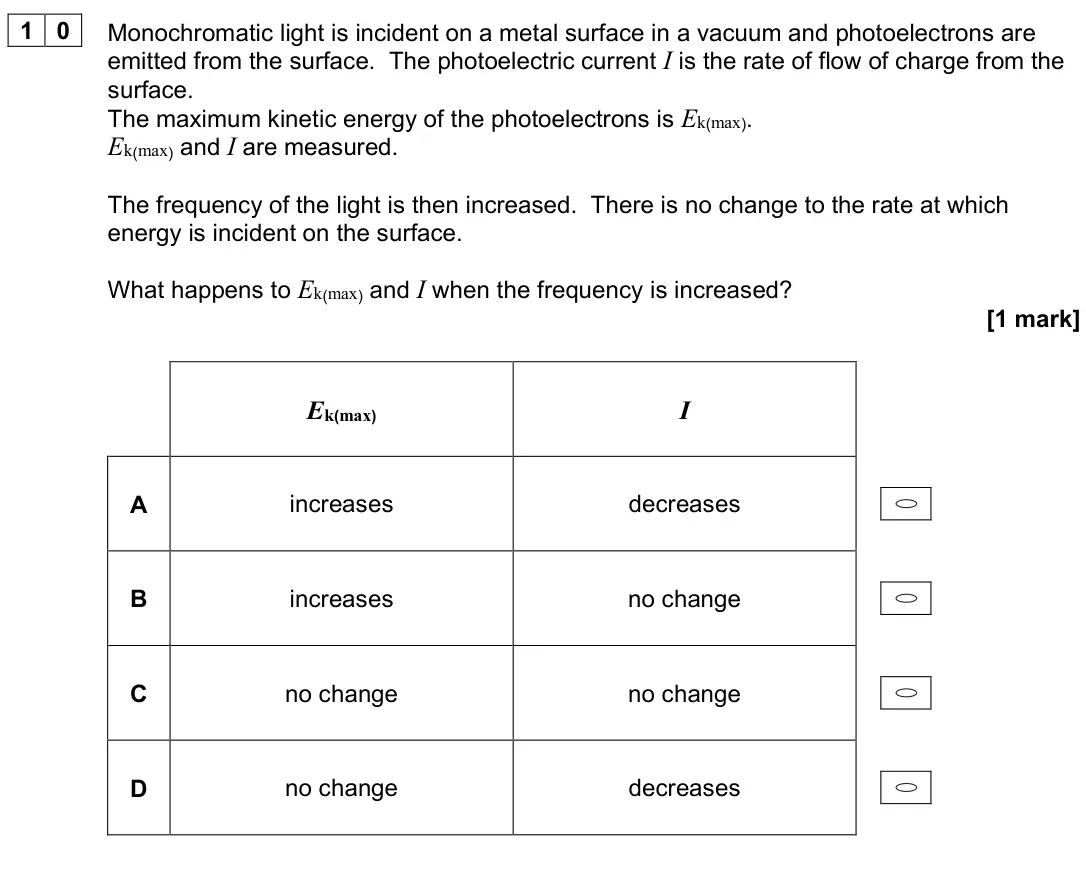
- June 2024, Paper 1, Q10 (1 mark): Monochromatic light is incident on a metal surface in a vacuum and photoelectrons are emitted from the surface. The photoelectric current I is the rate of flow
- June 2024, Paper 1, Q11 (1 mark): Three energy levels for an atom are shown. Energy change E1 leads to the emission of a photon of wavelength λ1. Energy change E2 leads to the emission of a phot
- June 2024, Paper 1, Q12 (1 mark): An electron and a proton move with the same speed. What is de Broglie wavelength of electron ? de Broglie wavelength of proton [1 mark] A 5.5 × 10⁻⁴ B 2.3 × 10−
- June 2024, AS Paper 1, Q02.1 (1 mark): Deduce V. [1 mark] V = V
- June 2024, AS Paper 1, Q02.2 (3 marks): Calculate the wavelength of the emitted photon of this ultraviolet radiation. [3 marks] wavelength = m
- June 2024, AS Paper 1, Q02.3 (4 marks): The experiment is repeated with a different gas. Figure 2 shows the three lowest energy levels for an atom of the gas. Figure 2 When an electron in the beam col
- June 2024, AS Paper 2, Q14 (1 mark): Monochromatic radiation from light source P is incident on a metal surface and photoelectrons are emitted. When monochromatic radiation from light source Q is u
- June 2024, AS Paper 2, Q17 (1 mark): What is the de Broglie wavelength of a positron travelling at 5% of the speed of light? [1 mark] A 2.7 × 10⁻¹⁶ m B 2.7 × 10⁻¹⁴ m C 4.9 × 10⁻¹³ m D 4.9 × 10⁻¹¹ m
- June 2023, Paper 1, Q01.4 (1 mark): The rest energy of a Λ0 is equal to the energy of a photon with a frequency of 2.69 × 10²³ Hz. Determine, in MeV, the rest energy of a Λ0. [1 mark] rest energy
- June 2023, Paper 1, Q12 (1 mark): Photoelectrons are released when monochromatic light with a photon energy of 4.2 × 10⁻¹⁹ J is incident on a metal surface. The work function of the surface is 2
- June 2023, Paper 1, Q13 (1 mark): Electrons with a certain kinetic energy pass through a powdered crystalline sample and are incident on a fluorescent screen. The diagram shows a sketch of the d
- June 2023, AS Paper 1, Q01.5 (2 marks): The π0 decays into gamma photons. Each gamma photon has a wavelength of 1.25 × 10⁻¹⁴ m. Calculate the energy of one of these photons. [2 marks] energy of photon
- June 2023, AS Paper 2, Q12 (1 mark): The four lowest energy levels of an atom are shown. A gas contains atoms in the n = 4 level. The atoms de-excite to the n = 1 level. How many photon frequencies
- June 2023, AS Paper 2, Q13 (1 mark): Monochromatic light of frequency f is incident on a metal surface in a vacuum. Photoelectrons are emitted from the surface. The photoelectric current I is measu
- June 2022, Paper 1, Q01.3 (2 marks): Before helium was identified, some scientists suggested that the lines of the helium spectrum seen in the absorption spectrum of the Sun were due to the presenc
- June 2022, Paper 1, Q01.4 (3 marks): Calculate, in eV, the change in energy level responsible for the spectral line labelled E in Figure 1. [3 marks] change in energy level = eV
- June 2022, Paper 1, Q01.5 (3 marks): Explain, with reference to the processes within an atom, the difference between an emission spectrum and an absorption spectrum. [3 marks]
- June 2022, Paper 1, Q14 (1 mark): In photoelectricity, Vs is the stopping potential. What quantity is eVs? [1 mark] A energy of an incident photon B maximum kinetic energy of a photoelectron C t
- June 2022, Paper 1, Q15 (1 mark): A fluorescent tube contains a gas. The coating of the tube [1 mark] A becomes ionised by the gas and emits photons of ultraviolet light. B absorbs photons of ul
- June 2022, Paper 1, Q16 (1 mark): Which row gives evidence for the wave nature of electrons and evidence for the particulate nature of light? [1 mark] Wave nature of electrons Particulate nature
- June 2022, Paper 1, Q17 (1 mark): Which particle has the smallest de Broglie wavelength? [1 mark] A an electron moving at 4 × 10³ m s−1 B a proton moving at 4 × 10³ m s−1 C an electron moving at
- June 2022, AS Paper 1, Q04.1 (6 marks): Discuss how the rate of loss of charge from the plate depends on the frequency and intensity of the incident radiation. In your answer you should explain why: •
- June 2022, AS Paper 1, Q04.2 (3 marks): Charged particles are emitted from the metal plate with a maximum kinetic energy of 1.1 eV when radiation of frequency 1.2 × 10¹⁵ Hz is incident on the plate. C
- June 2022, AS Paper 1, Q05.1 (2 marks): The electrons demonstrate wave-like and particle-like behaviour as they travel from the filament to the screen. State and explain at which of P, Q or R the elec
- June 2022, AS Paper 1, Q05.2 (3 marks): The apparatus is adjusted so that the electrons are incident on the graphite target with a greater speed. Explain why the bright rings formed on the screen now
- June 2022, AS Paper 2, Q12 (1 mark): The diagram shows the ground state and two higher-energy states X and Y of an atom. A transition from X to the ground state produces a photon of wavelength 147
- June 2022, AS Paper 2, Q13 (1 mark): Which provides evidence for discrete atomic energy levels? [1 mark] A β+ decay B electron diffraction C line spectra D the photoelectric effect
- November 2021, Paper 1, Q13 (1 mark): Monochromatic light with a photon energy of 4.1 × 10⁻¹⁹ J is incident on a metal surface. The maximum speed of the photoelectrons released is 4.2 × 10⁵ m s−1. W
- November 2021, Paper 1, Q14 (1 mark): What is the role of the mercury vapour in a fluorescent tube? [1 mark] A It absorbs photons of UV light and emits visible light. B It absorbs photons of visible
- November 2021, Paper 1, Q15 (1 mark): The diagram shows the three lowest energy levels for an atom. The energy levels have been drawn to scale. Transitions of electrons between these energy levels p
- November 2021, Paper 1, Q16 (1 mark): A muon and an electron are travelling at the same speed. Which row gives the particle with the greater kinetic energy and the particle with the longer de Brogli
- November 2021, Paper 3A, Q02.3 (2 marks): Figure 4 shows part of the current−voltage characteristics for LR and LG. Figure 4 When the linear part of the characteristic is extrapolated, the point at whic
- November 2021, Paper 3A, Q02.4 (2 marks): It can be shown that: A p hc V e = where h = the Planck constant. Deduce a value for the Planck constant based on the data given about the LEDs. [2 marks] h = J
- November 2021, AS Paper 2, Q05.1 (2 marks): A light emitting diode (LED) emits blue light with a wavelength of 440 nm. The rate of photon emission is 3.0 × 10¹⁶ s−1. Show that the power output of the LED
- November 2021, AS Paper 2, Q05.2 (3 marks): A different LED emits red light with a wavelength of 660 nm. Figure 12 shows how the rate of photon emission varies with current up to the maximum operating cur
- November 2021, AS Paper 2, Q05.3 (6 marks): The student has paint that fluoresces when light of any wavelength is incident on it. She coats the blue LED and the red LED with the paint. Compare the wavelen
- November 2021, AS Paper 2, Q13 (1 mark): Some energy levels of a lithium atom are shown below. A free electron with kinetic energy 6.0 × 10⁻¹⁹ J collides with a stationary lithium atom in its n = 1 ene
- November 2021, AS Paper 2, Q21 (1 mark): The graph shows how the maximum kinetic energy Ek(max) of photoelectrons emitted from a metal surface varies with the frequency f of the incident radiation. P i
- November 2020, Paper 1, Q02.1 (2 marks): Explain why the frequency of the electromagnetic radiation must be greater than a certain value. [2 marks]
- November 2020, Paper 1, Q02.2 (2 marks): Determine the number of photoelectrons per second leaving the photoemissive surface when the current is a maximum. [2 marks] number of photoelectrons per second
- November 2020, Paper 1, Q02.3 (2 marks): Explain why I reaches a constant value for positive values of V. [2 marks]
- November 2020, Paper 1, Q02.4 (3 marks): Explain why I decreases as the value of V becomes more negative. [3 marks]
- November 2020, Paper 1, Q02.5 (3 marks): The investigation is repeated with a different photoemissive surface that has a smaller value of the work function. The source of electromagnetic radiation is u
- November 2020, Paper 1, Q12 (1 mark): An electron collides with an isolated atom and raises an atomic electron to a higher energy level. Which statement is correct? [1 mark] A The colliding electron
- November 2020, Paper 1, Q13 (1 mark): Which graph shows the variation of momentum p with wavelength λ of a photon? [1 mark] A B C D A B C D
- November 2020, AS Paper 2, Q04.1 (2 marks): Beta particles collide with atoms in the scintillation material, which emits photons of light as a result. Explain how photons are produced by collisions betwee
- November 2020, AS Paper 2, Q04.2 (2 marks): A photon of light from the scintillation material enters the PMT, as shown in Figure 7. The front of the PMT contains a thin photocathode. The photon strikes th
- November 2020, AS Paper 2, Q10 (1 mark): The diagram shows four energy levels of an atom drawn to scale. These energy levels give rise to part of an emission spectrum. Which pattern of lines will be ob
- November 2020, AS Paper 2, Q11 (1 mark): A particle has a kinetic energy of Ek and a de Broglie wavelength of . What is the de Broglie wavelength when the particle has a kinetic energy of 4Ek? [1 mark]
- June 2019, Paper 1, Q09 (1 mark): An electron collides with an isolated atom and raises an orbiting electron to a higher energy level. Which statement is correct? [1 mark] A The colliding electr
- June 2019, Paper 1, Q10 (1 mark): Light of frequency 2.0 × 10¹⁵ Hz is incident on a metal surface. The work function of the metal is 4.6 × 10⁻¹⁹ J. Which statement is correct? [1 mark] A No phot
- June 2019, Paper 1, Q11 (1 mark): A photon of ultraviolet radiation has a frequency of 1.5 × 10¹⁵ Hz. What is the momentum of the photon? [1 mark] A 3.3 × 10–41 kg m s–1 B 1.3 × 10–40 kg m s–1 C
- June 2019, AS Paper 1, Q06.4 (3 marks): Line emission spectra of hydrogen and antihydrogen have been compared. Explain in terms of energy changes how line emission spectra are produced. [3 marks]
- June 2019, AS Paper 2, Q11 (1 mark): Photons of energy 1.0 × 10⁻¹⁸ J are incident on a metal surface and cause the emission of electrons from the metal surface. Which statement about the emitted el
- June 2019, AS Paper 2, Q12 (1 mark): Evidence of the wave-like properties of electrons is [1 mark] A the emission of electrons when short-wavelength light falls on a metal surface. B the movement o
- June 2019, AS Paper 2, Q14 (1 mark): The diagram shows the energy levels in an atom drawn to scale. A transition from E4 to E2 causes the emission of a photon of green light. Which transition could
- June 2018, Paper 1, Q02.1 (2 marks): Show that the data in Table 1 are consistent with the relationship [2 marks] ∝1 v
- June 2018, Paper 1, Q02.2 (2 marks): Calculate a value for the Planck constant suggested by the data in Table 1. [2 marks] Planck constant = J s
- June 2018, Paper 1, Q02.3 (3 marks): Figure 2 shows the side view of an electron diffraction tube used to demonstrate the wave properties of an electron. Figure 2 An electron beam is incident on a
- June 2018, Paper 1, Q02.4 (3 marks): Explain how the emission of light from the fluorescent screen shows that the electrons incident on it are behaving as particles. [3 marks]
- June 2018, Paper 1, Q13 (1 mark): The diagram shows an energy-level diagram for a hydrogen atom. Electrons, each having a kinetic energy of 2.0 × 10⁻¹⁸ J, collide with atoms of hydrogen in their
- June 2018, Paper 1, Q14 (1 mark): Photons of wavelength 290 nm are incident on a metal plate. The work function of the metal is 4.1 eV What is the maximum kinetic energy of the emitted electrons
- June 2018, AS Paper 1, Q03.1 (1 mark): The transitions shown in Figure 3 result in photons being emitted in the ultraviolet, visible and infrared regions of the electromagnetic spectrum. To which reg
- June 2018, AS Paper 1, Q03.2 (3 marks): Two ways to excite a hydrogen atom are by collision with a free electron or by the absorption of a photon. Explain why, for a particular transition, the photon
- June 2018, AS Paper 1, Q03.3 (3 marks): The surface of a sample of caesium is exposed to photons emitted in each of the three transitions shown in Figure 3. The threshold frequency of caesium is 5.1 ×
- June 2018, AS Paper 1, Q03.4 (3 marks): Photons each with energy 12.1 eV are incident on the surface of the caesium sample. Calculate the maximum speed of electrons emitted from the caesium. [3 marks]
- June 2018, AS Paper 2, Q09 (1 mark): The graph shows how the maximum kinetic energy Ek of photoelectrons emitted from a metal surface varies with the reciprocal of the wavelength λ of the incident
- June 2018, AS Paper 2, Q10 (1 mark): An atom in the inner coating of a fluorescent tube absorbs a photon of ultraviolet radiation. This causes excitation of the atom from its ground state. A photon
- June 2018, AS Paper 2, Q11 (1 mark): A particle of mass m has a kinetic energy of E. What is the de Broglie wavelength of this particle? [1 mark] A 2 (2 ) h Em B 2 h E C 2 2 h E m D 2 h
- June 2018, AS Paper 2, Q12 (1 mark): Which row links both the photoelectric effect and electron diffraction to the properties of waves and particles? [1 mark] Photoelectric effect Electron diffract
- June 2017, Paper 1, Q01.3 (3 marks): One decay mechanism for the decay of K 19 40 results in the argon nucleus having an excess energy of 1.46 MeV. It loses this energy by emitting a single gamma p
- June 2017, Paper 1, Q10 (1 mark): A beam of light of wavelength λ is incident on a clean metal surface and photoelectrons are emitted. The wavelength of the light is halved but energy incident p
- June 2017, Paper 1, Q11 (1 mark): Electrons moving in a beam have the same de Broglie wavelength as protons in a separate beam moving at a speed of 2.8 × 10⁴ m s–1. What is the speed of the elec
- June 2017, Paper 1, Q12 (1 mark): The diagram shows an energy level diagram for a hydrogen atom. Electrons with energy 13.0 eV collide with atoms of hydrogen in their ground state. What is the n
- June 2017, Paper 2, Q05.3 (1 mark): Following the production of excited states of Co 27 59 , γ-radiation of discrete wavelengths is emitted. State the maximum number of discrete wavelengths that c
- June 2017, Paper 2, Q05.4 (3 marks): Calculate the longest wavelength of the emitted γ-radiation. [3 marks] longest wavelength = m
- June 2017, AS Paper 1, Q06 (1 mark): Which statement suggests that electrons have wave properties? Tick () the correct answer. [1 mark] Electrons are emitted in photoelectric effect experiments. E
- June 2017, AS Paper 1, Q07.1 (3 marks): Calculate the energy, in eV, of a photon of light that has the lowest frequency in the visible hydrogen spectrum shown in Figure 8. [3 marks] energy of photon =
- June 2017, AS Paper 1, Q07.2 (1 mark): Identify the state of an electron in the energy level labelled 0. [1 mark]
- June 2017, AS Paper 1, Q07.3 (1 mark): Identify the state of an electron that is in the energy level labelled –13.6 eV. [1 mark]
- June 2017, AS Paper 1, Q07.4 (1 mark): Explain why the energy levels are negative. [1 mark]
- June 2017, AS Paper 1, Q07.5 (6 marks): Discuss how the discharge tube is made to emit electromagnetic radiation of specific frequencies. In your answer you should: • explain why there must be a high
- June 2017, AS Paper 2, Q20 (1 mark): When light of a certain frequency greater than the threshold frequency of a metal is directed at the metal, photoelectrons are emitted from the surface. The pow
- June 2017, AS Paper 2, Q21 (1 mark): Line X on the graphs below shows how the maximum kinetic energy of emitted photoelectrons varies with the frequency of incident radiation for a particular metal
- June 2017, AS Paper 2, Q22 (1 mark): Which graph best shows the relationship between photon energy E and wavelength of a photon of electromagnetic radiation? [1 mark] A B C D
- June 2016, AS Paper 1, Q05.1 (3 marks): Electromagnetic radiation is incident on the photoemissive surface. Explain why there is a current only if the frequency of the electromagnetic radiation is abo
- June 2016, AS Paper 1, Q05.2 (2 marks): State and explain the effect on the current when the intensity of the electromagnetic radiation is increased. [2 marks]
- June 2016, AS Paper 1, Q05.3 (3 marks): A student investigates the properties of the photocell. The student uses a source of electromagnetic radiation of fixed frequency and observes that there is a c
- June 2016, AS Paper 1, Q05.4 (1 mark): Use your answer from Question 5.3 to calculate the stopping potential for the photoemissive surface. [1 mark] stopping potential = ____________________ V
- June 2016, AS Paper 1, Q05.5 (3 marks): The student increases the frequency of the electromagnetic radiation. Explain the effect this has on the stopping potential. [3 marks]
- June 2016, AS Paper 2, Q10 (1 mark): The diagram gives some of the energy levels of a hydrogen atom. energy/ eV E4 ------------------------------------------ –0.54 E3 ------------------------------
- June 2016, AS Paper 2, Q11 (1 mark): A proton moving with a speed 𝑣 has a de Broglie wavelength λ. What is the de Broglie wavelength of an alpha particle moving at the same speed 𝑣? [1 mark] A 𝜆 4
- Specimen, Paper 1, Q09 (1 mark): Monochromatic radiation from a source of light (source A) is shone on to a metallic surface and electrons are emitted from the surface. When a second source (so
- Specimen, Paper 1, Q11 (1 mark): An electron has a kinetic energy E and a de Broglie wavelength λ. The kinetic energy is increased to 4E. What is the new de Broglie wavelength? [1 mark] A B C λ
- Specimen, Paper 1, Q14 (1 mark): In a photoelectric experiment, light is incident on the metal surface of a photocell. Increasing the intensity of the illumination at the surface leads to an in
- Specimen, Paper 1, Q18 (1 mark): An electron collides with a neutral atom and ionizes it. Which of the following describes the particles present after the collision? [1 mark] A An electron and
Questions, mark schemes and examiner’s reports are © AQA, from their published past papers. Plumi isn’t affiliated with any exam board. Want whole papers? Every AQA A-Level Physics paper.
Rather write your answers by hand on iPad? Plumi marks them against the same mark schemes.