 plumi
Gravitational fields: AQA A‑Level Physics questions
Every AQA A-Level Physics exam question on 3.7.2 Gravitational fields, 2016–2025, with its mark scheme and examiner’s report.
Find questions2,714
Calculations
Q04.1
The whole paper ↗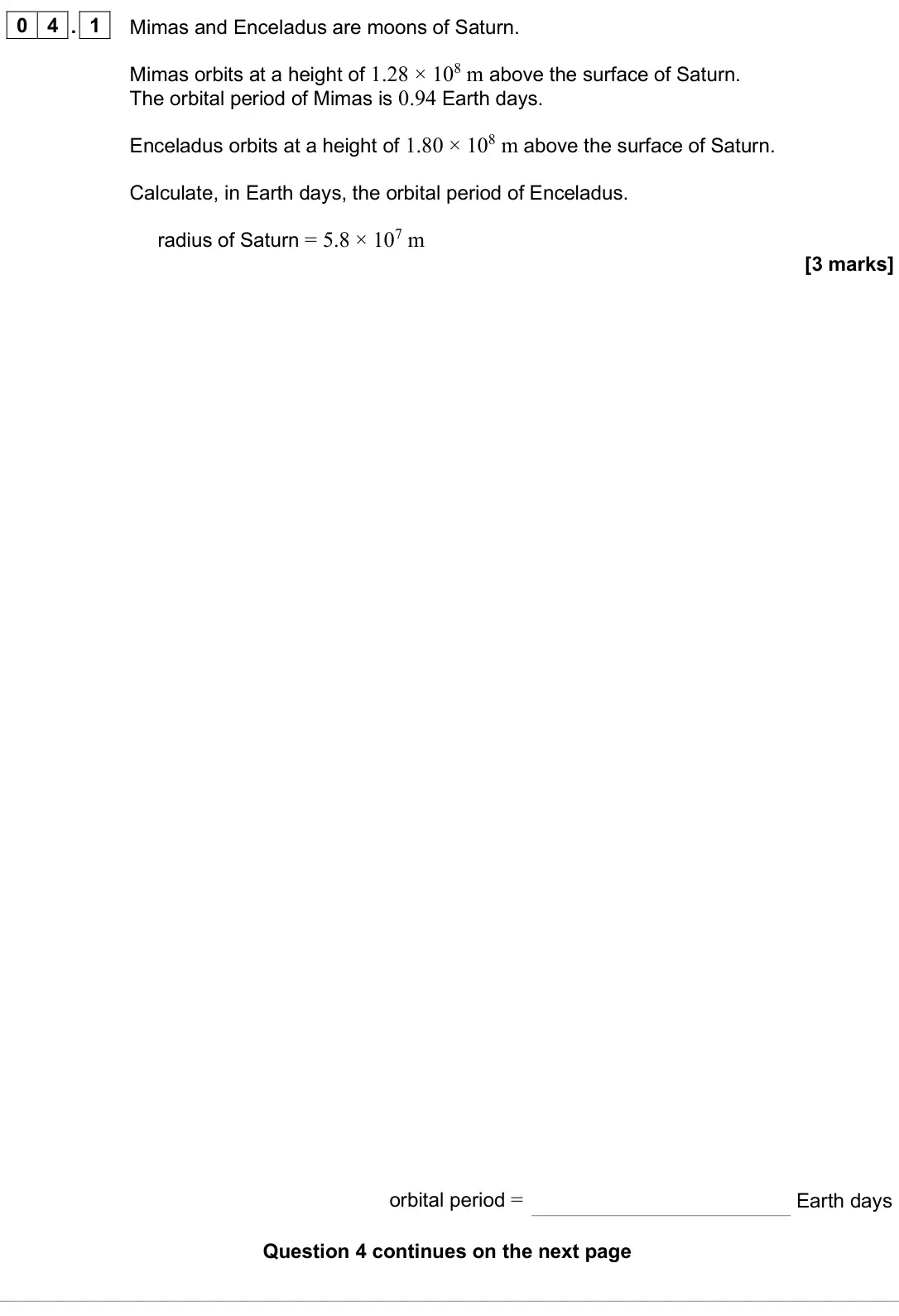
Q04.2
The whole paper ↗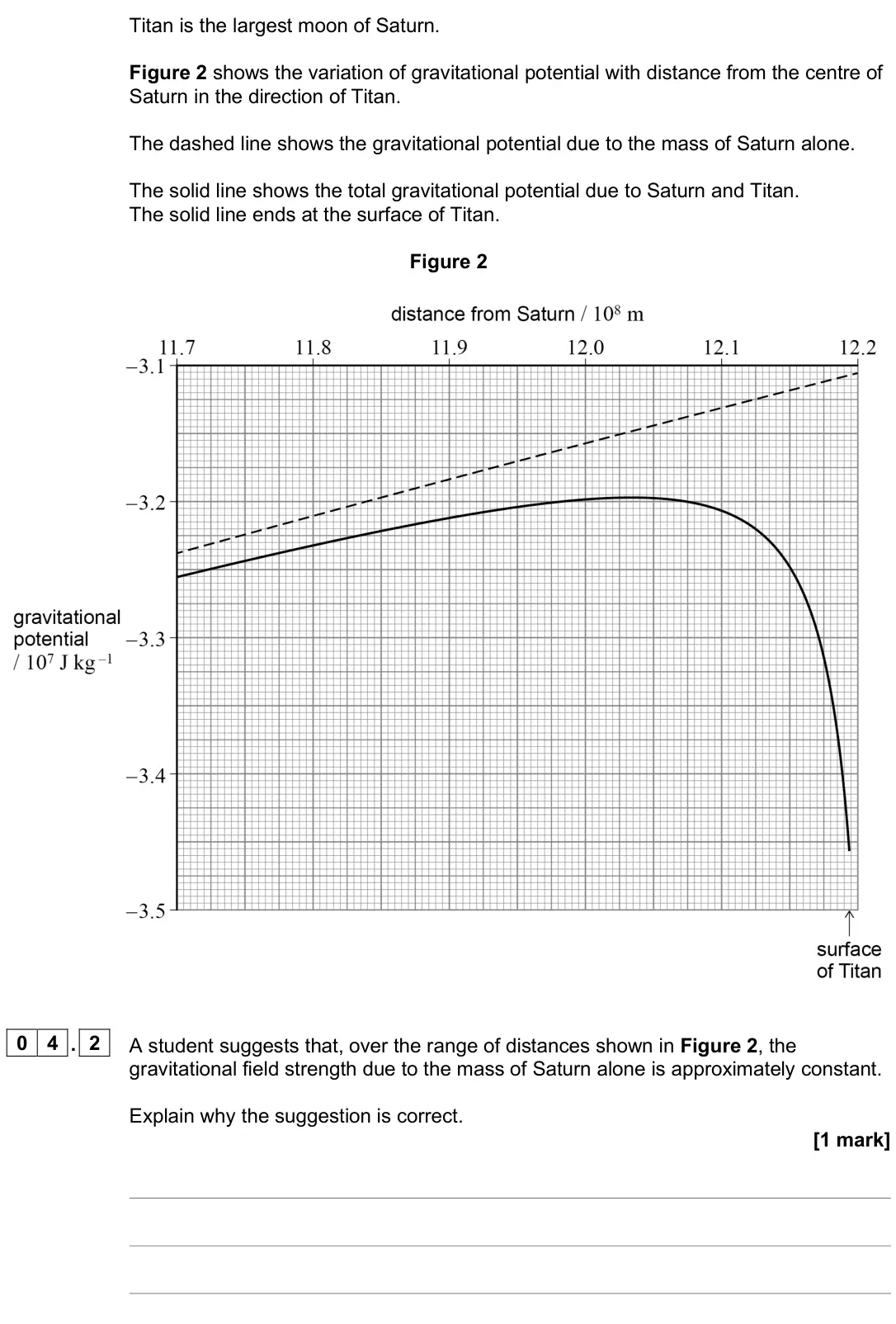
Q04.3
The whole paper ↗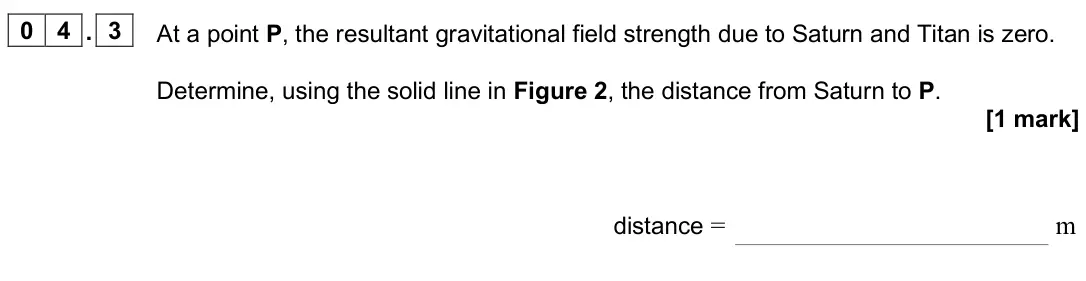
Q04.4
The whole paper ↗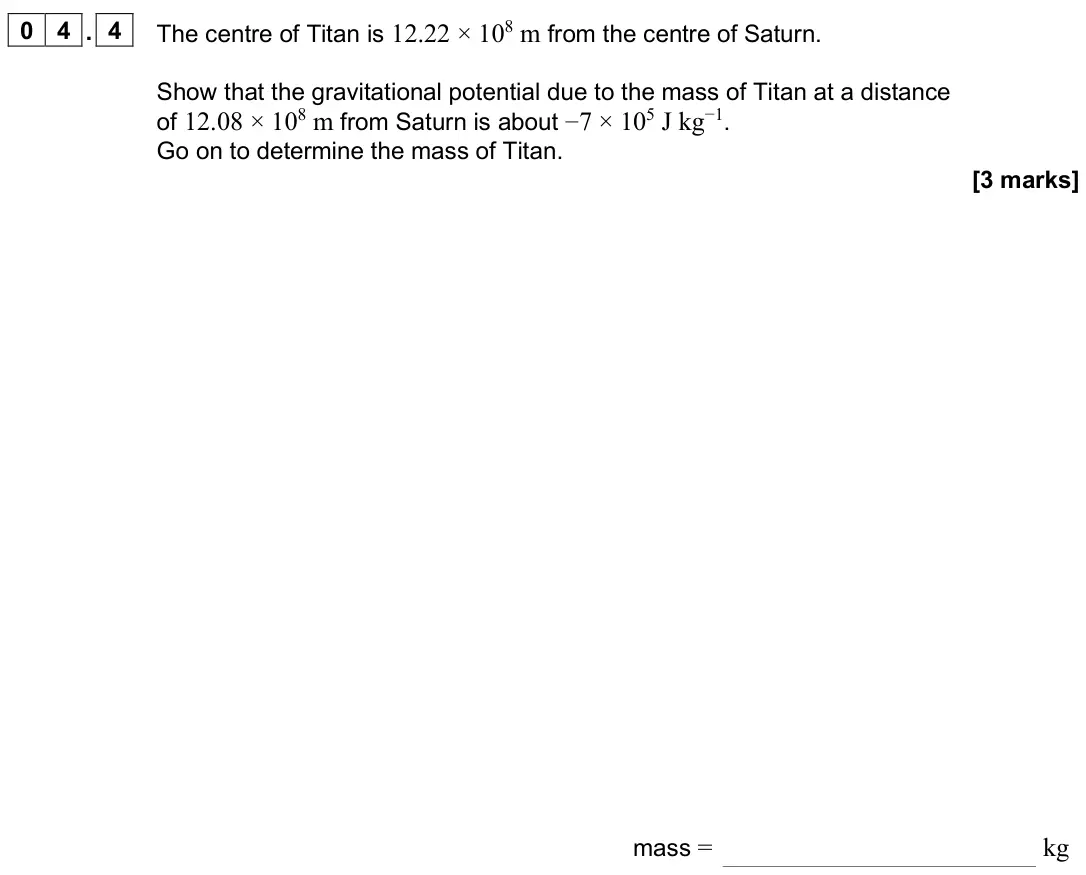
Q06.1
The whole paper ↗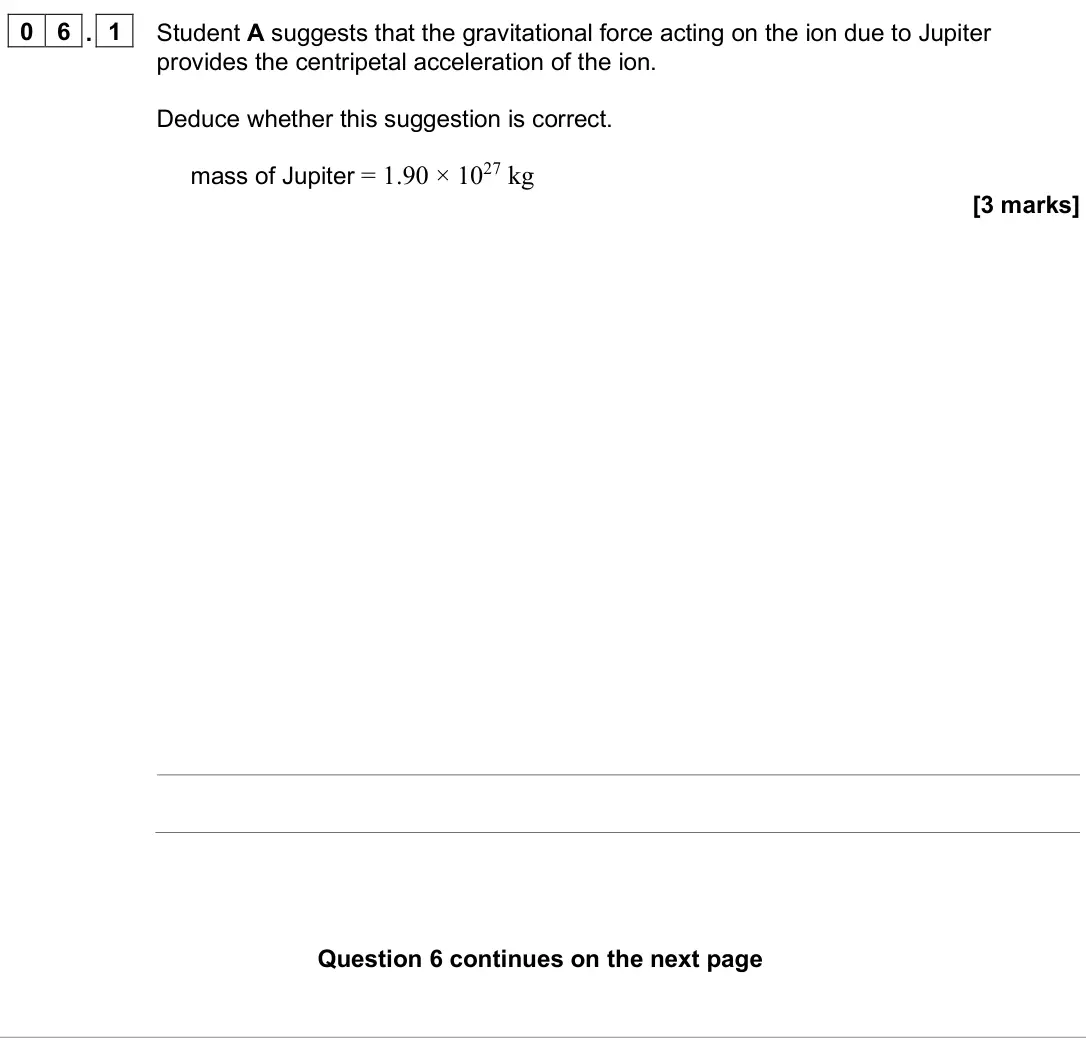
Q05.1
The whole paper ↗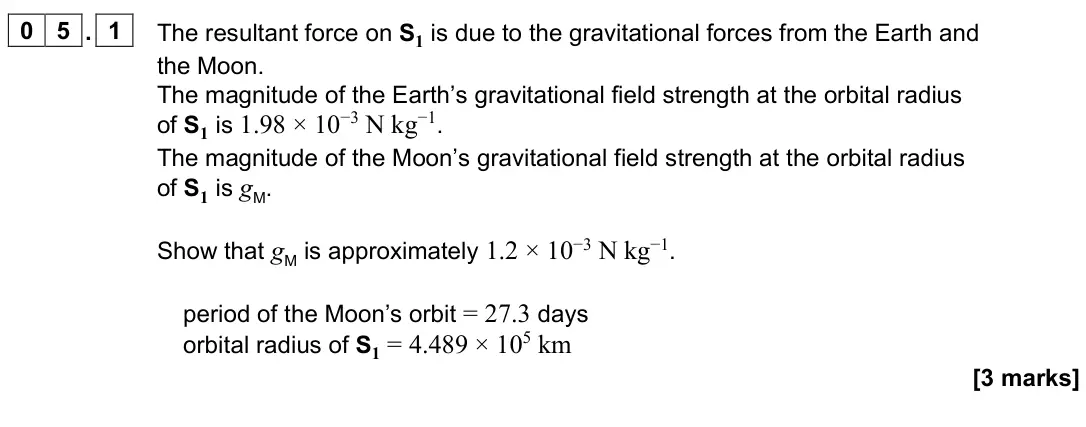
Q05.2
The whole paper ↗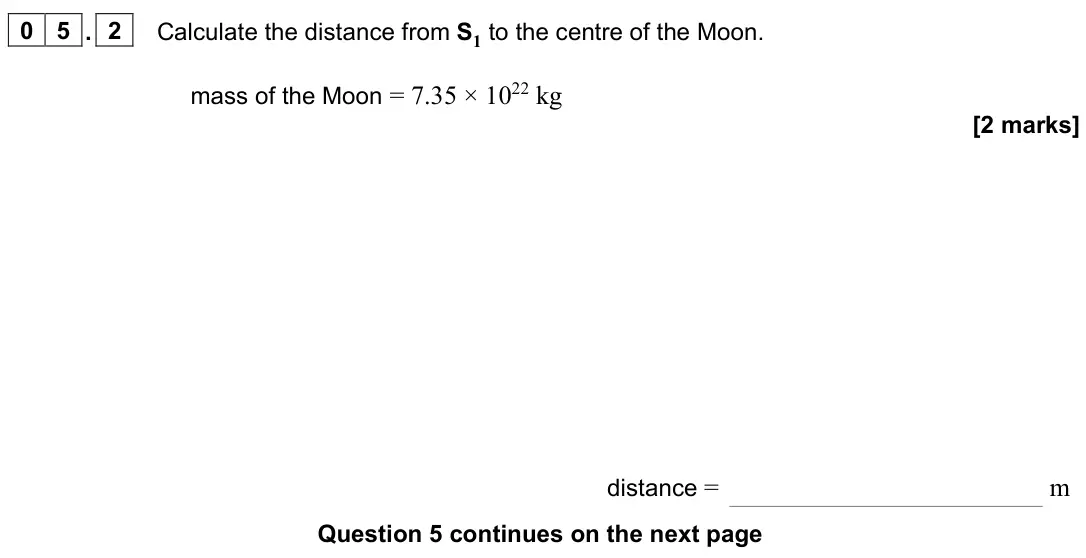
Q05.3
The whole paper ↗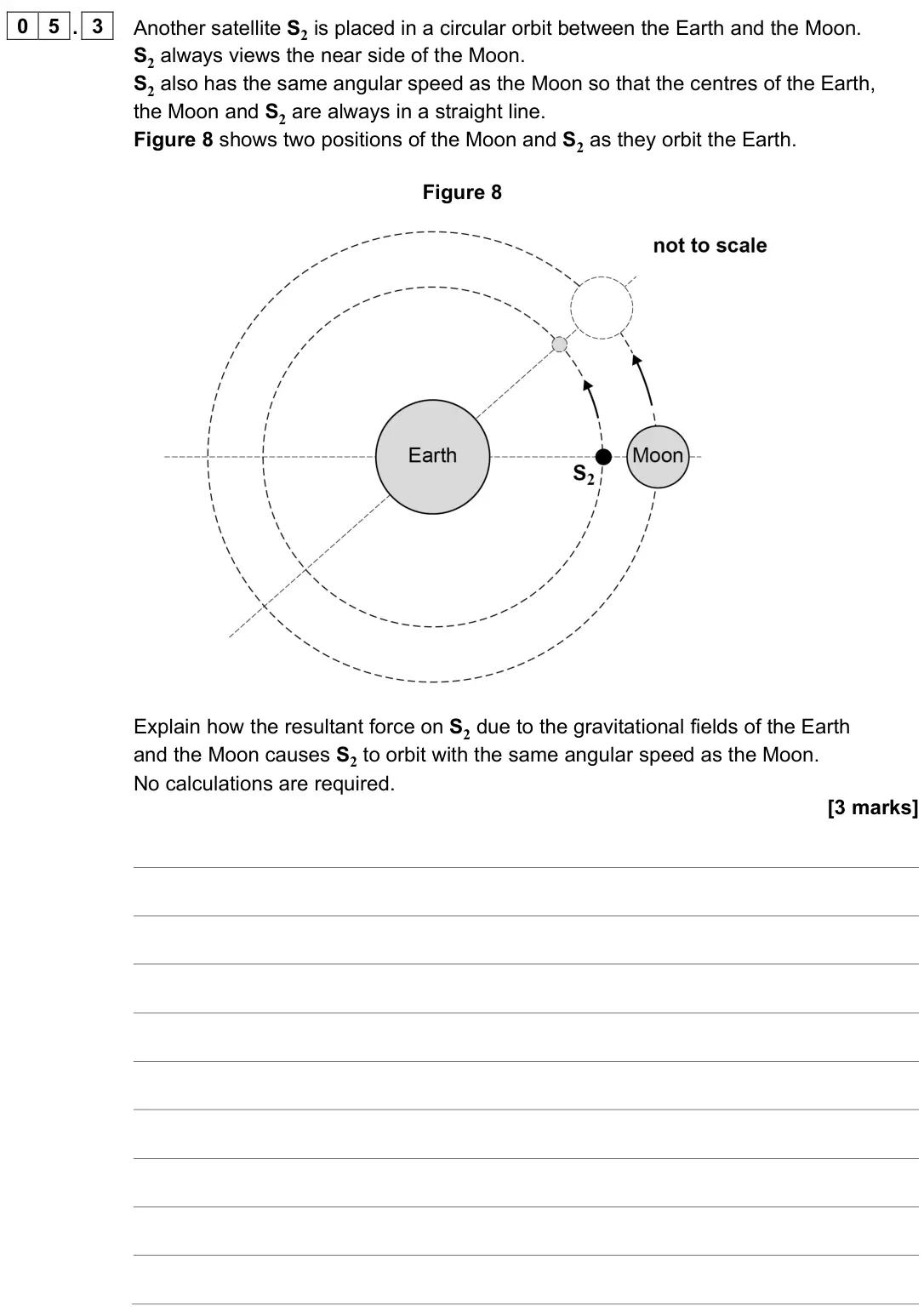
Q03.1
The whole paper ↗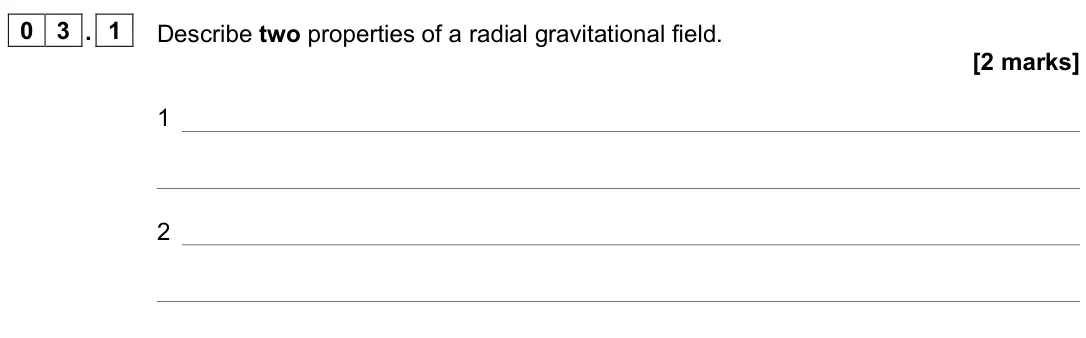
Q03.2
The whole paper ↗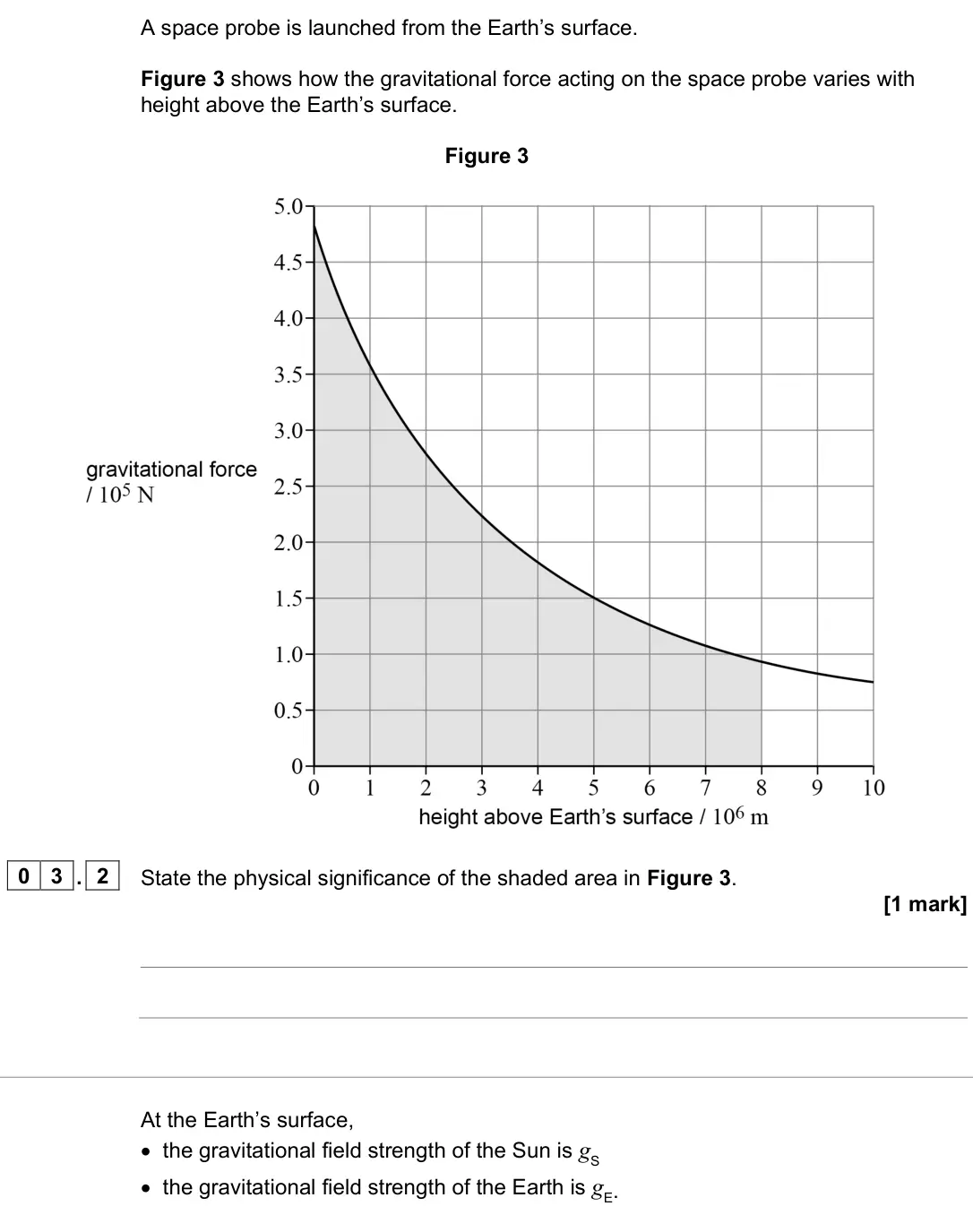
Q03.3
The whole paper ↗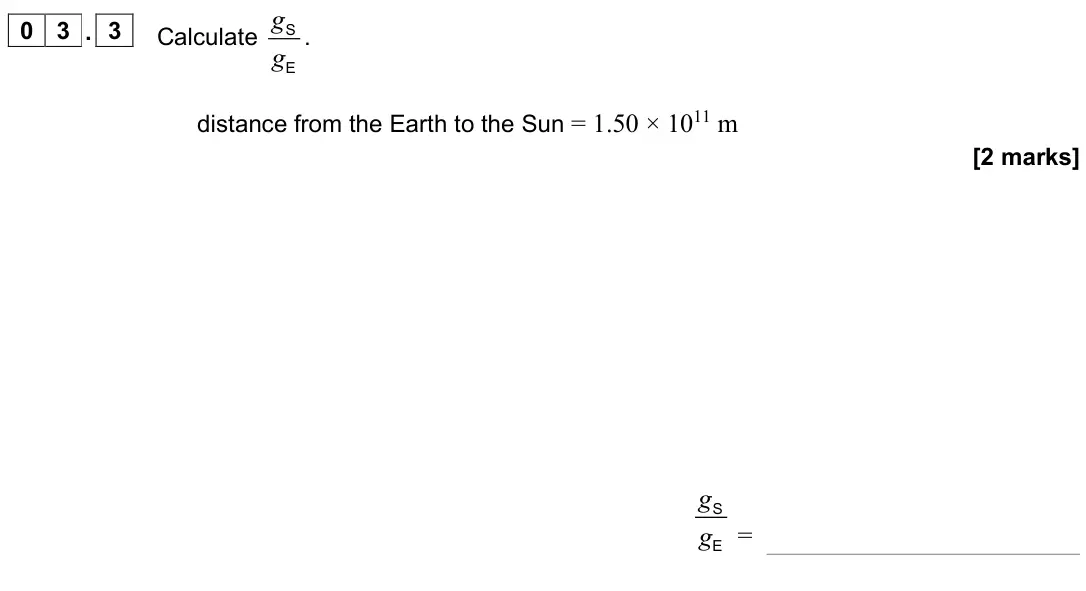
Q03.4
The whole paper ↗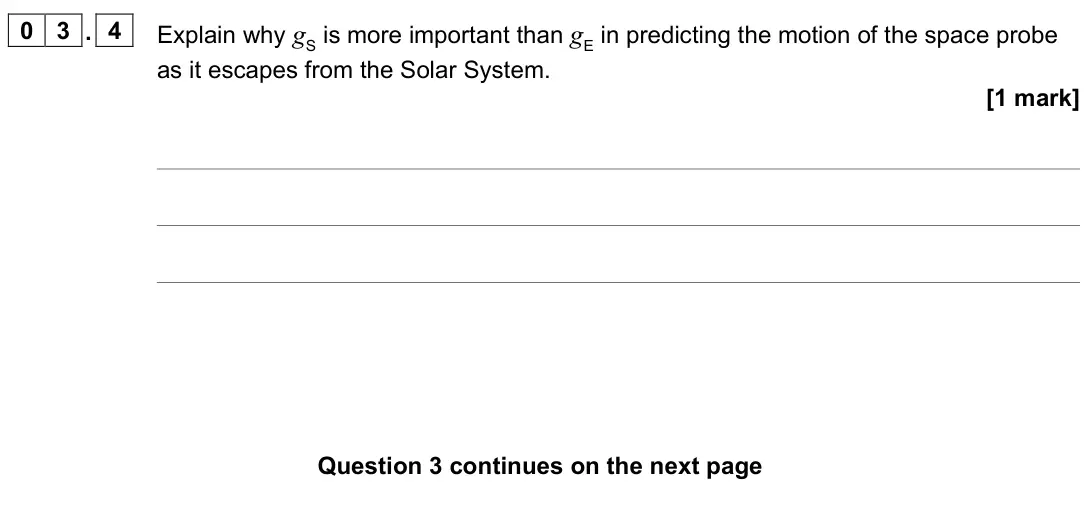
Q03.5
The whole paper ↗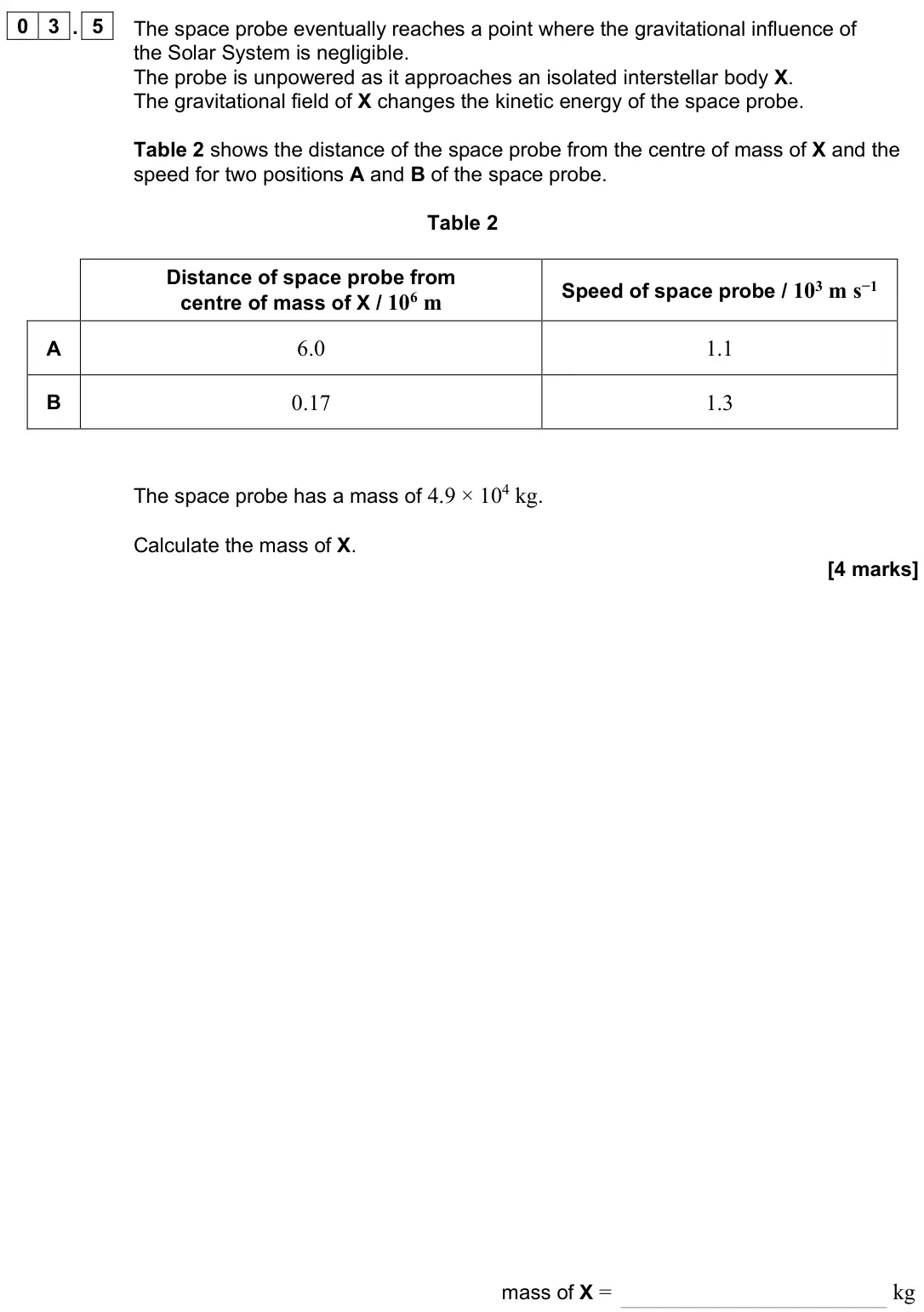
All 79 questions on Gravitational fields, as a list
- June 2025, Paper 2, Q04.1 (3 marks): Mimas and Enceladus are moons of Saturn. Mimas orbits at a height of 1.28 × 10⁸ m above the surface of Saturn. The orbital period of Mimas is 0.94 Earth days. E
- June 2025, Paper 2, Q04.2 (1 mark): A student suggests that, over the range of distances shown in Figure 2, the gravitational field strength due to the mass of Saturn alone is approximately consta
- June 2025, Paper 2, Q04.3 (1 mark): At a point P, the resultant gravitational field strength due to Saturn and Titan is zero. Determine, using the solid line in Figure 2, the distance from Saturn
- June 2025, Paper 2, Q04.4 (3 marks): The centre of Titan is 12.22 × 10⁸ m from the centre of Saturn. Show that the gravitational potential due to the mass of Titan at a distance of 12.08 × 10⁸ m fr
- June 2025, Paper 2, Q06.1 (3 marks): Student A suggests that the gravitational force acting on the ion due to Jupiter provides the centripetal acceleration of the ion. Deduce whether this suggestio
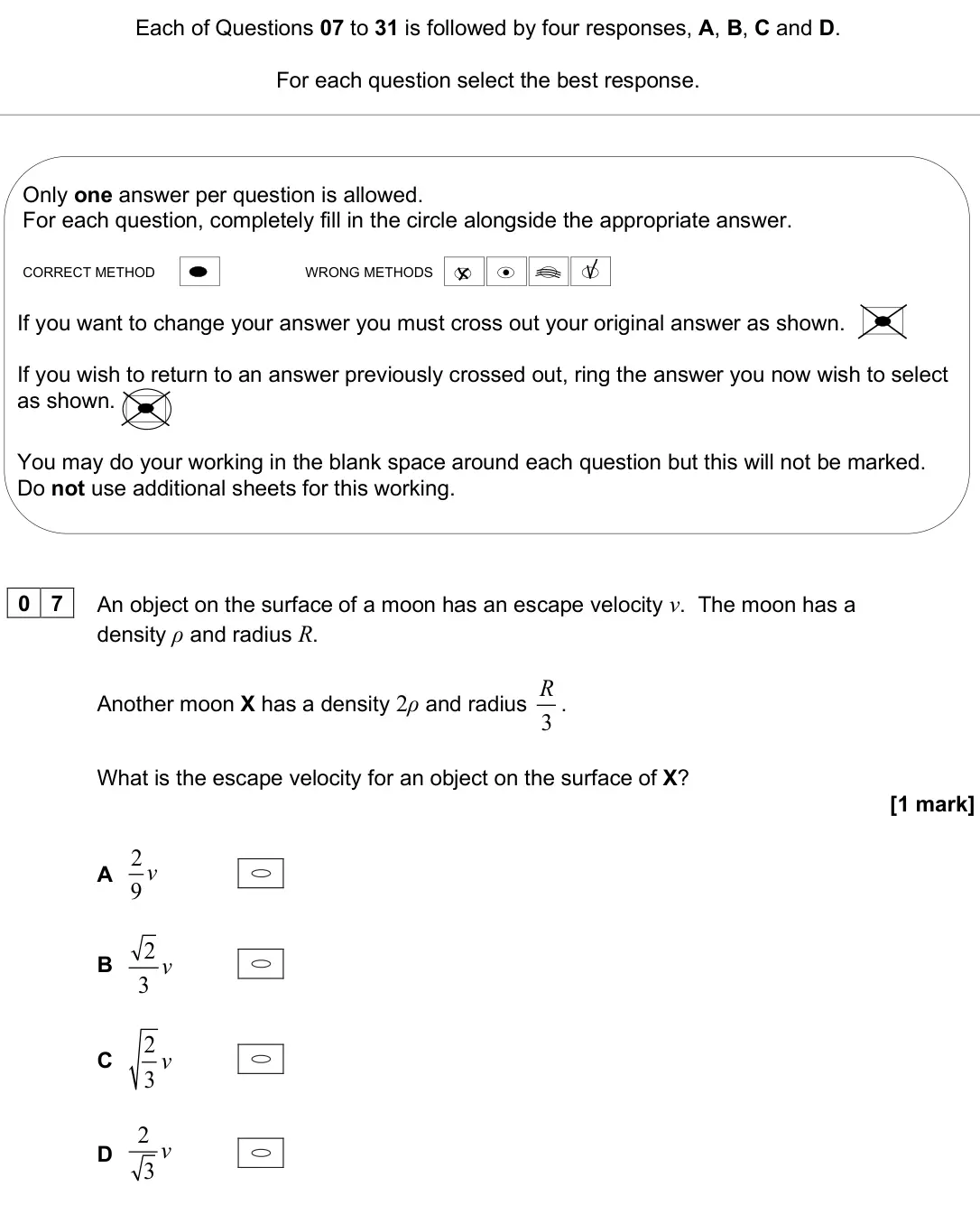
- June 2025, Paper 2, Q07 (1 mark): [multiple choice] An object on the surface of a moon has an escape velocity v. The moon has a density ρ and radius R. Another moon X has a density 2ρ and radius
- June 2024, Paper 2, Q05.1 (3 marks): The resultant force on S1 is due to the gravitational forces from the Earth and the Moon. The magnitude of the Earth’s gravitational field strength at the orbit
- June 2024, Paper 2, Q05.2 (2 marks): Calculate the distance from S1 to the centre of the Moon. mass of the Moon = 7.35 × 10²² kg [2 marks] distance = m
- June 2024, Paper 2, Q05.3 (3 marks): Another satellite S2 is placed in a circular orbit between the Earth and the Moon. S2 always views the near side of the Moon. S2 also has the same angular speed
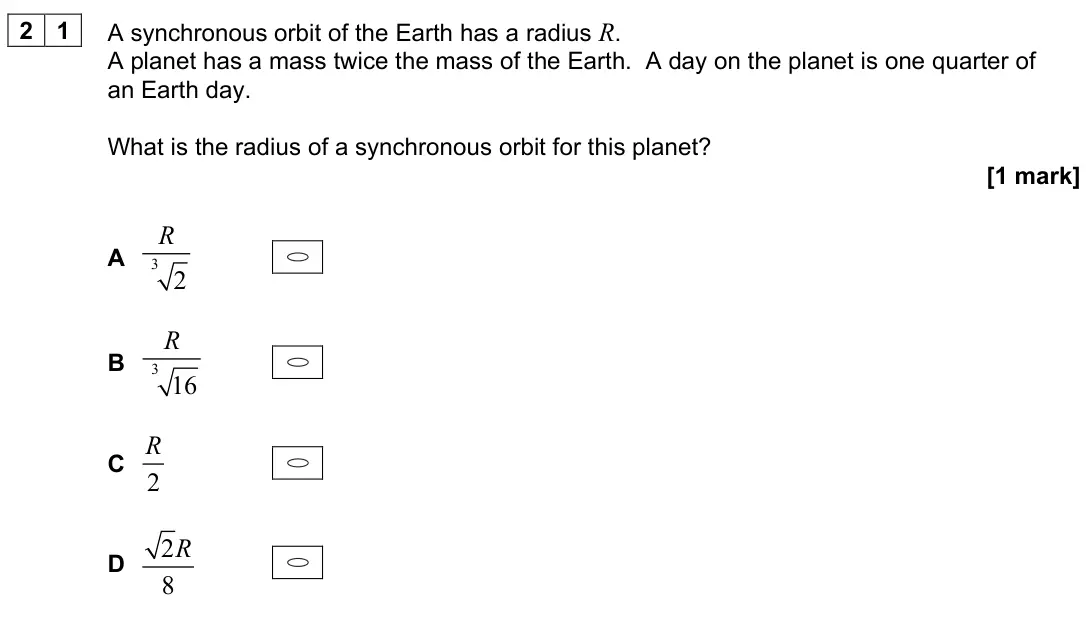
- June 2024, Paper 2, Q21 (1 mark): A synchronous orbit of the Earth has a radius R. A planet has a mass twice the mass of the Earth. A day on the planet is one quarter of an Earth day. What is th
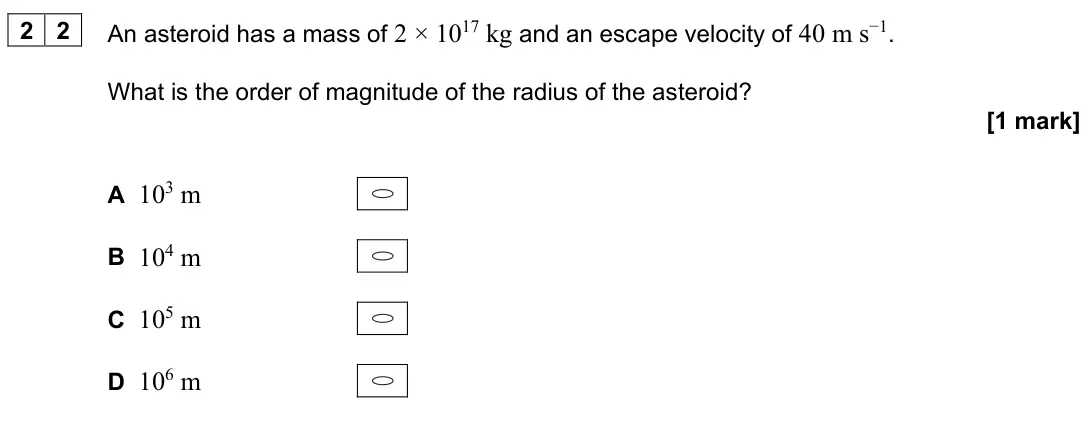
- June 2024, Paper 2, Q22 (1 mark): An asteroid has a mass of 2 × 10¹⁷ kg and an escape velocity of 40 m s−1. What is the order of magnitude of the radius of the asteroid? [1 mark] A 103 m B 104 m
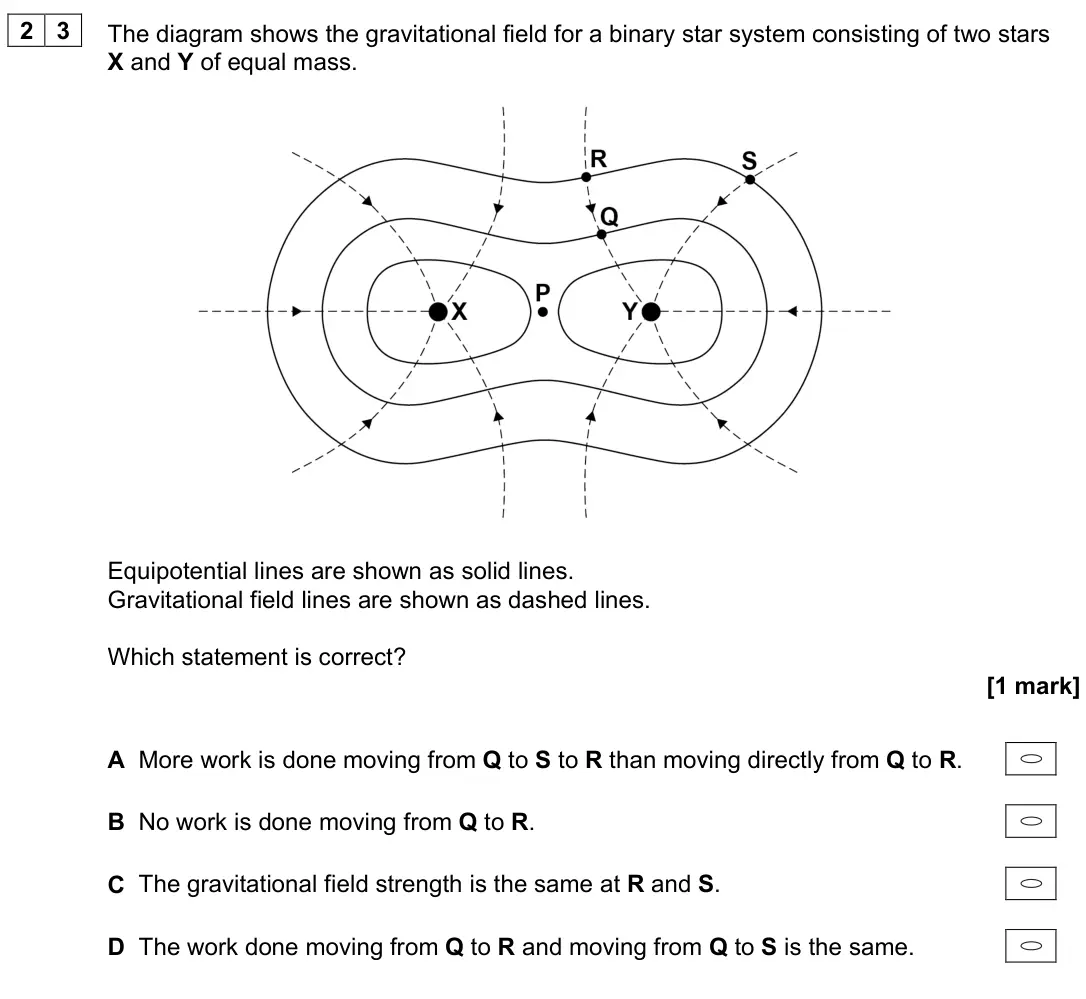
- June 2024, Paper 2, Q23 (1 mark): The diagram shows the gravitational field for a binary star system consisting of two stars X and Y of equal mass. Equipotential lines are shown as solid lines.
- June 2023, Paper 2, Q03.1 (2 marks): Describe two properties of a radial gravitational field. [2 marks] 1 2
- June 2023, Paper 2, Q03.2 (1 mark): State the physical significance of the shaded area in Figure 3. [1 mark] At the Earth’s surface, • the gravitational field strength of the Sun is gS • the gravi
- June 2023, Paper 2, Q03.3 (2 marks): Calculate g g S E . distance from the Earth to the Sun = 1.50 × 10¹¹ m [2 marks] g g S E =
- June 2023, Paper 2, Q03.4 (1 mark): Explain why gS is more important than gE in predicting the motion of the space probe as it escapes from the Solar System. [1 mark]
- June 2023, Paper 2, Q03.5 (4 marks): The space probe eventually reaches a point where the gravitational influence of the Solar System is negligible. The probe is unpowered as it approaches an isola
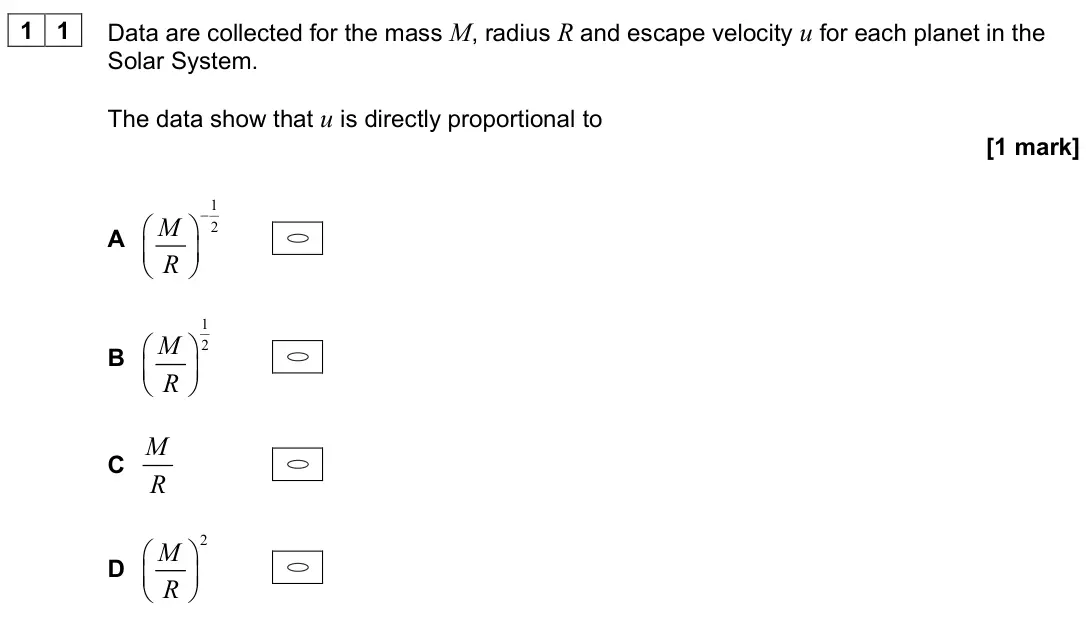
- June 2023, Paper 2, Q11 (1 mark): Data are collected for the mass M, radius R and escape velocity u for each planet in the Solar System. The data show that u is directly proportional to [1 mark]
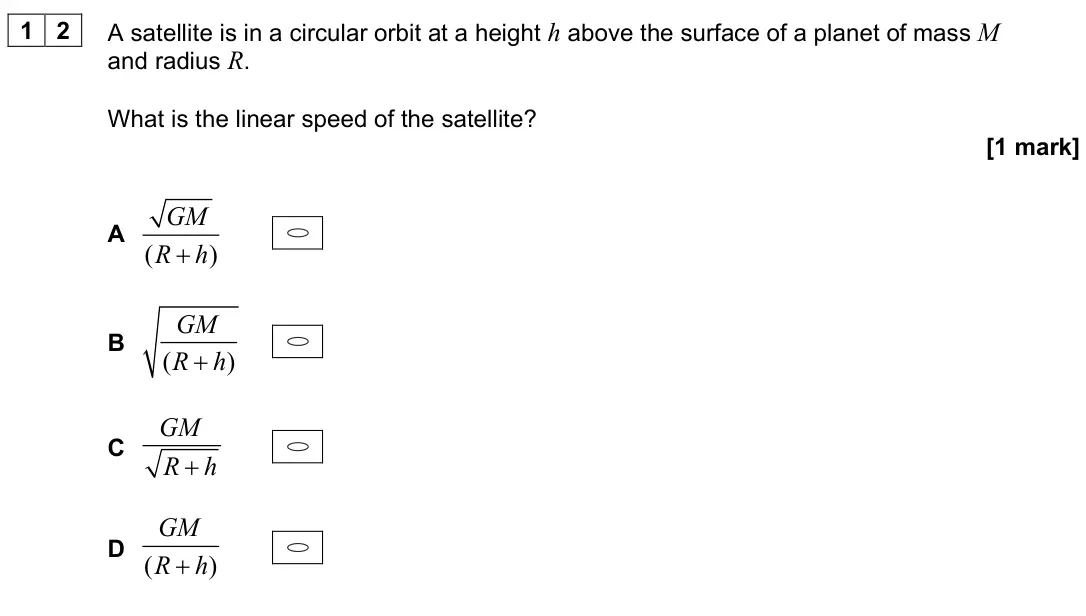
- June 2023, Paper 2, Q12 (1 mark): A satellite is in a circular orbit at a height h above the surface of a planet of mass M and radius R. What is the linear speed of the satellite? [1 mark] A ( )
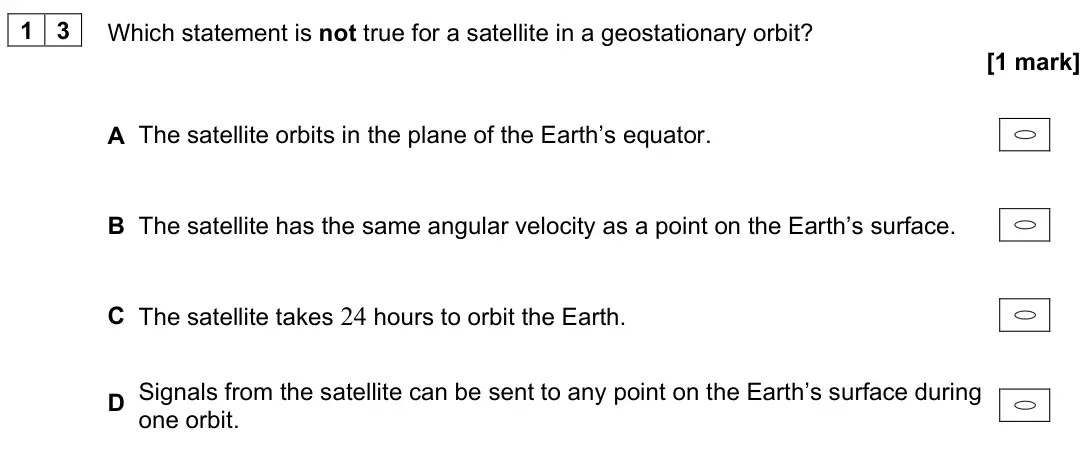
- June 2023, Paper 2, Q13 (1 mark): Which statement is not true for a satellite in a geostationary orbit? [1 mark] A The satellite orbits in the plane of the Earth’s equator. B The satellite has t
- June 2022, Paper 2, Q04.1 (2 marks): Compare, with reference to Figure 4, the masses of G and H. [2 marks]
- June 2022, Paper 2, Q04.2 (1 mark): X and Y are two points in the field. Annotate Figure 4 to show the field direction at X and the field direction at Y. [1 mark]
- June 2022, Paper 2, Q04.3 (1 mark): A spherical asteroid P has a mass of 2.0 × 10²⁰ kg. The gravitational field strength at its surface is 0.40 N kg−1. Calculate the radius R of P. [1 mark] R = m
- June 2022, Paper 2, Q04.4 (1 mark): Sketch, on Figure 5, the variation of the gravitational field strength g with distance r. The distance r is measured from the centre of P. [1 mark] Figure 5
- June 2022, Paper 2, Q04.5 (2 marks): Explain what is represented by the area under the graph between r = R and r = 2R on Figure 5. [2 marks]
- June 2022, Paper 2, Q04.6 (4 marks): The gravitational force on P from G is 6.38 × 10¹² N. The mass of H is 3.00 × 1025 kg and the mass of P is 2.00 × 10²⁰ kg. The distance HP is 1.50 × 10¹¹ m. Cal
- June 2022, Paper 2, Q04.7 (1 mark): Explain why P cannot have a circular orbit around H. [1 mark]
- June 2022, Paper 2, Q09 (1 mark): A planet of radius R and mass M has a gravitational field strength of g at its surface. Which row describes a planet with a gravitational field strength of 4g a
- June 2022, Paper 2, Q10 (1 mark): The Moon orbits the Earth in 27 days. What is the angular speed of the Moon’s orbit? [1 mark] A 4.3 × 10⁻⁷ rad s−1 B 2.7 × 10⁻⁶ rad s−1 C 3.7 × 10⁻² rad s−1 D 2
- June 2022, Paper 2, Q11 (1 mark): The radius of the Earth is R and the acceleration due to gravity at the surface of the Earth is g. What is the escape velocity for a mass m at the surface of th
- June 2022, Paper 2, Q12 (1 mark): A planet has a mass M and a radius R. Loose material at the equator only just remains in contact with the surface of the planet. This is because the speed at wh
- June 2022, Paper 2, Q13 (1 mark): Satellites N and F have the same mass and move in circular orbits about the same planet. The orbital radius of N is less than that of F. Which is smaller for N
- November 2021, Paper 2, Q02.1 (2 marks): One GPS satellite is in a circular orbit at a height h above the surface of the Earth. The Earth has mass M and radius R. Show that the angular speed of the sat
- November 2021, Paper 2, Q02.2 (2 marks): Calculate the orbital period of the satellite when h equals 2.02 × 10⁷ m. [2 marks] orbital period = s
- November 2021, Paper 2, Q02.3 (2 marks): Figure 3 shows the orbital plane of the satellite inclined at an angle to the equator. X, Y and Z are locations on the Earth. X is at the North Pole, Y is on a
- November 2021, Paper 2, Q02.4 (2 marks): The satellite has a mass of 1630 kg. Calculate the gravitational potential energy of the satellite when in the orbit in Question 02.2. [2 marks] gravitational p
- November 2021, Paper 2, Q02.5 (2 marks): A different satellite is in a higher circular orbit. Explain how the linear speed of this satellite compares with the linear speed of the satellite in Question
- November 2021, Paper 2, Q11 (1 mark): The diagram shows gravitational equipotentials. Adjacent equipotentials are separated by an equal gravitational potential difference V. Which point has the grea
- November 2021, Paper 2, Q12 (1 mark): A planet has radius R and density ρ. The gravitational field strength at the surface is g. What is the gravitational field strength at the surface of a planet o
- November 2021, Paper 2, Q13 (1 mark): The diagram shows equipotential lines for a uniform gravitational field. The lines are separated by 20 m. An object of mass 4 kg is moved from P to Q. What is t
- November 2020, Paper 2, Q02.1 (3 marks): Show that k = 2 4 GM π [3 marks]
- November 2020, Paper 2, Q02.2 (2 marks): Calculate the orbital radius X of Umbriel. [2 marks] orbital radius = m
- November 2020, Paper 2, Q02.3 (3 marks): Calculate the mass of Uranus. [3 marks] mass = kg
- November 2020, Paper 2, Q02.4 (3 marks): Deduce which moon in Table 3 has the greatest escape velocity for an object on its surface. Assume the effect of Uranus is negligible. [3 marks]
- November 2020, Paper 2, Q02.5 (3 marks): A spring mechanism can project an object vertically to a maximum height of 1.0 m from the surface of the Earth. Determine whether the same mechanism could proje
- November 2020, Paper 2, Q12 (1 mark): The graph shows how the gravitational potential V varies with the vertical distance d from the surface of the Earth. What does the gradient of the graph represe
- November 2020, Paper 2, Q13 (1 mark): What is the angular speed of a satellite in a geostationary orbit around the Earth? [1 mark] A 1.2 × 10⁻⁵ rad s−1 B 7.3 × 10⁻⁵ rad s−1 C 4.4 × 10⁻³ rad s−1 D 2.
- June 2019, Paper 2, Q03.1 (1 mark): Define gravitational potential at a point. [1 mark]
- June 2019, Paper 2, Q03.2 (1 mark): Figure 2 shows the positions of equipotential surfaces at different distances from the centre of the Moon. Figure 2 Explain how the equipotential surfaces in Fi
- June 2019, Paper 2, Q03.3 (4 marks): Calculate, using Figure 2, the escape velocity at the surface of the Moon. radius of Moon = 1.74 × 10⁶ m [4 marks] escape velocity = m s−1
- June 2019, Paper 2, Q04.6 (2 marks): The student says that the gravitational force between the two spheres has no significant effect on the angle at which the spheres are in equilibrium. Deduce wit
- June 2019, Paper 2, Q08 (1 mark): Which row shows two scalar quantities? [1 mark] A gravitational potential gravitational field strength B mass gravitational potential C gravitational field stre
- June 2019, Paper 2, Q09 (1 mark): What is the angular speed of a satellite in a geostationary orbit around the Earth? [1 mark] A 1.2 × 10⁻⁵ rad s–1 B 7.3 × 10⁻⁵ rad s–1 C 4.2 × 10⁻³ rad s–1 D 2.
- June 2019, Paper 2, Q10 (1 mark): A planet of mass M and radius R rotates so quickly that material at its equator only just remains on its surface. What is the period of rotation of the planet?
- June 2019, Paper 2, Q11 (1 mark): Satellites N and F have the same mass and are in circular orbits about the same planet. The orbital radius of F is greater than that of N. Which is greater for
- June 2019, Paper 2, Q12 (1 mark): An object moves freely at 90° to the direction of a gravitational field. The acceleration of the object is [1 mark] A zero. B opposite to the direction of the g
- June 2018, Paper 2, Q13 (1 mark): The distance between the Sun and the Earth is 1.5 × 10¹¹ m What is the gravitational force exerted on the Sun by the Earth? [1 mark] A 3.5 × 10²² N B 1.7 × 1026
- June 2018, Paper 2, Q14 (1 mark): The graph shows how the gravitational potential varies with distance between two planets, K and L, that have the same radius. Which statement is correct? [1 mar
- June 2018, Paper 2, Q15 (1 mark): The diagram shows equipotential lines near a group of asteroids. Which arrow shows the direction of the gravitational field at X? [1 mark] A B C D
- June 2018, Paper 2, Q16 (1 mark): Planet N has a gravitational potential –V at its surface. Planet M has double the density and double the radius of planet N. Both planets are spherical and have
- June 2018, Paper 2, Q17 (1 mark): A spacecraft of mass 1.0 × 10⁶ kg is in orbit around the Sun at a radius of 1.1 × 10¹¹ m The spacecraft moves into a new orbit of radius 2.5 × 10¹¹ m around the
- June 2018, Paper 2, Q18 (1 mark): Which graph shows the relationship between the time period T and the orbital radius r of a planet in orbit around the Sun? [1 mark] A B C D A B C D
- June 2018, Paper 2, Q19 (1 mark): The Earth can be assumed to be a uniform sphere of radius R. What is the mean density of the Earth? [1 mark] A 3g 4πRG B 3RG 4πg C 3G 4πRg D 3Rg 4πG
- June 2017, Paper 2, Q06.1 (1 mark): State what is represented by gravitational field lines. [1 mark]
- June 2017, Paper 2, Q06.2 (2 marks): Figure 6 shows the gravitational field above a small horizontal region on the surface of the Earth. Figure 6 Suggest why the field lines converge over a small a
- June 2017, Paper 2, Q06.3 (2 marks): A ball travelling at constant speed passes position J moving towards position K in Figure 6. Assume friction is negligible. Explain any change in the speed of t
- June 2017, Paper 2, Q07.1 (2 marks): Derive an expression to show that for satellites in a circular orbit T2 ∝ r3 where T is the period of orbit and r is the radius of the orbit. [2 marks]
- June 2017, Paper 2, Q07.2 (2 marks): Pluto is a dwarf planet. The mean orbital radius of Pluto around the Sun is 5.91 × 10⁹ km compared to a mean orbital radius of 1.50 × 10⁸ km for the Earth. Calc
- June 2017, Paper 2, Q07.3 (3 marks): A small mass released from rest just above the surface of Pluto has an acceleration of 0.617 m s−2. Assume Pluto has no atmosphere that could provide any resist
- June 2017, Paper 2, Q07.4 (3 marks): Figure 8 shows the variation in gravitational potential with distance from the centre of Pluto for points at and above its surface. Figure 8 A meteorite hits Pl
- June 2017, Paper 2, Q12 (1 mark): Charon is a moon of Pluto that has a mass equal to that of Pluto. The distance between the centre of Pluto and the centre of Charon is d. X is the point at whic
- June 2017, Paper 2, Q13 (1 mark): The distance between the Sun and Mars varies from 2.1 × 10¹¹ m to 2.5 × 10¹¹ m. When Mars is closest to the Sun, the force of gravitational attraction between t
- June 2017, Paper 2, Q14 (1 mark): A satellite X of mass m is in a concentric circular orbit of radius R about a planet of mass M. What is the kinetic energy of X? [1 mark] A GMm 2R B GMm R C 2GM
- Specimen, Paper 2, Q06.1 (2 marks): Read the following passage and answer the questions that follow Satellites used for telecommunications are usually in geostationary orbits. Using suitable dishe
- Specimen, Paper 2, Q06.2 (1 mark): Read the following passage and answer the questions that follow Satellites used for telecommunications are usually in geostationary orbits. Using suitable dishe
- Specimen, Paper 2, Q06.4 (3 marks): Read the following passage and answer the questions that follow Satellites used for telecommunications are usually in geostationary orbits. Using suitable dishe
- Specimen, Paper 2, Q08 (1 mark): A planet has a radius half the Earth's radius and a mass a quarter of the Earth's mass. What is the approximate gravitational field strength on the surface of t
- Specimen, Paper 2, Q09 (1 mark): Two stars of mass M and 4M are at a distance d between their centres. The resultant gravitational field strength is zero along the line between their centres at
- Specimen, Paper 2, Q10 (1 mark): Which of the following statements about Newton’s law of gravitation is correct? Newton’s gravitational law explains [1 mark] A the origin of gravitational force
Questions, mark schemes and examiner’s reports are © AQA, from their published past papers. Plumi isn’t affiliated with any exam board. Want whole papers? Every AQA A-Level Physics paper.
Rather write your answers by hand on iPad? Plumi marks them against the same mark schemes.