 plumi
Electric fields: AQA A‑Level Physics questions
Every AQA A-Level Physics exam question on 3.7.3 Electric fields, 2016–2025, with its mark scheme and examiner’s report.
Find questions2,714
Calculations
Q08.1
The whole paper ↗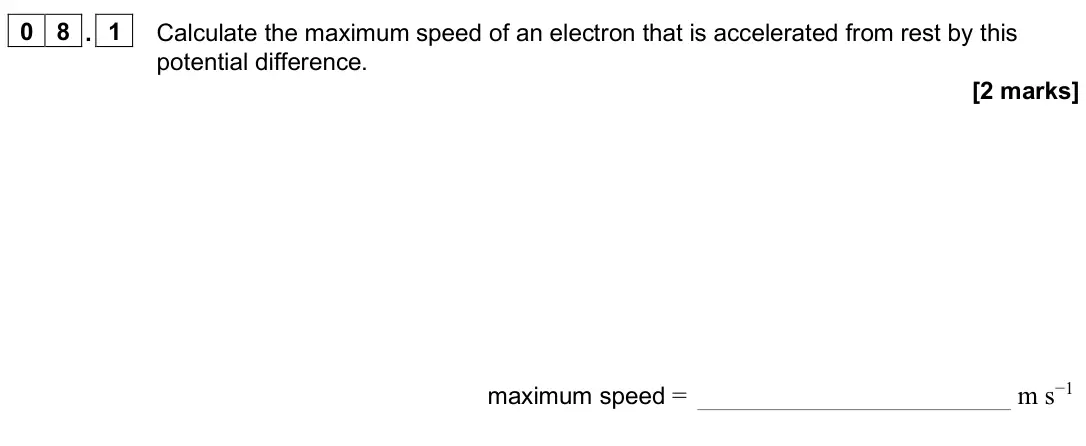
Q06.4
The whole paper ↗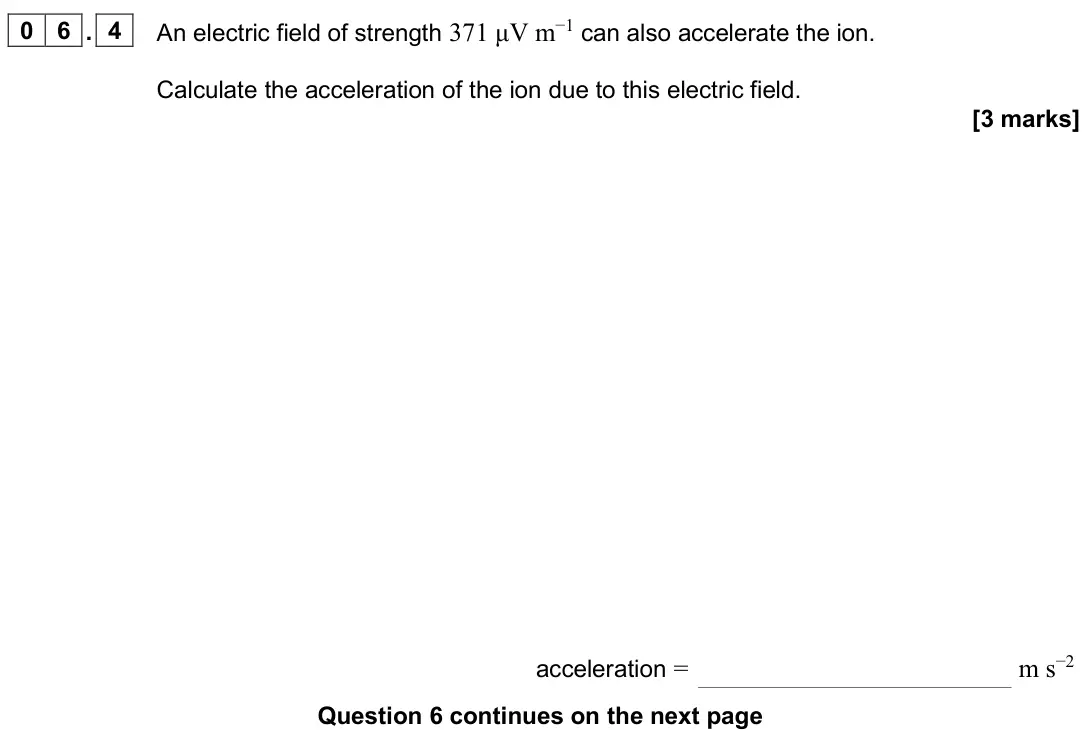
Q06.5
The whole paper ↗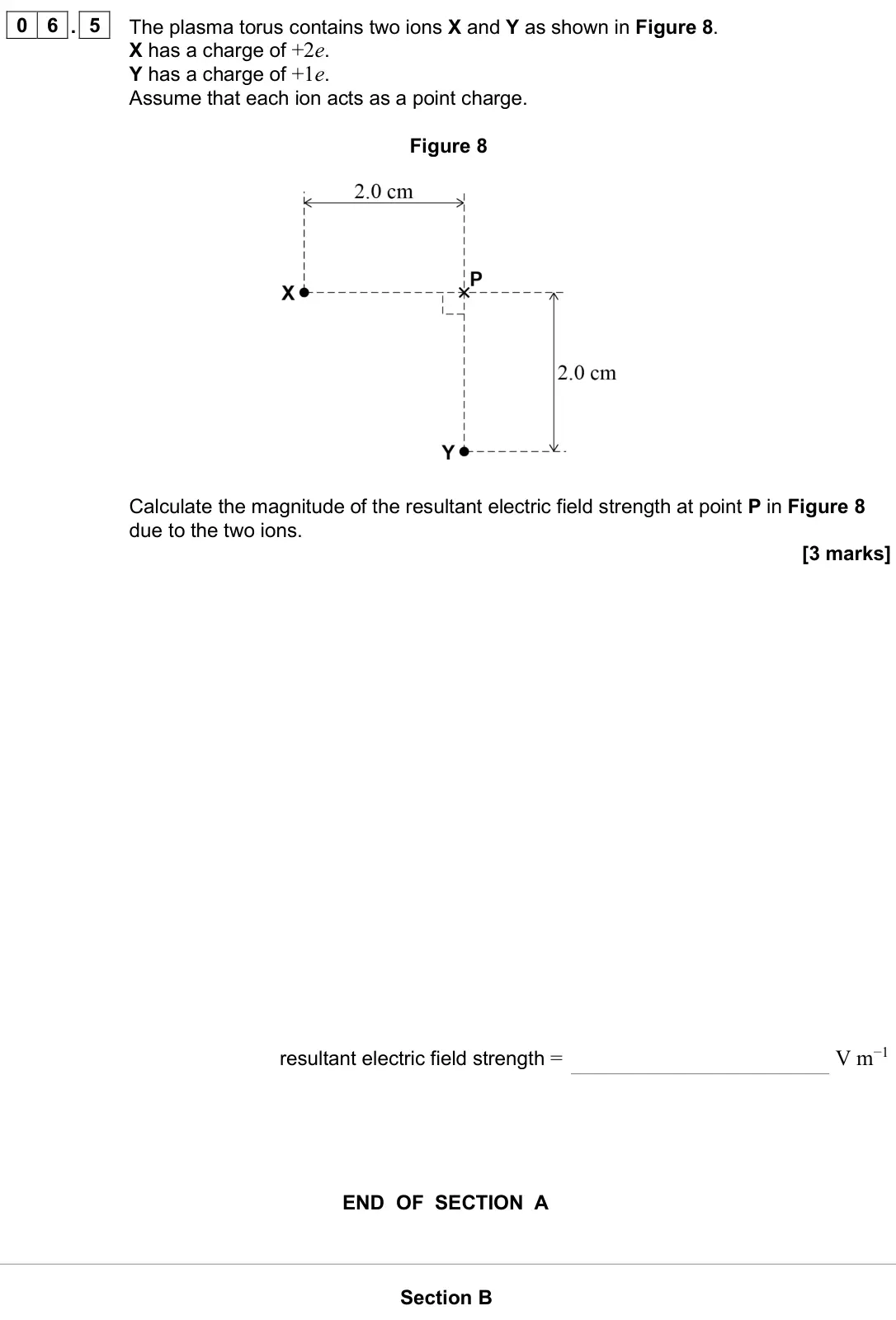
Q06.1
The whole paper ↗
Q06.2
The whole paper ↗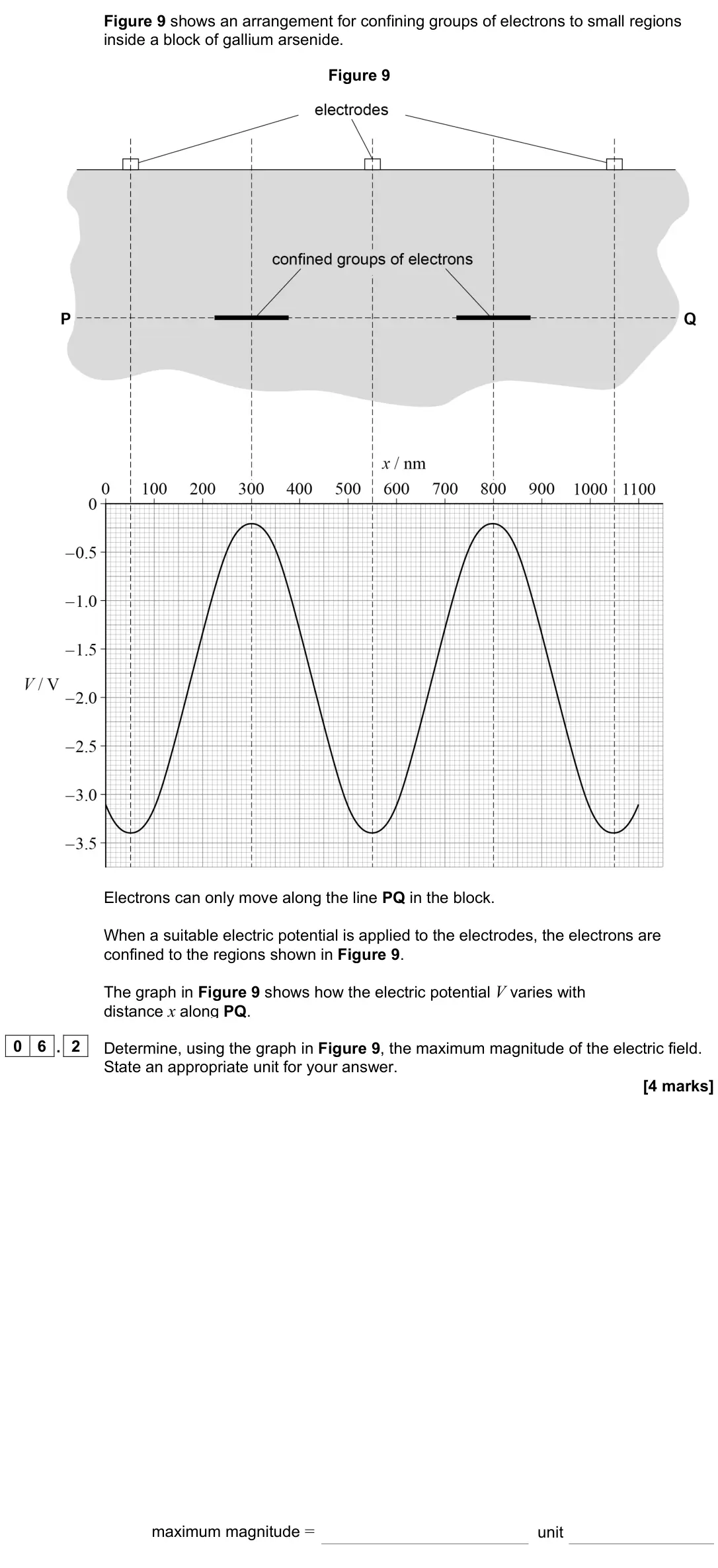
Q06.3
The whole paper ↗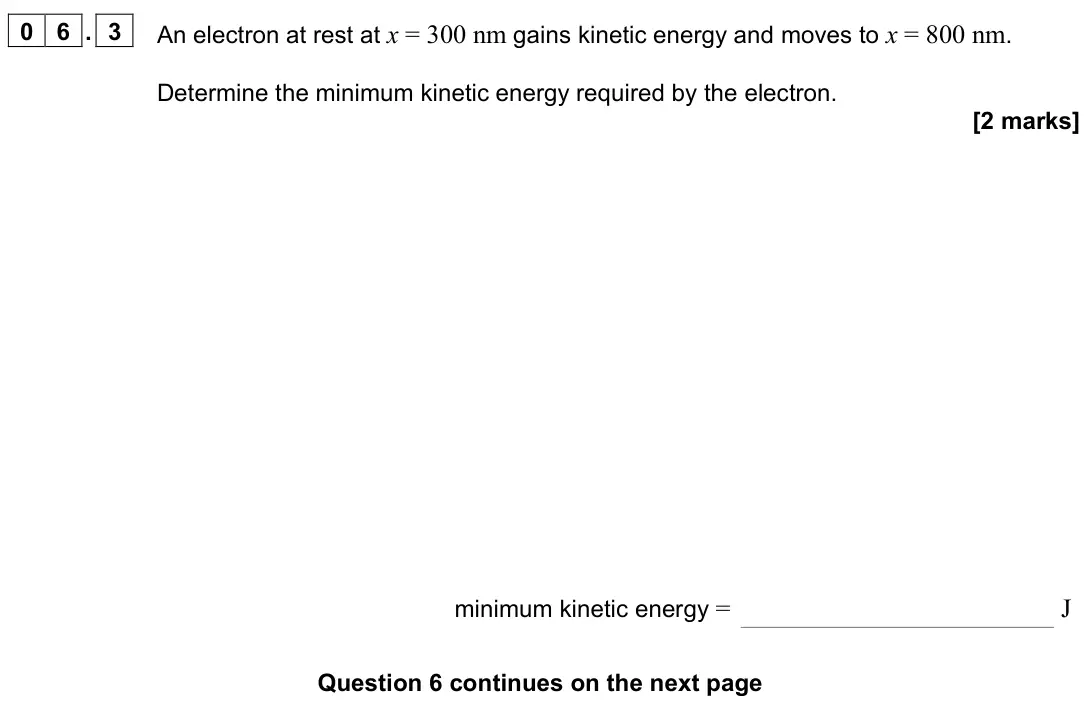
Q06.4
The whole paper ↗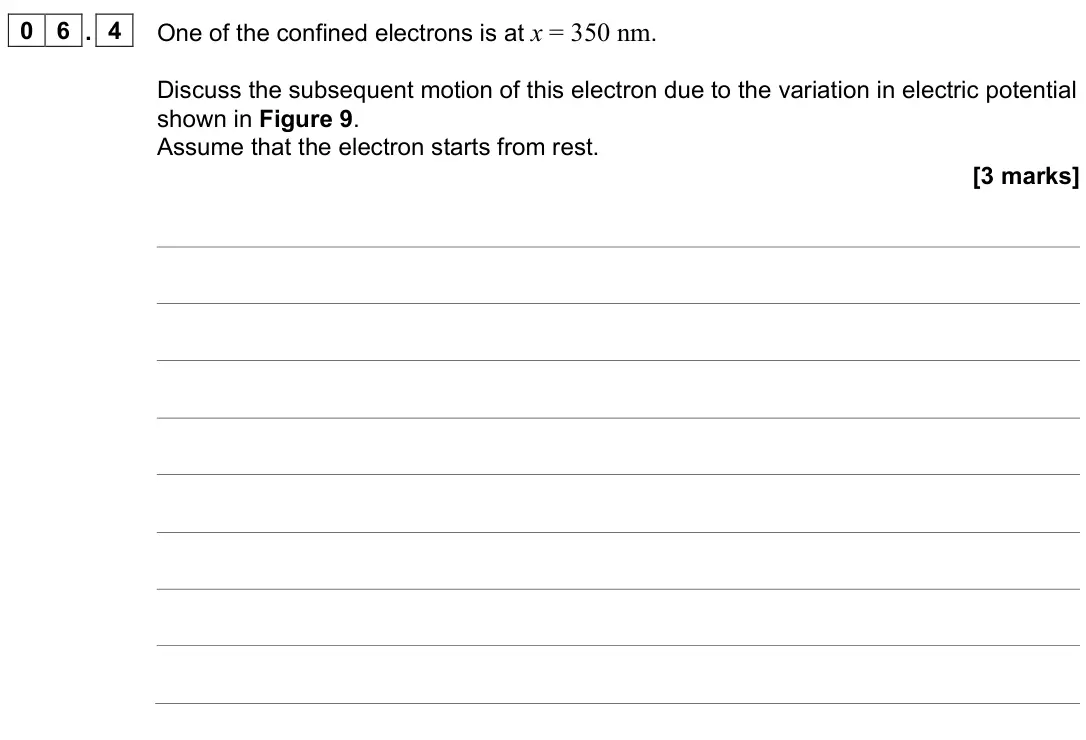
Q04.1
The whole paper ↗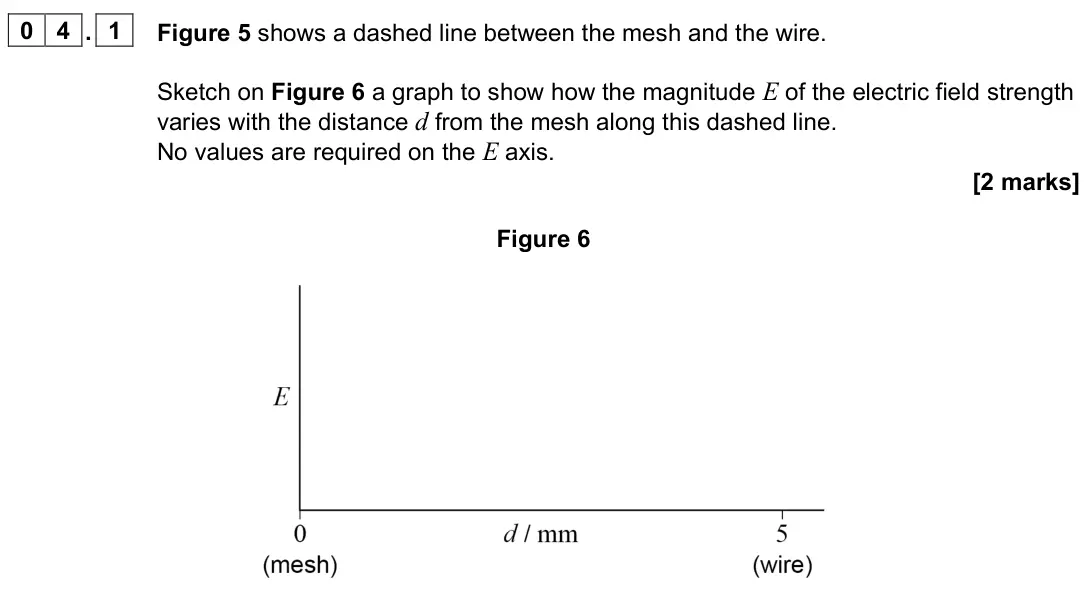
Q04.2
The whole paper ↗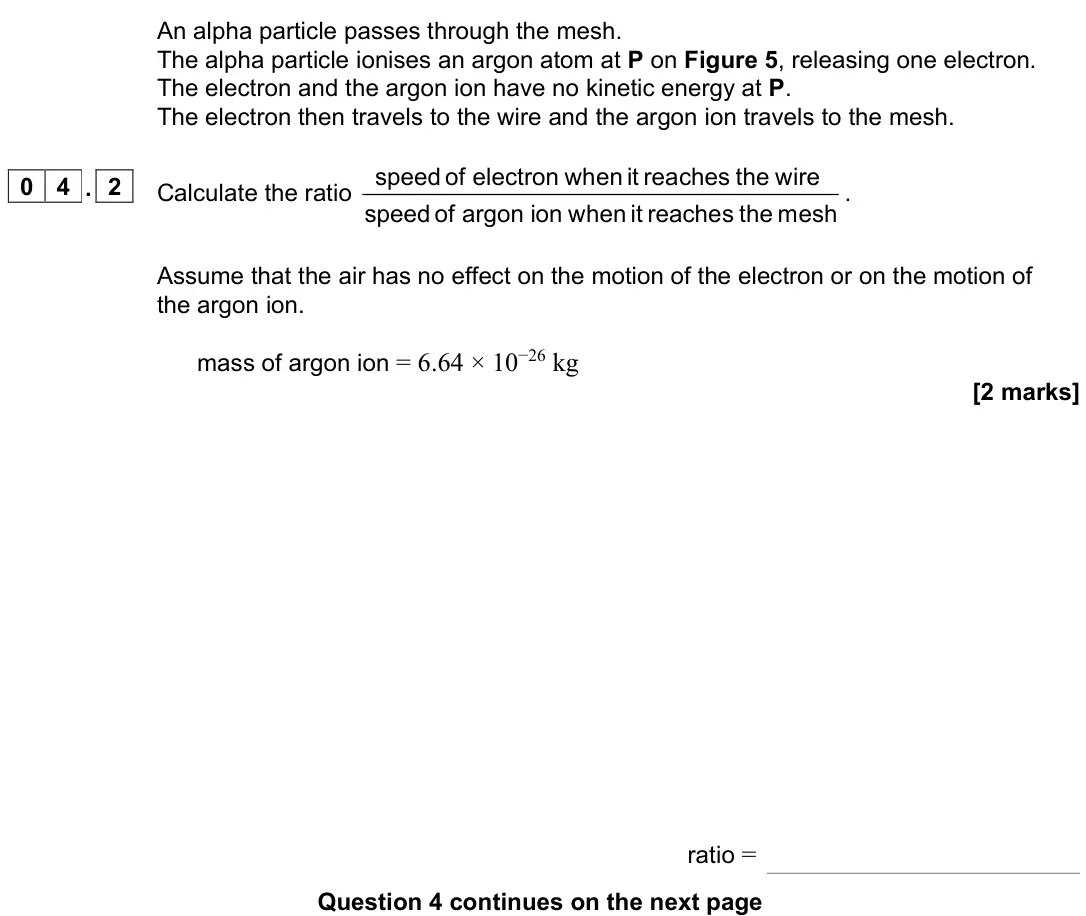
Q04.3
The whole paper ↗
All 73 questions on Electric fields, as a list
- June 2025, Paper 1, Q08.1 (2 marks): Calculate the maximum speed of an electron that is accelerated from rest by this potential difference. [2 marks] maximum speed = m s−1
- June 2025, Paper 2, Q06.4 (3 marks): An electric field of strength 371 μV m−1 can also accelerate the ion. Calculate the acceleration of the ion due to this electric field. [3 marks] acceleration =
- June 2025, Paper 2, Q06.5 (3 marks): The plasma torus contains two ions X and Y as shown in Figure 8. X has a charge of +2e. Y has a charge of +1e. Assume that each ion acts as a point charge. Figu
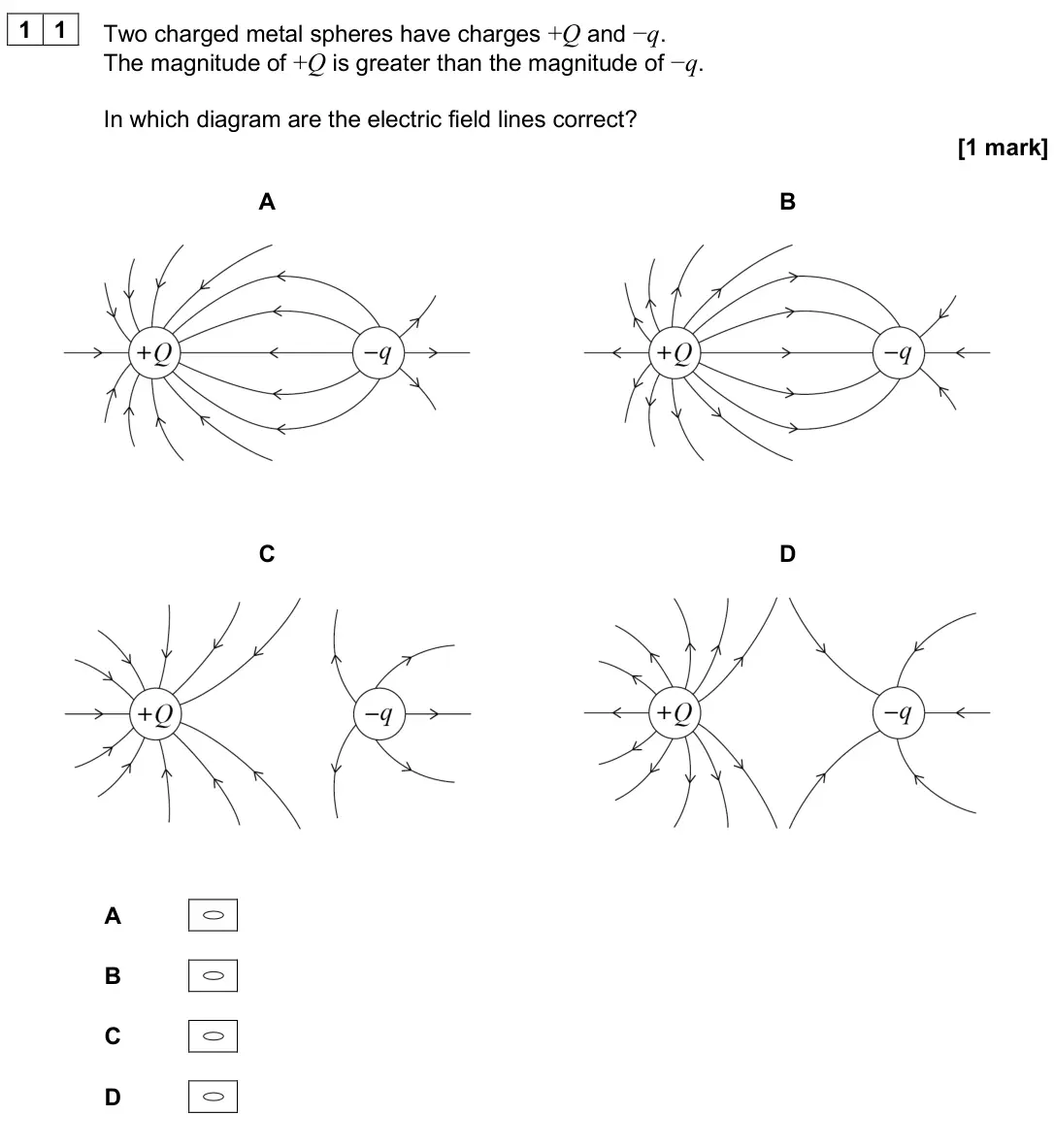
- June 2025, Paper 2, Q11 (1 mark): Two charged metal spheres have charges +Q and −q. The magnitude of +Q is greater than the magnitude of −q. In which diagram are the electric field lines correct
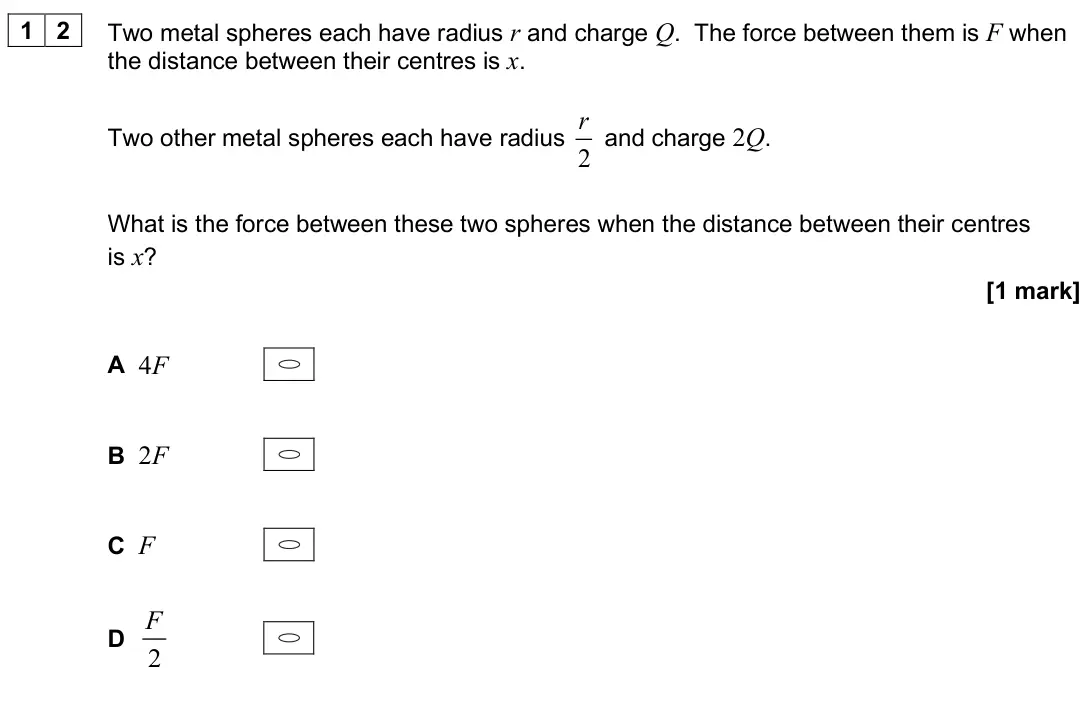
- June 2025, Paper 2, Q12 (1 mark): Two metal spheres each have radius r and charge Q. The force between them is F when the distance between their centres is x. Two other metal spheres each have r
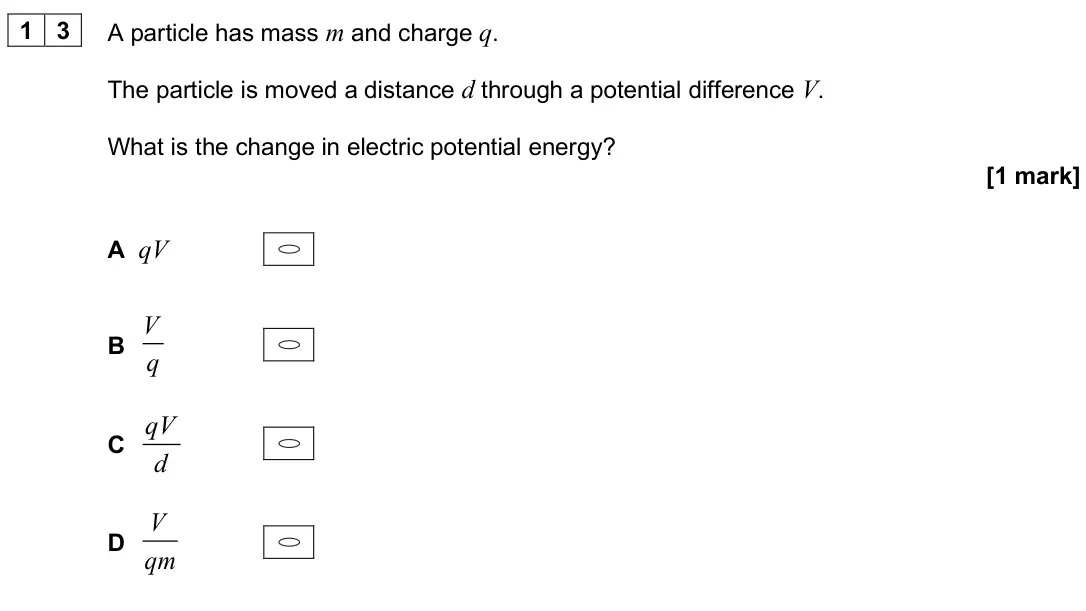
- June 2025, Paper 2, Q13 (1 mark): A particle has mass m and charge q. The particle is moved a distance d through a potential difference V. What is the change in electric potential energy? [1 mar
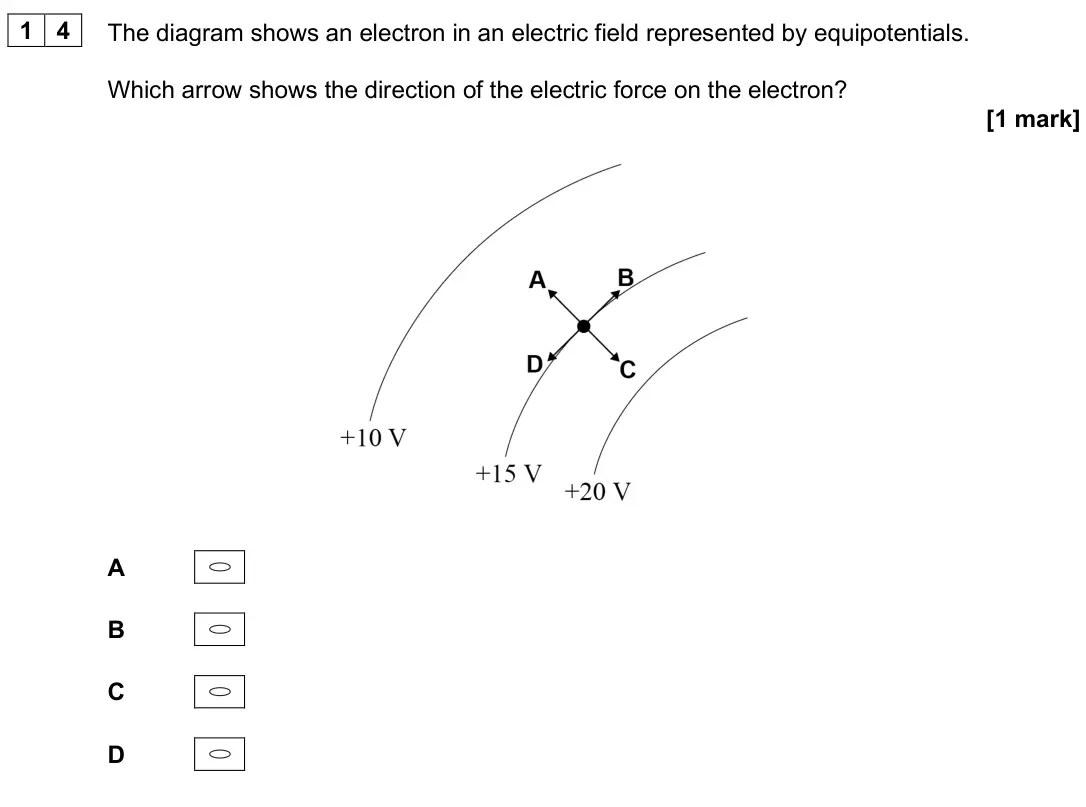
- June 2025, Paper 2, Q14 (1 mark): The diagram shows an electron in an electric field represented by equipotentials. Which arrow shows the direction of the electric force on the electron? [1 mark
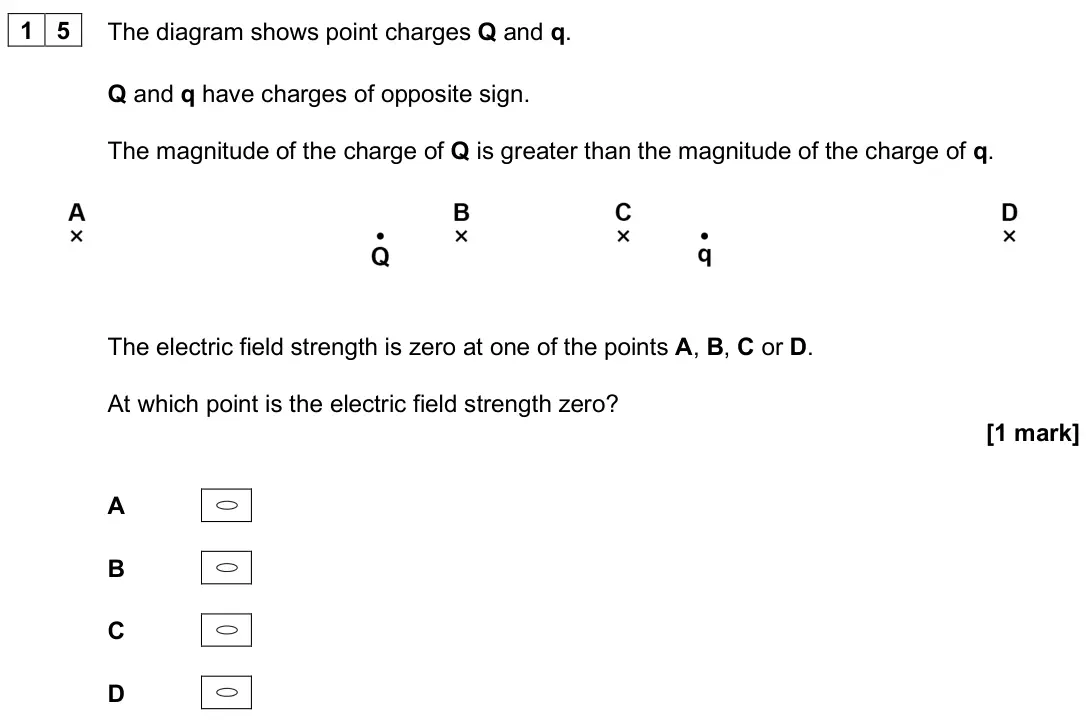
- June 2025, Paper 2, Q15 (1 mark): The diagram shows point charges Q and q. Q and q have charges of opposite sign. The magnitude of the charge of Q is greater than the magnitude of the charge of
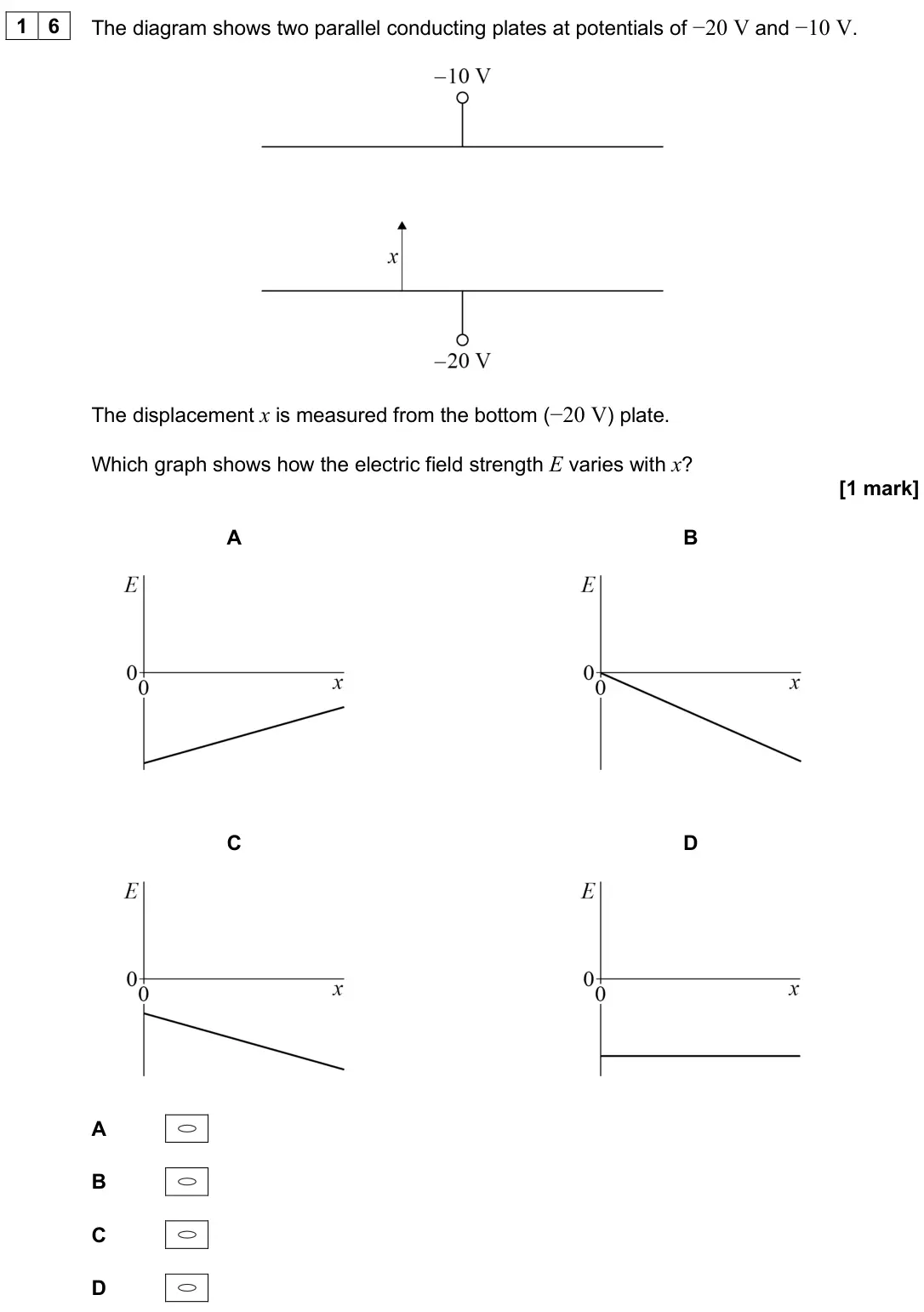
- June 2025, Paper 2, Q16 (1 mark): The diagram shows two parallel conducting plates at potentials of −20 V and −10 V. The displacement x is measured from the bottom (−20 V) plate. Which graph sho
- June 2024, Paper 2, Q06.1 (3 marks): The electric potential at a point in an electric field is −4.0 V. Explain what is meant by this statement. [3 marks]
- June 2024, Paper 2, Q06.2 (4 marks): Determine, using the graph in Figure 9, the maximum magnitude of the electric field. State an appropriate unit for your answer. [4 marks] maximum magnitude = un
- June 2024, Paper 2, Q06.3 (2 marks): An electron at rest at x = 300 nm gains kinetic energy and moves to x = 800 nm. Determine the minimum kinetic energy required by the electron. [2 marks] minimum
- June 2024, Paper 2, Q06.4 (3 marks): One of the confined electrons is at x = 350 nm. Discuss the subsequent motion of this electron due to the variation in electric potential shown in Figure 9. Ass
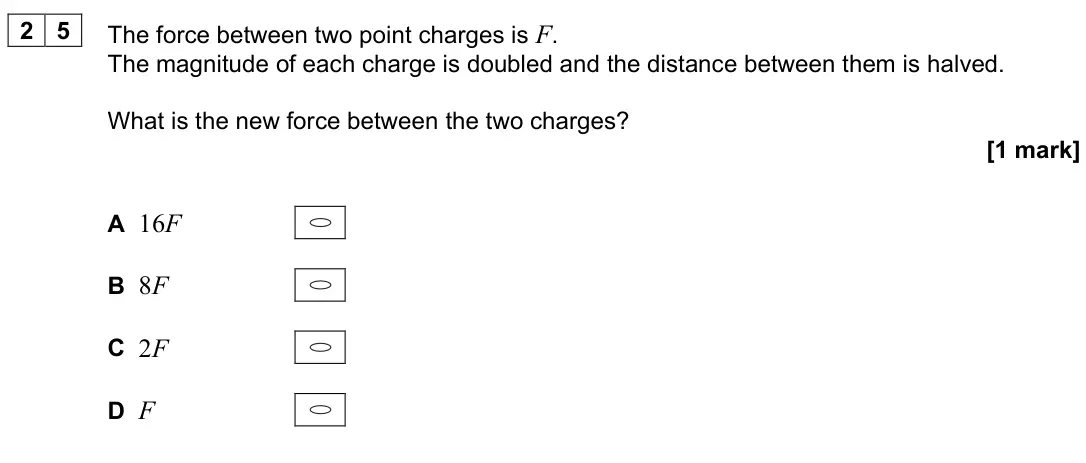
- June 2024, Paper 2, Q25 (1 mark): The force between two point charges is F. The magnitude of each charge is doubled and the distance between them is halved. What is the new force between the two
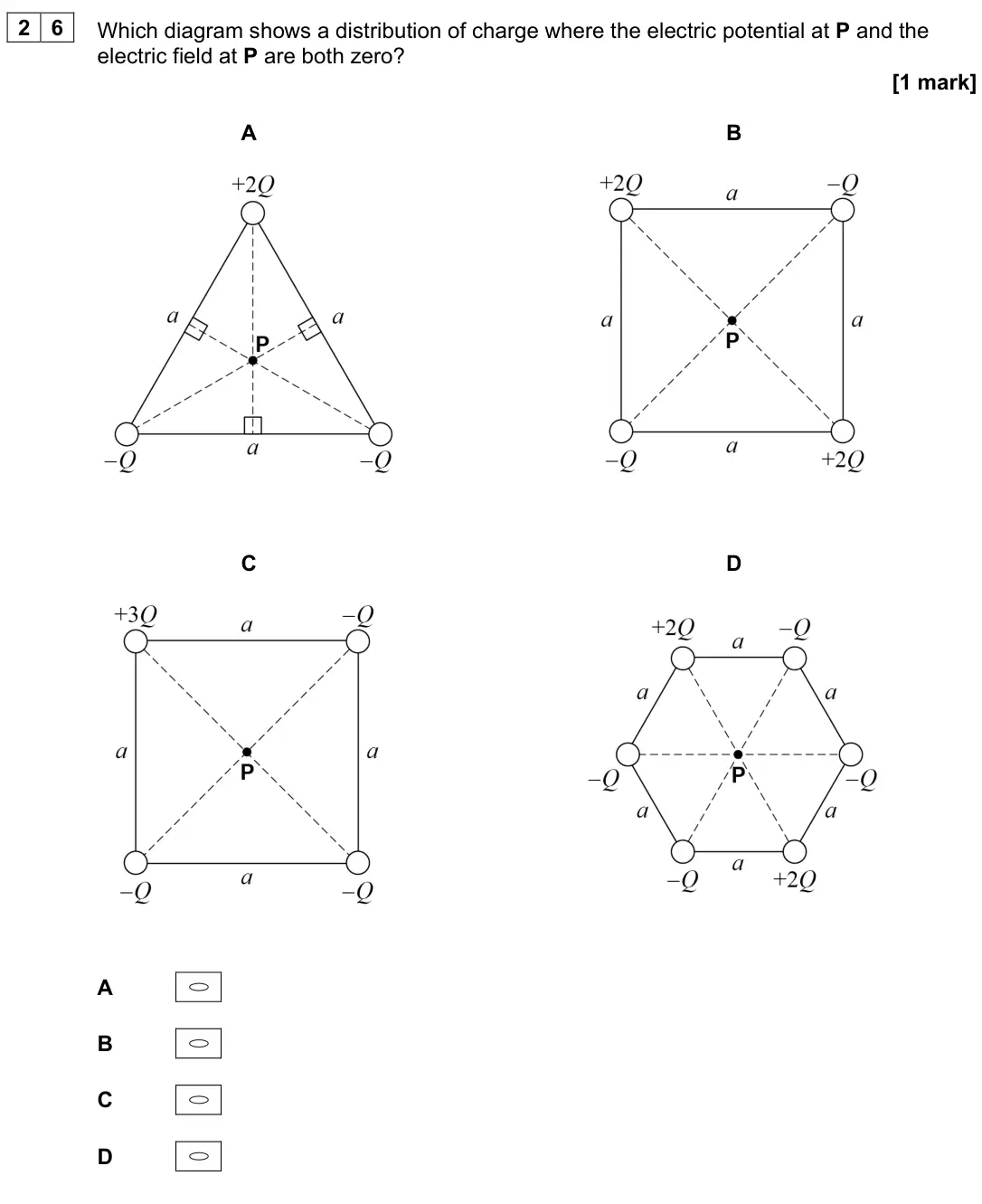
- June 2024, Paper 2, Q26 (1 mark): Which diagram shows a distribution of charge where the electric potential at P and the electric field at P are both zero? [1 mark] A B C D A B C D
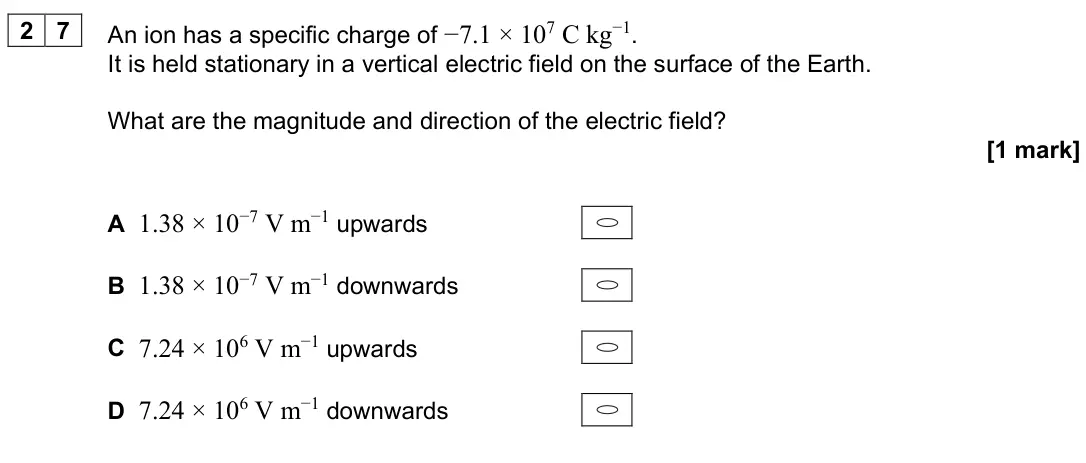
- June 2024, Paper 2, Q27 (1 mark): An ion has a specific charge of −7.1 × 10⁷ C kg−1. It is held stationary in a vertical electric field on the surface of the Earth. What are the magnitude and di
- June 2023, Paper 2, Q04.1 (2 marks): Figure 5 shows a dashed line between the mesh and the wire. Sketch on Figure 6 a graph to show how the magnitude E of the electric field strength varies with th
- June 2023, Paper 2, Q04.2 (2 marks): Calculate the ratio speed of electron when it reaches the wire speed of argon ion when it reaches the mesh . Assume that the air has no effect on the motion of
- June 2023, Paper 2, Q04.3 (1 mark): In practice, the air does affect the motion of the electron and the motion of the argon ion. Suggest how the presence of air between the mesh and the wire chang
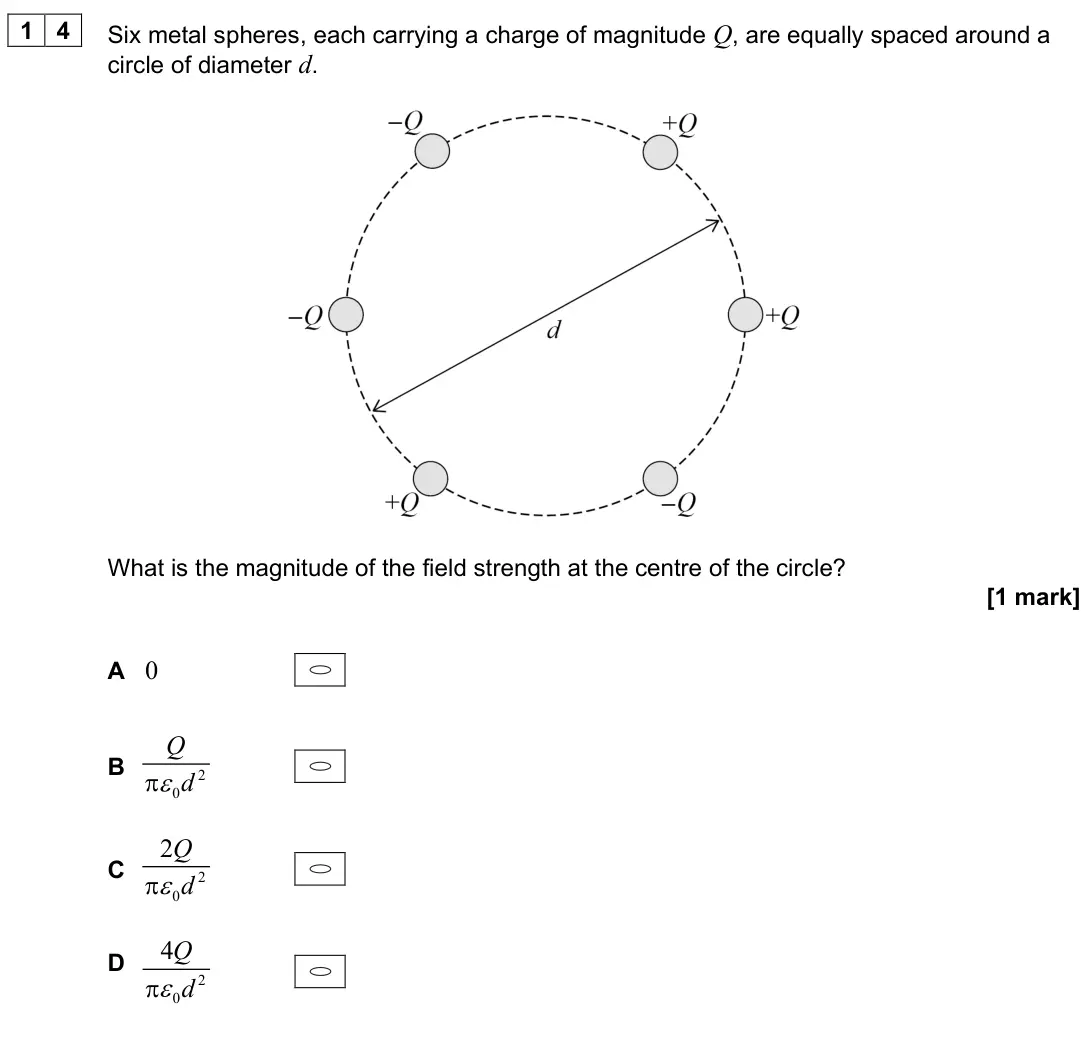
- June 2023, Paper 2, Q14 (1 mark): Six metal spheres, each carrying a charge of magnitude Q, are equally spaced around a circle of diameter d. What is the magnitude of the field strength at the c
- June 2023, Paper 2, Q15 (1 mark): Two point charges are separated by a distance of 200 mm. The force of attraction between them is 180 µN. The distance between the point charges is increased by
- June 2023, Paper 2, Q16 (1 mark): The diagram shows the path of an electron in a uniform electric field. The electron moves in a vertical plane. The direction of the electric field is [1 mark] A
- June 2023, Paper 2, Q17 (1 mark): The graph shows the variation of electric field strength E surrounding a charged sphere of radius R. The distance from the centre of the sphere is r. The total
- June 2023, Paper 2, Q19 (1 mark): An alpha particle is moving towards a stationary gold nucleus. The alpha particle has a kinetic energy of 9.0 × 10⁻¹³ J when it is a large distance from the gol
- June 2022, Paper 2, Q03.1 (2 marks): State and explain the location of the excess electrons. [2 marks]
- June 2022, Paper 2, Q03.2 (4 marks): The magnitude of the electric field strength E is related to V by E = V r ∆ ∆ . Determine, using this relationship, the magnitude of the electric field strength
- June 2022, Paper 2, Q15 (1 mark): A particle of mass m and charge Q is accelerated from rest through a potential difference V. The final velocity of the particle is u. A second particle of mass
- June 2022, Paper 2, Q16 (1 mark): The diagram shows a uniform electric field of strength 15 V m−1. The length RS is perpendicular to the field and the line ST is parallel to the field. What is t
- November 2021, Paper 2, Q06.3 (2 marks): One model of nuclear fusion suggests that fusion happens when nuclei touch. Initially the helium nucleus and oxygen nucleus are separated so that the force betw
- November 2021, Paper 2, Q14 (1 mark): The diagram shows a particle with charge +Q and a particle with charge −Q separated by a distance d. The particles exert a force F on each other. An additional
- November 2021, Paper 2, Q16 (1 mark): Two parallel metal plates separated by a distance d have a potential difference V across them. A particle with charge Q is placed midway between the plates. Wha
- November 2021, Paper 2, Q17 (1 mark): Two charged particles P and Q are separated by a distance of 120 mm. X is a point on the line between P and Q where the electric potential is zero. What is the
- November 2021, Paper 2, Q18 (1 mark): An isolated spherical conductor is charged. The conductor has a radius R and an electric potential V. The electric field strength at its surface is E. Point T i
- November 2021, Paper 2, Q19 (1 mark): O is the centre of a negatively charged sphere. K and L are two points at a distance r1 from O. M and N are two points at a distance r2 from O. Which statement
- November 2020, Paper 2, Q03.5 (3 marks): Figure 5 shows a different type of mass spectrometer working with lithium ions. Figure 5 A stationary Li+ 3 7 ion in the lithium sample is at the mid-point betw
- November 2020, Paper 2, Q03.6 (2 marks): Li 3 6 + and Li 3 7 + ions are produced in the sample simultaneously and travel a distance L from aperture P to the detector. For each type of ion, the time int
- November 2020, Paper 2, Q14 (1 mark): Two fixed charges of magnitude +Q and +3Q repel each other with a force F. An additional charge of −2Q is given to each charge. What are the magnitude and the d
- November 2020, Paper 2, Q15 (1 mark): At a distance L from a fixed point charge, the electric field strength is E and the electric potential is V. What are the electric field strength and the electr
- November 2020, Paper 2, Q16 (1 mark): Which diagram shows lines of equipotential in steps of equal potential difference near an isolated point charge? [1 mark] A B C D A B C D
- November 2020, Paper 2, Q17 (1 mark): A positive charge of 2.0 × 10⁻⁴ C is placed in an electric field at a point where the potential is +500 V. What is the potential energy of the system? [1 mark]
- November 2020, Paper 2, Q18 (1 mark): Two charges P and Q are 100 mm apart. X is a point on the line between P and Q where the electric potential is 0 V. What is the distance from P to X? [1 mark] A
- June 2019, Paper 1, Q22 (1 mark): Charged plates X and Y have a potential difference 1.5 V between them. Which particle gains 3.0 eV of kinetic energy when moving from Y to X? [1 mark] A proton
- June 2019, Paper 2, Q04.1 (3 marks): Calculate the potential of one of the spheres. [3 marks] potential = V
- June 2019, Paper 2, Q04.2 (2 marks): The charged spheres in Figure 3 are at equilibrium. Draw labelled arrows on Figure 3 to show the forces on sphere B. [2 marks]
- June 2019, Paper 2, Q04.3 (2 marks): Suggest a solution to one problem involved in the measurement of d in Figure 3. [2 marks]
- June 2019, Paper 2, Q04.4 (3 marks): Show that the magnitude of the electrostatic force on each sphere is about 4 × 10⁻³ N. [3 marks]
- June 2019, Paper 2, Q04.5 (2 marks): A student measures the angle θ when the apparatus in Figure 3 is at equilibrium. The student records θ as 7°. Discuss whether this measurement is consistent wit
- June 2019, Paper 2, Q14 (1 mark): A small object of mass m has a charge Q. The object remains stationary in an evacuated space between two horizontal plates. The plates are separated by a distan
- June 2019, Paper 2, Q15 (1 mark): 1.5 mJ of work is done when a charge of 30 µC is moved between two points, M and N, in an electric field. What is the potential difference between M and N? [1 m
- June 2019, Paper 2, Q16 (1 mark): An electric field acts into the plane of the paper. An electron enters the field at 90° to the field lines. The force on the electron is [1 mark] A zero. B alon
- June 2019, Paper 2, Q17 (1 mark): The ionisation potential for the atoms of a gas is V. Electrons of mass m and charge e travelling at a speed v can just cause ionisation of atoms in the gas. Wh
- June 2018, Paper 2, Q02.1 (2 marks): Define the electric field strength at a point in an electric field. [2 marks]
- June 2018, Paper 2, Q02.2 (3 marks): Figure 2 shows a point charge of +46 µC placed 120 mm from a point charge Q. Figure 2 Position P is on the line joining the charges at a distance 66 mm from cha
- June 2018, Paper 2, Q02.3 (2 marks): Explain, without calculation, whether net work must be done in moving a proton from infinity to position P in Figure 2. [2 marks]
- June 2018, Paper 2, Q02.4 (2 marks): A small rubber ball coated with a conducting paint carries a positive charge. The ball is suspended in equilibrium from a vertical wall by an uncharged non-cond
- June 2018, Paper 2, Q20 (1 mark): A conducting sphere holding a charge of +10 µC is placed centrally inside a second uncharged conducting sphere. Which diagram shows the electric field lines for
- June 2018, Paper 2, Q21 (1 mark): A charged spherical conductor has a radius r. An electric field of strength E exists at the surface due to the charge. What is the potential of the spherical co
- June 2018, Paper 2, Q22 (1 mark): Four positive charges are fixed at the corners of a square as shown. The total potential at the centre of the square, a distance d from each charge, is . Three
- June 2017, Paper 2, Q06.5 (1 mark): State which object L or M has a charge with the greater magnitude. object State which object L or M has a positive charge. object [1 mark]
- June 2017, Paper 2, Q06.6 (2 marks): Draw, on Figure 7, an equipotential line that passes through point N. Do not extend your line beyond the given field lines. [2 marks]
- June 2017, Paper 2, Q15 (1 mark): Two parallel metal plates of separation a carry equal and opposite charges. Which graph best represents how the electric field strength E varies with the distan
- June 2017, Paper 2, Q16 (1 mark): A particle of mass m and charge q is accelerated through a potential difference V over a distance d. What is the average acceleration of the particle? [1 mark]
- June 2017, Paper 2, Q17 (1 mark): An electron moves through a distance of 0.10 m parallel to the field lines of a uniform electric field of strength 2.0 kN C−1. What is the work done on the elec
- Specimen, Paper 2, Q01.1 (2 marks): Figure 1 shows a system that separates two minerals from the ore containing them using an electric field. Figure 1 The crushed particles of the two different mi
- Specimen, Paper 2, Q01.2 (3 marks): Figure 1 shows a system that separates two minerals from the ore containing them using an electric field. Figure 1 The crushed particles of the two different mi
- Specimen, Paper 2, Q01.3 (1 mark): Figure 1 shows a system that separates two minerals from the ore containing them using an electric field. Figure 1 The crushed particles of the two different mi
- Specimen, Paper 2, Q01.4 (2 marks): Figure 1 shows a system that separates two minerals from the ore containing them using an electric field. Figure 1 The crushed particles of the two different mi
- Specimen, Paper 2, Q01.5 (4 marks): Figure 1 shows a system that separates two minerals from the ore containing them using an electric field. Figure 1 The crushed particles of the two different mi
- Specimen, Paper 2, Q11 (1 mark): Q
- Specimen, Paper 2, Q12 (1 mark): Two parallel metal plates are separated by a distance d and have a potential difference V across them. Which expression gives the magnitude of the electrostatic
- Specimen, Paper 2, Q13 (1 mark): The diagram shows the path of an α particle deflected by the nucleus of an atom. Point P on the path is the point of closest approach of the α particle to the n
- Specimen, Paper 2, Q14 (1 mark): A 1.3 m B 1.5 m C 7.9 m D 15 m
- Specimen, Paper 2, Q15 (1 mark): The diagram shows two particles at distance d apart. One particle has charge +Q and the other –2Q. The two particles exert an electrostatic force of attraction,
Questions, mark schemes and examiner’s reports are © AQA, from their published past papers. Plumi isn’t affiliated with any exam board. Want whole papers? Every AQA A-Level Physics paper.
Rather write your answers by hand on iPad? Plumi marks them against the same mark schemes.