 plumi
Doppler effect: AQA A‑Level Physics questions
AQA A-Level Physics past-paper questions on 3.9.3.1 Doppler effect, 2008–2025, with mark schemes and examiner’s reports where available.
Paper
All papers
Exam
All years
Calculations
Q04.4
The whole paper ↗
Q04.5
The whole paper ↗Q04.1
The whole paper ↗
Q03.3
The whole paper ↗Q02.1
The whole paper ↗
Q02.2
The whole paper ↗Q02.3
The whole paper ↗Q02.4
The whole paper ↗Q04.2
The whole paper ↗
Q03.3
The whole paper ↗
Q04.1
The whole paper ↗Q2(a)
The whole paper ↗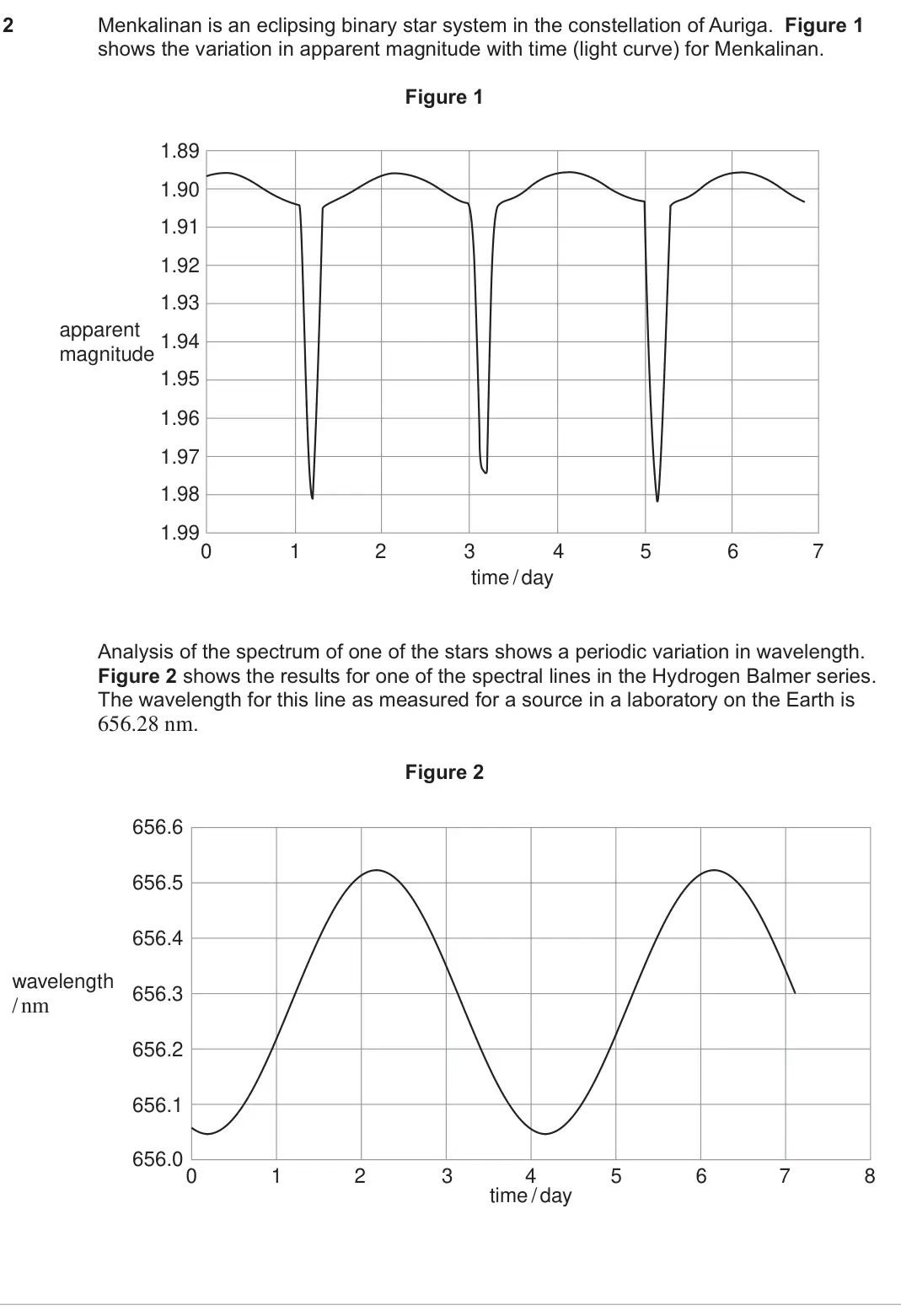
Q4(b)(i)
The whole paper ↗
Q4(a)
The whole paper ↗
Q3(a)(i)
The whole paper ↗
Q4(b)(i)
The whole paper ↗
Q5(b)
The whole paper ↗
All 17 questions on Doppler effect, as a list
- June 2025, Paper 3 Astrophysics, Q04.4 (3 marks): Explain the variation in apparent magnitude shown in Figure 2. In your answer you should explain: • the changes in observed brightness at P and Q, as shown in F
- June 2025, Paper 3 Astrophysics, Q04.5 (2 marks): Determine the angular velocity of the binary system. [2 marks] angular velocity = rad s−1
- June 2024, Paper 3 Astrophysics, Q04.1 (2 marks): The Andromeda Galaxy approaches the Milky Way at a speed of 110 km s−1. The distance between the galaxies is 770 kpc. Discuss whether these data can be used to
- June 2023, Paper 3 Astrophysics, Q03.3 (3 marks): A star is orbiting the black hole in M87. The star is observed in the plane of its orbit. The wavelength of a spectral line observed in the light emitted from t
- June 2022, Paper 3 Astrophysics, Q02.1 (2 marks): Explain the shape of the graph in Figure 1. [2 marks]
- June 2022, Paper 3 Astrophysics, Q02.2 (1 mark): State why the average of the values in Table 1 is different from the laboratory value. [1 mark]
- June 2022, Paper 3 Astrophysics, Q02.3 (3 marks): Show that the orbital speed of the primary star is about 250 km s−1. [3 marks]
- June 2022, Paper 3 Astrophysics, Q02.4 (2 marks): Calculate the orbital radius of the primary star. [2 marks] orbital radius = m
- November 2021, Paper 3 Astrophysics, Q04.2 (4 marks): IC2497 has a red shift of 0.0516 Determine the distance from the Earth to IC2497. Give an appropriate unit for your answer. [4 marks] distance = unit =
- November 2020, Paper 3 Astrophysics, Q03.3 (6 marks): Measurements of type 1a supernovae are used to find a value for the Hubble constant. The distance from Earth is known for many type 1a supernovae. Describe how
- June 2019, Paper 3 Astrophysics, Q04.1 (3 marks): Table 3 contains information about two galaxies. Table 3 Galaxy Red shift, z Distance from Earth / ly NGC 936 4.8 × 10⁻³ 6.8 × 10⁷ NGC 3379 3.0 × 10⁻³ 3.2 × 10⁷
- June 2015, PHYA5 Astrophysics (old spec), Q2(a) (6 marks): Describe the physical processes that give rise to the shape of each graph. Go on to show how the information in the graphs can be used to determine properties,
- June 2013, PHYA5 Astrophysics (old spec), Q4(b)(i) (3 marks): Use these data to calculate a value for the Hubble constant. value kms–1 Mpc–1 (3 marks)
- June 2012, PHYA5 Astrophysics (old spec), Q4(a) (4 marks): Cygnus A has a redshift, z, of 0.057. Calculate the distance to Cygnus A. State an appropriate unit. answer = unit = (4 marks)
- June 2011, PHYA5 Astrophysics (old spec), Q3(a)(i) (1 mark): Explain what is meant by red shift. (1 mark)
- June 2010, PHYA5 Astrophysics (old spec), Q4(b)(i) (1 mark): Calculate the value of the red shift, z, for this galaxy. z = (1 mark)
- June 2008, PHA5W (2008 spec), Q5(b) (4 marks): 5 (b) Analysis of radio waves from the galaxy IZW 1, suggest it is 800 million light years from Earth. 5 (b) (i) Calculate the recessional speed of the galaxy.
Questions, mark schemes and examiner’s reports are © AQA, from their published past papers. Plumi isn’t affiliated with any exam board. Want whole papers? AQA A-Level Physics past papers.
The Plumi iPad app also offers exam-style questions with AI feedback on your handwritten working.