 plumi
Sequences and series: AQA A‑Level Maths questions
Every AQA A-Level Maths exam question on D Sequences and series, 2018–2025, with its mark scheme and examiner’s report.
Find questions426

All 45 questions on Sequences and series, as a list
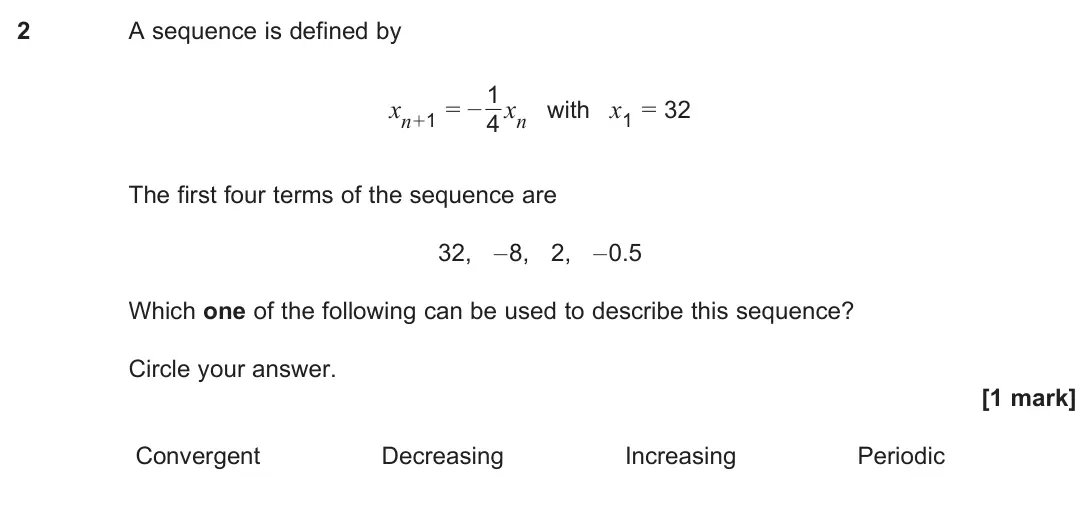
- June 2025, Paper 1, Q2 (1 mark): A sequence is defined by xn+1 = – 1 4 xn with x1 = 32 The first four terms of the sequence are 32, –8, 2, –0.5 Which one of the following can be used to describ
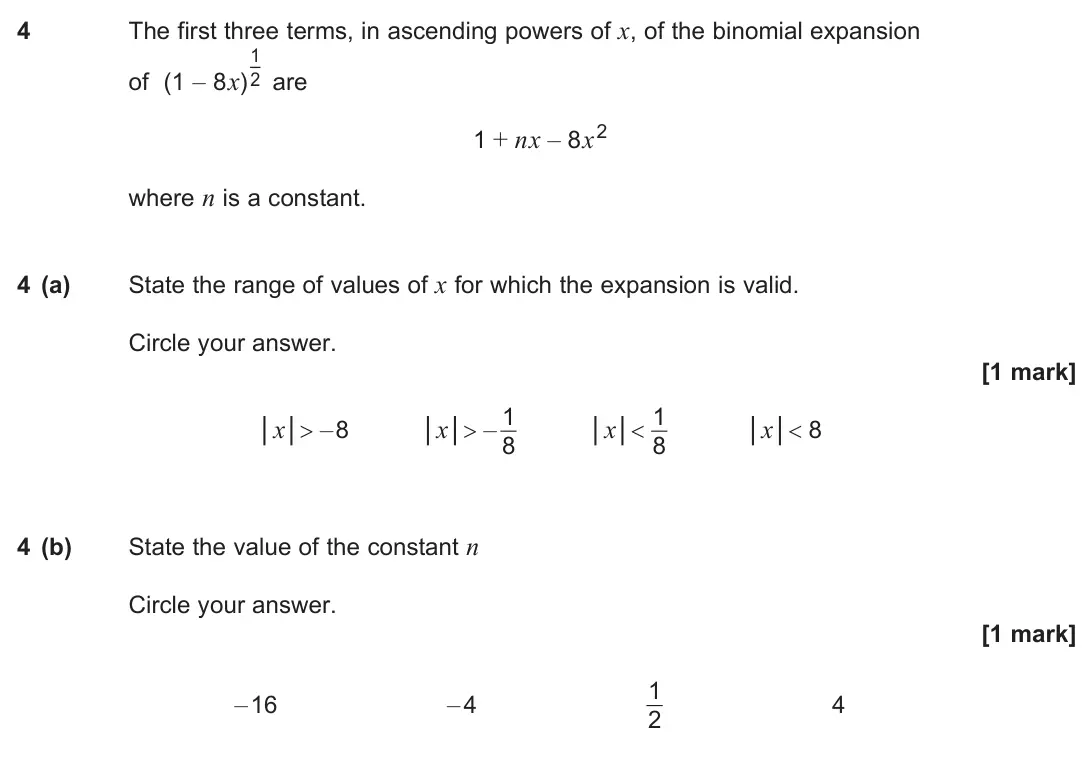
- June 2025, Paper 1, Q4 (2 marks): The first three terms, in ascending powers of x, of the binomial expansion of (1 – 8x) 1 2 are 1 + nx – 8x2 where n is a constant. 4 (a) State the range of valu
- June 2025, Paper 1, Q6 (2 marks): An arithmetic series has first term 3 and common difference –0.5 Find the sum of the first 250 terms. [2 marks]
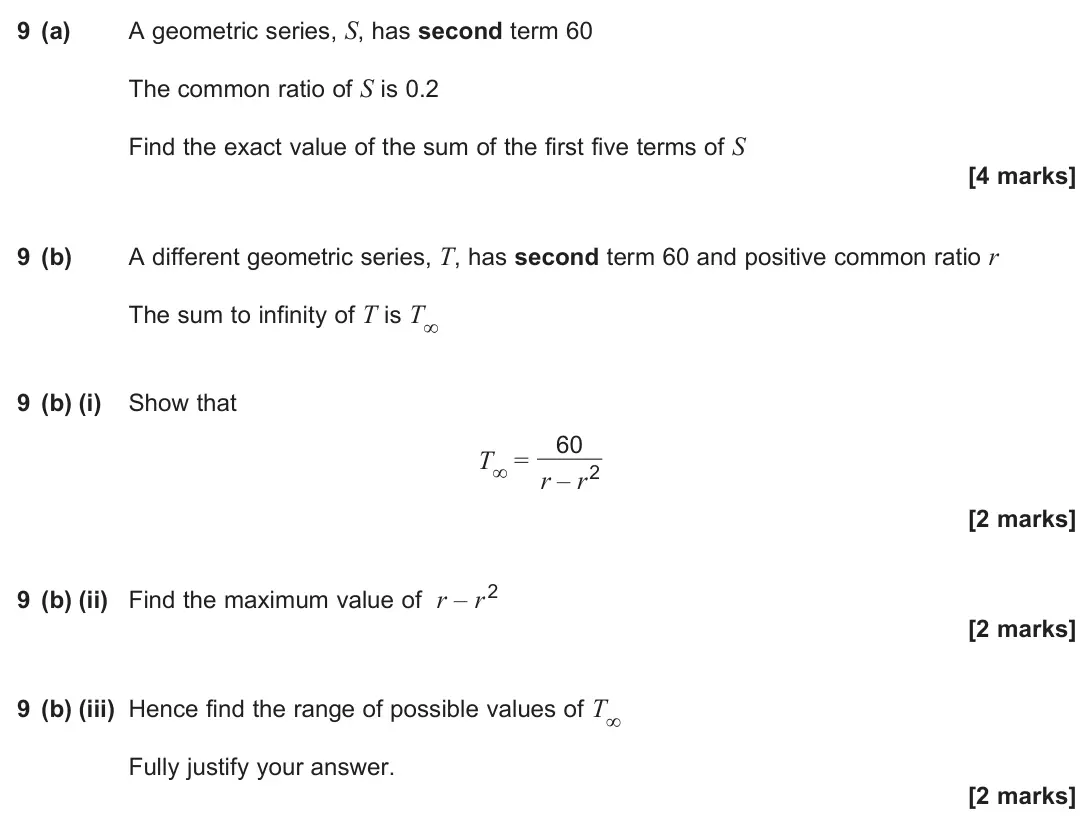
- June 2025, Paper 1, Q9 (10 marks): (a) A geometric series, S, has second term 60 The common ratio of S is 0.2 Find the exact value of the sum of the first five terms of S [4 marks] 9 (b) A differ
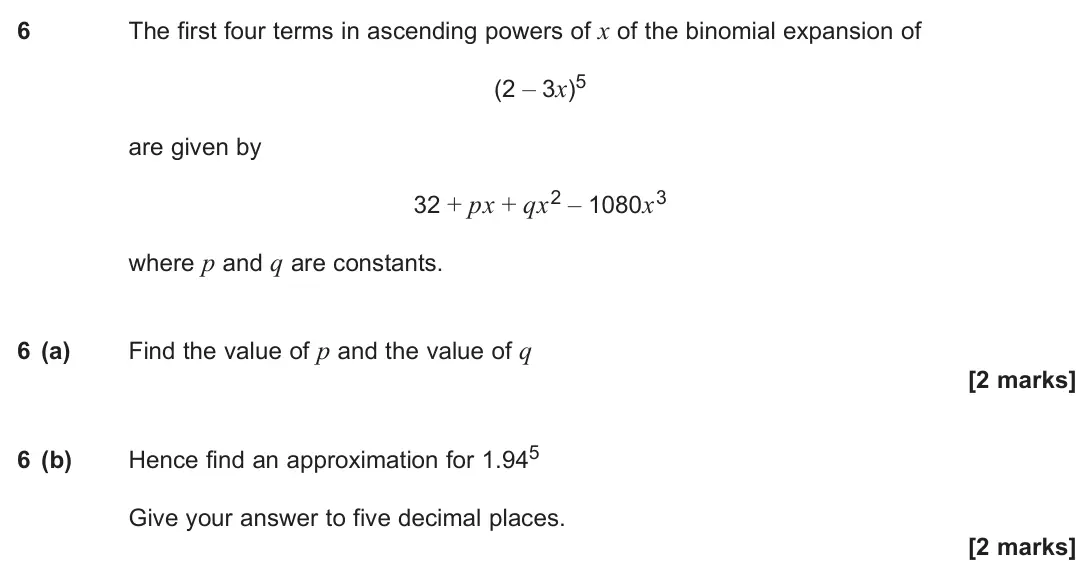
- June 2025, Paper 3, Q6 (4 marks): The first four terms in ascending powers of x of the binomial expansion of (2 – 3x)5 are given by 32 + px + qx2 – 1080x3 where p and q are constants. 6 (a) Find
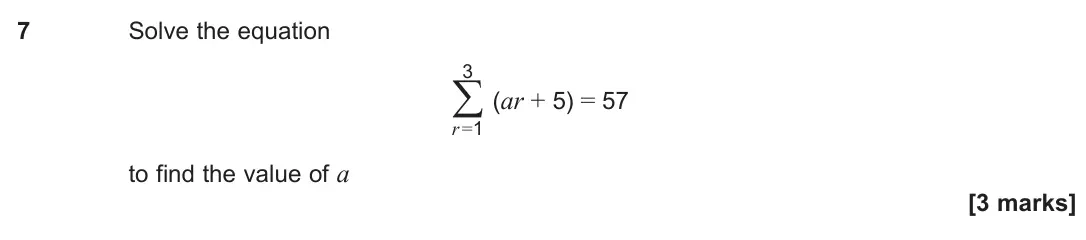
- June 2025, Paper 3, Q7 (3 marks): Solve the equation 3 ∑ r =1 (ar + 5) = 57 to find the value of a [3 marks]
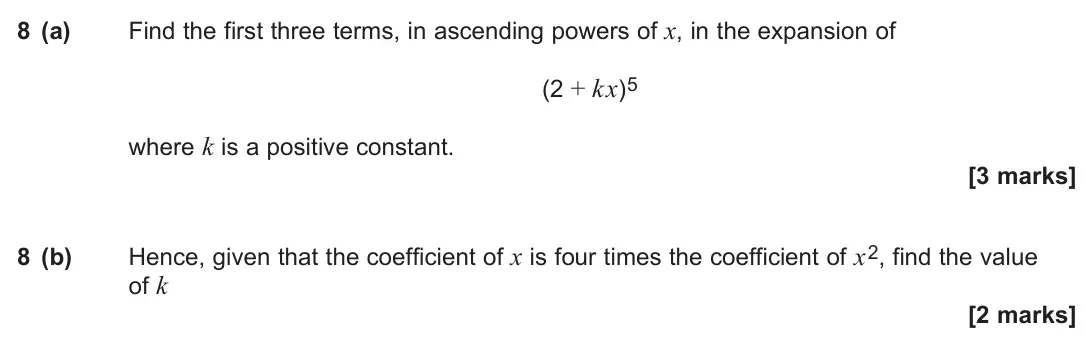
- June 2024, Paper 1, Q8 (5 marks): (a) Find the first three terms, in ascending powers of x, in the expansion of (2 + kx)5 where k is a positive constant. [3 marks] 8 (b) Hence, given that the co
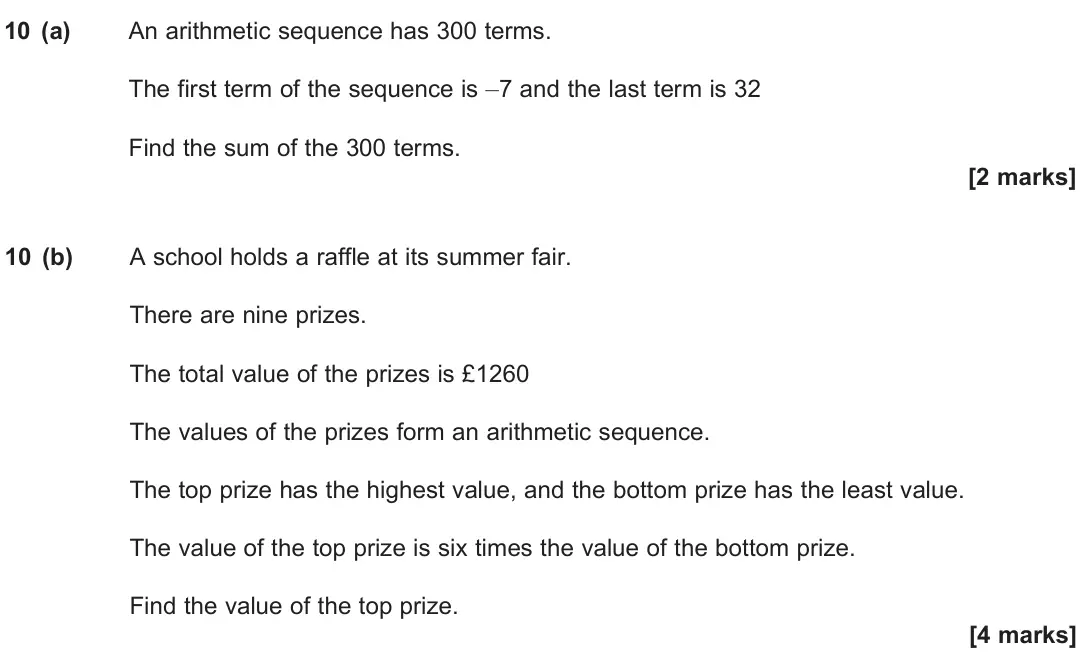
- June 2024, Paper 1, Q10 (6 marks): (a) An arithmetic sequence has 300 terms. The first term of the sequence is –7 and the last term is 32 Find the sum of the 300 terms. [2 marks] 10 (b) A school
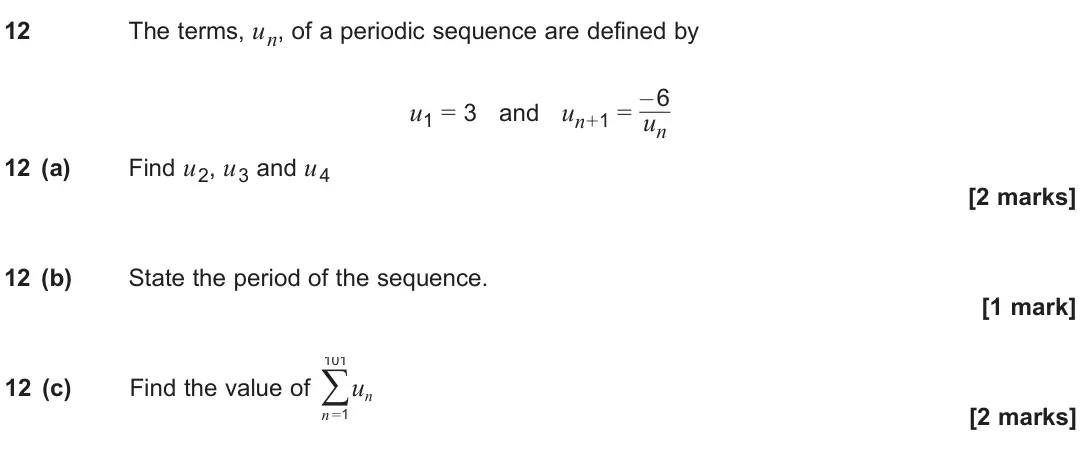
- June 2024, Paper 1, Q12 (5 marks): The terms, un, of a periodic sequence are defined by u1 = 3 and un+1 = –6 un 12 (a) Find u2, u3 and u4 [2 marks] 12 (b) State the period of the sequence. [1 mar
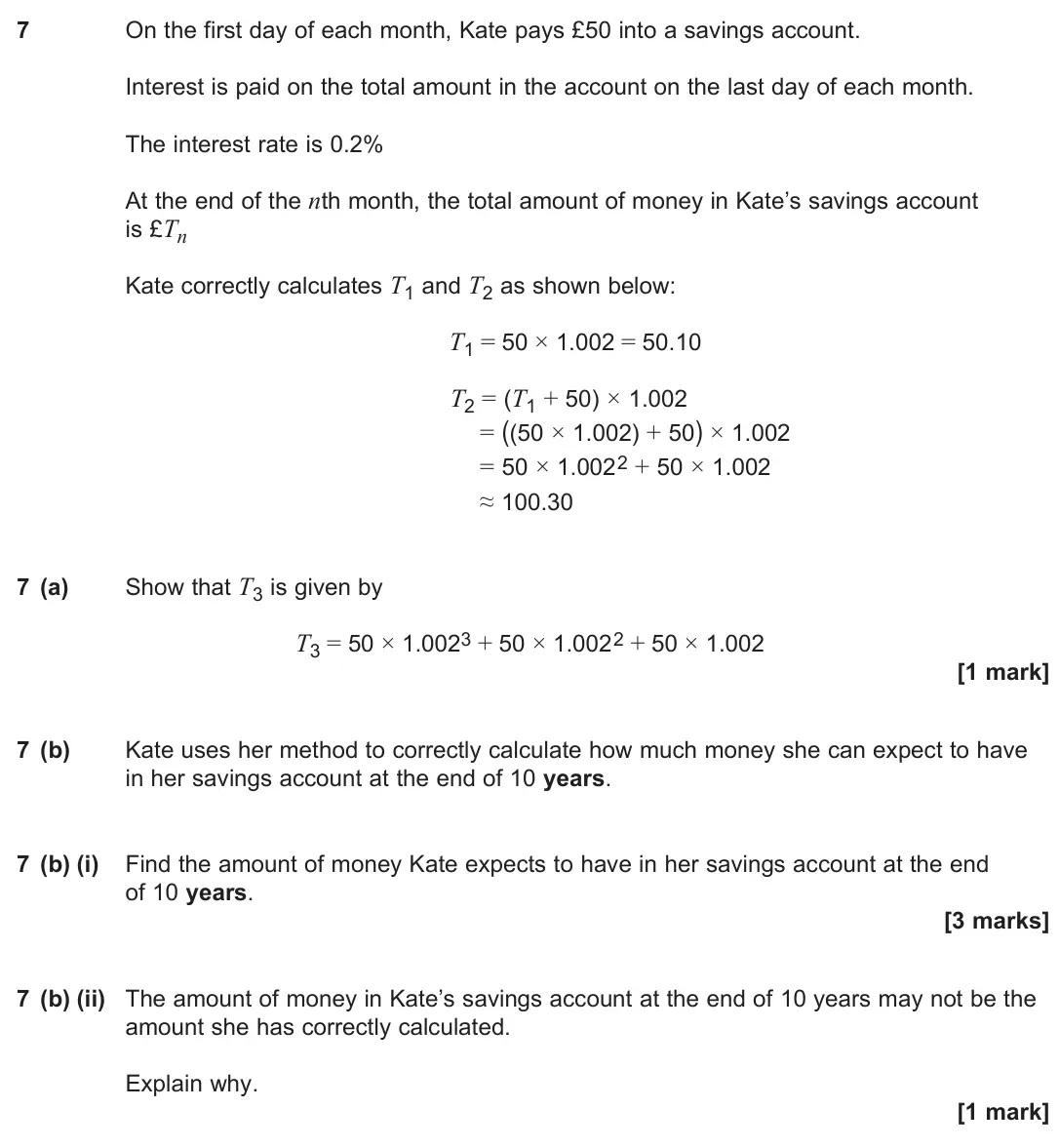
- June 2024, Paper 2, Q7 (5 marks): On the first day of each month, Kate pays £50 into a savings account. Interest is paid on the total amount in the account on the last day of each month. The int
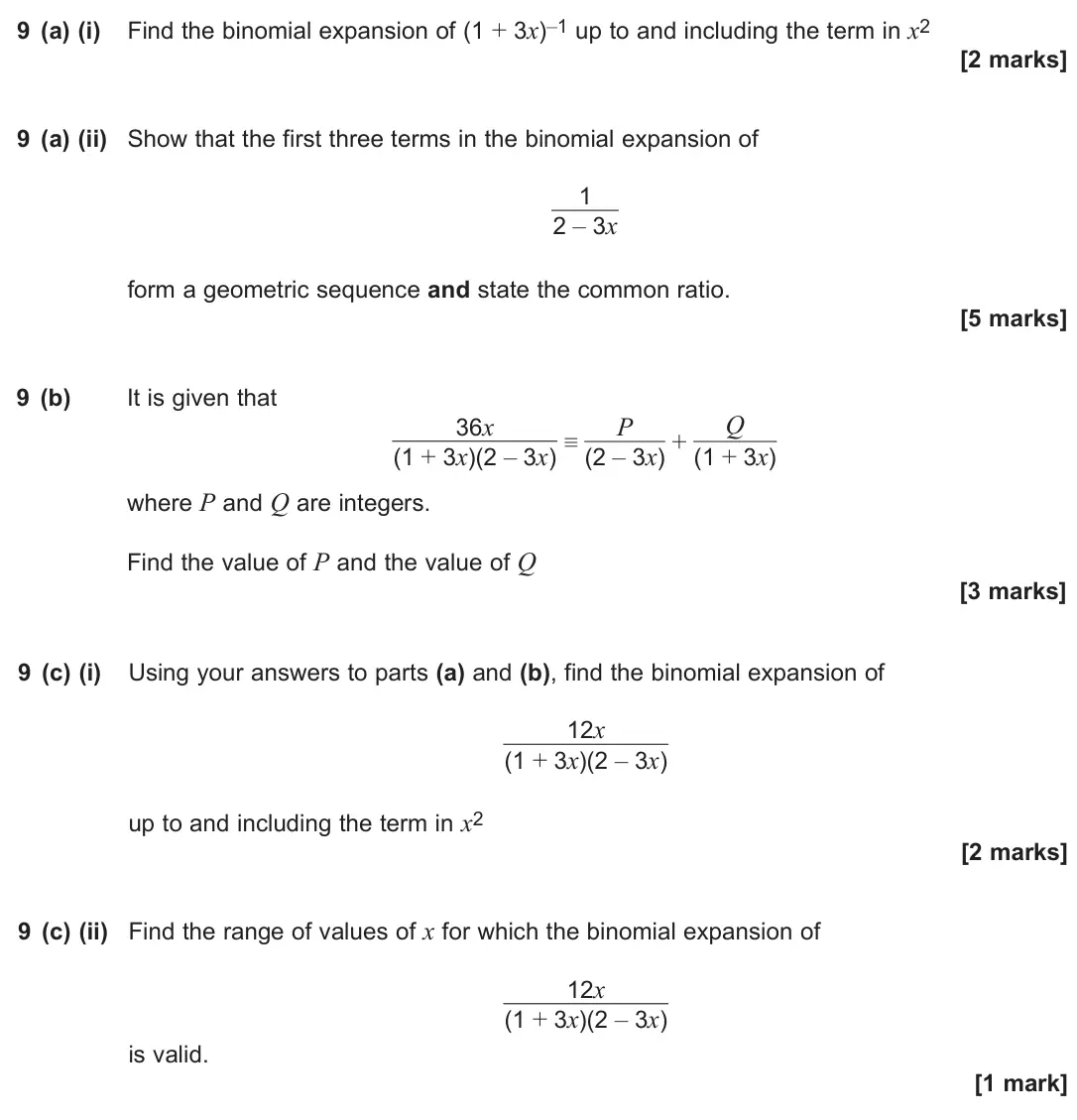
- June 2024, Paper 2, Q9 (13 marks): (a) (i) Find the binomial expansion of (1 + 3x)–1 up to and including the term in x2 [2 marks] 9 (a) (ii) Show that the first three terms in the binomial expans
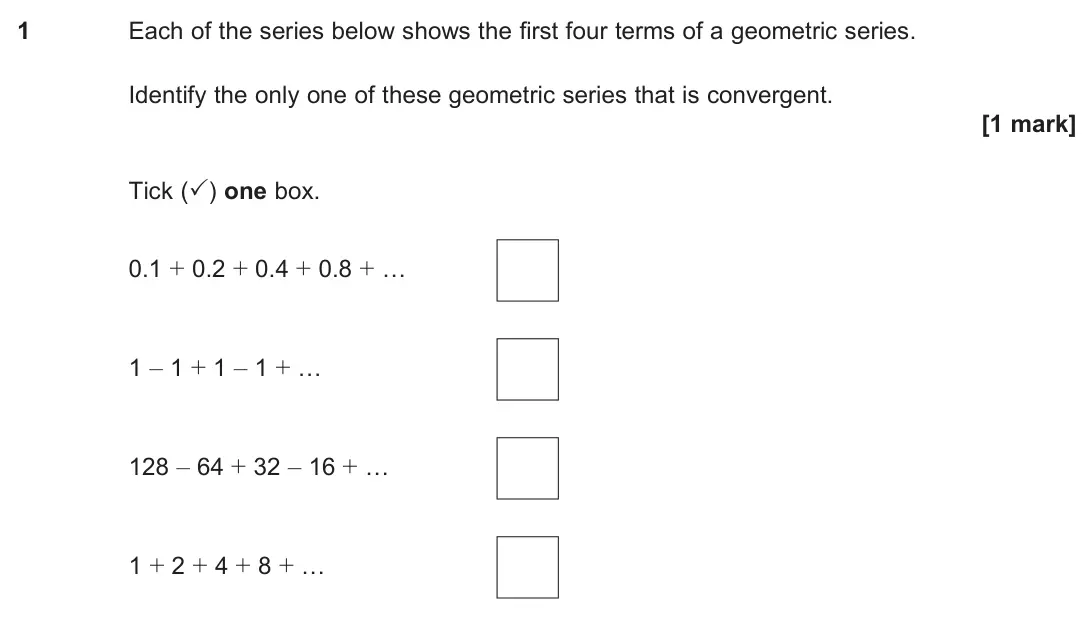
- June 2024, Paper 3, Q1 (1 mark): Each of the series below shows the first four terms of a geometric series. Identify the only one of these geometric series that is convergent. [1 mark] Tick (✓)
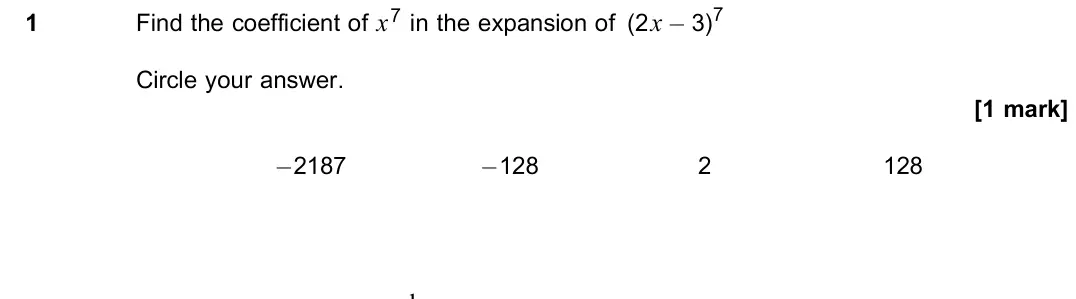
- June 2023, Paper 1, Q1 (1 mark): Find the coefficient of x7 in the expansion of (2x − 3)7 Circle your answer. [1 mark] −2187 −128 2 128 d
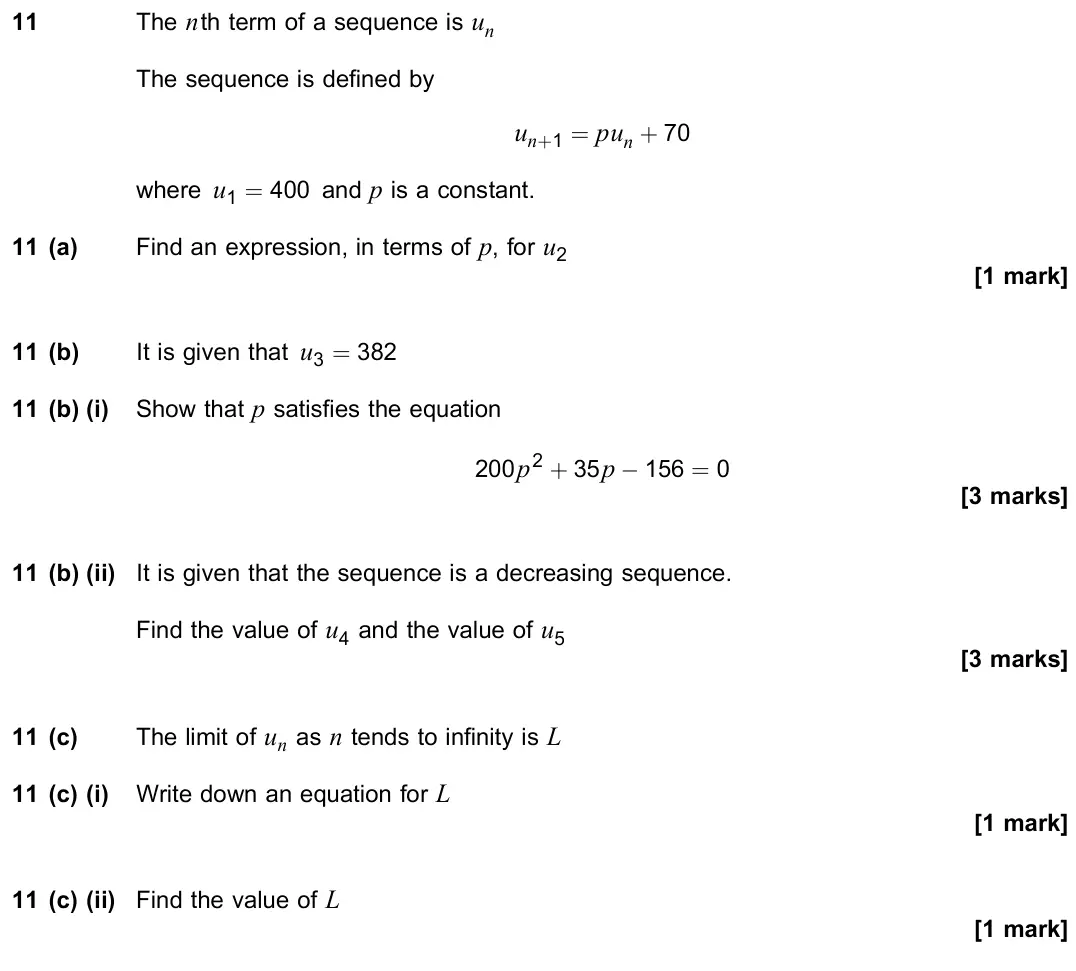
- June 2023, Paper 1, Q11 (9 marks): The nth term of a sequence is un The sequence is defined by un+1 = pun + 70 where u1 = 400 and p is a constant. 11 (a) Find an expression, in terms of p, for u2
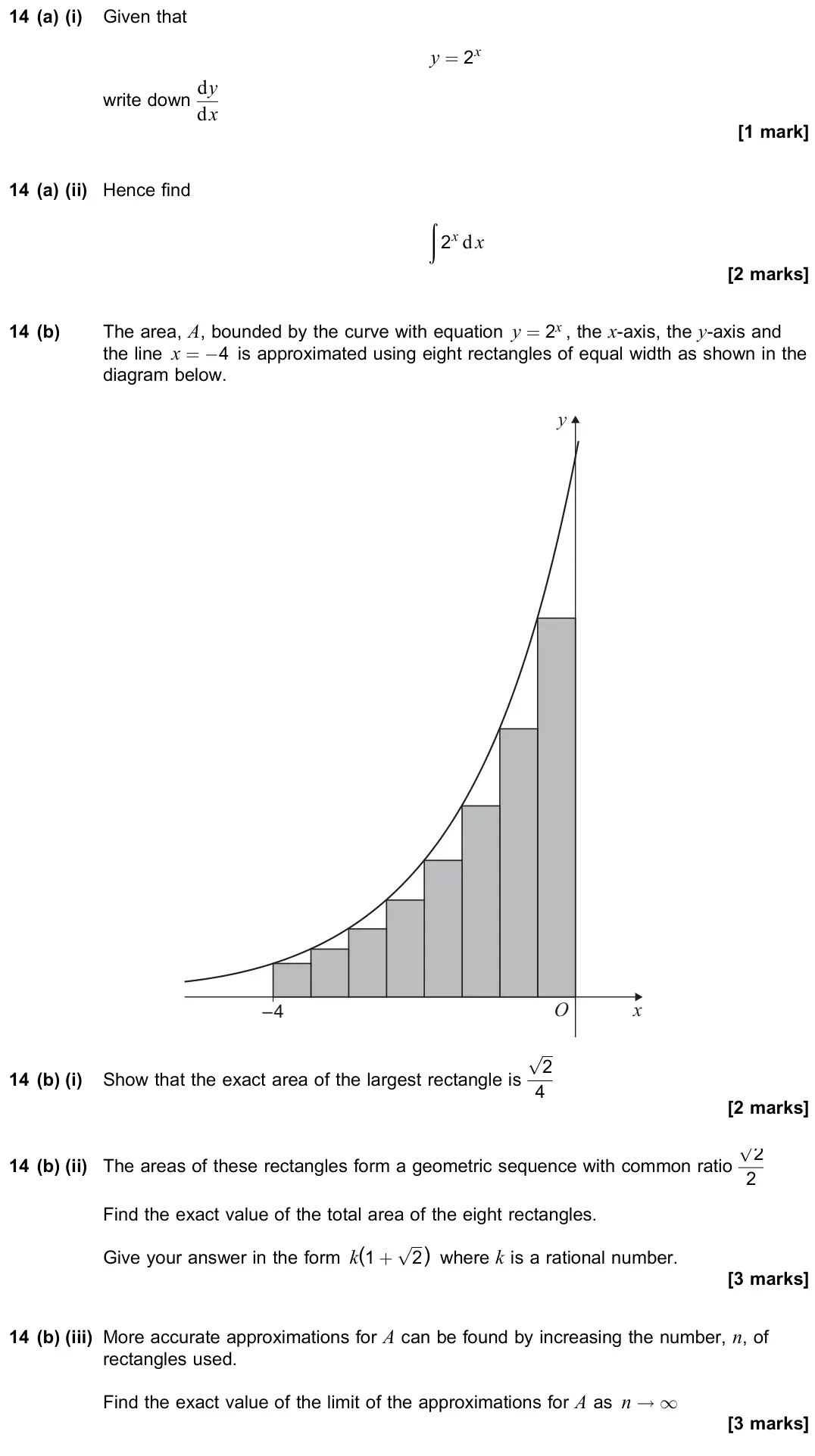
- June 2023, Paper 1, Q14 (11 marks): (a) (i) Given that y = 2x write down dy dx [1 mark] 14 (a) (ii) Hence find ( 2x dx [2 marks] 14 (b) The area, A, bounded by the curve with equation y = 2x , the
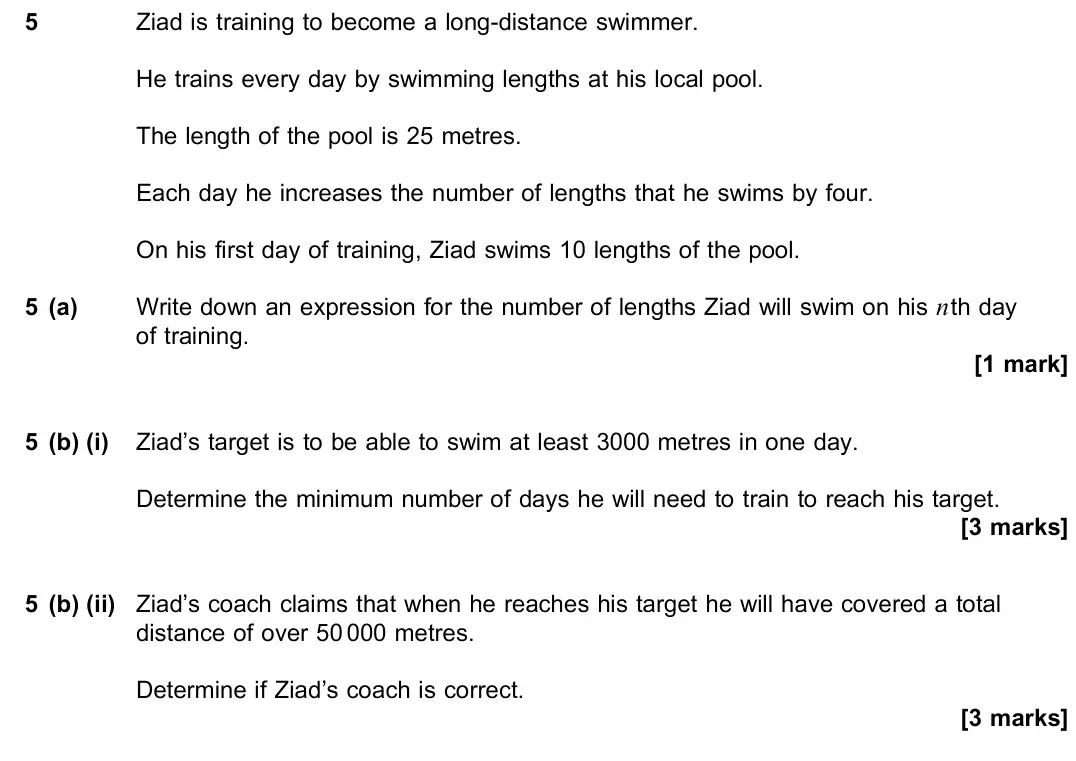
- June 2023, Paper 2, Q5 (7 marks): Ziad is training to become a long-distance swimmer. He trains every day by swimming lengths at his local pool. The length of the pool is 25 metres. Each day he
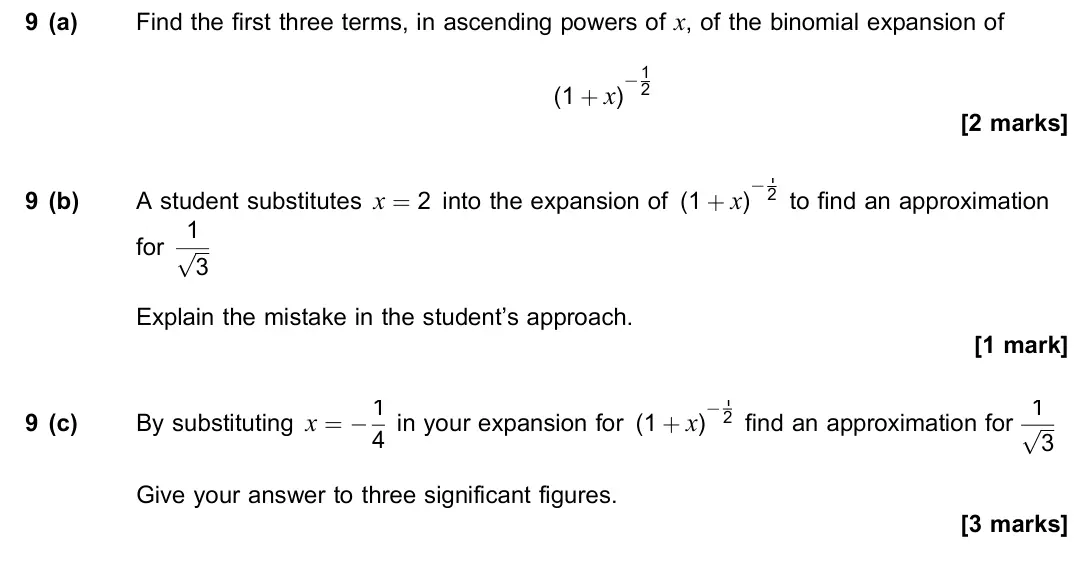
- June 2023, Paper 2, Q9 (6 marks): (a) Find the first three terms, in ascending powers of x, of the binomial expansion of (1 + x) −1 2 [2 marks] 9 (b) A student substitutes x = 2 into the expansi
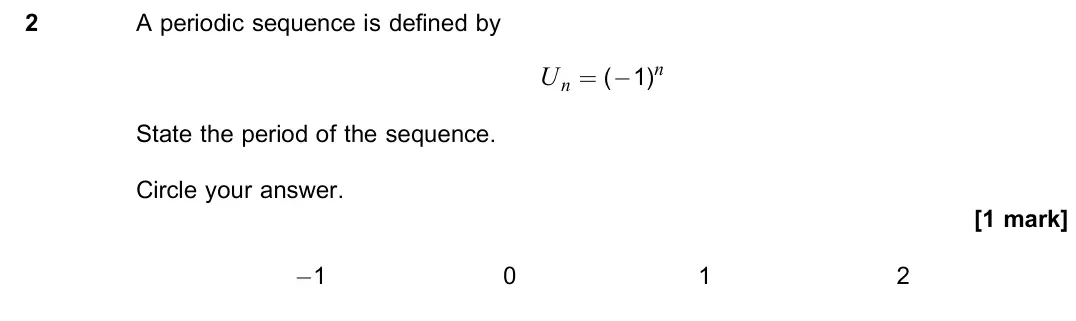
- June 2022, Paper 1, Q2 (1 mark): A periodic sequence is defined by Un = (×1)n State the period of the sequence. Circle your answer. [1 mark] ×1 0 1 2
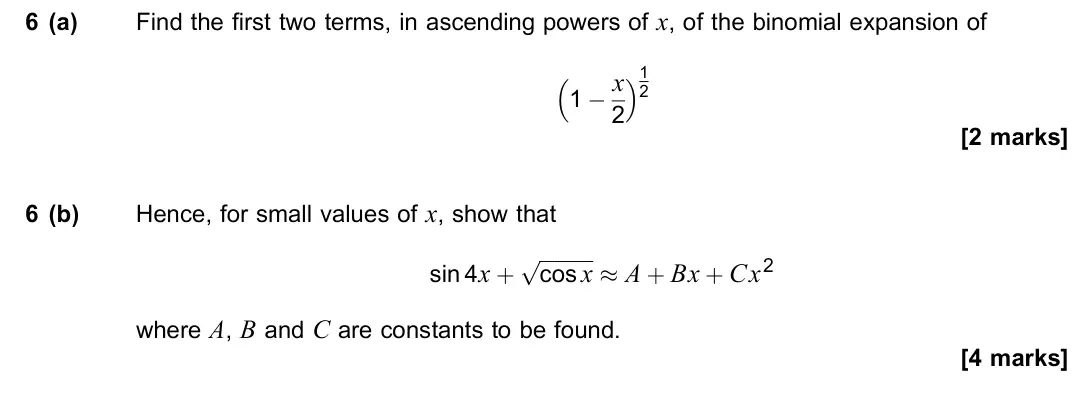
- June 2022, Paper 1, Q6 (6 marks): (a) Find the first two terms, in ascending powers of x, of the binomial expansion of 1 × x 2 1 2 [2 marks] 6 (b) Hence, for small values of x, show that sin 4x
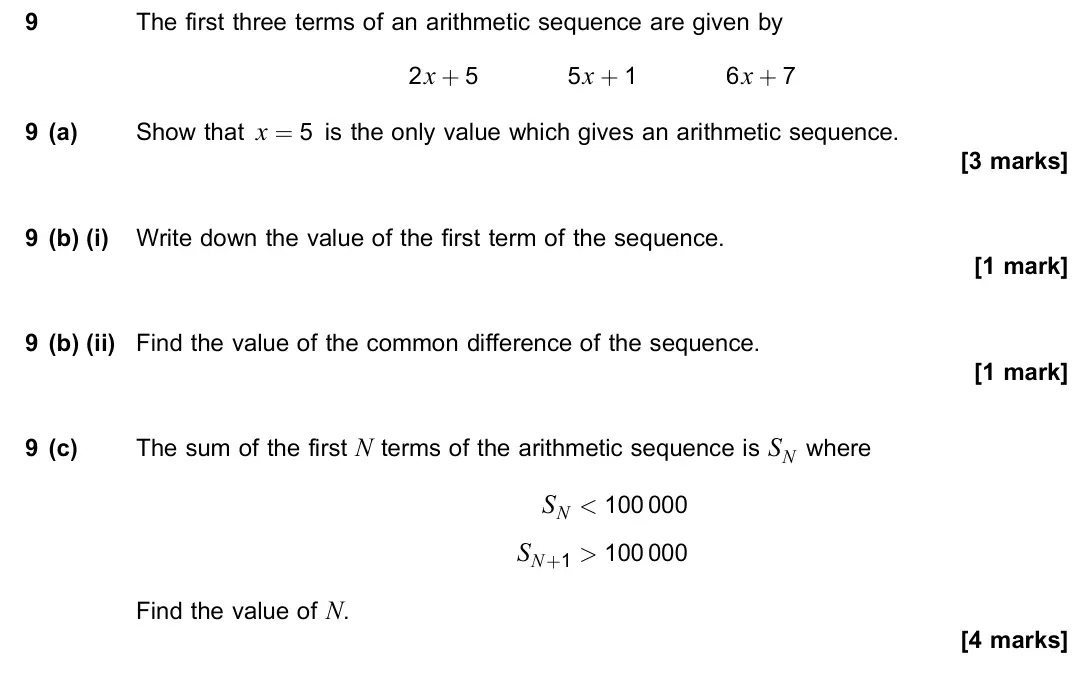
- June 2022, Paper 1, Q9 (9 marks): The first three terms of an arithmetic sequence are given by 2x + 5 5x + 1 6x + 7 9 (a) Show that x = 5 is the only value which gives an arithmetic sequence. [3
- June 2022, Paper 1, Q12 (8 marks): (a) A geometric sequence has first term 1 and common ratio 1 2 12 (a) (i) Find the sum to infinity of the sequence. [2 marks] 12 (a) (ii) Hence, or otherwise, e
- June 2022, Paper 2, Q5 (6 marks): The binomial expansion of (2 + 5x)4 is given by (2 + 5x)4 = A + 160x + Bx2 + 1000x3 + 625x4 5 (a) Find the value of A and the value of B. [2 marks] 5 (b) Show t
- June 2022, Paper 3, Q1 (1 mark): State the range of values of x for which the binomial expansion of 1 − x 4 r is valid. Circle your answer. [1 mark] jxj < 1 4 jxj < 1 jxj < 2 jxj < 4
- November 2021, Paper 1, Q3 (1 mark): A geometric sequence has a sum to infinity of −3 A second sequence is formed by multiplying each term of the original sequence by −2 What is the sum to infinity
- November 2021, Paper 1, Q6 (7 marks): (a) The ninth term of an arithmetic series is 3 The sum of the first n terms of the series is Sn and S21 = 42 Find the first term and common difference of the s
- November 2021, Paper 2, Q3 (1 mark): A sequence is defined by u1 = a and un+1 = −1 × un Find P 95 n=1 un Circle your answer. [1 mark] −a 0 a 95a for the next question
- November 2021, Paper 3, Q4 (5 marks): (a) Show that the first three terms, in descending powers of x, of the expansion of (2x − 3)10 are given by 1024x10 + px9 + qx8 where p and q are integers to be
- November 2021, Paper 3, Q7 (10 marks): A building has a leaking roof and, while it is raining, water drips into a 12 litre bucket. When the rain stops, the bucket is one third full. Water continues t
- November 2020, Paper 1, Q1 (2 marks): The first three terms, in ascending powers of x, of the binomial expansion of (9 + 2x) 1 2 are given by (9 + 2x) 1 2 − a + x 3 × x2 54 where a is a constant. 1
- November 2020, Paper 1, Q7 (4 marks): Consecutive terms of a sequence are related by un+1 = 3 × (un)2 7 (a) In the case that u1 = 2 7 (a) (i) Find u3 [2 marks] 7 (a) (ii) Find u50 [1 mark] 7 (b) Sta
- November 2020, Paper 1, Q10 (11 marks): (a) An arithmetic series is given by X 20 r=5 (4r + 1) 10 (a) (i) Write down the first term of the series. [1 mark] 10 (a) (ii) Write down the common difference
- November 2020, Paper 2, Q3 (3 marks): Find the coefficient of x2 in the binomial expansion of 2x − 3 x 8 [3 marks]
- November 2020, Paper 3, Q7 (7 marks): (a) Using nCr = n! r!(n − r)! show that nC2 = n(n − 1) 2 [2 marks] 7 (b) (i) Show that the equation 2 × nC4 = 51 × nC2 simplifies to n2 − 5n − 300 = 0 [3 marks]
- November 2020, Paper 3, Q8 (12 marks): The sum to infinity of a geometric series is 96 The first term of the series is less than 30 The second term of the series is 18 8 (a) Find the first term and c
- June 2019, Paper 1, Q5 (7 marks): An arithmetic sequence has first term a and common difference d. The sum of the first 16 terms of the sequence is 260 5 (a) Show that 4a + 30d = 65 [2 marks] 5
- June 2019, Paper 1, Q8 (4 marks): P(n) = X n k=0 k 3 − X n 1 k=0 k 3 where n is a positive integer. 8 (a) Find P(3) and P(10) [2 marks] 8 (b) Solve the equation P(n) = 1:25 × 108 [2 marks]
- June 2019, Paper 1, Q16 (16 marks): (a) y = e−x( sinx + cos x) Find dy dx Simplify your answer. [3 marks] 16 (b) Hence, show that ( e−x sinx dx = ae−x( sinx + cos x) + c where a is a rational numb
- June 2019, Paper 2, Q9 (9 marks): (a) Show that the first two terms of the binomial expansion of 4 − 2x2 p are 2 − x2 2 [2 marks] 9 (b) State the range of values of x for which the expansion fou
- June 2019, Paper 3, Q2 (1 mark): Find the value of 100! 98! × 3! Circle your answer. [1 mark] 50 147 1650 3300 161 700
- June 2019, Paper 3, Q3 (1 mark): Given u1 = 1 , determine which one of the formulae below defines an increasing sequence for n ≤ 1 Circle your answer. [1 mark] un+1 = 1 + 1 un un = 2 − 0:9n−1 u
- June 2018, Paper 1, Q3 (1 mark): A periodic sequence is defined by Un = sin np 2 State the period of this sequence. Circle your answer. [1 mark] 8 2p 4 p
- June 2018, Paper 1, Q6 (12 marks): (a) Find the first three terms, in ascending powers of x, of the binomial expansion of 1 4 + x p [3 marks] 6 (b) Hence, find the first three terms of the binomi
- June 2018, Paper 1, Q9 (9 marks): An arithmetic sequence has first term a and common difference d. The sum of the first 36 terms of the sequence is equal to the square of the sum of the first 6
- June 2018, Paper 2, Q2 (1 mark): Find the coefficient of x2 in the expansion of (1 + 2x)7 Circle your answer. [1 mark] 42 4 21 84
- June 2018, Paper 3, Q9 (7 marks): Helen is creating a mosaic pattern by placing square tiles next to each other along a straight line. w The area of each tile is half the area of the previous ti
Questions, mark schemes and examiner’s reports are © AQA, from their published past papers. Plumi isn’t affiliated with any exam board. Want whole papers? Every AQA A-Level Maths paper.
Rather write your answers by hand on iPad? Plumi marks them against the same mark schemes.