 plumi
New energy extraction and harnessing technologies: AQA A‑Level Environmental Science questions
AQA A-Level Environmental Science past-paper questions on 3.3.4.1 New energy extraction and harnessing technologies, 2020–2025, with mark schemes and examiner’s reports where available.
Getting your paper ready…
AQA A-Level Environmental ScienceNew energy extraction and harnessing technologies551 questions
Paper
All papers
Exam
All years
Calculations
Loading the full question list…




All 47 questions on New energy extraction and harnessing technologies, as a list
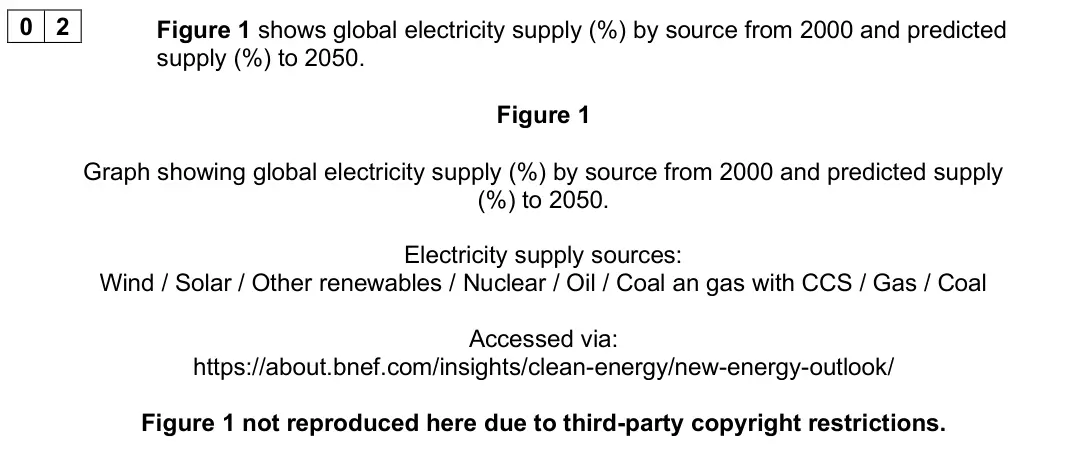
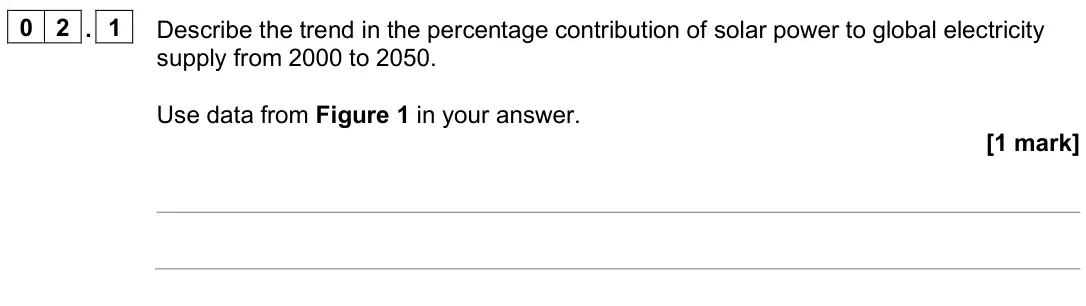
- June 2025, Paper 1, Q02.1 (1 mark): Describe the trend in the percentage contribution of solar power to global electricity supply from 2000 to 2050. Use data from Figure 1 in your answer. [1 mark]
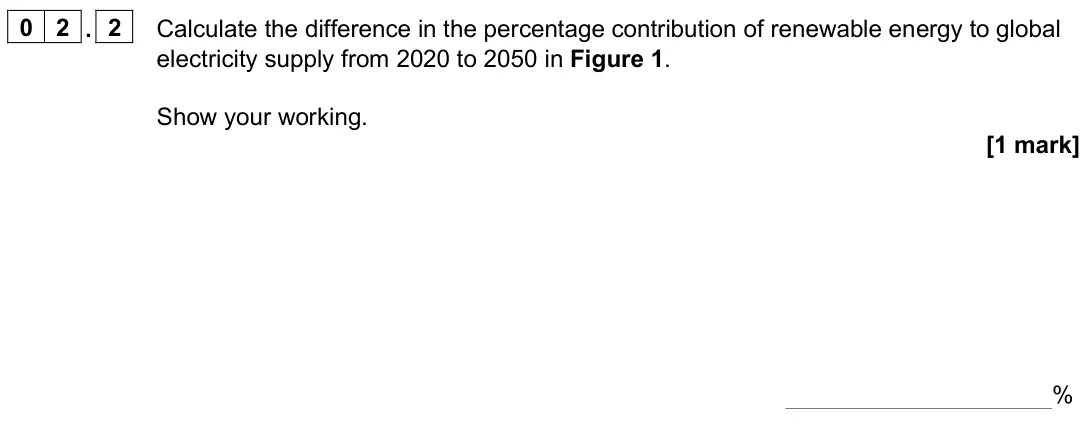
- June 2025, Paper 1, Q02.2 (1 mark): Calculate the difference in the percentage contribution of renewable energy to global electricity supply from 2020 to 2050 in Figure 1. Show your working. [1 ma
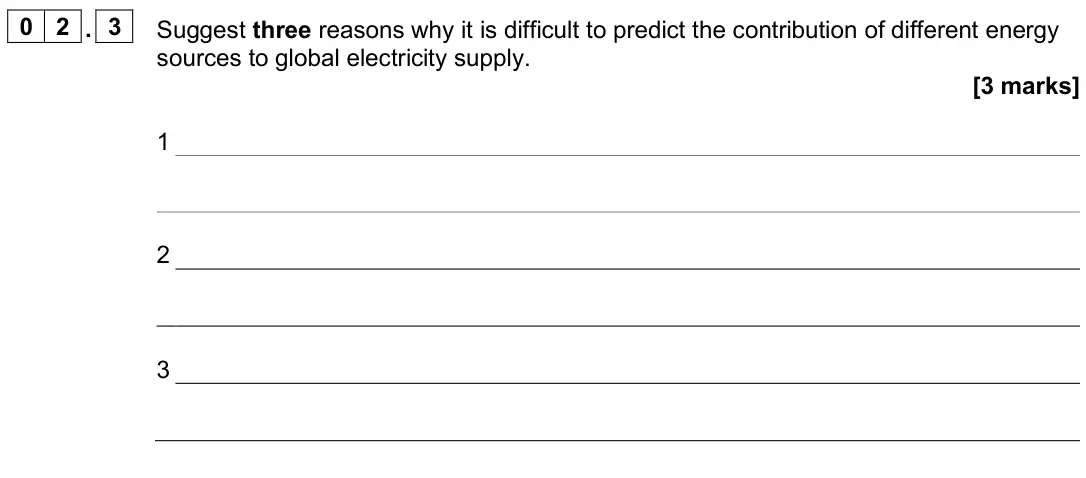
- June 2025, Paper 1, Q02.3 (3 marks): Suggest three reasons why it is difficult to predict the contribution of different energy sources to global electricity supply. [3 marks] 1 2 3
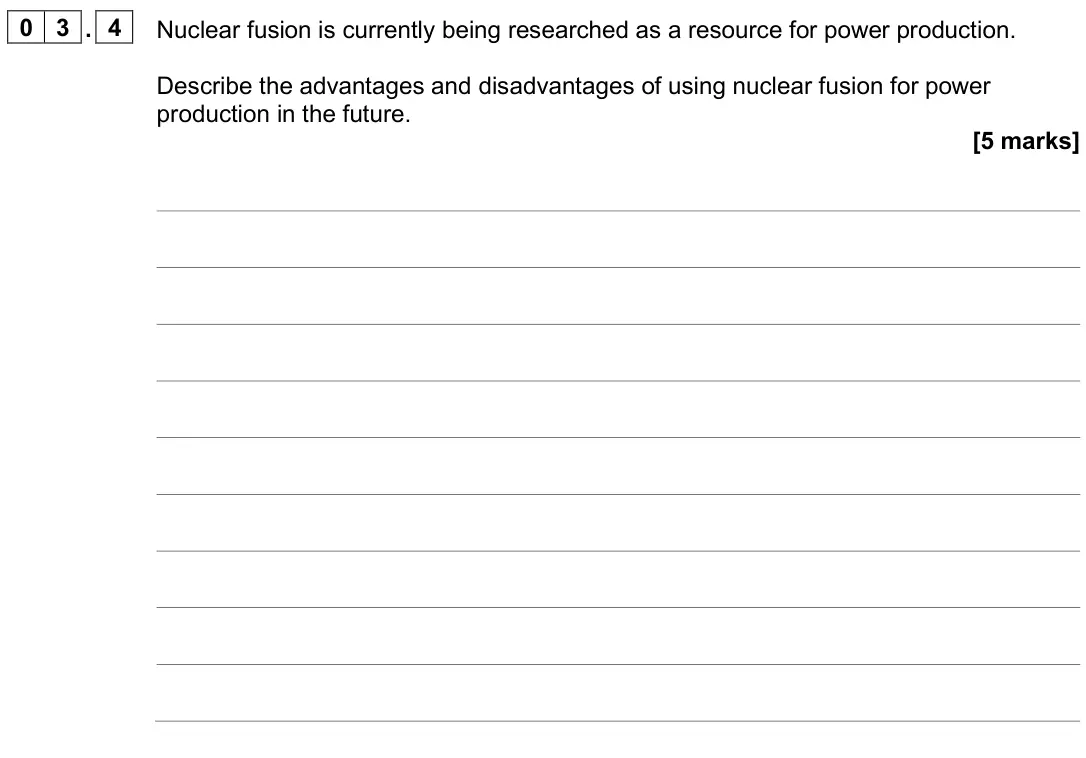
- June 2025, Paper 1, Q03.4 (5 marks): Nuclear fusion is currently being researched as a resource for power production. Describe the advantages and disadvantages of using nuclear fusion for power pro
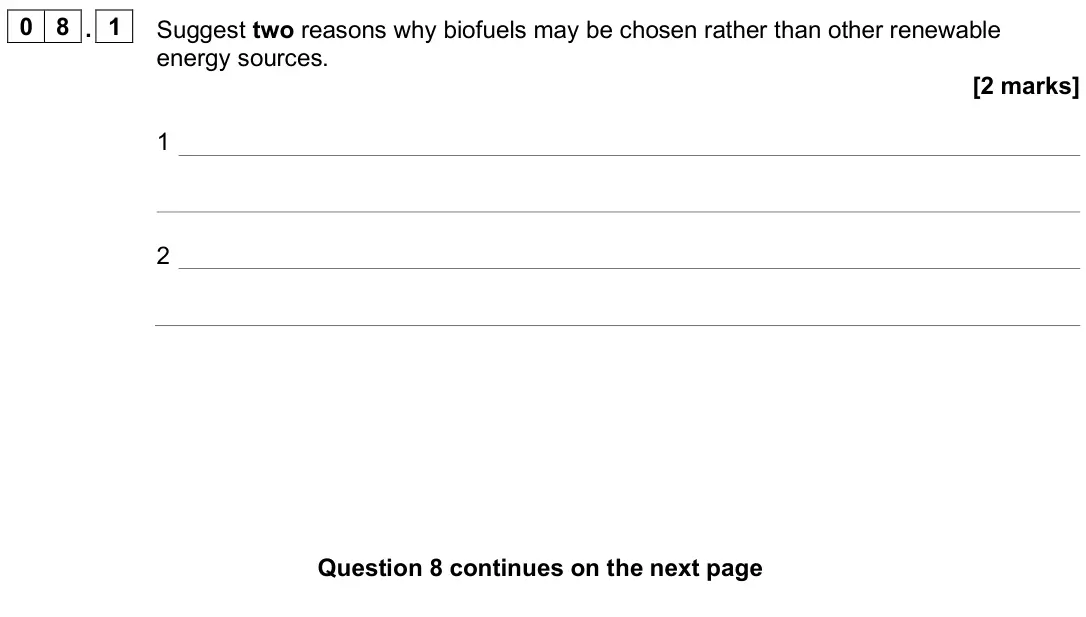
- June 2025, Paper 1, Q08.1 (2 marks): Suggest two reasons why biofuels may be chosen rather than other renewable energy sources. [2 marks] 1 2
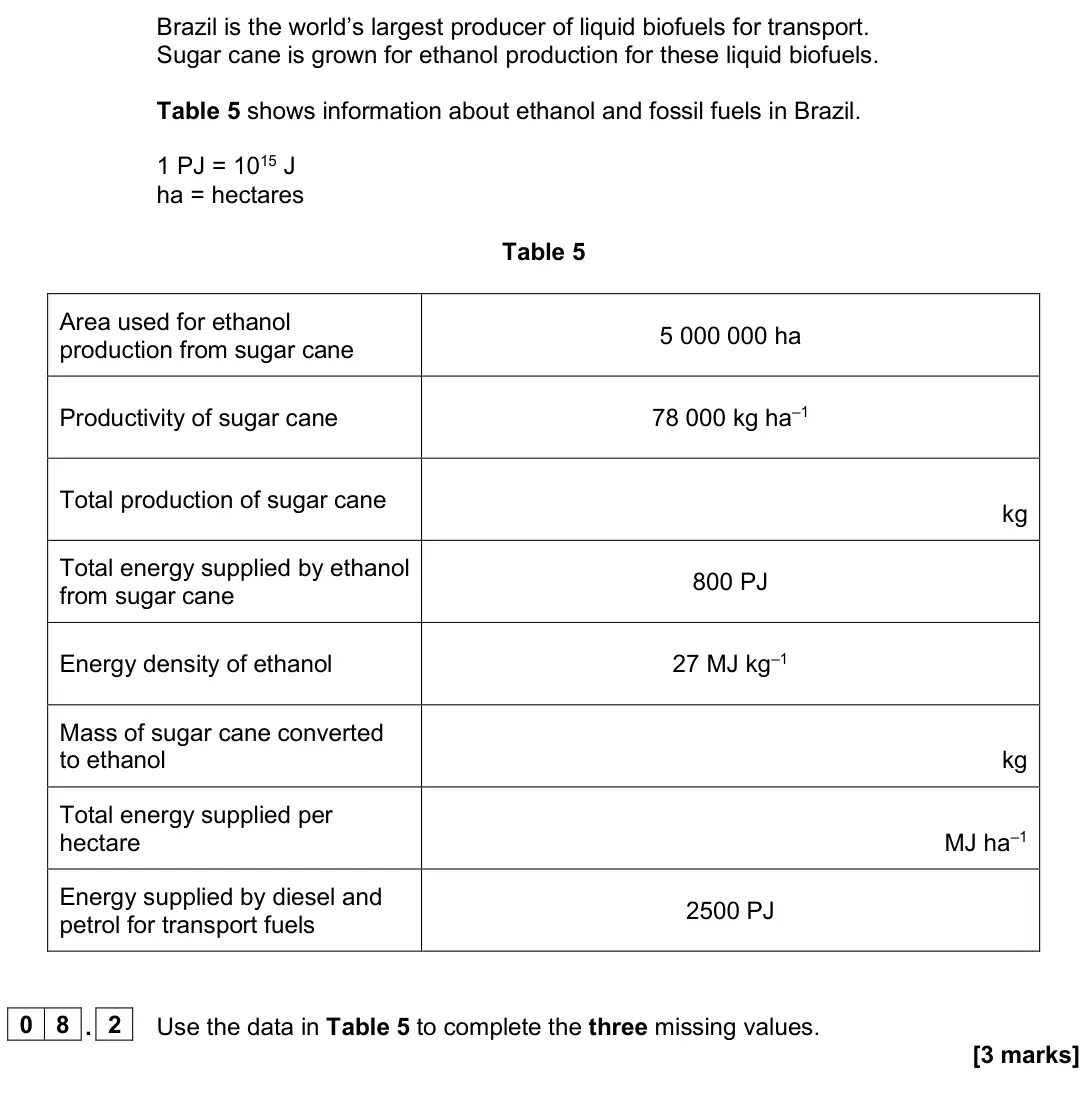
- June 2025, Paper 1, Q08.2 (3 marks): Use the data in Table 5 to complete the three missing values. [3 marks]
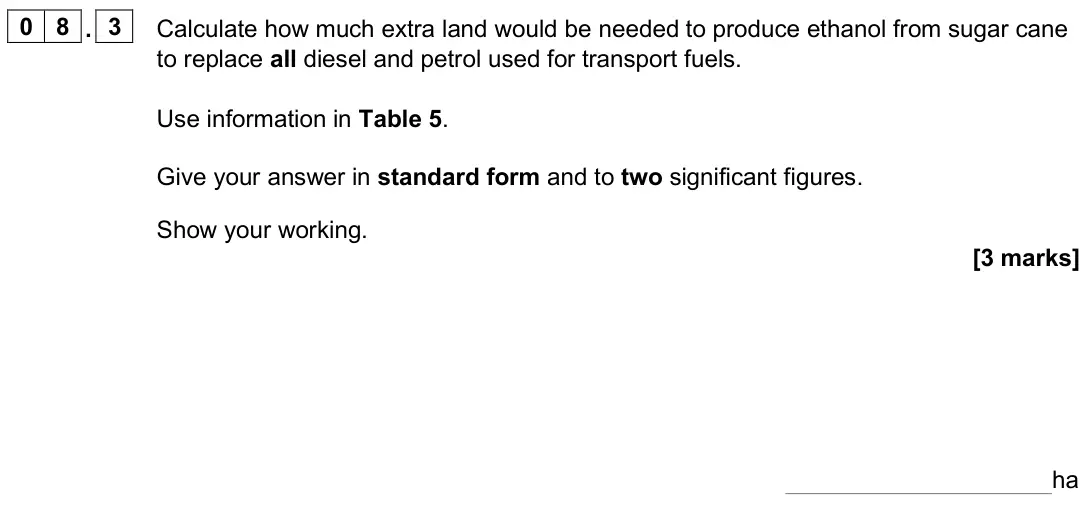
- June 2025, Paper 1, Q08.3 (3 marks): Calculate how much extra land would be needed to produce ethanol from sugar cane to replace all diesel and petrol used for transport fuels. Use information in T
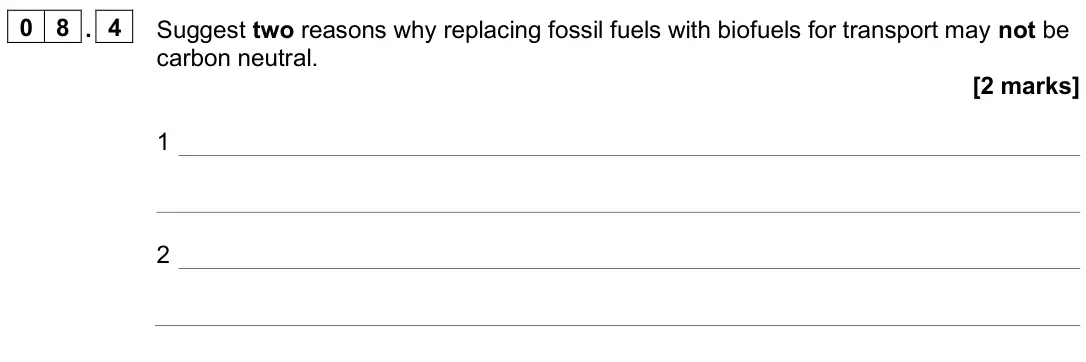
- June 2025, Paper 1, Q08.4 (2 marks): Suggest two reasons why replacing fossil fuels with biofuels for transport may not be carbon neutral. [2 marks] 1 2
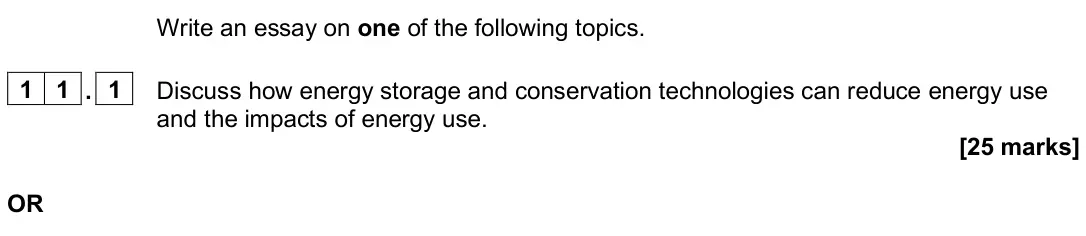
- June 2025, Paper 1, Q11.1 (25 marks): Discuss how energy storage and conservation technologies can reduce energy use and the impacts of energy use. [25 marks] OR
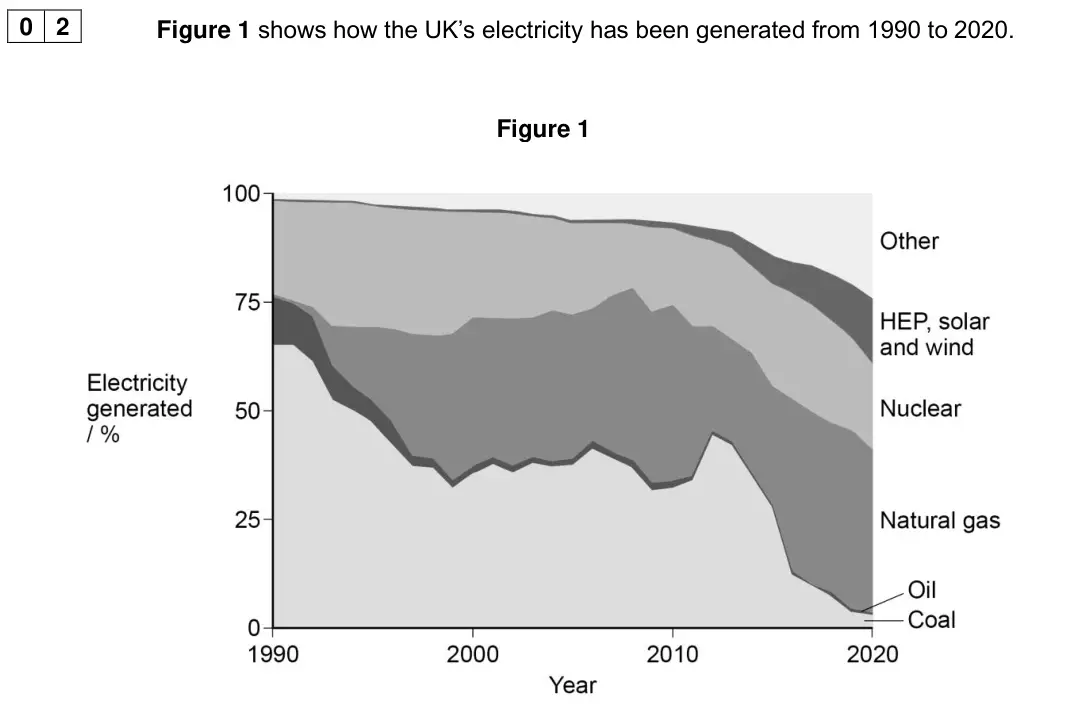
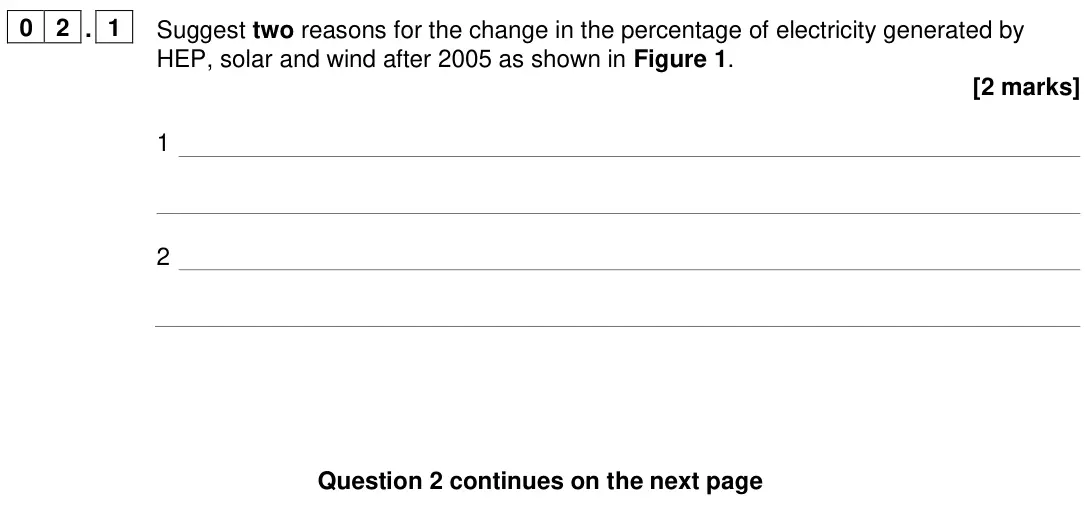
- June 2024, Paper 1, Q02.1 (2 marks): Suggest two reasons for the change in the percentage of electricity generated by HEP, solar and wind after 2005 as shown in Figure 1. [2 marks] 1 2
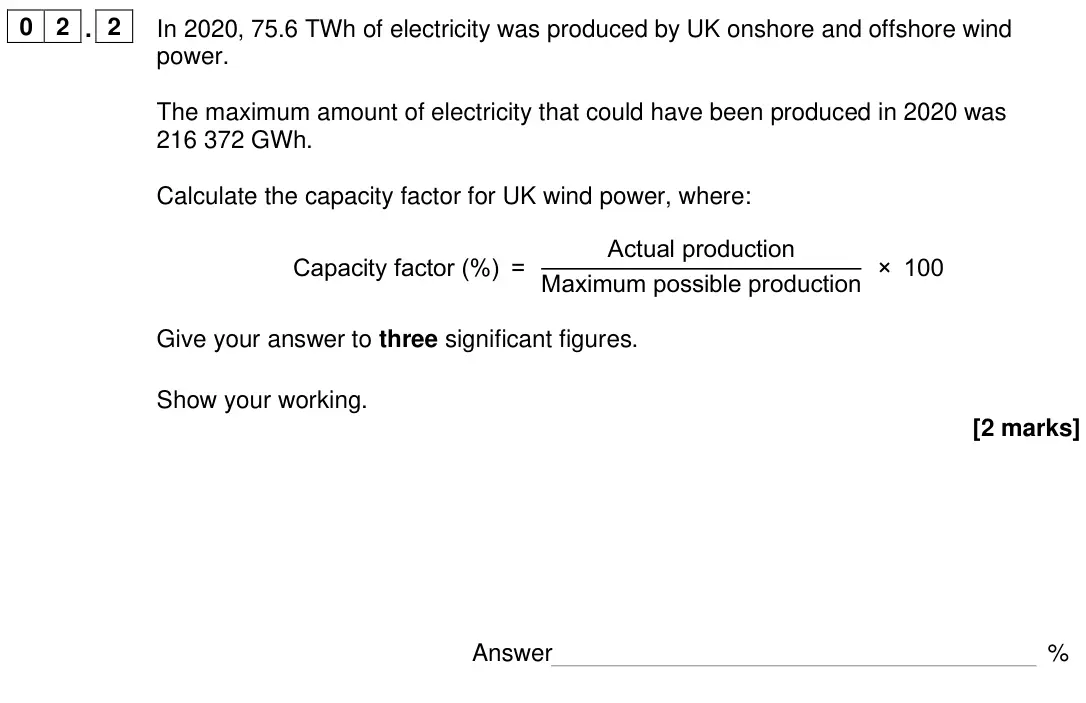
- June 2024, Paper 1, Q02.2 (2 marks): In 2020, 75.6 TWh of electricity was produced by UK onshore and offshore wind power. The maximum amount of electricity that could have been produced in 2020 was
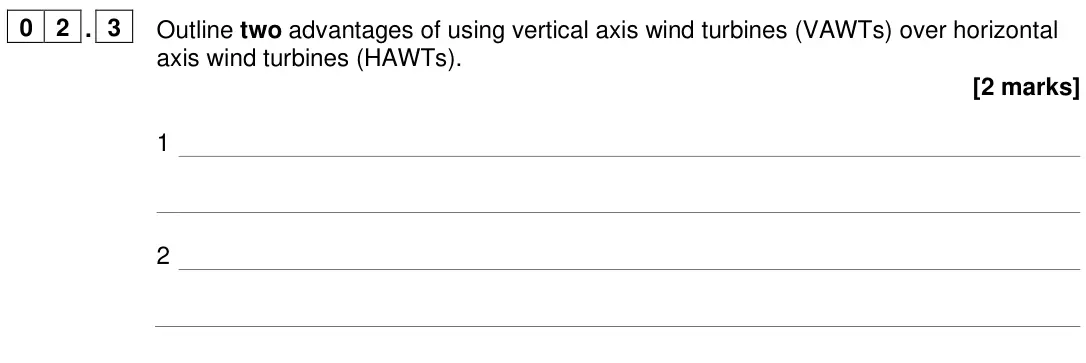
- June 2024, Paper 1, Q02.3 (2 marks): Outline two advantages of using vertical axis wind turbines (VAWTs) over horizontal axis wind turbines (HAWTs). [2 marks] 1 2
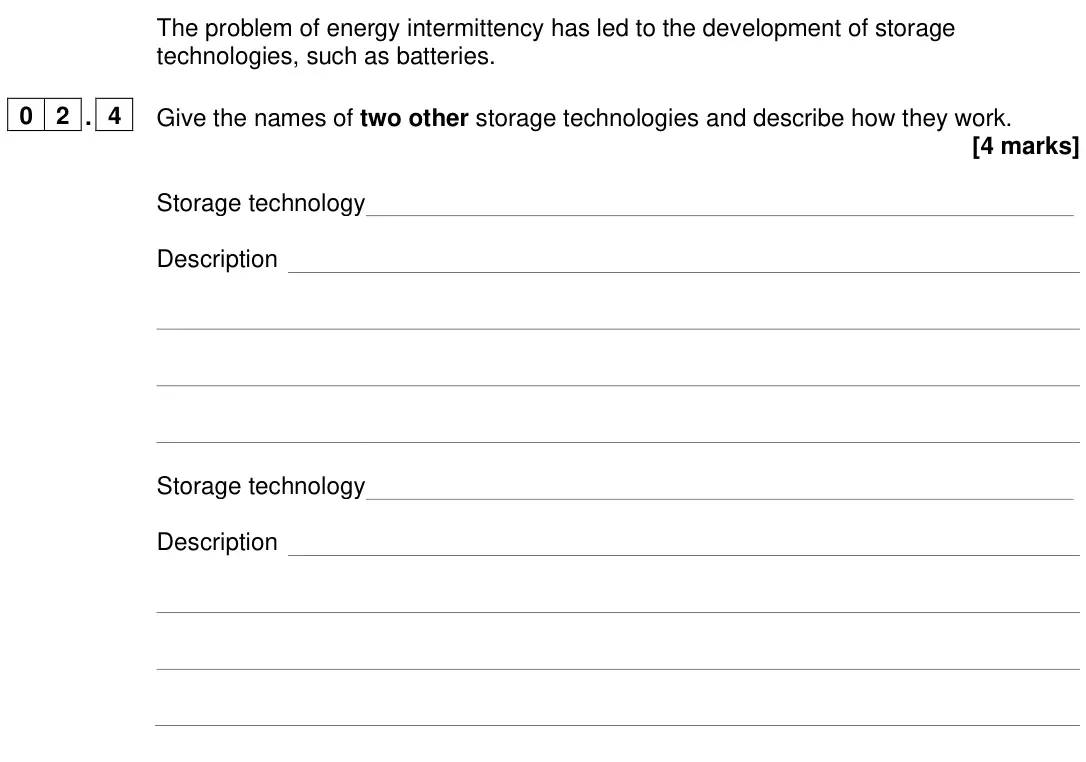
- June 2024, Paper 1, Q02.4 (4 marks): Give the names of two other storage technologies and describe how they work. [4 marks] Storage technology Description Storage technology Description
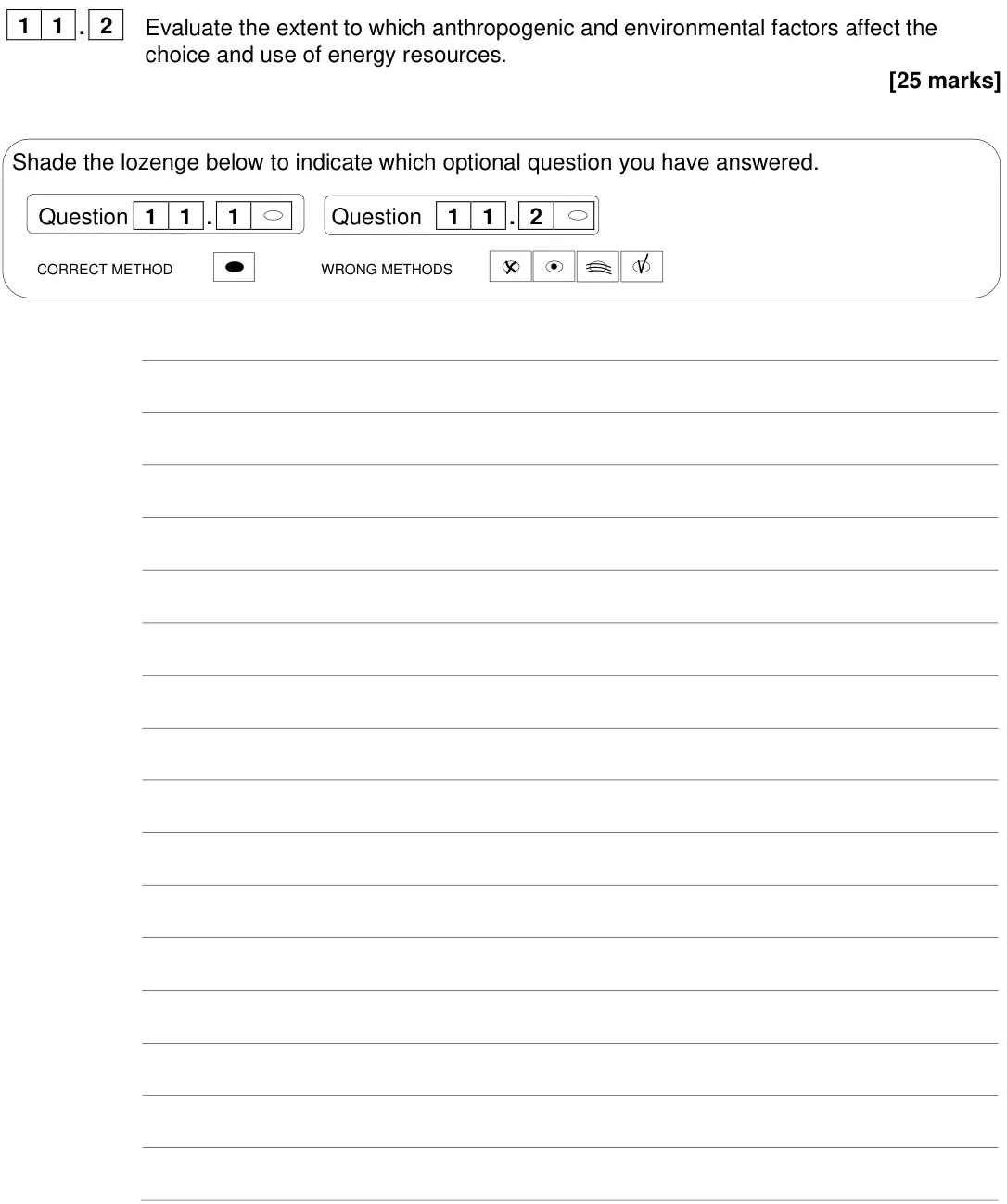
- June 2024, Paper 1, Q11.2 (25 marks): Evaluate the extent to which anthropogenic and environmental factors affect the choice and use of energy resources. [25 marks]
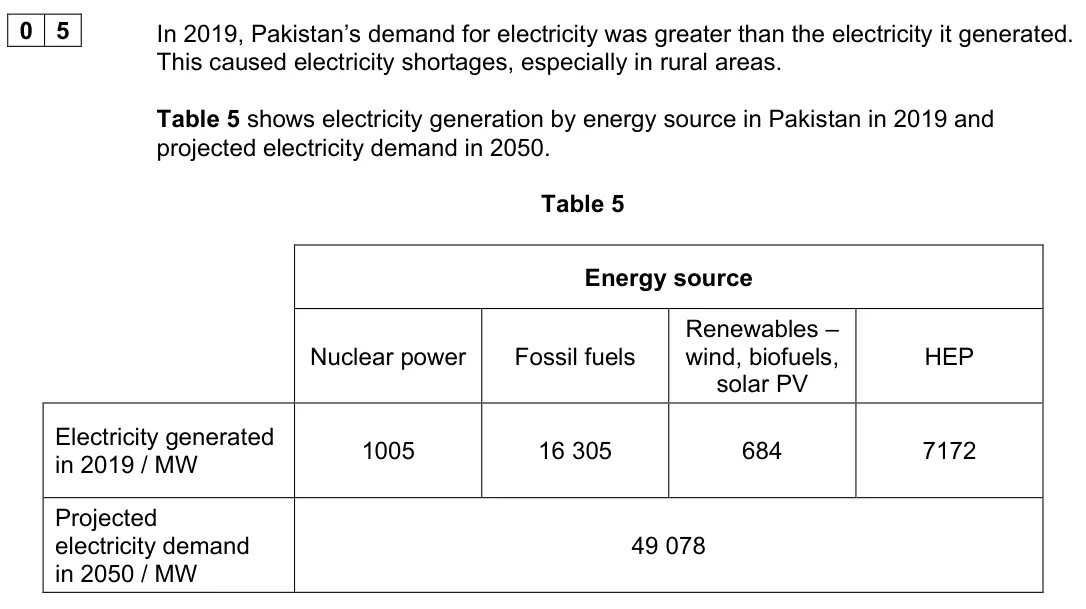
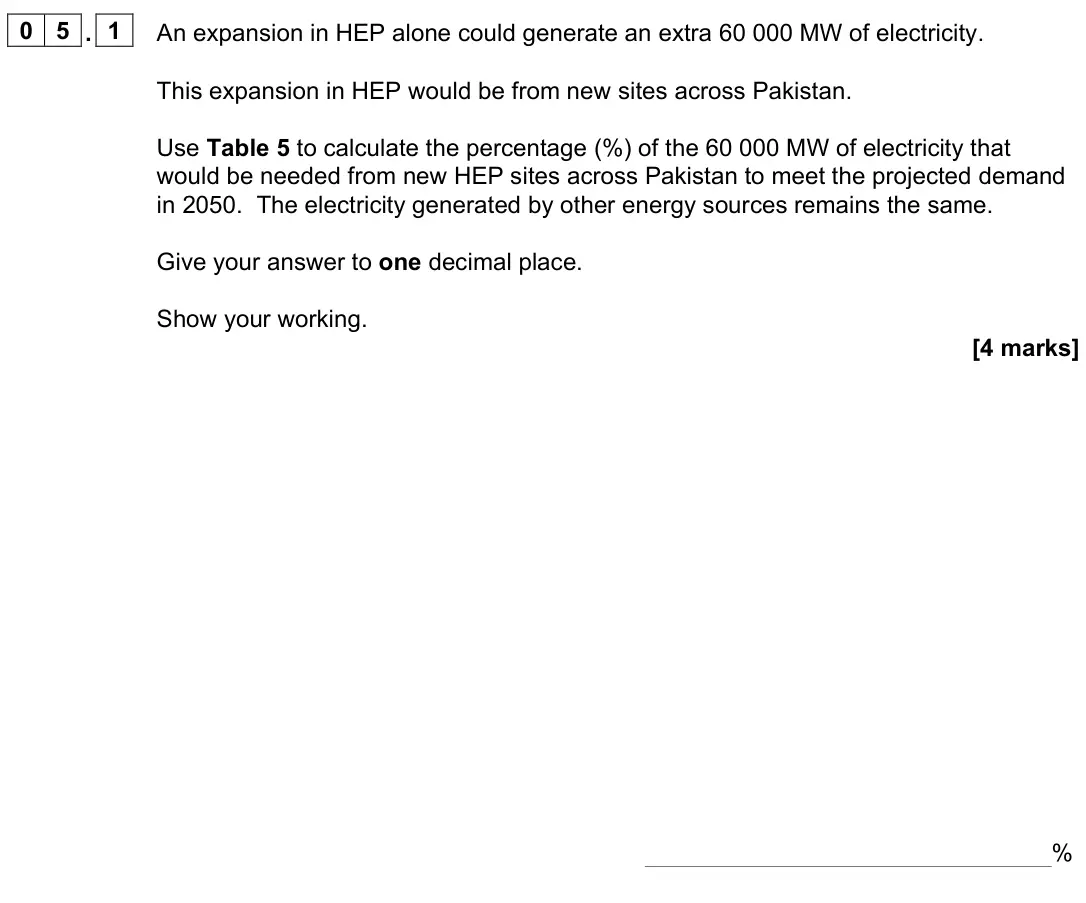
- June 2023, Paper 1, Q05.1 (4 marks): An expansion in HEP alone could generate an extra 60 000 MW of electricity. This expansion in HEP would be from new sites across Pakistan. Use Table 5 to calcul
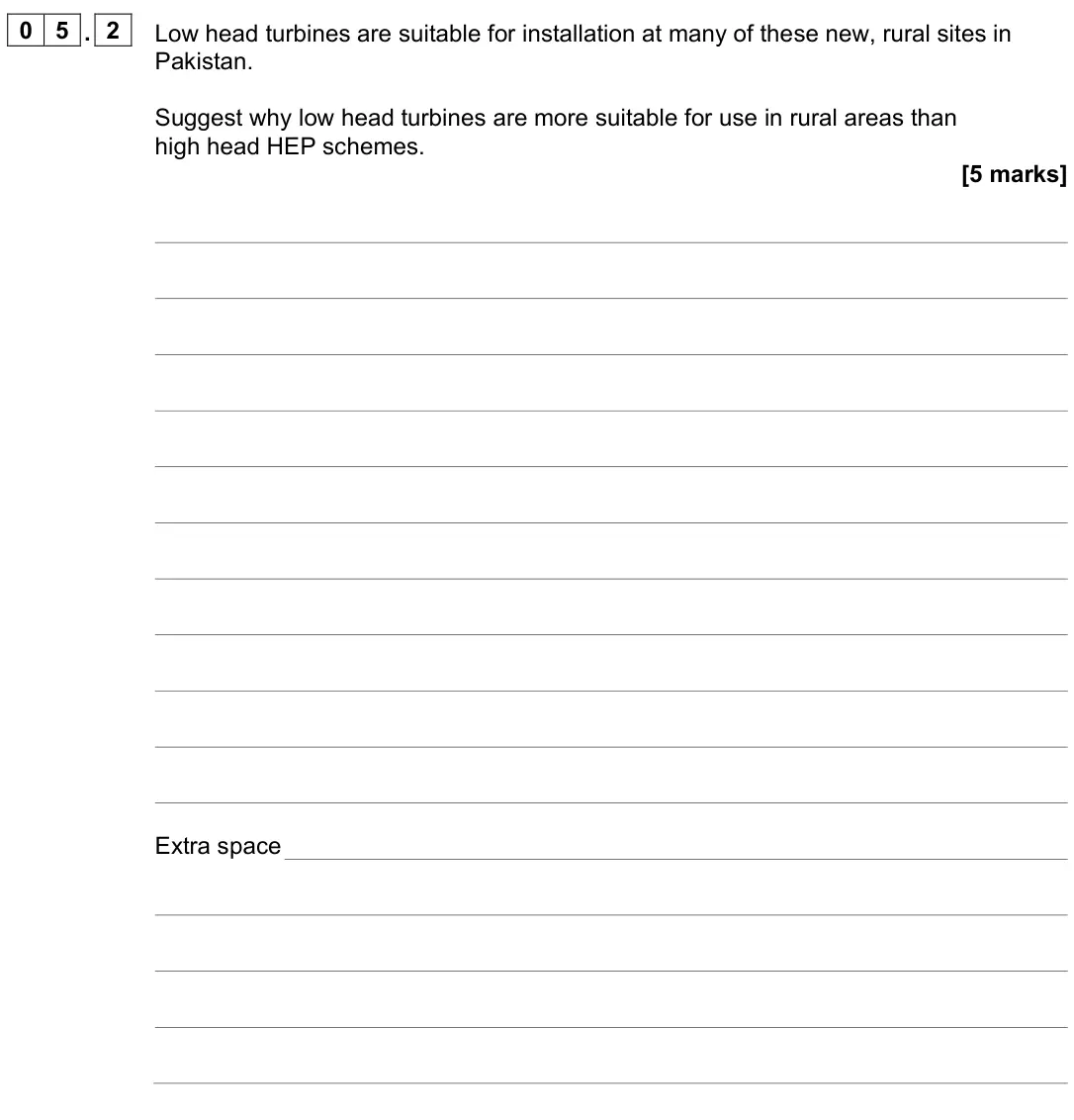
- June 2023, Paper 1, Q05.2 (5 marks): Low head turbines are suitable for installation at many of these new, rural sites in Pakistan. Suggest why low head turbines are more suitable for use in rural
- June 2023, Paper 1, Q05.3 (1 mark): Suggest one reason why low head turbine schemes may not be installed at suitable sites in rural areas. [1 mark]
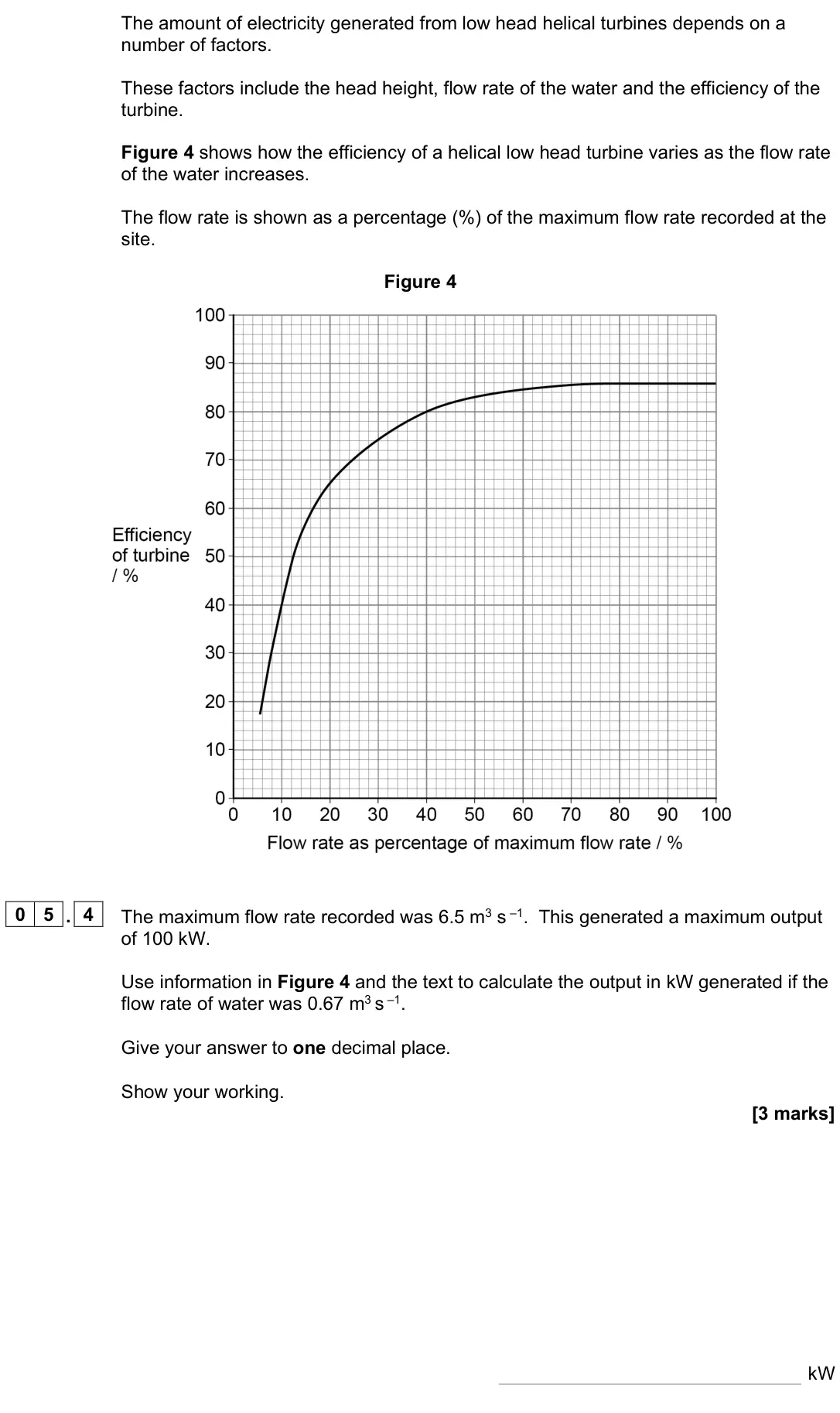
- June 2023, Paper 1, Q05.4 (3 marks): The maximum flow rate recorded was 6.5 m3 s –1. This generated a maximum output of 100 kW. Use information in Figure 4 and the text to calculate the output in k
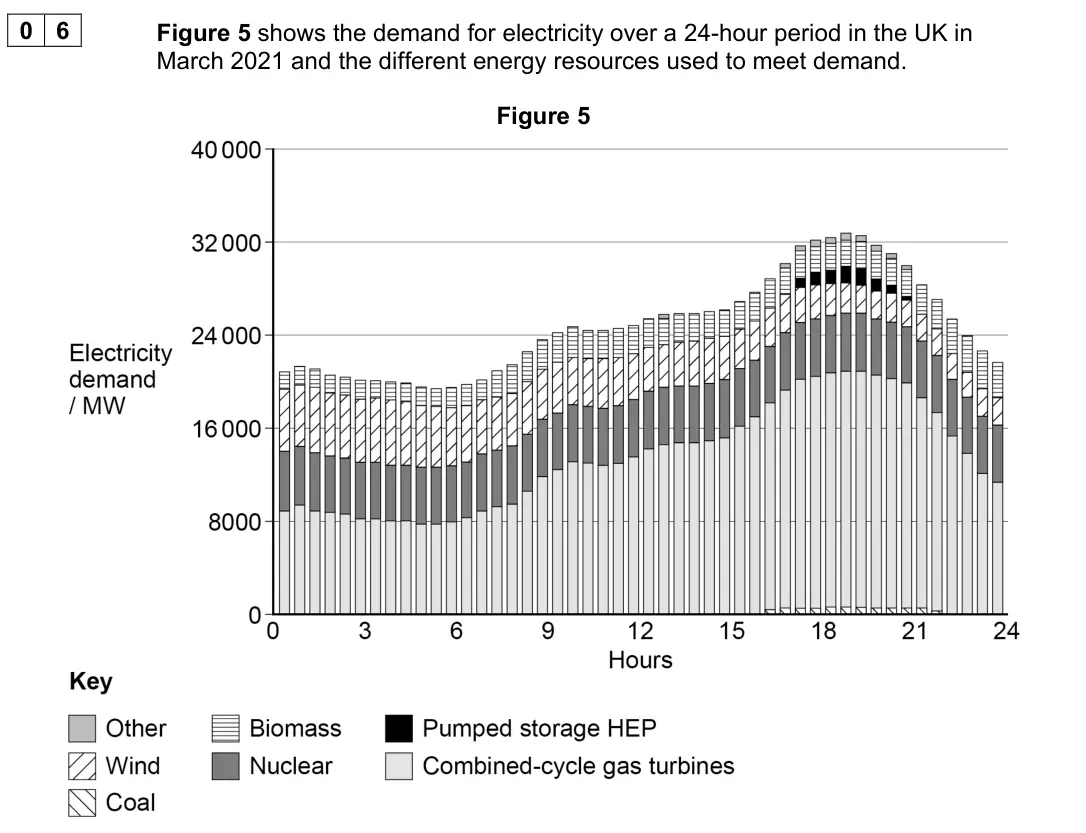
- June 2023, Paper 1, Q06.2 (3 marks): Explain how pumped storage HEP can be used to meet the demand for electricity during a 24-hour period. [3 marks]
- June 2022, Paper 1, Q02.1 (4 marks): Explain how the fuels used in plutonium and thorium nuclear reactors release energy that can be used to generate electricity. [4 marks]
- June 2022, Paper 1, Q03.3 (3 marks): Two methods that may be used for the sustainable management of the carbon cycle are: • carbon sequestration • carbon capture and storage (CCS). Describe one sim
- June 2022, Paper 1, Q04.3 (2 marks): Elephant grass has a lower energy density compared with many other biofuels but it is grown as a biofuel crop in many different parts of the world. Suggest two
- June 2022, Paper 1, Q04.4 (4 marks): Describe the advantages and disadvantages of biofuels compared with other renewable energy sources. [4 marks] Advantages Disadvantages
- June 2022, Paper 1, Q06.1 (1 mark): Which wave energy device uses gravitational energy to produce electricity? Shade one box only. [1 mark] A W1 B W2 C W3 D W4 E W5
- June 2022, Paper 1, Q06.2 (1 mark): Which wave energy devices can extract energy from waves moving in any direction? Shade one box only. [1 mark] A W1 and W2 B W1 and W3 C W2 and W4 D W2 and W5 E
- June 2022, Paper 1, Q06.3 (3 marks): The research and development of a wave energy device involves calculating its capacity factor. This involves comparing the actual annual output of electricity i
- November 2021, Paper 1, Q08.1 (2 marks): Use Table 4 to calculate the mean annual percentage rate of increase for solar PV capacity from June 2014 to June 2019. Give your answer to an appropriate numbe
- November 2021, Paper 1, Q08.2 (4 marks): Explain two ways in which an improvement in the design of solar PV panels has increased the efficiency. [4 marks] 1 2
- November 2021, Paper 1, Q08.3 (3 marks): Use information in the text above to calculate the capacity factor of the PS20 solar power plant. Give your answer to two significant figures. Show your working
- November 2021, Paper 1, Q08.4 (1 mark): State one method, other than battery storage, by which the energy generated by PS20 might be stored for use after dark. [1 mark]
- November 2020, Paper 1, Q03.1 (2 marks): Use Figure 2 and Table 2 to calculate the difference in CO2 emissions if uranium is extracted from 5 tonnes of 0.5% ore grade instead of 5 tonnes of 2% ore grad
- November 2020, Paper 1, Q05.1 (1 mark): Why do the two designs of HAWT produce no power at wind speeds lower than 3 ms–1? [1 mark]
- November 2020, Paper 1, Q05.2 (1 mark): Calculate the ratio of the power output of the wind lens HAWT to that of the conventional HAWT at a wind speed of 10 ms–1. Show your working. [1 mark]
- November 2020, Paper 1, Q05.3 (3 marks): State three variables that would need to be standardised in order to compare power outputs of HAWTs of different designs. [3 marks] 1 2 3
- November 2020, Paper 1, Q05.4 (5 marks): Use information in Figure 6 and Table 3 to suggest the advantages of offshore windfarms instead of onshore windfarms. [5 marks]
- November 2020, Paper 1, Q06.1 (1 mark): Identify the appropriate energy conversions involved when a fuel cell uses hydrogen gas. Shade one box only. [1 mark] A Chemical energy converted to electrical
- November 2020, Paper 1, Q06.2 (2 marks): Explain how the use of hydrogen storage and fuel cells increases the extent to which solar power can be exploited. [2 marks]
- November 2020, Paper 1, Q06.6 (2 marks): Explain the importance of the results of this study for the design of thermal energy stores. [2 marks]
- November 2020, Paper 2, Q08.2 (3 marks): Use data in Figure 5 to explain how the timing of the vertical movements of the Kelp Elevator may be controlled to increase the growth rate of kelp. [3 marks]
- November 2020, Paper 2, Q08.3 (4 marks): Explain why biofuel production in the open ocean is more sustainable than growing biofuel crops on land. [4 marks]
- Specimen, Paper 1, Q04.1 (2 marks): The design of a wind turbine affects the proportion of the energy that can be harnessed from the wind. Figure 6 shows the power output of a wind turbine at diff
- Specimen, Paper 1, Q04.2 (2 marks): The maximum power in watts produced by a wind turbine can be calculated using the formula: KE = 0.5 𝝅 r2 v3 d where KE = kinetic energy available /j 𝝅 = 3.142 r
- Specimen, Paper 1, Q04.3 (1 mark): Use data from Figure 7 to estimate the increase in power output if the wind velocity is 16 km hr-1 and blade diameter is increased from 5 m to 40 m. [1 mark]
- Specimen, Paper 1, Q04.4 (2 marks): Use the data in Table 2 to plot a graph on Figure 7 of the effect of blade diameter on power output when the wind velocity is 8 km hr-1. [2 marks]
- Specimen, Paper 1, Q04.5 (1 mark): Use data from Figure 7 to calculate the effect of doubling the blade diameter on the power output of wind turbines. Show your working. [1 mark]
- Specimen, Paper 1, Q04.6 (2 marks): Figure 8 shows the maximum wind speeds for the UK and Ireland. Figure 8 Use information from Figure 8 and your own knowledge to explain why the windiest areas i
- Specimen, Paper 1, Q11.1 (25 marks): Discuss the extent to which the development of new technologies has reduced the environmental impacts of the use of energy resources. [25 marks] OR
Questions, mark schemes and examiner’s reports are © AQA, from their published past papers. Plumi isn’t affiliated with any exam board. Want whole papers? AQA A-Level Environmental Science past papers.
The Plumi iPad app also offers exam-style questions with AI feedback on your handwritten working.