 plumi
Positive and negative externalities in consumption and production: AQA A‑Level Economics questions
Every AQA A-Level Economics exam question on 4.1.8.4 Positive and negative externalities in consumption and production, 2020–2025, with its mark scheme and examiner’s report.
Find questions686
Calculations







All 18 questions on Positive and negative externalities in consumption and production, as a list
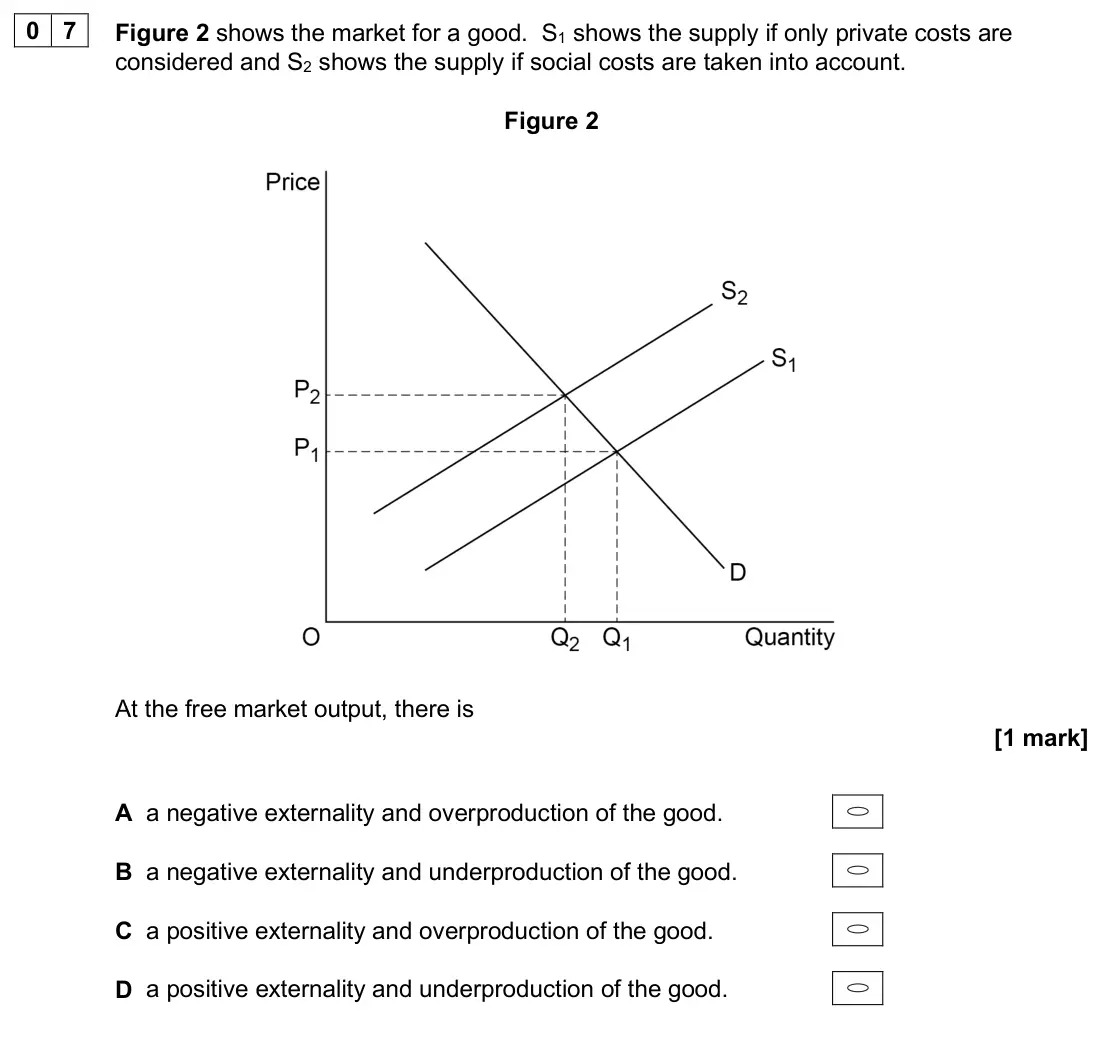
- June 2025, AS Paper 1, Q07 (1 mark): Figure 2 shows the market for a good. S1 shows the supply if only private costs are considered and S2 shows the supply if social costs are taken into account. F
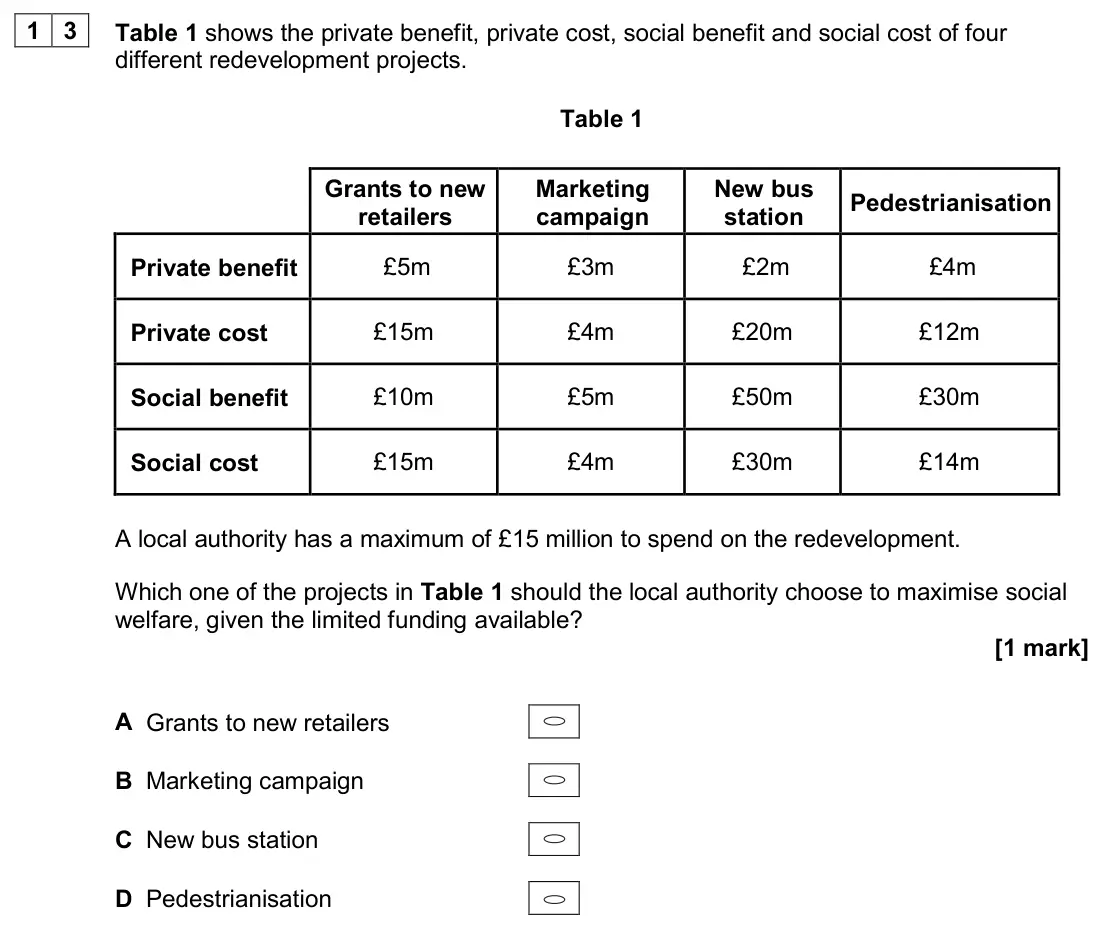
- June 2024, AS Paper 1, Q13 (1 mark): Table 1 shows the private benefit, private cost, social benefit and social cost of four different redevelopment projects. Table 1 Grants to new retailers Market
- June 2024, AS Paper 1, Q26 (25 marks): Extract C (lines 13–14) states: ‘In recent years, with more people holidaying in the UK, some tourist sites have been overwhelmed by visitors.’ Use the extracts
- June 2023, Paper 1, Q03 (9 marks): Extract C (lines 3–4) states that ‘the mining, manufacturing and disposal process for batteries could soon become an environmental disaster.’ With the help of a
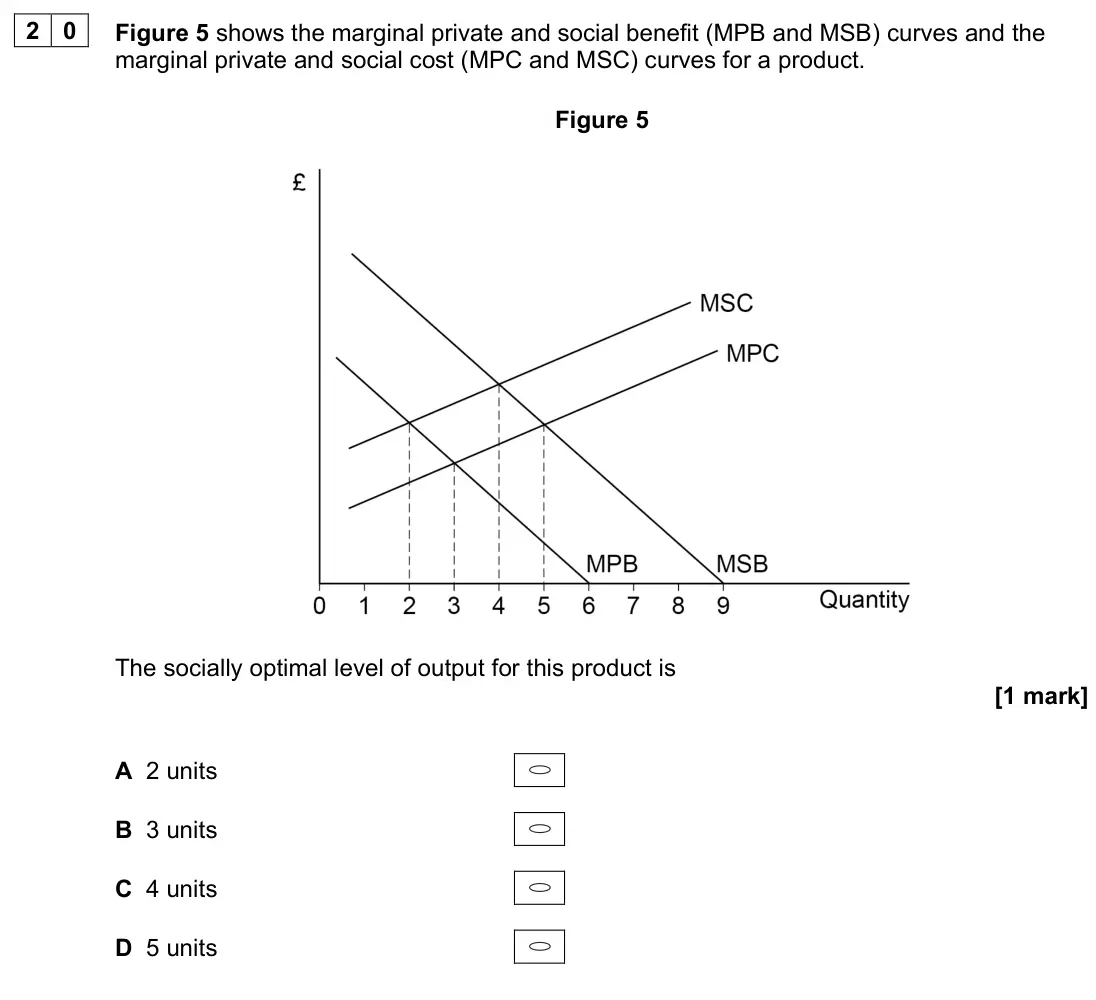
- June 2023, Paper 3, Q20 (1 mark): Figure 5 shows the marginal private and social benefit (MPB and MSB) curves and the marginal private and social cost (MPC and MSC) curves for a product. Figure
- June 2023, AS Paper 1, Q13 (1 mark): Hedges around fields encourage wildlife and bring widespread benefits but many farmers choose to have wire fences instead. Which one of the following best descr
- June 2023, AS Paper 1, Q32 (25 marks): Extract F (lines 23–24) states: ‘if drones become more common, another review may be needed of what is best for all’. Use the extracts and your knowledge of eco
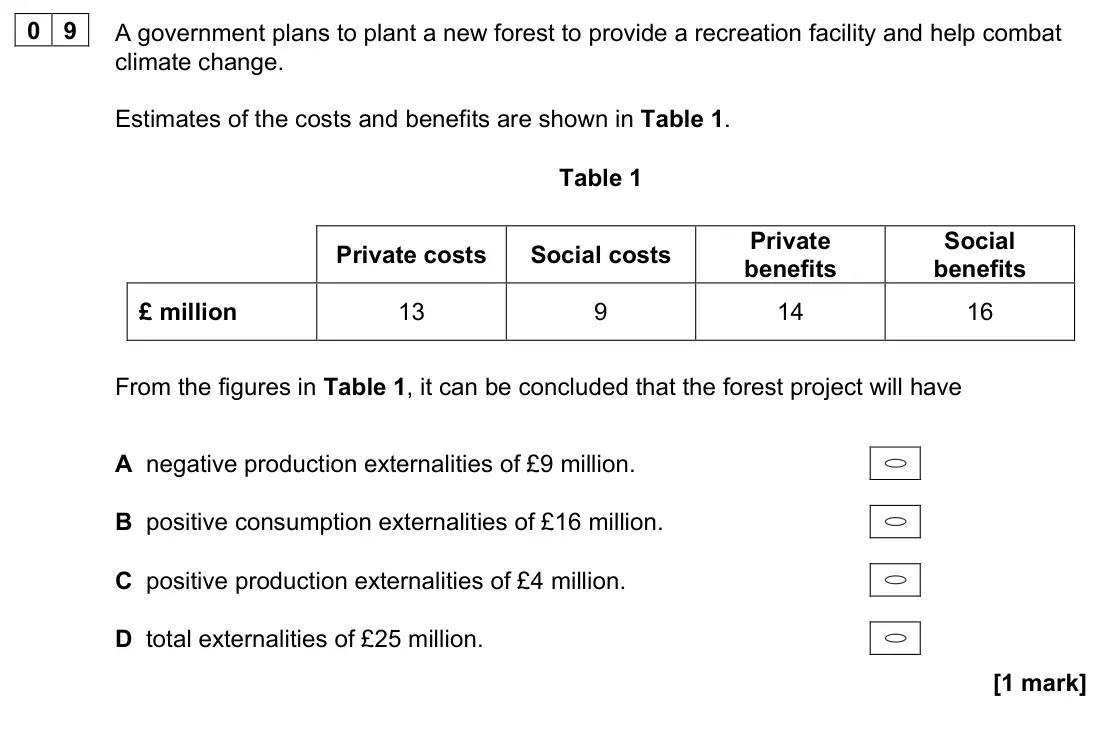
- June 2022, AS Paper 1, Q09 (1 mark): A government plans to plant a new forest to provide a recreation facility and help combat climate change. Estimates of the costs and benefits are shown in Table
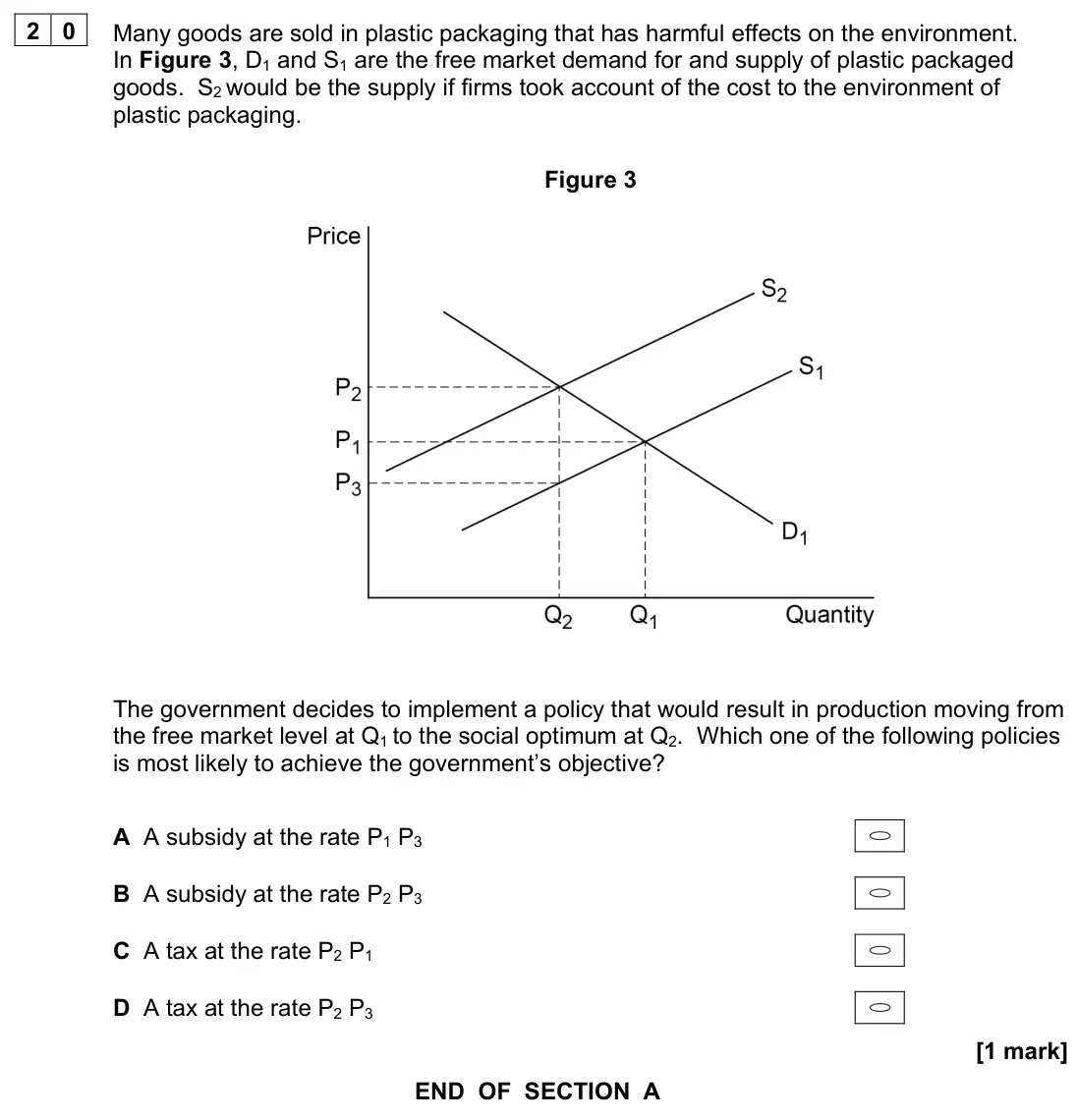
- June 2022, AS Paper 1, Q20 (1 mark): Many goods are sold in plastic packaging that has harmful effects on the environment. In Figure 3, D1 and S1 are the free market demand for and supply of plasti
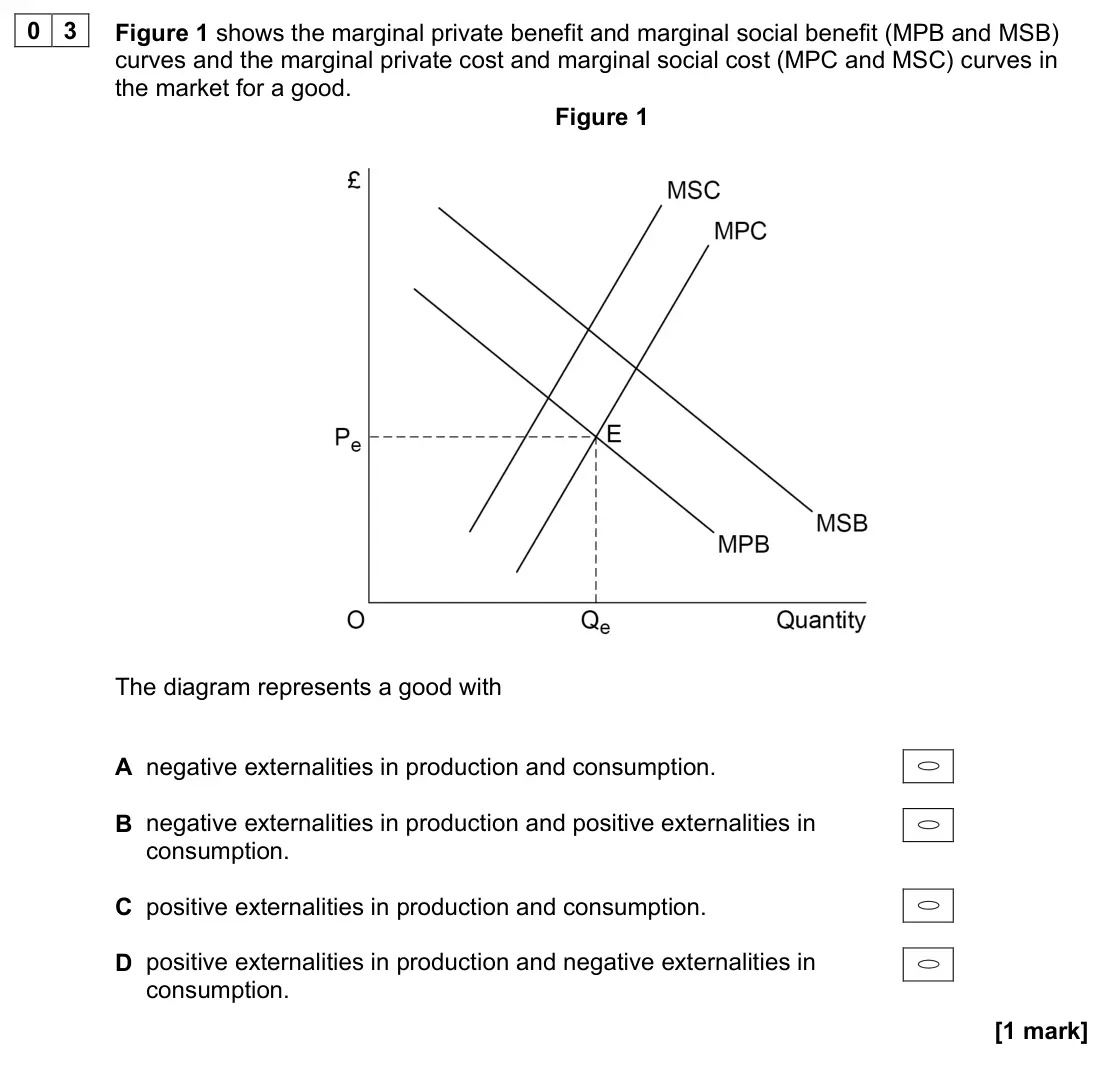
- November 2021, Paper 3, Q03 (1 mark): Figure 1 shows the marginal private benefit and marginal social benefit (MPB and MSB) curves and the marginal private cost and marginal social cost (MPC and MSC
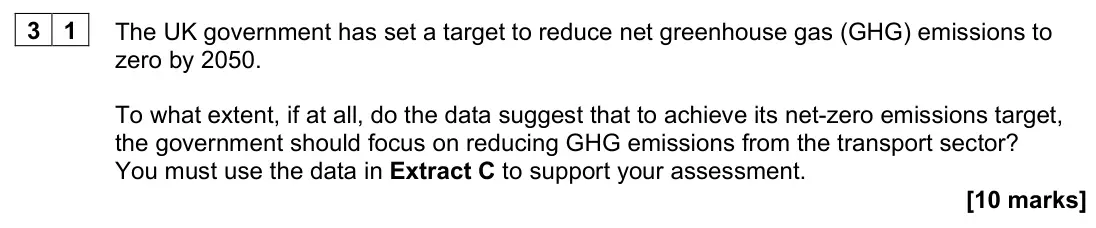
- November 2021, Paper 3, Q31 (10 marks): The UK government has set a target to reduce net greenhouse gas (GHG) emissions to zero by 2050. To what extent, if at all, do the data suggest that to achieve
- November 2021, Paper 3, Q32 (15 marks): Explain why, without government intervention, markets are likely to allocate too few resources to dealing with the problem of climate change. [15 marks] Section
- November 2020, Paper 1, Q02 (4 marks): Explain how the data in Extract A (Figure 2) show that higher living standards lead to greater volumes of waste per capita being produced. [4 marks] Context 1 T
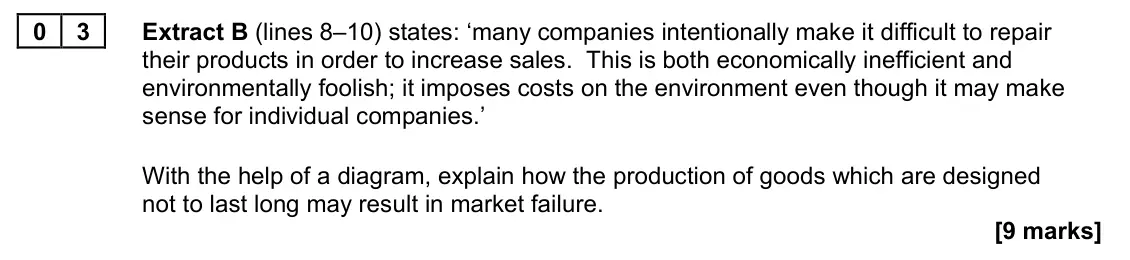
- November 2020, Paper 1, Q03 (9 marks): Extract B (lines 8–10) states: ‘many companies intentionally make it difficult to repair their products in order to increase sales. This is both economically in
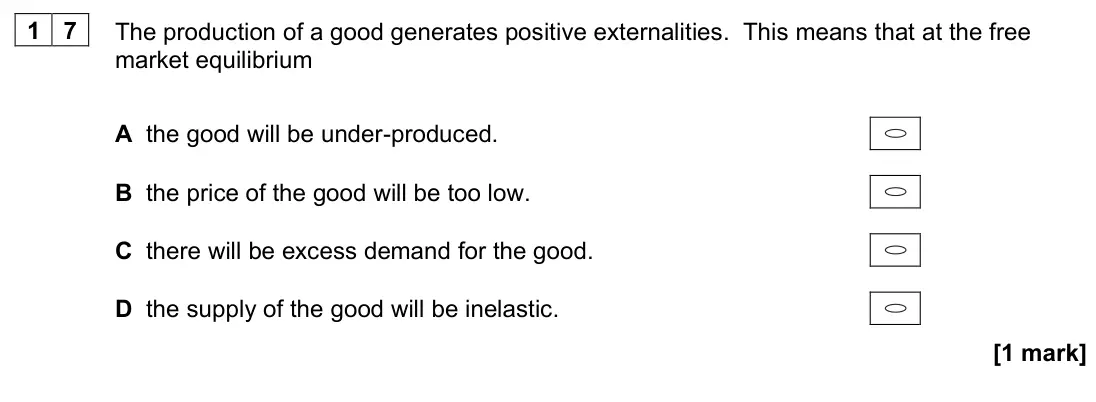
- November 2020, AS Paper 1, Q17 (1 mark): The production of a good generates positive externalities. This means that at the free market equilibrium A the good will be under-produced. B the price of the
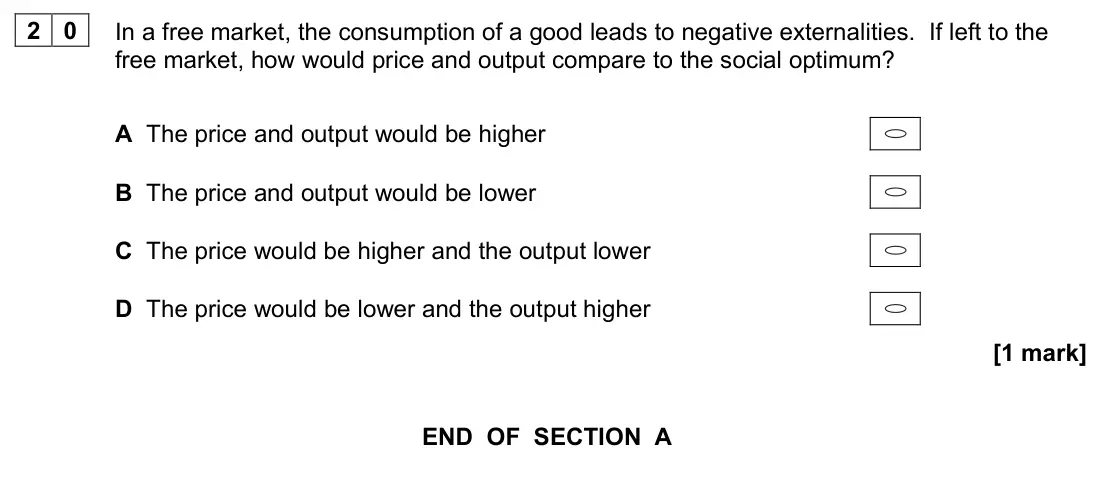
- November 2020, AS Paper 1, Q20 (1 mark): In a free market, the consumption of a good leads to negative externalities. If left to the free market, how would price and output compare to the social optimu
- November 2020, AS Paper 1, Q26 (25 marks): Extract C (lines 16–17) states: ‘Perhaps the time has come to stop free bus travel for the elderly or to limit it to certain groups?’ Use the extracts and your
- November 2020, AS Paper 1, Q27 (3 marks): Define ‘social cost’ in Extract E (line 7). [3 marks] Context 2 Total for this context: 50 marks E-CIGARETTES Extract D: Rates of cigarette smoking in Great Bri
Questions, mark schemes and examiner’s reports are © AQA, from their published past papers. Plumi isn’t affiliated with any exam board. Want whole papers? Full past papers.
Rather write your answers by hand on iPad? Plumi marks them against the same mark schemes.