 plumi
Gibbs free-energy change, ∆G, and entropy change, ∆S: AQA A‑Level Chemistry questions
AQA A-Level Chemistry past-paper questions on 3.1.8.2 Gibbs free-energy change, ∆G, and entropy change, ∆S, 2008–2025, with mark schemes and examiner’s reports where available.
Paper
All papers
Exam
All years
Calculations
Q04.2
The whole paper ↗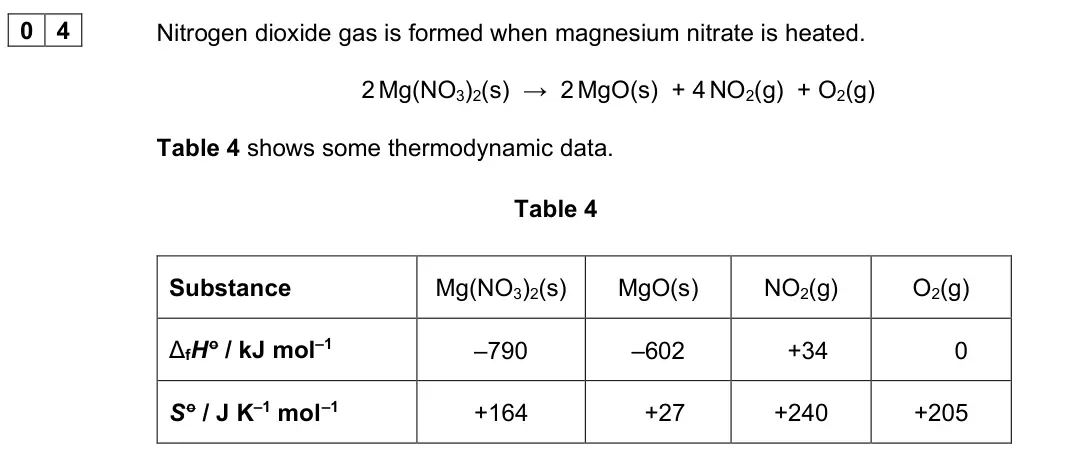
Q08.8
The whole paper ↗
Q01.7
The whole paper ↗
Q01.8
The whole paper ↗Q07.1
The whole paper ↗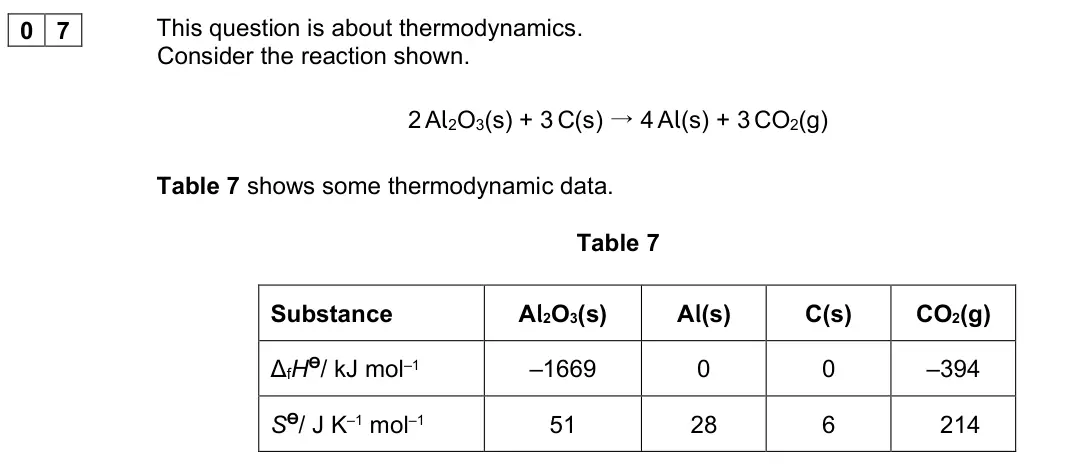
Q07.2
The whole paper ↗Q07.3
The whole paper ↗Q10.1
The whole paper ↗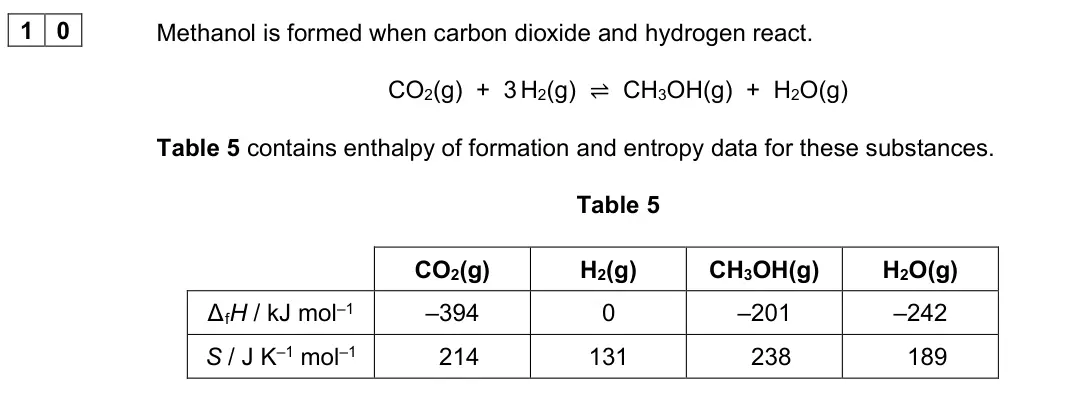
Q10.2
The whole paper ↗Q10.3
The whole paper ↗Q03.1
The whole paper ↗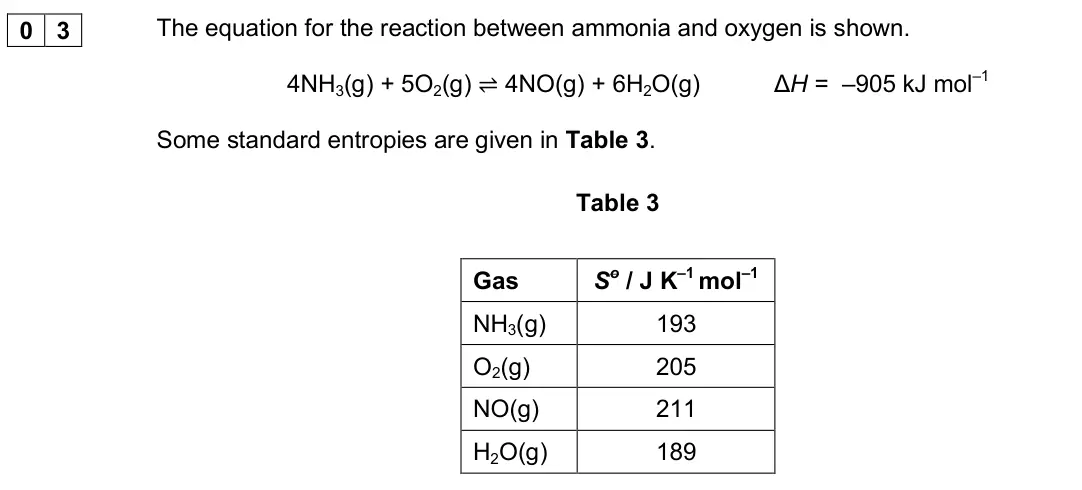
Q03.2
The whole paper ↗Q03.3
The whole paper ↗Q05.1
The whole paper ↗
Q01.4
The whole paper ↗
Q05.1
The whole paper ↗Q05.2
The whole paper ↗Q08.5
The whole paper ↗Q6(b)
The whole paper ↗
All 91 questions on Gibbs free-energy change, ∆G, and entropy change, ∆S, as a list
- June 2025, Paper 1, Q04.2 (5 marks): Use the equation and the data in Table 4 to calculate the temperature at which this reaction becomes feasible. [5 marks] Temperature K
- June 2024, Paper 1, Q08.8 (3 marks): Calculate the temperature, in °C, at which this reaction becomes feasible. NaCl(s) → Na(s) + 1 2 Cl2(g) ΔH = +411 kJ mol–1 ΔS = +90.1 J K–1 mol–1 [3 marks] Temp
- June 2022, Paper 3, Q01.7 (4 marks): Table 3 shows some entropy data at 298 K Table 3 Entropy S / J K 1 mol 1 NH4NO3(s) 151 NH4+(aq) 113 NO3−(aq) 146 Calculate a value for the Gibbs free-energy cha
- June 2022, Paper 3, Q01.8 (2 marks): Ammonium nitrate decomposes as shown. NH4NO3(s) → N2 (g) + 1 2 O2 (g) + 2 H2 O (g) ∆H = +123 kJ mol−1 The entropy change (∆S) for this reaction is +144 J K–1 mo
- November 2021, Paper 1, Q07.1 (1 mark): Explain why the standard entropy value for carbon dioxide is greater than that for carbon. [1 mark]
- November 2021, Paper 1, Q07.2 (1 mark): State the temperature at which the standard entropy of aluminium is 0 J K–1 mol–1 [1 mark]
- November 2021, Paper 1, Q07.3 (7 marks): Use the equation and the data in Table 7 to calculate the minimum temperature, in K, at which this reaction becomes feasible. [7 marks] Minimum temperature K
- November 2020, Paper 1, Q10.1 (6 marks): Use the equation and the data in Table 5 to calculate the Gibbs free-energy change (ΔG), in kJ mol–1, for this reaction at 890 K [6 marks] ΔG kJ mol–1
- November 2020, Paper 1, Q10.2 (4 marks): Use the values of the intercept and gradient from the graph in Figure 4 to calculate the enthalpy change (ΔH), in kJ mol–1, and the entropy change (ΔS), in J K–
- November 2020, Paper 1, Q10.3 (1 mark): State what Figure 4 shows about the feasibility of the reaction. [1 mark]
- June 2018, Paper 1, Q03.1 (2 marks): Calculate the entropy change for the reaction between ammonia and oxygen. [2 marks] Entropy change J K–1 mol–1
- June 2018, Paper 1, Q03.2 (2 marks): Calculate a value for the Gibbs free-energy change (ΔG), in kJ mol–1, for the reaction between ammonia and oxygen at 600 °C (If you were unable to obtain an ans
- June 2018, Paper 1, Q03.3 (2 marks): The reaction between ammonia and oxygen was carried out at a higher temperature. Explain how this change affects the value of ΔG for the reaction. [2 marks]
- June 2017, Paper 1, Q05.1 (6 marks): Some entropy data are shown in Table 3. Table 3 Substance TiO2(s) C(s) Cl2(g) CO(g) TiCl4(l) So / J K−1 mol−1 50.2 5.70 223 198 253 Use the equation and the dat
- June 2017, Paper 3, Q01.4 (5 marks): Anhydrous magnesium chloride can be formed by direct reaction between its elements. Mg(s) + Cl2(g) → MgCl2(s) The free-energy change, ∆G, for this reaction vari
- June 2017, Paper 3, Q32 (1 mark): A reaction is exothermic and has a negative entropy change. Which statement is correct? [1 mark] A The reaction is always feasible B The reaction is feasible ab
- Specimen, Paper 1, Q05.1 (4 marks): Free-energy change = Units = 3
- Specimen, Paper 1, Q05.2 (2 marks): Temperature = K
- Specimen, Paper 1, Q08.5 (2 marks): Explain why the reaction in Question 8.3 occurs despite having an enthalpy change that is approximately zero. [2 marks] 0 8 . 5
- June 2016, CHEM5 (old spec), Q6(b) (2 marks): Use data from Table 3 to calculate the standard entropy change for this reaction. [2 marks]
- June 2016, CHEM5 (old spec), Q6(c) (1 mark): State what the sign of the entropy change in your answer to part (b) indicates about the product of this reaction relative to the reactants. [1 mark]
- June 2016, CHEM5 (old spec), Q6(d) (3 marks): Use your answers to parts (a) and (b) to calculate a value for the free–energy change for this reaction at 50 °C. (If you were unable to calculate ΔH in part (a
- June 2016, CHEM5 (old spec), Q6(e) (1 mark): Use your answer to part (d) to explain whether the reaction is feasible at 50 °C [1 mark]
- June 2015, CHEM5 (old spec), Q3(a)(ii) (2 marks): Use data from Table 4 to calculate the entropy change, ΔS, for the reaction of steam with methane. [2 marks]
- June 2015, CHEM5 (old spec), Q3(b) (4 marks): Use your values of ΔH and ΔS from Questions 3 (a) (i) and 3 (a) (ii) to calculate the temperature above which this reaction is feasible. [4 marks]
- June 2015, CHEM5 (old spec), Q3(d)(i) (3 marks): Explain, using a calculation, why this reaction should not occur at 1300 K. [3 marks]
- June 2015, CHEM5 (old spec), Q3(d)(ii) (2 marks): Explain how the conditions for the reaction could be changed to allow this reaction to take place. [2 marks]
- June 2014, CHEM5 (old spec), Q2(d) (4 marks): Silver chloride is insoluble in water at room temperature. Use data from Table 2 to calculate the temperature at which the dissolving of silver chloride in wate
- June 2014, CHEM5 (old spec), Q2(e) (3 marks): When silver fluoride dissolves in water at 25 ºC, the free-energy change is –9 kJ mol–1. Use this information and data from Table 2 to calculate a value, with u
- June 2013, CHEM5 (old spec), Q2(c)(i) (3 marks): Explain why the free-energy change for the dissolving of potassium chloride in water is negative, even though the enthalpy change is positive.
- June 2013, CHEM5 (old spec), Q3(a)(i) (2 marks): Explain, in terms of molecules, why the entropy is zero when the temperature is zero Kelvin.
- June 2013, CHEM5 (old spec), Q3(a)(ii) (2 marks): Explain, in terms of molecules, why the first part of the graph in Figure 1 is a line that slopes up from the origin.
- June 2013, CHEM5 (old spec), Q3(a)(iii) (1 mark): On Figure 1, mark on the appropriate axis the boiling point (Tb) of substance X. (1 mark)
- June 2013, CHEM5 (old spec), Q3(a)(iv) (2 marks): In terms of the behaviour of molecules, explain why L2 is longer than L1 in Figure 1.
- June 2013, CHEM5 (old spec), Q3(b)(i) (2 marks): Explain, with the aid of a thermodynamic equation, why this line obeys the mathematical equation for a straight line, y = mx + c.
- June 2013, CHEM5 (old spec), Q3(b)(ii) (1 mark): Explain why the magnitude of ΔG decreases as T increases in this reaction. (1 mark)
- June 2013, CHEM5 (old spec), Q3(b)(iii) (1 mark): State what you can deduce about the feasibility of this reaction at temperatures lower than 500 K. (1 mark)
- June 2013, CHEM5 (old spec), Q3(c)(i) (1 mark): Calculate the entropy change ΔS for this reaction. (1 mark)
- June 2013, CHEM5 (old spec), Q3(c)(ii) (3 marks): Calculate a value, with units, for the enthalpy change for this reaction at 5440 K. (If you have been unable to answer part (c) (i), you may assume that the val
- January 2013, CHEM5 (old spec), Q3(a) (2 marks): Suggest how these quantities can be used to predict whether a change is feasible.
- January 2013, CHEM5 (old spec), Q3(b) (4 marks): Explain why the evaporation of water is spontaneous even though this change is endothermic. In your answer, refer to the change in the arrangement of water mole
- January 2013, CHEM5 (old spec), Q3(c)(i) (4 marks): Calculate the temperature above which the reaction between hydrogen and oxygen to form gaseous water is not feasible.
- January 2013, CHEM5 (old spec), Q3(c)(ii) (2 marks): State what would happen to a sample of gaseous water that was heated to a temperature higher than that of your answer to part (c) (i). Give a reason for your an
- January 2013, CHEM5 (old spec), Q3(d) (3 marks): When hydrogen is used as a fuel, more heat energy can be obtained if the gaseous water formed is condensed into liquid water. Use entropy data from the table in
- June 2012, CHEM5 (old spec), Q2(a) (1 mark): Write an equation to show the relationship between ΔG, ΔH and ΔS. (1 mark)
- June 2012, CHEM5 (old spec), Q2(b) (3 marks): Use the graph to calculate a value for the slope (gradient) of the line. Give the units of this slope and the symbol for the thermodynamic quantity that this sl
- June 2012, CHEM5 (old spec), Q2(c) (2 marks): Explain the significance, for this reaction, of temperatures below the temperature value where the line crosses the temperature axis.
- June 2012, CHEM5 (old spec), Q2(d) (1 mark): The line is not drawn below a temperature of 240 K because its slope (gradient) changes at this point. Suggest what happens to the ammonia at 240 K that causes
- June 2012, CHEM5 (old spec), Q3(d)(ii) (1 mark): Suggest why the entropy change for dissolving silver fluoride in water has a positive value. (1 mark)
- June 2012, CHEM5 (old spec), Q3(d)(iii) (2 marks): Explain why the dissolving of silver fluoride in water is always a spontaneous process.
- June 2012, CHEM5 (old spec), Q4(b) (2 marks): Calculate the entropy change for this reaction.
- June 2012, CHEM5 (old spec), Q4(c) (2 marks): Calculate the temperature below which this reaction is spontaneous.
- June 2012, CHEM5 (old spec), Q4(d) (1 mark): Suggest one reason why nitrogen dioxide is not formed by this reaction in an internal combustion engine. (1 mark)
- June 2012, CHEM5 (old spec), Q4(f) (2 marks): Use your equation from part (e) to explain why the free-energy change for the reaction to form nitrogen monoxide stays approximately constant at different tempe
- January 2012, CHEM5 (old spec), Q1(e) (1 mark): The standard free-energy change for the formation of magnesium oxide from magnesium and oxygen, ΔGf = –570 kJ mol–1. Suggest one reason why a sample of magnesiu
- January 2012, CHEM5 (old spec), Q1(f) (3 marks): Use the value of ΔGf given in part (e) and the value of ΔHf from part (c) to calculate a value for the entropy change ΔS when one mole of magnesium oxide is for
- January 2012, CHEM5 (old spec), Q1(g) (2 marks): In terms of the reactants and products and their physical states, account for the sign of the entropy change that you calculated in part (f).
- January 2012, CHEM5 (old spec), Q2(c) (3 marks): Calculate the temperature at which ΔG = 0 for this process. Show your working.
- June 2011, CHEM5 (old spec), Q2(a) (1 mark): Write an equation, including state symbols, for the process that occurs when potassium nitrate dissolves in water. (1 mark)
- June 2011, CHEM5 (old spec), Q2(b) (1 mark): Suggest why the entropy change for this process is positive. (1 mark)
- June 2011, CHEM5 (old spec), Q2(c) (3 marks): Calculate the temperature at which the free-energy change, ΔG, for this process is zero.
- June 2011, CHEM5 (old spec), Q2(d)(i) (1 mark): Deduce what happens to the value of ΔG when potassium nitrate dissolves in water at a temperature lower than your answer to part 2 (c). (1 mark)
- June 2011, CHEM5 (old spec), Q2(d)(ii) (1 mark): What does this new value of ΔG suggest about the dissolving of potassium nitrate at this lower temperature? (1 mark)
- June 2011, CHEM5 (old spec), Q3(b) (3 marks): The table below contains some entropy data. Use these data to calculate a value for the entropy change, with units, for the formation of one mole of ammonia fro
- June 2011, CHEM5 (old spec), Q3(c)(i) (3 marks): Use the ΔH value of –46 kJ mol–1 and your answer from part 3 (b) to calculate a value for ΔG, with units, for the synthesis at this temperature. (If you have be
- June 2011, CHEM5 (old spec), Q3(c)(ii) (1 mark): Use the value of ΔG that you have obtained to comment on the feasibility of the reaction at 800 K. (1 mark)
- January 2011, CHEM5 (old spec), Q2(a) (2 marks): Explain why the entropy value for the element nitrogen is much greater than the entropy value for the element carbon (graphite). (2 marks)
- January 2011, CHEM5 (old spec), Q2(b) (1 mark): Suggest the condition under which the element carbon (diamond) would have an entropy value of zero. (1 mark)
- January 2011, CHEM5 (old spec), Q2(c) (1 mark): Write the equation that shows the relationship between ΔG, ΔH and ΔS for a reaction. (1 mark)
- January 2011, CHEM5 (old spec), Q2(d) (1 mark): State the requirement for a reaction to be feasible. (1 mark)
- January 2011, CHEM5 (old spec), Q2(e) (5 marks): Consider the following reaction that can lead to the release of the pollutant NO into the atmosphere. N2(g) + O2(g) →NO(g) Use data from the table on page 4 to
- January 2011, CHEM5 (old spec), Q2(f) (1 mark): At temperatures below the value calculated in part 2 (e), decomposition of NO into its elements should be spontaneous. However, in car exhausts this decompositi
- January 2011, CHEM5 (old spec), Q2(g) (3 marks): A student had an idea to earn money by carrying out the following reaction. C(graphite) →C(diamond) Use data from the table on page 4 to calculate values for ΔH
- June 2010, CHEM5 (old spec), Q6(b) (3 marks): Calculate the standard entropy change for this reaction.
- June 2010, CHEM5 (old spec), Q6(c) (6 marks): Use your answers to parts (a) and (b) to explain why this reaction is not feasible at high temperatures. Calculate the temperature at which the reaction becomes
- June 2010, CHEM5 (old spec), Q6(d) (4 marks): Write an equation for the complete combustion of methanol. Use your equation to explain why the combustion reaction in the gas phase is feasible at all temperat
- January 2010, CHEM5 (old spec), Q5(a) (1 mark): State why the entropy value for ammonia is equal to zero at 0K. (1 mark)
- January 2010, CHEM5 (old spec), Q5(b) (1 mark): Explain, in terms of the movement of particles, why the entropy value increases between points A and B on the diagram. (1 mark)
- January 2010, CHEM5 (old spec), Q5(c) (1 mark): Temperature T is marked on the diagram. What does the value of this temperature represent? (1 mark)
- January 2010, CHEM5 (old spec), Q5(d) (2 marks): Explain why there is a large entropy change between points D and E on the diagram. (2 marks)
- January 2010, CHEM5 (old spec), Q5(e)(i) (2 marks): Calculate a value for the entropy change, ∆S , for the formation of one mole of ammonia.
- January 2010, CHEM5 (old spec), Q5(e)(ii) (4 marks): Give the equation that relates free-energy change, ∆G , to enthalpy change, ∆H , and entropy change, ∆S . Use this equation to calculate the temperature at whic
- January 2010, CHEM5 (old spec), Q5(e)(iii) (1 mark): What can you deduce about the formation of ammonia if the reaction mixture is heated to a temperature above the value that you have calculated in part (e) (ii)?
- June 2008, CHM5 (2008 spec), Q2(a) (1 mark): 2 (a) State the equation that relates free-energy change, ∆G, to enthalpy change, ∆H, and entropy change, ∆S. (1 mark)
- June 2008, CHM5 (2008 spec), Q2(b) (1 mark): 2 (b) Suggest why the free-energy change is equal to zero (∆G = 0) when a liquid boils. (1 mark)
- June 2008, CHM5 (2008 spec), Q2(c) (2 marks): 2 (c) Use data from the table above to calculate the standard entropy change, in J K–1 mol–1, when liquid ammonia boils. (2 marks)
- June 2008, CHM5 (2008 spec), Q3(b) (3 marks): 3 (b) Using data from the table above calculate the entropy change for the formation of one mole of ammonia from its elements. (3 marks)
- June 2008, CHM5 (2008 spec), Q3(c) (3 marks): 3 (c) (i) Use your answer from part (b) and data from the table to calculate the value of the free-energy change, ∆G, for the formation of one mole of ammonia f
- June 2008, CHM5 (2008 spec), Q3(d) (1 mark): 3 (d) Suggest one advantage, in industry, of operating this reaction at temperatures higher than 700 K. (1 mark)
- June 2008, CHM6W (2008 spec), Q29 (1 mark): 29 Chlorine trifluoride can be decomposed into its elements: 2ClF3(g) Cl2(g) 3F2(g) ∆H = +159 kJ mol–1 colourless green yellow gas gas gas Correct statements in
- June 2008, CHM6W (2008 spec), Q40 (1 mark): 40 Consider the following reaction, which involves the breaking of only one covalent bond. O2N–NO2(g) →2NO2(g) Correct statements include 1 ∆H is positive. 2 ∆G
Questions, mark schemes and examiner’s reports are © AQA, from their published past papers. Plumi isn’t affiliated with any exam board. Want whole papers? AQA A-Level Chemistry past papers.
The Plumi iPad app also offers exam-style questions with AI feedback on your handwritten working.