 plumi
Fundamental particles: AQA A‑Level Chemistry questions
AQA A-Level Chemistry past-paper questions on 3.1.1.1 Fundamental particles, 2008–2025, with mark schemes and examiner’s reports where available.
Paper
All papers
Exam
All years
Calculations
Q01.1
The whole paper ↗
Q01.1
The whole paper ↗
Q01.1
The whole paper ↗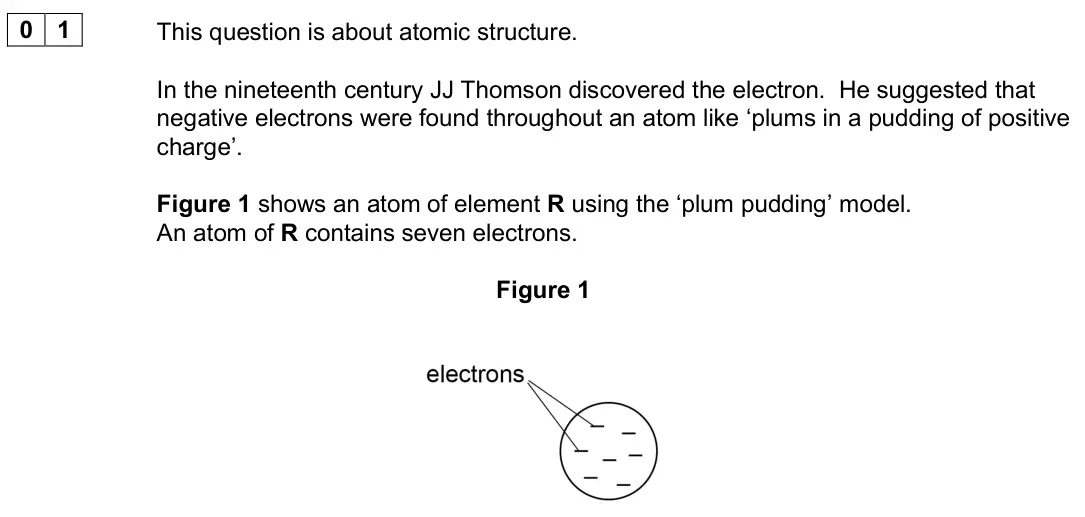
Q1(a)(i)
The whole paper ↗Q1(a)(ii)
The whole paper ↗Q8(a)
The whole paper ↗
How many marks did you get?
All 12 questions on Fundamental particles, as a list
- June 2025, AS Paper 1, Q12 (1 mark): Which row shows the order of discovery? [1 mark] Earliest Latest A electron neutron nucleus B electron nucleus neutron C nucleus electron neutron D nucleus neut
- June 2024, Paper 1, Q01.1 (3 marks): In 1897 JJ Thomson discovered the electron. He suggested that atoms were positively charged spheres with electrons embedded within them. Figure 1 represents an
- June 2024, Paper 3, Q06 (1 mark): Which row contains two species with different numbers of electrons? [1 mark] A NH3 and HF B CO32– and NO3– C H3O+ and HF2+ D CH4 and NH2–
- June 2023, Paper 3, Q07 (1 mark): Which row shows the number of each fundamental particle in one 25Mg2+ ion? [1 mark] protons neutrons electrons A 12 12 10 B 14 11 12 C 12 13 10 D 12 13 12
- November 2021, AS Paper 1, Q01.1 (2 marks): Figure 1 is a model proposed by Rutherford to show the structure of an atom. Figure 1 State two features of the current model that are not shown in the Rutherfo
- June 2018, Paper 3, Q07 (1 mark): What conclusion can be drawn from the detection of He2+ particles at point P? [1 mark] A Gold atoms contain electrons. B Gold atoms contain protons. C Gold atom
- June 2018, Paper 3, Q08 (1 mark): What conclusion can be drawn from the detection of He2+ particles at point Q? [1 mark] A Gold atoms have a small, positive nucleus. B Gold atoms have electrons
- June 2018, AS Paper 1, Q01.1 (2 marks): State two differences between the ‘plum pudding’ model and the model of atomic structure used today. [2 marks] 1 2
- June 2014, CHEM1 (old spec), Q1(a)(i) (1 mark): An atom of hydrogen can be represented as 1H Use data from Table 1 to calculate the mass of this hydrogen atom. [1 mark]
- June 2014, CHEM1 (old spec), Q1(a)(ii) (1 mark): Which one of the following is a fundamental particle that would not be deflected by an electric field? A electron B neutron C proton Write the correct letter, A
- June 2010, CHEM1 (old spec), Q8(a) (3 marks): Define the term mass number of an atom. The mass number of an isotope of nitrogen is 15. Deduce the number of each of the fundamental particles in an atom of 15
- January 2009, CHEM1 (old spec), Q1(a) (2 marks): 1 (a) Complete the following table for the particles in the nucleus. Particle Relative charge Relative mass proton neutron (2 marks)
Questions, mark schemes and examiner’s reports are © AQA, from their published past papers. Plumi isn’t affiliated with any exam board. Want whole papers? AQA A-Level Chemistry past papers.
The Plumi iPad app also offers exam-style questions with AI feedback on your handwritten working.