 plumi
Estimating, accuracy and bounds: WJEC GCSE Maths questions
WJEC GCSE Maths past-paper questions on N9 Estimating, accuracy and bounds, November 2016 to June 2025, with mark schemes and examiner’s reports where available.
Past paper difficulty
Paper
All papers
Exam
All years
Calculator
Loading the full question list…








All 47 questions on Estimating, accuracy and bounds, as a list
- June 2025, Unit 1 Foundation, Q1 (5 marks): (a) Write twenty thousand, three hundred and six in figures. [1] Write 3 (b) 10 as a percentage. [1] % (c) Subtract 435 from 826. [1] (d) Write 8467·2 correct t
- June 2025, Unit 1 Intermediate, Q3 (2 marks): Estimate the value of 89 × 6349. You must show all your working. [2]
- June 2025, Unit 1 Intermediate, Q19 (2 marks): The length of each side of a square is 15 cm, correct to the nearest 1 cm. Calculate the greatest possible perimeter of this square. [2]
- June 2025, Unit 1 Higher, Q8 (2 marks): The length of each side of a square is 15 cm, correct to the nearest 1 cm. Calculate the greatest possible perimeter of this square. [2]
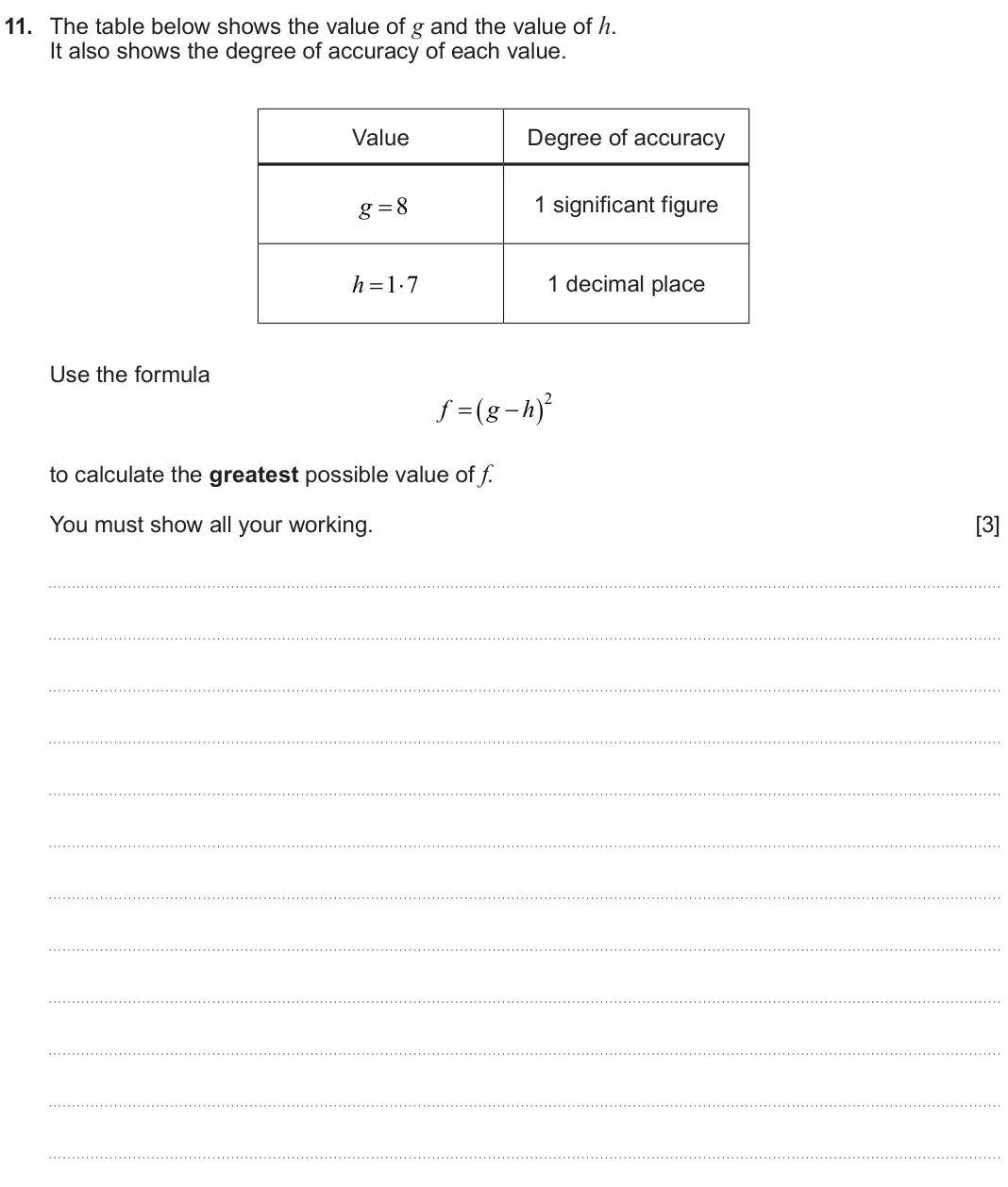
- June 2025, Unit 2 Higher, Q11 (3 marks): The table below shows the value of g and the value of h. It also shows the degree of accuracy of each value. Value Degree of accuracy g 8 1 significant figure
- November 2024, Unit 1 Foundation, Q12 (2 marks): Estimate the value of 33 × 7940. You must show your approximations in your working. [2]
- November 2024, Unit 1 Intermediate, Q2 (2 marks): Estimate the value of 33 × 7940. You must show your approximations in your working. [2]
- June 2024, Unit 1 Intermediate, Q10 (6 marks): (a) Write the reciprocal of 4 as a decimal. [1] 79·34 (b) Estimate the value of . 40·1× 0·48 You must show all your approximations in your working. [2] (c) Eval
- June 2024, Unit 1 Higher, Q1 (6 marks): (a) Write the reciprocal of 4 as a decimal. [1] 79·34 (b) Estimate the value of . 40·1× 0·48 You must show all your approximations in your working. [2] (c) Eval
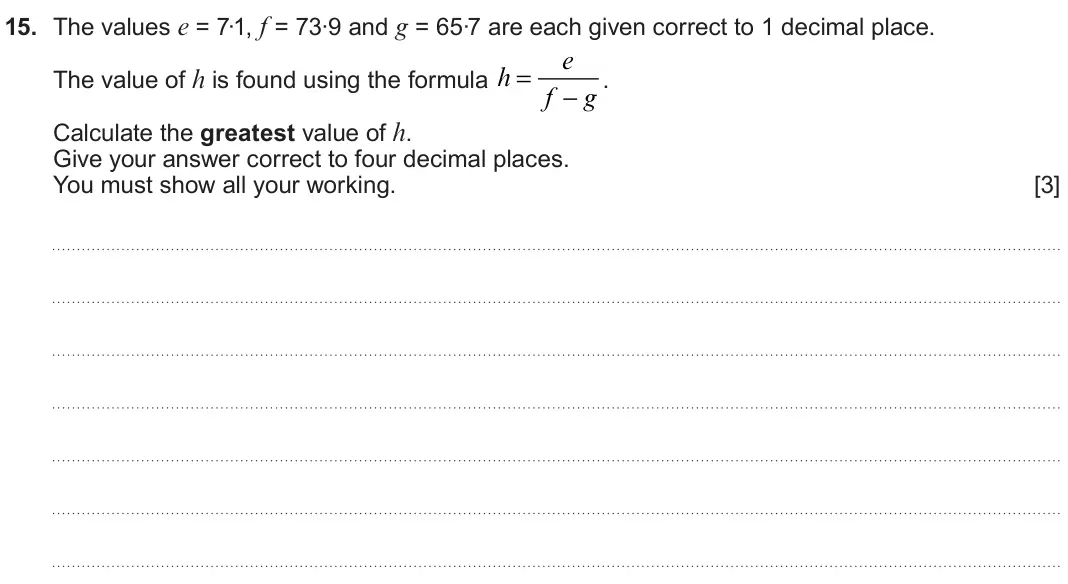
- June 2024, Unit 2 Higher, Q15 (3 marks): The values e = 7·1, f = 73·9 and g = 65·7 are each given correct to 1 decimal place. e h = The value of h is found using the formula . f − g Calculate the great
- November 2023, Unit 2 Foundation, Q14 (4 marks): 18 4 8 79 14. (a) Evaluate . 2 7 3 Give your answer correct to the nearest 10. [2] 1456 3 7 . (b) Evaluate Give your answer correct to 1 decimal pla
- November 2023, Unit 2 Intermediate, Q5 (4 marks): 18 4 8 79 5. (a) Evaluate . 2 7 3 Give your answer correct to the nearest 10. [2] 1456 3 7 . (b) Evaluate Give your answer correct to 1 decimal plac
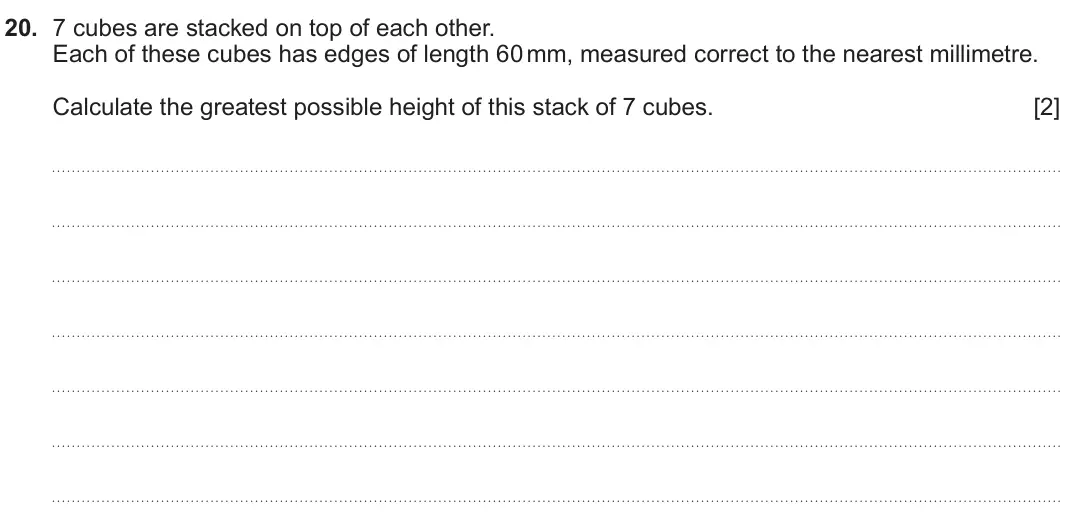
- November 2023, Unit 2 Intermediate, Q20 (2 marks): 7 cubes are stacked on top of each other. Each of these cubes has edges of length 60 mm, measured correct to the nearest millimetre. Calculate the greatest poss
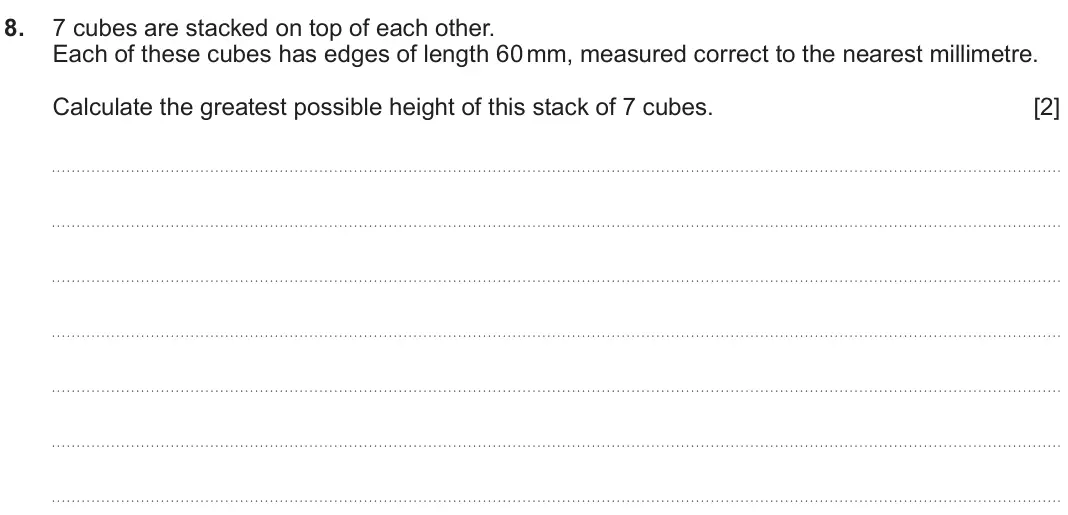
- November 2023, Unit 2 Higher, Q8 (2 marks): 7 cubes are stacked on top of each other. Each of these cubes has edges of length 60 mm, measured correct to the nearest millimetre. Calculate the greatest poss
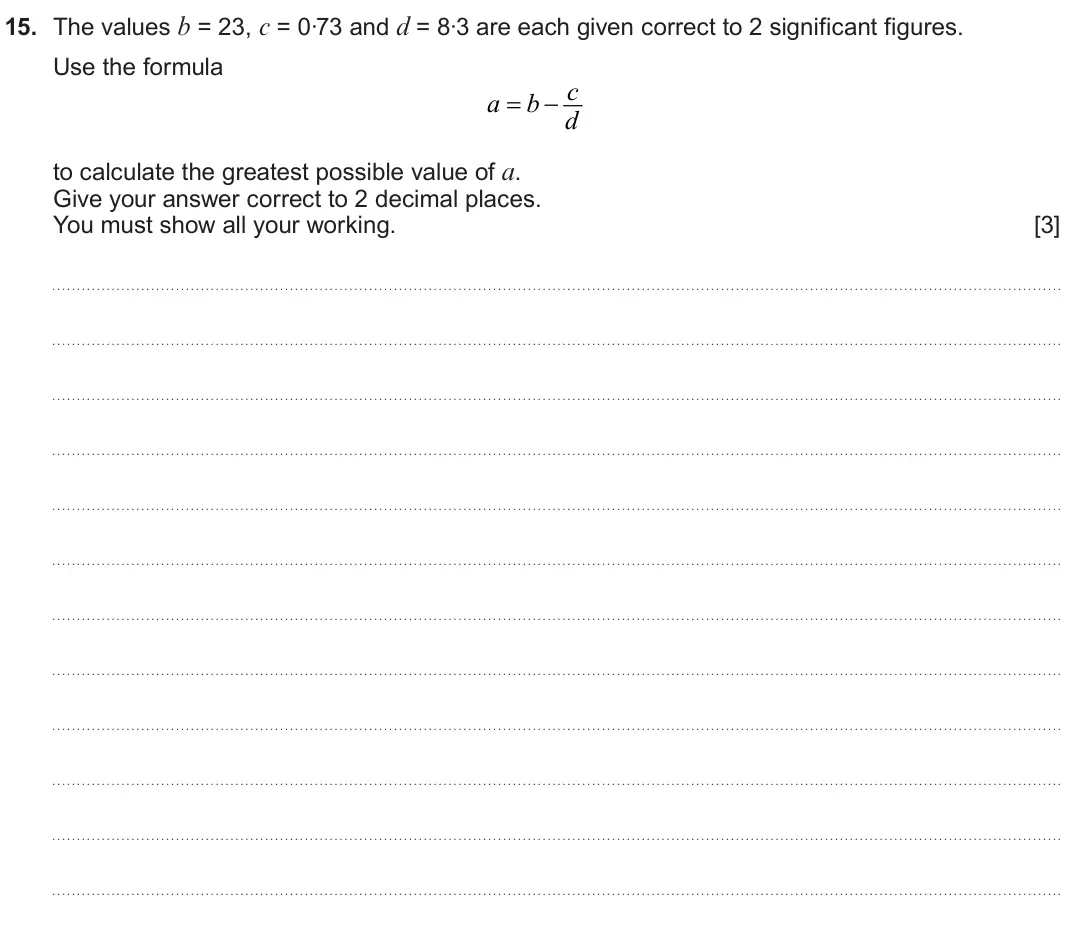
- November 2023, Unit 2 Higher, Q15 (3 marks): The values b = 23, c = 0·73 and d = 8·3 are each given correct to 2 significant figures. Use the formula c a b d to calculate the greatest possible value of
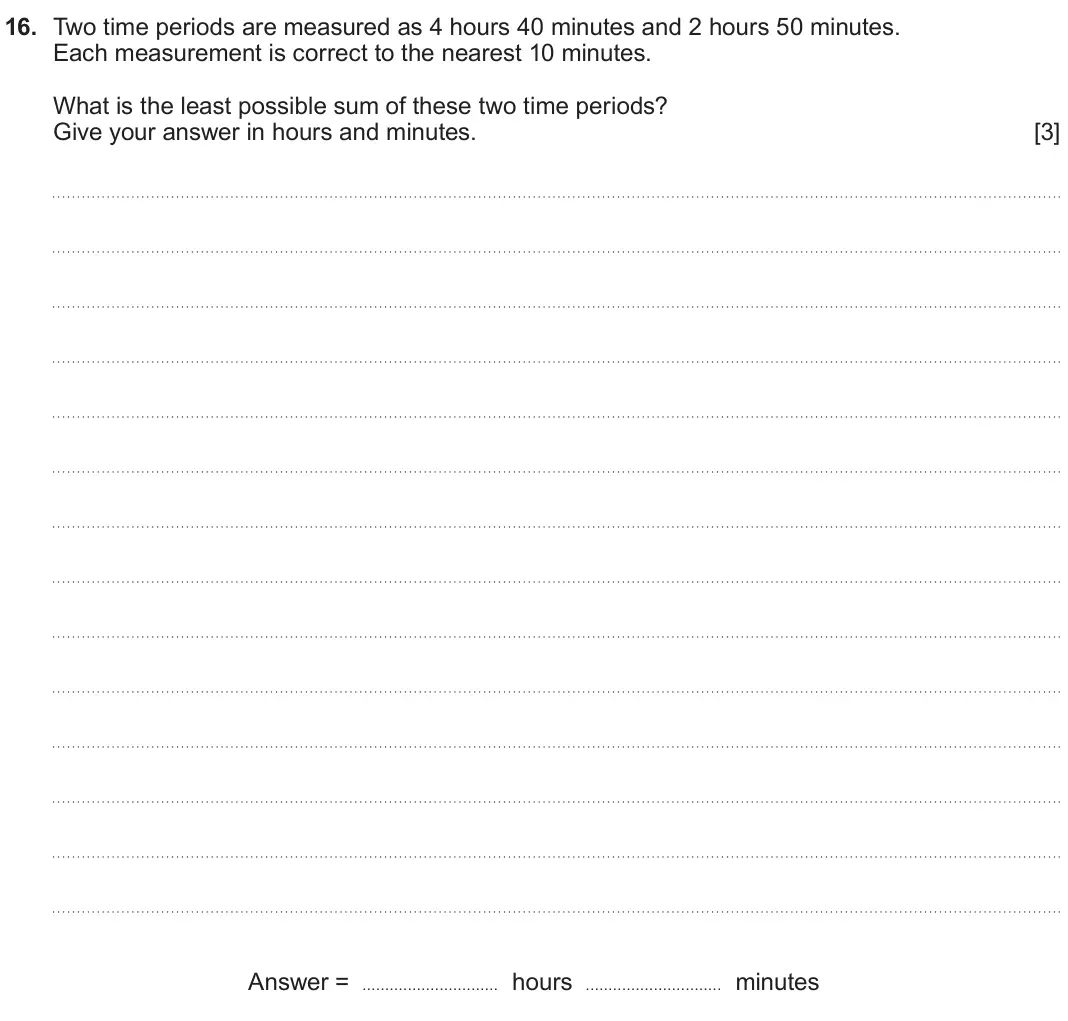
- June 2023, Unit 1 Intermediate, Q16 (3 marks): Two time periods are measured as 4 hours 40 minutes and 2 hours 50 minutes. Each measurement is correct to the nearest 10 minutes. What is the least possible su
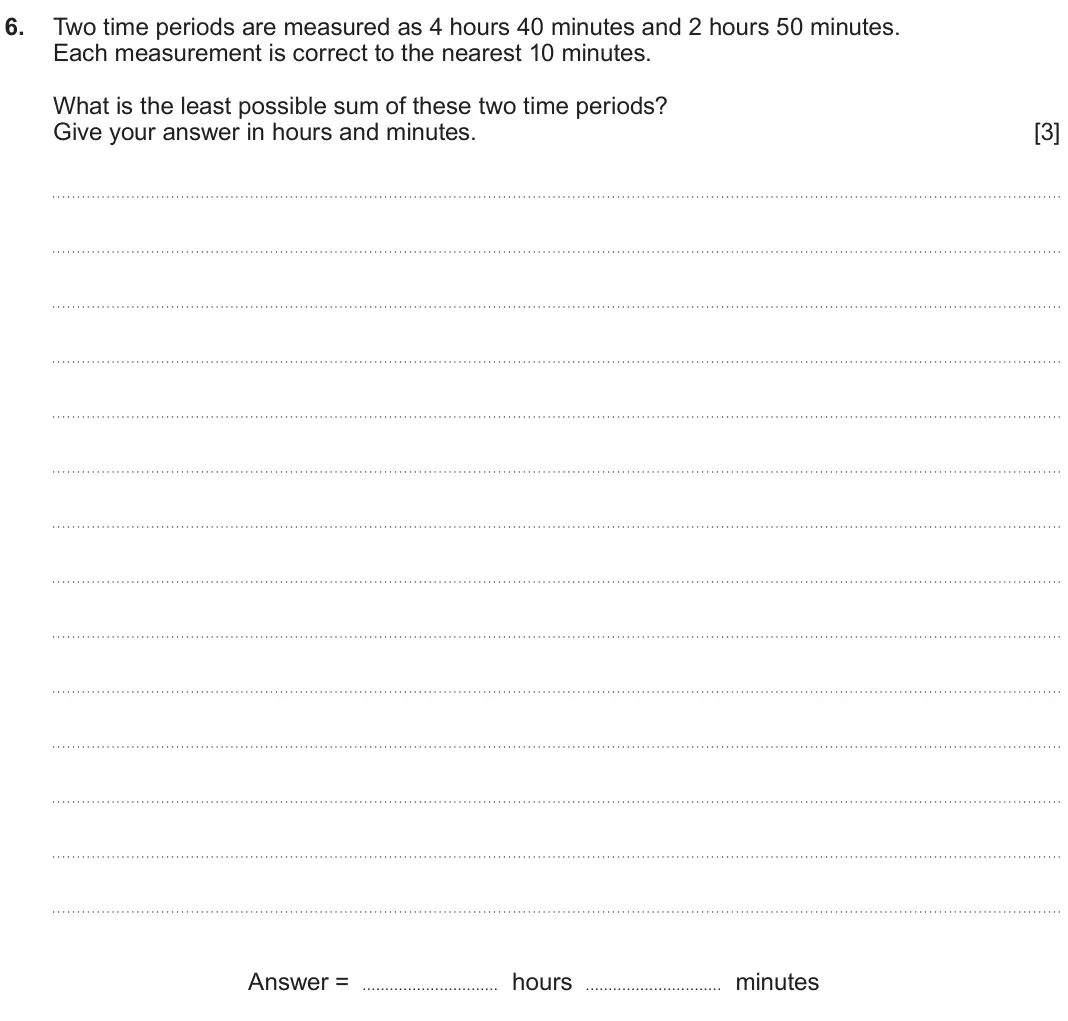
- June 2023, Unit 1 Higher, Q6 (3 marks): Two time periods are measured as 4 hours 40 minutes and 2 hours 50 minutes. Each measurement is correct to the nearest 10 minutes. What is the least possible su
- November 2022, Unit 1 Foundation, Q20 (2 marks): Estimate the value of 20 ⋅ 4 × 59 ⋅1 . 407 You must show all your working. [2]
- November 2022, Unit 1 Intermediate, Q10 (2 marks): Estimate the value of 20 ⋅ 4 × 59 ⋅1 . 407 You must show all your working. [2]
- November 2022, Unit 2 Intermediate, Q16 (3 marks): Two times are recorded correct to the nearest 0·1 second. 12·4 seconds 25·5 seconds Calculate the greatest possible difference between these times. [3]
- November 2022, Unit 2 Higher, Q6 (3 marks): Two times are recorded correct to the nearest 0·1 second. 12·4 seconds 25·5 seconds Calculate the greatest possible difference between these times. [3]
- June 2022, Unit 2 Higher, Q10 (3 marks): y = t 10. The value of y is found using the formula . w t = 98, correct to 2 significant figures. w = 0·5, correct to 1 significant figure. Calculate the least
- November 2021, Unit 2 Foundation, Q12 (4 marks): A company produces 440 boxes of paper clips each day. Each box contains between 320 and 330 paper clips. Calculate the approximate total number of paper clips p
- November 2021, Unit 2 Intermediate, Q3 (6 marks): In this question, you will be assessed on the quality of your organisation, communication and accuracy in writing. A company produces 440 boxes of paper clips e
- November 2021, Unit 2 Higher, Q11 (3 marks): The table below shows the value of d and the value of e. It also shows the degree of accuracy of each value. Value Degree of accuracy d = 64 Nearest whole numbe
- November 2020, Unit 2 Intermediate, Q17 (3 marks): The lengths of the sides of a rectangle are given as 24 cm and 15 cm. Each measurement is given correct to the nearest centimetre. Calculate the difference betw
- November 2020, Unit 2 Higher, Q8 (3 marks): The lengths of the sides of a rectangle are given as 24 cm and 15 cm. Each measurement is given correct to the nearest centimetre. Calculate the difference betw
- November 2020, Unit 2 Higher, Q16 (3 marks): An amount written correct to the nearest £10 is £7180. This amount is increased by 23·5%, correct to the nearest 0·1%. Calculate the least possible value of the
- November 2019, Unit 1 Intermediate, Q20 (3 marks): A cuboid has dimensions of 40 mm, 25 mm and 12 mm. All of these measurements are correct to the nearest mm. 12 mm 25 mm 40 mm Diagram not drawn to scale Four of
- November 2019, Unit 1 Higher, Q9 (3 marks): A cuboid has dimensions of 40 mm, 25 mm and 12 mm. All of these measurements are correct to the nearest mm. 12 mm 25 mm 40 mm Diagram not drawn to scale Four of
- June 2019, Unit 1 Intermediate, Q14 (3 marks): Estimate the value of 30.21 × 1.983 [3] 0.49
- June 2019, Unit 1 Intermediate, Q16 (5 marks): (a) (i) A mass is written as 430 kg, correct to the nearest 10 kg. Circle the least possible value of this mass. [1] 420 kg 425 kg 429·5 kg 426 kg 424·9 kg (ii)
- June 2019, Unit 1 Higher, Q5 (3 marks): Estimate the value of 30.21 × 1.983 [3] 0.49
- June 2019, Unit 1 Higher, Q7 (5 marks): (a) (i) A mass is written as 430 kg, correct to the nearest 10 kg. Circle the least possible value of this mass. [1] 420 kg 425 kg 429·5 kg 426 kg 424·9 kg (ii)
- June 2019, Unit 2 Higher, Q13 (3 marks): A car travels 300 km, measured correct to the nearest 5 km. It travels this distance in 6 hours, measured correct to the nearest hour. Calculate the least possi
- November 2018, Unit 1 Foundation, Q17 (4 marks): × 301 17. (a) Estimate the answer to . 1997 You must show all your working. [2] (b) Given that 341 × 57 = 19 437, write down the answer to each of the following
- November 2018, Unit 1 Intermediate, Q5 (4 marks): × 301 5. (a) Estimate the answer to . 1997 You must show all your working. [2] (b) Given that 341 × 57 = 19 437, write down the answer to each of the following.
- June 2018, Unit 1 Intermediate, Q10 (3 marks): (a) Circle the best approximate value for the following calculation. [1] 596.3 38.2 + 11.5 110 12 11 120 10 (b) A number is increased by 4% of its value. This i
- June 2018, Unit 1 Higher, Q1 (3 marks): (a) Circle the best approximate value for the following calculation. [1] 596.3 38.2 + 11.5 110 12 11 120 10 (b) A number is increased by 4% of its value. This i
- June 2018, Unit 2 Higher, Q13 (3 marks): The values a = 27, b = 1.9 and c = 0.81 are each correct to 2 significant figures. d = a − b Use the formula to calculate the least value of d. c You must show
- November 2017, Unit 2 Higher, Q12 (2 marks): The area of a rectangle is 137 cm2, correct to the nearest cm2. Its width is 11 cm, correct to the nearest cm. Calculate the greatest possible length of the rec
- June 2017, Unit 1 Foundation, Q18 (5 marks): 3 × 29.6 18. (a) Estimate the value of . 198.7 You must show all your working. [2] Given that 54 × 84.2 = 4546.8, write down the exact value of each of the foll
- June 2017, Unit 1 Intermediate, Q8 (5 marks): 3 × 29.6 8. (a) Estimate the value of . 198.7 You must show all your working. [2] Given that 54 × 84.2 = 4546.8, write down the exact value of each of the follo
- June 2017, Unit 2 Intermediate, Q11 (4 marks): Calculate 8.53 + (4.5 – 0.76)2, correct to 3 significant figures. 11. (a) [2] Calculate the reciprocal of −0.07, correct to 1 decimal place. (b) [2]
- June 2017, Unit 2 Higher, Q1 (4 marks): Calculate 8.53 + (4.5 – 0.76)2, correct to 3 significant figures. 1. (a) [2] Calculate the reciprocal of −0.07, correct to 1 decimal place. (b) [2]
- June 2017, Unit 2 Higher, Q14 (3 marks): The region between two rectangles is shaded, as shown in the diagram below. All of the measurements shown are given correct to the nearest cm. 31 cm 21 cm 23 cm
- November 2016, Unit 2 Higher, Q11 (2 marks): A rectangle measures 38 cm by 26 cm. Each measurement is correct to the nearest cm. Calculate the least possible area of the rectangle. [2]
Questions, mark schemes and examiner’s reports are © WJEC CBAC Ltd, from their published past papers. Plumi isn’t affiliated with any exam board. Want whole papers? WJEC GCSE Maths past papers.
The Plumi iPad app also offers exam-style questions with AI feedback on your handwritten working.