 plumi
What is radioactivity?: OCR GCSE Physics B questions
Every OCR GCSE Physics B exam question on P5.1 What is radioactivity?, 2018–2025, with its mark scheme and examiner’s report.
Paper
All papers
Exam
All years
Calculations
Q6(a)(i)
The whole paper ↗
Q6(a)(ii)
The whole paper ↗Q6(a)(iii)
The whole paper ↗Q6(a)(iv)
The whole paper ↗Q5(a)
The whole paper ↗
Q5(b)(i)
The whole paper ↗Q5(b)(ii)
The whole paper ↗Q5(a)
The whole paper ↗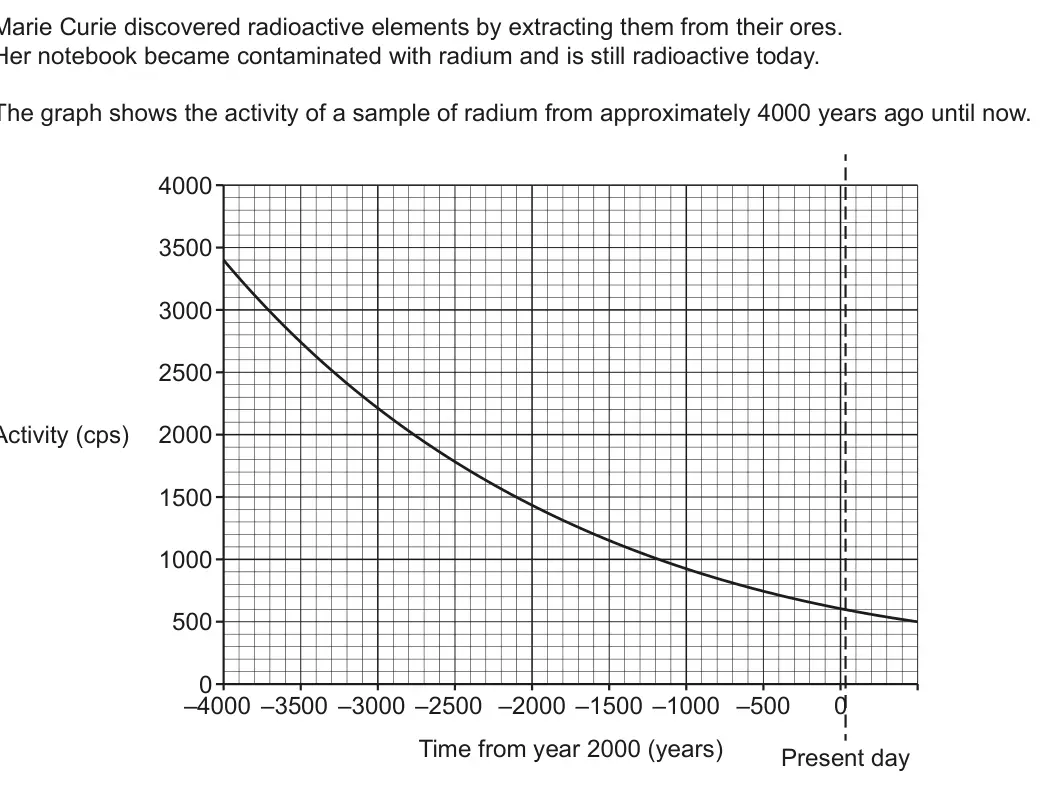
Q5(b)(i)
The whole paper ↗Q5(b)(ii)
The whole paper ↗Q3(a)
The whole paper ↗
Q3(b)
The whole paper ↗Q3(c)(i)
The whole paper ↗Q3(c)(ii)
The whole paper ↗Q3(c)(iii)
The whole paper ↗Q6(a)
The whole paper ↗
Q6(b)(i)
The whole paper ↗Q6(b)(ii)
The whole paper ↗Q3(a)
The whole paper ↗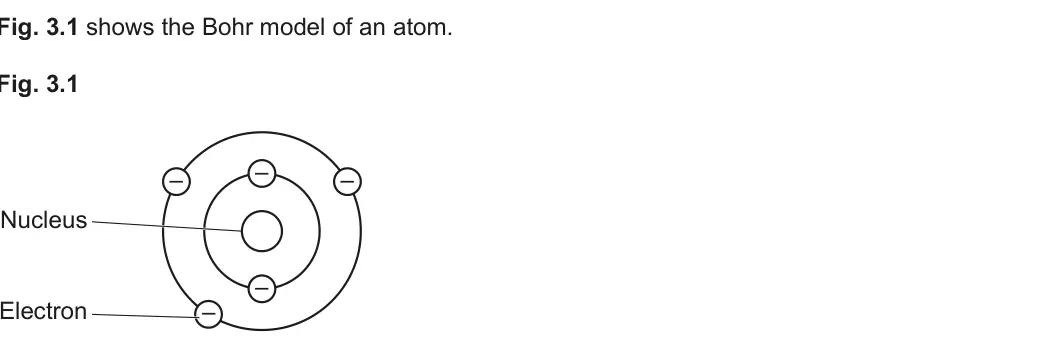
Q3(b)
The whole paper ↗
All 85 questions on What is radioactivity?, as a list
- June 2025, Paper 1 Foundation, Q6(a)(i) (1 mark): Why does the activity of a radioactive source decrease? Tick (✓) one box. Half-life decreases. Half-life increases. The number of undecayed nuclei decreases. Th
- June 2025, Paper 1 Foundation, Q6(a)(ii) (1 mark): What will the activity of the radium on the notebook be 2500 years from now? Use the graph. Activity = cps [1]
- June 2025, Paper 1 Foundation, Q6(a)(iii) (2 marks): Find the half-life of radium. Use the graph. Half-life = years [2]
- June 2025, Paper 1 Foundation, Q6(a)(iv) (2 marks): Explain why the statement below is not correct. The radium on the notebook will be much less radioactive in 100 years’ time. [2]
- June 2025, Paper 2 Foundation, Q5(a) (2 marks): An alpha particle is a helium-4 nucleus and can be written as: 4 2He How many protons and neutrons are contained in the nucleus of helium-4? Number of protons =
- June 2025, Paper 2 Foundation, Q5(b)(i) (1 mark): What is the activity at 15 seconds? Activity = cpm [1]
- June 2025, Paper 2 Foundation, Q5(b)(ii) (1 mark): What is the change in the activity between 15 and 30 seconds? Change in activity = cpm [1]
- June 2025, Paper 3 Higher, Q5(a) (3 marks): Find the half-life of radium. Use the graph. Half-life = years [3]
- June 2025, Paper 3 Higher, Q5(b)(i) (2 marks): The activity of the radium that remains on the notebook will decrease in the future. Calculate the activity of the radium that remains on the notebook after 3 f
- June 2025, Paper 3 Higher, Q5(b)(ii) (1 mark): Calculate the fraction of the number of nuclei that will decay in 3 half-lives. Fraction = [1]
- June 2025, Paper 4 Higher, Q3(a) (2 marks): Uranium-235 can be written as: 23 5 2U 9 How many protons and neutrons are contained in the nucleus of uranium-235? Number of protons = Number of neutrons = [2]
- June 2025, Paper 4 Higher, Q3(b) (1 mark): Uranium-235 undergoes alpha decay. Which of these is the correct equation for this decay? Tick (✓) one box. 23 5 23 1 2U + 4 2U 0He 9 9 23 5 23 1 2U + 4 2U 1He
- June 2025, Paper 4 Higher, Q3(c)(i) (1 mark): What is meant by the half-life of a radioactive isotope? Tick (✓) one box. Half of the decrease in activity per second. The number of atoms formed in half a yea
- June 2025, Paper 4 Higher, Q3(c)(ii) (1 mark): Find the activity of the sample at 14 × 108 years. Use the graph. Activity at 14 × 108 years = cpm [1]
- June 2025, Paper 4 Higher, Q3(c)(iii) (2 marks): The half-life of uranium-235 is 7 × 10⁸ years. Calculate the activity at 21 × 108 years. Activity at 21 × 108 years = cpm [2]
- June 2024, Paper 1 Foundation, Q6(a) (2 marks): Complete the nuclear equation to show the decay of radium‑223 (Ra) to radon (Rn). 223 4 88Ra 2α + Rn [2]
- June 2024, Paper 1 Foundation, Q6(b)(i) (1 mark): Which of these is the correct definition of half‑life? Tick (3) one box. The activity after half the age of the sample. The time taken for the activity to reach
- June 2024, Paper 1 Foundation, Q6(b)(ii) (1 mark): The graph shows the decay of radium‑223. 500 450 400 350 300 Activity (Bq) 250 200 150 100 50 0 0 2 4 6 8 10 12 14 16 18 20 Time (days) Find the half‑life of ra
- June 2024, Paper 2 Foundation, Q3(a) (3 marks): Complete the sentences about the Bohr model of an atom. Put a ring around each correct option. The nucleus has an overall negative / neutral / positive charge.
- June 2024, Paper 2 Foundation, Q3(b) (2 marks): Fig. 3.2 shows the Bohr model of two isotopes of the same element. Fig. 3.2 Isotope A Isotope B Neutron – – – – – – Proton Electron Describe the similarities an
- June 2024, Paper 2 Foundation, Q3(c) (2 marks): Which two statements describe why the model of the atom has changed over time? Tick (✓) two boxes. Atoms have changed. Experiments have provided new evidence. N
- June 2024, Paper 3 Higher, Q10(a) (2 marks): Neutrons are involved in beta decay. Explain why the atomic mass number does not change when a nucleus emits a beta particle. [2]
- June 2024, Paper 3 Higher, Q10(b)(i) (2 marks): Complete the equation for beryllium-13 when it decays. 13 + 1 4Be 0n 4 [2]
- June 2024, Paper 3 Higher, Q10(b)(ii) (1 mark): The half-life of beryllium-13 is 3 × 10–21 seconds. Describe what is meant by half-life. [1]
- June 2024, Paper 3 Higher, Q10(c)(iv) (2 marks): When boron-10 absorbs a neutron, it decays to become stable lithium-7 by emitting alpha and gamma radiation. Show that total mass is conserved in the decay of b
- June 2024, Paper 4 Higher, Q3(a) (2 marks): State two reasons why the model of the atom has changed over time. 1 2 [2]
- June 2024, Paper 4 Higher, Q3(b) (3 marks): Describe the structure of the nuclear model of the atom. [3]
- June 2023, Paper 1 Foundation, Q8(a) (2 marks): Complete the sentences about radioactive substances. Put a ring around each correct option. Atoms in radioactive substances have balanced / stable / unstable nu
- June 2023, Paper 1 Foundation, Q8(b) (1 mark): The nuclear equation shows the radioactive decay of a sulfur nucleus to a chlorine nucleus. 35 35 –1e– 0 16S 17Cl + Identify the radioactive decay in the nuclea
- June 2023, Paper 1 Foundation, Q8(c) (1 mark): Which statement explains why sulfur and chlorine are different elements? Tick (3) one box. They have different numbers of electrons. They have different numbers
- June 2023, Paper 2 Foundation, Q6(a)(i) (1 mark): What is particle X? Put a ring around the correct option. 0e 4 1 2He 0n –1 [1]
- June 2023, Paper 2 Foundation, Q6(a)(ii) (2 marks): Complete the sentences about the decay equation. Put a ring around the correct options. 1. When a nucleus of radon-222 decays the mass number reduces by 4 / 2 /
- June 2023, Paper 2 Foundation, Q6(b) (1 mark): Half-life is used to measure the length of time of decay. Define the term half-life. [1]
- June 2023, Paper 2 Foundation, Q6(c)(i) (1 mark): Ling says that some of the measurements do not lie exactly on the expected decay curve because of experimental errors. Give one other reason why some readings d
- June 2023, Paper 3 Higher, Q9(a) (1 mark): What is the typical diameter of an atom? Tick (3) one box. 1 × 10³ m 1 × 10⁻³ m 1 × 10⁻⁶ m 1 × 10⁻¹⁰ m [1]
- June 2023, Paper 3 Higher, Q9(b) (1 mark): Which example gives the best estimate for the ratio of the relative diameters of the atom and its nucleus? The values in brackets are estimates for the diameter
- June 2023, Paper 3 Higher, Q9(c) (1 mark): Ideas about the model of the atom have developed over the last 200 years. Write the numbers 2, 3 and 4 to show the correct historical order. The earliest idea h
- June 2023, Paper 3 Higher, Q10(a)(i) (2 marks): Complete the balanced nuclear equation. 35 35 16S Cl + e [2]
- June 2023, Paper 3 Higher, Q10(a)(ii) (3 marks): Compare and contrast the composition of the sulfur and chlorine nuclei to explain where the beta particle has come from. [3]
- June 2023, Paper 3 Higher, Q10(b)(i) (2 marks): Explain how chlorine nuclei can have differing nuclear masses. [2]
- June 2023, Paper 3 Higher, Q10(b)(ii) (2 marks): Calculate the mean nuclear mass. Mean nuclear mass = [2]
- June 2023, Paper 4 Higher, Q4(a) (2 marks): Compare the structures of the nuclei of actinium-225 and actinium-227. [2]
- June 2023, Paper 4 Higher, Q4(b)(i) (1 mark): State why a nucleus might decay. [1]
- June 2023, Paper 4 Higher, Q4(b)(ii) (1 mark): Name the electromagnetic radiation that is emitted in both cases. [1]
- June 2023, Paper 4 Higher, Q4(b)(iii) (2 marks): Name one other ionising radiation emitted in each case. Actinium-225: Actinium-227: [2]
- June 2022, Paper 1 Foundation, Q2(a)(i) (1 mark): Use a word from the list to complete the sentence. electrons neutrons protons The atom has a positive nucleus surrounded by negative [1]
- June 2022, Paper 1 Foundation, Q2(a)(ii) (2 marks): Use words from this list to complete the sentence. charge mass nucleus space volume Almost all of the of the atom is in the [2]
- June 2022, Paper 1 Foundation, Q2(b) (1 mark): What is the typical size of an atom? Tick (✓) one box. 1010 m 105 m 10–5 m 10–10 m [1]
- June 2022, Paper 1 Foundation, Q2(c)(i) (1 mark): Which statement could be used to describe these atoms? Tick (✓) one box. They are identical They are isotopes They are negative ions They are positive ions [1]
- June 2022, Paper 1 Foundation, Q2(c)(ii) (1 mark): One of the atoms is unstable. Which statement can be used to describe this atom? Tick (✓) one box. The neutrons are positively charged. The nucleus may emit a r
- June 2022, Paper 2 Foundation, Q8(b) (2 marks): One possible product of the nuclear fission of uranium-235 is strontium-90. Strontium-90 emits beta particles, and decays to yttrium (Yt). Complete the decay eq
- June 2022, Paper 2 Foundation, Q8(c)(i) (2 marks): Use the graph to find the half-life of strontium-90. Half-life = years [2]
- June 2022, Paper 2 Foundation, Q8(c)(ii) (1 mark): Use the graph to find the percentage activity of strontium-90 after 100 years. Percentage activity = % [1]
- June 2022, Paper 2 Foundation, Q8(d)(i) (1 mark): How many protons are there in a strontium-88 nucleus? [1]
- June 2022, Paper 2 Foundation, Q8(d)(ii) (1 mark): How many neutrons are there in a strontium-88 nucleus? [1]
- November 2021, Paper 1 Foundation, Q11(a) (1 mark): Li comments that there is a problem with Amaya’s experiment. This experiment is not valid. You cannot be confident that the radiation you detect is coming from
- November 2020, Paper 1 Foundation, Q13(c) (2 marks): Alpha radiation is also harmful to living organisms. Give two reasons why alpha radiation would not be suitable for disinfecting water. 1 2 [2]
- November 2020, Paper 2 Foundation, Q5(a) (1 mark): Complete the two missing values in the table. [1]
- November 2020, Paper 2 Foundation, Q5(b) (1 mark): Isotopes of an element are atoms with the same number of protons but a different number of neutrons. Which two atoms are isotopes of the same element? Put a rin
- November 2020, Paper 2 Foundation, Q5(c) (1 mark): Carbon-14 is an unstable isotope which decays to nitrogen-14. 1 4C 1 4N + Decay 6 7 particle What is the decay particle emitted when carbon-14 decays? Put a rin
- November 2020, Paper 3 Higher, Q3(c) (2 marks): Alpha radiation is also harmful to living organisms. Give two reasons why alpha radiation would not be suitable for disinfecting water. 1 2 [2]
- June 2019, Paper 1 Foundation, Q3(a) (1 mark): What is the typical size of an atom? Put a ring around the correct answer. 10–3 m 10–6 m 10–10 m 10–20 m [1]
- June 2019, Paper 1 Foundation, Q3(b) (2 marks): Mia finds out about the models of atoms suggested by Dalton and Rutherford. She draws these diagrams. nucleus Dalton model Rutherford model Describe some of the
- June 2019, Paper 1 Foundation, Q3(c) (2 marks): Mia finds out more information about the nucleus of the atom on the Internet. Mia ‘The Internet says the nucleus is tiny and negatively charged. It contains pro
- June 2019, Paper 1 Foundation, Q3(d)(i) (1 mark): What is the total mass of these two nuclei? Put a ring around the correct answer. 12 – 6 10 + 6 20 + 10 20 + 12 [1]
- June 2019, Paper 1 Foundation, Q3(d)(ii) (1 mark): What is the difference between the charges of these two nuclei? Put a ring around the correct answer. 10 – 6 12 – 6 20 – 12 20 – 10 [1]
- June 2019, Paper 2 Foundation, Q5(d)(i) (2 marks): Use the graph to determine the half-life of the alpha source. Show your working on the graph. Half-life = years [2]
- June 2019, Paper 2 Foundation, Q5(d)(ii) (3 marks): The initial activity of the source is 40 000 counts per second. What is the activity of the source after a time equal to 2 half-lives? Activity = counts per sec
- June 2019, Paper 2 Foundation, Q5(d)(iii) (3 marks): On the graph axes above, sketch a graph for another sample of the alpha source that has an initial activity of 30 000 counts per second. [3]
- June 2019, Paper 3 Higher, Q5(a) (2 marks): Thorium-232 can be represented as: 232 90Th Complete the correct representation of the isotope of radium shown in Fig. 5.1. Ra [2]
- June 2019, Paper 3 Higher, Q5(b) (2 marks): State the type of radiation emitted during the decay shown in Fig. 5.1. Give a reason for your answer. Type of radiation Reason [2]
- June 2019, Paper 3 Higher, Q5(c) (1 mark): The isotope of radium is also radioactive. It decays by emitting a beta particle. Add an arrow to the graph in Fig. 5.1 to show this decay. [1]
- June 2019, Paper 4 Higher, Q11(b)(i) (3 marks): Sketch a graph to show how the activity of the source changes with time. 2.0 × 10⁷ activity (counts per second) 1.0 × 10⁷ 0 0 74 148 time (days) [3]
- June 2019, Paper 4 Higher, Q11(b)(ii) (3 marks): The initial activity of another iridium-192 source is different from (b)(i). What fraction of the iridium nuclei are left in the new source after 3 half-lives?
- June 2018, Paper 1 Foundation, Q8(a)(i) (1 mark): Which is the number of protons in americium-241? Put a ring around the correct answer. [1] 95 241 241 + 95 241 – 95
- June 2018, Paper 1 Foundation, Q8(a)(ii) (1 mark): Which is the number of neutrons in americium-241? Put a ring around the correct answer. [1] 95 241 241 + 95 241 – 95
- June 2018, Paper 2 Foundation, Q5(a)(i) (2 marks): Complete the radioactive decay equation for plutonium-238. 238 4 94Pu U + 2 a [2]
- June 2018, Paper 3 Higher, Q8(a) (2 marks): Complete these nuclear equations to show the production of technetium-99m. 98 99 42 Mo + n 42 Mo 99 99 42 Mo 43 Tc + e [2]
- June 2018, Paper 3 Higher, Q8(c)(i) (2 marks): Calculate the percentage of technetium-99m remaining after 24 hours. Percentage remaining = % [2]
- June 2018, Paper 4 Higher, Q3(a)(i) (3 marks): Complete the radioactive decay equation for plutonium-238. 23 8 4Pu U + α 9 [3]
- June 2018, Paper 4 Higher, Q3(a)(ii) (3 marks): The plutonium emits 1.6 × 10¹⁵ alpha particles every second, each with an energy of 9.0 × 10⁻¹³ J. The energy released is all transferred to the internal energy
- June 2018, Paper 4 Higher, Q8(a) (2 marks): Use the graph to obtain an estimate of the half-life of americium-241. Show your working on the graph. Half-life = years [2]
- June 2018, Paper 4 Higher, Q8(c)(i) (1 mark): What does the number of dice remaining at any roll stand for? [1]
- June 2018, Paper 4 Higher, Q8(c)(ii) (1 mark): What does the number of sixes taken out in any roll stand for? [1]
- June 2018, Paper 4 Higher, Q8(c)(iii) (3 marks): Explain why the data in this table suggest that the half-life is about 4 ‘rolls’ but that it’s not possible to be exact. [3]
Questions, mark schemes and examiner’s reports are © OCR, from their published past papers. Plumi isn’t affiliated with any exam board. Want whole papers? Every OCR GCSE Physics B paper.
Rather write your answers by hand on iPad? Plumi marks them against the same mark schemes.