 plumi
What are electrolytes and what happens during electrolysis?: OCR GCSE Combined Science B questions
Every OCR GCSE Combined Science B exam question on C3.3 What are electrolytes and what happens during electrolysis?, 2018–2025, with its mark scheme and examiner’s report.
Paper
All papers
Exam
All years
Calculations
Q7(a)
The whole paper ↗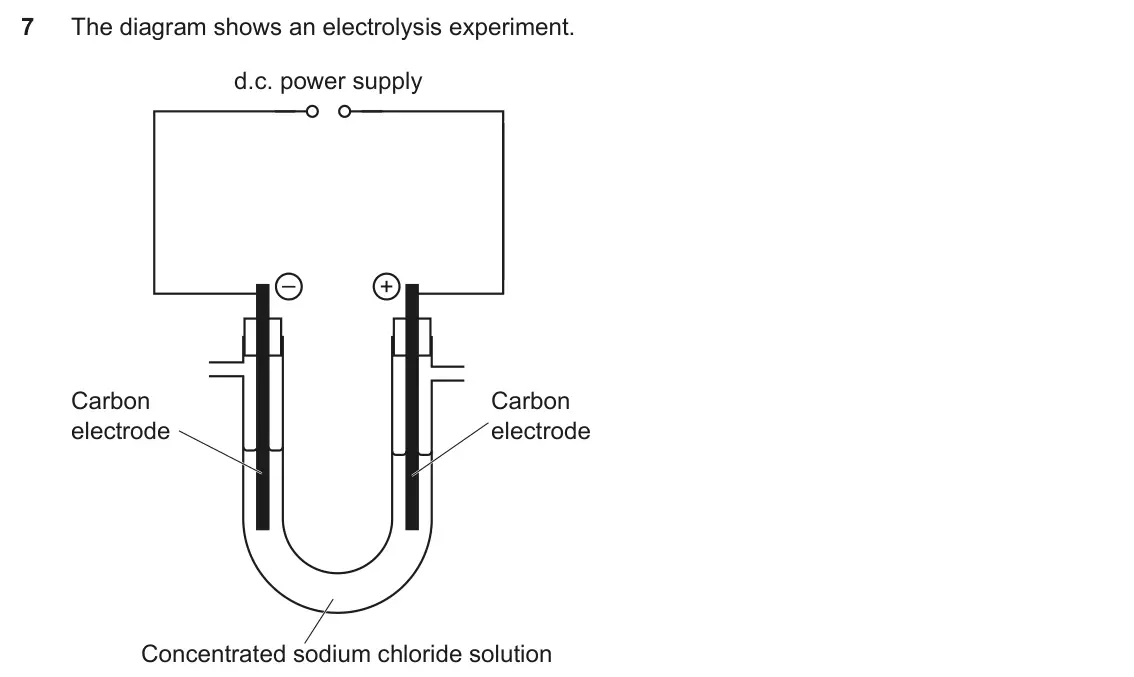
Q7(b)(i)
The whole paper ↗Q7(b)(ii)
The whole paper ↗Q9(a)(i)
The whole paper ↗
Q9(a)(ii)
The whole paper ↗Q9(a)(iii)
The whole paper ↗Q9(b)(i)
The whole paper ↗Q9(b)(ii)
The whole paper ↗Q9(b)(iii)
The whole paper ↗Q9(b)(iv)
The whole paper ↗Q9(a)(i)
The whole paper ↗
Q9(a)(ii)
The whole paper ↗Q9(a)(iii)
The whole paper ↗Q9(c)
The whole paper ↗Q6(a)(i)
The whole paper ↗Q6(a)(ii)
The whole paper ↗Q6(a)(iii)
The whole paper ↗Q6(b)
The whole paper ↗Q7(c)(i)
The whole paper ↗
Q7(c)(ii)
The whole paper ↗
All 38 questions on What are electrolytes and what happens during electrolysis?, as a list
- June 2024, Combined Science Paper 4 Foundation, Q7(a) (1 mark): Which ions are present in a concentrated solution of sodium chloride? Tick (✓) one box. Cl – H+ Na+ OH– Cl – H+ S2– OH– Cl – Na+ Cl – S2– [1]
- June 2024, Combined Science Paper 4 Foundation, Q7(b)(i) (1 mark): Name the gas that forms at the positive electrode. [1]
- June 2024, Combined Science Paper 4 Foundation, Q7(b)(ii) (2 marks): Describe a test to identify this gas that forms. [2]
- June 2024, Chemistry Paper 6 Higher, Q9(a)(i) (1 mark): Explain why the electrolysis must use molten aluminium oxide, and not solid aluminium oxide. [1]
- June 2024, Chemistry Paper 6 Higher, Q9(a)(ii) (3 marks): The half equations show the reactions at the electrodes. Al 3+ + 3e– Al 2O2– O2 + 4e– What is oxidised and what is reduced during the electrolysis of aluminium
- June 2024, Chemistry Paper 6 Higher, Q9(a)(iii) (4 marks): This is the balanced symbol equation for the decomposition of aluminium oxide by electrolysis: 2Al 2O3 4Al + 3O2 Calculate the mass of aluminium that will be pr
- June 2024, Chemistry Paper 6 Higher, Q9(b)(i) (3 marks): Complete the diagram to show how the gases can be collected by electrolysis of aqueous sodium sulfate. Include labels. + − [3]
- June 2024, Chemistry Paper 6 Higher, Q9(b)(ii) (1 mark): The ions present in aqueous sodium sulfate are Na+, SO4 2–, H+ and OH–. State where the H+ ions and OH– ions come from. [1]
- June 2024, Chemistry Paper 6 Higher, Q9(b)(iii) (1 mark): Explain why hydrogen is formed instead of sodium. [1]
- June 2024, Chemistry Paper 6 Higher, Q9(b)(iv) (3 marks): Complete the table to show where hydrogen gas and oxygen gas are formed and the half equations for the reactions occurring at each electrode. Electrode Product
- June 2023, Chemistry Paper 2 Foundation, Q9(a)(i) (2 marks): Complete the balanced symbol equation for the decomposition of aluminium oxide by electrolysis. 2Al 2O3 Al + O2 [2]
- June 2023, Chemistry Paper 2 Foundation, Q9(a)(ii) (2 marks): During electrolysis, reactions take place at the positive and negative electrodes. Complete the table to explain the reactions at each electrode. Use the diagra
- June 2023, Chemistry Paper 2 Foundation, Q9(a)(iii) (1 mark): Explain why carbon dioxide is also produced. [1]
- June 2023, Chemistry Paper 2 Foundation, Q9(c) (6 marks): The diagram shows how aluminium is extracted from its ore by electrolysis of molten aluminium oxide. It is carried out at high temperature with carbon electrode
- June 2022, Combined Science Paper 8 Higher, Q6(a)(i) (2 marks): Which two substances could be separated by electrolysis? Tick (✓) two boxes. Diamond Graphite Lead bromide Potassium chloride Silicon dioxide [2]
- June 2022, Combined Science Paper 8 Higher, Q6(a)(ii) (2 marks): Amir uses a sodium chloride solution and wants to collect the gases given off at the electrodes. The diagram shows the equipment he plans to use. test tube NaCl
- June 2022, Combined Science Paper 8 Higher, Q6(a)(iii) (2 marks): Name the gas formed at each electrode during the electrolysis of sodium chloride solution. Anode Cathode [2]
- June 2022, Combined Science Paper 8 Higher, Q6(b) (2 marks): During the electrolysis of a molten ionic compound the reaction taking place at each of the electrodes is either oxidation or reduction. Write the balanced half
- November 2021, Chemistry Paper 2 Foundation, Q7(c)(i) (2 marks): Explain why solid ionic compounds must be melted before electrolysis. [2]
- November 2021, Chemistry Paper 2 Foundation, Q7(c)(ii) (1 mark): Give the name of the product formed at each electrode when molten sodium chloride is electrolysed. Positive electrode Negative electrode [1]
- November 2021, Chemistry Paper 6 Higher, Q8(a)(i) (2 marks): Explain why solid aluminium oxide cannot be electrolysed. Use ideas about ions in your answer. [2]
- November 2021, Chemistry Paper 6 Higher, Q8(a)(ii) (1 mark): The melting point of pure aluminium oxide is 2072 °C. Aluminium oxide dissolved in cryolite melts at approximately 900 °C. Explain one advantage of electrolysin
- November 2021, Chemistry Paper 6 Higher, Q8(b) (4 marks): The diagram shows the tank used for the electrolysis of aluminium oxide. Positive electrodes dip into the molten solution of aluminium oxide. The casing of the
- November 2020, Chemistry Paper 2 Foundation, Q3(c)(i) (2 marks): Explain why sodium chloride conducts electricity when it is molten but does not conduct electricity when it is solid. [2]
- November 2020, Chemistry Paper 2 Foundation, Q3(c)(ii) (2 marks): When electricity passes through molten sodium chloride it decomposes. Name the two products formed when molten sodium chloride decomposes. and [2]
- November 2020, Chemistry Paper 6 Higher, Q10(a) (3 marks): Explain the reactions at each electrode when molten sodium chloride is electrolysed. Use ideas about oxidation, reduction, and electrons in your answer. [3]
- November 2020, Chemistry Paper 6 Higher, Q10(b)(i) (2 marks): Draw a fully labelled diagram in the box to show how he does this. [2]
- November 2020, Chemistry Paper 6 Higher, Q10(b)(ii) (2 marks): Sodium chloride solution contains sodium and chloride ions dissolved in water. Give the names and formulae for the ions that come from the water. Names: and For
- November 2020, Chemistry Paper 6 Higher, Q10(b)(iii) (3 marks): When Alex passes electricity through the sodium chloride solution, he sees bubbles of hydrogen gas forming at the negative electrode. Explain why, at the negati
- November 2020, Chemistry Paper 6 Higher, Q10(b)(iv) (2 marks): Suggest what Alex could do to test for the presence of chlorine gas at the positive electrode, and what the test will show if chlorine gas is present. [2]
- June 2019, Chemistry Paper 2 Foundation, Q5(b)(i) (1 mark): What state is molten aluminium oxide in? Put a ring around the correct answer. gas liquid solvent solution [1] Fig. 5.1 shows the ions in molten aluminium oxide
- June 2019, Chemistry Paper 2 Foundation, Q5(b)(ii) (2 marks): Molten aluminium oxide conducts electricity. Solid aluminium oxide does not. Explain why, using Fig. 5.1 to help you. [2]
- June 2019, Chemistry Paper 2 Foundation, Q5(b)(iii) (2 marks): A positive and negative electrode are used to pass electricity through molten aluminium oxide. A product is made at each electrode. Draw lines to join each elec
- June 2018, Chemistry Paper 6 Higher, Q7(a) (3 marks): The aluminium oxide must be molten in this process so that it conducts electricity. Explain why aluminium oxide conducts electricity when it is liquid but not w
- June 2018, Chemistry Paper 6 Higher, Q7(b)(i) (3 marks): Complete the table to show the product and half equation at the positive electrode. Name of Electrode Half equation product Al3+ + 3e- → Al Negative aluminium P
- June 2018, Chemistry Paper 6 Higher, Q7(b)(ii) (1 mark): Complete the following sentence by putting a ring around the correct words: The reaction at the negative electrode is oxidation / reduction because electrons ar
- June 2018, Chemistry Paper 6 Higher, Q7(d)(i) (1 mark): Explain why aluminium is not formed at the negative electrode. [1]
- June 2018, Chemistry Paper 6 Higher, Q7(d)(ii) (3 marks): Name the gas that forms at the negative electrode and explain why this gas is produced during the electrolysis. [3]
Questions, mark schemes and examiner’s reports are © OCR, from their published past papers. Plumi isn’t affiliated with any exam board. Want whole papers? Full past papers.
Rather write your answers by hand on iPad? Plumi marks them against the same mark schemes.