 plumi
How has the Earth’s atmosphere changed over time, and why?: OCR GCSE Combined Science B questions
Every OCR GCSE Combined Science B exam question on C1.1 How has the Earth’s atmosphere changed over time, and why?, 2018–2025, with its mark scheme and examiner’s report.
Paper
All papers
Exam
All years
Calculations
Q10(a)(i)
The whole paper ↗
Q10(a)(ii)
The whole paper ↗Q10(a)(iii)
The whole paper ↗Q1(a)(i)
The whole paper ↗
Q1(a)(ii)
The whole paper ↗Q1(a)(iii)
The whole paper ↗Q2(a)
The whole paper ↗
Q2(c)
The whole paper ↗Q4(b)
The whole paper ↗
Q5(a)
The whole paper ↗Q5(b)
The whole paper ↗Q5(c)(i)
The whole paper ↗Q5(c)(ii)
The whole paper ↗Q9(a)(i)
The whole paper ↗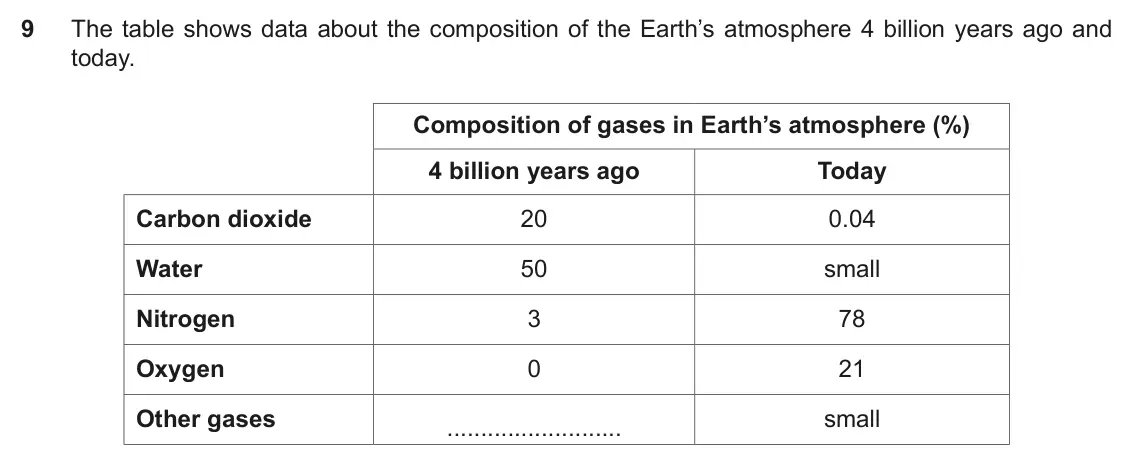
Q9(a)(ii)
The whole paper ↗Q9(b)
The whole paper ↗Q9(c)(i)
The whole paper ↗Q9(c)(ii)
The whole paper ↗Q1(a)(i)
The whole paper ↗
Q1(a)(ii)
The whole paper ↗
All 29 questions on How has the Earth’s atmosphere changed over time, and why?, as a list
- June 2023, Chemistry Paper 2 Foundation, Q10(a)(i) (2 marks): Draw lines to connect each harmful substance with the description of its major source. Harmful Major source substance Carbon monoxide Combustion of sulfur impur
- June 2023, Chemistry Paper 2 Foundation, Q10(a)(ii) (2 marks): Explain one problem caused by increased amounts of sulfur dioxide in the atmosphere. [2]
- June 2023, Chemistry Paper 2 Foundation, Q10(a)(iii) (1 mark): Describe one method that is used to decrease the amount of harmful substances put into the atmosphere by petrol cars. [1]
- June 2023, Chemistry Paper 6 Higher, Q1(a)(i) (2 marks): Draw lines to connect each harmful substance with the description of its major source. Harmful Major source substance Carbon monoxide Combustion of sulfur impur
- June 2023, Chemistry Paper 6 Higher, Q1(a)(ii) (2 marks): Explain one problem caused by increased amounts of sulfur dioxide in the atmosphere. [2]
- June 2023, Chemistry Paper 6 Higher, Q1(a)(iii) (1 mark): Describe one method that is used to decrease the amount of harmful substances put into the atmosphere by petrol cars. [1]
- June 2022, Chemistry Paper 2 Foundation, Q2(a) (4 marks): These gases are produced in the car engine. Draw lines to connect each gas with its formula and how it is formed. Gas Formula How it is formed Sulfur Combustion
- June 2022, Chemistry Paper 2 Foundation, Q2(c) (2 marks): The equation shows one reaction of the gases in the catalytic converter. 2CO + 2NO 2CO2 + N2 Identify which gas is oxidised. Explain your answer. Gas which is o
- June 2022, Chemistry Paper 6 Higher, Q4(b) (3 marks): Tests can be used to identify gases produced in a reaction. Complete the table to show the method and the result for the tests for the three gases. Gas Method R
- June 2022, Chemistry Paper 6 Higher, Q5(a) (3 marks): Table 5.1 shows information about some pollutants in the air over 100 days in 2020. Particulates (µg / m3) NO (µg / m3) NO2 (µg / m3) Year Change from five Chan
- June 2022, Chemistry Paper 6 Higher, Q5(b) (2 marks): Table 5.2 shows information about the same pollutants in the air over a 100-day period in 5 years from 2015–2019. Particulates (µg / m3) NO (µg / m3) NO2 (µg /
- June 2022, Chemistry Paper 6 Higher, Q5(c)(i) (4 marks): Describe how particulates and oxides of nitrogen are produced by car engines. Particulates Oxides of nitrogen [4]
- June 2022, Chemistry Paper 6 Higher, Q5(c)(ii) (2 marks): Carbon monoxide, carbon dioxide and sulfur dioxide are also emitted from car exhausts. Draw lines to connect each gas with the main problem caused by increased
- November 2021, Chemistry Paper 2 Foundation, Q9(a)(i) (1 mark): Complete the table to show the approximate percentage of other gases in the atmosphere 4 billion years ago. [1]
- November 2021, Chemistry Paper 2 Foundation, Q9(a)(ii) (3 marks): Four billion years ago the Earth was extremely hot. When the temperature of the Earth cooled to below 100 °C there was a large decrease in the amount of water v
- November 2021, Chemistry Paper 2 Foundation, Q9(b) (3 marks): How and why have the percentages of carbon dioxide and oxygen in the atmosphere changed over time? Use data from the table to support your answer. [3]
- November 2021, Chemistry Paper 2 Foundation, Q9(c)(i) (1 mark): Complete the balanced symbol equation for the reaction which produces iron oxide. Fe + O2 2Fe2O3 [1]
- November 2021, Chemistry Paper 2 Foundation, Q9(c)(ii) (1 mark): Scientists think these red rocks formed 2.3 million years ago. Suggest why these rocks could not form 4 billion years ago. Use data from the table to support yo
- November 2021, Chemistry Paper 6 Higher, Q1(a)(i) (1 mark): Complete the table to show the approximate percentage of other gases in the atmosphere 4 billion years ago. [1]
- November 2021, Chemistry Paper 6 Higher, Q1(a)(ii) (3 marks): Four billion years ago the Earth was extremely hot. When the temperature of the Earth cooled to below 100 °C there was a large decrease in the amount of water v
- November 2021, Chemistry Paper 6 Higher, Q1(b) (3 marks): How and why have the percentages of carbon dioxide and oxygen in the atmosphere changed over time? Use data from the table to support your answer. [3]
- November 2021, Chemistry Paper 6 Higher, Q1(c)(i) (1 mark): Complete the balanced symbol equation for the reaction which produces iron oxide. Fe + O2 2Fe2O3 [1]
- November 2021, Chemistry Paper 6 Higher, Q1(c)(ii) (1 mark): Scientists think these red rocks formed 2.3 million years ago. Suggest why these rocks could not form 4 billion years ago. Use data from the table to support yo
- June 2019, Chemistry Paper 2 Foundation, Q9(a) (2 marks): How could you test that the gas formed is carbon dioxide? [2]
- June 2019, Chemistry Paper 2 Foundation, Q9(b) (2 marks): Explain why burning charcoal without enough oxygen can cause a health hazard. [2]
- June 2019, Chemistry Paper 6 Higher, Q6(a) (6 marks): (a)* The table shows the emissions of nitrogen oxides and carbon monoxide from 1980 to 2015 for cars in the UK. Catalytic converters have been fitted to all new
- June 2019, Chemistry Paper 6 Higher, Q6(b) (2 marks): Car emissions also contain small amounts of sulfur dioxide. The amount of sulfur dioxide emitted by cars in 2019 is much less than it was 20 years ago. Which tw
- June 2018, Chemistry Paper 2 Foundation, Q2(a) (3 marks): Table 2.1 shows some changes that produce water. Place a tick (✓) in one box in each row to show whether each change is a physical change or chemical change. Ph
- June 2018, Chemistry Paper 2 Foundation, Q2(b) (3 marks): The different states of water can be explained by the particle model. Complete Table 2.2 to describe the particles in the three states of water. Some have been
Questions, mark schemes and examiner’s reports are © OCR, from their published past papers. Plumi isn’t affiliated with any exam board. Want whole papers? Full past papers.
Rather write your answers by hand on iPad? Plumi marks them against the same mark schemes.