 plumi
How do substances get into, out of and around our bodies?: OCR GCSE Combined Science B questions
Every OCR GCSE Combined Science B exam question on B5.1 How do substances get into, out of and around our bodies?, 2018–2025, with its mark scheme and examiner’s report.
Paper
All papers
Exam
All years
Calculations
Q8(a)
The whole paper ↗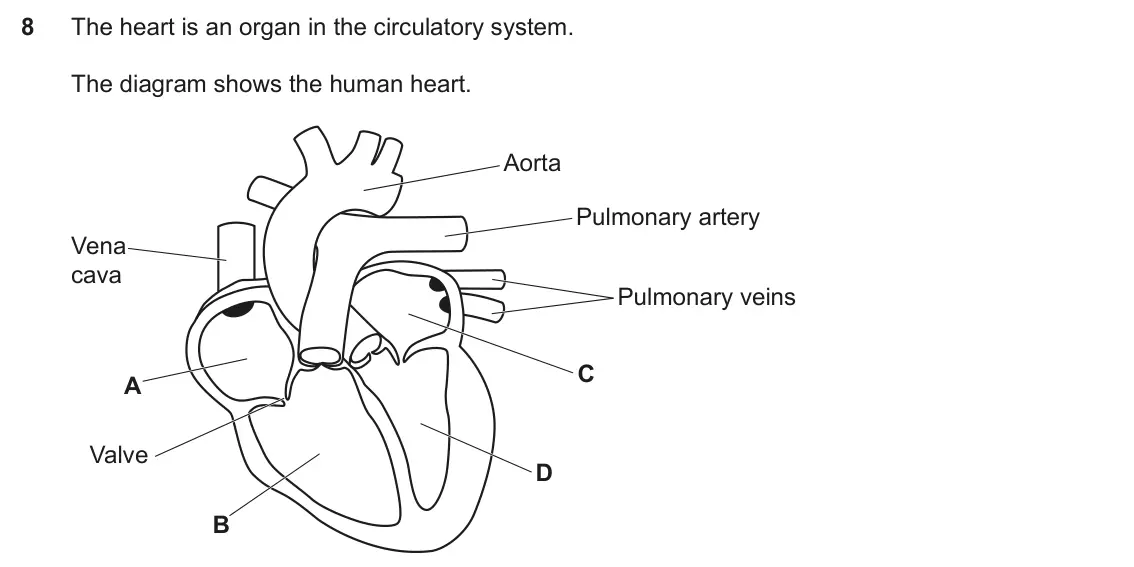
Q8(b)
The whole paper ↗Q8(c)
The whole paper ↗Q8(d)(i)
The whole paper ↗Q8(d)(ii)
The whole paper ↗Q9(d)
The whole paper ↗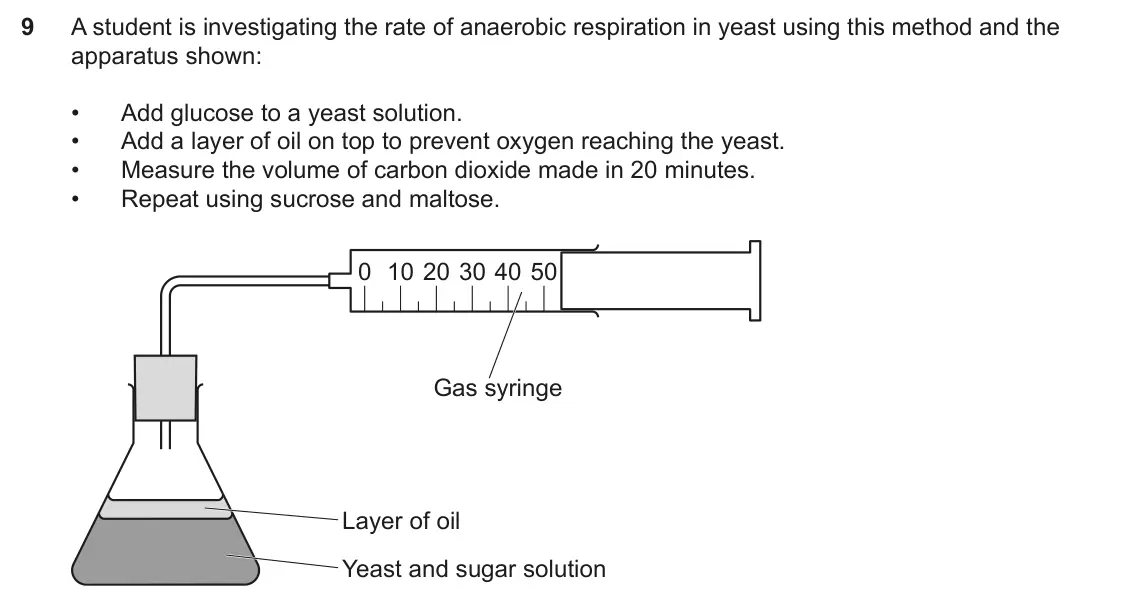
Q7(a)
The whole paper ↗
Q7(b)
The whole paper ↗Q9(a)(i)
The whole paper ↗
Q9(b)
The whole paper ↗Q9(c)
The whole paper ↗Q9(d)(i)
The whole paper ↗Q9(d)(ii)
The whole paper ↗Q2(a)(i)
The whole paper ↗
Q2(b)
The whole paper ↗Q2(c)
The whole paper ↗Q2(d)(i)
The whole paper ↗Q2(d)(ii)
The whole paper ↗Q1(a)(i)
The whole paper ↗
Q8(a)(i)
The whole paper ↗
All 78 questions on How do substances get into, out of and around our bodies?, as a list
- June 2025, Biology Paper 1 Foundation, Q8(a) (1 mark): Which part of the heart pumps oxygenated blood to the body? Tick (✓) one box. A B C D [1]
- June 2025, Biology Paper 1 Foundation, Q8(b) (1 mark): Which blood vessel carries deoxygenated blood back to the heart? Tick (✓) one box. Aorta Pulmonary artery Pulmonary vein Vena cava [1]
- June 2025, Biology Paper 1 Foundation, Q8(c) (2 marks): Explain the function of the valves in the heart. [2]
- June 2025, Biology Paper 1 Foundation, Q8(d)(i) (2 marks): Complete the table by showing which feature each blood vessel has. Tick (✓) one box in each row. Feature Arteries Capillaries Veins The walls have a thick layer
- June 2025, Biology Paper 1 Foundation, Q8(d)(ii) (4 marks): Explain how red blood cells and plasma are adapted to their functions in the blood. Red blood cells Plasma [4]
- June 2025, Combined Science Paper 4 Foundation, Q9(d) (3 marks): Yeast cells absorb oxygen across their cell membranes. An axolotl is a multicellular animal that lives in water. It has external gills for gas exchange. Externa
- June 2025, Biology Paper 5 Higher, Q7(a) (2 marks): Describe how the human circulatory system works together with the gaseous exchange and digestive systems. Gaseous exchange system Digestive system [2]
- June 2025, Biology Paper 5 Higher, Q7(b) (1 mark): Fig. 7.1 shows the inside of the human heart. Fig. 7.1 Valves The heart is adapted to pump blood around the body. Describe the function of the valves in the hea
- June 2024, Biology Paper 1 Foundation, Q9(a)(i) (1 mark): The cereal is made of carbohydrate. Which small molecule does the body get by breaking down the carbohydrate from the cereal? Put a ring around the correct opti
- June 2024, Biology Paper 1 Foundation, Q9(b) (3 marks): Explain how the partially-permeable cell membrane controls movement of small molecules into and out of a cell. Put a ring around each correct option. Gases such
- June 2024, Biology Paper 1 Foundation, Q9(c) (3 marks): Small molecules move into and out of the blood. Which statements about how this happens are true, and which are false? Tick (v) one box in each row. True False
- June 2024, Biology Paper 1 Foundation, Q9(d)(i) (4 marks): Calculate the surface area:volume ratio of organism B. Give your answer in its simplest form. Surface area:volume ratio = . [4]
- June 2024, Biology Paper 1 Foundation, Q9(d)(ii) (1 mark): The surface area:volume ratio of organism A is 6:1. Explain why the surface area:volume ratio of organism C is also 6:1. [1]
- June 2024, Biology Paper 5 Higher, Q2(a)(i) (1 mark): The cereal is made of carbohydrate. Which small molecule does the body get by breaking down the carbohydrate from the cereal? Put a ring around the correct opti
- June 2024, Biology Paper 5 Higher, Q2(b) (3 marks): Explain how the partially-permeable cell membrane controls movement of small molecules into and out of a cell. Put a ring around each correct option. Gases such
- June 2024, Biology Paper 5 Higher, Q2(c) (3 marks): Small molecules move into and out of the blood. Which statements about how this happens are true, and which are false? Tick (✓) one box in each row. True False
- June 2024, Biology Paper 5 Higher, Q2(d)(i) (4 marks): Calculate the surface area:volume ratio of organism B. Give your answer in its simplest form. Surface area:volume ratio = : [4]
- June 2024, Biology Paper 5 Higher, Q2(d)(ii) (1 mark): The surface area:volume ratio of organism A is 6:1. Explain why the surface area:volume ratio of organism C is also 6:1. [1]
- June 2023, Biology Paper 1 Foundation, Q1(a)(i) (1 mark): Write down the name of the organ that pumps the blood around our body. [1]
- June 2023, Biology Paper 1 Foundation, Q8(a)(i) (2 marks): Calculate the volume of cube B. Volume = cm3 [2]
- June 2023, Biology Paper 1 Foundation, Q8(a)(ii) (2 marks): Calculate the surface area : volume ratio of cube C. Surface area : volume ratio = : [2]
- June 2023, Biology Paper 1 Foundation, Q8(a)(iii) (1 mark): Describe the relationship between cube size and surface area : volume ratio. [1]
- June 2023, Biology Paper 1 Foundation, Q8(a)(iv) (2 marks): Sam places jelly cubes A, B, C and D into a solution of coloured stain. The stain diffuses into the jelly cubes. Predict which cube will take the longest time f
- June 2023, Biology Paper 1 Foundation, Q8(b)(i) (2 marks): The surface area of the digestive system wall has villi rather than being flat. Explain why this is an advantage. [2]
- June 2023, Biology Paper 1 Foundation, Q8(b)(ii) (2 marks): The villi contain blood vessels. Explain why this is an advantage. [2]
- June 2023, Biology Paper 5 Higher, Q5(a)(i) (2 marks): Explain why chamber A has a thick wall of cardiac muscle. [2]
- June 2023, Biology Paper 5 Higher, Q5(a)(ii) (1 mark): Why is there a valve between chamber A and chamber B? [1]
- June 2023, Biology Paper 5 Higher, Q5(b) (5 marks): Outside the heart, blood flows through blood vessels. Complete the table by naming the blood vessels and explaining how their structures are related to their fu
- June 2023, Biology Paper 5 Higher, Q5(c) (6 marks): People have a pulse because their heart beats. (c)* Describe how you could use only the equipment shown in Fig. 5.2 to: • investigate the effect of exercise on
- June 2023, Biology Paper 5 Higher, Q6(a) (1 mark): Urea is a waste product made by the body. Complete the sentences to describe what happens to urea. Urea is transported around the body by the system. It is remo
- June 2023, Biology Paper 5 Higher, Q6(b)(i) (3 marks): Complete the table by describing how to test for the presence of each substance absorbed by the digestive system. Result when the substance is Substance Reagent
- June 2023, Biology Paper 5 Higher, Q6(c) (4 marks): A teacher turns two identical beakers upside-down. • Beaker A is filled with air from outside. • Beaker B is filled with air exhaled by a person. The teacher pl
- June 2023, Combined Science Paper 8 Higher, Q6(a) (4 marks): Describe the method the students use to obtain these results. [4]
- June 2023, Combined Science Paper 8 Higher, Q6(b)(i) (4 marks): Plot the students’ results on the grid and draw a line of best fit. Use the concentration of sugar solution and percentage change in mass data. [4]
- June 2023, Combined Science Paper 8 Higher, Q6(b)(ii) (3 marks): The student concludes that the concentration of the potato cells is 0.2 mol / dm3. Explain why the student is wrong. Use ideas about osmosis in your answer. [3]
- June 2023, Combined Science Paper 8 Higher, Q6(b)(iii) (2 marks): Describe two ways in which the student can determine a more accurate value for the concentration of the potato cells. 1 2 [2]
- June 2023, Combined Science Paper 8 Higher, Q6(c) (3 marks): The student puts another piece of potato into a sugar solution of 0.4 mol / dm3. The initial mass of the potato is 1.04 g. The final mass of the potato is 0.90
- June 2022, Biology Paper 1 Foundation, Q2(b) (3 marks): Organ systems in the body have different roles in what happens to the sugar from the milk we drink. Draw lines to connect the correct three organ system to thei
- June 2022, Biology Paper 5 Higher, Q7(b) (4 marks): Substances involved in cellular respiration are transported by the blood. Complete the sentences about the transport of these substances by the blood. Use words
- November 2021, Biology Paper 1 Foundation, Q8(d)(ii) (1 mark): Leukaemia is a type of this disease which can cause a reduced amount of haemoglobin in red blood cells. How will this affect the function of the blood? [1]
- November 2021, Biology Paper 5 Higher, Q5(c) (2 marks): Glycogen is a long-chain carbohydrate, which is stored in animal cells. Explain how the partially permeable membrane allows the movement of glucose in and out o
- November 2021, Biology Paper 5 Higher, Q7(b)(iv) (1 mark): Haemophiliacs lack a protein which helps to make blood platelets active. Which statement about the adaptations of platelets is correct? Tick (3) one box. Platel
- November 2020, Biology Paper 1 Foundation, Q5(a) (4 marks): The circulatory system moves substances around the body. The blood vessels, A, B, C and D, in Fig. 5.1 each carry different compositions of blood. Identify whic
- November 2020, Biology Paper 1 Foundation, Q5(b) (3 marks): Explain how the structure of the heart is adapted to pump blood around the body. [3]
- November 2020, Biology Paper 1 Foundation, Q5(c) (6 marks): Fig. 5.1 shows a model of the circulatory system in a human. Lungs B Heart A Liver C Digestive system D Kidneys Other organs Fig. 5.1 (c)* Some babies are born
- November 2020, Biology Paper 1 Foundation, Q6(a) (2 marks): Blood transports many substances around the body. Complete the table to show whether each substance is transported in the blood by the plasma or by the red bloo
- November 2020, Biology Paper 1 Foundation, Q6(b) (4 marks): The diagram shows two views of a red blood cell. Explain how the shape of a red blood cell is adapted to its function. [4]
- November 2020, Biology Paper 1 Foundation, Q6(c) (1 mark): Red blood cells have an approximate diameter of 7.8 × 10⁻³ mm. Convert 7.8 × 10⁻³ mm into decimal form. Tick (3) one box. 0.00078 mm 0.0078 mm 0.078 mm 0.78 mm
- November 2020, Combined Science Paper 4 Foundation, Q4(a)(i) (1 mark): Which student is correctly talking about osmosis? Tick (✓) one box. Nina Kareem Sarah Jack [1]
- November 2020, Combined Science Paper 4 Foundation, Q4(a)(ii) (1 mark): Which student is correctly talking about active transport? Tick (✓) one box. Nina Kareem Sarah Jack [1]
- November 2020, Combined Science Paper 4 Foundation, Q4(b)(i) (3 marks): Mia is investigating osmosis in potato cells. She writes a six-step plan. Step 1. Cut 5 pieces of potato. Step 2. Weigh them and record the masses. Step 3. Put
- November 2020, Combined Science Paper 4 Foundation, Q4(b)(ii) (3 marks): Mia’s measurements for one piece of potato are shown in the table. Starting mass (g) 20.4 Final mass (g) 18.2 Calculate the percentage decrease in mass for this
- November 2020, Biology Paper 5 Higher, Q4(a) (2 marks): Draw lines to connect blood vessels, A, B and C, to their correct names and their correct drawings. Name of Drawing of blood vessel blood vessel Blood vessel Ar
- November 2020, Biology Paper 5 Higher, Q4(b) (3 marks): Explain why exchange surfaces and transport systems are needed in multicellular organisms. [3]
- June 2019, Biology Paper 1 Foundation, Q2(c)(i) (2 marks): Suggest two ways that the gas exchange surface is similar in humans and chicken eggs. 1 2 [2]
- June 2019, Biology Paper 1 Foundation, Q2(c)(ii) (1 mark): Sarah and some of her friends discuss cellular respiration in the chicken embryo. Ben Amir The membrane must be The respiration partially-permeable so must be t
- June 2019, Biology Paper 1 Foundation, Q3(b)(i) (6 marks): People with sickle cell disease have differences in their red blood cells. They are often treated by being given extra oxygen. Fig. 3.2 shows red blood cells fr
- June 2019, Biology Paper 1 Foundation, Q4(a) (2 marks): Diagrams A, B, C and D in Fig. 4.1 show stages in a heartbeat. The shading shows which chambers and arteries contain blood during each stage. The diagrams are n
- June 2019, Biology Paper 1 Foundation, Q4(b) (3 marks): Fig. 4.2 shows the relationships between the circulatory system and other systems in the human body. The numbers 1, 2, 3 and 4 represent substances that move fr
- June 2019, Biology Paper 1 Foundation, Q4(c)(i) (1 mark): The student is correct that the thumb should not be used to take the pulse. Suggest why. [1]
- June 2019, Biology Paper 1 Foundation, Q4(c)(ii) (1 mark): In step 1 the student plans to count the number of beats. How should the student calculate the resting pulse rate per minute from the count? [1]
- June 2019, Biology Paper 1 Foundation, Q4(c)(iii) (1 mark): Describe how the student can work out the recovery rate from her measurements. [1]
- June 2019, Biology Paper 1 Foundation, Q4(d)(i) (2 marks): Plot the results from Table 4.2 on the graph and draw a curve of best fit. 100 90 Pulse rate (bpm) 80 70 0 30 60 90 120 150 Time after exercise (s) [2]
- June 2019, Biology Paper 1 Foundation, Q4(d)(ii) (1 mark): The student’s resting pulse rate was 72 bpm. She uses Table 4.3 to decide her fitness rating. Time taken to return to resting pulse rate (s) Fitness rating 0–30
- June 2019, Biology Paper 1 Foundation, Q4(d)(iii) (1 mark): From these results, how confident should the student be about her fitness rating? Explain your answer. [1]
- June 2019, Biology Paper 5 Higher, Q3(e)(ii) (1 mark): An adult man has a lung volume of 5 litres and a lung surface area of 70 m2. Write down the simplest surface area to volume ratio for this man’s lungs. Surface
- June 2019, Biology Paper 5 Higher, Q3(e)(iii) (4 marks): Pneumonia causes fluid to collect in the alveoli of the lungs. The diagram in Fig. 3.3 shows this happening in one alveolus. alveolus fluid Fig. 3.3 Suggest how
- June 2019, Biology Paper 5 Higher, Q5(a)(i) (4 marks): The structure of red blood cells is adapted to carry oxygen. Changes to the red blood cells in people with SCD mean they carry less oxygen. Explain why. [4]
- June 2019, Biology Paper 5 Higher, Q5(d) (2 marks): The diagrams show two stages of the heartbeat. The shading shows which chambers and arteries contain blood at the end of each stage. The arrows show the directi
- June 2018, Biology Paper 1 Foundation, Q4(f) (1 mark): Energy from cellular respiration can be used to transport molecules across cell membranes. What is the name of this process? Tick (✓) one box. Active transport
- June 2018, Biology Paper 1 Foundation, Q5(a)(i) (2 marks): Which two substances will cell A need to take in more of? Put rings around the two correct answers. carbon dioxide dissolved food molecules oxygen urea water [2
- June 2018, Biology Paper 1 Foundation, Q5(a)(ii) (2 marks): Explain why cell A needs more of these substances. [2]
- June 2018, Biology Paper 1 Foundation, Q5(b)(i) (1 mark): Kareem thinks vessel X is an artery and vessel Y is a vein. Explain why he is correct. [1]
- June 2018, Biology Paper 1 Foundation, Q5(b)(ii) (1 mark): What other structure not shown in the diagrams would be found in a vein? [1]
- June 2018, Biology Paper 5 Higher, Q8(a) (1 mark): Draw a circle on the diagram of the heart around the valve between the left atrium and the left ventricle. [1]
- June 2018, Biology Paper 5 Higher, Q8(b) (3 marks): Explain to Jack the function of heart valves and why his faulty valve is making him feel tired and breathless. [3]
- June 2018, Biology Paper 5 Higher, Q8(c) (1 mark): Write down one other type of structure in the circulatory system that has valves. [1]
- June 2018, Biology Paper 5 Higher, Q8(d) (4 marks): This information is about Jack’s circulatory system: The volume of blood pumped out by Jack’s heart in one beat is 40 cm3. • • Jack’s resting pulse rate is 80 b
Questions, mark schemes and examiner’s reports are © OCR, from their published past papers. Plumi isn’t affiliated with any exam board. Want whole papers? Full past papers.
Rather write your answers by hand on iPad? Plumi marks them against the same mark schemes.