 plumi
How do chemists control the rate of reactions?: OCR GCSE Combined Science B questions
Every OCR GCSE Combined Science B exam question on C6.2 How do chemists control the rate of reactions?, 2018–2025, with its mark scheme and examiner’s report.
Paper
All papers
Exam
All years
Calculations
Q7(a)
The whole paper ↗
Q7(b)(i)
The whole paper ↗Q7(b)(ii)
The whole paper ↗Q7(b)(iii)
The whole paper ↗Q7(b)(iv)
The whole paper ↗Q1(c)(i)
The whole paper ↗
Q1(c)(ii)
The whole paper ↗Q1(c)(iii)
The whole paper ↗Q8(b)(i)
The whole paper ↗
Q8(b)(ii)
The whole paper ↗Q8(c)
The whole paper ↗Q8(d)
The whole paper ↗Q4(b)
The whole paper ↗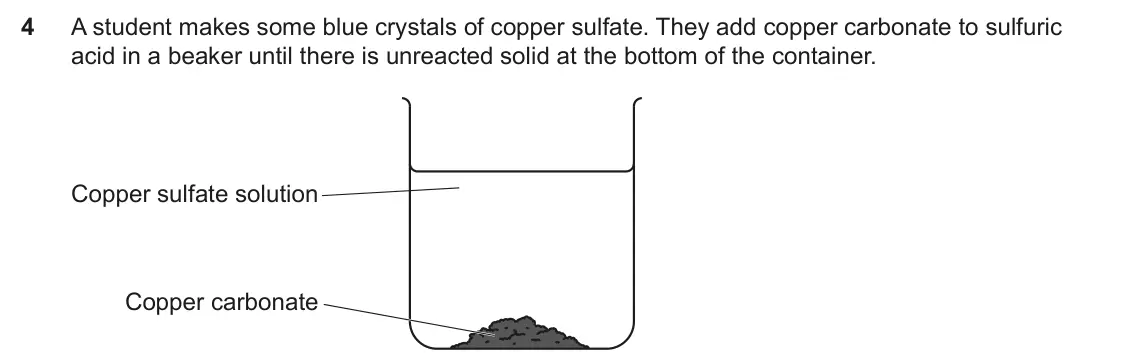
Q1(a)(i)
The whole paper ↗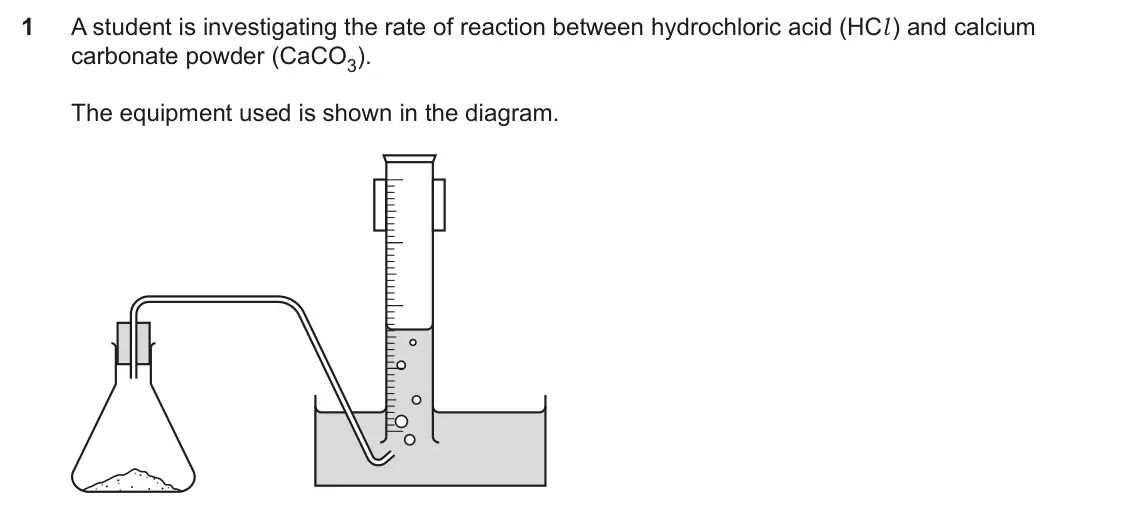
Q1(a)(ii)
The whole paper ↗Q1(b)
The whole paper ↗Q1(d)(i)
The whole paper ↗Q1(d)(ii)
The whole paper ↗Q7(b)(ii)
The whole paper ↗
Q4(a)(i)
The whole paper ↗
All 91 questions on How do chemists control the rate of reactions?, as a list
- June 2025, Chemistry Paper 2 Foundation, Q7(a) (2 marks): This is the method: • Add powdered calcium carbonate to 50 cm3 of 2 mol / dm3 dilute hydrochloric acid. • Measure the volume of carbon dioxide gas produced ever
- June 2025, Chemistry Paper 2 Foundation, Q7(b)(i) (1 mark): What is the time taken for the reaction to finish? Time taken = s [1]
- June 2025, Chemistry Paper 2 Foundation, Q7(b)(ii) (1 mark): What is the volume of carbon dioxide collected when the reaction has finished? Volume of carbon dioxide collected = cm3 [1]
- June 2025, Chemistry Paper 2 Foundation, Q7(b)(iii) (3 marks): Calculate the average rate of reaction from the start to the end of the reaction. Use the equation: average rate of reaction (cm3 / s) = volume of carbon dioxid
- June 2025, Chemistry Paper 2 Foundation, Q7(b)(iv) (4 marks): Describe the changes in the gradient of the graph and the rate of reaction shown in the graph. Gradient Rate [4]
- June 2025, Combined Science Paper 4 Foundation, Q1(c)(i) (1 mark): Plot the results from the table on the graph. Three points have already been plotted. [1]
- June 2025, Combined Science Paper 4 Foundation, Q1(c)(ii) (1 mark): Draw a curve of best fit on the graph. [1] 60 50 40 Time taken (s) 30 20 10 0 0 0.2 0.4 0.6 0.8 1.0 Concentration of hydrochloric acid (mol / dm3)
- June 2025, Combined Science Paper 4 Foundation, Q1(c)(iii) (2 marks): Describe the effect of changes in concentration on the time taken. [2]
- June 2025, Chemistry Paper 6 Higher, Q8(b)(i) (2 marks): The student decides to use a gas syringe to collect and measure the volume of hydrogen. Describe other apparatus they could use to collect and measure the volum
- June 2025, Chemistry Paper 6 Higher, Q8(b)(ii) (2 marks): The student keeps the temperature and the concentration of the acid the same for the two experiments. Identify two other factors which should be kept constant.
- June 2025, Chemistry Paper 6 Higher, Q8(c) (2 marks): The student sketches their results on a graph as shown. Reaction with catalyst Volume of hydrogen Reaction without catalyst Time Explain how the shape of the li
- June 2025, Chemistry Paper 6 Higher, Q8(d) (2 marks): Explain why increasing the temperature of the sulfuric acid increases the rate of the reaction. Use ideas about particles. [2]
- June 2024, Chemistry Paper 2 Foundation, Q4(b) (2 marks): How can the student speed up the reaction? Tick (✓) two boxes. Add water to the beaker. Heat the solution in the beaker. Use a bigger volume of acid. Use a more
- June 2024, Combined Science Paper 4 Foundation, Q1(a)(i) (1 mark): What is the name of this piece of equipment? Tick (✓) one box. Beaker Conical flask Delivery tube Measuring cylinder [1]
- June 2024, Combined Science Paper 4 Foundation, Q1(a)(ii) (1 mark): What is the name of this piece of equipment? Tick (✓) one box. Beaker Conical flask Delivery tube Measuring cylinder [1]
- June 2024, Combined Science Paper 4 Foundation, Q1(b) (1 mark): Suggest one safety precaution the student should take when working with acid. [1]
- June 2024, Combined Science Paper 4 Foundation, Q1(d)(i) (2 marks): Explain why the rate of reaction increases when the concentration of the hydrochloric acid increases. Use ideas about collisions in your answer. [2]
- June 2024, Combined Science Paper 4 Foundation, Q1(d)(ii) (2 marks): The student wants to ensure that the data they collect is valid. State two variables that the student needs to control in this experiment. 1 2 [2]
- June 2024, Chemistry Paper 6 Higher, Q7(b)(ii) (4 marks): Explain why the rate of reaction increases when the temperature and pressure are increased. Temperature Pressure [4]
- June 2024, Combined Science Paper 8 Higher, Q4(a)(i) (2 marks): Name one piece of equipment the students can use, instead of a Bunsen burner, to heat the reactants and conduct the experiment at 80 °C. Explain your answer. Eq
- June 2024, Combined Science Paper 8 Higher, Q4(a)(ii) (4 marks): Suggest two improvements to this method. Explain each suggestion. Suggestion 1 Explanation 1 Suggestion 2 Explanation 2 [4]
- June 2023, Chemistry Paper 2 Foundation, Q5(b) (2 marks): A catalyst of iron is used when ammonia is manufactured. What effect does a catalyst have on a reaction? Tick (3) two boxes. It decreases the activation energy.
- June 2023, Chemistry Paper 2 Foundation, Q7(a) (1 mark): What is the total volume of carbon dioxide collected? Volume of carbon dioxide = cm3 [1]
- June 2023, Chemistry Paper 2 Foundation, Q7(b) (1 mark): How long does it take for the reaction to finish? Time taken = s [1]
- June 2023, Chemistry Paper 2 Foundation, Q7(c) (4 marks): Draw a tangent to the curve and use it to find the rate of reaction at 40 seconds. Rate of reaction = cm3 / s [4]
- June 2023, Combined Science Paper 4 Foundation, Q5(b)(ii) (3 marks): Estimate when all of the calcium carbonate has reacted. Explain your answer. Time = minutes Explanation [3]
- June 2023, Chemistry Paper 6 Higher, Q6(a)(ii) (2 marks): Alex finds that the reaction is slow. Give two ways in which Alex can make the reaction faster. 1 2 [2]
- June 2023, Chemistry Paper 6 Higher, Q7(a)(ii) (3 marks): State the role of the platinum gauze and explain why it causes the reaction to occur. Role Explanation [3]
- June 2022, Chemistry Paper 2 Foundation, Q2(b)(i) (1 mark): Why do the gases not react with each other until they are in contact with the hot catalyst? Tick (3) one box. The reaction has a high activation energy. The rea
- June 2022, Chemistry Paper 2 Foundation, Q2(b)(ii) (1 mark): Suggest why the catalyst is coated on a ceramic honeycomb. [1]
- June 2022, Chemistry Paper 2 Foundation, Q9(a)(i) (1 mark): What was the time taken for the reaction to finish? s [1]
- June 2022, Chemistry Paper 2 Foundation, Q9(a)(ii) (2 marks): What was the total mass lost during the reaction? Total mass lost = g [2]
- June 2022, Chemistry Paper 2 Foundation, Q9(a)(iii) (2 marks): Calculate the average rate of the reaction. Rate of reaction = g / s [2]
- June 2022, Chemistry Paper 2 Foundation, Q9(b) (2 marks): Jane repeats the experiment with 10 g of calcium carbonate powder instead of 10 g of lumps. She keeps everything else the same. Sketch a line on the graph to sh
- June 2022, Chemistry Paper 2 Foundation, Q9(c) (2 marks): Complete the sentences to explain why the rate of reaction changes when powdered calcium carbonate is used instead of lumps. Put a ring around each correct answ
- June 2022, Chemistry Paper 6 Higher, Q2(a)(i) (1 mark): What was the time taken for the reaction to finish? s [1]
- June 2022, Chemistry Paper 6 Higher, Q2(a)(ii) (2 marks): What was the total mass lost during the reaction? Total mass lost = g [2]
- June 2022, Chemistry Paper 6 Higher, Q2(a)(iii) (2 marks): Calculate the average rate of the reaction. Rate of reaction = g / s [2]
- June 2022, Chemistry Paper 6 Higher, Q2(b) (2 marks): Jane repeats the experiment with 10 g of calcium carbonate powder instead of 10 g of lumps. She keeps everything else the same. Sketch a line on the graph to sh
- June 2022, Chemistry Paper 6 Higher, Q2(c) (2 marks): Complete the sentences to explain why the rate of reaction changes when powdered calcium carbonate is used instead of lumps. Put a ring around each correct answ
- November 2021, Chemistry Paper 2 Foundation, Q6(a) (2 marks): Sarah finds that the reaction is very slow. Describe two ways in which Sarah could change her experiment to make the rate of reaction faster. 1 2 [2]
- November 2021, Chemistry Paper 2 Foundation, Q6(b)(i) (1 mark): How many seconds does it take for 40 cm3 of hydrogen to be collected? s [1]
- November 2021, Chemistry Paper 2 Foundation, Q6(b)(ii) (1 mark): What happens to the rate of the reaction during the first 4 minutes? Tick (✓) one box. It slows down It speeds up It stays constant [1]
- November 2021, Chemistry Paper 2 Foundation, Q6(b)(iii) (1 mark): What is the total volume of hydrogen collected after 4.5 minutes? cm3 [1]
- November 2021, Chemistry Paper 2 Foundation, Q6(b)(iv) (1 mark): Why does the graph level out after 4.5 minutes? [1]
- November 2021, Chemistry Paper 2 Foundation, Q6(c)(i) (2 marks): Plot the results in the table on Fig. 6.2 and draw a line of best fit. [2]
- November 2021, Chemistry Paper 2 Foundation, Q6(c)(ii) (2 marks): What happens when she uses 50 cm3 of 0.05 mol / dm3 sulfuric acid instead of 50 cm3 of 0.1 mol / dm3 sulfuric acid? Put a ring around the correct answers. The r
- November 2021, Chemistry Paper 2 Foundation, Q10(d) (2 marks): Nanoparticles are used as catalysts. Which two statements explain how a catalyst increases the rate of a reaction? Tick (✓) two boxes. Catalysts decrease the ac
- November 2021, Chemistry Paper 6 Higher, Q2(d) (2 marks): Nanoparticles are used as catalysts. Which two statements explain how a catalyst increases the rate of a reaction? Tick (✓) two boxes. Catalysts decrease the ac
- November 2021, Chemistry Paper 6 Higher, Q4(a)(i) (2 marks): Explain why increasing the temperature increases the rate of a reaction. Use ideas about collisions of particles in your answer. [2]
- November 2021, Chemistry Paper 6 Higher, Q4(a)(ii) (1 mark): Give two other ways that she could speed up the reaction. 1 2 [1]
- November 2021, Chemistry Paper 6 Higher, Q4(b)(i) (1 mark): How long does it take for the reaction to finish? minutes [1]
- November 2021, Chemistry Paper 6 Higher, Q4(b)(ii) (1 mark): What volume of hydrogen is given off by the end of the reaction? cm3 [1]
- November 2021, Chemistry Paper 6 Higher, Q4(b)(iii) (2 marks): Calculate the average volume of hydrogen given off per second. cm3 / s [2]
- November 2021, Chemistry Paper 6 Higher, Q4(b)(iv) (3 marks): Draw a tangent on the graph and use it to calculate the initial rate of the reaction in cm3 / s. Initial rate = cm3 / s [3]
- November 2021, Chemistry Paper 6 Higher, Q4(b)(v) (2 marks): Some zinc pieces are left behind when the reaction ends. Explain how and why the rate of reaction changes during the first two minutes of the reaction. [2]
- November 2020, Chemistry Paper 2 Foundation, Q8(a)(i) (1 mark): Why does the mass of the flask and its contents decrease after 1 minute? Tick (3) one box. Gases are lighter than liquids. Gas particles leave the flask. The pr
- November 2020, Chemistry Paper 2 Foundation, Q8(a)(ii) (3 marks): Calculate the rate of reaction for this experiment. Use the equation: rate of reaction (g / s) = change in mass (g) time (s) Give your answer to 2 significant f
- November 2020, Chemistry Paper 2 Foundation, Q8(b) (2 marks): What can Sundip do to make the reaction faster? Tick (3) two boxes. Use a smaller volume of acid. Use larger pieces of calcium carbonate. Use a lower temperatur
- November 2020, Chemistry Paper 2 Foundation, Q8(c)(i) (2 marks): Complete the diagram to show how she could measure the volume of gas given off. [2]
- November 2020, Chemistry Paper 2 Foundation, Q8(c)(ii) (2 marks): Sundip measures the volume of gas given off after 1 minute. She repeats the experiment at different temperatures. Here are her results. Temperature (°C) 20 30 4
- November 2020, Chemistry Paper 6 Higher, Q1(a)(i) (1 mark): Why does the mass of the flask and its contents decrease after 1 minute? Tick (3) one box. Gases are lighter than liquids. Gas particles leave the flask. The pr
- November 2020, Chemistry Paper 6 Higher, Q1(a)(ii) (3 marks): Calculate the rate of reaction for this experiment. Use the equation: rate of reaction (g / s) = change in mass (g) time (s) Give your answer to 2 significant f
- November 2020, Chemistry Paper 6 Higher, Q1(b) (2 marks): What can Sundip do to make the reaction faster? Tick (3) two boxes. Use a smaller volume of acid. Use larger pieces of calcium carbonate. Use a lower temperatur
- November 2020, Chemistry Paper 6 Higher, Q1(c)(i) (2 marks): Complete the diagram to show how she could measure the volume of gas given off. [2]
- November 2020, Chemistry Paper 6 Higher, Q1(c)(ii) (2 marks): Sundip measures the volume of gas given off after 1 minute. She repeats the experiment at different temperatures. Here are her results. Temperature (°C) 20 30 4
- November 2020, Chemistry Paper 6 Higher, Q9(c)(ii) (3 marks): Beth adds 10 g of magnesium ribbon to 100 cm3 of the four solutions. She measures how long it takes to collect 10 cm3 of hydrogen for each acid. Her results are
- November 2020, Chemistry Paper 6 Higher, Q9(c)(iii) (2 marks): Solutions A and D both have concentrations of 0.1 mol / dm3. Explain why solution D takes much longer to react than solution A. Use data from Table 9.2 to suppo
- June 2019, Chemistry Paper 2 Foundation, Q4(b) (1 mark): Mia measures the volume of hydrogen gas every 30 seconds. Which piece of apparatus could she use to measure the volume of hydrogen collected? Put a ring around
- June 2019, Chemistry Paper 2 Foundation, Q4(c)(i) (1 mark): Which statement is the best description of what is happening during the first 12 s of the reaction in Fig. 4.1? Tick (3) one box. No reaction is happening. The
- June 2019, Chemistry Paper 2 Foundation, Q4(c)(ii) (1 mark): Which statement is the best description of what is happening after 300 seconds in Fig. 4.1? Tick (3) one box. The reaction has stopped. The reaction is at its f
- June 2019, Chemistry Paper 2 Foundation, Q4(c)(iii) (1 mark): Using Fig. 4.1 how long did it take to collect 20 cm3 of hydrogen? Time = s [1]
- June 2019, Chemistry Paper 2 Foundation, Q4(c)(iv) (1 mark): Using Fig. 4.1, what is the total volume of hydrogen collected in this experiment? Total volume = cm3 [1]
- June 2019, Chemistry Paper 2 Foundation, Q8(a)(i) (1 mark): The hydrogen peroxide does not break down to make oxygen gas until Ali adds the enzyme. Which statement explains why? Tick (3) one box. The enzyme is a catalyst
- June 2019, Chemistry Paper 2 Foundation, Q8(a)(ii) (2 marks): Ali then adds the enzyme to different concentrations of hydrogen peroxide. He finds that the reaction is faster when the concentration of hydrogen peroxide solu
- June 2019, Chemistry Paper 2 Foundation, Q8(b)(ii) (2 marks): Ali adds the enzyme to these solutions of hydrogen peroxide with different pH values. He finds that the rate of reaction increases when pH values increase from
- June 2019, Chemistry Paper 6 Higher, Q3(a) (2 marks): Explain why the cross becomes hidden by the contents of the flask. [2]
- June 2019, Chemistry Paper 6 Higher, Q3(b)(i) (1 mark): Suggest a piece of apparatus that James could use to accurately measure out the dilute acid, water and sodium thiosulfate. [1]
- June 2019, Chemistry Paper 6 Higher, Q3(b)(ii) (2 marks): Explain why different volumes of water are used for each experiment. [2]
- June 2019, Chemistry Paper 6 Higher, Q3(b)(iii) (3 marks): Describe and explain the effect of changing the concentration of hydrochloric acid on the rate of reaction. Use ideas from the particle model in your answer. [3
- June 2019, Chemistry Paper 6 Higher, Q7(b)(i) (2 marks): Give two variables which Ben must keep constant at each temperature. 1 2 [2]
- June 2019, Chemistry Paper 6 Higher, Q7(b)(ii) (2 marks): When Ben does a trial experiment he finds that the reaction is very slow. What changes can he make for the reaction to be faster at each temperature? [2]
- June 2019, Chemistry Paper 6 Higher, Q7(c)(i) (2 marks): Explain why, initially, the rate of reaction increases as the temperature increases. Use ideas from the particle model in your answer. [2]
- June 2019, Chemistry Paper 6 Higher, Q7(c)(ii) (3 marks): Describe how the rate of reaction changes at temperatures above 30 °C. Explain your answer. [3]
- June 2019, Chemistry Paper 6 Higher, Q7(c)(iii) (1 mark): What is the optimum temperature for the reaction shown in Fig. 7.1? Optimum temperature = °C [1]
- June 2018, Chemistry Paper 2 Foundation, Q7(d) (2 marks): Jane finds that the reaction takes a long time. Give two changes she could make to her experiment to make the reaction faster. 1 2 [2]
- June 2018, Chemistry Paper 2 Foundation, Q10(a) (2 marks): The catalyst in the converter increases the rate of the reactions between the gases. Use ideas about energy to explain how catalysts increase the rate of a reac
- June 2018, Chemistry Paper 2 Foundation, Q10(b) (2 marks): Platinum and other very expensive metals are used as catalysts in the converter. Very small particles of the metals are spread in a thin layer over a support. T
- June 2018, Chemistry Paper 6 Higher, Q2(a) (2 marks): The catalyst in the converter increases the rate of the reactions between the gases. Use ideas about energy to explain how catalysts increase the rate of a reac
- June 2018, Chemistry Paper 6 Higher, Q2(b) (2 marks): Platinum and other very expensive metals are used as catalysts in the converter. Very small particles of the metals are spread in a thin layer over a support. T
- June 2018, Combined Science Paper 8 Higher, Q3(b)(i) (1 mark): Suggest one other physical method for determining the rate of chemical reactions. [1]
Questions, mark schemes and examiner’s reports are © OCR, from their published past papers. Plumi isn’t affiliated with any exam board. Want whole papers? Full past papers.
Rather write your answers by hand on iPad? Plumi marks them against the same mark schemes.