 plumi
How can and should gene technology be used?: OCR GCSE Combined Science B questions
Every OCR GCSE Combined Science B exam question on B1.3 How can and should gene technology be used?, 2018–2025, with its mark scheme and examiner’s report.
Paper
All papers
Exam
All years
Calculations
Q4(a)
The whole paper ↗
Q4(b)
The whole paper ↗Q4(c)
The whole paper ↗Q7(e)(i)
The whole paper ↗
Q7(e)(ii)
The whole paper ↗Q10(d)
The whole paper ↗
Q2(c)
The whole paper ↗Q2(d)(i)
The whole paper ↗Q2(d)(ii)
The whole paper ↗Q1(d)
The whole paper ↗
Q4(a)(i)
The whole paper ↗
Q4(a)(ii)
The whole paper ↗Q4(b)
The whole paper ↗Q4(c)
The whole paper ↗Q7(b)
The whole paper ↗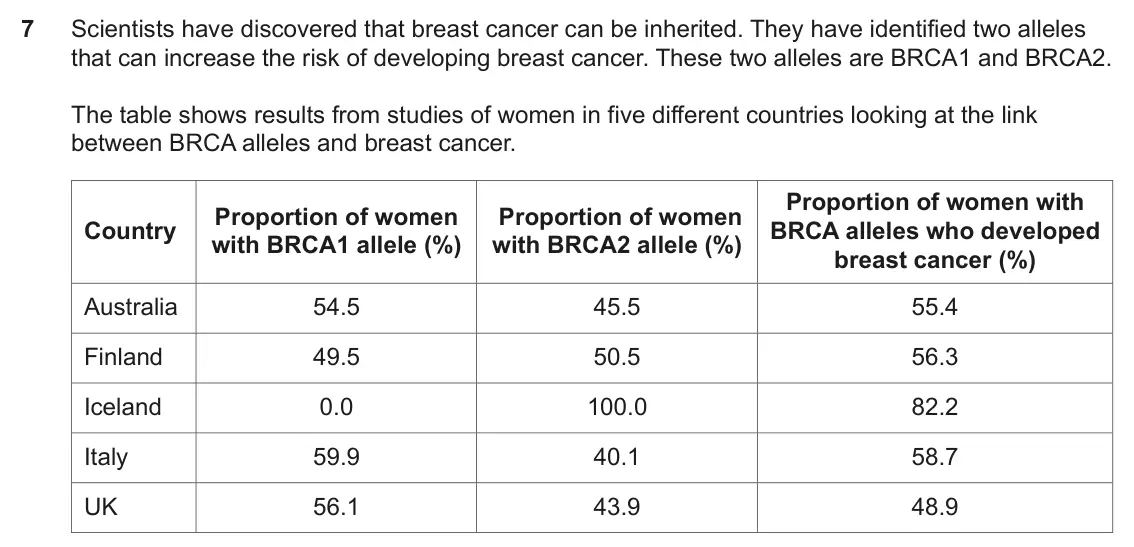
Q7(c)(i)
The whole paper ↗Q7(c)(ii)
The whole paper ↗Q2(a)(i)
The whole paper ↗
Q2(a)(ii)
The whole paper ↗Q2(a)(iii)
The whole paper ↗
All 37 questions on How can and should gene technology be used?, as a list
- June 2025, Biology Paper 1 Foundation, Q4(a) (1 mark): How did scientists use genetic engineering to produce the Flavr Savr tomato? Tick (✓) one box. They applied pesticides to the tomatoes. They modified the genome
- June 2025, Biology Paper 1 Foundation, Q4(b) (2 marks): One benefit of this genetic engineering is that it delays rotting of the tomatoes. One risk is the disruption of food chains. Explain one other benefit or risk
- June 2025, Biology Paper 1 Foundation, Q4(c) (2 marks): The table shows which countries used the largest area of land to grow genetically engineered crops in 2015. Country Area of land used to grow genetically engine
- June 2024, Biology Paper 5 Higher, Q7(e)(i) (2 marks): Describe what is meant by genetic engineering. [2]
- June 2024, Biology Paper 5 Higher, Q7(e)(ii) (4 marks): Describe the four main steps in the process of genetic engineering. 1 2 3 4 [4]
- June 2023, Biology Paper 1 Foundation, Q10(d) (3 marks): Some females have a condition called Turner syndrome. • They only have one X chromosome instead of two. • There is no cure. • They need to have their heart, kid
- June 2023, Combined Science Paper 4 Foundation, Q2(c) (2 marks): Scientists can genetically engineer crop plants. Complete the description of genetic engineering. Use words from the list. copied DNA modified protein removed d
- June 2023, Combined Science Paper 4 Foundation, Q2(d)(i) (3 marks): Give three conclusions that can be made from the data. 1 2 3 [3]
- June 2023, Combined Science Paper 4 Foundation, Q2(d)(ii) (2 marks): There are 31 million hectares of canola grown. 30% of the canola grown is genetically engineered. Calculate the number of hectares used to grow genetically engi
- June 2023, Biology Paper 5 Higher, Q1(d) (3 marks): Some females have a condition called Turner syndrome. • They only have one X chromosome instead of two. • There is no cure. • They need to have their heart, kid
- June 2022, Biology Paper 5 Higher, Q4(a)(i) (1 mark): Describe why this is an example of genetic engineering. [1]
- June 2022, Biology Paper 5 Higher, Q4(a)(ii) (3 marks): Describe the main steps in the process of genetically engineering the maize. ... [3]
- June 2022, Biology Paper 5 Higher, Q4(b) (1 mark): Suggest the next step that the scientists should take to investigate whether the modified maize could improve people’s diets. [1]
- June 2022, Biology Paper 5 Higher, Q4(c) (2 marks): Suggest one benefit and one possible risk of genetically engineering maize in this way. Benefit Risk [2]
- June 2022, Combined Science Paper 8 Higher, Q7(b) (2 marks): Genetic testing can be used to determine if someone has inherited BRCA alleles. Suggest two ways that genetic testing for BRCA alleles can be used to reduce the
- June 2022, Combined Science Paper 8 Higher, Q7(c)(i) (1 mark): Which student is discussing the reliability of genetic testing? [1]
- June 2022, Combined Science Paper 8 Higher, Q7(c)(ii) (1 mark): Which student is talking about a medical risk of genetic testing? [1]
- November 2020, Biology Paper 1 Foundation, Q2(a)(i) (1 mark): Which friend is considering risk? [1]
- November 2020, Biology Paper 1 Foundation, Q2(a)(ii) (1 mark): Which friend has a concern that should be answered by government and society? [1]
- November 2020, Biology Paper 1 Foundation, Q2(a)(iii) (1 mark): Which friend is thinking about ethical issues? [1]
- November 2020, Biology Paper 1 Foundation, Q2(a)(iv) (1 mark): Give one other example of when a genetic test could be used. [1]
- November 2020, Biology Paper 1 Foundation, Q2(b) (2 marks): 679 106 babies were born in the UK in 2017. It is estimated that 1 in every 2000 babies are born with DiGeorge syndrome. Calculate the expected number of babies
- November 2020, Biology Paper 1 Foundation, Q2(c) (2 marks): Scientific discoveries are often reported in newspapers. Why is it important that scientific discoveries are reported in newspapers? Tick (3) two boxes. More pe
- November 2020, Biology Paper 5 Higher, Q8(b)(ii) (2 marks): Scientists want new born babies to be tested for DiGeorge syndrome. Give one benefit and one risk or ethical issue of testing newborn babies for DiGeorge Syndro
- November 2020, Biology Paper 5 Higher, Q8(b)(iv) (2 marks): The article on DiGeorge syndrome is from a newspaper. Scientists report their work to other scientists in peer-reviewed journals. Why is it important that scien
- June 2019, Combined Science Paper 4 Foundation, Q2(b)(i) (1 mark): Which student talks about a risk of genetic engineering? [1]
- June 2019, Combined Science Paper 4 Foundation, Q2(b)(ii) (1 mark): Which student talks about an ethical objection to genetic engineering? [1]
- June 2019, Combined Science Paper 4 Foundation, Q2(b)(iii) (1 mark): Which student talks about a benefit of genetic engineering? [1]
- June 2019, Combined Science Paper 8 Higher, Q2(a) (2 marks): The first stage of the gene transfer process is to locate and isolate the gene for anthocyanin in the nucleus of the blackberry cell. Describe the next four sta
- June 2019, Combined Science Paper 8 Higher, Q2(b)(i) (2 marks): Anthocyanins are antioxidants which may prevent cell damage. This means eating blue tomatoes may be beneficial to our health. Suggest two possible benefits of u
- June 2019, Combined Science Paper 8 Higher, Q2(b)(ii) (2 marks): Blue tomatoes are still being tested and are not yet available for sale. Suggest two possible risks of using genetically modified (GM) crops. 1 2 [2] There are
- June 2018, Biology Paper 1 Foundation, Q3(a)(iii) (1 mark): The sequence of bases in a whole human genome can be worked out. It cost £1 000 000 000 to sequence a human genome in 2003. It can now be done for £1000. How ma
- June 2018, Biology Paper 1 Foundation, Q3(b)(i) (1 mark): Which student suggests that only a few diseases are caused by single genes? Tick (✓) one box. Nina Jack Kai Sarah [1]
- June 2018, Biology Paper 1 Foundation, Q3(b)(ii) (1 mark): Which student suggests a possible extra health risk caused by having a genetic test? Tick (✓) one box. Nina Jack Kai Sarah [1]
- June 2018, Biology Paper 1 Foundation, Q3(b)(iii) (1 mark): Which student has forgotten that the genome and the environment both affect our features? Tick (✓) one box. Nina Jack Kai Sarah [1]
- June 2018, Biology Paper 5 Higher, Q4(d)(i) (5 marks): Complete the sentences to describe the main steps in the process of genetically engineering corn in this way. Choose the correct words from the list. Each word
- June 2018, Biology Paper 5 Higher, Q4(d)(ii) (2 marks): Describe some of the risks of growing genetically engineered corn. [2]
Questions, mark schemes and examiner’s reports are © OCR, from their published past papers. Plumi isn’t affiliated with any exam board. Want whole papers? Full past papers.
Rather write your answers by hand on iPad? Plumi marks them against the same mark schemes.