 plumi
How was the theory of evolution developed?: OCR GCSE Biology B questions
Every OCR GCSE Biology B exam question on B6.1 How was the theory of evolution developed?, 2018–2025, with its mark scheme and examiner’s report.
Paper
All papers
Exam
All years
Calculations
Q5(a)(i)
The whole paper ↗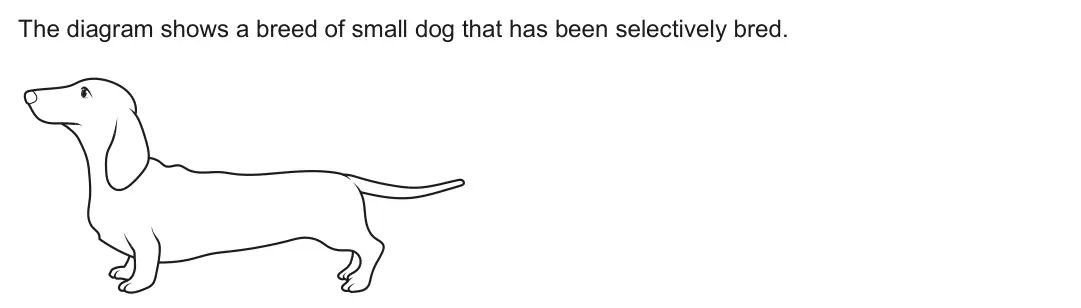
Q9(e)
The whole paper ↗
Q9(f)
The whole paper ↗Q6(c)(iii)
The whole paper ↗
Q1(e)
The whole paper ↗
Q1(f)
The whole paper ↗Q6(d)
The whole paper ↗
Q4(a)
The whole paper ↗Q4(b)
The whole paper ↗Q8(c)
The whole paper ↗Q5(a)
The whole paper ↗
Q5(b)
The whole paper ↗Q5(c)
The whole paper ↗Q5(d)
The whole paper ↗Q6(a)(i)
The whole paper ↗
Q6(a)(ii)
The whole paper ↗Q5(a)(i)
The whole paper ↗
Q5(b)
The whole paper ↗Q5(c)
The whole paper ↗Q5(d)
The whole paper ↗
All 73 questions on How was the theory of evolution developed?, as a list
- June 2025, Paper 1 Foundation, Q5(a)(i) (3 marks): The statements describe the steps in the process. They are not in the correct order. A Select the offspring with short legs and breed again. B Breeders select a
- June 2025, Paper 1 Foundation, Q9(e) (2 marks): Some bacteria have evolved to become resistant to antibiotics. The statements describe the steps in this process. They are not in the correct order. A Bacterium
- June 2025, Paper 1 Foundation, Q9(f) (1 mark): Bacteria evolve by natural selection. Darwin was one of the scientists who originally developed the theory of natural selection. Who was the other scientist? [1
- June 2025, Paper 2 Foundation, Q6(c)(iii) (3 marks): A few ash trees are resistant and do not die when infected with ash dieback. Complete the sentences to explain why resistant trees will gradually become more co
- June 2025, Paper 3 Higher, Q1(e) (2 marks): Some bacteria have evolved to become resistant to antibiotics. The statements describe the steps in this process. They are not in the correct order. A Bacterium
- June 2025, Paper 3 Higher, Q1(f) (1 mark): Bacteria evolve by natural selection. Darwin was one of the scientists who originally developed the theory of natural selection. Who was the other scientist? [1
- June 2025, Paper 4 Higher, Q6(d) (3 marks): Conifer trees have a genetic variant that makes them resistant to crown gall disease. Scientists hope to transfer this genetic variant from conifer trees into s
- June 2024, Paper 1 Foundation, Q4(a) (1 mark): Which scientists developed the theory of evolution by natural selection? Tick (✓) one box. Charles Darwin and Alfred Russel Wallace. Charles Darwin and Gregor M
- June 2024, Paper 1 Foundation, Q4(b) (4 marks): Rats are considered a pest to many farmers as they eat their crops. A chemical called warfarin can be used to kill rats. Put statements A to E in the correct or
- June 2024, Paper 1 Foundation, Q8(c) (2 marks): Different species of squirrels can be found on either side of Arizona’s Grand Canyon. A canyon is a deep, narrow valley with steep sides. When the Grand Canyon
- June 2024, Paper 3 Higher, Q5(a) (1 mark): What is the most likely cause of this resistance? [1]
- June 2024, Paper 3 Higher, Q5(b) (3 marks): Complete the sentences to explain how more rats developed resistance to warfarin. Use words from the list. allele die genome reproduce respire ribosome survive
- June 2024, Paper 3 Higher, Q5(c) (1 mark): State the names of the two scientists who developed the theory of evolution by natural selection. and [1]
- June 2024, Paper 3 Higher, Q5(d) (1 mark): Explain why some people do not accept this modern theory of evolution. [1]
- June 2024, Paper 4 Higher, Q6(a)(i) (1 mark): What process did the farmers use? Tick (✓) one box. Evolution Mutation Natural selection Selective breeding [1]
- June 2024, Paper 4 Higher, Q6(a)(ii) (2 marks): Suggest two advantages of growing domesticated pea plants that produce more peas per plant. 1 2 [2]
- June 2023, Paper 2 Foundation, Q5(a)(i) (6 marks): Read the article. Beak Swordbill Tube hummingbird Nectar found here Passionflower One species of hummingbird called a swordbill is the only bird that has a beak
- June 2023, Paper 2 Foundation, Q5(b) (4 marks): Darwin and Wallace suggested that natural selection could be an explanation for the evolution of species. Describe two pieces of evidence that helped them to de
- June 2023, Paper 2 Foundation, Q5(c) (1 mark): Which two statements explain the impacts of Darwin and Wallace’s explanation for the evolution of species? Tick (✓) two boxes. Everybody now believes that it is
- June 2023, Paper 2 Foundation, Q5(d) (3 marks): A type of bacteria uses an enzyme to digest nylon. Nylon was invented in 1935. Scientists think this new enzyme only appeared in bacteria after 1935. Describe t
- June 2023, Paper 4 Higher, Q6(f) (3 marks): The scientist thinks a mutation must have happened in the fungi in the soil in sample C. Describe how this mutation could have caused the results for sample C.
- June 2023, Paper 4 Higher, Q7(a) (3 marks): Mutations to alleles happen quite often. Explain why mutations often have no observable effects. [3]
- June 2023, Paper 4 Higher, Q7(b) (3 marks): Elephants in Mozambique are hunted by humans. The humans kill the elephants so they can sell their valuable tusks. Scientists recorded data on the Mozambique el
- June 2023, Paper 4 Higher, Q7(c) (6 marks): Elephants live in the wild in Mozambique, Africa. Tusk Some elephants inherit an allele that causes them to never develop tusks. This no-tusks allele is the res
- June 2023, Paper 4 Higher, Q7(e) (3 marks): Predict what is likely to happen to the population of elephants in Mozambique if the hunting continues. [3]
- June 2022, Paper 2 Foundation, Q5(b) (1 mark): Mosquitoes can be killed with insecticide. However, in the case of mosquitoes that spread malaria, many of the mosquitoes have become resistant to insecticide.
- June 2022, Paper 2 Foundation, Q5(c)(i) (3 marks): Write the letters of the statements in the correct order to explain why the mutation has become so common. [3]
- June 2022, Paper 2 Foundation, Q5(c)(ii) (1 mark): What is the name of the process described by statements A, B, C and D? [1]
- June 2022, Paper 3 Higher, Q8(a)(i) (2 marks): What caused the fish in the lake to evolve into two different subspecies? [2]
- June 2022, Paper 3 Higher, Q8(a)(ii) (3 marks): Describe how evolution occurs. [3]
- June 2022, Paper 4 Higher, Q4(c)(iii) (2 marks): Explain how a bacterium could become resistant to an antibiotic without receiving a plasmid. [2]
- November 2021, Paper 1 Foundation, Q7(c)(iii) (1 mark): Scientists have recently discovered that some Tasmanian devils have developed resistance to Devil Facial Tumour disease. This resistance can be passed on to off
- November 2021, Paper 1 Foundation, Q8(a) (3 marks): Explain how farmers selectively breed cows that produce more meat. [3]
- November 2021, Paper 2 Foundation, Q2(b)(ii) (3 marks): Statements A to D explain how natural selection caused the mice to become larger. They are not in the correct order. A These mice got more food, so were more li
- November 2021, Paper 3 Higher, Q6(a)(i) (2 marks): Select two breeds of sheep from Table 6.1 that the scientists could use in the selective breeding programme to prevent flystrike, and give one reason for your s
- November 2021, Paper 3 Higher, Q6(a)(ii) (2 marks): Describe how the scientists would use selective breeding to produce sheep that are less likely to get flystrike. [2]
- November 2021, Paper 3 Higher, Q8(a) (3 marks): Explain why farmers are worried about the effect that Colorado potato beetles may have on potato crops in the future. Use data from the graph to support your an
- November 2021, Paper 4 Higher, Q6(a) (2 marks): What can happen as a result of natural selection? Tick (3) two boxes. New species can be formed. Species can become less well adapted to their environment. Spec
- November 2021, Paper 4 Higher, Q6(b)(i) (2 marks): This variation in observable characteristics exists because of genetic variation. Explain what causes genetic variation. [2]
- November 2021, Paper 4 Higher, Q6(b)(ii) (2 marks): Describe one other type of evidence observed by Darwin and Wallace that helped them to develop their explanation. [2]
- November 2021, Paper 4 Higher, Q6(c)(i) (4 marks): Explain why using antibiotics on bacteria can cause antibiotic-resistant bacteria to become more common. Use ideas about natural selection in your answer. [4]
- November 2020, Paper 1 Foundation, Q3(c) (3 marks): The statements A, B, C and D explain how bacteria become resistant to antibiotics but they are in the wrong order. A The bacterium reproduces. B The bacterium s
- November 2020, Paper 1 Foundation, Q3(d) (1 mark): The theory of evolution by natural selection was developed by which two scientists? Tick (✓) one box. Darwin and Wallace Mendel and Darwin Wallace and Mendel [1
- November 2020, Paper 1 Foundation, Q3(e) (3 marks): Fig. 3.2 shows the evolution of humans using fossils. Evolution of humans over time Homo sapiens Australopithecus Homo Homo neanderthalensis erectus sapiens 7o0
- November 2020, Paper 2 Foundation, Q6(a) (1 mark): The straws are like a population of prey. Which statement is an example of variation between the straws? Tick (✓) one box. They are all small. They are differen
- November 2020, Paper 2 Foundation, Q6(b) (2 marks): The straws are ‘hunted’ by the students, who are like predators. Explain why the green straws are better suited to ‘survive’ in the grassy environment. [2]
- November 2020, Paper 2 Foundation, Q6(c) (1 mark): The students are in competition to pick up as many straws as they can. Suggest one example of variation between students that could affect their ability to comp
- November 2020, Paper 2 Foundation, Q6(d) (1 mark): Which biological process is the game a model of? Tick (✓) one box. Mutation Natural selection Reproduction Selective breeding [1]
- November 2020, Paper 2 Foundation, Q6(e)(i) (1 mark): Straws that have been picked up are not put back on the grass after each round. The total population of straws left on the grass will therefore be smaller after
- November 2020, Paper 2 Foundation, Q6(e)(ii) (2 marks): The student who picks up the fewest straws in each round has to drop out of the game. The total population of students will therefore be smaller after several r
- November 2020, Paper 3 Higher, Q7(c) (1 mark): Suggest how scientists could produce onions that make our eyes water less. [1]
- November 2020, Paper 4 Higher, Q2(c) (6 marks): Milk contains proteins and other nutrients. (c)* Milk contains a carbohydrate called lactose. Only people with a particular mutation in their DNA can digest lac
- June 2019, Paper 1 Foundation, Q4(a)(ii) (1 mark): Cows produce different amounts of milk. A farmer wants a calf that will produce a lot of milk in the future. The farmer carefully chooses which female cow to ma
- June 2019, Paper 2 Foundation, Q4(a)(i) (1 mark): How does the Archaeopteryx fossil provide evidence that birds evolved from dinosaurs? Tick (✓) one box. It has features of both birds and dinosaurs. It is now e
- June 2019, Paper 2 Foundation, Q4(a)(ii) (2 marks): Twelve fossils of Archaeopteryx have been found. The twelve Archaeopteryx fossil animals vary in appearance. Suggest what could have caused these differences in
- June 2019, Paper 2 Foundation, Q4(b)(i) (5 marks): Explain how natural selection caused the humans on the island to become smaller over many generations. [5]
- June 2019, Paper 3 Higher, Q7(a)(i) (1 mark): Place the following statements in the correct order to explain how scientists think this may have occurred. A The birds are more likely to survive and reproduce
- June 2019, Paper 3 Higher, Q7(a)(ii) (1 mark): What phrase describes the process occurring in part (a)(i)? [1]
- June 2019, Paper 3 Higher, Q10(c)(i) (2 marks): How could a farmer use selective breeding to try to make sure the cows in the next generation make a lot of milk? [2]
- June 2019, Paper 4 Higher, Q3(d)(ii) (2 marks): Bacteria gaining the ability to break down plastic is an example of evolution. Explain what changes must have taken place in the bacteria cells to give them the
- June 2019, Paper 4 Higher, Q6(c)(i) (5 marks): Use the information to explain why sickle-cell disease is common in regions in which malaria is widespread. [5]
- June 2019, Paper 4 Higher, Q6(c)(ii) (2 marks): Suggest why sickle-cell disease would be less common in these regions if malaria was wiped out. [2]
- June 2019, Paper 4 Higher, Q7(b) (4 marks): Scientists have been studying two different enzymes in invertebrates. • Both enzymes break down the same substrate. • The shape of the active site of each enzym
- June 2018, Paper 1 Foundation, Q6(a)(i) (2 marks): Describe how dogs are selectively bred. [2]
- June 2018, Paper 1 Foundation, Q6(a)(ii) (1 mark): Explain the impact of selective breeding on domesticated animals such as dogs. [1]
- June 2018, Paper 1 Foundation, Q8(a)(i) (2 marks): Which of the following are observations made by Darwin? Tick (3) two boxes. There are differences between fossils and living examples of similar organisms. Pea
- June 2018, Paper 1 Foundation, Q8(a)(ii) (1 mark): Darwin suggested a theory to explain his observations. Write down the name of the theory he suggested. [1]
- June 2018, Paper 2 Foundation, Q4(c) (6 marks): Warfarin is a medicine that helps to prevent the formation of blood clots. It is given to people who are at risk from a blood clot blocking one of their veins.
- June 2018, Paper 3 Higher, Q1(a)(i) (2 marks): Which of the following are observations made by Darwin? Tick (3) two boxes. There are differences between fossils and living examples of similar organisms. Pea
- June 2018, Paper 3 Higher, Q1(a)(ii) (1 mark): Darwin suggested a theory to explain his observations. Write down the name of the theory he suggested. [1]
- June 2018, Paper 3 Higher, Q6(b)(i) (3 marks): The mosquito responsible for the spread of Zika has become resistant to some of the insecticides used to kill it. Explain how a population of mosquitos could ha
- June 2018, Paper 3 Higher, Q8(c) (2 marks): Monkeys also have different variants of the gene that affects how they taste bitterness. Scientists have proposed two explanations for how the non-tasting varia
- June 2018, Paper 4 Higher, Q4(b)(i) (3 marks): Explain how scientists could use selective breeding to produce ash trees with improved tolerance. [3]
Questions, mark schemes and examiner’s reports are © OCR, from their published past papers. Plumi isn’t affiliated with any exam board. Want whole papers? Every OCR GCSE Biology B paper.
Rather write your answers by hand on iPad? Plumi marks them against the same mark schemes.