 plumi
Kinetic theory of gases: OCR A‑Level Physics B questions
OCR A-Level Physics B past-paper questions on 5.2.1.4 Kinetic theory of gases, 2016–2025, with mark schemes and examiner’s reports where available.
Paper
All papers
Exam
All years
Calculations
- Your answer
Q6(a)(i)
The whole paper ↗
Q6(b)(i)
The whole paper ↗Q6(b)(ii)
The whole paper ↗- Your answer
Q3(b)
The whole paper ↗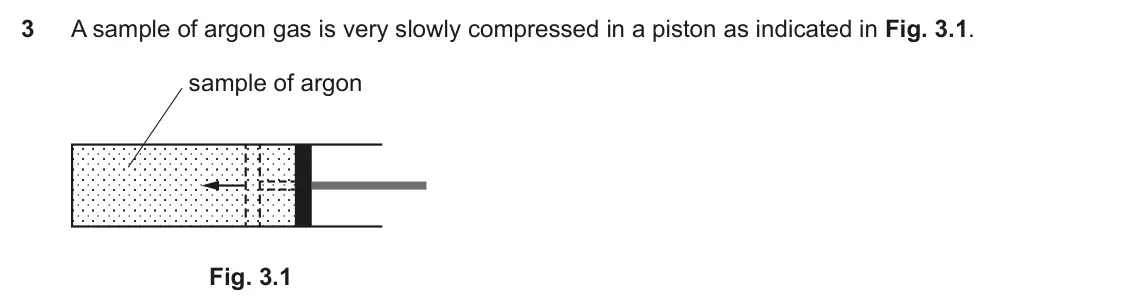
Q3(c)(i)
The whole paper ↗Q3(c)(ii)
The whole paper ↗Q38(b)(ii)
The whole paper ↗
Q38(b)(iii)
The whole paper ↗Q40(b)(i)
The whole paper ↗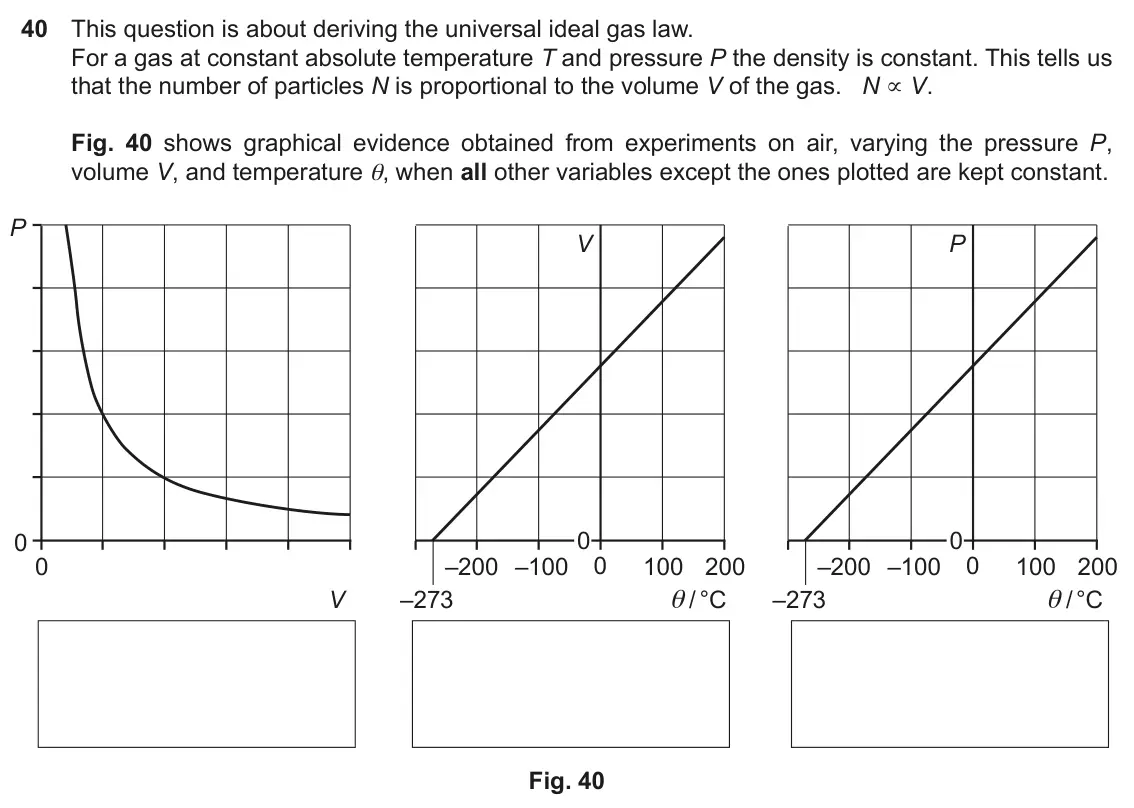
Q40(b)(ii)
The whole paper ↗- Your answer
Q32(b)
The whole paper ↗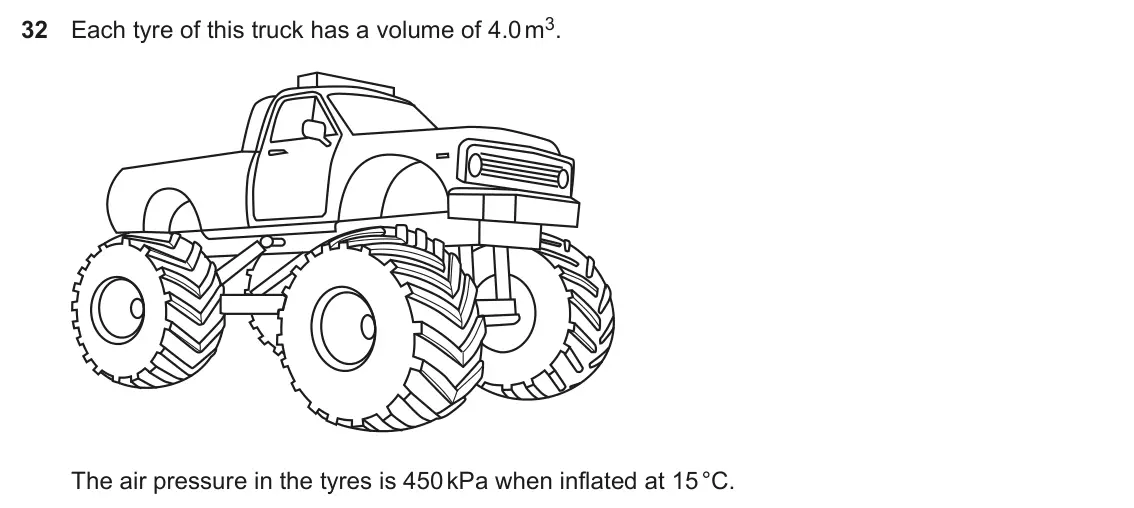
- Your answer
- Your answer
Q37(c)(i)
The whole paper ↗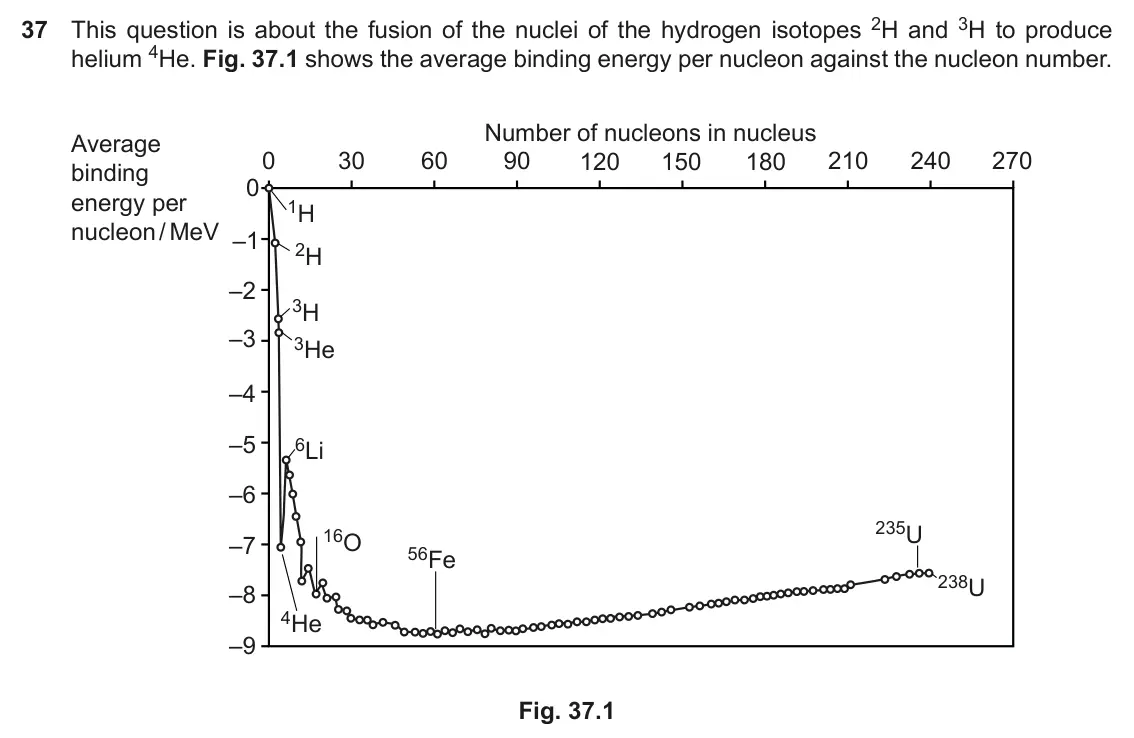
Q4(a)(i)
The whole paper ↗
Q4(a)(ii)
The whole paper ↗
All 25 questions on Kinetic theory of gases, as a list
- June 2025, Paper 1, Q20 (1 mark): What happens to the root mean square speed of the molecules in the gas when the volume is increased to 3V and the pressure is increased to 3P? A It stays the sa
- June 2025, Paper 2, Q6(a)(i) (4 marks): Explain why it is necessary to keep the temperature of the air constant during the demonstration. Use ideas from kinetic theory to explain the effect of the tem
- June 2025, Paper 2, Q6(b)(i) (3 marks): The temperature of the trapped air is 293 K. Show that the root mean square speed of the air molecules is about 500 m s–1. Assume the mass of a molecule is 4.8
- June 2025, Paper 2, Q6(b)(ii) (1 mark): The movement of particles in an ideal gas can be described as a ‘random walk’. State the meaning of ‘random walk’ in this context. [1]
- June 2023, Paper 1, Q20 (1 mark): A closed cylinder contains equal numbers of particles of two ideal gases, X and Y. Particles of gas X have twice the mass of particles of gas Y. Which is the co
- June 2023, Paper 2, Q3(b) (3 marks): The temperature of the gas is 298 K. The mass of an argon atom is 6.6 × 10⁻²⁶ kg. Show that the root mean square speed of the atoms is about 430 m s–1. [3]
- June 2023, Paper 2, Q3(c)(i) (2 marks): The collision between the atom and the piston is elastic. Explain why the velocity of the gas atom is – 433 m s–1 after the collision. [2]
- June 2023, Paper 2, Q3(c)(ii) (3 marks): Describe and explain how the behaviour of the gas would change if the gas were compressed more quickly. You may use equations and refer to your graphs in Fig. 3
- June 2022, Paper 1, Q38(b)(ii) (3 marks): Use the kinetic model of ideal gas behaviour to explain why length L increases when the temperature of the trapped gas increases without change in atmospheric p
- June 2022, Paper 1, Q38(b)(iii) (3 marks): The temperature of the gas inside the cylinder is raised and length L increases to 1.8 m. Atmospheric pressure remains at 1.0 × 10⁵ Pa. Calculate the r.m.s. spe
- June 2022, Paper 2, Q7 (3 marks): This question is about the movement of energy through the radiative zone (lines 53 – 60). Use the equation given in the article (line 58) to estimate the number
- November 2021, Paper 1, Q40(b)(i) (2 marks): Calculate the root mean square speed for helium gas at 300 K. molar mass for helium = 4.0 × 10⁻³ kg speed = m s–1 [2]
- November 2021, Paper 1, Q40(b)(ii) (2 marks): A typical speed for an air molecule at 300 K is about 4 × 10³ m s–1. Explain why the scent from an air freshener may take several minutes to reach across a room
- November 2020, Paper 1, Q14 (1 mark): Which statement about the kinetic theory of ideal gases is correct? A Particles have a significant volume compared to the gas volume. B Particles have average e
- November 2020, Paper 1, Q32(b) (3 marks): During driving, the tyres warm to 47 °C and the volume remains constant. Using ideas from kinetic theory, explain what happens to the air pressure in the tyres.
- June 2019, Paper 1, Q18 (1 mark): A fixed mass of gas occupies a volume V. The temperature of the gas is increased so that the mean square speed of the molecules is doubled. What is the new volu
- June 2019, Paper 1, Q25 (1 mark): What is the best estimate of the average pressure exerted on the lead by the α-particles? 2 × 10⁻²⁰ Pa A 2 × 10⁻¹⁶ Pa B 2 × 10⁻¹² Pa C 2 × 10⁻⁸ Pa D Your answer
- June 2019, Paper 1, Q37(c)(i) (3 marks): The density of the bead of solid 2H and 3H (1:1 ratio by atoms) is 230 kg m−3. Estimate the energy needed to produce plasma at 400 MK from this bead of material
- June 2019, Paper 3, Q4(a)(i) (3 marks): Explain what is meant by an ideal gas. [3]
- June 2019, Paper 3, Q4(a)(ii) (3 marks): The average kinetic energy of the particles (atoms) in an ideal gas at absolute (kelvin) temperature T is given by the equation average kinetic energy = 3 2 kT
- June 2019, Paper 3, Q4(b) (3 marks): Argon is a gas at room temperature. You may assume that it behaves as an ideal gas at this temperature. The molar mass of argon is 0.0399 kg mol–1. Calculate th
- June 2018, Paper 1, Q39(a) (6 marks): 39 (a)* Boyle’s Law states that at constant temperature, pressure is proportional to volume. Explain how the random motion of particles gives rise to Boyle’s la
- June 2018, Paper 1, Q39(b)(i) (3 marks): Calculate the ratio: . speed of xenon atom with average kinetic energy Make your reasoning clear. ratio = [3]
- June 2017, Paper 1, Q19 (1 mark): Two samples L and M contain the same mass of an ideal gas. In which of the following cases will it always be true that the molecules in L have a larger root mea
- June 2017, Paper 2, Q3(a) (3 marks): Explain how air particles exert a pressure on a sail and why, when no wind is blowing, the sail experiences the same pressure on both sides. [3]
Questions, mark schemes and examiner’s reports are © OCR, from their published past papers. Plumi isn’t affiliated with any exam board. Want whole papers? OCR A-Level Physics B past papers.
The Plumi iPad app also offers exam-style questions with AI feedback on your handwritten working.