 plumi
Circular motion and orbits: OCR A‑Level Physics B questions
OCR A-Level Physics B past-paper questions on 5.1.2.3 Circular motion and orbits, 2016–2025, with mark schemes and examiner’s reports where available.
Paper
All papers
Exam
All years
Calculations
Q5(a)(i)
The whole paper ↗
Q5(a)(ii)
The whole paper ↗Q5(a)(iii)
The whole paper ↗Q5(c)(i)
The whole paper ↗- Your answer
Q10(b)(i)
The whole paper ↗
Q10(b)(ii)
The whole paper ↗- Your answer
Q36(c)
The whole paper ↗
Q5(a)
The whole paper ↗
Q5(b)
The whole paper ↗Q5(d)
The whole paper ↗- Your answer
Q38(b)(i)
The whole paper ↗- Your answer
- Your answer
Q6(b)(ii)
The whole paper ↗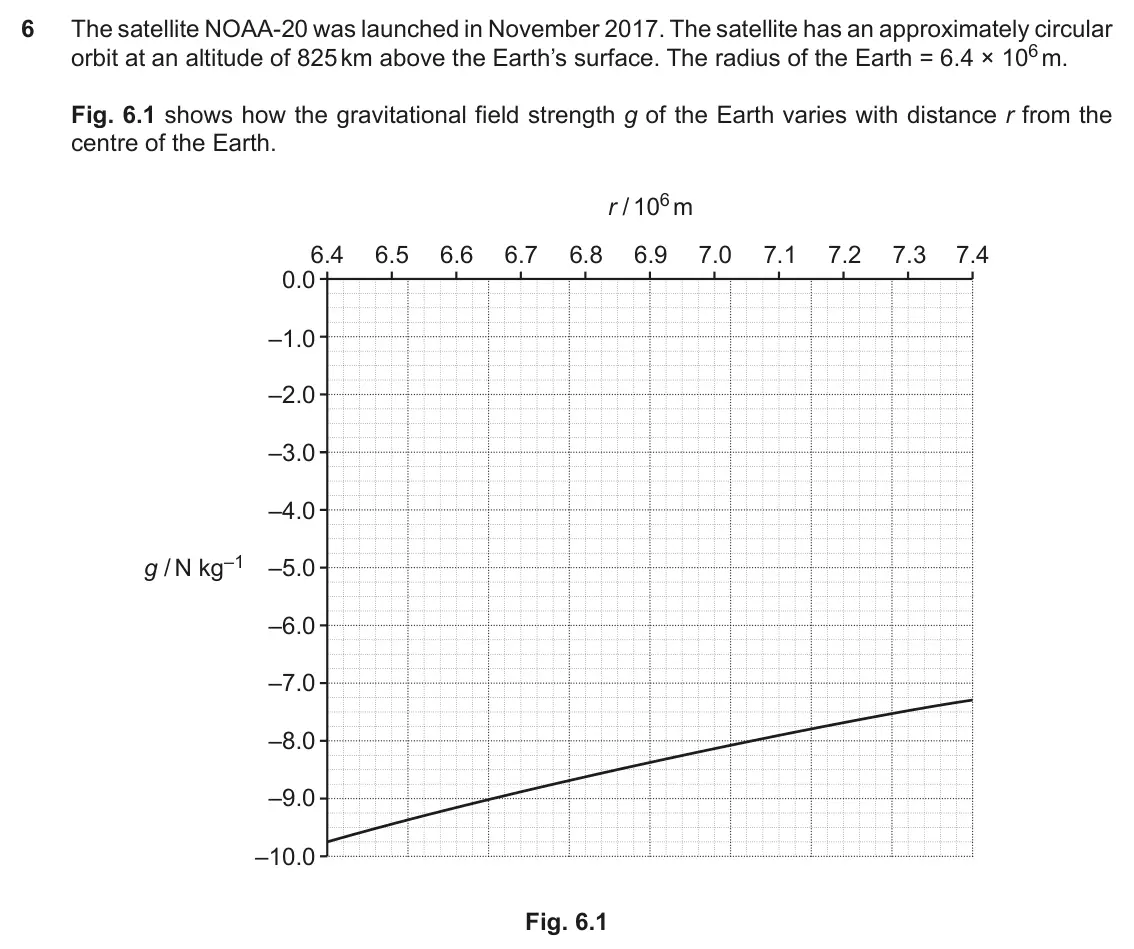
Q6(c)
The whole paper ↗Q38(a)
The whole paper ↗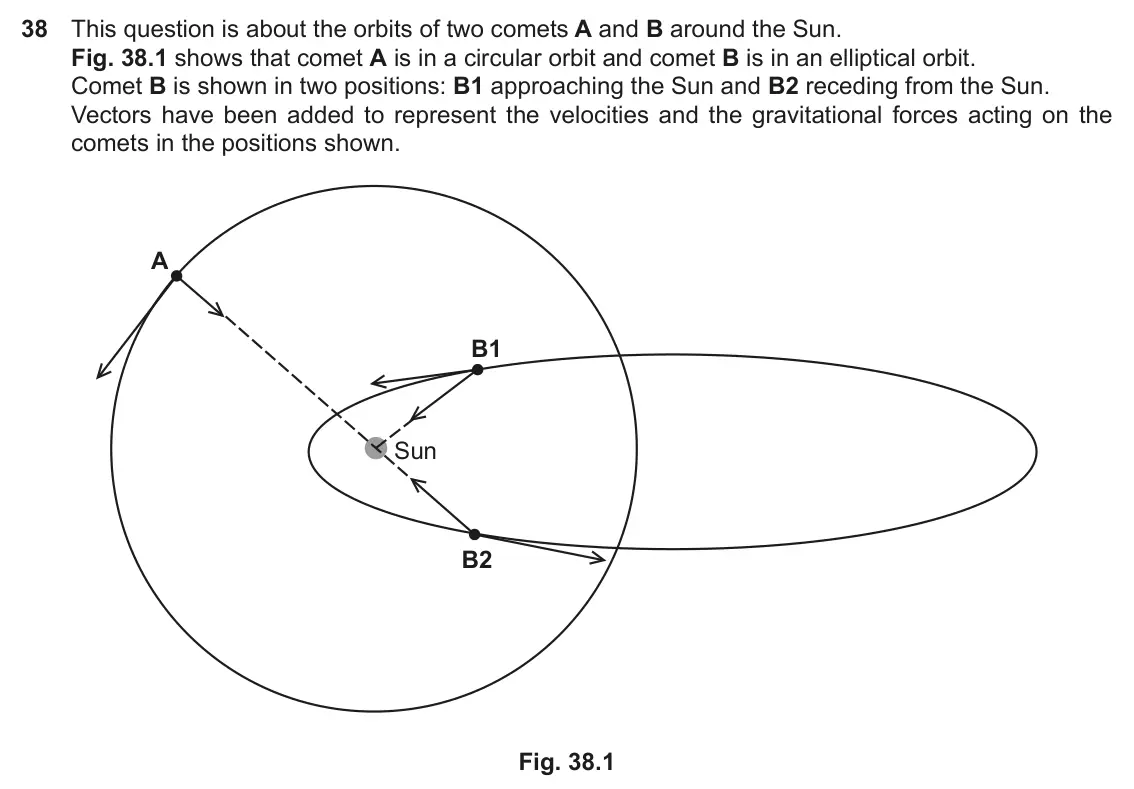
All 29 questions on Circular motion and orbits, as a list
- June 2025, Paper 2, Q5(a)(i) (2 marks): orbital speed of the Earth. Orbital period = 3.2 × 10⁷ s (1 year) angular velocity = rad s–1 orbital speed = m s–1 [2]
- June 2025, Paper 2, Q5(a)(ii) (1 mark): Use your answer to (a)(i) to show that the centripetal acceleration of the Earth in its orbit is about 6 × 10⁻³ m s–2. [1]
- June 2025, Paper 2, Q5(a)(iii) (3 marks): Use the value from (a)(ii) to calculate the mass of the Sun. mass = kg [3]
- June 2025, Paper 2, Q5(c)(i) (2 marks): Calculate the centripetal acceleration of an electron orbiting a proton at a separation of 0.5 × 10⁻¹⁰ m. centripetal acceleration = m s–2 [2]
- June 2024, Paper 1, Q23 (1 mark): A car of mass 1000 kg travels round a bend. The bend is a horizontal circular path of radius 50 m. The maximum speed the car can travel at without skidding is 1
- June 2024, Paper 2, Q9 (4 marks): This question is about the Chandra X-ray Observatory (lines 26–32). The Chandra X-ray Observatory has a highly elliptical orbit. The total energy of the satelli
- June 2024, Paper 2, Q10(b)(i) (2 marks): Show that the L2 point will make one revolution of the Sun in about 3.2 × 10⁷ s (one year). [2]
- June 2024, Paper 2, Q10(b)(ii) (3 marks): The mass of the Moon is about 1% that of the Earth. It orbits the Earth at a radius of 3.8 × 10⁸ m. Suggest and explain the effect of the Moon, if any, on the J
- June 2023, Paper 1, Q26 (1 mark): A hawk glides in a horizontal circle of radius 12 m. The speed of the hawk is 8.9 m s–1. weight of hawk What is the ratio centripetal force on hawk ? 12 m A 1.0
- June 2023, Paper 1, Q36(c) (6 marks): This question is about the gravitational field between the Earth and the Moon. (c)* It is suggested that projectiles can be launched from the Moon to the Earth
- June 2022, Paper 2, Q5(a) (3 marks): Use the equation for centripetal force and the equation giving the gravitational force between two bodies, to show that the constant k in Kepler’s relationship
- June 2022, Paper 2, Q5(b) (2 marks): Ganymede is the largest moon of the planet Jupiter. It orbits Jupiter at a distance of 1.07 × 10⁹ m. The period of the orbit is 6.18 × 10⁵ s. Use Kepler’s relat
- June 2022, Paper 2, Q5(d) (3 marks): The spacecraft fired motors to slow it down before it entered orbit with Jupiter. Suggest and explain why this was necessary. [3]
- November 2021, Paper 1, Q9 (1 mark): The planet Mercury has an orbital period of 88.0 Earth days. The mean angular velocity of its orbit, in rad s–1, is 4.13 × 10⁻⁷ A 8.26 × 10⁻⁷ B 4.73 × 10⁻⁵ C 4.
- November 2021, Paper 1, Q38(b)(i) (1 mark): Show that the kinetic energy of the electron in orbit is k e2 2r where k is the electric force constant = 1 / 4πεo. [1]
- November 2020, Paper 1, Q7 (1 mark): Which vector alters only the magnitude of the velocity? Your answer [1]
- November 2020, Paper 1, Q8 (1 mark): Which vector alters only the direction of the velocity? Your answer [1]
- November 2020, Paper 2, Q6(b)(ii) (3 marks): Calculate the time taken for one orbit of the satellite. time = s [3]
- November 2020, Paper 2, Q6(c) (3 marks): The satellite takes a polar orbit, revolving around the Earth from pole to pole, as shown in Fig. 6.2. Geostationary satellites orbit at a greater distance from
- June 2019, Paper 1, Q38(a) (6 marks): This question is about the orbits of two comets A and B around the Sun. Fig. 38.1 shows that comet A is in a circular orbit and comet B is in an elliptical orbi
- June 2019, Paper 1, Q38(b)(ii) (3 marks): The orbital period of S1 is 33 years. Show that the mass of the black hole is about 4 million times the mass of the Sun. Mass of the Sun ≈ 2.0 × 1030 kg. [3]
- June 2019, Paper 2, Q6(c)(ii) (2 marks): Calculate the radius r of the path the proton will follow. radius = m [2]
- June 2019, Paper 2, Q11(a) (5 marks): Calculate the centripetal force required to keep a 1000 kg ‘shield’ in orbit around the Sun at the L1 point with an orbital period the same as the orbital perio
- June 2019, Paper 2, Q11(b) (1 mark): Suggest why the shield may not remain at the L1 point even though the net force from Mars and the Sun is equal to the centripetal force required. [1]
- June 2018, Paper 1, Q27 (1 mark): If P is the centre of mass of the two stars, which ratio is correct for x : y ? A 1 : 4 B 1 : 2 C 2 : 1 D 4 : 1 Your answer [1]
- June 2017, Paper 1, Q17 (1 mark): Which of the following is correct? A As the planet leaves X it is speeding up. B As the planet approaches X it is slowing down. C As the planet approaches Y it
- June 2017, Paper 1, Q36(a) (2 marks): Explain why we describe the Moon as accelerating towards the Earth. [2]
- June 2017, Paper 1, Q36(b)(i) (1 mark): Starting from the equation for circular motion show that the acceleration of the Moon 2 4 R r towards the Earth is given by a = 2 T where the Moon’s orbital rad
- June 2017, Paper 1, Q36(b)(ii) (1 mark): Show that the Moon’s acceleration is less than 3 mm s–2. 8 6 R 3 84 . 10 m T 2 35 . 10 s = = # # [1]
Questions, mark schemes and examiner’s reports are © OCR, from their published past papers. Plumi isn’t affiliated with any exam board. Want whole papers? OCR A-Level Physics B past papers.
The Plumi iPad app also offers exam-style questions with AI feedback on your handwritten working.