 plumi
Data types: OCR A‑Level Computer Science questions
Every OCR A-Level Computer Science exam question on 1.4.1 Data types, 2021–2025, with its mark scheme and examiner’s report.
Find questions593
Calculations
Q3(a)(i)
The whole paper ↗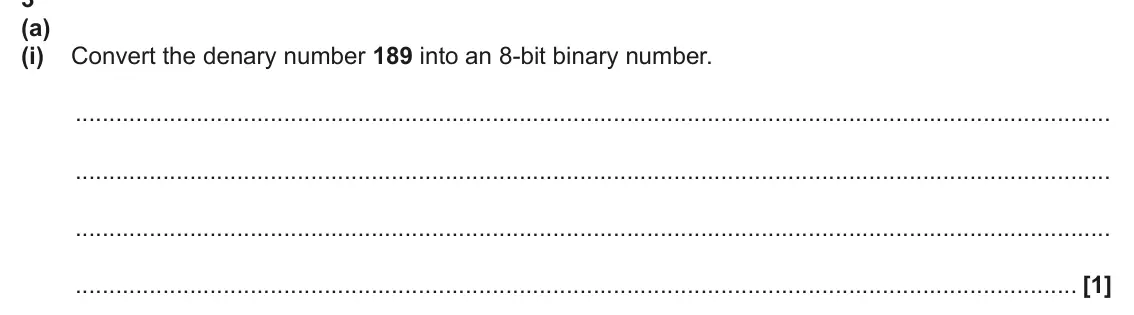
Q3(a)(ii)
The whole paper ↗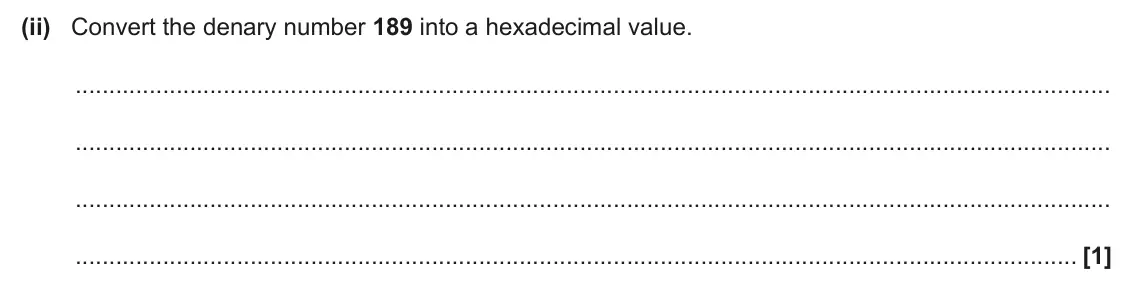
Q3(a)(iii)
The whole paper ↗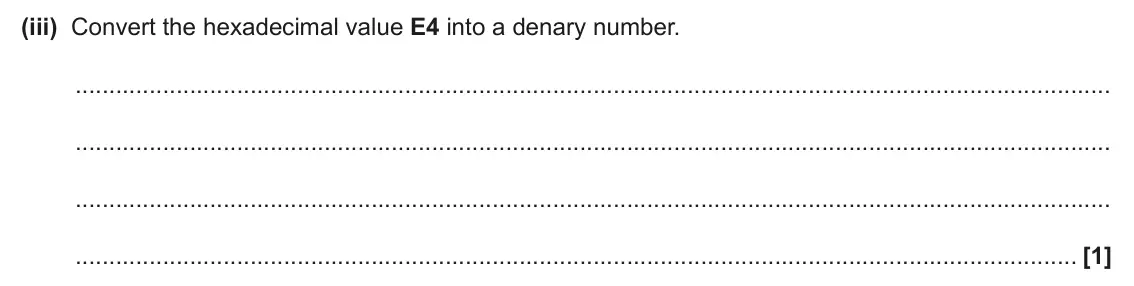
Q3(b)
The whole paper ↗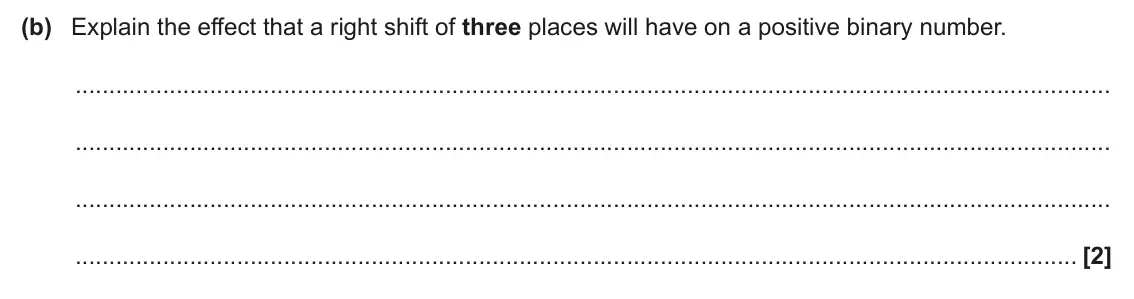
Q3(c)
The whole paper ↗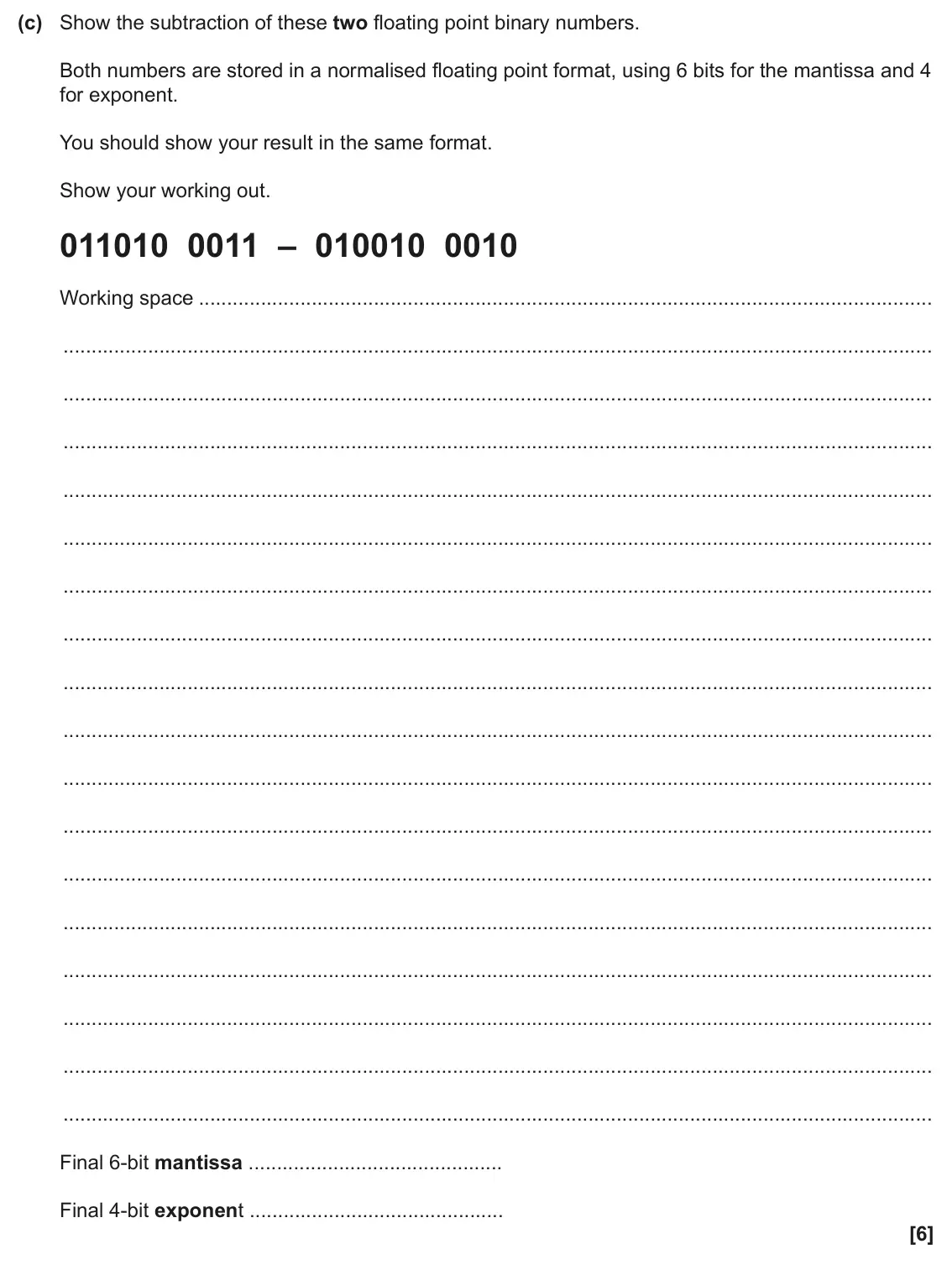
Q3(d)(i)
The whole paper ↗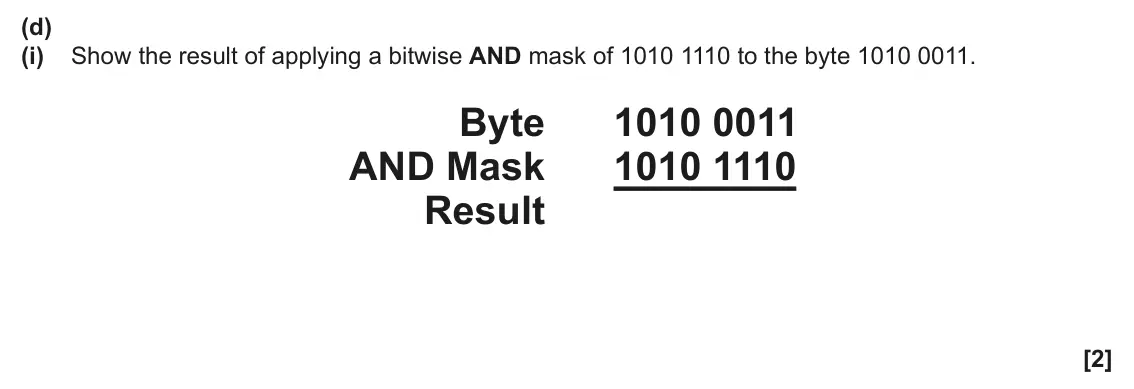
Q3(d)(ii)
The whole paper ↗
Q5(a)
The whole paper ↗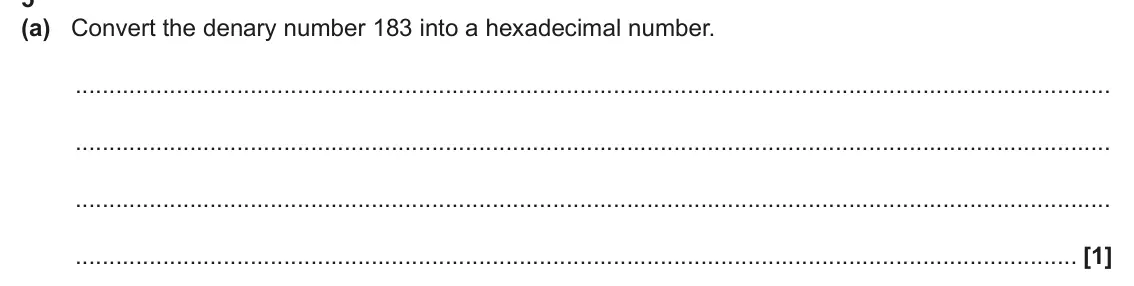
Q5(b)
The whole paper ↗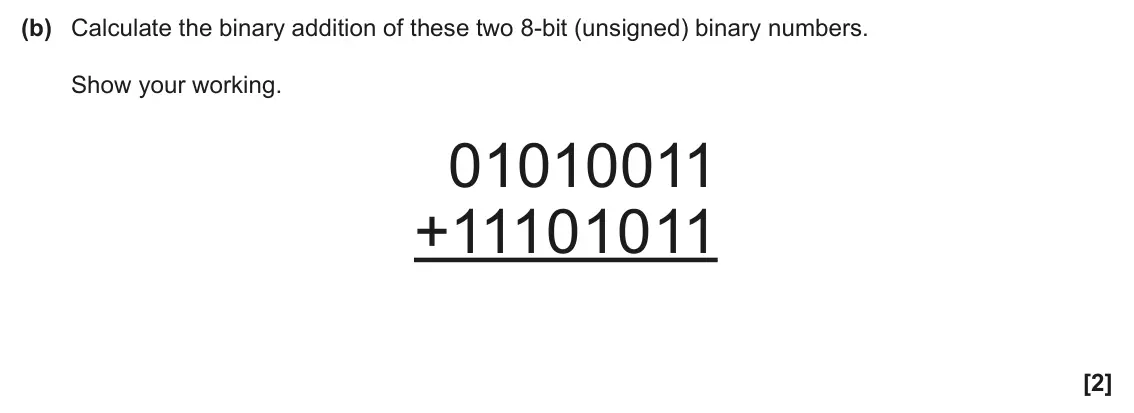
Q5(c)
The whole paper ↗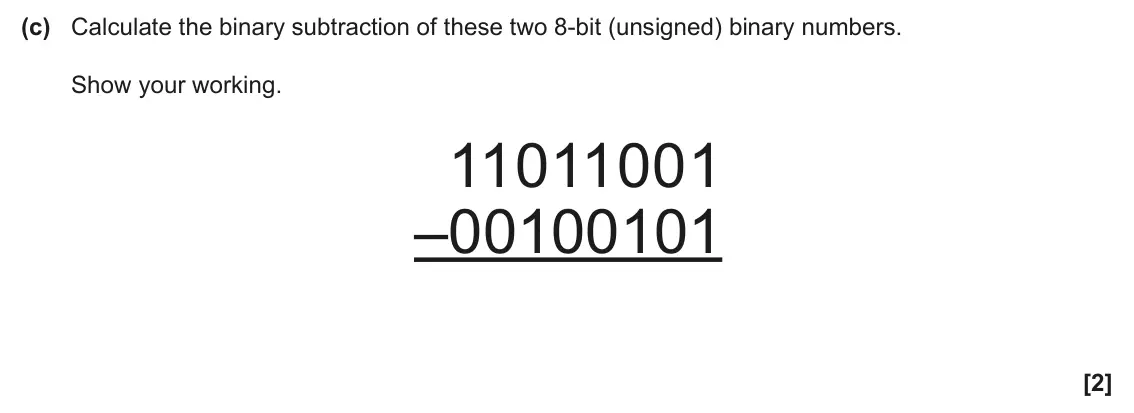
Q5(d)
The whole paper ↗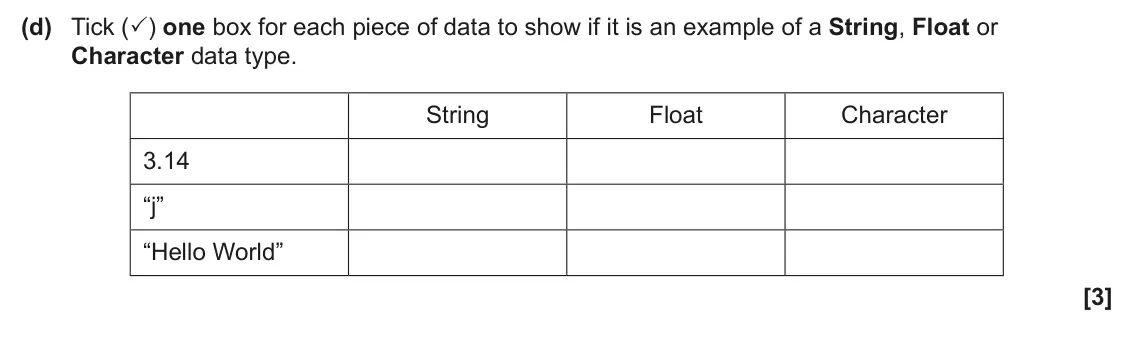
Q6(a)
The whole paper ↗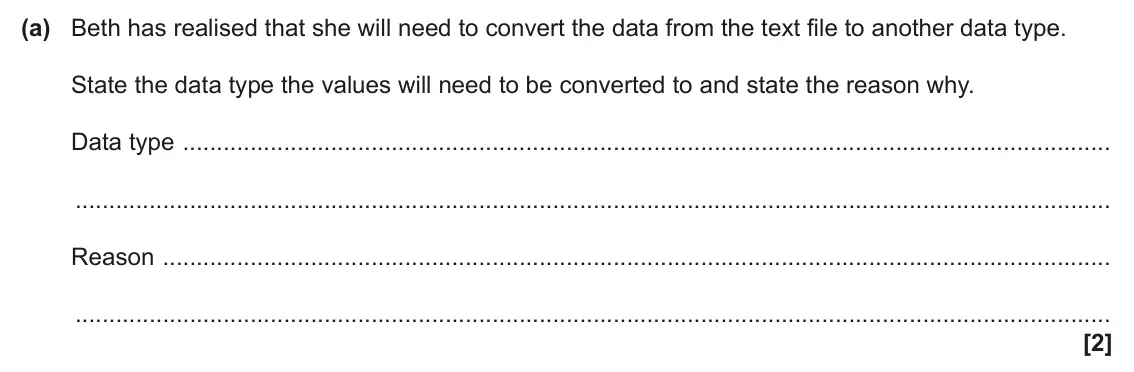
Q7(a)
The whole paper ↗
Q7(b)
The whole paper ↗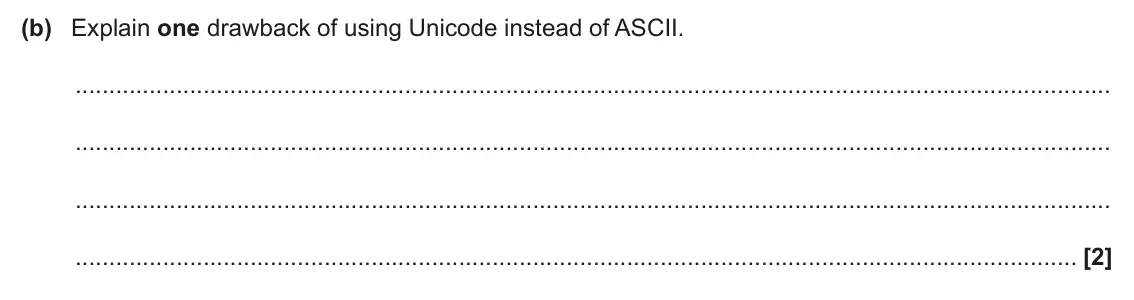
Q2(b)(i)
The whole paper ↗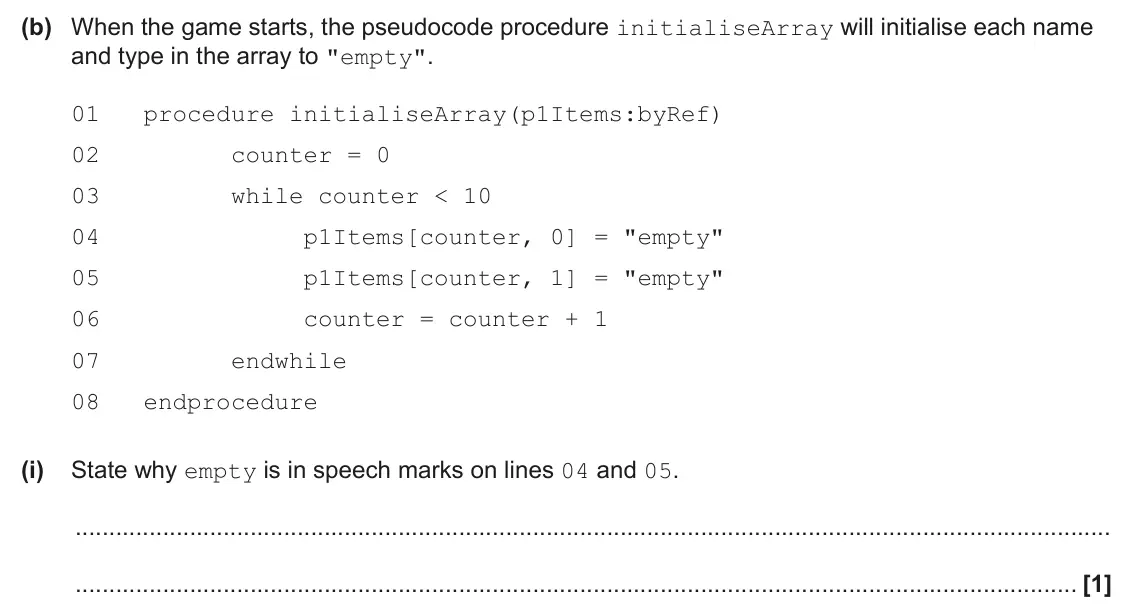
Q4(a)(i)
The whole paper ↗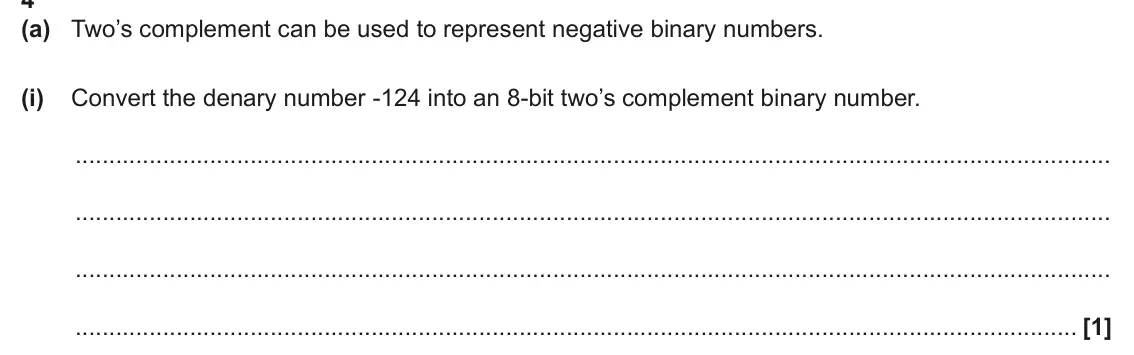
Q4(a)(ii)
The whole paper ↗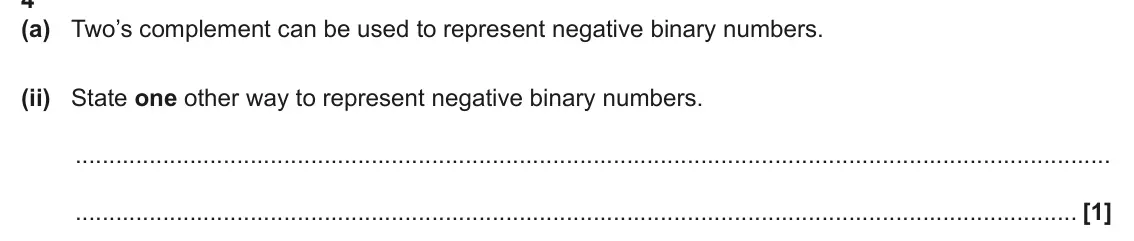
Q4(b)
The whole paper ↗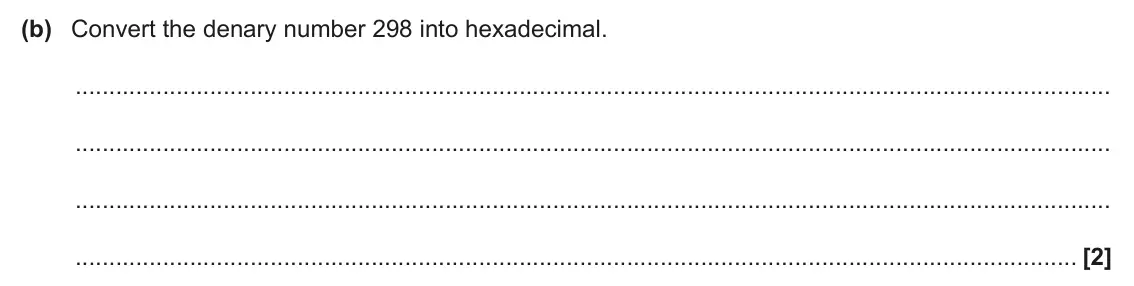
Q4(c)
The whole paper ↗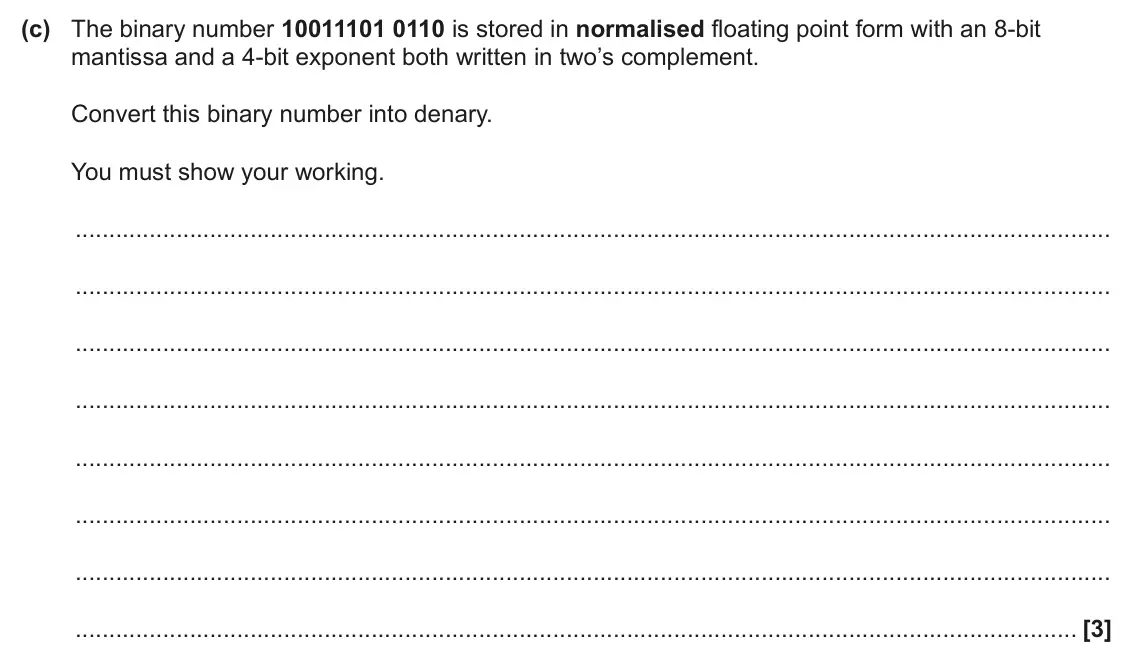
Q4(d)
The whole paper ↗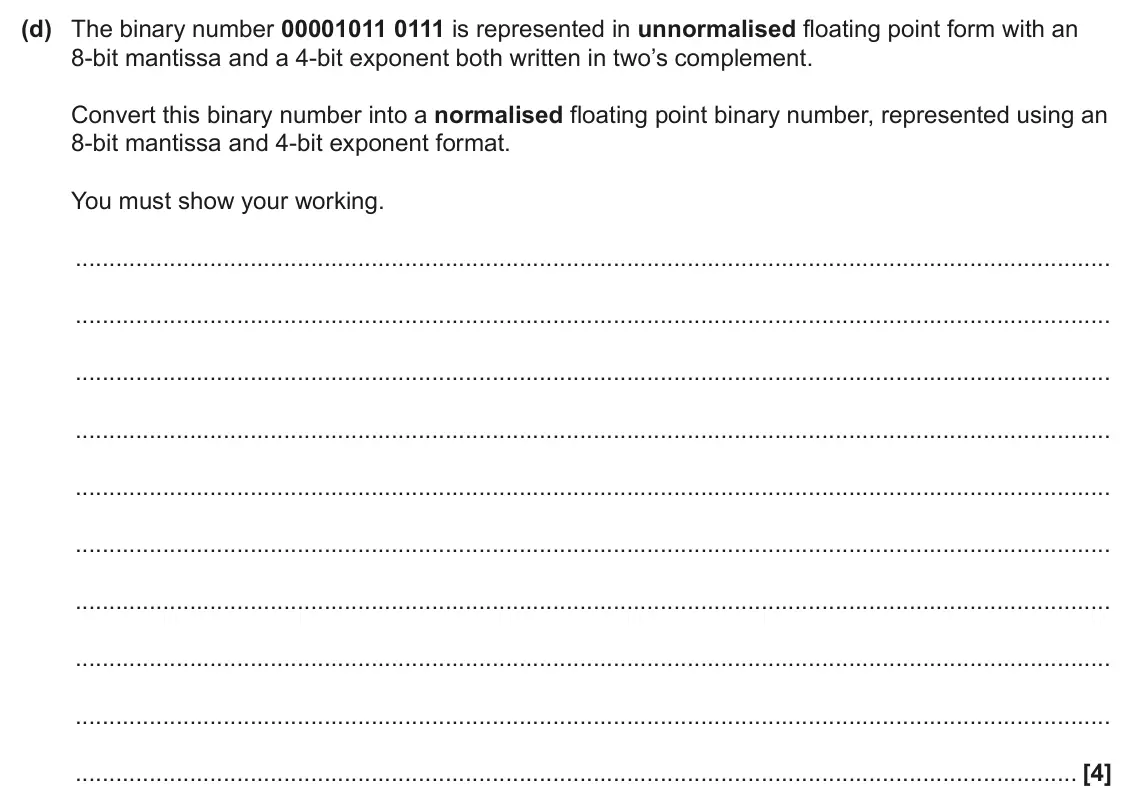
All 60 questions on Data types, as a list
- June 2025, Paper 1, Q3(a)(i) (1 mark): Convert the denary number 189 into an 8-bit binary number. [1]
- June 2025, Paper 1, Q3(a)(ii) (1 mark): Convert the denary number 189 into a hexadecimal value. [1]
- June 2025, Paper 1, Q3(a)(iii) (1 mark): Convert the hexadecimal value E4 into a denary number. [1]
- June 2025, Paper 1, Q3(b) (2 marks): Explain the effect that a right shift of three places will have on a positive binary number. [2]
- June 2025, Paper 1, Q3(c) (6 marks): Show the subtraction of these two floating point binary numbers. Both numbers are stored in a normalised floating point format, using 6 bits for the mantissa an
- June 2025, Paper 1, Q3(d)(i) (2 marks): Show the result of applying a bitwise AND mask of 1010 1110 to the byte 1010 0011. Byte 1010 0011 AND Mask 1010 1110 Result [2]
- June 2025, Paper 1, Q3(d)(ii) (1 mark): State the purpose of the bitwise AND mask. [1]
- June 2025, AS Paper 1, Q5(a) (1 mark): Convert the denary number 183 into a hexadecimal number. [1]
- June 2025, AS Paper 1, Q5(b) (2 marks): Calculate the binary addition of these two 8-bit (unsigned) binary numbers. Show your working. 01010011 +11101011 [2]
- June 2025, AS Paper 1, Q5(c) (2 marks): Calculate the binary subtraction of these two 8-bit (unsigned) binary numbers. Show your working. 11011001 –00100101 [2]
- June 2025, AS Paper 1, Q5(d) (3 marks): Tick () one box for each piece of data to show if it is an example of a String, Float or Character data type. String Float Character 3.14 “j” “Hello World” [3]
- June 2025, AS Paper 1, Q6(a) (2 marks): Beth has realised that she will need to convert the data from the text file to another data type. State the data type the values will need to be converted to an
- June 2025, AS Paper 1, Q7(a) (2 marks): Explain one benefit of using Unicode instead of ASCII. [2]
- June 2025, AS Paper 1, Q7(b) (2 marks): Explain one drawback of using Unicode instead of ASCII. [2]
- June 2025, AS Paper 2, Q2(b)(i) (1 mark): State why empty is in speech marks on lines 04 and 05. [1]
- June 2024, Paper 1, Q4(a)(i) (1 mark): Convert the denary number -124 into an 8-bit two’s complement binary number. [1]
- June 2024, Paper 1, Q4(a)(ii) (1 mark): State one other way to represent negative binary numbers. [1]
- June 2024, Paper 1, Q4(b) (2 marks): Convert the denary number 298 into hexadecimal. [2]
- June 2024, Paper 1, Q4(c) (3 marks): The binary number 10011101 0110 is stored in normalised floating point form with an 8-bit mantissa and a 4-bit exponent both written in two’s complement. Conver
- June 2024, Paper 1, Q4(d) (4 marks): The binary number 00001011 0111 is represented in unnormalised floating point form with an 8-bit mantissa and a 4-bit exponent both written in two’s complement.
- June 2024, Paper 1, Q4(e) (2 marks): Calculate the binary addition of these two 8-bit (unsigned) binary numbers. Show your working. 00110111 10011001 + [2]
- June 2024, AS Paper 1, Q6(a)(i) (1 mark): A positive denary number. [1]
- June 2024, AS Paper 1, Q6(a)(ii) (1 mark): A negative denary number using two’s complement. [1]
- June 2024, AS Paper 1, Q6(a)(iii) (1 mark): A hexadecimal value. [1]
- June 2024, AS Paper 1, Q6(b) (9 marks): (b)* Binary values stored by a computer can represent different types of data. Discuss the different types of data that can be stored in binary and why computer
- June 2023, Paper 1, Q3(a)(i) (1 mark): Convert the denary number 189 to hexadecimal. [1]
- June 2023, Paper 1, Q3(a)(ii) (1 mark): Convert the unsigned binary number 1010101111 to hexadecimal. [1]
- June 2023, Paper 1, Q3(b)(i) (1 mark): Convert the denary number -107 to an 8-bit binary number using sign and magnitude. [1]
- June 2023, Paper 1, Q3(b)(ii) (1 mark): Convert the denary number -107 to an 8-bit binary number using two’s complement. [1]
- June 2023, Paper 1, Q3(b)(iii) (1 mark): Give one advantage of storing values using two’s complement instead of sign and magnitude. [1]
- June 2023, Paper 1, Q3(c) (4 marks): Show how the denary value -15.75 can be represented as a normalised floating point binary number using 8 bits for the mantissa and 4 bits for the exponent. You
- June 2023, Paper 1, Q3(d) (3 marks): The normalised floating point binary number 0100 1110 is stored using 4 bits for the mantissa and 4 bits for the exponent, both in two’s complement. Convert thi
- June 2023, Paper 1, Q3(e) (2 marks): Complete each of the following sentences relating to the storage of floating point binary numbers with an appropriate word. Increasing the number of bits used f
- June 2023, AS Paper 1, Q3(a) (2 marks): Describe what is meant by the term ‘character set’. [2]
- June 2023, AS Paper 1, Q3(b)(i) (2 marks): Convert the hexadecimal number 66 into a denary number. Show your working. [2]
- June 2023, AS Paper 1, Q3(b)(ii) (2 marks): State two reasons why a programmer would prefer to use hexadecimal numbers rather than binary numbers. 1 2 [2]
- June 2023, AS Paper 1, Q3(c) (3 marks): Show the denary value 6.25 as a floating point binary number representing the mantissa and exponent. Both of these should be stored in two’s complement represen
- June 2023, AS Paper 1, Q3(d) (1 mark): State the benefit of using a normalised form when representing data as a floating point number. [1]
- June 2022, Paper 1, Q2(a)(iii) (1 mark): Identify the data type of the CostPerMonth(£) field. [1]
- June 2022, Paper 1, Q2(a)(iv) (1 mark): Give the name of the field that could be stored using a Boolean data type. [1]
- June 2022, Paper 1, Q3(a)(i) (1 mark): Convert the hexadecimal value B7E to a binary number. [1]
- June 2022, Paper 1, Q3(a)(ii) (1 mark): 110010101 is a binary number that is represented using sign and magnitude. Convert this binary number to a denary number. [1]
- June 2022, Paper 1, Q3(a)(iii) (3 marks): Complete this binary subtraction. Both numbers are 8-bit integer values represented using two’s complement. Show the result in the same format and show your wor
- June 2022, Paper 1, Q3(b) (4 marks): The normalised floating point number 1010 1110 is stored using 4 bits for the mantissa and 4 bits for the exponent, both in two’s complement. Give the denary ve
- June 2022, Paper 1, Q3(c) (4 marks): Table 3 here shows floating point numbers that are stored using 6 bits for the mantissa and 3 bits for the exponent, both in two’s complement. Tick (✓) one box
- June 2022, Paper 1, Q5(e)(ii) (1 mark): Give one similarity between ASCII and Unicode. [1]
- June 2022, Paper 1, Q5(e)(iii) (2 marks): Give two differences between ASCII and Unicode. Difference 1 Difference 2 [2]
- June 2022, AS Paper 1, Q4(a) (1 mark): State why computer systems store data in binary. [1]
- June 2022, AS Paper 1, Q4(b)(i) (1 mark): Convert the denary number 97 into an 8-bit binary number. [1]
- June 2022, AS Paper 1, Q4(b)(ii) (1 mark): Convert the denary number 171 into a hexadecimal number. [1]
- June 2022, AS Paper 1, Q4(b)(iii) (1 mark): Convert the denary number –97 into an 8-bit binary number using two’s complement. [1]
- June 2022, AS Paper 1, Q4(b)(iv) (1 mark): Convert the denary number –17 into an 8-bit binary number using sign and magnitude. [1]
- June 2022, AS Paper 1, Q4(c) (2 marks): State one advantage of using two’s complement instead of sign and magnitude. [2]
- June 2022, AS Paper 1, Q4(d) (2 marks): Calculate the addition of these two 8-bit (unsigned) binary numbers. Show your working. 11011011 10001001 + [2]
- June 2022, AS Paper 1, Q6(a) (2 marks): When the values are being read from the Sales.txt file they will be a string data type. In order for them to be processed they will need to be cast (i.e. conver
- November 2021, Paper 1, Q2(a)(i) (1 mark): Convert the denary number 231 to an unsigned 8-bit binary number. [1]
- November 2021, Paper 1, Q2(a)(ii) (1 mark): Convert the hexadecimal number 6F to an unsigned 8-bit binary number. [1]
- November 2021, Paper 1, Q2(b)(i) (4 marks): Give the normalised version of this number, showing your working. [4]
- November 2021, Paper 1, Q2(b)(ii) (3 marks): Convert your answer to part (i) to denary, showing your working. [3]
- November 2021, Paper 1, Q2(c) (5 marks): Add together the two numbers below. Both numbers are stored in normalised floating point format, using 6 bits for their mantissa and 4 bits for their exponent w
Questions, mark schemes and examiner’s reports are © OCR, from their published past papers. Plumi isn’t affiliated with any exam board. Want whole papers? Full past papers.
Rather write your answers by hand on iPad? Plumi marks them against the same mark schemes.