Skip to content
Try on iPad

Style

Get started

Standard form: Eduqas GCSE Maths questions

Eduqas GCSE Maths past-paper questions on N9 Standard form, June 2017 to June 2025, with mark schemes and examiner’s reports where available.

Getting your paper ready…

Eduqas GCSE MathsStandard form1,464 questions

Paper
All papers
Exam
All years
Calculator
Difficulty
More filters
Exam boards
Eduqas

Loading the full question list…

1,464 questions

More options
  1. Q8June 2025 · Component 1 Higher5 marksStretch

    N7 Laws of indicesR11 Compound units: speed, density and pressure

    1
    Original question 8: Work out the value of 5–32 ÷ 5–35. 8. (a) [2] In a vacuum, a particle of light travels at approximately 3 × 10⁸ metres per second. (b) What is this speed in kil

    Loading the question…

    The whole paper ↗
  2. Q21November 2024 · Component 2 Foundation1 markWarm-up

    N9 Standard formR1 Converting units

    2
    Original question 21: 1 micrometre = 1 × 10⁻⁴ centimetres. Which of the answers below represents 2·4 micrometres in metres? Circle your answer. [1] 2·4 × 10–4 2·4 × 10–6 2·4 × 102 2·

    Loading the question…

    The whole paper ↗
  3. 3
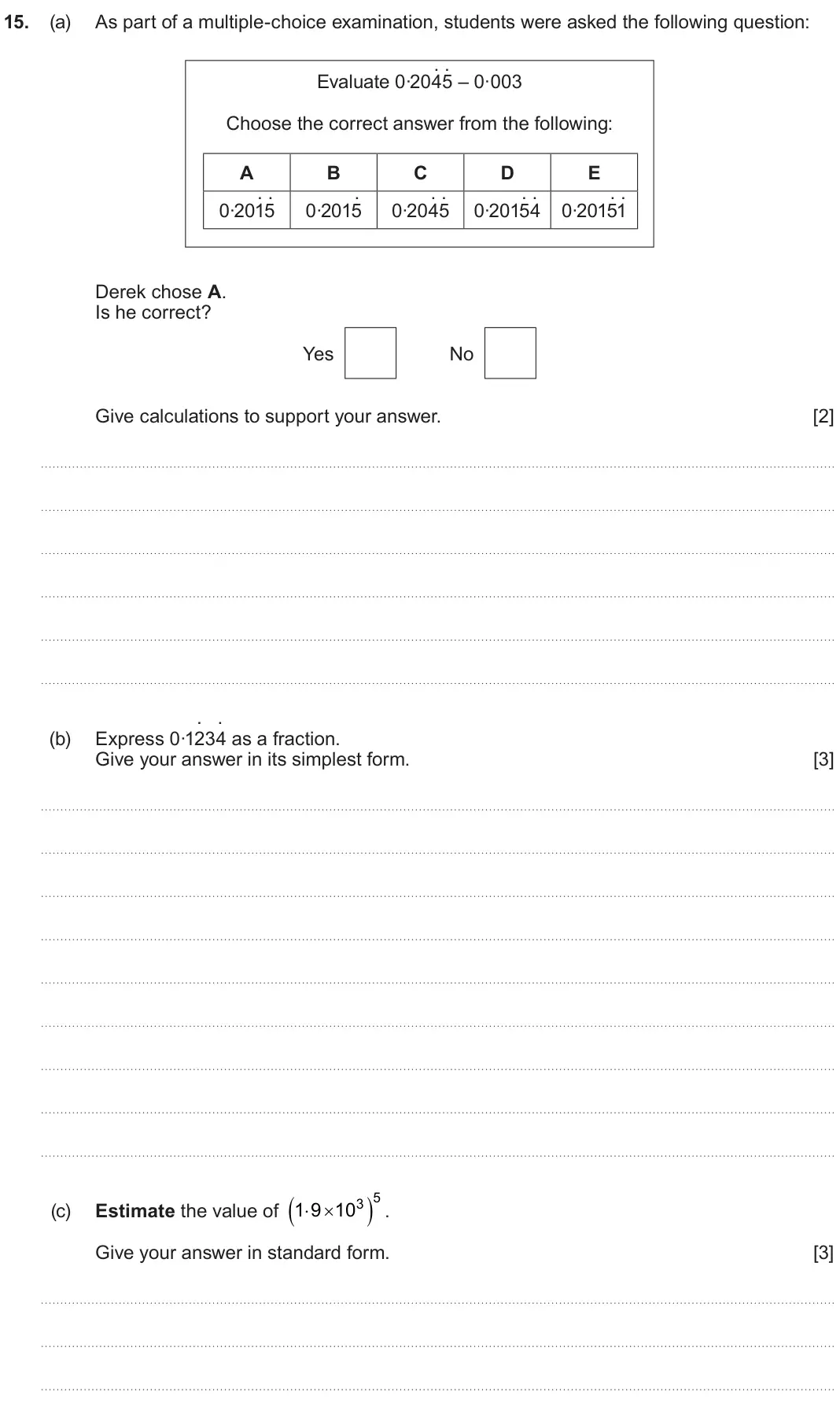
    Original question 15: (a) As part of a multiple-choice examination, students were asked the following question: . . Evaluate 0∙2045 – 0∙003 Choose the correct answer from the followi

    Loading the question…

    The whole paper ↗
  4. Q5November 2024 · Component 2 Higher1 markWarm-up

    N9 Standard formR1 Converting units

    4
    Original question 5: 1 micrometre = 1 × 10⁻⁴ centimetres. Which of the answers below represents 2·4 micrometres in metres? Circle your answer. [1] 2·4 × 10–4 2·4 × 10–6 2·4 × 102 2·

    Loading the question…

    The whole paper ↗
  5. Q29June 2024 · Component 1 Foundation4 marksCore

    N9 Standard form

    5
    Original question 29: 1 29 10   29. (a) Calculate the value of .  7 3 10  Give your answer in standard form. [2] Calculate the value of    5  4 7 6 10  3 10  (b) . Give y

    Loading the question…

    The whole paper ↗
  6. Q12June 2024 · Component 1 Higher4 marksCore

    N9 Standard form

    6
    Original question 12: 1 29 10   12. (a) Calculate the value of .  7 3 10  Give your answer in standard form. [2] Calculate the value of    5  4 7 6 10  3 10  (b) . Give y

    Loading the question…

    The whole paper ↗
  7. Q29November 2023 · Component 1 Foundation2 marksWarm-up

    N9 Standard form

    7
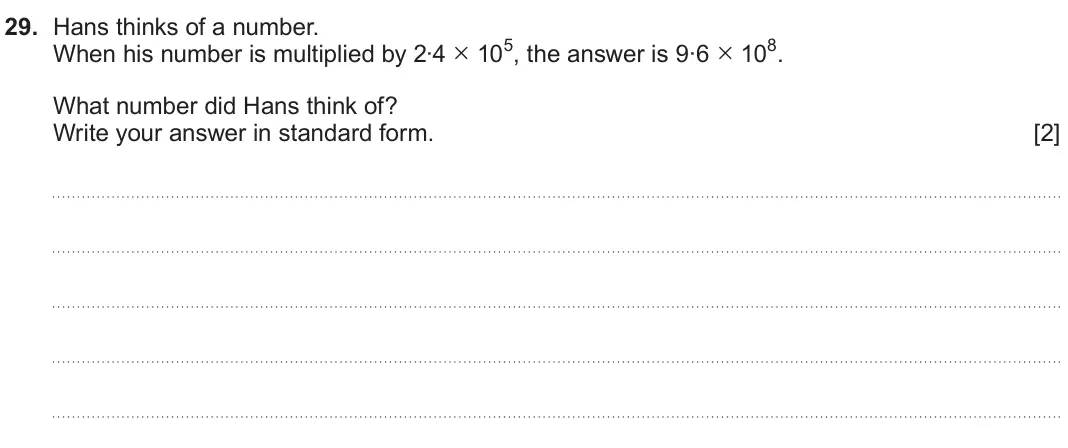
    Original question 29: Hans thinks of a number. When his number is multiplied by 2·4 × 105, the answer is 9·6 × 108. What number did Hans think of? Write your answer in standard form.

    Loading the question…

    The whole paper ↗
  8. Q9November 2023 · Component 1 Higher2 marksWarm-up

    N9 Standard form

    8
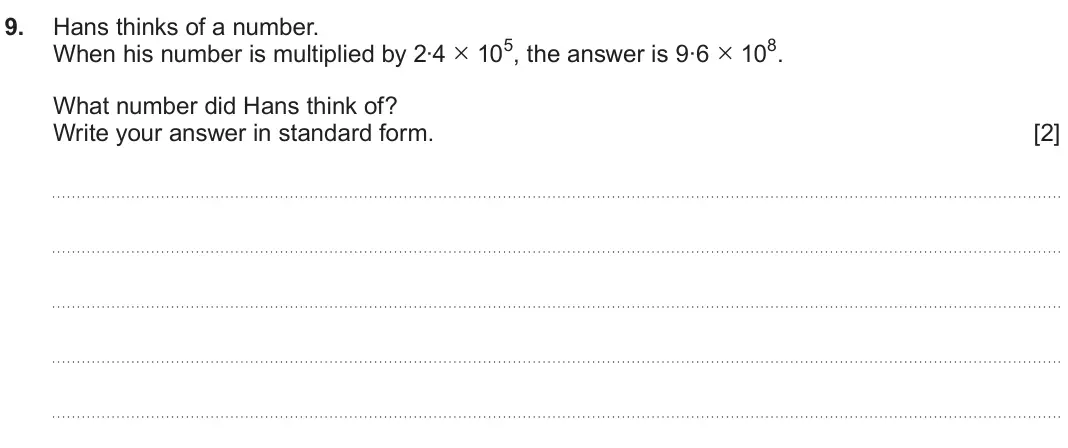
    Original question 9: Hans thinks of a number. When his number is multiplied by 2·4 × 105, the answer is 9·6 × 108. What number did Hans think of? Write your answer in standard form.

    Loading the question…

    The whole paper ↗
  9. Q17November 2023 · Component 1 Higher7 marksStretch

    N7 Laws of indicesN8 Exact calculation and surds

    9
    Original question 17: 8 . 17. (a) Evaluate 3 [2] Write 6 a 2 where a is an integer. (b) in the form [2] 2 Estimate the value of (1·96 × 108) + (6·89 × 108) (c) . 298 Write your answe

    Loading the question…

    The whole paper ↗
  10. Q23June 2023 · Component 1 Foundation3 marksCore

    R9 PercentagesN9 Standard form

    10
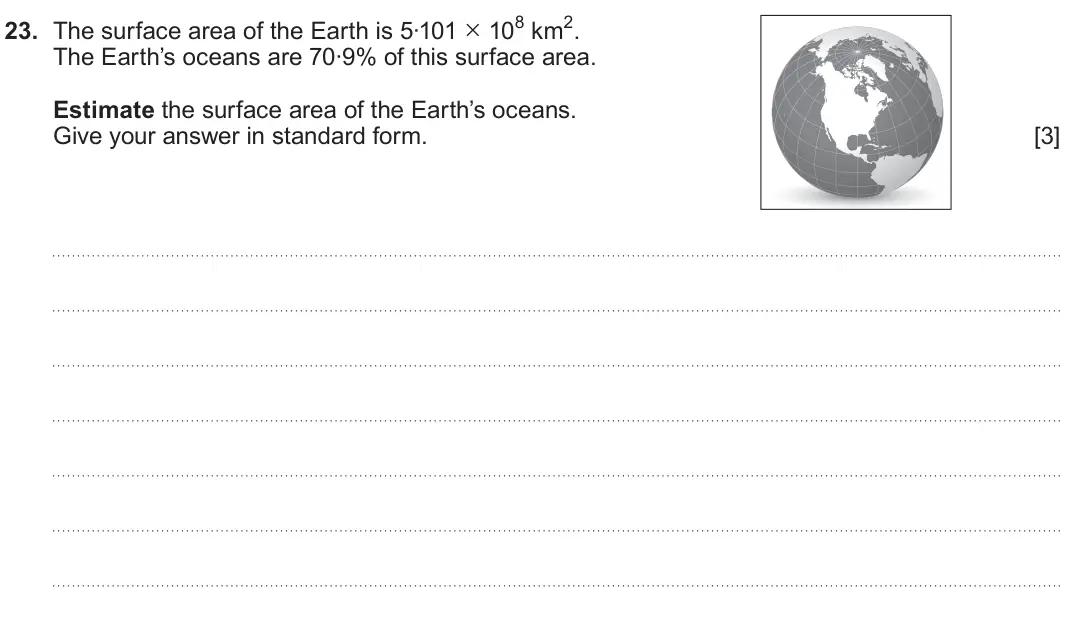
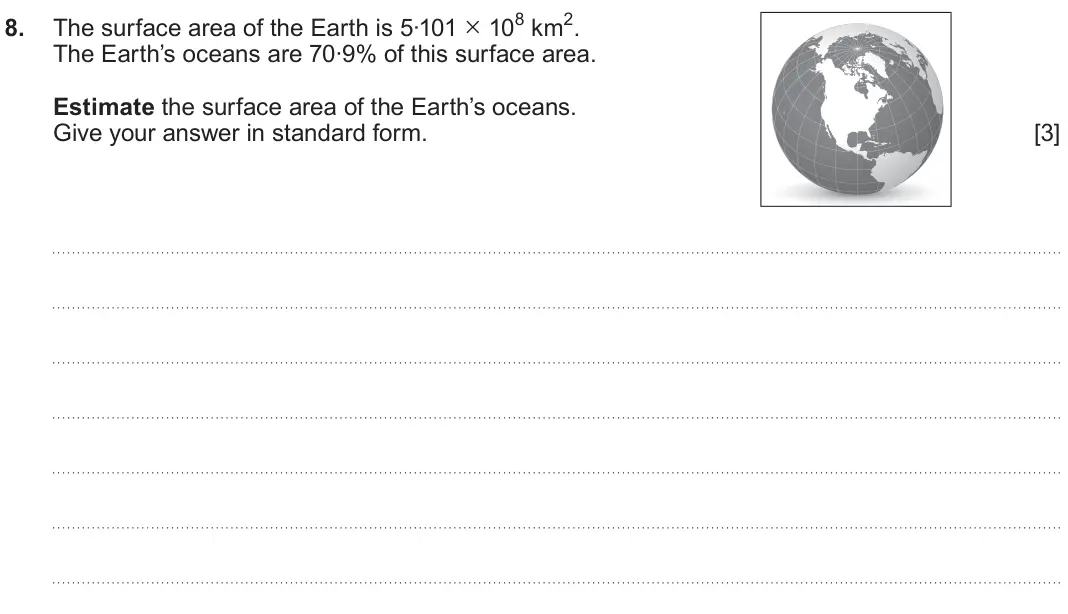
    Original question 23: The surface area of the Earth is 5·101 × 108 km2. The Earth’s oceans are 70·9% of this surface area. Estimate the surface area of the Earth’s oceans. Give your

    Loading the question…

    The whole paper ↗
  11. Q8June 2023 · Component 1 Higher3 marksCore

    R9 PercentagesN9 Standard form

    11
    Original question 8: The surface area of the Earth is 5·101 × 108 km2. 8. The Earth’s oceans are 70·9% of this surface area. Estimate the surface area of the Earth’s oceans. Give yo

    Loading the question…

    The whole paper ↗
  12. Q22November 2022 · Component 1 Foundation5 marksStretch

    N9 Standard formR11 Compound units: speed, density and pressure

    12
    Original question 22: Work out (6 ×10⁵) ÷ 20 . 22. (a) Give your answer in standard form. [2] At midday, the volume of water flowing over a waterfall is 3 × 10⁸ litres per minute. (b

    Loading the question…

    The whole paper ↗
  13. Q4November 2022 · Component 1 Higher5 marksStretch

    N9 Standard formR11 Compound units: speed, density and pressure

    13
    Original question 4: Work out (6 ×10⁵) ÷ 20 . 4. (a) Give your answer in standard form. [2] At midday, the volume of water flowing over a waterfall is 3 × 10⁸ litres per minute. (b)

    Loading the question…

    The whole paper ↗
  14. Q14June 2022 · Component 2 Foundation4 marksCore

    N2 The four operationsN15 Rounding and error intervals

    14
    Original question 14: ·6 × 5·7 14. (a) Calculate the value of . 3·4 − 1·8 Give your answer correct to 1 decimal place. [2] (b) Write 68 321 correct to 2 significant figures. [1] (c)

    Loading the question…

    The whole paper ↗
  15. Q13June 2022 · Component 1 Higher4 marksCore

    R11 Compound units: speed, density and pressureN9 Standard form

    15
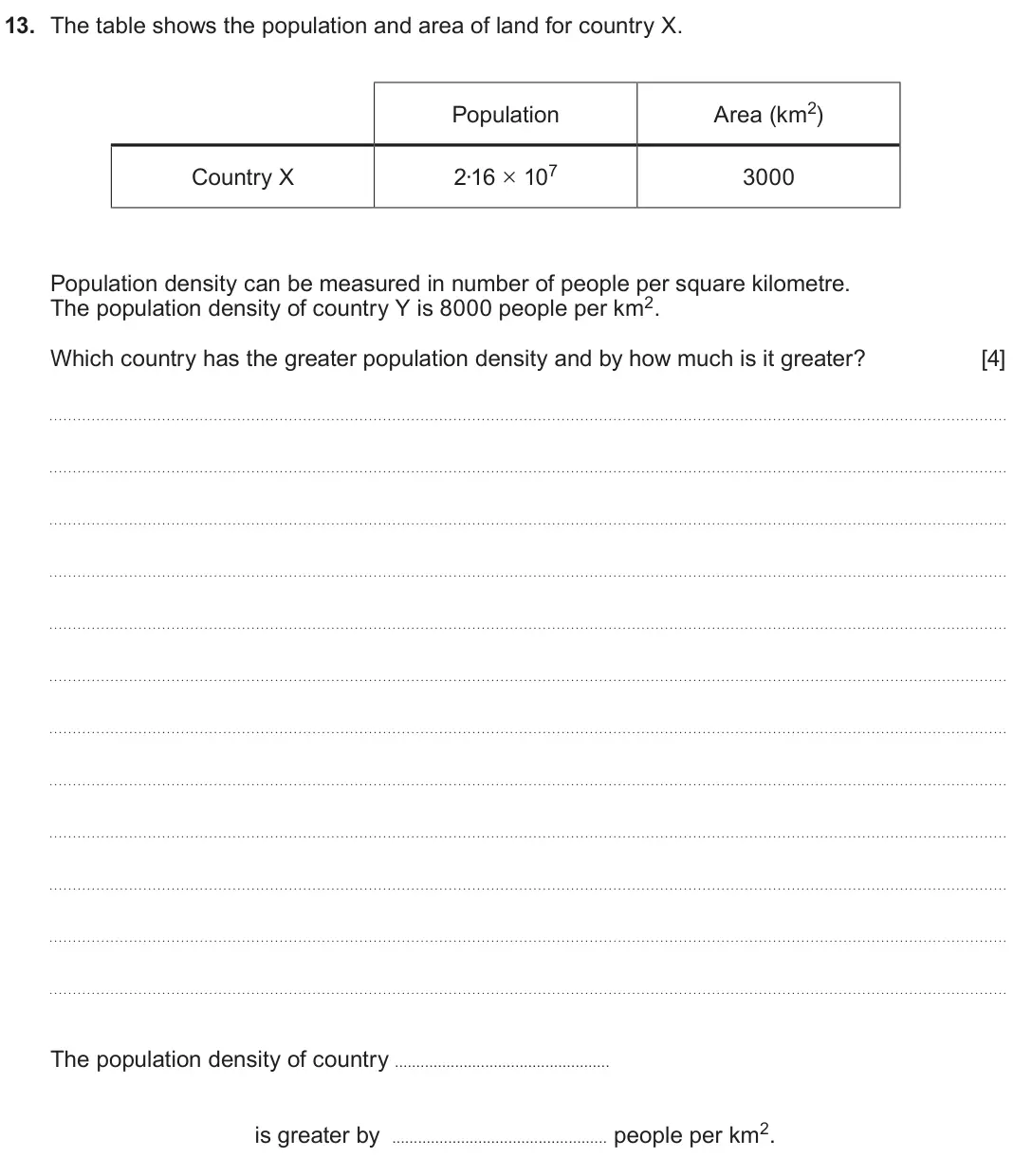
    Original question 13: The table shows the population and area of land for country X. Area (km2) Population 2·16 × 107 Country X 3000 Population density can be measured in number of p

    Loading the question…

    The whole paper ↗
  16. Q12November 2021 · Component 1 Higher9 marksChallenge

    G18 Arcs and sectorsG17 Circles, surface area and volume

    16
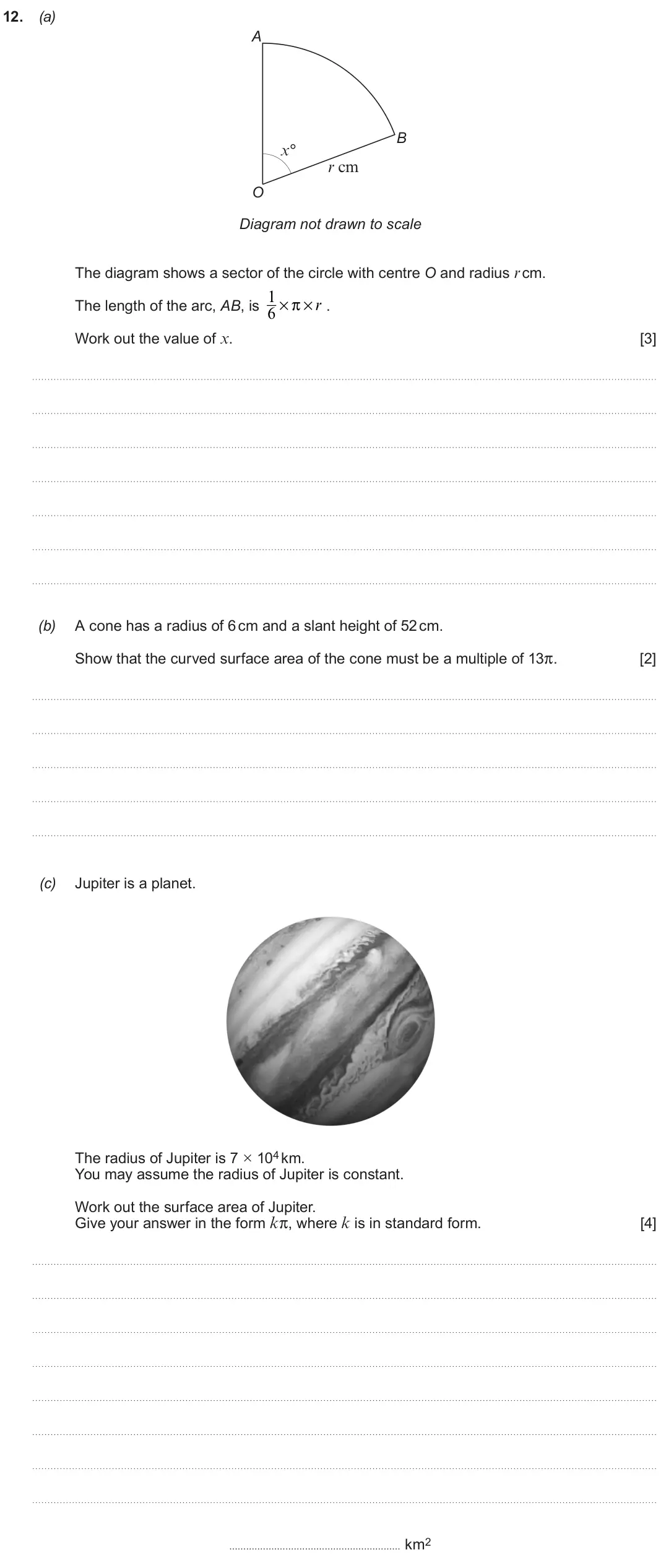
    Original question 12: (a) A B x° r cm O Diagram not drawn to scale The diagram shows a sector of the circle with centre O and radius r cm. 1 6 × π × r The length of the arc, AB, is .

    Loading the question…

    The whole paper ↗
  17. Q14November 2020 · Component 1 Higher10 marksChallenge

    N7 Laws of indicesN9 Standard form

    17
    Original question 14: x2 × x7 14. (a) Simplify . [2] x3 1 (b) (i) Find the positive value of . 16 4 [1] 4 3 (ii) Find the value of . 27 [2] ( ) 3 3.9 ×10⁶ (c) Estimate the value of .

    Loading the question…

    The whole paper ↗
  18. Q13November 2020 · Component 2 Higher3 marksCore

    N9 Standard formR11 Compound units: speed, density and pressure

    18
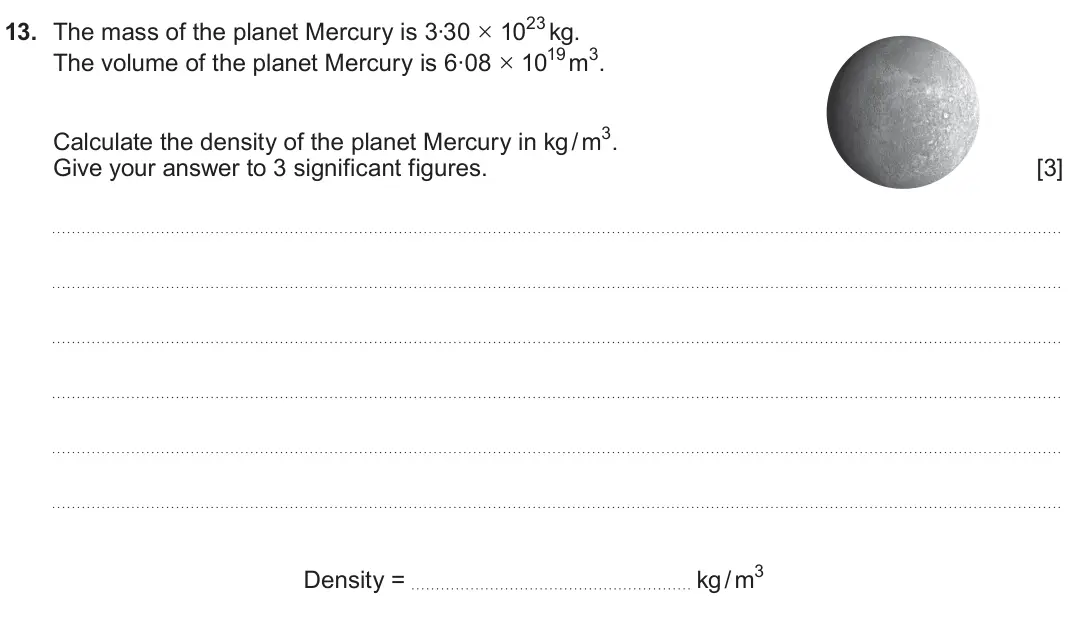
    Original question 13: The mass of the planet Mercury is 3·30 × 1023 kg. The volume of the planet Mercury is 6·08 × 1019 m3. Calculate the density of the planet Mercury in kg / m3. Gi

    Loading the question…

    The whole paper ↗
  19. Q17November 2019 · Component 1 Foundation6 marksStretch

    N9 Standard form

    19
    Original question 17: Write 4.8 × 10⁻³ as an ordinary number. 17. (a) (i) [1] Work out the value of (2.5 × 10²⁰) + (9 × 10²⁰). (ii) Give your answer in standard form. [2] In 2018, th

    Loading the question…

    The whole paper ↗
  20. Q3November 2019 · Component 1 Higher3 marksCore

    N9 Standard formG16 Area of 2D shapes and volume of prisms

    20
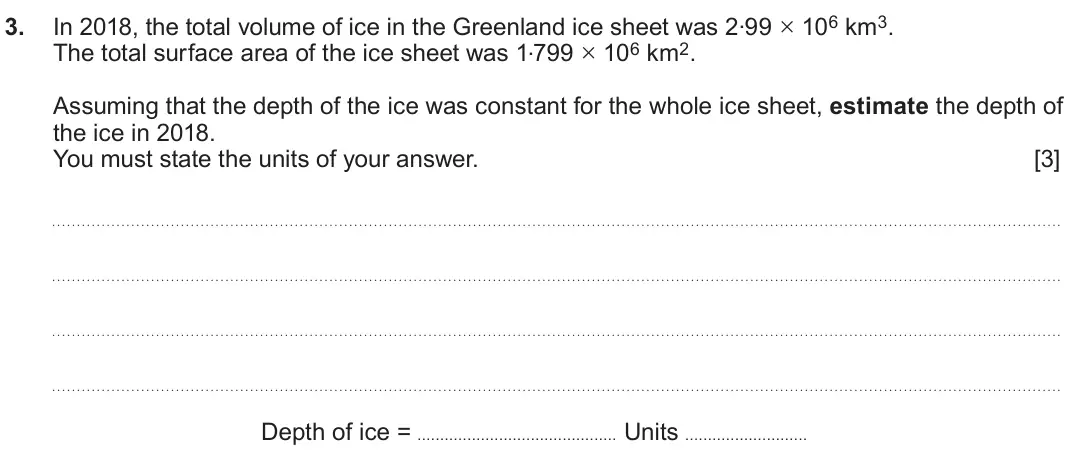
    Original question 3: In 2018, the total volume of ice in the Greenland ice sheet was 2.99 × 10⁶ km3. 3. The total surface area of the ice sheet was 1.799 × 10⁶ km2. Assuming that th

    Loading the question…

    The whole paper ↗
All 30 questions on Standard form, as a list
  1. June 2025, Component 1 Higher, Q8 (5 marks): Work out the value of 5–32 ÷ 5–35. 8. (a) [2] In a vacuum, a particle of light travels at approximately 3 × 10⁸ metres per second. (b) What is this speed in kil
  2. November 2024, Component 2 Foundation, Q21 (1 mark): 1 micrometre = 1 × 10⁻⁴ centimetres. Which of the answers below represents 2·4 micrometres in metres? Circle your answer. [1] 2·4 × 10–4 2·4 × 10–6 2·4 × 102 2·
  3. November 2024, Component 1 Higher, Q15 (8 marks): (a) As part of a multiple-choice examination, students were asked the following question: . . Evaluate 0∙2045 – 0∙003 Choose the correct answer from the followi
  4. November 2024, Component 2 Higher, Q5 (1 mark): 1 micrometre = 1 × 10⁻⁴ centimetres. Which of the answers below represents 2·4 micrometres in metres? Circle your answer. [1] 2·4 × 10–4 2·4 × 10–6 2·4 × 102 2·
  5. June 2024, Component 1 Foundation, Q29 (4 marks): 1 29 10   29. (a) Calculate the value of .  7 3 10  Give your answer in standard form. [2] Calculate the value of    5  4 7 6 10  3 10  (b) . Give y
  6. June 2024, Component 1 Higher, Q12 (4 marks): 1 29 10   12. (a) Calculate the value of .  7 3 10  Give your answer in standard form. [2] Calculate the value of    5  4 7 6 10  3 10  (b) . Give y
  7. November 2023, Component 1 Foundation, Q29 (2 marks): Hans thinks of a number. When his number is multiplied by 2·4 × 105, the answer is 9·6 × 108. What number did Hans think of? Write your answer in standard form.
  8. November 2023, Component 1 Higher, Q9 (2 marks): Hans thinks of a number. When his number is multiplied by 2·4 × 105, the answer is 9·6 × 108. What number did Hans think of? Write your answer in standard form.
  9. November 2023, Component 1 Higher, Q17 (7 marks): 8 . 17. (a) Evaluate 3 [2] Write 6 a 2 where a is an integer. (b) in the form [2] 2 Estimate the value of (1·96 × 108) + (6·89 × 108) (c) . 298 Write your answe
  10. June 2023, Component 1 Foundation, Q23 (3 marks): The surface area of the Earth is 5·101 × 108 km2. The Earth’s oceans are 70·9% of this surface area. Estimate the surface area of the Earth’s oceans. Give your
  11. June 2023, Component 1 Higher, Q8 (3 marks): The surface area of the Earth is 5·101 × 108 km2. 8. The Earth’s oceans are 70·9% of this surface area. Estimate the surface area of the Earth’s oceans. Give yo
  12. November 2022, Component 1 Foundation, Q22 (5 marks): Work out (6 ×10⁵) ÷ 20 . 22. (a) Give your answer in standard form. [2] At midday, the volume of water flowing over a waterfall is 3 × 10⁸ litres per minute. (b
  13. November 2022, Component 1 Higher, Q4 (5 marks): Work out (6 ×10⁵) ÷ 20 . 4. (a) Give your answer in standard form. [2] At midday, the volume of water flowing over a waterfall is 3 × 10⁸ litres per minute. (b)
  14. June 2022, Component 2 Foundation, Q14 (4 marks): ·6 × 5·7 14. (a) Calculate the value of . 3·4 − 1·8 Give your answer correct to 1 decimal place. [2] (b) Write 68 321 correct to 2 significant figures. [1] (c)
  15. June 2022, Component 1 Higher, Q13 (4 marks): The table shows the population and area of land for country X. Area (km2) Population 2·16 × 107 Country X 3000 Population density can be measured in number of p
  16. November 2021, Component 1 Higher, Q12 (9 marks): (a) A B x° r cm O Diagram not drawn to scale The diagram shows a sector of the circle with centre O and radius r cm. 1 6 × π × r The length of the arc, AB, is .
  17. November 2020, Component 1 Higher, Q14 (10 marks): x2 × x7 14. (a) Simplify . [2] x3 1 (b) (i) Find the positive value of . 16 4 [1] 4 3 (ii) Find the value of . 27 [2] ( ) 3 3.9 ×10⁶ (c) Estimate the value of .
  18. November 2020, Component 2 Higher, Q13 (3 marks): The mass of the planet Mercury is 3·30 × 1023 kg. The volume of the planet Mercury is 6·08 × 1019 m3. Calculate the density of the planet Mercury in kg / m3. Gi
  19. November 2019, Component 1 Foundation, Q17 (6 marks): Write 4.8 × 10⁻³ as an ordinary number. 17. (a) (i) [1] Work out the value of (2.5 × 10²⁰) + (9 × 10²⁰). (ii) Give your answer in standard form. [2] In 2018, th
  20. November 2019, Component 1 Higher, Q3 (3 marks): In 2018, the total volume of ice in the Greenland ice sheet was 2.99 × 10⁶ km3. 3. The total surface area of the ice sheet was 1.799 × 10⁶ km2. Assuming that th
  21. June 2019, Component 2 Foundation, Q15 (3 marks): (a) Calculate 2.42 3 × 5.1 Give your answer correct to 2 decimal places. [2] (b) Calculate (1·8 × 106) × (2·5 × 108) giving your answer in standard form. [1]
  22. June 2019, Component 1 Higher, Q11 (5 marks): Find the value of (3 × 1017) × (8 × 109). 11. (a) Give your answer in standard form. [2] (b) In a particular country for one year: the total energy consumption
  23. November 2018, Component 1 Foundation, Q18 (6 marks): (a) (i) Write down the value of . 3 [1] 8 (ii) Simplify . 5 × [1] 5 Work out the value of (2 × 104) × (4 × 103). (b) (i) Give your answer in standard form. [2]
  24. November 2018, Component 1 Higher, Q3 (2 marks): Light travels at 3 × 10⁵ kilometres per second. 3. The circumference of the Earth at the equator is 40 000 km. Show that, in theory, a beam of light could circl
  25. June 2018, Component 2 Foundation, Q17 (3 marks): (a) Which of the following are not written in standard form? Circle your answers. [1] 1.2 × 10³ 12.5 × 10⁷ 12 000 000 7 million 6.087 × 10⁶ Calculate 5 × (2.6 ×
  26. June 2018, Component 2 Higher, Q3 (3 marks): 1 AU is 1 astronomical unit. 1 AU = 1.496 × 10⁸ km, which is the distance from the Sun to Earth. The distance between the planet Mercury and Earth can vary from
  27. November 2017, Component 1 Higher, Q1 (8 marks): (a) Write 360 as a product of prime factors using index notation. [3] In index notation, 315 = 32 × 5 × 7. (b) Find the highest common factor of 315 and 360. [2
  28. November 2017, Component 2 Higher, Q8 (3 marks): Each wheel on a truck has a diameter of 1.22 metres. 8. During April each wheel made 2.4 × 10⁶ revolutions. How far did the truck travel in April? Give your ans
  29. June 2017, Component 2 Foundation, Q26 (1 mark): Work out the answer. Give your answer in standard form. 4.5 × 10–6 × 3.4 × 1020 [1]
  30. June 2017, Component 2 Higher, Q6 (2 marks): Work out each of the following. Give your answers in standard form. 4.5 × 10–6 × 3.4 × 1020 (a) [1] 6.8 × 1025 (b) [1] 8 × 10⁵ + 2.6 × 10⁶

Questions, mark schemes and examiner’s reports are © WJEC Eduqas, from their published past papers. Plumi isn’t affiliated with any exam board. Want whole papers? Eduqas GCSE Maths past papers.

The Plumi iPad app also offers exam-style questions with AI feedback on your handwritten working.