Skip to content
Try on iPad

Style

Get started

Generating sequences: Eduqas GCSE Maths questions

Eduqas GCSE Maths past-paper questions on A23 Generating sequences, June 2017 to June 2025, with mark schemes and examiner’s reports where available.

Getting your paper ready…

Eduqas GCSE MathsGenerating sequences1,464 questions

Paper
All papers
Exam
All years
Calculator
Difficulty
More filters
Exam boards
Eduqas

Loading the full question list…

1,464 questions

More options
  1. Q11June 2025 · Component 2 Foundation8 marksChallenge

    A23 Generating sequencesA4 Simplifying, expanding and factorising

    1
    Original question 11: (a) Write down the next two terms in the sequence. [2] –15, –12, –9, –6, ,   16 3 2 7 (b) Simplify y  y  . [2] Factorise 12 9 w  (c) . [1] Solve 5 3 14 x 

    Loading the question…

    The whole paper ↗
  2. Q8November 2024 · Component 2 Foundation3 marksCore

    A23 Generating sequencesA24 Special sequences

    2
    Original question 8: (a) (i) Write down the next term in the following sequence. [1] 3, 12, 48, 192, . . . (ii) Write down the rule for continuing the following sequence. [1] −3, −1

    Loading the question…

    The whole paper ↗
  3. Q10June 2024 · Component 2 Foundation6 marksStretch

    A23 Generating sequencesA25 The nth term

    3
    Original question 10: (a) The following sequence of patterns is made using squares and triangles. Pattern 1 Pattern 2 Pattern 3 (i) Draw Pattern 5 in the space below. [1] (ii) Is it

    Loading the question…

    The whole paper ↗
  4. Q20June 2024 · Component 2 Foundation5 marksStretch

    R16 Growth, decay and compound interestA23 Generating sequences

    4
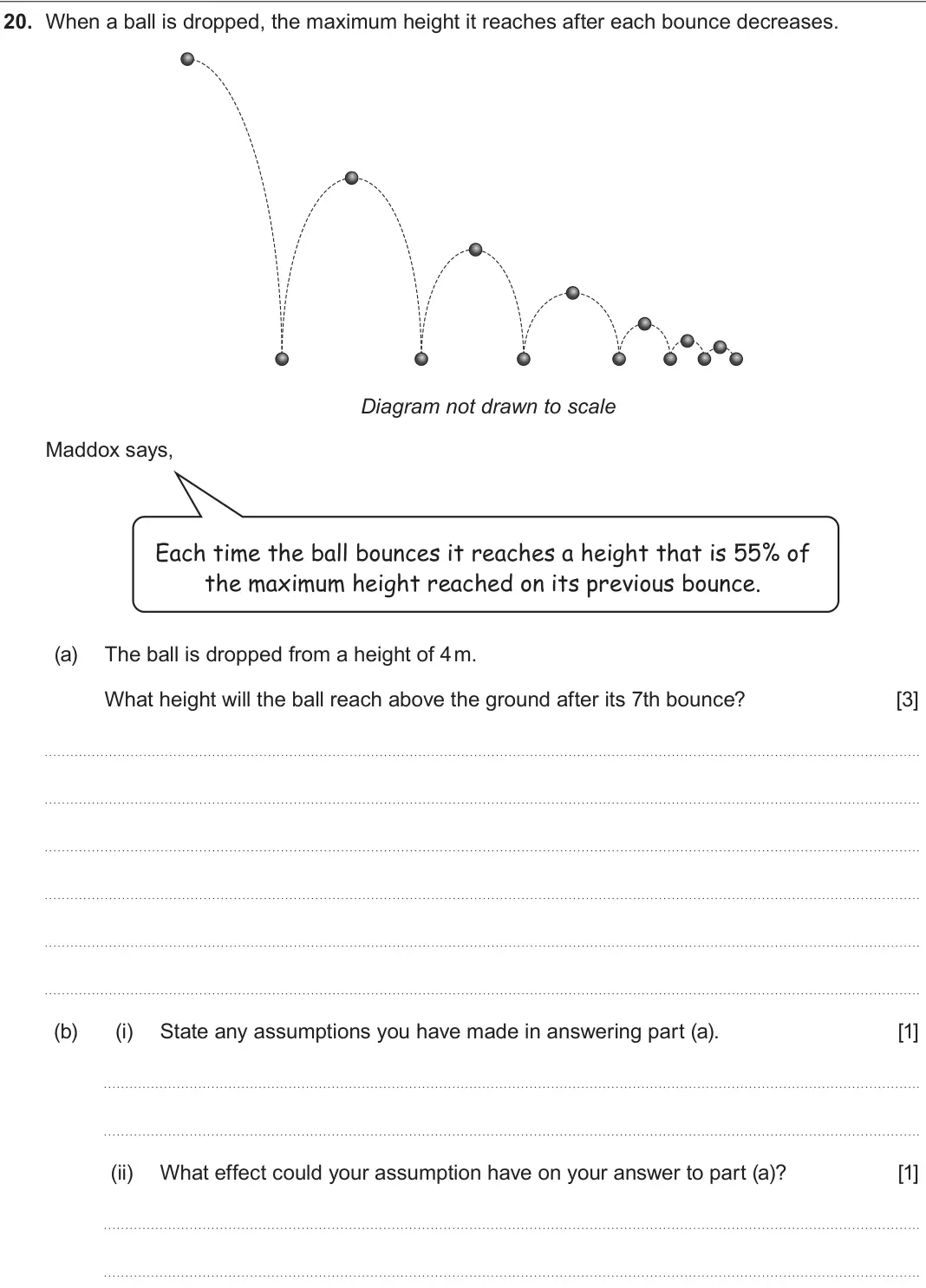
    Original question 20: When a ball is dropped, the maximum height it reaches after each bounce decreases. Diagram not drawn to scale Maddox says, Each time the ball bounces it reaches

    Loading the question…

    The whole paper ↗
  5. Q5June 2024 · Component 2 Higher5 marksStretch

    R16 Growth, decay and compound interestA23 Generating sequences

    5
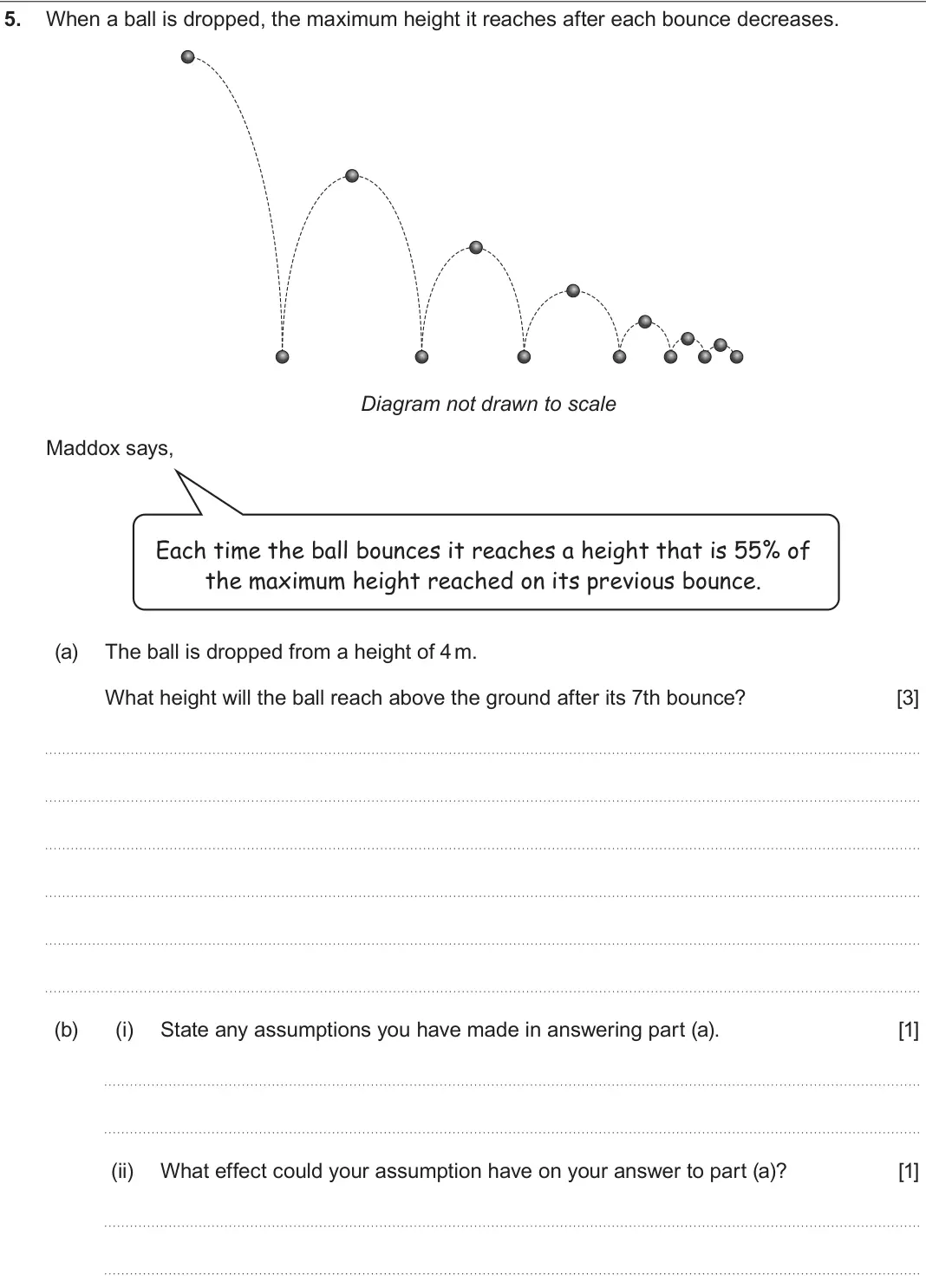
    Original question 5: When a ball is dropped, the maximum height it reaches after each bounce decreases. Diagram not drawn to scale Maddox says, Each time the ball bounces it reaches

    Loading the question…

    The whole paper ↗
  6. Q16June 2023 · Component 1 Foundation6 marksStretch

    A23 Generating sequencesN2 The four operations

    6
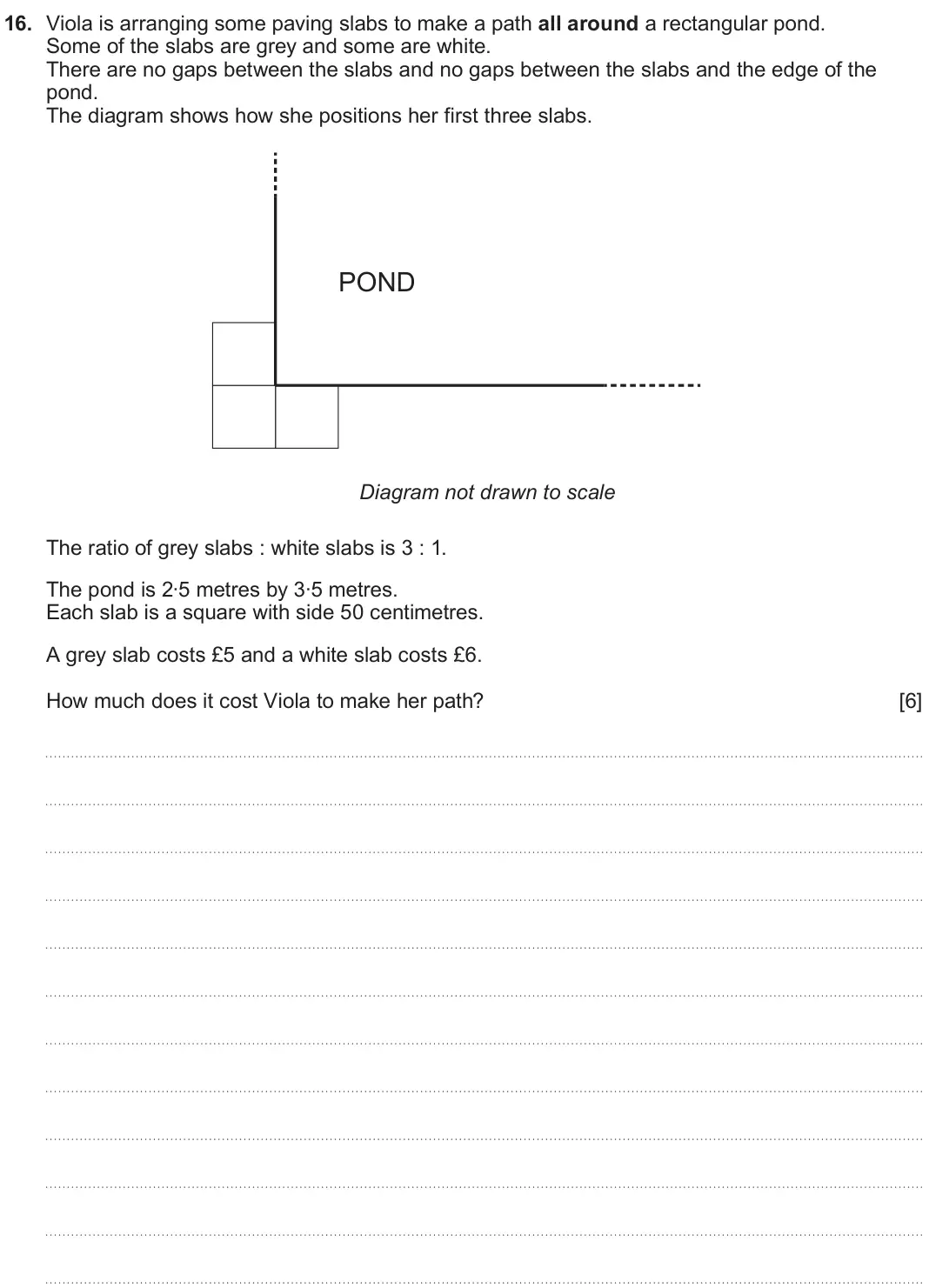
    Original question 16: Viola is arranging some paving slabs to make a path all around a rectangular pond. Some of the slabs are grey and some are white. There are no gaps between the

    Loading the question…

    The whole paper ↗
  7. Q22June 2023 · Component 2 Higher5 marksStretch

    A23 Generating sequencesA20 Iteration

    7
    Original question 22: (a) The first 5 terms of a sequence are shown below. 5 8 11 14 17 Complete the term-to-term rule for this sequence. [1] 5 t  1 tn+1 = tn , n x 1 2x + 5 Show th

    Loading the question…

    The whole paper ↗
  8. Q7June 2022 · Component 2 Foundation3 marksCore

    A23 Generating sequencesA25 The nth term

    8
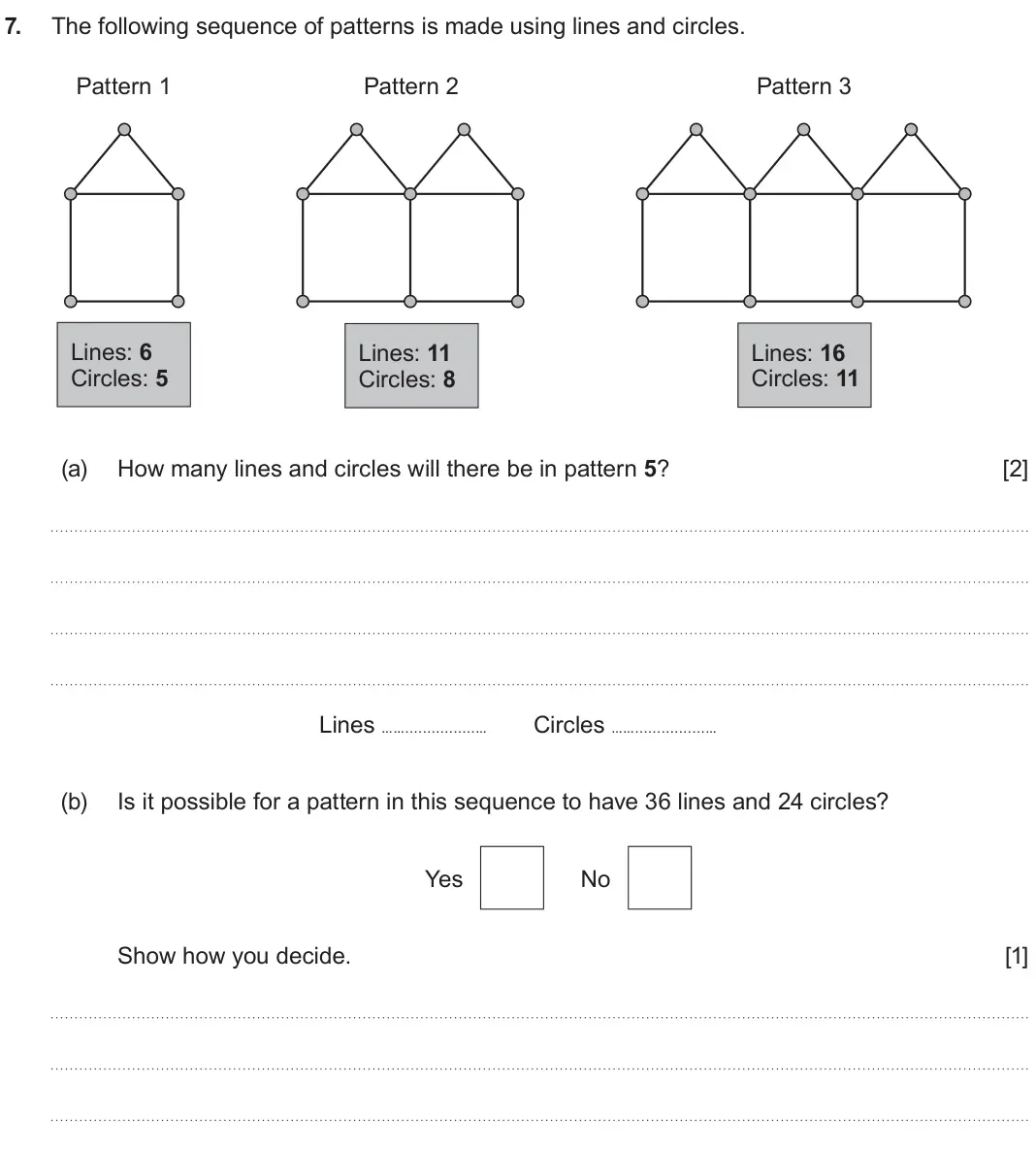
    Original question 7: The following sequence of patterns is made using lines and circles. Pattern 1 Pattern 2 Pattern 3 Lines: 6 Lines: 11 Lines: 16 Circles: 5 Circles: 8 Circles: 11

    Loading the question…

    The whole paper ↗
  9. Q4November 2020 · Component 2 Foundation4 marksCore

    A23 Generating sequencesA25 The nth term

    9
    Original question 4: (a) Here are the first four patterns in a sequence. Pattern 1 2 3 4 5 (i) Draw pattern 5. [1] (ii) How many circles will be in pattern 6? [1] (iii) Which patter

    Loading the question…

    The whole paper ↗
  10. Q11November 2018 · Component 2 Foundation5 marksStretch

    A23 Generating sequencesA25 The nth term

    10
    Original question 11: (a) Write down the next two terms for this sequence 17, 31, 45, 59, ……. , ……. [1] (b) For the sequence below, what is the rule for finding the next term? 13, 26

    Loading the question…

    The whole paper ↗
  11. Q26June 2018 · Component 1 Foundation4 marksCore

    A25 The nth termA23 Generating sequences

    11
    Original question 26: (a) Find an expression for the nth term of this sequence. [2] 3 11 19 27 35 The nth term of a different sequence is 2n3 + 3. (b) Write down the first 3 terms of

    Loading the question…

    The whole paper ↗
  12. Q3June 2018 · Component 1 Higher4 marksCore

    A25 The nth termA23 Generating sequences

    12
    Original question 3: (a) Find an expression for the nth term of this sequence. [2] 3 11 19 27 35 The nth term of a different sequence is 2n3 + 3. (b) Write down the first 3 terms of

    Loading the question…

    The whole paper ↗
  13. Q14November 2017 · Component 2 Higher5 marksStretch

    A25 The nth termA23 Generating sequences

    13
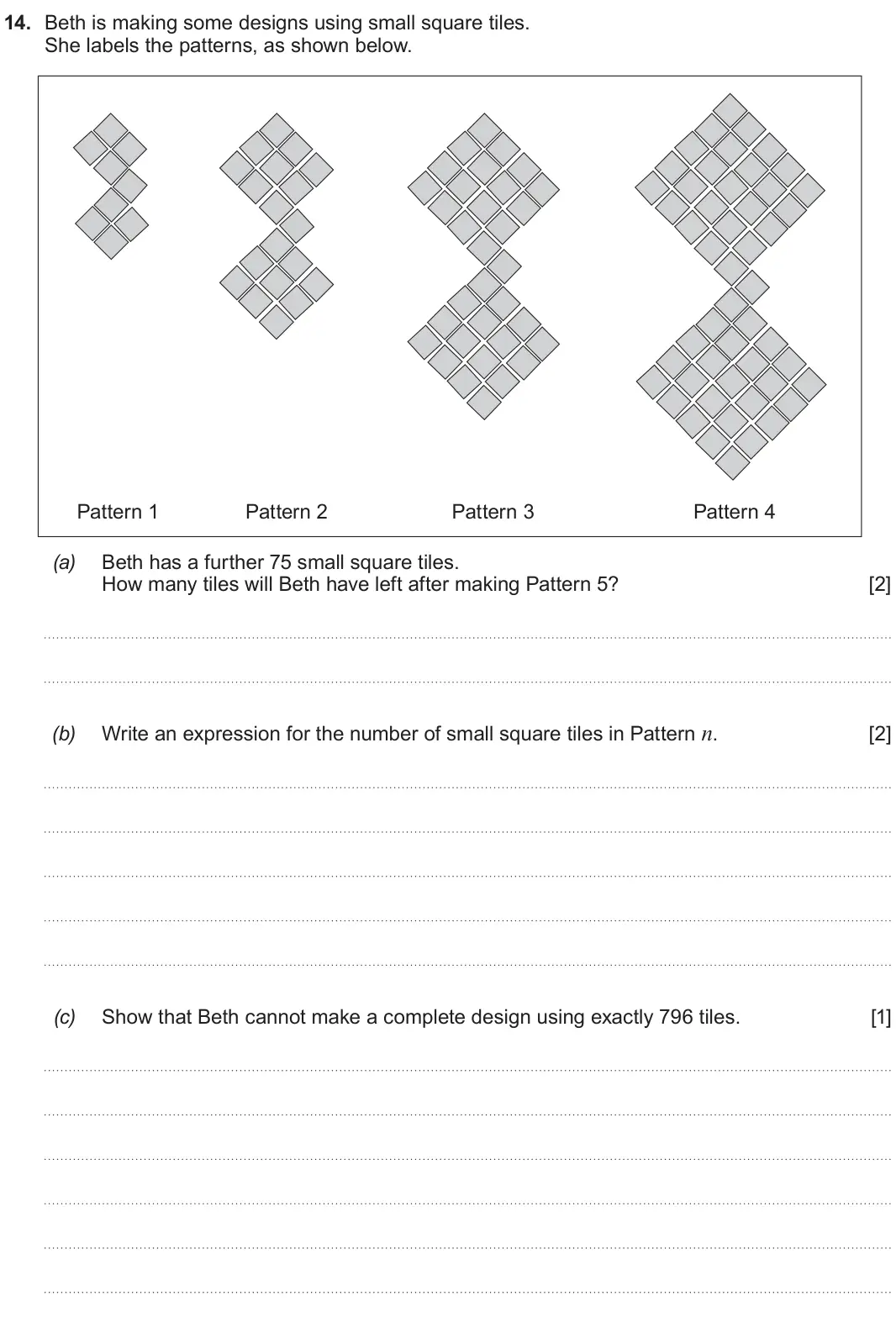
    Original question 14: Beth is making some designs using small square tiles. She labels the patterns, as shown below. Pattern 1 Pattern 2 Pattern 3 Pattern 4 (a) Beth has a further 75

    Loading the question…

    The whole paper ↗
  14. Q14June 2017 · Component 1 Foundation3 marksCore

    A23 Generating sequencesN2 The four operations

    14
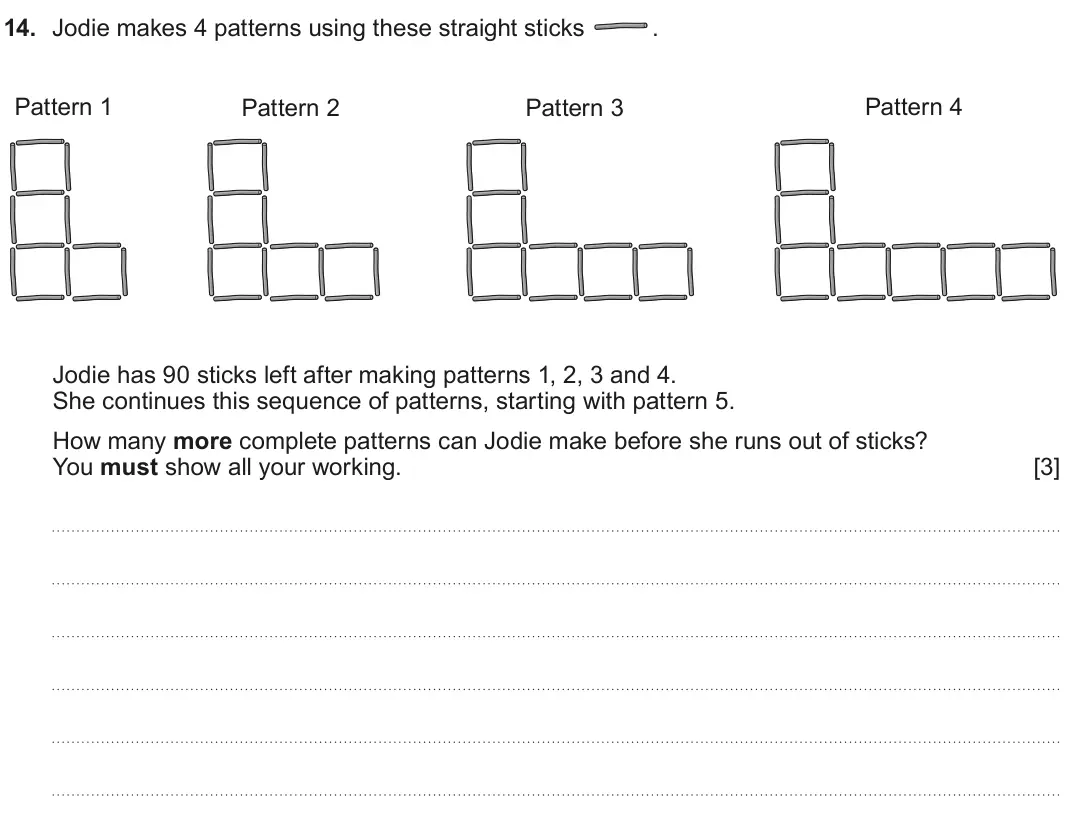
    Original question 14: Jodie makes 4 patterns using these straight sticks . Pattern 1 Pattern 2 Pattern 3 Pattern 4 Jodie has 90 sticks left after making patterns 1, 2, 3 and 4. She c

    Loading the question…

    The whole paper ↗
  15. Q20June 2017 · Component 2 Foundation4 marksCore

    A23 Generating sequencesA25 The nth term

    15
    Original question 20: (a) The nth term of a sequence is 3n – 2. Write down the first three terms in the sequence. [2] (b) Reza says 1000 is in this sequence Show that Reza is correct

    Loading the question…

    The whole paper ↗
  16. Q16June 2017 · Component 2 Higher4 marksCore

    A25 The nth termA23 Generating sequences

    16
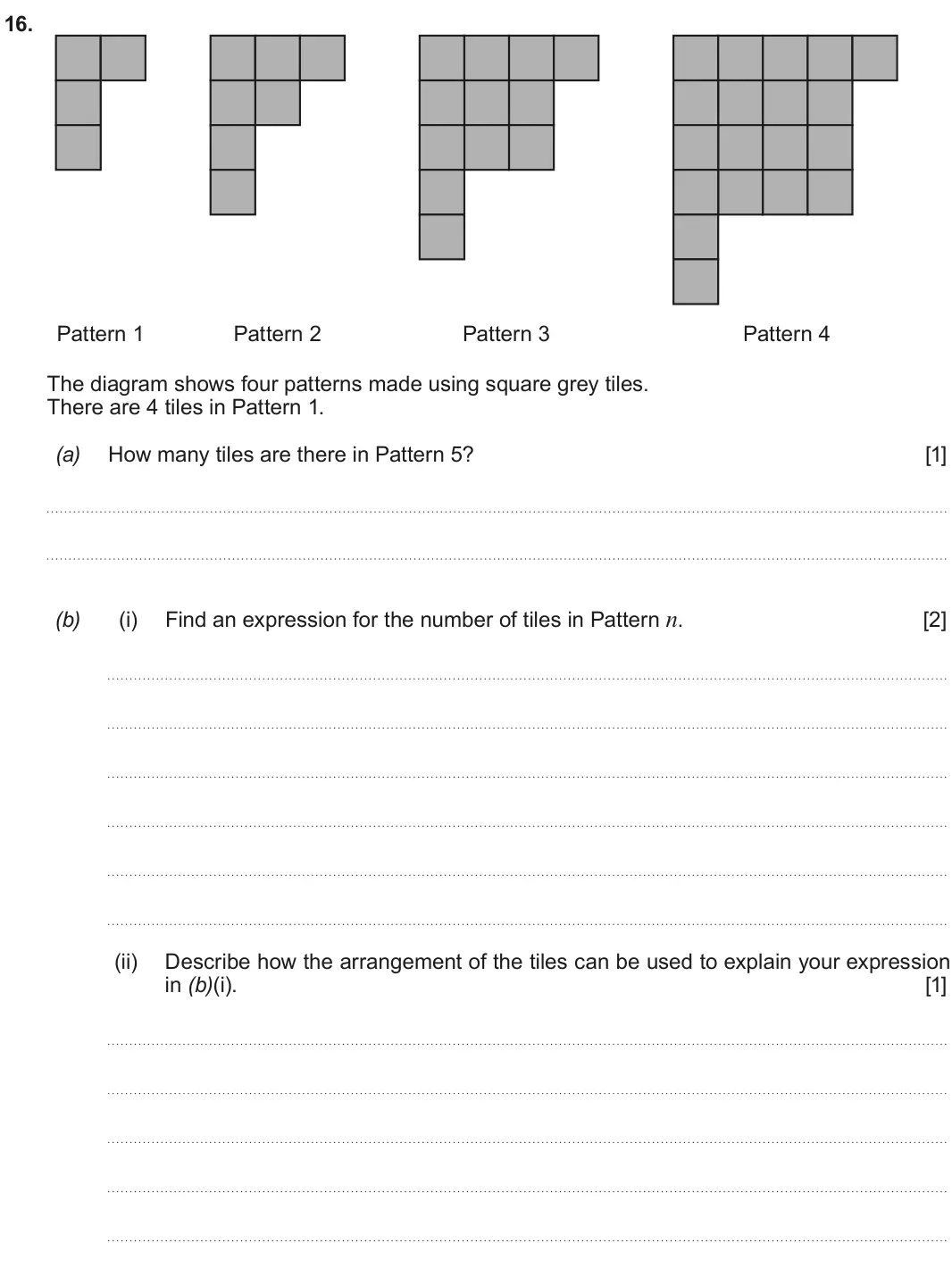
    Original question 16: Pattern 1 Pattern 2 Pattern 3 Pattern 4 The diagram shows four patterns made using square grey tiles. There are 4 tiles in Pattern 1. (a) How many tiles are the

    Loading the question…

    The whole paper ↗
All 16 questions on Generating sequences, as a list
  1. June 2025, Component 2 Foundation, Q11 (8 marks): (a) Write down the next two terms in the sequence. [2] –15, –12, –9, –6, ,   16 3 2 7 (b) Simplify y  y  . [2] Factorise 12 9 w  (c) . [1] Solve 5 3 14 x 
  2. November 2024, Component 2 Foundation, Q8 (3 marks): (a) (i) Write down the next term in the following sequence. [1] 3, 12, 48, 192, . . . (ii) Write down the rule for continuing the following sequence. [1] −3, −1
  3. June 2024, Component 2 Foundation, Q10 (6 marks): (a) The following sequence of patterns is made using squares and triangles. Pattern 1 Pattern 2 Pattern 3 (i) Draw Pattern 5 in the space below. [1] (ii) Is it
  4. June 2024, Component 2 Foundation, Q20 (5 marks): When a ball is dropped, the maximum height it reaches after each bounce decreases. Diagram not drawn to scale Maddox says, Each time the ball bounces it reaches
  5. June 2024, Component 2 Higher, Q5 (5 marks): When a ball is dropped, the maximum height it reaches after each bounce decreases. Diagram not drawn to scale Maddox says, Each time the ball bounces it reaches
  6. June 2023, Component 1 Foundation, Q16 (6 marks): Viola is arranging some paving slabs to make a path all around a rectangular pond. Some of the slabs are grey and some are white. There are no gaps between the
  7. June 2023, Component 2 Higher, Q22 (5 marks): (a) The first 5 terms of a sequence are shown below. 5 8 11 14 17 Complete the term-to-term rule for this sequence. [1] 5 t  1 tn+1 = tn , n x 1 2x + 5 Show th
  8. June 2022, Component 2 Foundation, Q7 (3 marks): The following sequence of patterns is made using lines and circles. Pattern 1 Pattern 2 Pattern 3 Lines: 6 Lines: 11 Lines: 16 Circles: 5 Circles: 8 Circles: 11
  9. November 2020, Component 2 Foundation, Q4 (4 marks): (a) Here are the first four patterns in a sequence. Pattern 1 2 3 4 5 (i) Draw pattern 5. [1] (ii) How many circles will be in pattern 6? [1] (iii) Which patter
  10. November 2018, Component 2 Foundation, Q11 (5 marks): (a) Write down the next two terms for this sequence 17, 31, 45, 59, ……. , ……. [1] (b) For the sequence below, what is the rule for finding the next term? 13, 26
  11. June 2018, Component 1 Foundation, Q26 (4 marks): (a) Find an expression for the nth term of this sequence. [2] 3 11 19 27 35 The nth term of a different sequence is 2n3 + 3. (b) Write down the first 3 terms of
  12. June 2018, Component 1 Higher, Q3 (4 marks): (a) Find an expression for the nth term of this sequence. [2] 3 11 19 27 35 The nth term of a different sequence is 2n3 + 3. (b) Write down the first 3 terms of
  13. November 2017, Component 2 Higher, Q14 (5 marks): Beth is making some designs using small square tiles. She labels the patterns, as shown below. Pattern 1 Pattern 2 Pattern 3 Pattern 4 (a) Beth has a further 75
  14. June 2017, Component 1 Foundation, Q14 (3 marks): Jodie makes 4 patterns using these straight sticks . Pattern 1 Pattern 2 Pattern 3 Pattern 4 Jodie has 90 sticks left after making patterns 1, 2, 3 and 4. She c
  15. June 2017, Component 2 Foundation, Q20 (4 marks): (a) The nth term of a sequence is 3n – 2. Write down the first three terms in the sequence. [2] (b) Reza says 1000 is in this sequence Show that Reza is correct
  16. June 2017, Component 2 Higher, Q16 (4 marks): Pattern 1 Pattern 2 Pattern 3 Pattern 4 The diagram shows four patterns made using square grey tiles. There are 4 tiles in Pattern 1. (a) How many tiles are the

Questions, mark schemes and examiner’s reports are © WJEC Eduqas, from their published past papers. Plumi isn’t affiliated with any exam board. Want whole papers? Eduqas GCSE Maths past papers.

The Plumi iPad app also offers exam-style questions with AI feedback on your handwritten working.