 plumi
Addictive behaviours: Eduqas A‑Level Psychology questions
Eduqas A-Level Psychology past-paper questions on Addictive behaviours, 2017–2025, with mark schemes and examiner’s reports where available.
Paper
All papers
Exam
All years
Calculations
Loading the full question list…
Q1(a)
The whole paper ↗Q1(b)
The whole paper ↗Q1(a)(i)
The whole paper ↗Q1(a)(ii)
The whole paper ↗Q1(b)
The whole paper ↗Q1(a)
The whole paper ↗Q1(b)
The whole paper ↗Q1(c)
The whole paper ↗Q1(a)
The whole paper ↗Q1(b)
The whole paper ↗Q1(a)
The whole paper ↗Q1(b)
The whole paper ↗Q1(a)
The whole paper ↗Q1(b)
The whole paper ↗Q1(a)
The whole paper ↗Q1(b)
The whole paper ↗Q1(a)
The whole paper ↗Q1(b)
The whole paper ↗Q1(a)
The whole paper ↗Q1(b)
The whole paper ↗



























All 20 questions on Addictive behaviours, as a list
- June 2025, Component 3, Q1(a) (10 marks): a) Describe two social psychological explanations of addictive behaviours. [10]
- June 2025, Component 3, Q1(b) (15 marks): b) ‘Biological explanations are limited so do not offer the best way of understanding addictive behaviours.’ With reference to this statement, evaluate biologic
- June 2024, Component 3, Q1(a)(i) (5 marks): a) i) Briefly evaluate the ethical and social implications of agonist and antagonist substitution as a method of modifying addictive behaviours. [5]
- June 2024, Component 3, Q1(a)(ii) (5 marks): ii) Briefly evaluate the ethical and social implications of aversion therapy as a method of modifying addictive behaviours. [5]
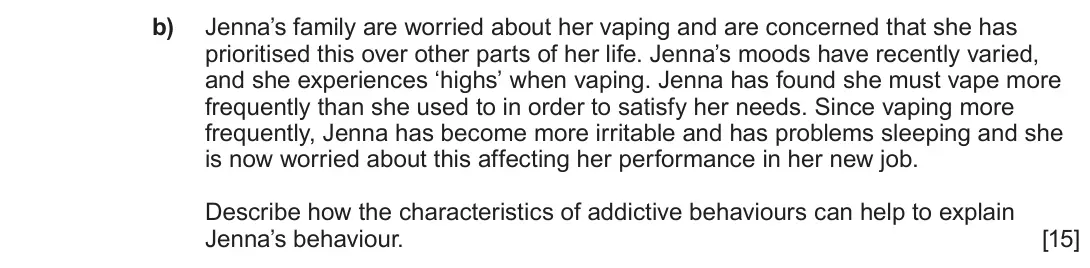
- June 2024, Component 3, Q1(b) (15 marks): b) Jenna’s family are worried about her vaping and are concerned that she has prioritised this over other parts of her life. Jenna’s moods have recently varied,
- June 2023, Component 3, Q1(a) (10 marks): a) Describe biological explanations of addictive behaviours. [10]
- June 2023, Component 3, Q1(b) (5 marks): b) Briefly explain how biological explanations could be applied to modifying addictive behaviours. [5]
- June 2023, Component 3, Q1(c) (10 marks): c) Evaluate the effectiveness and ethical implications of one method of modifying addictive behaviours. [10]
- June 2022, Component 3, Q1(a) (15 marks): a) Abiya’s friends are concerned about a recent change in her mood, appearance and ability to make sensible decisions. Abiya frequently asks to borrow money fro
- June 2022, Component 3, Q1(b) (10 marks): b) Describe how one social psychological explanation helps us to understand addictive behaviours. [10]
- Autumn 2021, Component 3, Q1(a) (10 marks): a) Describe one biological explanation of addictive behaviours. [10]
- Autumn 2021, Component 3, Q1(b) (15 marks): b) ‘Social psychological explanations are ineffective in providing a clear explanation for addictive behaviours.’ With reference to this statement, evaluate soc
- Autumn 2020, Component 3, Q1(a) (15 marks): a) ‘Methods of modifying addictive behaviours are often controversial yet always effective.’ With reference to this statement, evaluate aversion therapy as a me
- Autumn 2020, Component 3, Q1(b) (10 marks): b) Describe one individual differences explanation of addictive behaviours. [10]
- June 2019, Component 3, Q1(a) (10 marks): a) Describe the characteristics of addictive behaviours. [10]
- June 2019, Component 3, Q1(b) (15 marks): b) Nigel works with people with a variety of addictive behaviours. One of his clients, Richard, has read about individual differences explanations and believes
- June 2018, Component 3, Q1(a) (15 marks): (a) Natalie likes going to the casino. At first she would go only once a month. Now she goes at least four times a week. She realises she has an addiction to ga
- June 2018, Component 3, Q1(b) (10 marks): (b) Evaluate two individual differences explanations of addictive behaviour. [10]
- June 2017, Component 3, Q1(a) (10 marks): (a) Describe one social psychological explanation for addictive behaviours. [10]
- June 2017, Component 3, Q1(b) (15 marks): (b) Laurence is a young apprentice working at a garage. Whenever the mobile tool seller arrives, Laurence just has to buy more tools for himself. He can barely
Questions, mark schemes and examiner’s reports are © WJEC Eduqas, from their published past papers. Plumi isn’t affiliated with any exam board. Want whole papers? Eduqas A-Level Psychology past papers.
The Plumi iPad app also offers exam-style questions with AI feedback on your handwritten working.